

Every market cycle gets its word. In 2021 it was “metaverse,” in 2023 it was “generative AI,” and if you’ve spent any time on financial Twitter, Substack Notes or earnings calls this autumn, you already know the word of 2026:
Agentic.
Agentic “AI,” more specifically.
Chatbots answered our questions. Agents go off and do things for us – book the hotel, compare the insurance quotes, pay the bill, cancel the subscription you forgot about three years ago. They edit videos for you. Etc., etc.
That shift from talking to acting is what has investors nervous, and for once the nervousness has a product attached to it. Three products, to be precise.
The first to arrive was Grok Bot, which xAI put into beta on August 11 alongside Grok 4.6. It's a persistent agent that runs on its own cloud computer and keeps working while you sleep. xAI hasn't given it a standalone price – access comes bundled with SuperGrok Heavy at $300 a month, or through Cursor at $200 for individuals and $120 per seat for teams – which puts it squarely in power-user and small-business territory.
Around the same time, an invite-only, text-based assistant called Instinct started taking over my feeds. Instinct, an AI agent startup founded by Noah Shinn in 2025, has raised a total of $1.35 billion across major funding rounds, reaching a $10 billion valuation by September 2026.
“It’s only been a month since AI assistant startup Instinct announced a fundraise that valued it at $2.5 billion, and now the company has already raised another $1 billion from investors, including Sequoia Capital, Benchmark Capital, and Coatue, valuing the company at $10 billion.“ - TechCrunch
Early users describe it as unusually proactive. It answers messages, books rides to the airport, shops for insurance and even negotiates bills, and it reportedly crossed 100,000 users by mid-September without ever officially launching.
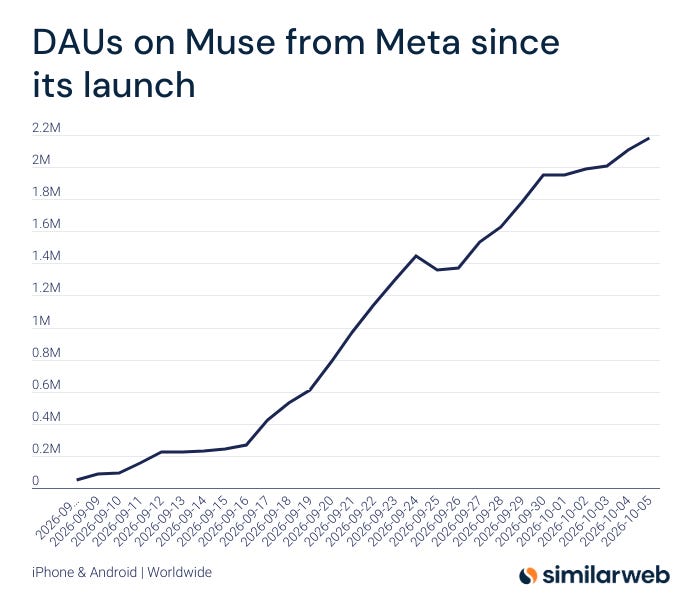
Then came Muse. Meta released its personal agent on September 8 as a standalone app and inside WhatsApp, with a free tier and paid plans at $20 and $100 a month. Within two weeks it had 2.5 million US downloads and the top spot in the App Store.
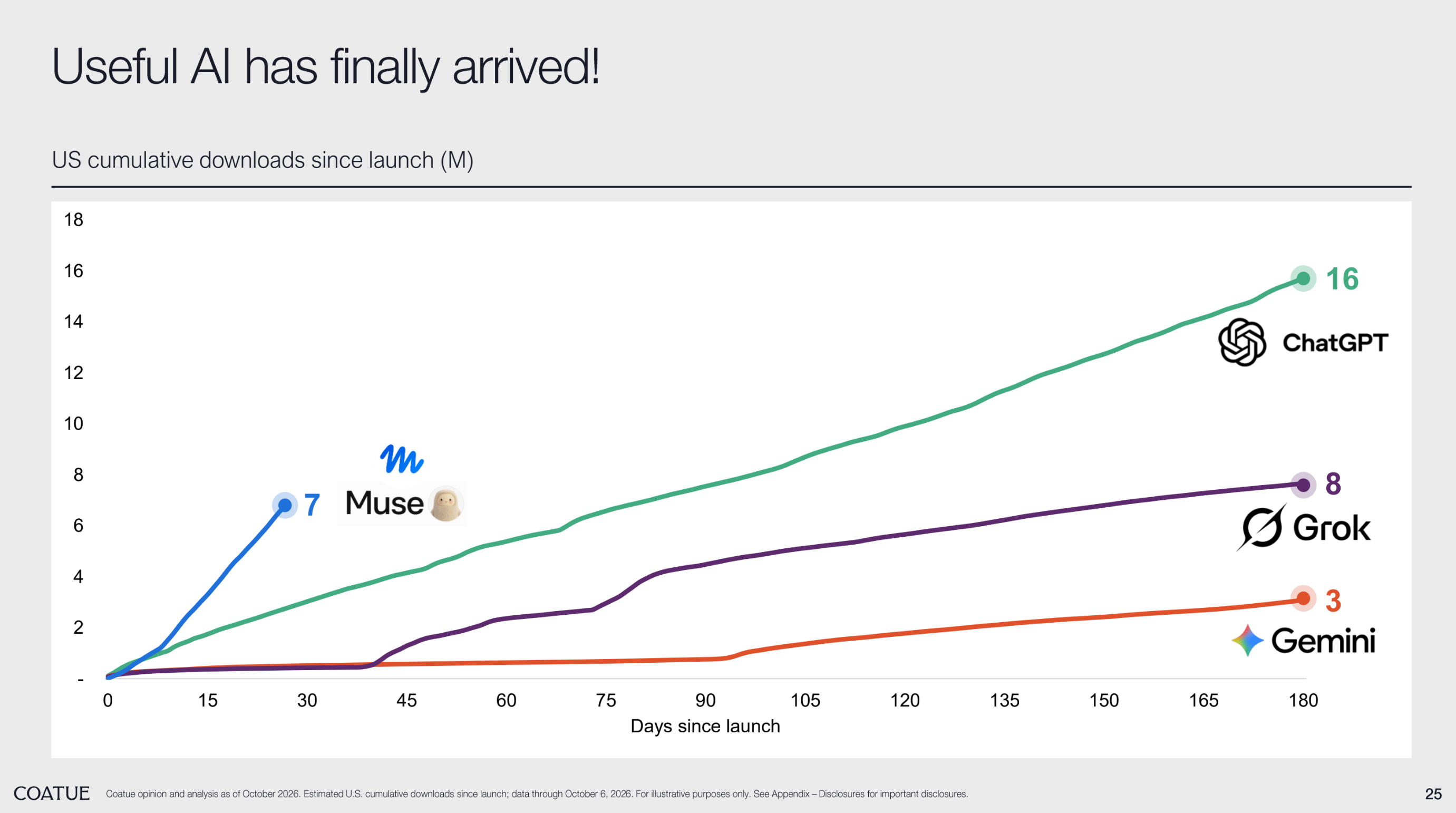
Joseph Carlson called Muse one of the best-executed apps he has seen, and I find it hard to disagree. It’s built for people who have never used the word “workflow” in their lives, which is exactly why it matters. Meta’s stock jumped 6.5% the day after the launch.
The rest of the market did what markets always do when a new technology shows up with a credible distribution engine behind it. It went looking for victims. Online travel was first in line. On September 23 alone, Expedia fell 7%, Airbnb 6% and Booking 5%, and Booking now trades roughly 30% below its 52-week high.
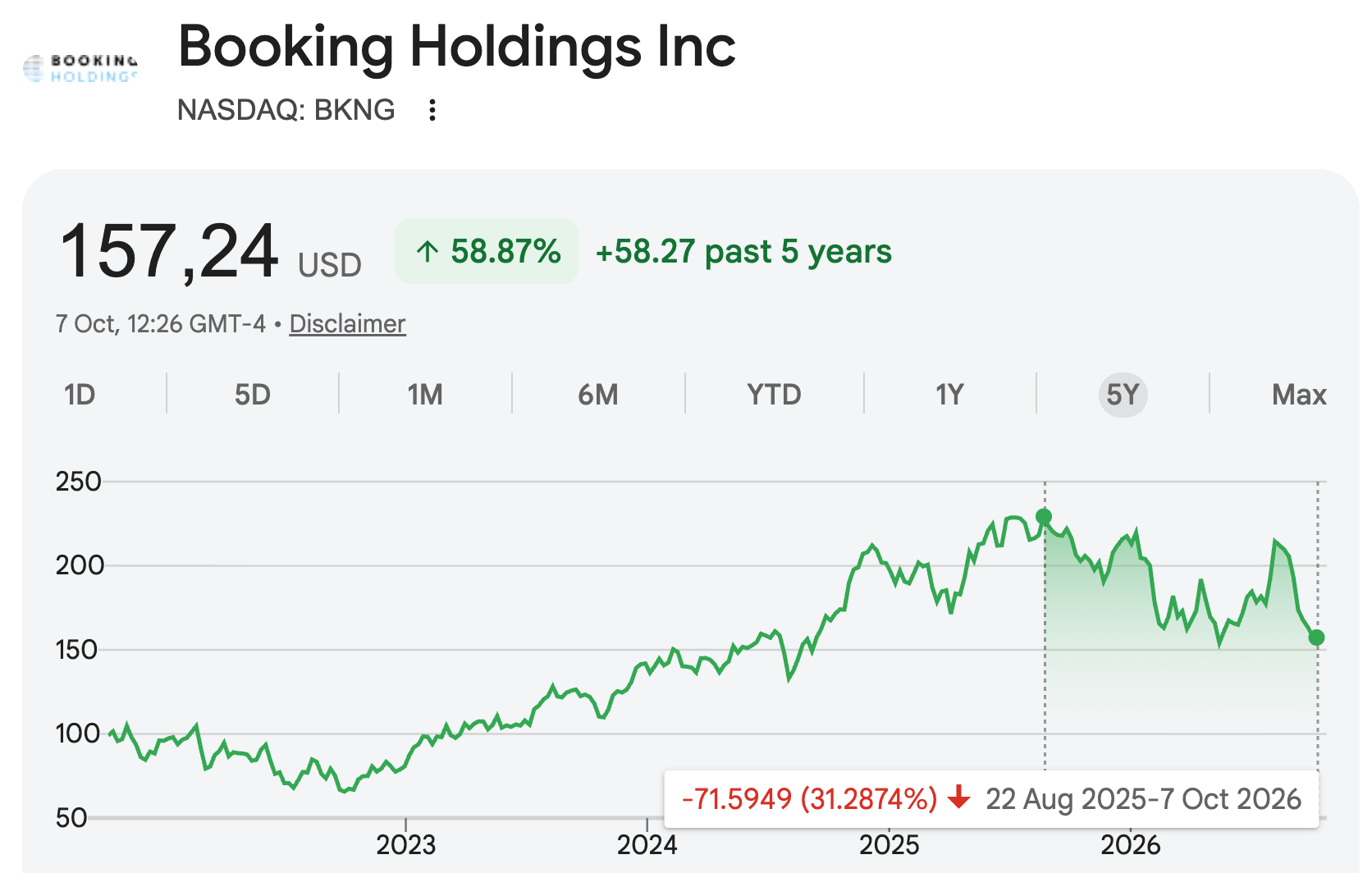
Banks, insurers, card networks, subscription businesses and e-commerce platforms have all had their own “are we next?” moment since.
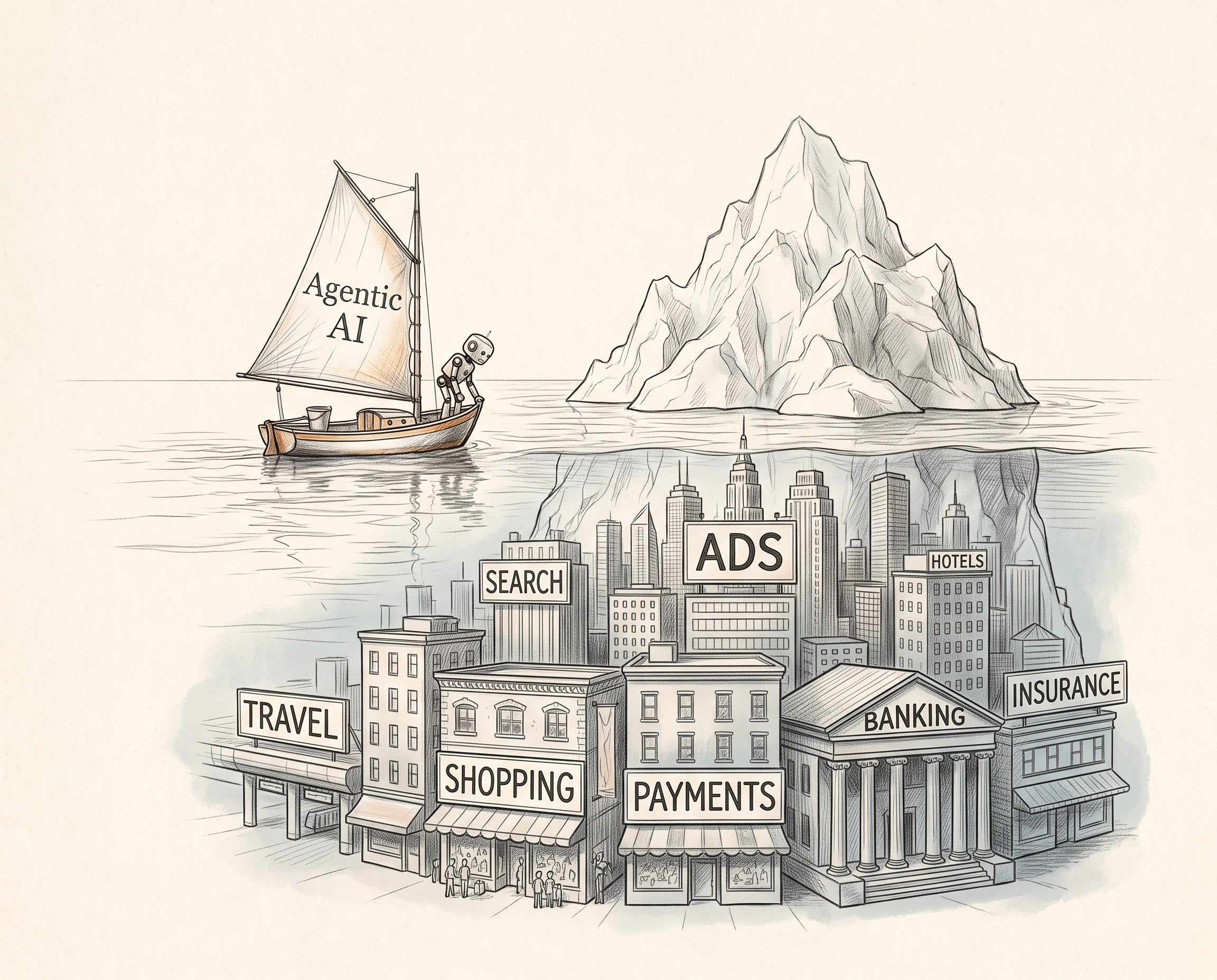
A neat summary of the anxiety I’ve come across came from Emerging Moats Research and listed Search, travel, subscription media, insurance and banking, card networks and online shopping as the categories where disruption is on the table (I think they are planning to release a podcast on that subject too).
That’s sort of my map for this post too. I’ll go sector by sector, name the companies that are discussed as potential agentic winners of losers, and borrow a distinction from Drew Cohen that helped me think this through critically for various sectors: the difference between what can theoretically be built and what is actually likely to be built.
I’ll also point out where I think the defenders of the incumbents are fooling themselves, because there’s plenty of wishful thinking on both sides of this debate.
Here’s what I’ll cover:
Why a rounding error can erase a fifth of a company – why terminal value explains the selloff, and what Booking’s current price already assumes
What can be built, what will be built, and who will bother to use it – four filters I apply to every sector: product reality, adoption speed, the value of the process, and trust
Is Booking the librarian or just another book on the shelf? – the bear case for online travel, my Muse experiment in Florence, and where the bear case still bites
What happens to Amazon and MercadoLibre when nobody browses? – the aggregator paradox, the threat to retail media, and whether it’s all just a take rate in disguise
Google: will search die, or just change its name? – why the commercial queries that pay the bills are the ones agents target first
Bots don’t click on ads. So what happens to advertising? – ads inside agents, ads for machines, and Meta’s awkward double role
Payments: who holds the knobs when the buyer is a machine? – Know Your Agent, Visa and Mastercard, stablecoins, and whether agents could be Wise’s best salespeople
Banking, insurance and subscriptions: what happens when inertia stops paying? – why the most exposed profit pool may not be the one that sold off hardest
The opportunity in B2B.
What did we miss? – comparison sites, local delivery, exclusive supply, and the picks and shovels of the bot economy
Existential threat or just another risk? – my ranking of who is most exposed, and the signposts I’ll be watching

Credit where credit is due:
A special thank you to the many members of my investing community who discussed Booking.com specifically as well as the impact on the e-commerce sector at length and helped me think this through from various angles. Drew Cohen and Joseph Carlson also shared helpful takes on X, specifically on Booking.com and Amazon, and their thinking influenced these parts of this piece too to some extent. I might have missed others and apologize if I didn’t give you proper credit, but I think I did where needed. Thanks for inspiring me to put together this post.
Why Investors Should Care
First, though, a puzzle.
Booking’s CFO said on the Q2 call that bookings coming from AI chatbots and agents, paid and organic combined, account for well under 1% of the group’s room nights, and that this share has barely moved in recent quarters.
“So if we look at the traffic we’re currently receiving from large language models, so this is not what we are receiving directly in terms of traffic, but from large language models, both on a paid and an unpaid basis that is still significantly below 1% of our room nights. And that hasn’t moved so much recently. So no material change over the last few months or quarters. I’m not saying that, that will never change in the future.
This, of course, at some point, might go in a different trajectory. But at this moment, it’s still very minimal and is not really moving so much.
So how does a rounding error take tens of billions of dollars off a company’s market value in a matter of weeks?
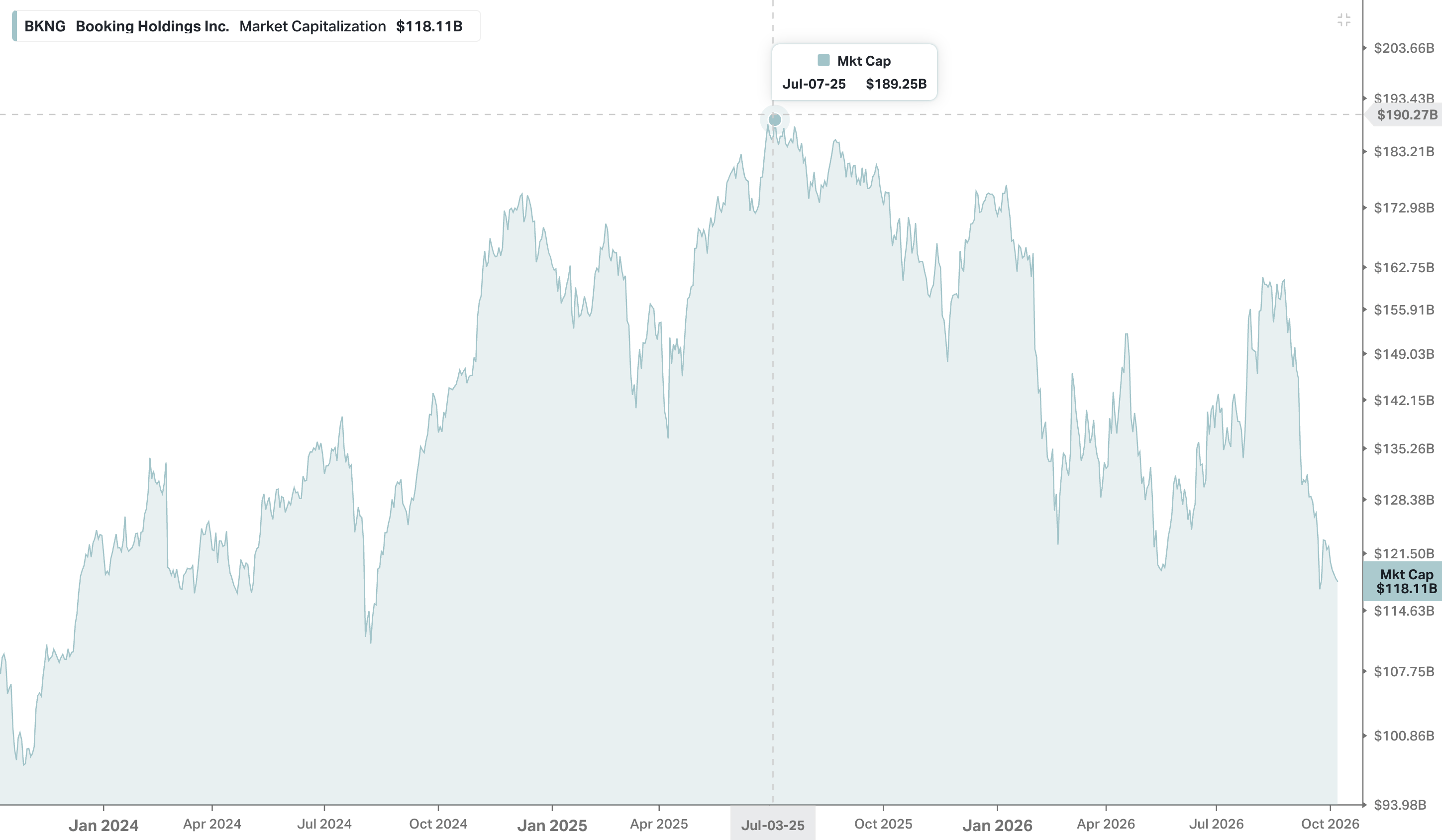
The short answer: the market may be doing exactly what it’s supposed to do.
If you only look at the next four quarters, the selloff makes little sense. Booking is still growing room nights, still converting the bulk of its earnings into free cash flow, and still buying back stock at a pace few companies can match.
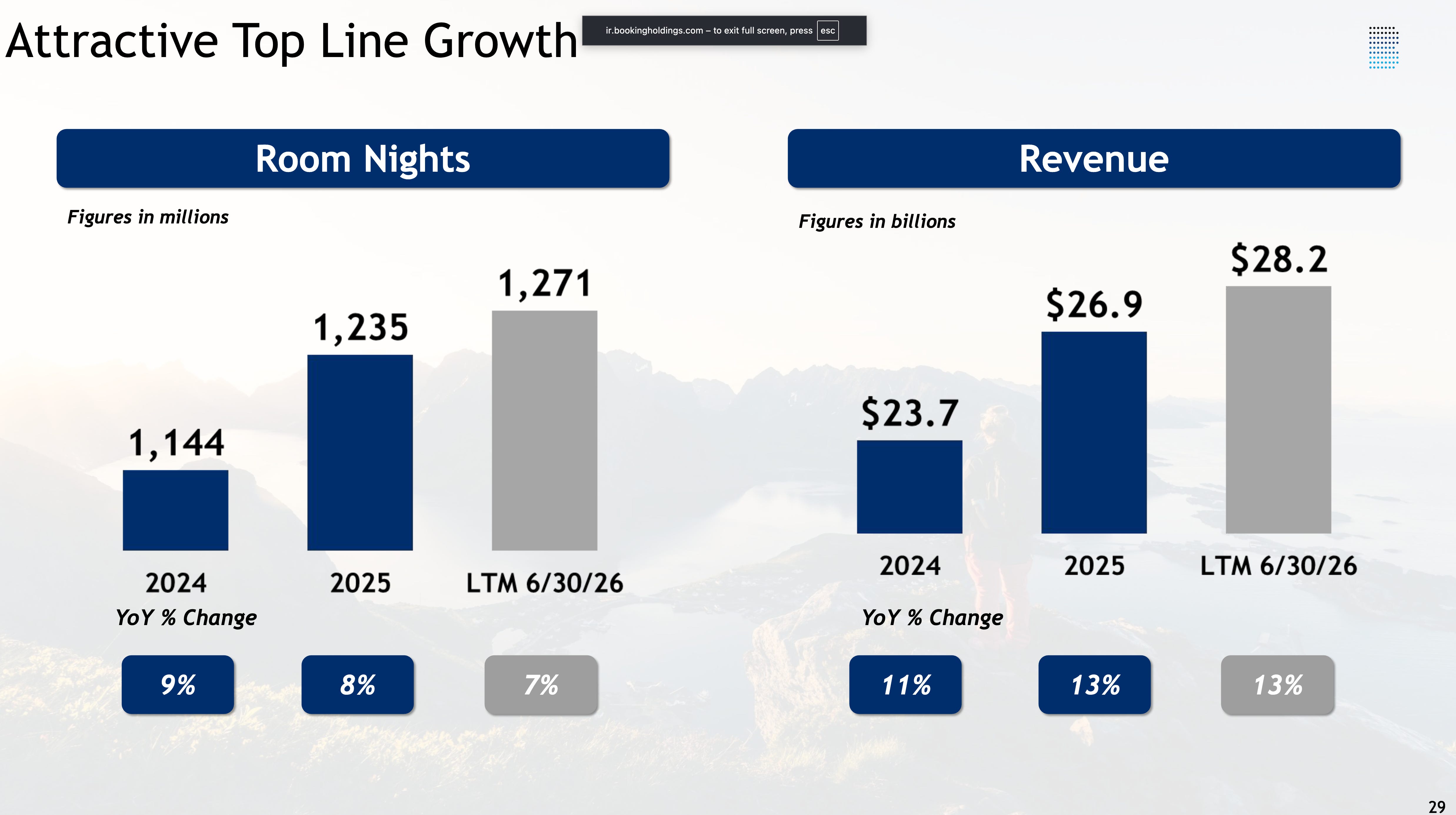
Nothing in the 2027 consensus numbers has been rewritten because of Muse. But the next four quarters are not where the value of a business like Booking lives.
Any discounted cash flow model splits a company into two pieces. There’s the explicit forecast period, usually five to ten years, and there’s everything after that, which gets compressed into a single number called the terminal value. For a high-quality, growing business, whose stock is usually trading at a double-digit multiple as a result of that outlook, for it, that second piece is almost always the larger one.
New here? Join 5,000+ readers and get 3 FREE GIFTS when you subscribe:
📈 Valuation Spreadsheet
📚 eBook: Investing Visualizations
💡 eBook: 250 Thought-Provoking Quotes

I ran a simple illustration. Take Booking’s roughly $9.5 billion in trailing free cash flow, grow it at 8% a year for a decade, discount everything at 9%, and assume 3% growth forever after. The first ten years are worth about $90 billion in today’s money. The terminal value is worth about $149 billion. More than 60% of the company’s intrinsic value sits beyond 2036.
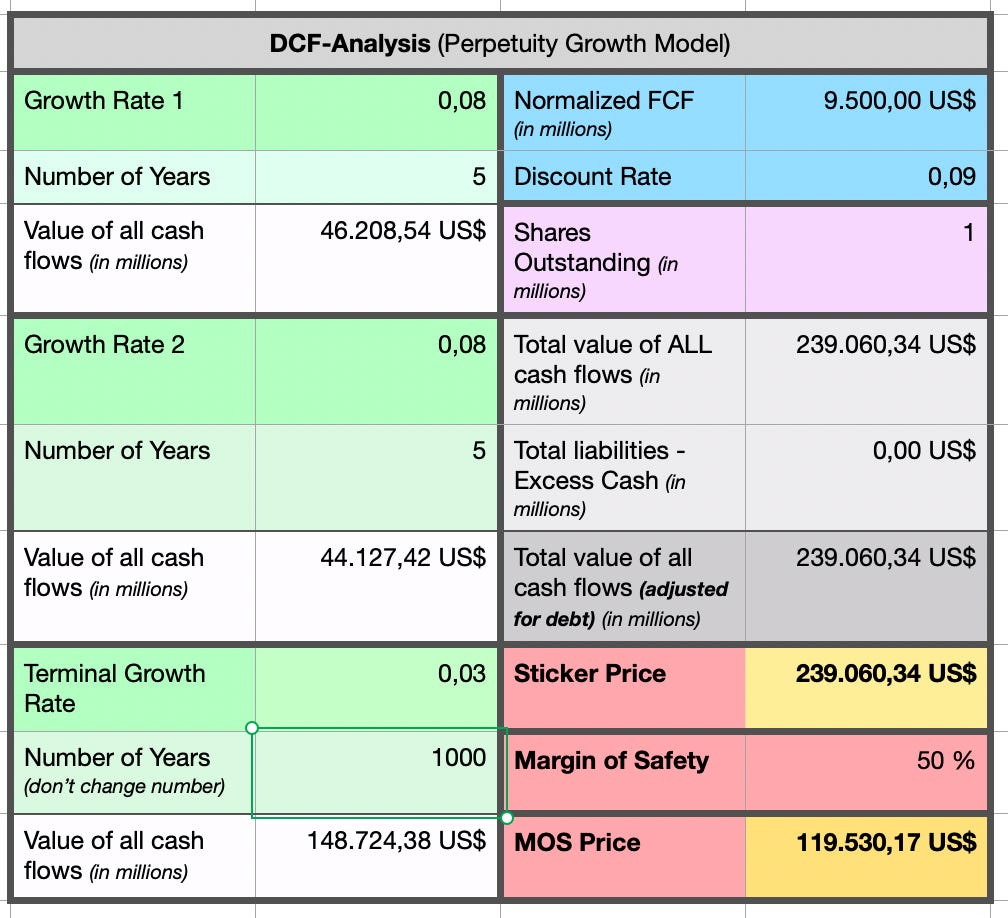
Now you can see why investors don’t need to believe Muse will dent next year’s earnings to sell the stock. They only need to become a little less sure that Booking will still own the relationship with the traveler a decade from now. In my illustration, trimming the terminal cash flow by 20% takes about $30 billion off the value.
Assuming the business stops growing after year ten takes off roughly $50 billion.
Not a single number in the next ten years has changed in either scenario. That’s the uncomfortable math behind every “disruption” selloff: the evidence that would settle the debate arrives in the terminal period, so the market has to reprice before the evidence shows up. It can’t wait.

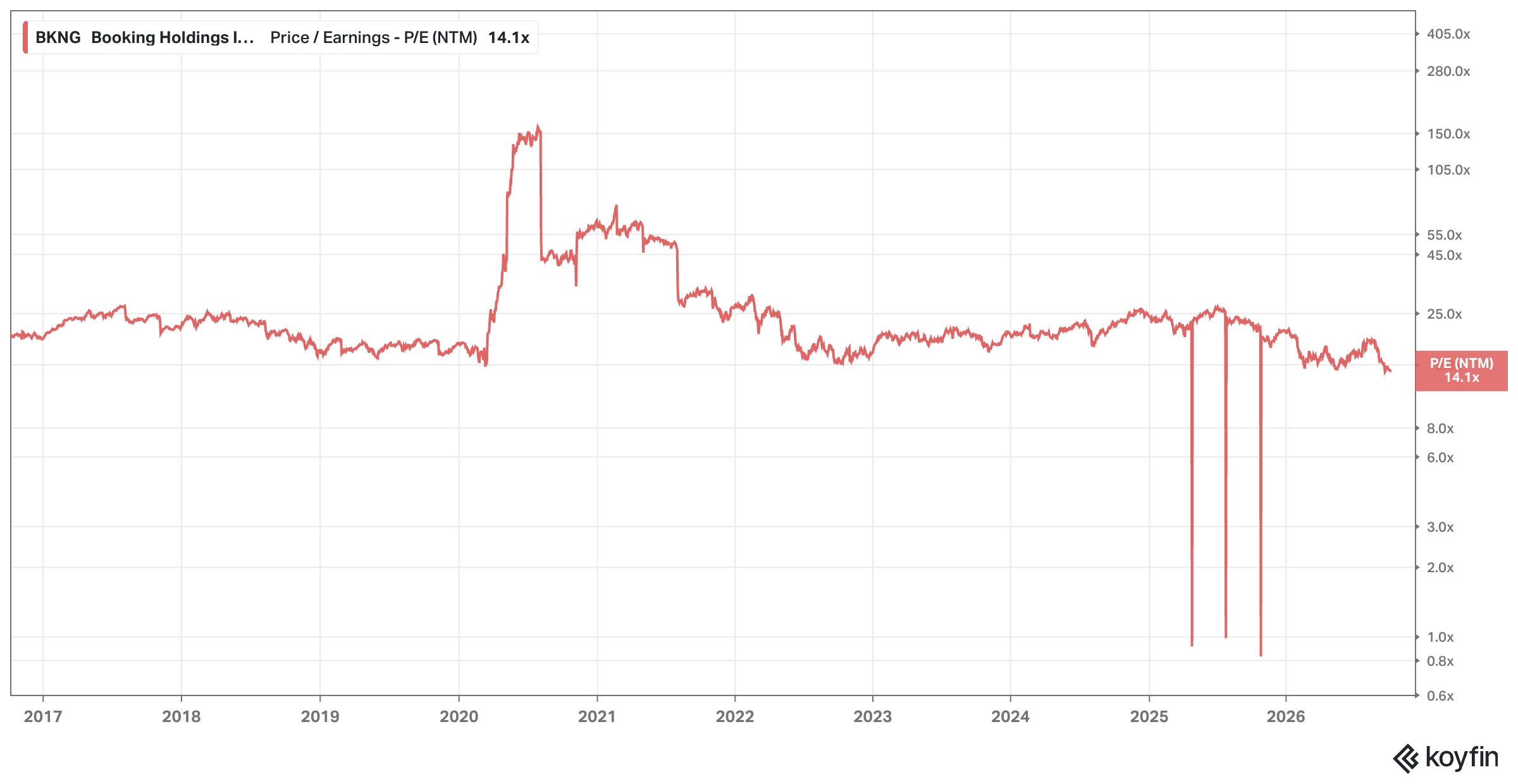
The more interesting exercise, at least for me, is to run the model backwards and ask what today’s price already assumes. At around $160 a share after the 25-for-1 split, Booking’s market value as I write this is roughly $120 billion, and with modest net debt the enterprise value lands near $125 billion (I’m rounding the figures here and just doing some napkin math; see comment below by Quick Takes On Quality).

That’s about 14 times forward earnings.
Using the same 9% discount rate, today’s price is consistent with free cash flow growing around 6% a year for the next decade and then shrinking by about 5% a year forever.
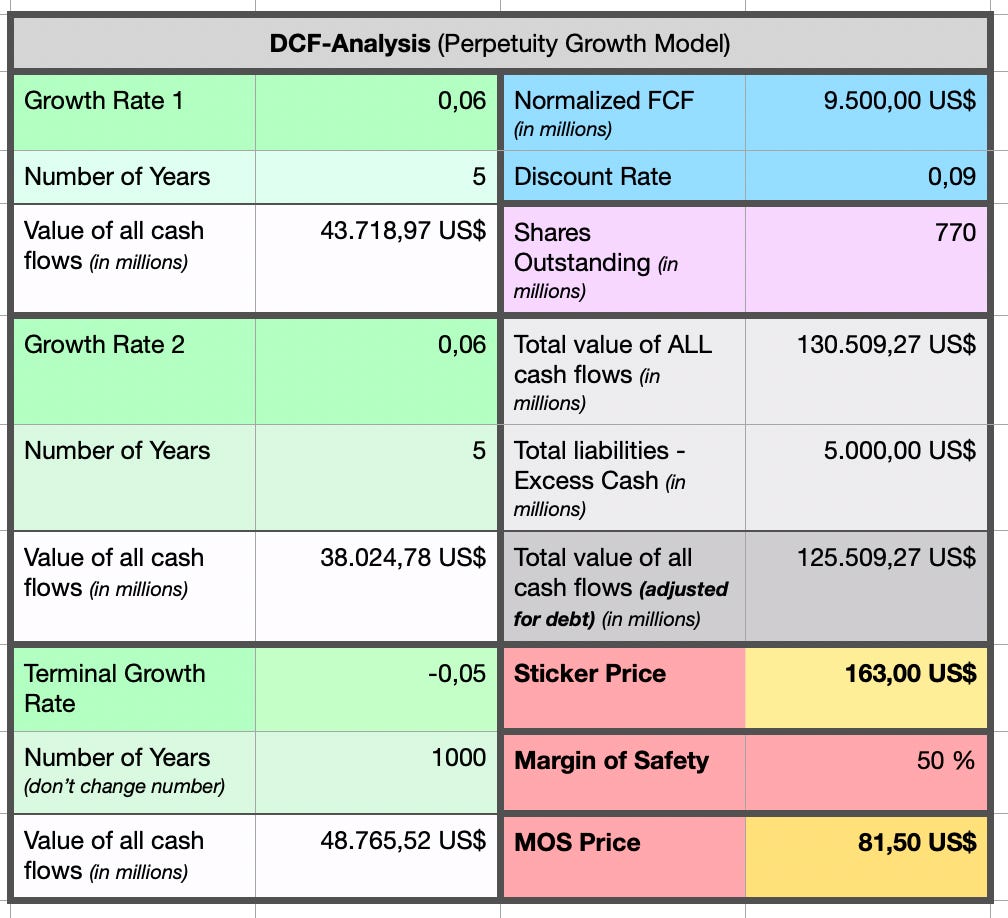
If you’d rather keep the long tail stable, you get to a similar value with growth closer to 4% followed by a slow decline. For comparison, a business that simply kept producing $9.5 billion a year with zero growth, forever, would be worth about $106 billion at that discount rate.
The market is paying only about 20% more than that for one of the best-run platforms on the internet.
There are two ways to read that:
The optimistic reading says the market has overshot. It’s pricing in a structural decline that the hard data – that sub-1% share of room nights – doesn’t support yet, and patient buyers get paid for exactly this kind of fear.
The pessimistic reading deserves just as much respect. Disruption has a habit of looking like a rounding error right up until it doesn’t, and history is full of investors who bought newspapers, Yellow Pages publishers and video rental chains at “cheap” multiples while the cash flows kept shrinking faster than anticipated. By the time agentic bookings show up in Booking’s reported numbers at a meaningful scale, the question of the terminal value will already have been answered, and the stock will have moved long before then. Markets are forward-looking.
I should be honest about the limits of my own back-of-the-envelope math here. The 9% discount rate is my assumption, consensus earnings could prove too high or too low, and a reverse DCF frames expectations rather than spitting out a fair value. But it reframes the debate in a useful way.
The question to ask about Booking, or Amazon, or Visa, or Google (names we will come back to further below), isn’t whether agentic AI will change their businesses. Of course it will. The question is whether it damages the economics of their terminal period by more than the current price already assumes.
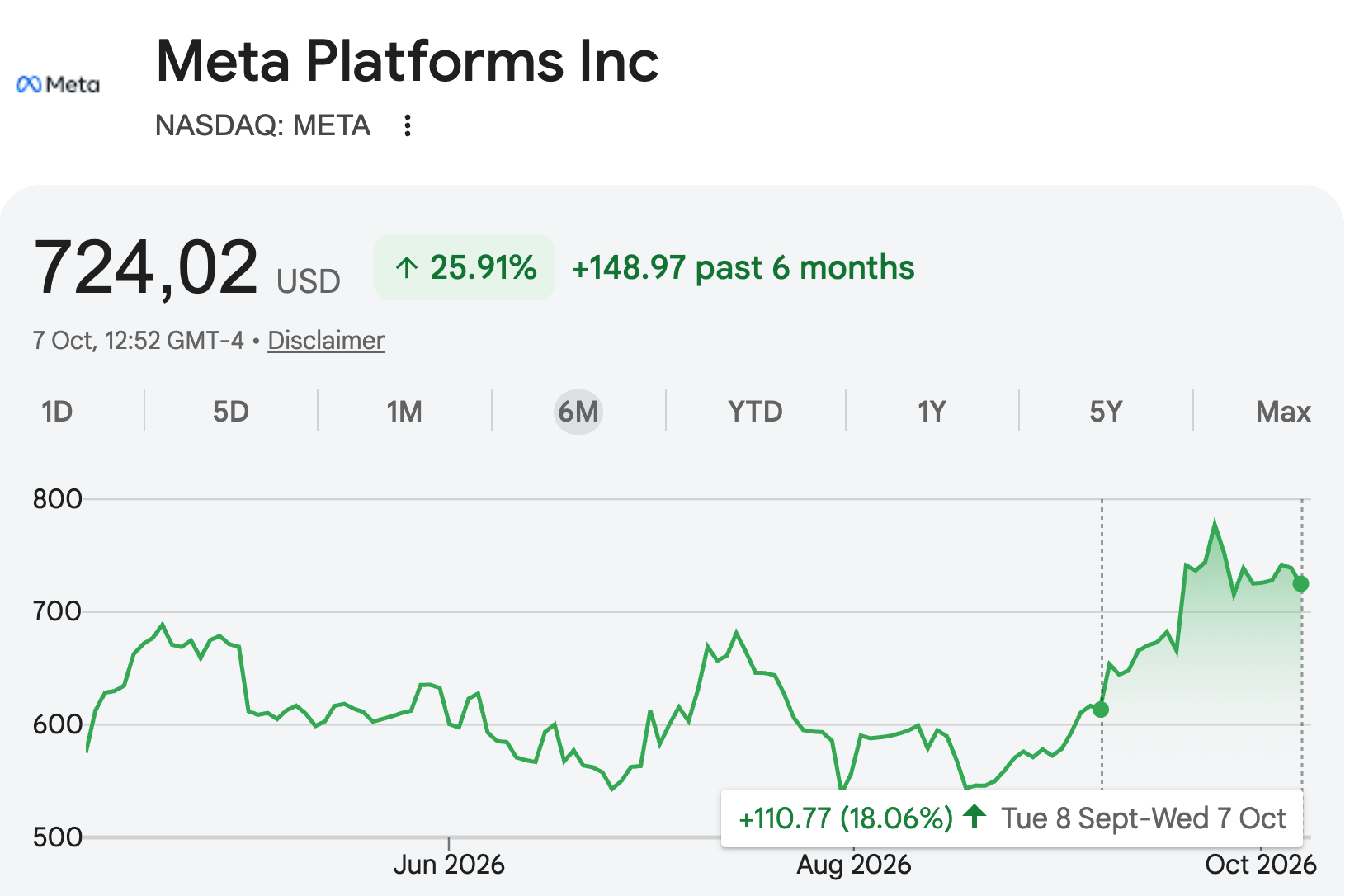
The same logic also works in reverse, which is why Meta added tens of billions in market value the day after Muse launched. The market didn’t add significant additional dollars to Meta’s 2027 earnings that morning. It added a few years to the ending of its story.
A Helpful Lens Before Looking at Specific Sectors – What Can Be Built & What Will Be Built?
Before I go sector by sector, I want to set out four questions that I’ll keep coming back to. Most of the bear cases I’ve read this autumn fail at least one of them. To be fair, most of the defenses of the incumbents conveniently ignore at least one as well.
The first question, which I owe to Drew Cohen who articulated it on X. He flagged the distinction between what can theoretically be built and what is likely to be built.

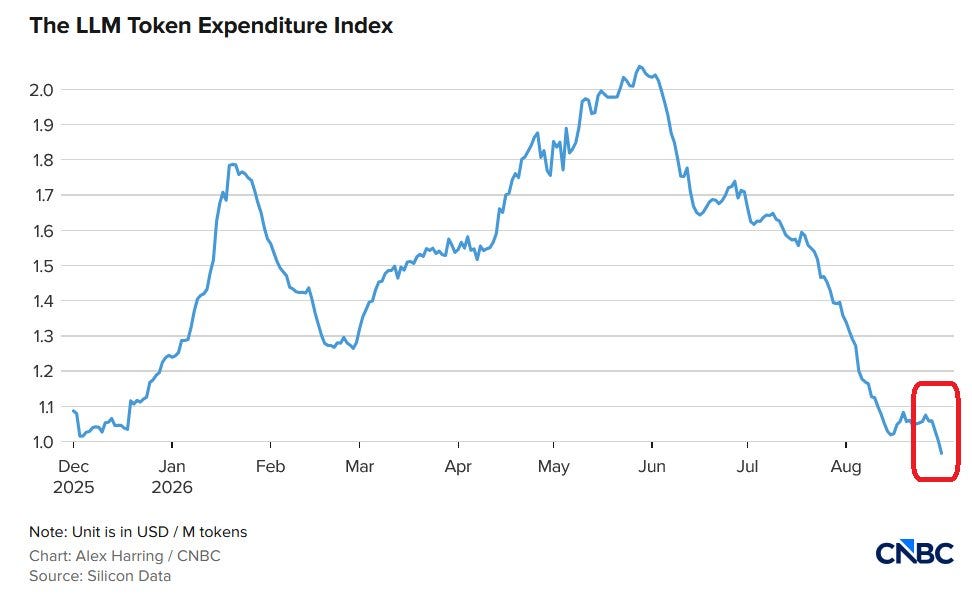
It’s easy to imagine an agent that knows every price, every room, every product, and every insurance policy on earth, and that always picks the best one for you. Imagination is free. Products, on the other hand, live under very unglamorous constraints: compute costs, latency, access to live data, and someone having to pay for all of it. Whoever builds the agent will take the path of least resistance. If that path runs through an incumbent’s inventory and API, the incumbent becomes a supplier to the agent instead of getting bypassed. That’s a much better outcome than extinction, although anyone who has watched online travel agencies pay Google a growing share of their revenue for two decades will know it isn’t necessarily a comfortable one. I also want to flag one caveat right away, because it applies to every sector that follows. The cost of running these models has been falling at a remarkable pace. Something that is too slow and too expensive to build in 2026 may be trivial by 2029.
Thus, this first filter buys incumbents time. It doesn’t give them immunity.

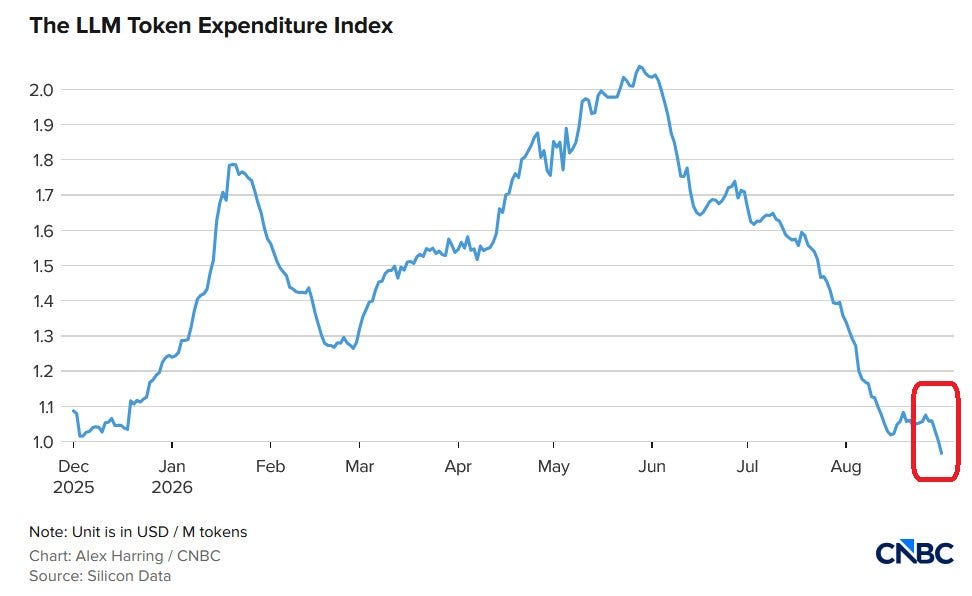
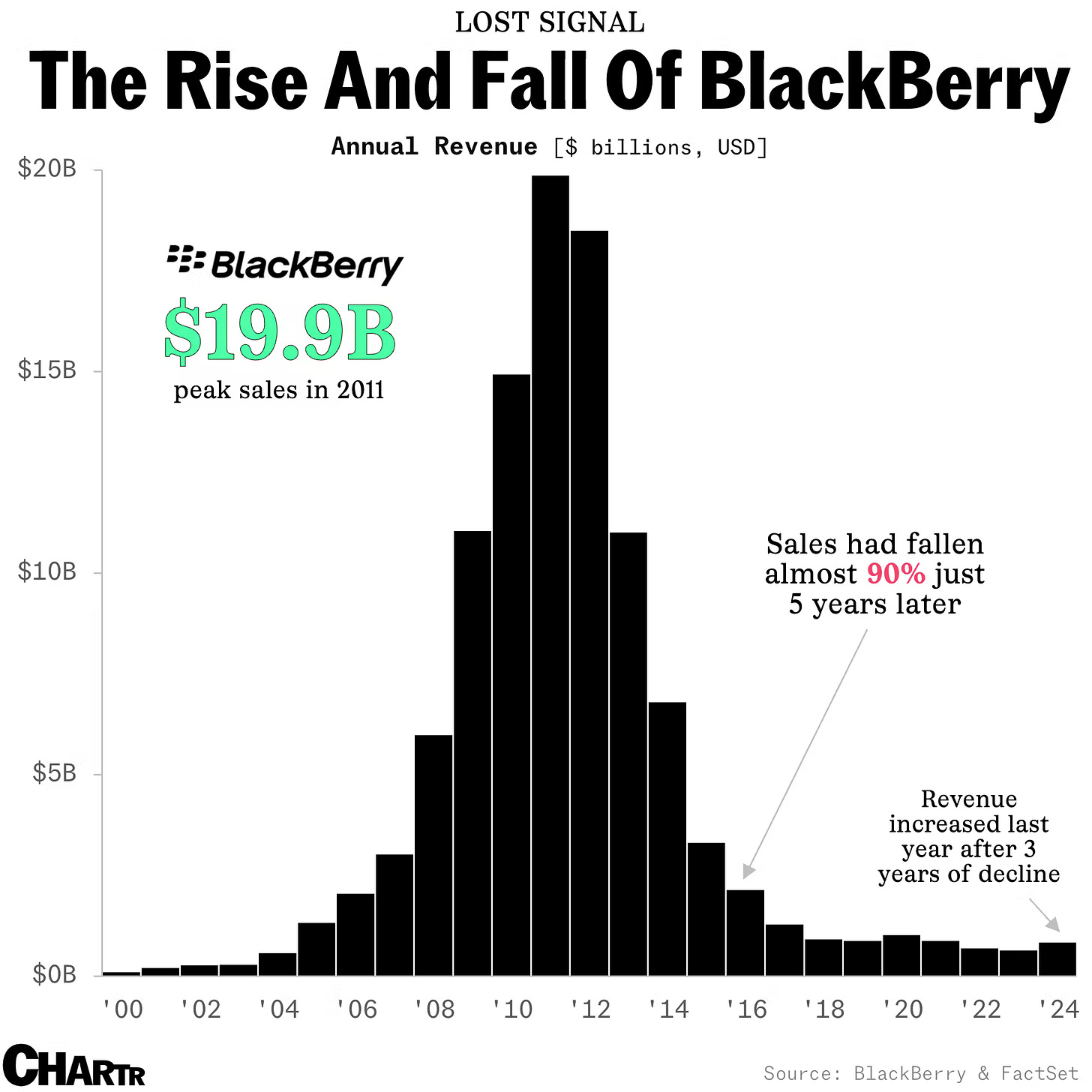
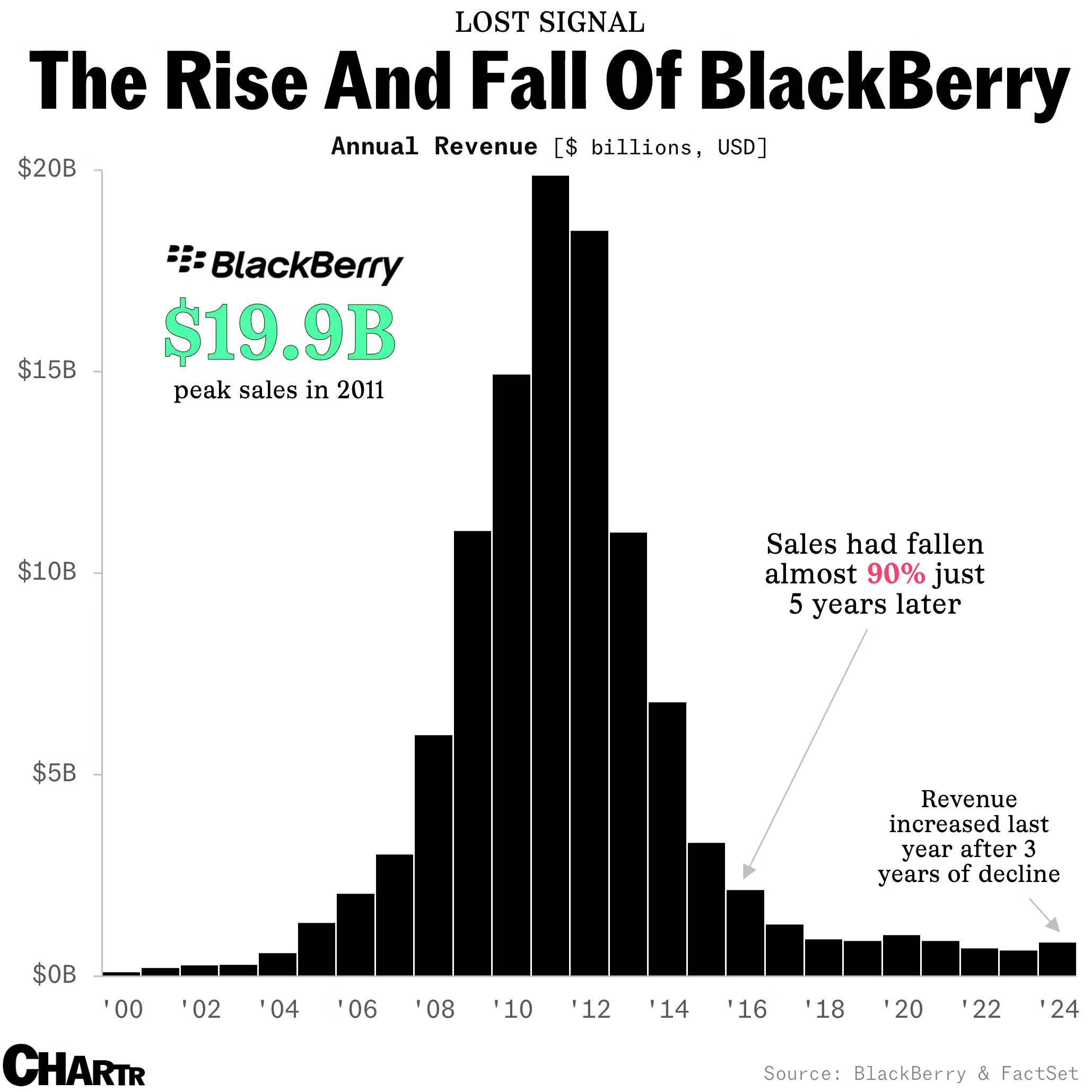
The second question is how fast people actually change their habits. Markets reprice stocks quickly to process new information, and from my experience, they often overshoot in that attempt. Human behavior on the other hand moves at a crawl. The iPhone launched in 2007, and BlackBerry’s numbers held up for roughly four years before the damage showed; and was still significant.
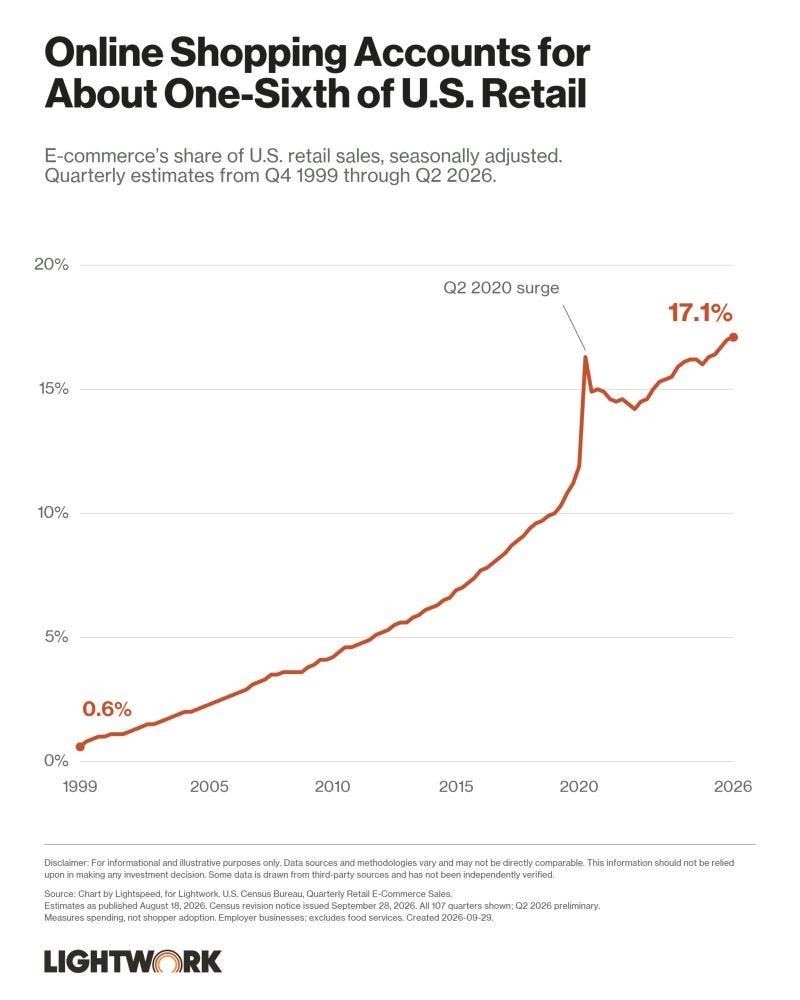
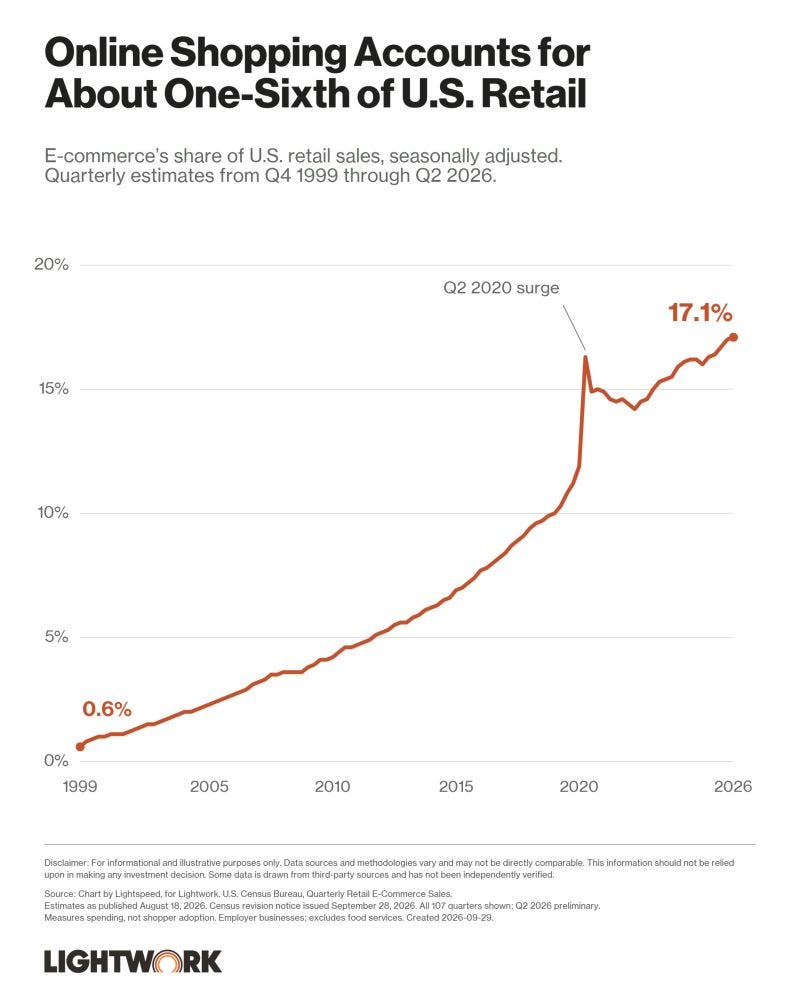
Amazon started selling books in 1995, and Borders didn’t go bankrupt until 2011. Netflix launched streaming in 2007, needed several years before streaming outgrew the DVD business, and only shut down its DVD-by-mail service in 2023. Even e-commerce as a whole, three decades after the first online orders, still accounts for only around 17% of US retail sales. And just in case you didn’t know, the U.S. is the most penetrated consumer e-commerce market globally by user adoption rate, with roughly 87% to over 90% of its population shopping online.
Note: While China has the highest total e-commerce revenue and retail market share of e-commerce sales, the U.S. ranks first in terms of individual consumer digital buyer penetration rate among major global economies.
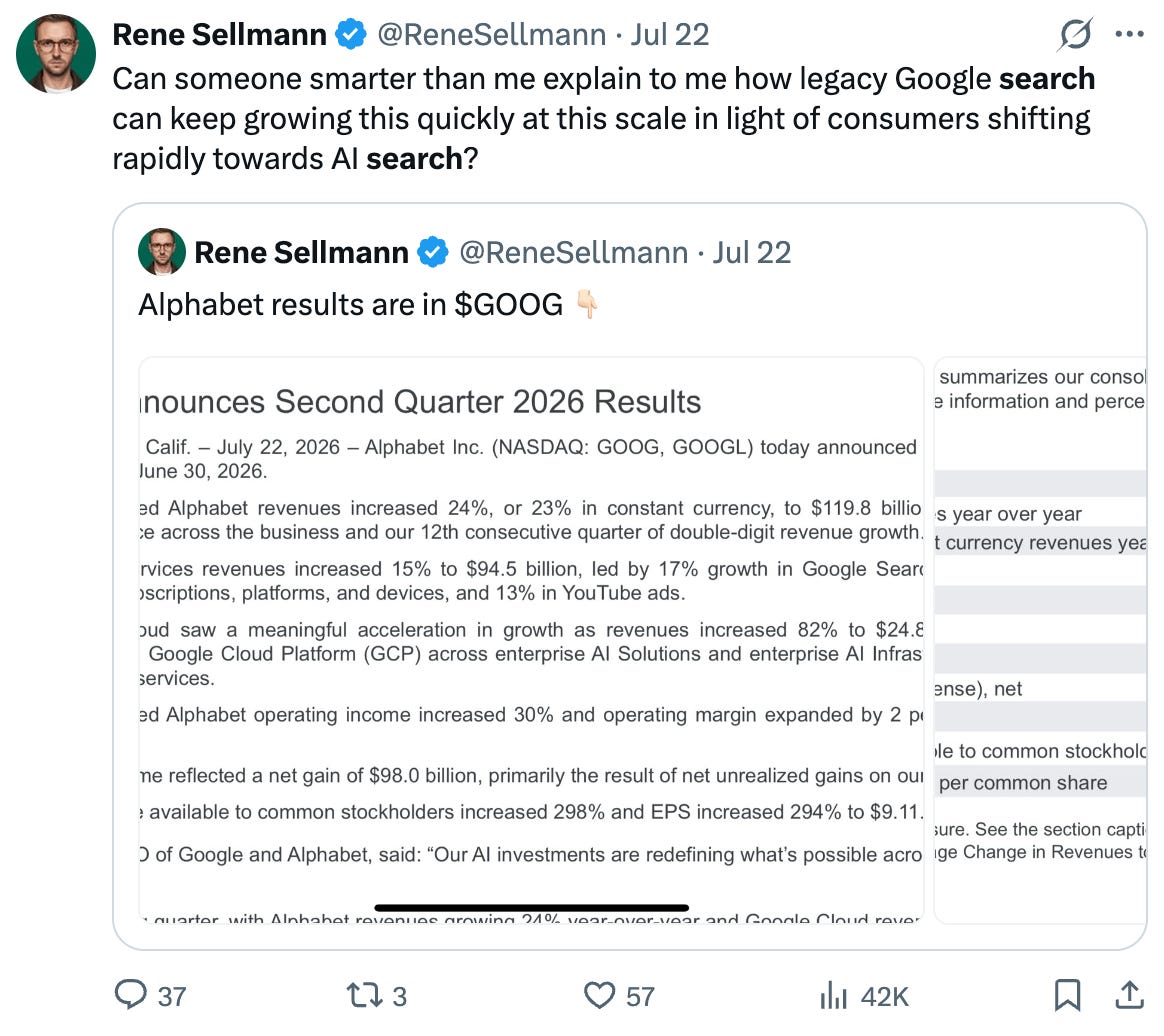
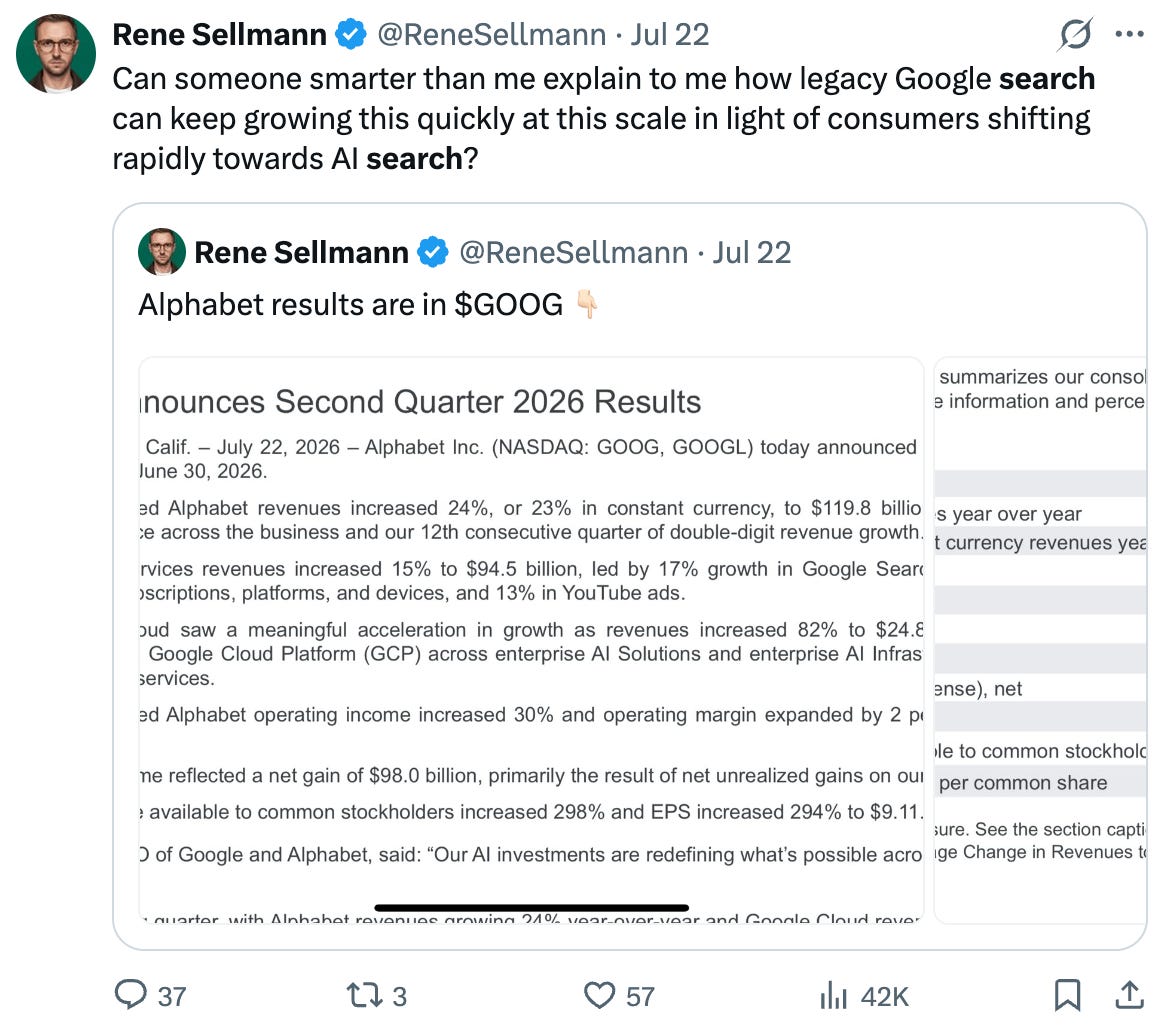
Someone in my community put it well when we discussed this: Google.com will die eventually – this was my reason for selling it last year (which turned out to be a mistake), and I still believe that I will be directionally right –, maybe by being replaced by Gemini or maybe by turning into Gemini, but it won’t happen tomorrow. I still struggle to comprehend how Google’s Search business keeps growing at the rates it is given the scale of this business (see tweet below).
But then again, two caveats: First, sure, distribution today is nothing like it was in 1995. Muse didn’t need to sell anyone a new device. It reached millions of downloads in two weeks because Meta could push it to people who already use WhatsApp multiple times a day.
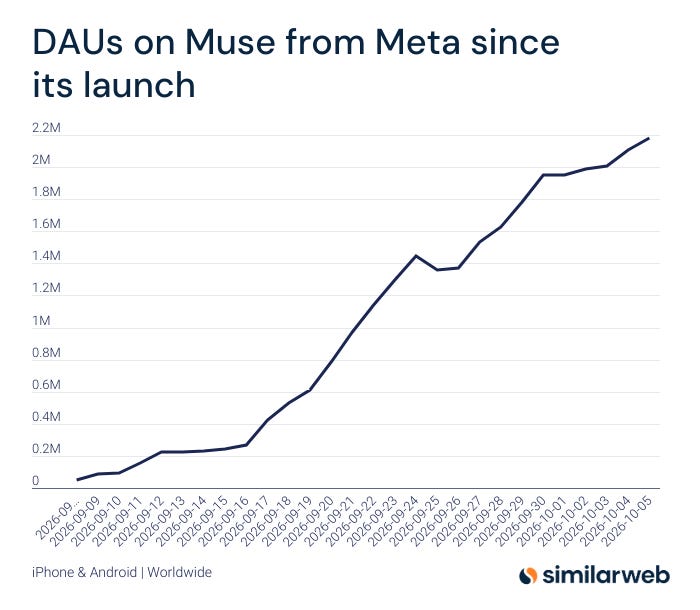
However, downloads aren’t habits, of course, but the on-ramp has never been shorter. Second, and more importantly for investors, slow adoption protects the earnings of the next few years.
“So they still very much would like to go to the platform they know and trust and they rely on. But we are working together with all of these LLMs and we are a launch partner with all of these LLM providers because we learn a lot. We learn where they’re moving from a technology perspective. We can observe the behavioral aspects from consumers because we don’t know really what has tractions. And because it doesn’t have a lot of traction today from an Agentic e-commerce perspective, it doesn’t mean it won’t have traction in the future.“ - Booking at the September Goldman conference
That doesn’t mean an S-curve adoption curve of a new disruptive tech shouldn’t significantly affect (read: lower) a stock’s “fair multiple.” If you’ve read the previous section, you know why.
The third question is whether people actually value the process that the agent wants to take away from them. Sure, nobody enjoys renewing their car insurance, comparing electricity tariffs or reordering dishwasher tablets. Most people would hand that task to an agent any day of the week. However, for others the process is half the fun. Plenty of people enjoy scrolling through hotels in Lisbon on a Sunday evening, because the anticipation is part of the trip. Ruki from our community, who lives in the UK, shared his experience of grocery shopping, illustrating how stubborn consumer preferences can be. Supermarkets there have offered grocery delivery since the early 2000s, yet on any Saturday the aisles are packed with people pushing trolleys. Convenience was available for two decades. A large share of people simply chose the friction. This distinction between chores and pleasures flips the obvious ranking of who is most exposed. Travel feels like the natural victim because it’s where Muse made its splashiest demos. But booking a holiday is something a lot of people often enjoy, while switching insurers or negotiating a phone bill is something almost everyone hates. If agents win first where the process is a chore, the most vulnerable profit pools may be the boring ones built on inertia, and they aren’t necessarily the ones that sold off hardest in September.
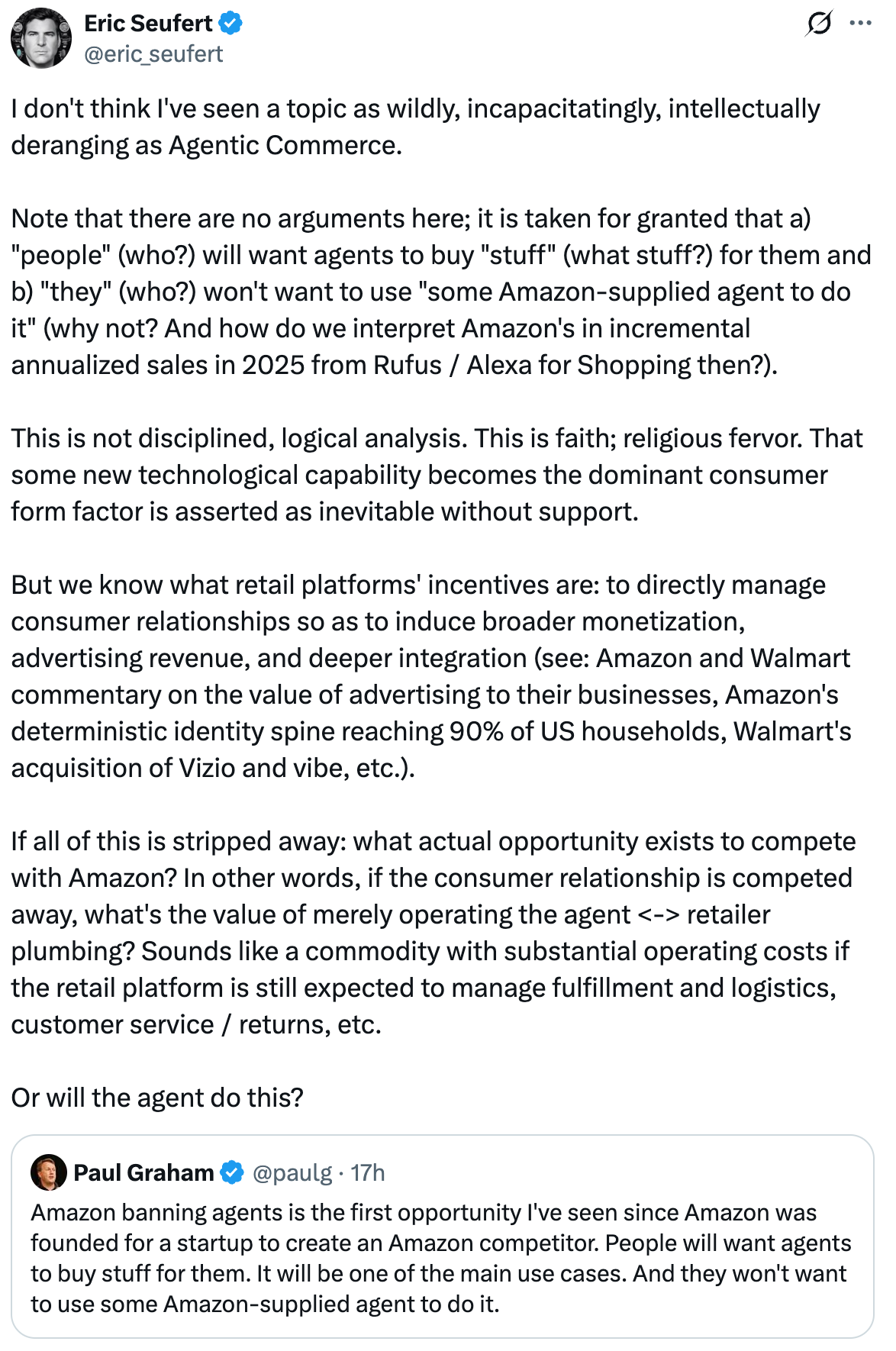
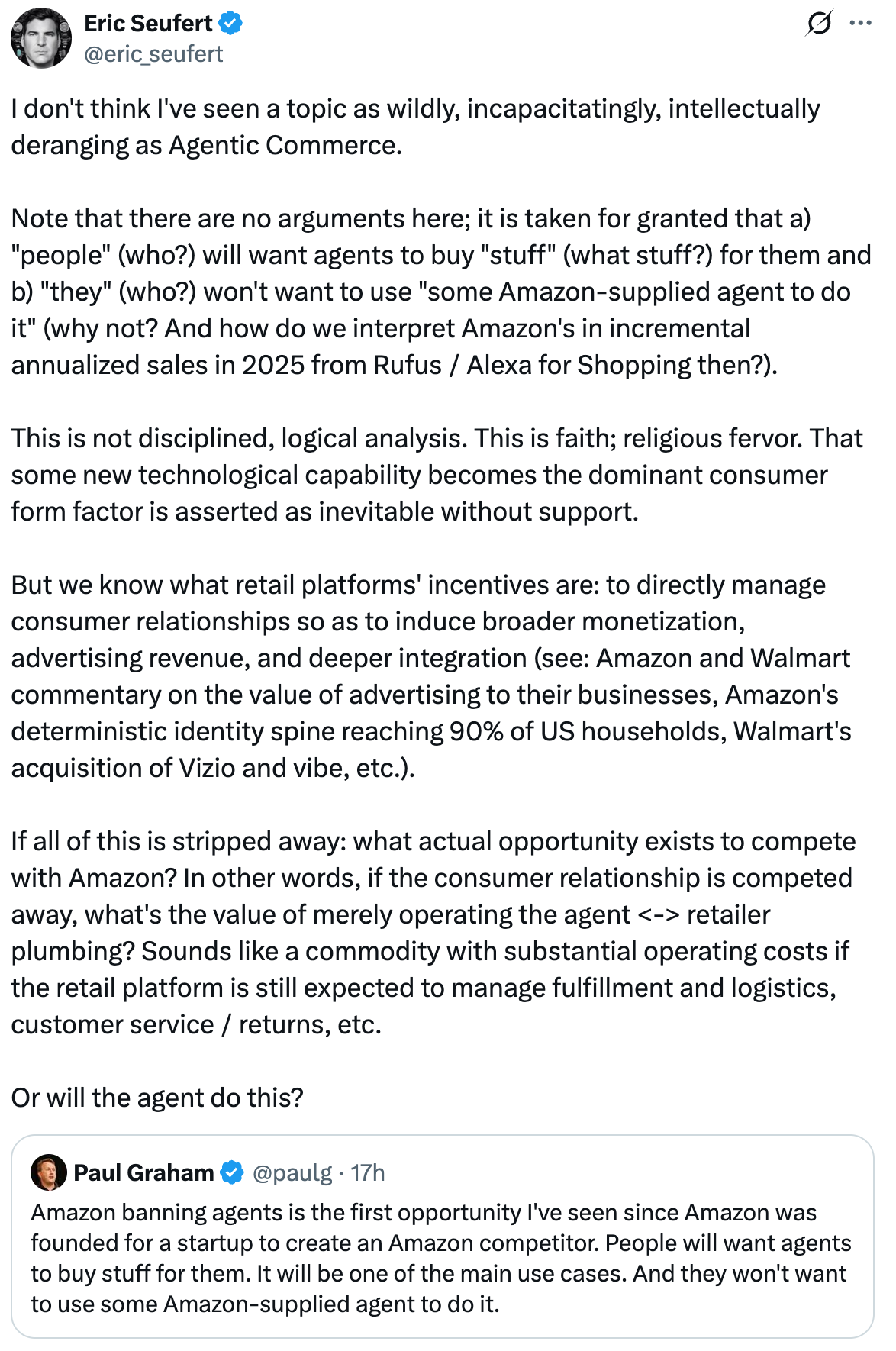
The fourth question is trust. Letting an agent read your email is one thing. Handing it your card details and the authority to spend your money is a much bigger step, and the legal plumbing hasn’t caught up. Someone in my community who recently attended an agentic payments conference pointed out that under EU rules the user can end up bearing the loss if their agent buys from a fraudulent website. Whoopsie! That has an interesting consequence. In the early years, agents will almost certainly stick to a whitelist of merchants they can trust (just like consumers trust Amazon and are willing to pay a slight premium), and those will be the big, established names like Booking.com and Amazon. The agentic era may well begin by funneling even more volume to incumbents before it does anything else. There’s also the question of who owns the agent. I’ll admit that I’d instruct any agent to buy from Amazon, simply because of the benefits and the trust I’ve built up with the brand over the years. Whether I’d want that agent to be built by Meta and hand it all my data is a different question. Still, I wouldn’t lean too hard on this filter. People were terrified of typing their credit card numbers into websites in the late 1990s, and a few years later they were doing it without a second thought. Privacy concerns tend to lose to convenience. I’d love to tell you otherwise, but trust is only a speed bump on this road, and I don’t see it becoming a wall.
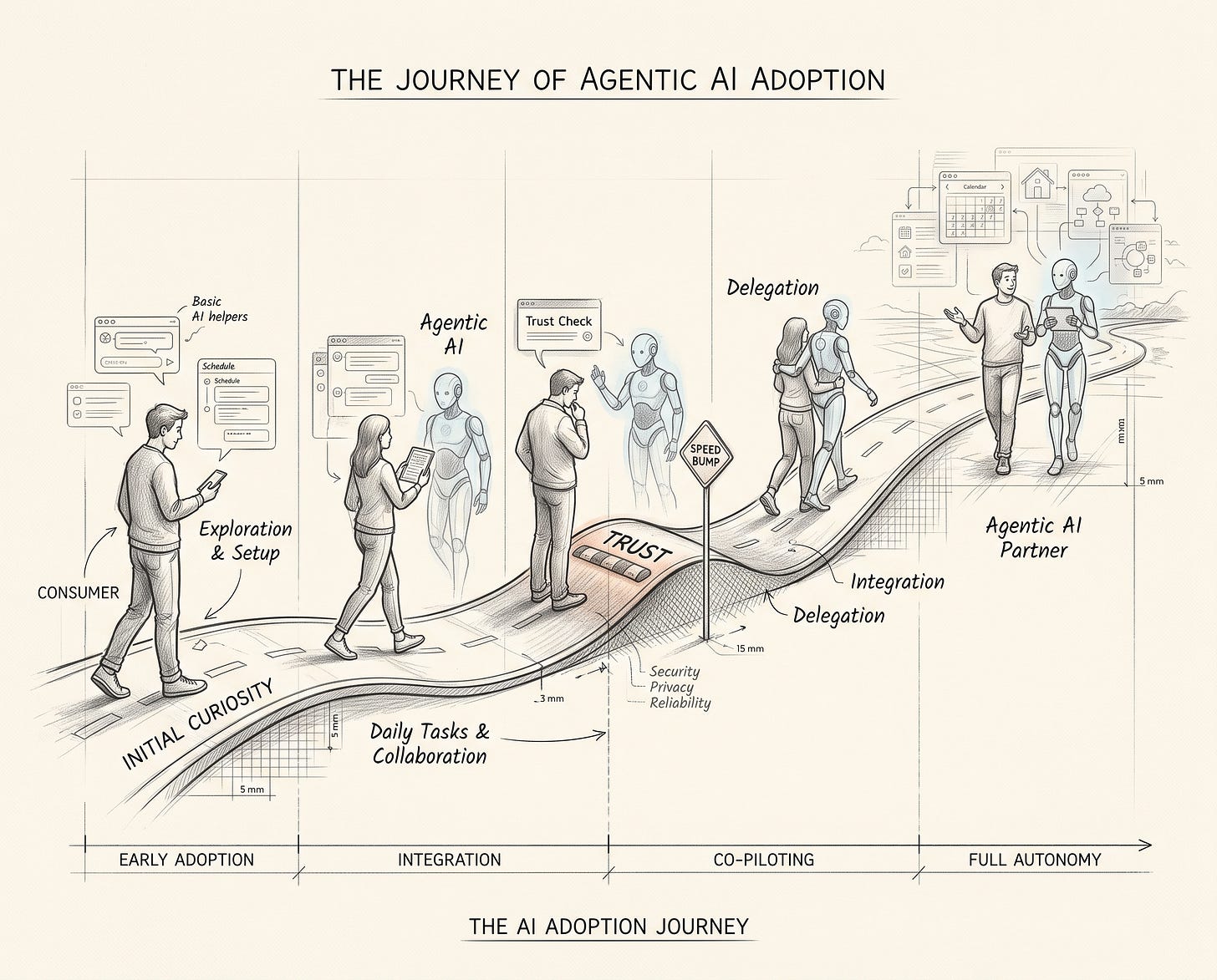
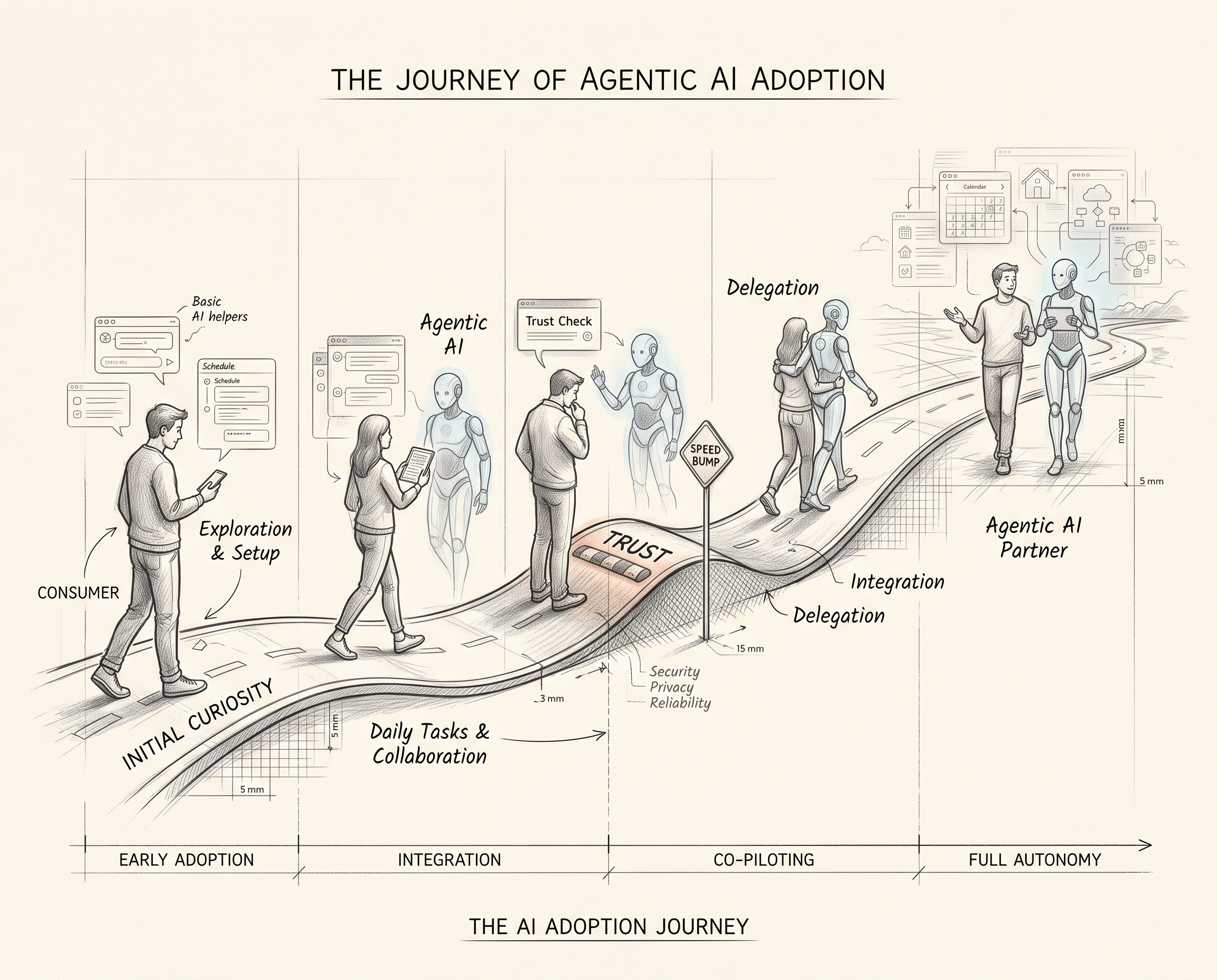
These four questions won’t tell me what Booking or Amazon is worth. What they do help me judge is the shape and timing of any disruption, while the terminal-value math from the previous section tells me how much is at stake. Where all four filters point in the same direction, I take the threat seriously. Where they contradict each other, as I’ll argue they do in travel, I think the market is more likely to overreact. Let’s see how travel holds up.
Let’s discuss!
If you disagree with the hypothesis or some of the takes I shared so far, leave a comment below. The sharpest corrections I get come from readers, and they usually arrive in the comments rather than my inbox.
Travel – Is Booking the librarian or just another book on the shelf?
Let’s discuss the impact on individual sectors. We’ll start with travel and OTAs.
Steve Eisman, of Big Short fame, made the bear case for online travel on the New Money podcast this week. He tells his agent to book a flight to Miami and the best hotel, and the agent goes through every travel site, finds the best price and books it.
As Eisman put it:
“You’re not their customer anymore. Your AI agent is the customer.”
He then asks the obvious follow-up: what exactly is Booking’s switching moat if you never visit the website again?
It’s worth being precise about which moat he’s questioning. It’s a habit moat. You open the app, you compare, you book, and after a few years the opening becomes a reflex. An agent that queries every site and books the cheapest option has no reflexes and no favorite apps. If the customer relationship moves from the site to the agent, the advertising money that paid for that traffic moves with it.
Eisman contrasts this with software deeply embedded in the enterprise. A company like ServiceNow, or one of Constellation Software’s vertical market businesses, sits inside the daily operations of a firm, with the data, the trained staff, and the switching costs already in place. An agent can shop for a flight. Ripping out the system a company runs on is a different matter.
I think that distinction is directionally correct, and it explains why travel sits at the top of nearly every list of potential victims.
It’s also, however, where I think the debate has become lazy and needs a little more nuance.
Let me steelman the bear case first, and here I lean on Drew Cohen once again, who made the most balanced case I've come across on both sides of this debate on X. As he put it, it's very easy to imagine an agent that checks every online travel agency and every hotel’s own website, then comes back with the three, or five, or ten best options.
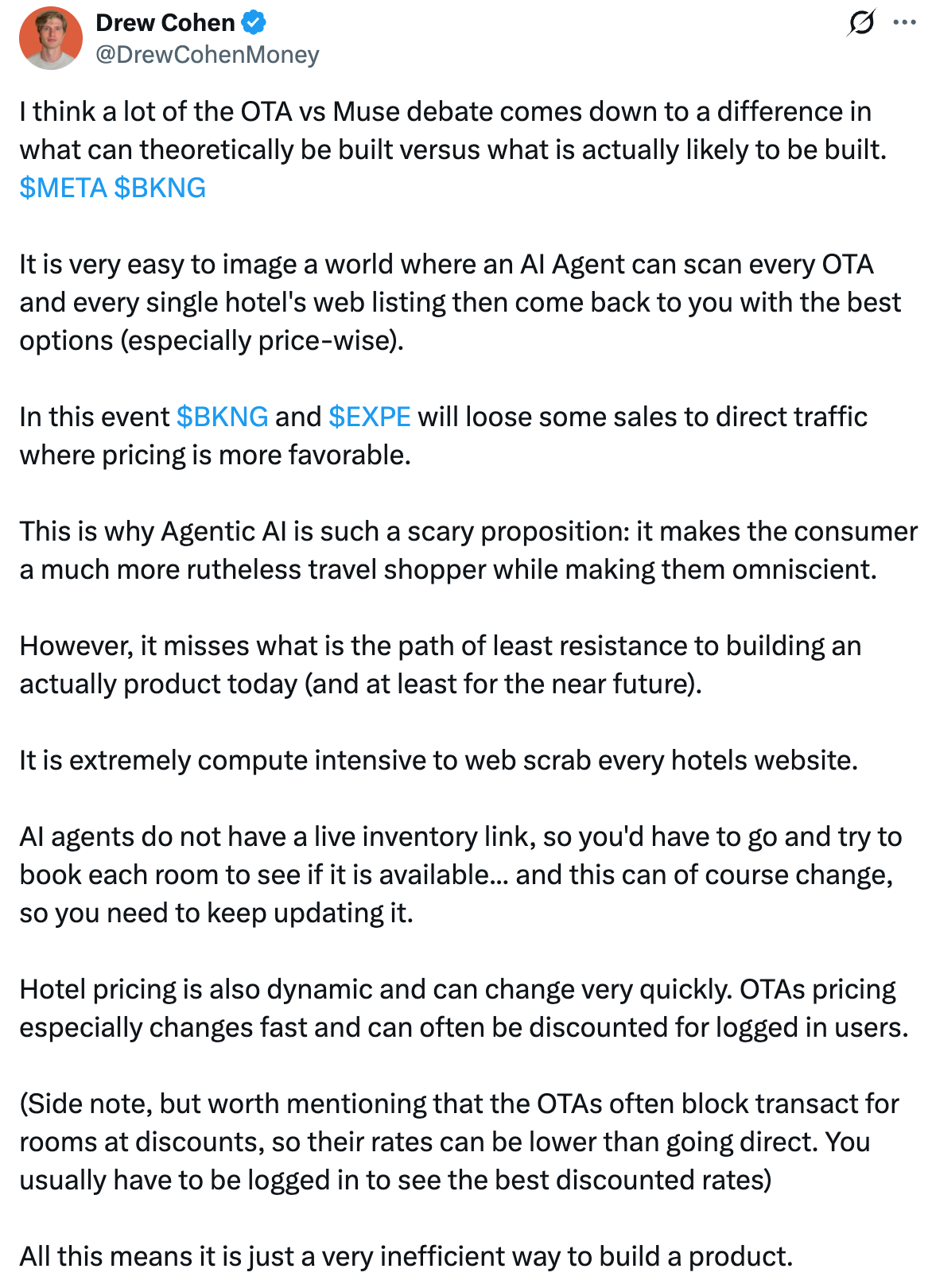
In that world, Booking and Expedia lose a slice of their bookings to direct channels wherever the hotel offers a better price.
That’s what makes agentic AI such a scary proposition for an intermediary. In Drew's words, it makes the consumer a much more ruthless travel shopper while making them omniscient; basically a real-world homo oeconomicus, who is purely rational in his decision-making.
Two decades of brand building, app downloads and loyalty perks count for little if your customer is a piece of software that only cares about the final price, or the best bang for the buck.
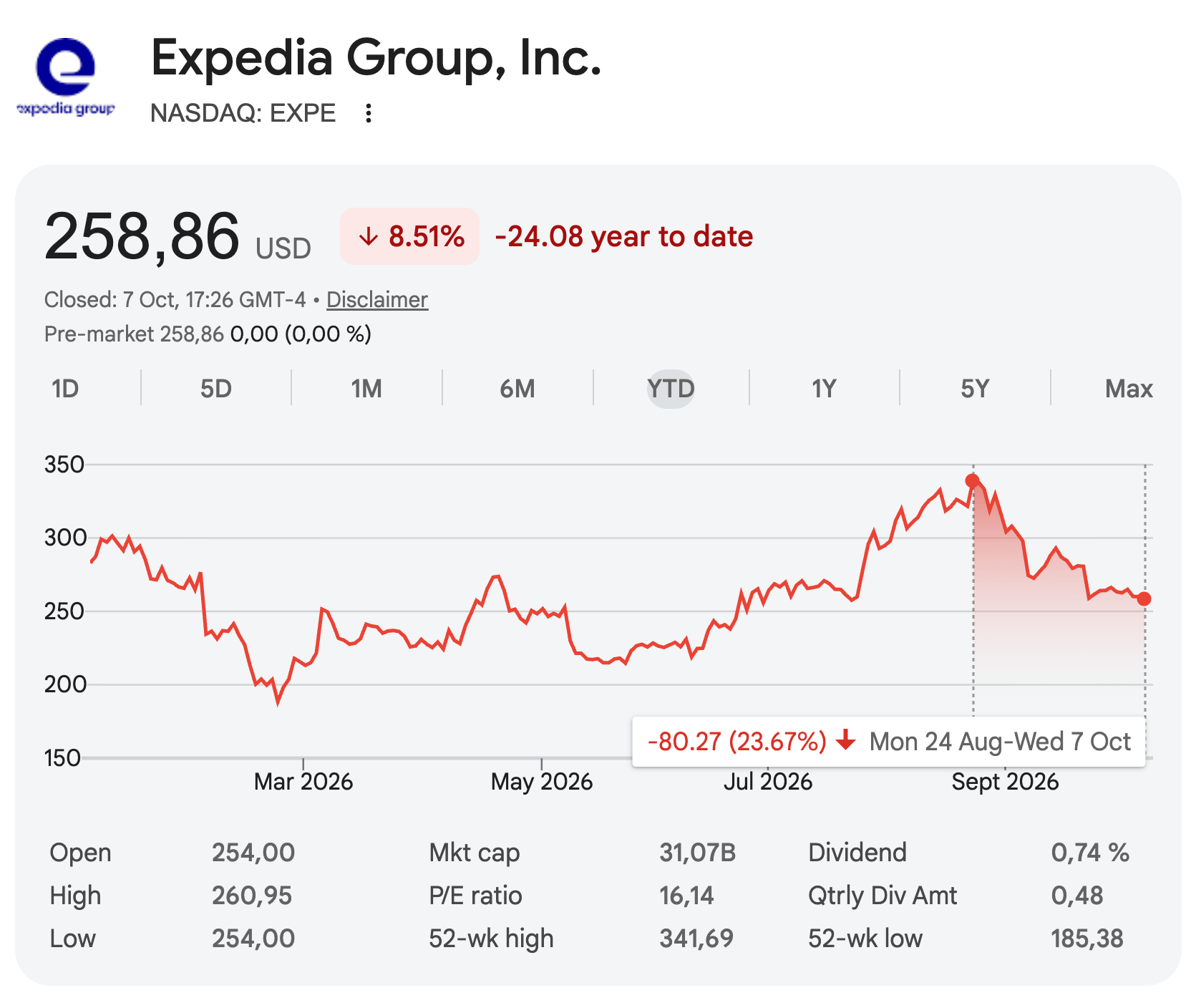
The problem with this scenario is that it describes what can theoretically be built and skips the question of how anyone would build it today – the first question we raised in the segment above.
Booking.com started in 1996 as a small Dutch startup, and the bulk of what it built over the following three decades happened on the ground. It set up local offices across Europe and later Asia and Latin America, with account managers who walked into independent hotels, family-run B&Bs and guesthouses and signed them up one by one. The pitch was simple and unusually generous for its time: no upfront fee and no marketing budget, only a commission once a guest had actually stayed. That model fit Europe's fragmented hotel market in particular, where most rooms belong to independent owners rather than large chains, and every one of those owners had to be onboarded, have their photos and room types loaded, connected to rate and availability feeds, and supported in their own language when something went wrong. Layer after layer of that work compounded into a supply base that, as of December 2025, stood at 32 million listings across 4.4 million properties, along with decades of verified reviews, payment infrastructure and customer service that guests and hotels have come to trust. Rebuilding that from scratch would be close to impossible for a new entrant, because supply alone does not make a hotel owner sign up. They join for the demand Booking brings, and a challenger without bookings to offer is asking a busy owner to do onboarding work for nothing.
An agent has no live inventory link to the vast majority of hotels. To find out whether a room is available at a given price, it has to go through the booking flow on each website, step by step, almost as if it were going to book. The answer can be different an hour later, because hotel pricing is dynamic and changes constantly. The best OTA rates are often only visible to logged-in members – Booking’s Genius discounts being the obvious example – so an agent that scrapes the public page doesn’t even see the cheapest price.
And contrary to popular belief, going direct often isn’t cheaper. Hotels frequently give OTAs discounted rates for members, which means the Booking price can be lower than the one on the hotel’s own website.
Repeating all of that for every property, for every query, from every user, is extraordinarily compute-intensive and slow.
Another interesting question for agentic AI is whether that replication is even necessary. An agent sitting between the traveller and the booking doesn’t need to rebuild the network if it can rent it through Booking, Expedia or the chains’ own direct APIs and channel managers, which have made the plumbing far more standardized than it was twenty years ago.
I find the library analogy presented by Draw Cohen on X helpful here. Imagine you’re looking for a book, and there’s a librarian who knows where every book is and what each one is about. You refuse to talk to her. Instead, you pick up every book in the library, read each one, and only then decide which one you wanted.

Then it gets even crazier, because you repeat the whole exercise every time you need a book. That’s roughly what an agent does when it bypasses the OTAs. Booking has spent more than 25 years building the infrastructure that knows where every room is, what it costs right now, and what other guests thought of it. An agent can, in theory, rebuild that index from scratch on every request.
Whether that makes sense as a product, given the compute bill and the waiting time, is another question.
This matters even more because of where Booking’s supply comes from. One recent analysis estimated that only around 10% of Booking’s room nights come from the big global hotel brands. Those chains have loyalty programs and booking systems an agent can plug into directly. The long tail of independent hotels, guesthouses and apartments mostly doesn’t, so an agent that wants those rooms still needs Booking. Booking also processes the payment on roughly three-quarters of its gross bookings, which keeps it inside the transaction rather than just at the top of the funnel.
But ultimately, ordinary users now have a price-comparison tool that does the legwork for them (if they have the time to wait for the agent to do its thing), and that will discipline pricing at the margin.
Then look at what the AI companies are actually doing:
Muse partners with Expedia.
ChatGPT has integrations with both Booking and Expedia.
When Google began testing agentic hotel booking in the US this summer, Booking’s CEO confirmed that Booking was among Google’s first partners.
Fwiw, Grok has no announced OTA partnerships.
Drew Cohen again in his thread asks the obvious question: if agents could easily do this job without the OTAs, why would the companies building them go out of their way to sign these partnerships?
Where The Bear Case Still Bites
I don’t want to stop there, because the comfortable version of this argument has some holes.
The first is that a partnership can also be a trap. Online travel agencies already lived through one version of this story. Google started as a source of free traffic and turned into the industry’s biggest toll collector, and OTAs now spend billions of dollars a year buying back their own customers through search ads.
Booking Holdings (the parent company of Booking.com, Priceline, Agoda, and Kayak) pays Google an estimated $5 billion to $7 billion per year for advertising
Becoming a supplier to the agent means the agent decides who gets ranked first, can auction that placement, and can lean on take rates once it controls enough demand. That’s why I find the split between Expedia and Booking so interesting. Expedia joined Muse and is integrated for travel booking there, while Booking chose to stay out and protect its direct channel.
The market hasn’t rewarded either choice so far – both stocks fell by roughly the same amount over the past month.
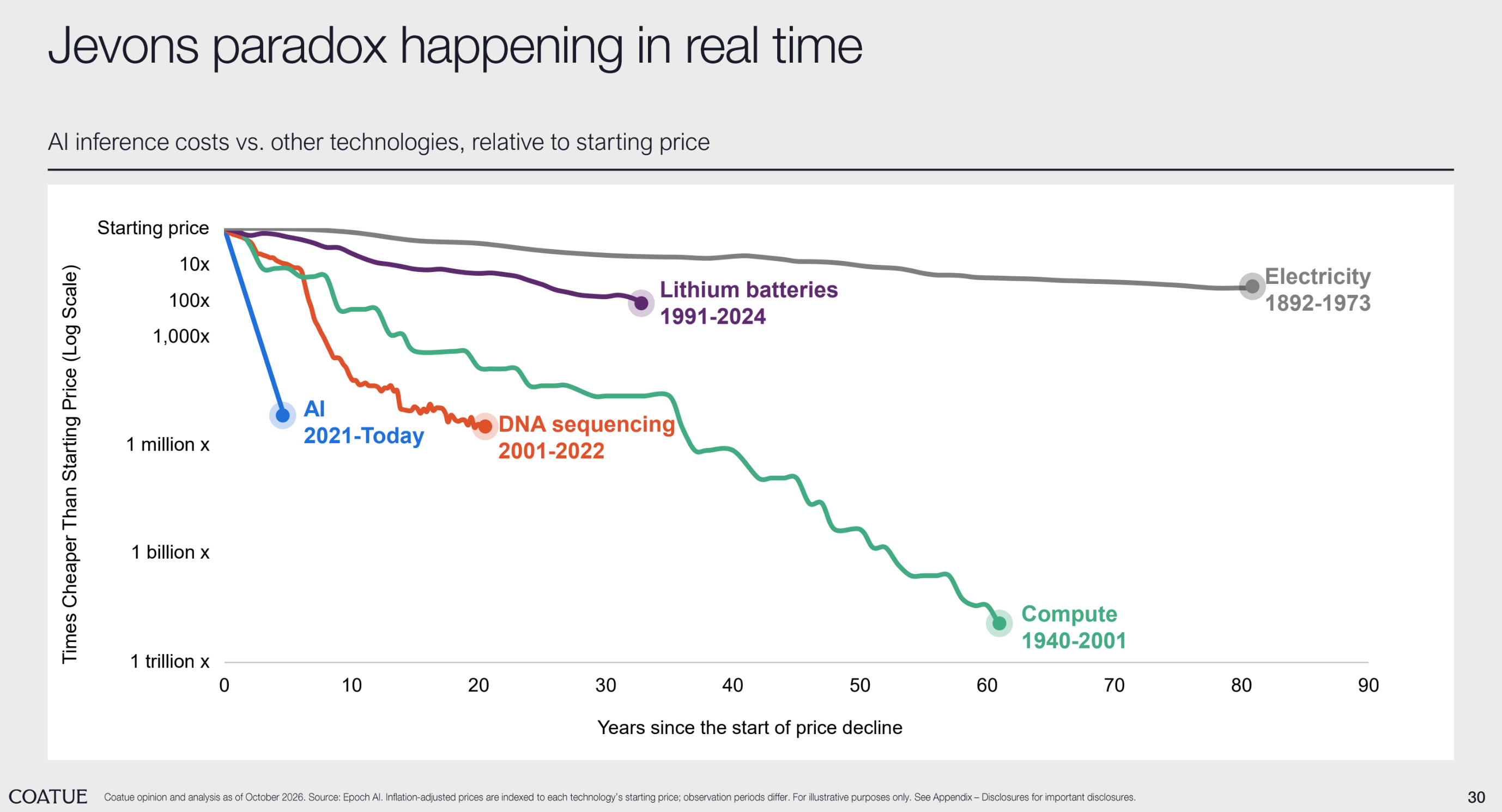
The second hole is “speed.” Investors may object that agents are still too slow, since an LLM that has to query several sources in real time takes noticeably longer to return an answer than a traveler needs to open Booking’s app and scroll through a results page. I remember when I first tested Grok Bok, my main frustration was the waiting time. However, if you zoom out a little, I find that objection weak. Inference costs keep collapsing (see chart below), response times keep shrinking, and the plumbing underneath is starting to change. Channel managers and hotel chains have every incentive to expose live inventory to agents through standardized protocols, because cutting out a 15% to 20% commission is the dream of every hotel CFO. If hotels end up running their own “librarians,” to stick with Drew’s analogy, Booking’s index loses part of what makes it unique.
The obvious counterweight is that the large chains account for only a small share of Booking’s business, and wiring up the independent long tail will take years, if it happens at all.
The third hole concerns advertising. OTAs also sell visibility to hotels through their own sponsored placement programs. If an agent ignores the OTA’s ranking and simply optimizes for price, that ad revenue comes under pressure.
There's a flip side, though, which Drew pointed out and which I think is underappreciated. Performance marketing is Booking’s largest expense, and most of it flows to Google. In an agentic world, OTAs could get more unpaid traffic from AI assistants that send users to them, and they could shift ad budgets from Google Search to a range of AI channels. A market with several AI gatekeepers competing for travel demand should, in principle, mean lower customer acquisition costs than one where everyone depends on a single search engine. The risk in that bullish argument is that the AI market consolidates into one or two winners (at 3 or more, I think OTAs would be a net beneficiary). Then OTAs would simply swap one toll collector for another, and the new one would be even more powerful, because it also makes the booking.
Finally, there’s the question of how much of a problem an agent actually solves. When we moved from high-street travel agents to Booking-type platforms, the internet fixed a genuine problem. Prices were opaque, availability was hard to check, and comparing options took hours or days. An agent solves a much smaller problem. Booking a hotel yourself already takes a few minutes, and you can compare prices and reviews in one place. Handing that over to software requires a lot of trust for very little time saved.
I’m not convinced that’s enough to make hundreds of millions of people change their habits.
“The chains of habit are too light to be felt until they are too heavy to be broken" - Buffett
Customer inertia is hard to overestimate, especially when it’s reinforced by loyalty programs. Genius members at levels 2 and 3 account for a share of Booking’s room nights in the high 50s percent, and the mobile app’s share of room nights has also reached the high 50s. Both figures are still rising. These are people who have chosen to come back on their own.
That said, I can easily see certain segments moving first. Corporate travel is a natural fit, since companies already route bookings through policies and intermediaries, and an agent that enforces a travel policy is an easy sell to a CFO.
Among individuals, I’d expect a tech-savvy minority to adopt agents early – probably younger, probably mostly men, and probably people who already are early adopters. That segment isn’t tiny, and it tends to be relatively affluent. But it’s a long way from the mass market.
It’s also worth remembering that the incumbents aren’t sitting still waiting to be disrupted. Booking is a deep-pocketed, technologically sophisticated company with a huge data advantage in exactly this domain. Its CEO has said Booking already offers personalized agents that know a traveler’s history and preferences. An agent that remembers you always want a quiet room, a late checkout and free cancellation, and that comes with your Genius discounts already applied, is a tough competitor for a general-purpose assistant that has to rebuild the whole picture from scratch. Agentic AI will create competition among agents as well, and travel incumbents can build very good ones.
Airbnb deserves a brief mention as a contrast. It fell alongside the OTAs, but a meaningful part of its supply can’t be booked anywhere else. An agent can compare prices across Booking, Expedia and a hotel’s website. It can’t compare an Airbnb listing that exists only on Airbnb. Exclusive supply is the toughest defense against disintermediation, and it will be a recurring theme throughout this post.
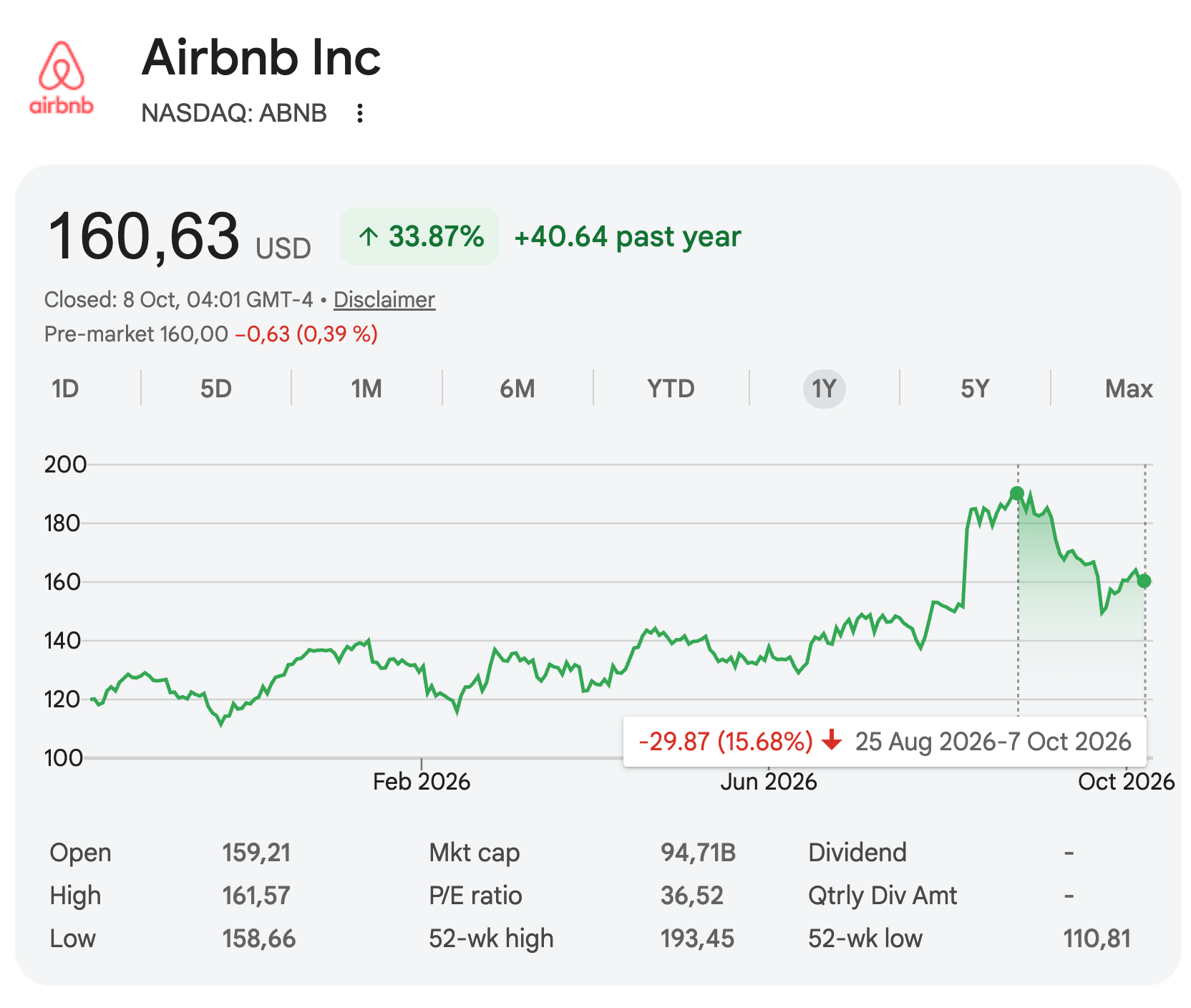
So is agentic AI an existential risk for Booking? It might very well be. And it might very well not be. But based on what I can see today, I see it as one of many risks the company faces, alongside regulation, Google’s power in search, and the cyclical nature of travel. The most plausible bad outcome isn’t Booking’s disappearance. It’s a slow squeeze over the next decade, in which a growing share of demand arrives through agents that negotiate harder on commissions and placement. That would hurt the terminal value, and the reverse DCF from earlier shows that the market is already pricing in something like this.
My own reading, and that’s a view losely held, is that today’s price assumes more damage than the evidence supports, but I’m aware that the evidence always arrives late in disruption stories.
I think investors should be watching a few signposts:
The first is the share of room nights coming from AI agents, which management says is still below 1%; if it rises to several percent, revisit everything from above.
Also watch whether the direct share of bookings holds in the mid-60s percent range, …
… whether marketing costs as a share of revenue fall as traffic sources diversify, and …
… whether Booking eventually joins Muse after all. If Booking signs up, I’d read it as either a sign of strength or capitulation, depending on the terms.
E-Commerce – What Happens to Amazon and MercadoLibre When Nobody Browses?
If travel is where the market panicked first, e-commerce is where I think the more interesting debate can be had.
A question from someone in my community captured it perfectly. Many e-commerce platforms make a large share of their profits from advertising rather than from the transaction itself.
"Bob, so the margin structure for the advertising business is fairly consistent across geographies. It's a very high-margin business. I think we've set EBIT margins in the high 70s, low 80s. Attach rates or adoption do vary by geography. Mexico is the country with the highest attach rate." - Q3 2022 Call (from my Mercado Libre Deep Dive)
If consumers place more and more orders through an external agent instead of searching on Amazon or MercadoLibre themselves, what happens to that ad model?
The transaction might still happen on MercadoLibre. But if the agent simply compares every available offer and optimizes for the best deal – akin to our travel discussion –, sponsored listings look much less valuable. T-
he platform could keep the sale and still lose the most profitable part of the relationship, which is owning the discovery layer.

I want to start with a paradox Joseph Carlson pointed out, because it shapes everything else in this section: Amazon is arguably exposed to agentic commerce precisely because it’s already an aggregator. Much of Amazon’s advantage comes from two facts. Its website has nearly everything, and the rest of online shopping is broken into millions of small shops, each with its own checkout, shipping policy, and return process. Amazon became the default partly because it saved you the trouble of dealing with that fragmented mess.
An agent does that aggregation for you. It can visit 30 shops in the time it takes you to open the Amazon app, compare them, and present the result as if it were a single store. In that world, the rest of the internet suddenly looks a lot more like Amazon, and Amazon’s aggregation advantage shrinks.
It doesn’t vanish, but it shrinks.
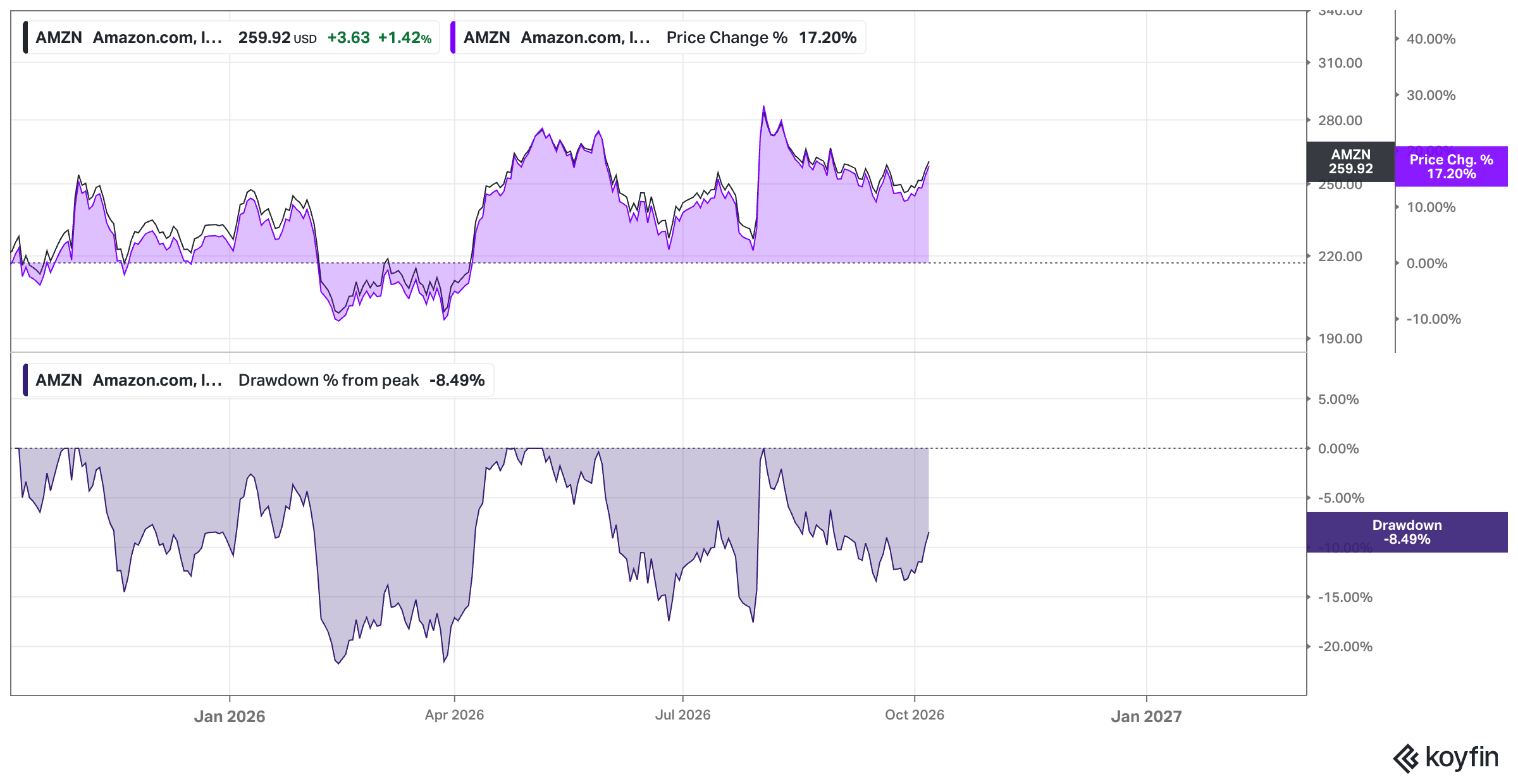
The Two Amazons
To think about this clearly, I find it helpful to split Amazon’s retail business into two parts that are usually lumped together.
The first is the retailer and logistics machine: an enormous selection, the fastest delivery network in the Western world, painless returns and competitive prices. Agents don’t threaten this part. They may even reward it. If you tell an agent to get you a pair of running shoes by Thursday at the best price with free returns, Amazon will win that comparison more often than not, on merit. An agent that ruthlessly optimizes for the customer is good news for whoever has the best customer proposition, and in much of the world that’s Amazon.
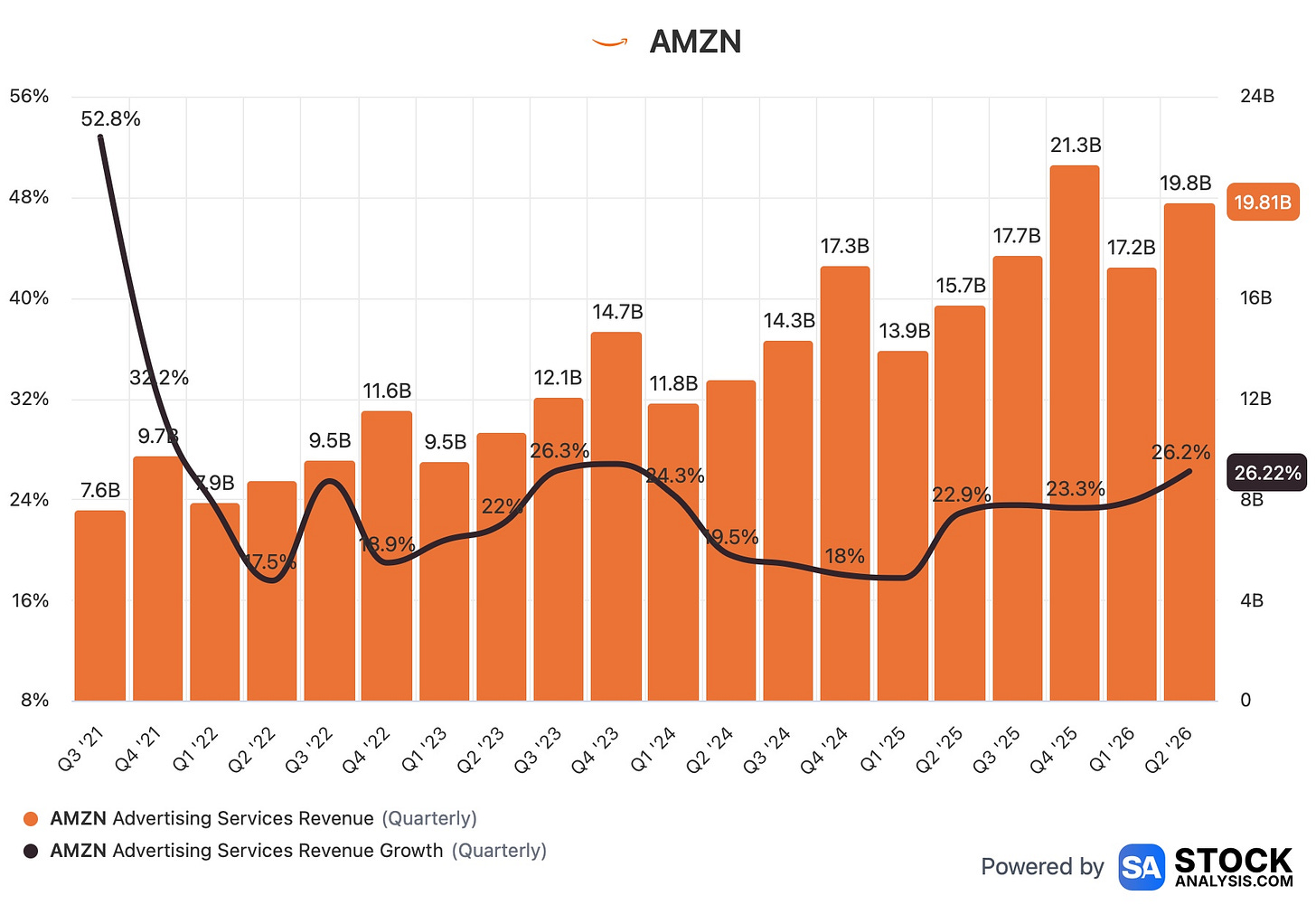
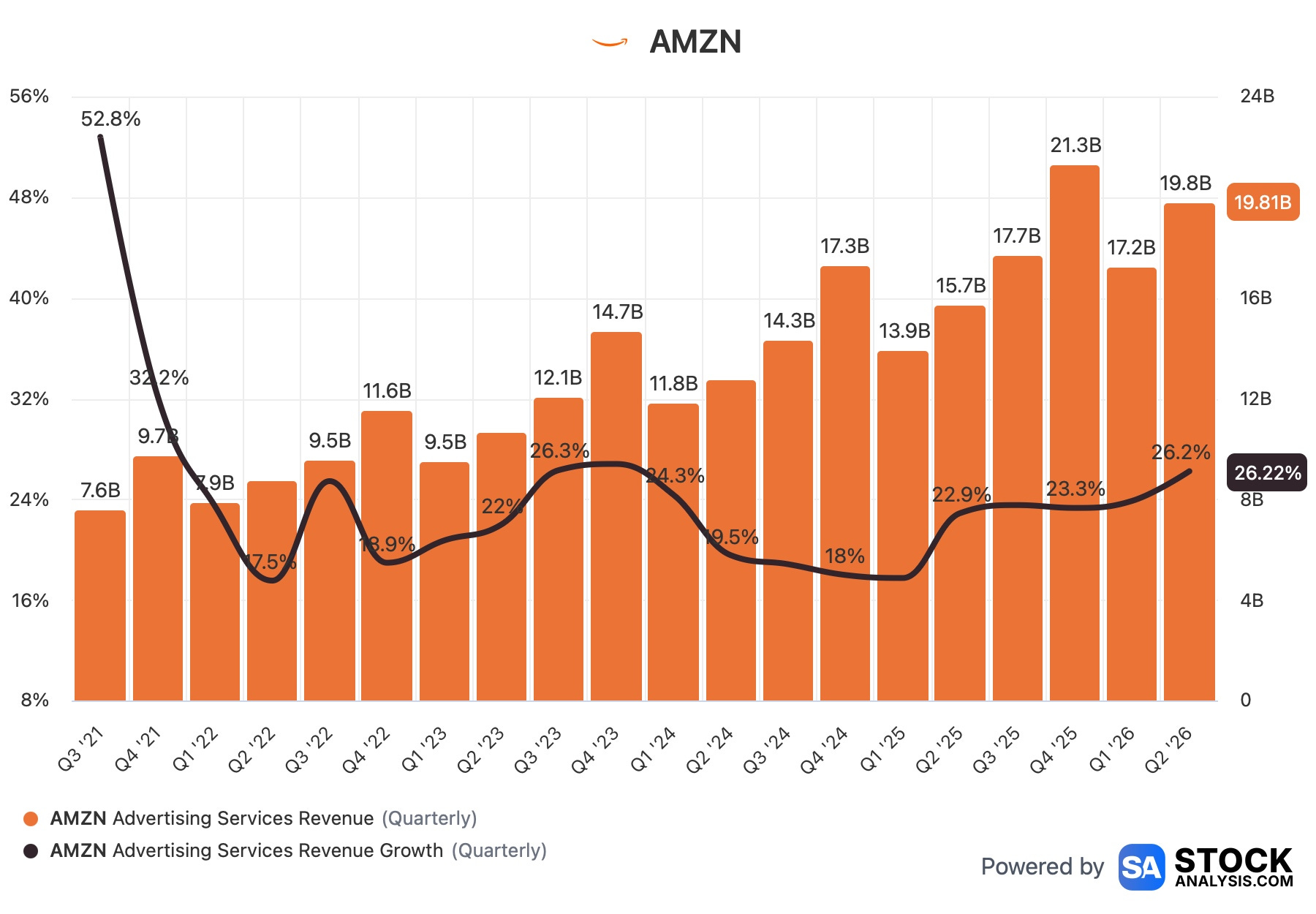
The second part is the advertising business layered on top of that machine, and this is where the risk seems higher. Amazon’s ad revenue reached $19.8 billion in the second quarter of 2026, up 26% year over year. That’s an annual run rate of roughly $80 billion, at margins most retailers can only dream of. Many analysts believe advertising now generates a large share, if not most, of the profit in Amazon’s retail operations. The business works because hundreds of millions of people type queries into Amazon’s search bar and scroll through results that sellers pay to influence. An agent doesn’t scroll. It doesn’t get tempted by the sponsored listing at the top, and it doesn’t care which brand paid for the banner.
Amazon clearly understands this, and it has shown it’s willing to fight. Its first target was Perplexity, whose Comet browser had been placing orders on Amazon on behalf of users. One of the arguments Amazon made in that lawsuit is revealing: AI agents bypass sponsored listings and thereby hurt its ad revenue. When a company tells a federal court what it fears, I tend to take it at its word. Amazon won a preliminary injunction in March, but in August the Ninth Circuit vacated it. The court found that when an agent shops on a user’s behalf, it’s the user who accesses Amazon’s servers, not the company behind the agent.

The underlying case is still open, and the judges stressed that their ruling doesn’t create a broader legal framework for agents. Still, the legal road to keeping agents out has become narrower.
So Amazon has turned to the tools it controls directly. On September 20, less than two weeks after Muse launched, Amazon cut it off. People who tried to shop on Amazon through Muse got a popup saying that “continued access by an unauthorized AI agent violates Amazon’s Conditions of Use, to which our customers have agreed.” Amazon’s complaints are that Meta never told it Muse would access its store, that the agent doesn’t identify itself when it browses, and that it appears to capture and store customer credentials. For its part, Meta says Muse can’t see passwords or payment details.
Amazon also made a broader point: agents bypass its personalization and recommendations. Read that next to the Perplexity filing, and the commercial motive is hard to miss. According to Adweek, Amazon has also moved against shopping agents built by Google and OpenAI.
What makes the standoff with Meta remarkable is how intertwined the two companies are. Amazon products have been purchasable inside Facebook and Instagram since 2024, and Meta has a multibillion-dollar deal to use Amazon’s AI chips. Even close partners become rivals once the question is who owns the customer at the moment of purchase.
Bucco Capital, who is bullish on Meta and Muse, put it well: many people are overlooking the “digital knife fight” that’s about to begin, because nobody wants to get commoditized or layered. For now, Amazon can keep its garden walled, through its terms of service and technical blocks rather than through the courts.
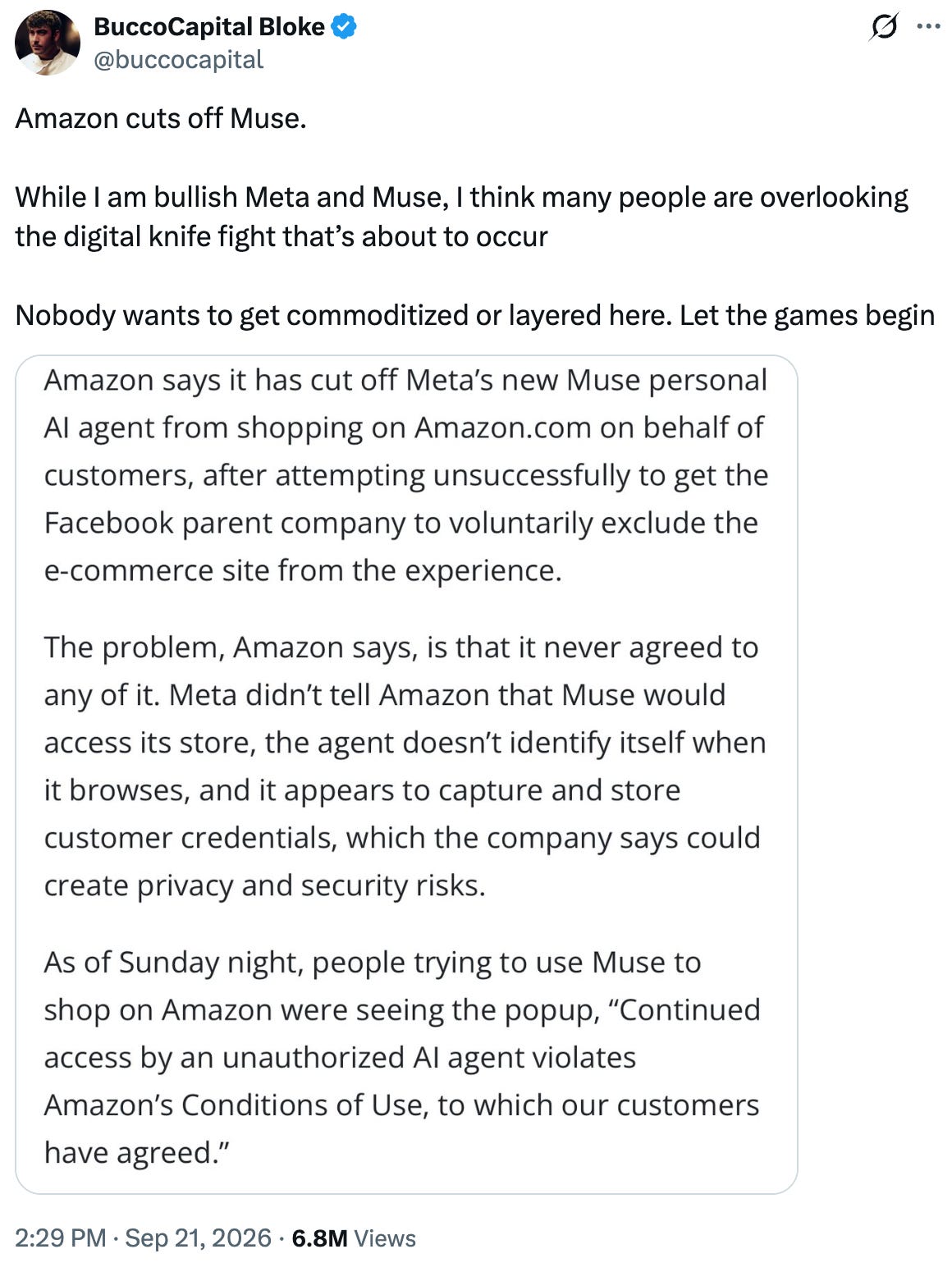
Whether that's a winning strategy over ten years is a different question. Walled gardens work as long as demand is/starts inside the garden. If a growing share of shopping journeys starts in Muse, ChatGPT, or Gemini, a store that refuses to be visited by agents risks becoming the store agents don't recommend. Retailers that open up and integrate with agentic checkout, such as Walmart and the merchants running on Shopify, would capture that demand instead.
Amazon's response so far has been to build its own agentic layer: it replaced Rufus with Alexa for Shopping and is placing ads inside the conversation through so-called sponsored prompts. Amazon claims that customers who click those prompts convert 48% more often and spend 21% more. These are self-reported numbers, and I'd take them with a grain of salt. But they point to Amazon's preferred future, one in which the agent you shop with belongs to Amazon.
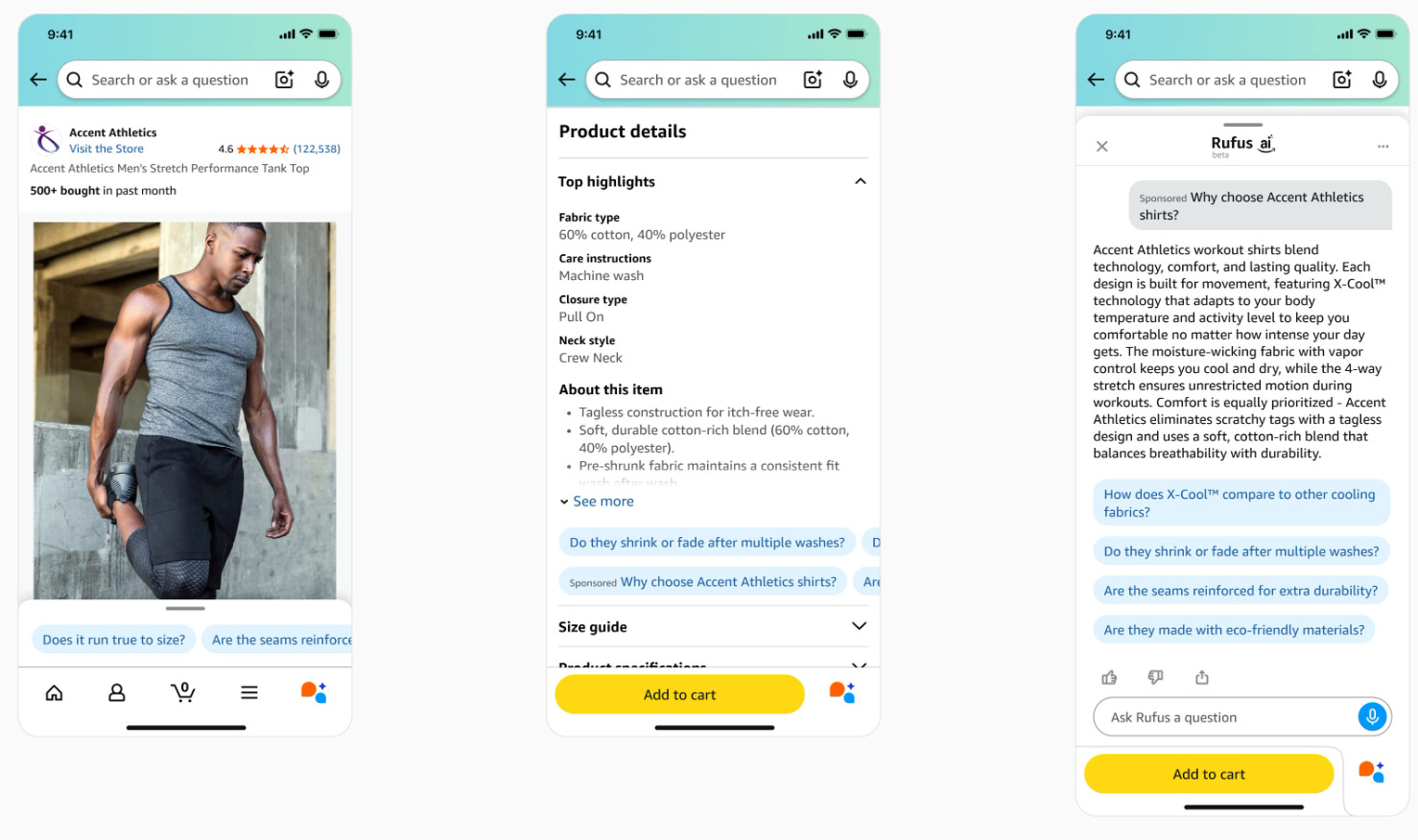
A peer pushed back on me here, and his argument deserves an answer. A good chunk of Amazon’s marketplace ads, he pointed out, appear after the shopper has already shown purchase intent by typing a search. So Amazon may not be very exposed to agents taking over discovery. I agree with the premise, but I draw the opposite conclusion. Sponsored Products, Amazon’s largest ad format, sit between intent and choice. You’ve decided you want running shoes, and the ad tries to influence which pair you buy. That difference between “I want this kind of thing” and “I’ll take this one” is exactly the step an agent is built to take over, even though an agent may also present a reduced number of options which you choose from.
The part an agent can’t easily replace is Instagram-style discovery, the moment you learn you want something at all. In other words, Amazon’s ads are less exposed to agents replacing discovery and more exposed to people delegating the choice.
There are fair caveats. When a shopper tells an agent to buy a specific product, the ad wasn’t going to change the outcome anyway. And an agent that searches within Amazon still sees Amazon’s ranking, which Amazon could make more machine-readable for sponsored placements. But between the Perplexity filing and its statement on Muse, Amazon itself seems to see the risk the same way I do.
Isn’t this just the take rate in disguise?
The strongest counterargument I’ve heard runs as follows, and I think it deserves more attention than it gets. First, none of this is new. Around 2012, Google rolled out product listing ads and pushed into flight and hotel search precisely to avoid being disintermediated by Amazon in e-commerce and by Booking in travel. Intermediaries have always fought over who owns the starting point of a purchase, and the incumbents have usually adapted. Second, the volume isn’t there yet. Adyen has been talking for several quarters about investing in agentic payment protocols because its merchants want them, but it has been candid that there is very little volume so far. It may well come, but nobody knows when.
For Amazon, the person making this case boils the issue down to two questions…
Does agentic commerce take meaningful share, and over what period?
And when a shopper uses an agent, do they say “buy X from Amazon,” or just “buy X”?
That second question is the same disintermediation risk this industry has always lived with, and Amazon and every other retailer will work very hard to make sure the answer is “from Amazon.”
Prime is, among other things, a mechanism for exactly that. Speaking for myself, I’d tell any agent to buy from Amazon, because of the delivery speed, the easy returns, and a level of trust I’ve built up over many years.
The most interesting part of the argument concerns advertising itself. From Amazon’s perspective, advertising is ultimately just a way to raise the take rate on third-party sellers. If agents make sponsored listings less effective, Amazon has plenty of other levers to collect the same money. The most direct one is to charge the agents themselves, since Amazon controls who gets reliable access to its live prices, inventory and checkout, and its lawsuit against Perplexity over the Comet browser shows it intends to guard that gate. It can also keep the agentic journey on its own turf through Rufus and “Buy for Me,” where sponsored placements are already appearing inside the answers. Beyond that, Amazon can sell sellers better visibility to agents through richer structured data and priority feed inclusion, tie the Buy Box more tightly to Fulfilment by Amazon, raise referral and fulfilment fees, or introduce an explicit agent processing fee for orders that arrive via external agents. And if agents end up shopping across retailers, Prime, Multi-Channel Fulfilment and Buy with Prime still let Amazon collect on delivery wherever the order is placed, while the ad budgets that leave sponsored listings can flow into Prime Video, the DSP and Amazon Marketing Cloud instead.
Enjoying This?
These articles take time to write. If you learned something from this write-up, please …
❤️ like this post and leave a comment with your thoughts
🔁 share it with your investing friends to spread the message to others
✅ subscribe to the newsletter for more investing content
Thank you.
I find this argument persuasive, with one important caveat. Sellers pay for ads voluntarily, because ads buy visibility in a contest for attention that Amazon controls. A fee that replaces ad revenue only sticks if sellers have nowhere better to go. Today they don’t, because Amazon is where the customers are. But agents make it easier for customers to find sellers anywhere, including on their own Shopify stores. The more an agent can reach merchants outside Amazon, the less pricing power Amazon has over those merchants.
So the take-rate argument holds as long as Amazon remains the default place where demand lands. It’s circular: Amazon can keep its take rate if it stays the default, and the question of whether it stays the default is the whole debate.
I wouldn’t bet against Amazon here, but I’d also be wary of anyone who says ads are safe because “it’s just a take rate.”
MercadoLibre
MercadoLibre is the case I find hardest to call, and it’s personal for me because MELI is a company I own.
Disclaimer:. The analysis presented in this blog may be flawed and/or critical information may have been overlooked. The content provided should be considered an educational resource and should not be construed as individualized investment advice, nor as a recommendation to buy or sell specific securities. I may own some of the securities discussed. The stocks, funds, and assets discussed are examples only and may not be appropriate for your individual circumstances. It is the responsibility of the reader to do their own due diligence before investing in any index fund, ETF, asset, or stock mentioned or before making any sell decisions. Also double-check if the comments made are accurate. You should always consult with a financial advisor before purchasing a specific stock and making decisions regarding your portfolio.
The ad business is young and growing fast. Mercado Ads grew 62% on an FX-neutral basis in the second quarter, and MercadoLibre says it now holds more than 10% of the digital advertising market in Latin America.
For the investment case, that matters a great deal. MELI’s consolidated operating margin was 6.7% in the quarter, weighed down by heavy investment in credit and logistics. A lot of the long-term margin expansion investors are counting on, and therefore a lot of the terminal value, depends on high-margin advertising becoming a much bigger share of the mix.
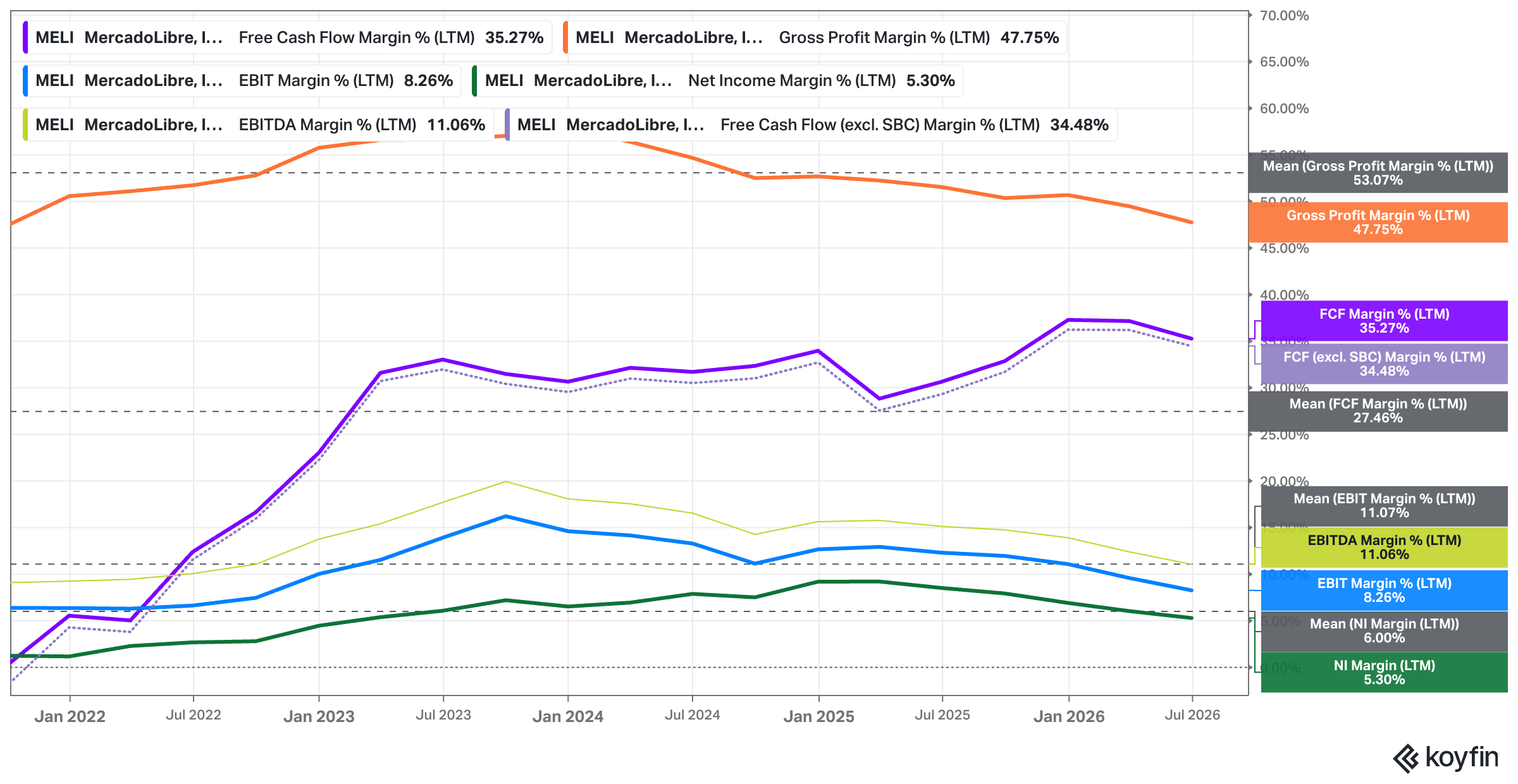
If agents dull the value of sponsored listings before Mercado Ads reaches maturity, the impact lands directly on the part of the thesis that justifies the multiple.
There’s another detail I can’t stop thinking about. Muse launched inside WhatsApp. And there are few places on earth where WhatsApp is more central to daily life than Brazil, Mexico and Argentina, MELI’s three core markets. People there already chat with businesses, pay and coordinate their lives in WhatsApp. If Meta ever pushes Muse aggressively in Latin America - so far Meta launched its personal AI agent in the US AND expanded availability to Canada on September 18, 2026 -, it will have a distribution advantage in MercadoLibre’s backyard.
The counterarguments are strong, though, and in some ways they’re stronger for MELI than for Amazon. In markets where fraud is more common and online merchants are more fragmented and less trustworthy, the trust filter from earlier carries even more weight. An agent that has to whitelist reliable merchants will route a lot of volume to MercadoLibre, simply because it’s the safest place to shop.
MELI’s moat also extends well beyond its search results: it includes its own logistics network, Mercado Pago, and a credit book built on years of transaction data. An agent can bypass a sponsored listing. It can’t bypass a delivery network or a payment wallet that hundreds of millions of people already use. Mercado Pago could even end up being the payment rail that agents use in the region. In that case, MELI would collect a toll on agentic commerce regardless of where the purchase began.
Do People Even Want to Stop Shopping?
Finally, it’s worth coming back to a question I raised earlier, because it applies more to e-commerce than to any other sector. For many people, shopping is an experience in itself. They browse on a lazy Sunday, discover things they didn’t know they wanted, and enjoy that small dopamine hit when they finally press “buy.” A push notification from an agent saying “your order has been placed” cuts out all of that. For replenishment purchases like detergent, office stuff, printer ink, and pet food, agents will probably win easily, and Amazon’s Subscribe & Save already shows how little people want to think about those. But discovery-driven categories like fashion, home decor and gifts are where retail media earns much of its keep, and they’re also the categories where people are least likely to hand control to a machine.
The irony is that the ad-heavy part of e-commerce may also be the part most resistant to agents.
So where do I come out? I see agentic commerce as a real but slow-moving threat to the advertising layer of e-commerce, rather than to the retailers themselves. It’s a smaller threat to the companies with the best logistics, the broadest selection and the most trust, which happen to be Amazon and MercadoLibre in their respective markets. Amazon has the tools and the leverage to defend its take rate, though its walled-garden strategy carries a long-term risk if demand migrates to third-party agents. MELI has a more valuable ad optionality at stake and faces a uniquely awkward opponent in Meta’s WhatsApp, but it also has stronger trust and payment defenses than almost anyone.
Here are the signposts I’ll be observing:
whether Amazon eventually opens up to external agents, and on what terms
whether “agent fees” show up in seller fee schedules
whether Mercado Ads growth holds up as Muse expands beyond the US
Search – Google: Will Search Die, or Just Change Its Name?
When the topic of AI and AI agents comes up, Google is usually the first name on everyone’s list of potential victims. In a discussion in my community, one member made a point that I’ve been thinking about myself. It took Netflix five years before streaming revenue overtook the DVD business, and another eleven before it could shut down DVD rentals entirely. In his view, Google.com will take something like ten years to die. It might die to Gemini, or google.com might simply become Gemini, but it won’t happen tomorrow. I largely agree with the assessment. I find the second half of his sentence even more interesting, because it gets at the real question for Google shareholders. Google is the one company in this post that is simultaneously the incumbent under threat and one of the most capable builders of the thing threatening it.
Is Google overcoming the innovator’s dilemma?
Let’s start with the numbers, because they still don’t look like a business in decline. In the second quarter of 2026, Search and other revenue grew 17% year over year to more than $63 billion. According to management, retail and finance were the biggest contributors to that growth. AI Mode, Google’s conversational search experience, now has more than a billion monthly users. The Gemini app reached 950 million monthly active users, and its daily active users have tripled over the past year. The death of search has been predicted every year since ChatGPT launched in November 2022, and so far it has been postponed every year. Anyone who sold Alphabet in 2023, 2024 or 2025 on the “search is dead” thesis has learned an expensive lesson.
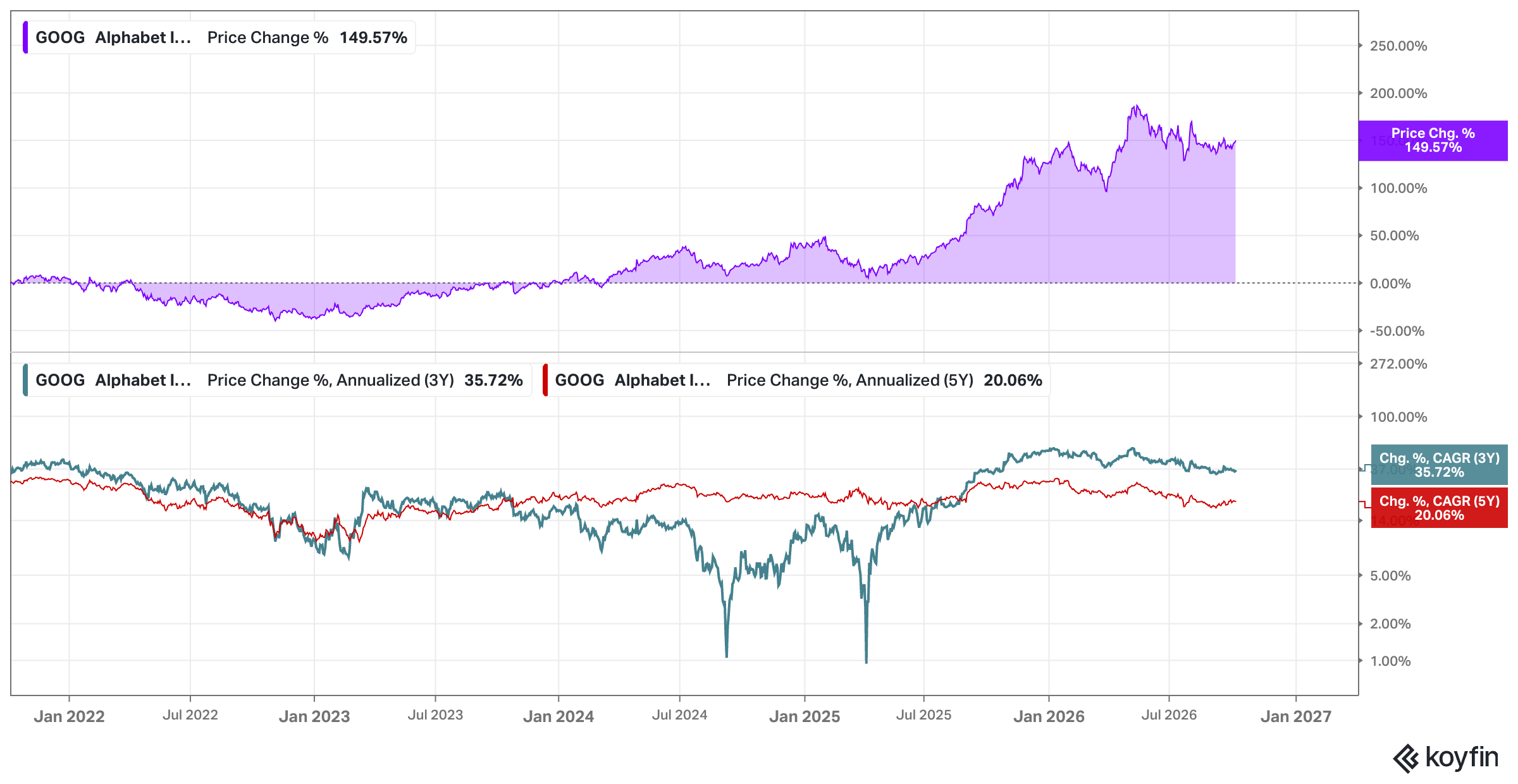
Google isn’t sitting still on agents either. At I/O in May, it presented the Universal Commerce Protocol, a common checkout language for agents, along with a Universal Cart that follows users across Search, Gemini, YouTube and Gmail. The Universal Cart watches for price drops and handles checkout through Google Pay. Launch partners include Walmart, Target, Nike, Sephora, Wayfair and a number of Shopify brands. Google also introduced the Agent Payments Protocol, which lets agents make purchases within limits the user sets in advance. And as I mentioned in the travel section, Google has been testing agentic hotel booking in the US since August, with Amadeus as its technical partner and Booking among its first partners.
If you’re looking for a company preparing to be the toll collector of the agentic era, Google’s product roadmap fits that description very well.

The Queries That Pay The Bills
So why am I not more relaxed about Google? Because the threat is concentrated precisely where Google earns most of its money. Most searches are worth very little. Nobody pays to advertise against “how tall is the Eiffel Tower” or “who won the game last night.” Google’s profit comes overwhelmingly from a minority of commercial queries: hotels in Europe, running shoes, car insurance quotes, mortgage rates, flights to NYC. These are exactly the tasks Muse, Instinct and Grok Bot are designed to take over, and it’s no coincidence that management named retail and finance as the biggest growth drivers last quarter. An agent doesn’t need to win the long tail of informational searches to hurt Google. It only needs to win the commercial queries, which happen to be the ones it was built for.
There’s also a subtle problem with the economics. The search ad auction works because people click. They compare a few results, go back to the results page, and click again. Every click is a toll. An agent collapses that whole process into a single decision. Even if Google builds the best agent in the world, it’s far from obvious that a completed transaction through Gemini will produce as much revenue as the five or six paid clicks a human generated on the way to the same purchase. Google could end up taking a commission on transactions rather than selling clicks, which is more like a marketplace than an ad auction. That could turn out to be a perfectly good business. But it would be a different business, with different margins, and the transition would be anything but smooth.
Then there’s the cost side. Serving a traditional search query costs a fraction of a cent. An agent that browses, compares, fills out forms, and completes a checkout uses orders of magnitude more compute per task. Alphabet just raised its 2026 capex guidance to between $195 billion and $205 billion. Some of that spending is for Google Cloud customers, which is a separate story. But if the future of search is agentic, Google will have to spend far more to answer each commercial query while possibly earning less per query than before. That’s the classic innovator’s dilemma, and the market has every reason to discount it.
8 Signs the AI Bubble Is Further Along Than You Think

Let’s start with an anecdote before we move on to more structural things I’m seeing.
Finally, there’s the competitive question that Muse has raised. Google’s dominance in search rests partly on defaults: Android, Chrome, and the payments to Apple that make Google the starting point on the iPhone. Meta built its distribution elsewhere. It launched Muse inside WhatsApp, where billions of people already spend their days, and Meta didn’t need Google’s permission to do it. For the first time in two decades, a company with comparable reach is competing for the starting point of commercial intent. And Meta’s starting point is a conversation with a friend, not a search box.
Having said all that, I think Google is better hedged against agentic AI than almost any other company in this post. It has the distribution through Android, Chrome, Gmail and Maps. It has the data: decades of commercial queries, a shopping graph with billions of products, and live prices and availability for flights and hotels. It has a payments wallet and a growing set of agentic commerce protocols that major merchants are already adopting. And it has one of the two or three best AI models in the world, built and served on its own chips. If the toll collector moves from the search box to the agent, Google is one of the most likely companies to end up running that agent.
So, in the phrasing of one of our community members (shoutout to Steve!(, I lean toward the version where Google.com doesn’t die but turns into Gemini, which may be less monopolistic in nature than legacy Search, though.
Cannibalizing yourself and ending up with an industry structure that is more oligopolistic is painful, but it beats being cannibalized by someone else entirely. Google seems to have understood that now (after hesitating with the timing of its LLM earlier in the decade). The question for investors is a) how much of the current profit pool Google will have to share with the other market participants (remember Google holds approximately 91% of the legacy global search engine market share across all devices), b) whether the monetization of AI works equally well as the monetization of blue links (I have my doubts), and c) whether the business on the other side earns the same margins as the near-monopoly ad auction it replaces. I’m skeptical it will.
An agentic Google will likely face more competition, from Meta, OpenAI and possibly Amazon, than the search Google ever did, and it will cost much more to run.
That’s not a reason to panic about Alphabet. In 2026, Alphabet is more than Google Search. But it is a reason to be cautious about assuming that the economics of the past twenty years carry over into the terminal value.
Advertising – Bots Don’t Click on Ads…
Cloudflare’s CEO Matthew Prince summed up the problem AI agents create for advertisers extremely succinctly:
“Bots don’t click on ads. They don’t respond to what we traditionally think of as a brand, and so we’ve gotta come up with something else that’s going to power that just incredible, insatiable demand that’s gonna be put on the internet going forward.”
Prince is in a better position than most to see this coming. According to Cloudflare’s data, bots now account for 57.2% of requests to HTML pages, which means machines have overtaken humans as the main visitors to the web.
Prince admitted it happened faster than he expected. He had initially thought it would take until late 2027.

For anyone who owns an ad-funded business, that should be sobering.
The economic model of the consumer internet for the past 25 years has been simple. You attract human attention, you build some kind of business around it, and then eventually you sell those eyeballs to advertisers.
Every company, so the Wall Street saying goes, will eventually be becoming an ad and media company because first-party data monetization, high-margin revenue streams, and owned distribution channels are so lucrative.
Search ads, display ads, social feeds, retail media and affiliate links all depend on a human being looking at something and sometimes clicking on it.
An agent breaks that chain! And it arguably break it in two places:
It consumes content without seeing the ads around it, and
it makes purchasing decisions without being persuaded by them (either consciously or subconsciously; or both).
“The rational brain is great at rationalizing what the emotional brain has already decided to do.” - Professor of Marketing Baba Shiv
So the question at the end of that original list – will the world of ads evolve? – has an easy answer.
Of course it will.
The harder questions are how it evolves, how fast, and who ends up collecting the money.
That last question comes up because advertising economics are so attractive that sooner or later every tech business seems to become an ad business. The internet has already produced a handful of advertising companies that now rank among the largest businesses in the world, and given that track record, I can easily see a new set of advertising behemoths emerging over the coming decades.
Overall, I see three directions for the advertising industry, and they have very different implications for investors.
The first is ads inside the agent. As mentioned, Amazon is already placing sponsored prompts inside its shopping assistant, and it’s easy to imagine an agent that returns one main recommendation plus a few sponsored alternatives below it.
“As frontier AI models increasingly shape how products are discovered, evaluated and selected, we are helping merchants to standardize the way they connect 3 things: identity; data; and decisioning, because as transactions move earlier in the flow and happen without direct user interaction, the ability to combine these 3 things becomes critical. And that's also where Talon.One comes in, enabling merchants to directly influence what is shown and sold by applying pricing, promotions and incentives in real time even as those interactions become more automated. We are investing in the protocols and infrastructure needed to support this. As transactions become more distributed across agents and platforms, consistent identity and interoperability are key to making these models work in practice. We do not expect a material impact from this in the next 8 to 12 months, but we do expect it to become increasingly relevant beyond that.“ - Adyen Q1 call
This is the most natural extension of the current model. It’s also the most dangerous one, because it brings a conflict of interest that search advertising never had in the same form. When Google shows you a sponsored link, it’s labeled, and you still make the choice. When an agent books your hotel, the agent makes the choice. If that choice can be bought, the agent stops leading you to the best product or the best fit for you. It leads you to whoever paid the most. Even a hint of that would destroy the trust that agents depend on; the trust we discussed above as a requirement for more widespread agent adoption. Who would hand their credit card to a shopping assistant that secretly works on commission? I’d expect regulators, especially in Europe who will likely go first (after all this is what we are reall good at, right?), to look very closely at undisclosed paid influence over agent decisions. One agency executive summed up the dilemma for advertisers in a phrase I like: with an agent, you get just one shot. On a social feed, you get many chances to reach someone. With an agent, you have one recommendation, and the stakes for everyone are much higher.
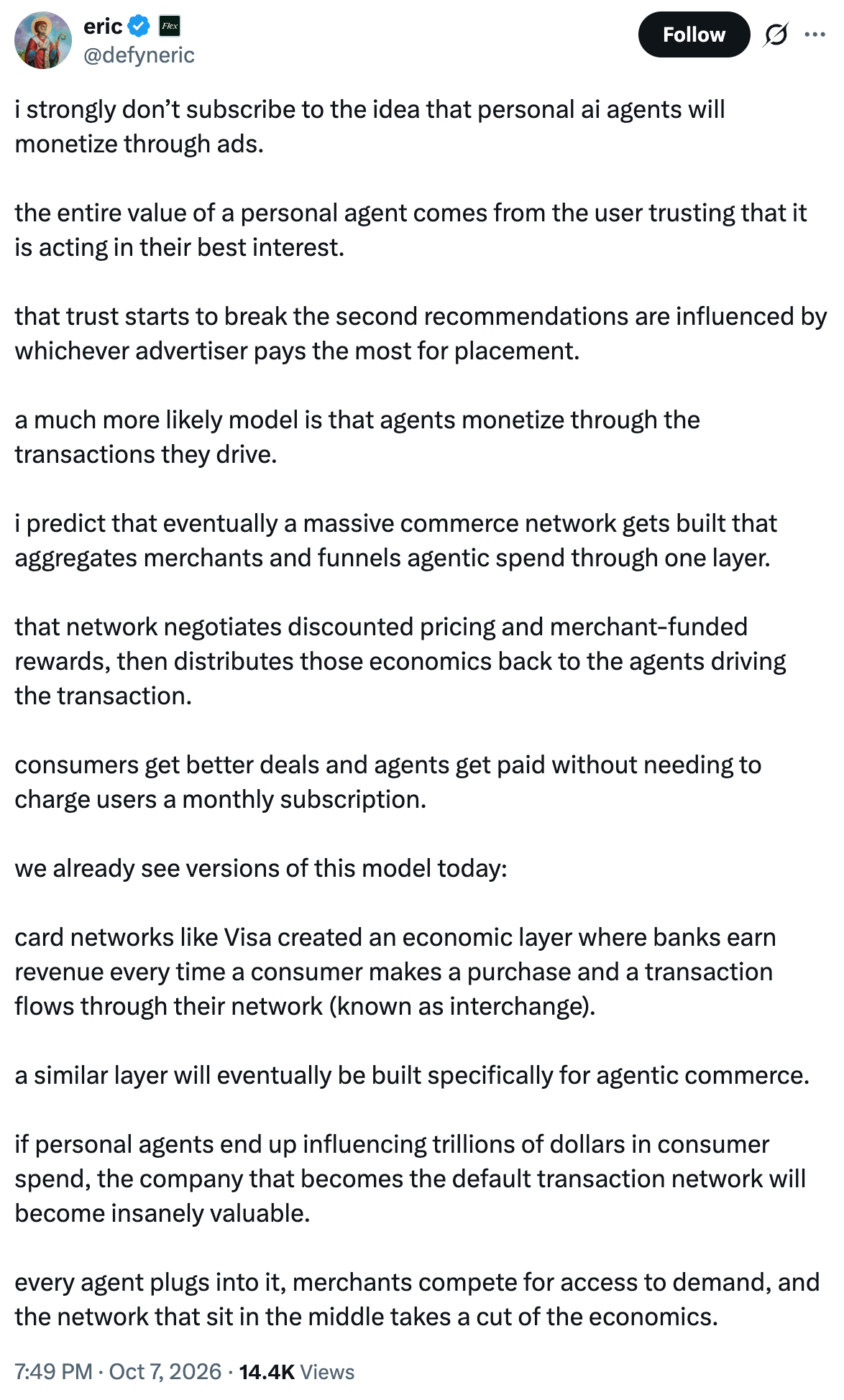
The second direction is advertising aimed at machines. This sounds absurd, but it’s already happening. Time has started selling ad placements inside markdown files formatted specifically for bots to read. More broadly, there’s an entire industry emerging around making products more visible and attractive to AI systems – the successor to search engine optimization. If agents read structured data instead of looking at banners, brands will pay to make that data as compelling as possible. Whether that counts as advertising or as a new form of SEO is a matter of definition. Either way, it’s a smaller and less profitable business than selling human attention.
The third direction, and in my view the most important, is a shift from selling attention to charging tolls. Cloudflare is building exactly that: infrastructure that lets websites charge bots for access, which Prince argues could make the internet free for humans again. In commerce, the equivalent is a commission on every transaction an agent completes, closer to an affiliate model or a marketplace take rate than to an ad auction. That’s a perfectly good business model. Visa and Mastercard have made a fortune from it. But it’s priced and regulated very differently from advertising, and it usually doesn’t earn the extraordinary margins of a dominant ad platform.
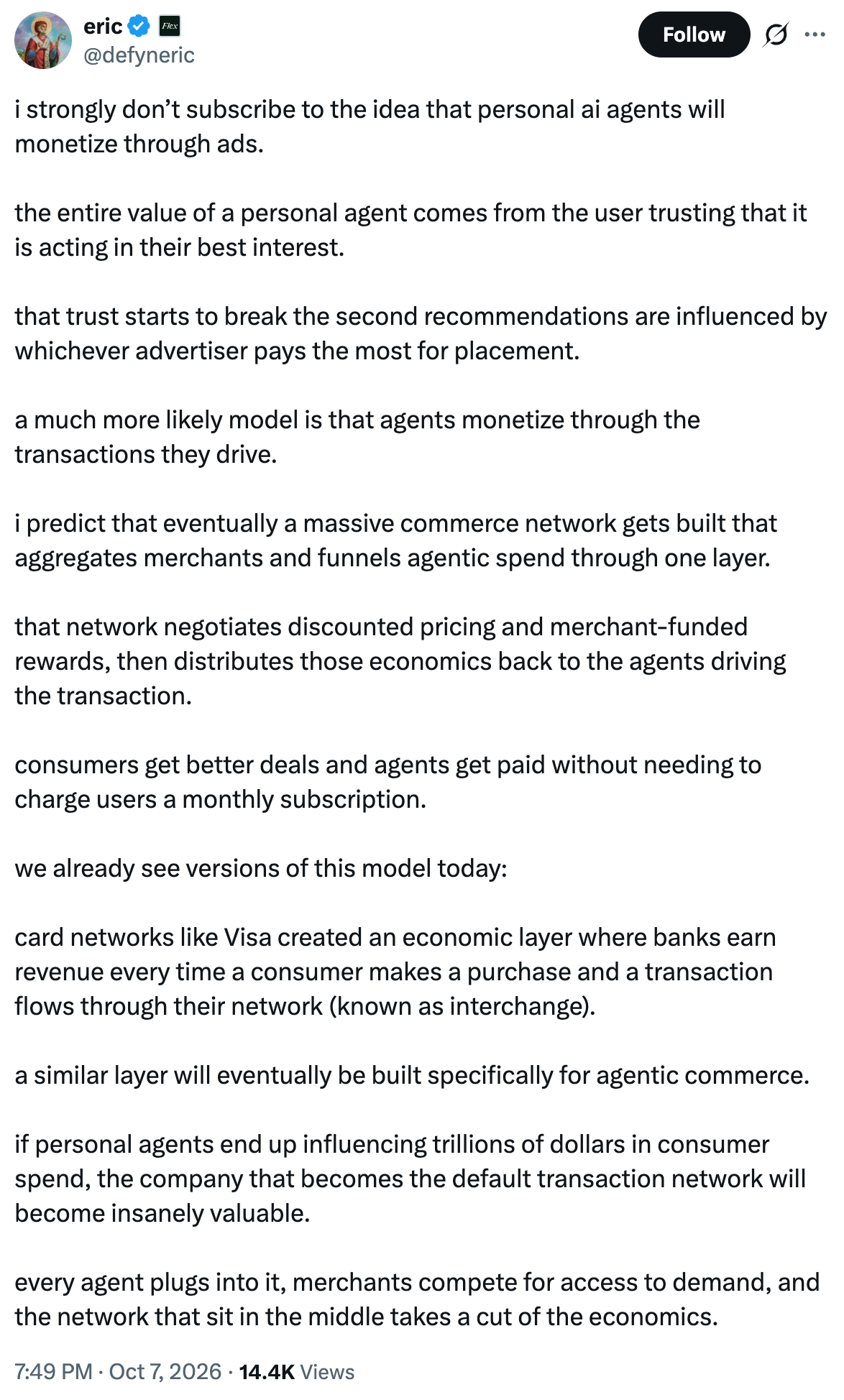
Let me challenge Prince on one point, though. Bots may not respond to brands, but the people instructing them still do. “Book me a Marriott” and “buy me On running shoes” (noticed how I didn’t go for Nike? 😉) are commands that have already been shaped by brand advertising. In an agentic world, brand building doesn’t disappear. It moves upstream, into the instruction itself. The work of creating desire, making someone want a specific product or trust a specific company, becomes more valuable, because it determines what the agent is told to look for.
By contrast, the business of capturing intent at the last second – the sponsored listing, the bottom-of-funnel search ad, the comparison-site placement – becomes less valuable, because the agent handles that step on its own.
That distinction leads directly to Meta.
Meta’s Awkward Double Role
Meta is in a unique position. It owns the agent that triggered this whole debate, and it is also one of the two largest advertising businesses in the world. Those two roles pull in opposite directions.
For now, Meta has chosen a clean separation. Muse shows no ads – after all, this has always been Meta’s success formula (roll out a product, build an audience over the long run, eventually turn on ads), and Meta has promised to keep Muse conversations separate from its ad systems.
Muse is monetized through subscriptions at $20 and $100 a month and through small transaction fees from merchants when Muse makes a purchase. That’s sensible for building trust. But I struggle to see how it holds up financially. Meta’s trailing twelve-month revenue is around $228 billion, so Muse would need well over ten million paying subscribers just to add one percent.
Meanwhile, Meta plans to spend up to $145 billion on capex this year, almost all of it funded by advertising. At some point, shareholders will ask why one of the most commercially valuable data streams Meta has ever had – what people want to buy, book and negotiate – is kept away from the ad machine that pays for everything.
I’d be surprised if that separation lasted for the life of the product. And as soon as it weakens, Muse runs straight into the trust problem I described above.
There’s a second tension that I find even more interesting. Many of Meta’s advertisers are precisely the companies Muse could disintermediate. Online travel agencies, e-commerce brands, insurers, and fintechs spend billions on Facebook and Instagram to acquire customers. If Muse becomes the place where those customers make their decisions, and it optimizes ruthlessly for the user, those advertisers could get less value from their Meta ad spend.
In the worst case, Meta’s agent would be cannibalizing the business of Meta’s own clients.
Yet I think Meta is better placed in this shift than its own critics suggest, for the reason I outlined above. Most of Meta’s ad revenue doesn’t come from capturing intent. It comes from creating it. You’re scrolling through Instagram and see a jacket, a hotel, or a gadget you didn’t know you wanted. That’s demand generation, and agents can’t replace it, because an agent only acts once someone has already decided they want something. In a world where agents handle the “get,” whoever owns the “want” becomes more valuable.
On that view, Instagram creates the desire and Muse fulfills it, and Meta gets paid at both ends.
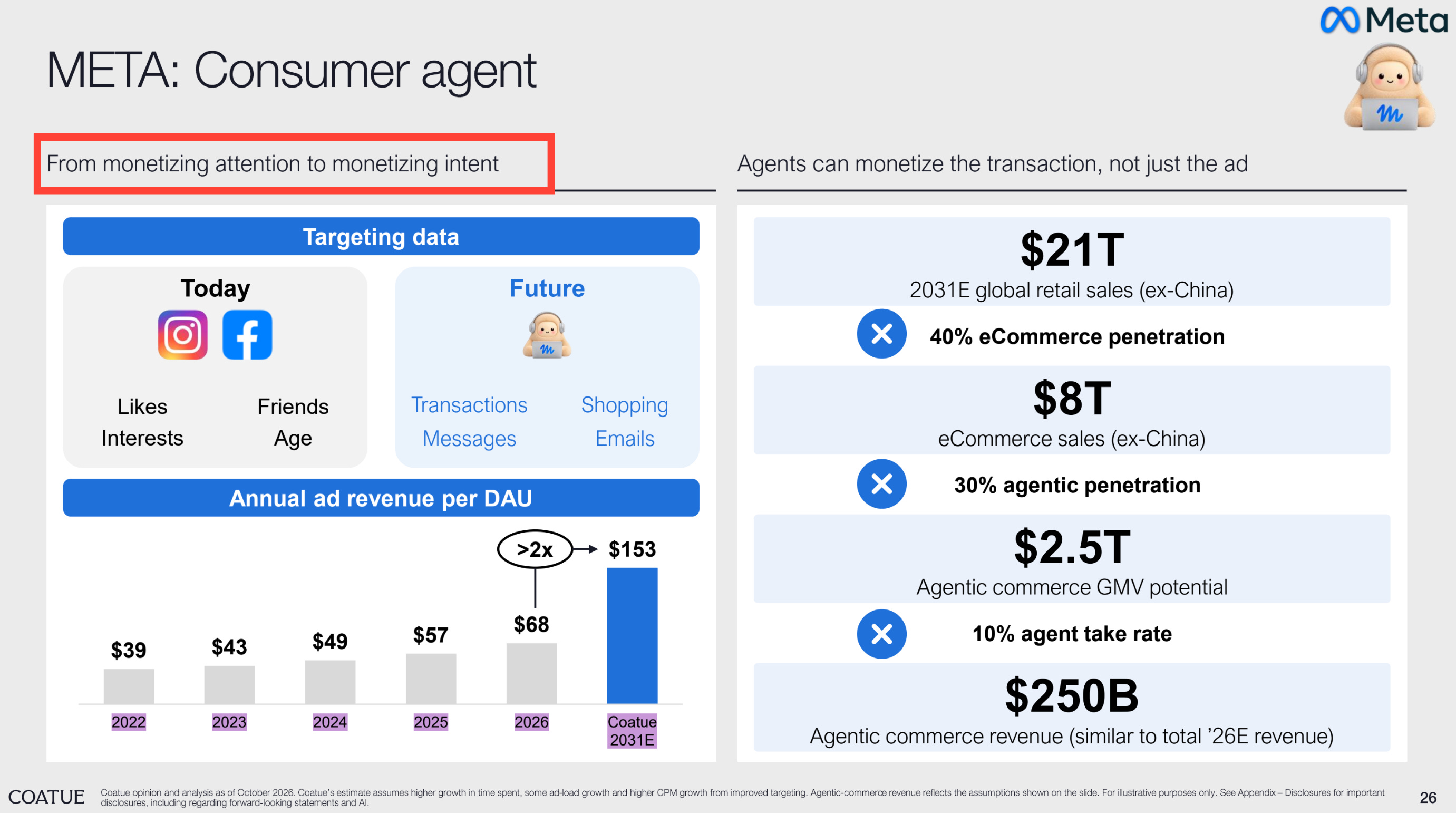
That’s the bullish case for Meta, and I think it’s more compelling than the market’s initial reaction to Muse suggested. The bear case is that this only works if Meta can resist the temptation to turn Muse into an ad product, which, given its history and its capex bill, isn’t something I’d take for granted.
So who loses in the advertising world?
I’d look first at businesses that live on capturing intent at the last moment: comparison sites, affiliate publishers, and any business that depends on paid search to acquire customers.
The second group is ad-funded publishers whose pages are now read more often by bots than by humans.
And the third is retail media networks, whose profits depend on owning the shelf where customers browse.
Who wins? The owners of the agents, the companies that build desire through brand and community, and the infrastructure providers in between. Cloudflare is an obvious example of the latter, since it’s positioning itself to collect a toll on the very bot traffic that threatens everyone else.
At the same time, if agents become commoditized, and I think they will, why wouldn’t a personal agent hurt Meta’s ad business too? Much of what Meta sells is discovery, and not all discovery is impulsive. A lot of it is what I’d call considered discovery. You know you need a winter jacket, a stroller, or a hotel in Copenhagen, but you haven’t decided which one. Instagram’s ads do much of their work in exactly that window, retargeting people who are already in the market. An agent asked to “find me a good winter jacket under $200” substitutes for that kind of browsing.
Only pure impulse discovery stays safely in the feed: the jacket you didn’t know you wanted until it appeared on your screen.
There’s a second, more technical risk. Meta’s ad machine learns from conversion signals, the pixel and server events that tell it which ad led to which purchase. If a growing share of checkouts is completed by agents, many of them not owned by Meta, those signals get noisier, and the targeting that makes Meta’s ads so effective gets worse.
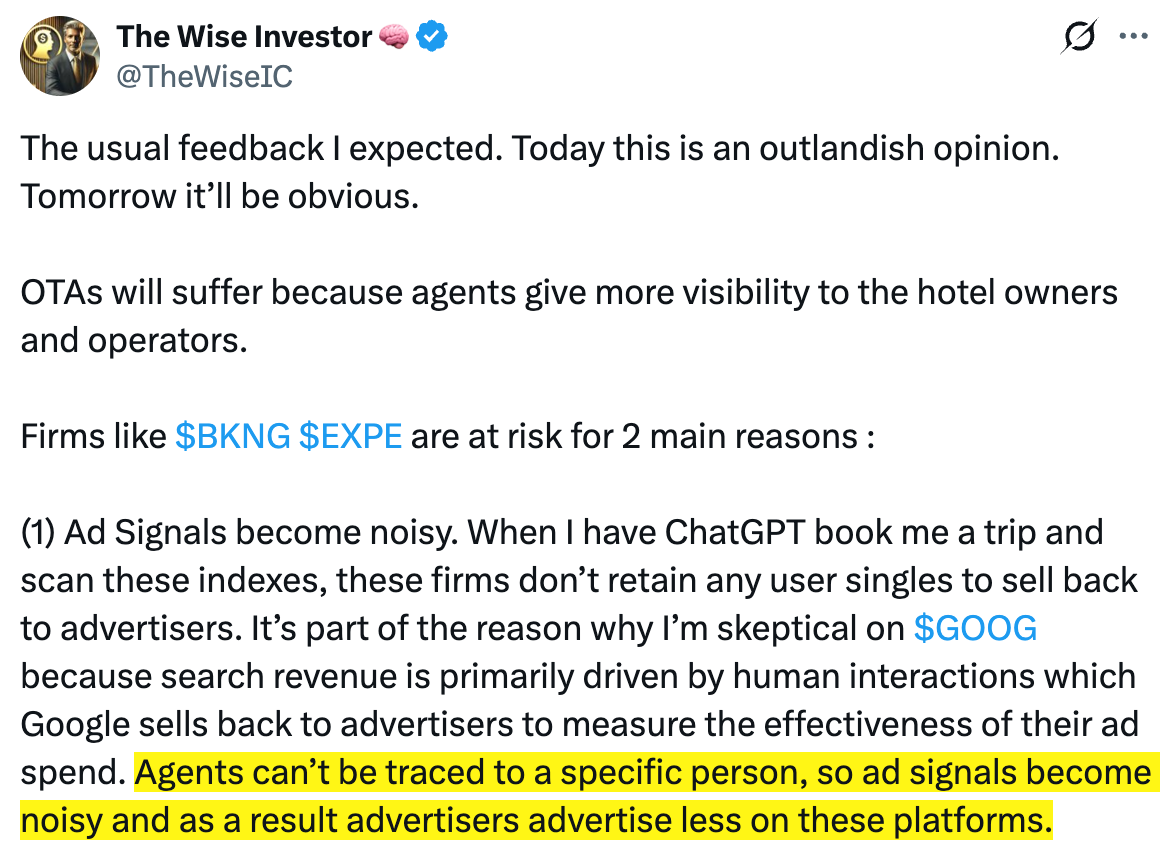
The Amazon block discussed further above exposes a third weakness. Unlike Amazon or Google, Meta owns no commerce inventory, so Muse depends on the cooperation of the very merchants and marketplaces whose margins it threatens. If agents do become commoditized, Meta’s edge has to come from distribution and from owning the “want.”
Payments – Who Holds the Knobs When the Buyer Is a Machine?
Travel and e-commerce get most of the attention, but the most interesting fight in agentic commerce may be the one most consumers never see - and many aren’t aware of at all.
When an agent pays, someone has to answer some awkward questions. Who is this agent? Did the human actually authorize this purchase? And who pays when something goes wrong?
Whoever answers those questions holds the knobs of the whole system, becomes the Visa/Mastercard of the agentic digital economy, and that’s where some of the most valuable positions of the next decade could be built.

Let me start with an observation from someone in my community who recently attended a conference on agentic payments. In the early years, agents will need to trust merchants. They’ll mostly stick to well-known websites like Booking.com, and only gradually whitelist more. We discussed these dynamics already. Otherwise, the risk of buying something from a fraudulent website is simply too high, especially since under EU rules the user is typically liable for the loss in that scenario.
That point supports what I said earlier about trust favoring incumbents. An agent that has to protect its owner’s money will default to the merchants least likely to defraud them.
Another member of the community challenged that view, and I think he raised an equally important point. Trust doesn’t necessarily have to emerge on the merchant side. It might live on the agent side instead.
Ant International’s Agentic Mobile Protocol, launched in April and now being rolled out globally, is a good example. Ten digital wallets, including Alipay, GCash, KakaoPay and Toss, are integrating it, along with acquirers such as Adyen, Checkout.com, Fiserv and Worldline.
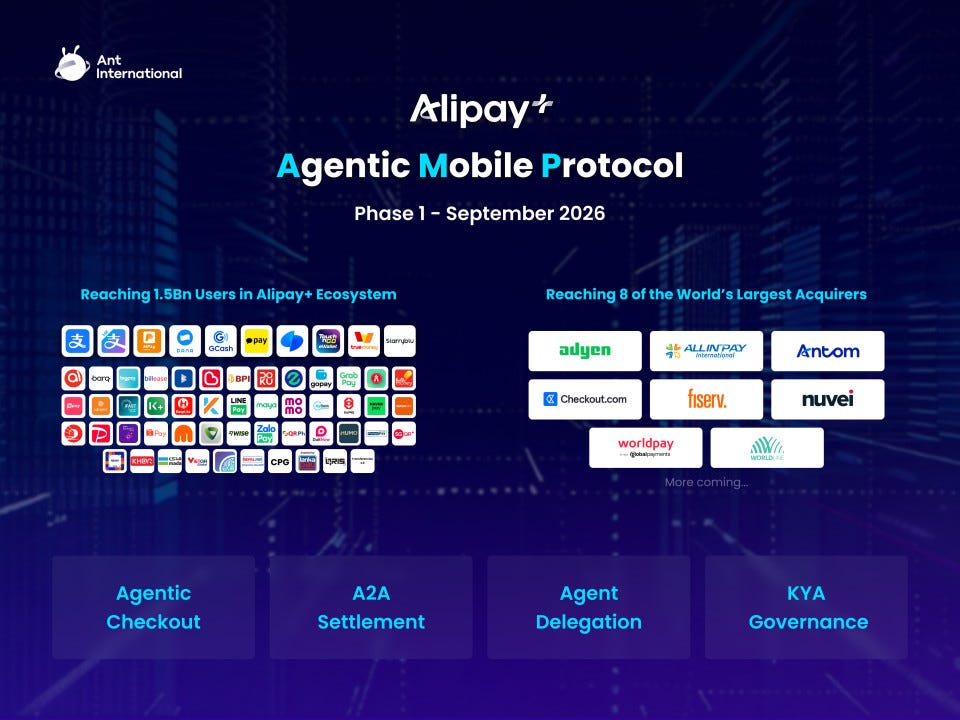
Its centerpiece is a Know Your Agent framework, KYA for short. It gives agents a digital identity and an Agent Trust Rating that certifies what they’re authorized to do, plus a guarantee for merchants against agent-specific fraud. Visa and Mastercard are working with Ant on making KYA interoperable across networks. Visa has its own Trusted Agent Protocol, and Mastercard issues so-called Agentic Tokens that cryptographically bind an agent to a specific user and limit what it’s allowed to buy.
If that pattern prevails, the moat may shift to the agent layer. You use Muse as your agent, Muse is verified everywhere through KYA, and suddenly it doesn’t matter much whether the merchant is a household name.
In that world, Meta holds the knobs. The agent becomes the trusted party, and every merchant and payment provider has to accommodate it.
That’s a scenario I’d take seriously, because it gives agent owners enormous bargaining power over everyone downstream.
I’d add one nuance here, though. From a consumer’s point of view, you’d simply expect your agent to do its due diligence on merchants – that’s part of what you’re paying it for. KYA is a different animal. It’s a tool for card issuers and acquirers, the banks and processors that need to manage fraud risk on the transactions flowing through their systems. So there are really two layers of trust.
One is between the user and the agent.
And the other is between the agent and the financial system.
The agent owner controls the first. The networks and processors still control the second, at least for now.
Why I’d still bet on the networks (with an asterik)
The person who raised the KYA point ended with a candid remark that I’ve been thinking about when drafting this segment. He doesn’t know how many agent services will appear and connect to these protocols, and the only moat he’s comfortable underwriting is Visa and Mastercard’s – while admitting that, as a Mastercard shareholder, he’s biased.
I think his instinct is largely right, and the reason is a little counterintuitive.
When an agent buys the wrong thing, buys too much, or buys from a merchant that never delivers, someone has to absorb the loss.
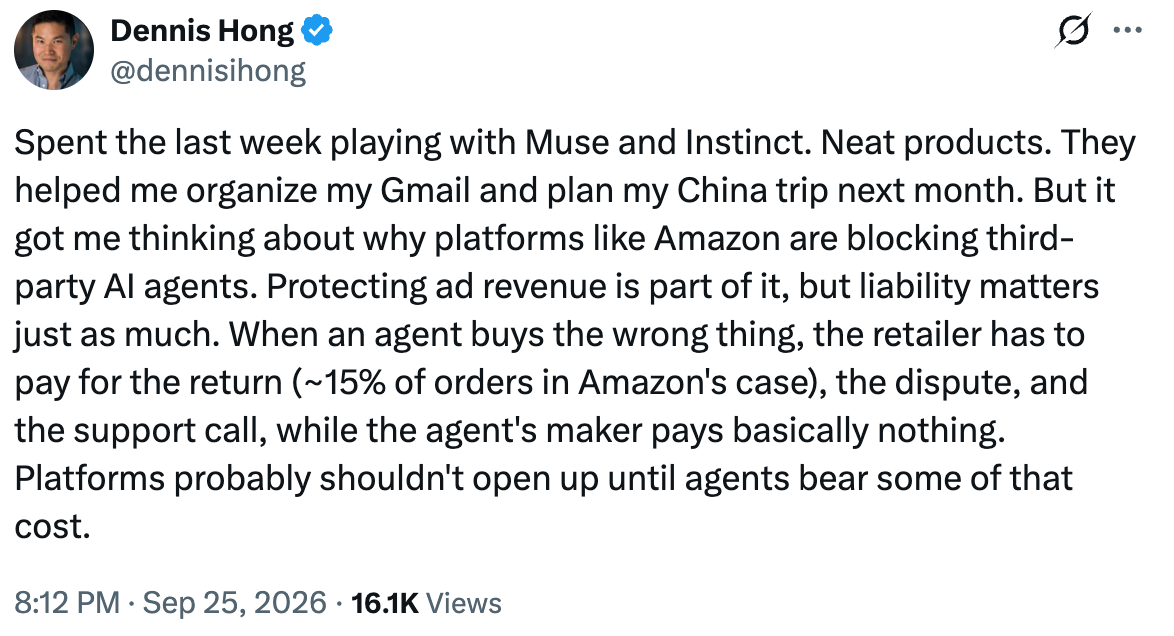
Card networks have spent more than half a century building exactly the machinery for that: chargebacks, dispute resolution, liability shifts, and consumer protection rules that every bank and merchant on earth already understands.
Account-to-account payments and most wallets have nothing comparable. In a world where software makes purchases on our behalf, the ability to reverse a mistake becomes more valuable, not less. That’s why it’s no coincidence that Visa and Mastercard have positioned themselves as the identity and tokenization layer for agents. They’re partnering with OpenAI, Google, Stripe, PayPal and Cloudflare, and both report that their value-added services – the fraud tools, tokens and data products around the core network – are growing considerably faster than their transaction businesses.
Now for the asterisk I’d add. The volumes are still tiny. Visa said it had completed hundreds of agent-driven transactions by December 2025 – hundreds, on a network that handles hundreds of millions a day. Adyen has launched Adyen Agentic so enterprise merchants can accept payments across agent protocols. But as I mentioned in the e-commerce section, it has been candid for several quarters that there just isn’t much volume yet. That means everything I’m saying is still a hypothesis.
“Second, we introduced Adyen Agentic to solve a critical problem for our merchants, how to sell safely and efficiently in the emerging AI agent economy. Without the universal standards, merchants would need to build and maintain dozens of separate integrations just to keep their inventory, pricing and payments in sync. This creates massive operational cost and risk. Our product suite solves this. It acts as the universal translator that allows merchants to connect once to our platform and securely accept payments across all major agentic protocols, all while using the same unified fraud detection and compliance rails they trust today.“ - Adyen August Call
The second part of the asterisk is more structural. Agents are natively digital, and they may well prefer natively digital money. Adyen has joined the x402 Foundation, which is building an open protocol that lets agents and online services send and receive payments directly over the internet. It also backs Open USD, a stablecoin infrastructure standard that has drawn more than 140 companies. Mastercard bought BVNK to build out its stablecoin capabilities for B2B settlement. Consider the small machine-to-machine payments that Cloudflare’s pay-per-crawl model implies. A bot paying a fraction of a cent to read a page is a terrible fit for card interchange and a natural fit for stablecoins. For consumer purchases with a human behind them, I’d bet on cards for a long time. But for payments between machines, the networks have no birthright, and the fact that they’re hedging so actively tells you they know it.
Could agents be Wise’s best salespeople?
This brings me to a company I own, so take what follows with the appropriate grain of salt.
Disclaimer:. The analysis presented in this blog may be flawed and/or critical information may have been overlooked. The content provided should be considered an educational resource and should not be construed as individualized investment advice, nor as a recommendation to buy or sell specific securities. I may own some of the securities discussed. The stocks, funds, and assets discussed are examples only and may not be appropriate for your individual circumstances. It is the responsibility of the reader to do their own due diligence before investing in any index fund, ETF, asset, or stock mentioned or before making any sell decisions. Also double-check if the comments made are accurate. You should always consult with a financial advisor before purchasing a specific stock and making decisions regarding your portfolio.
A few weeks ago I tweeted a question I keep turning over in my mind. Could agentic AI be positive for Wise, because an agent naturally picks the cheapest cross-border payment rail and doesn’t care about lobbying, old habits, or brand awareness?
If so, that could massively accelerate adoption at some point – assuming, of course, that Wise remains cheaper than stablecoins, including on- and off-ramp costs.
The bullish logic is simple and, I think, compelling. Banks still earn a fortune on cross-border payments, largely because their fees are hidden in the exchange rate and most customers never check. That business model depends on inertia and opacity. An agent has neither. It reads the total cost of a transfer, compares it with the alternatives, and picks the cheapest one, without being impressed by a bank’s century-old brand or its relationship manager.
Wise is built for exactly that kind of comparison. Its pricing is cost-plus, and its average take rate on cross-border volume fell to about 51 basis points, roughly 20% lower than a year earlier.
Wise Can’t Catch a Break! ... And Remains the Most Misunderstood Company in the Market

You can read this article entirely for free. If you find value in this research, consider becoming a Premium Member for less than €1/day to support my work and unlock our full archive and join our growing circle of investors (I highly recommend checking out “The Library” to see what’s inside; you can find it right on the homepage).
Wise does that deliberately, because each price cut makes it more attractive to customers and partners. Recall Eisman’s distinction from the travel section. Booking’s moat is partly a habit moat, and agents dissolve habits. Wise’s moat is a cost moat, built on scale, direct connections to domestic payment systems, and licenses in dozens of countries.
Agents don’t dissolve cost-/scale-based moats. They reward them. They reward companies with the best value proposition.
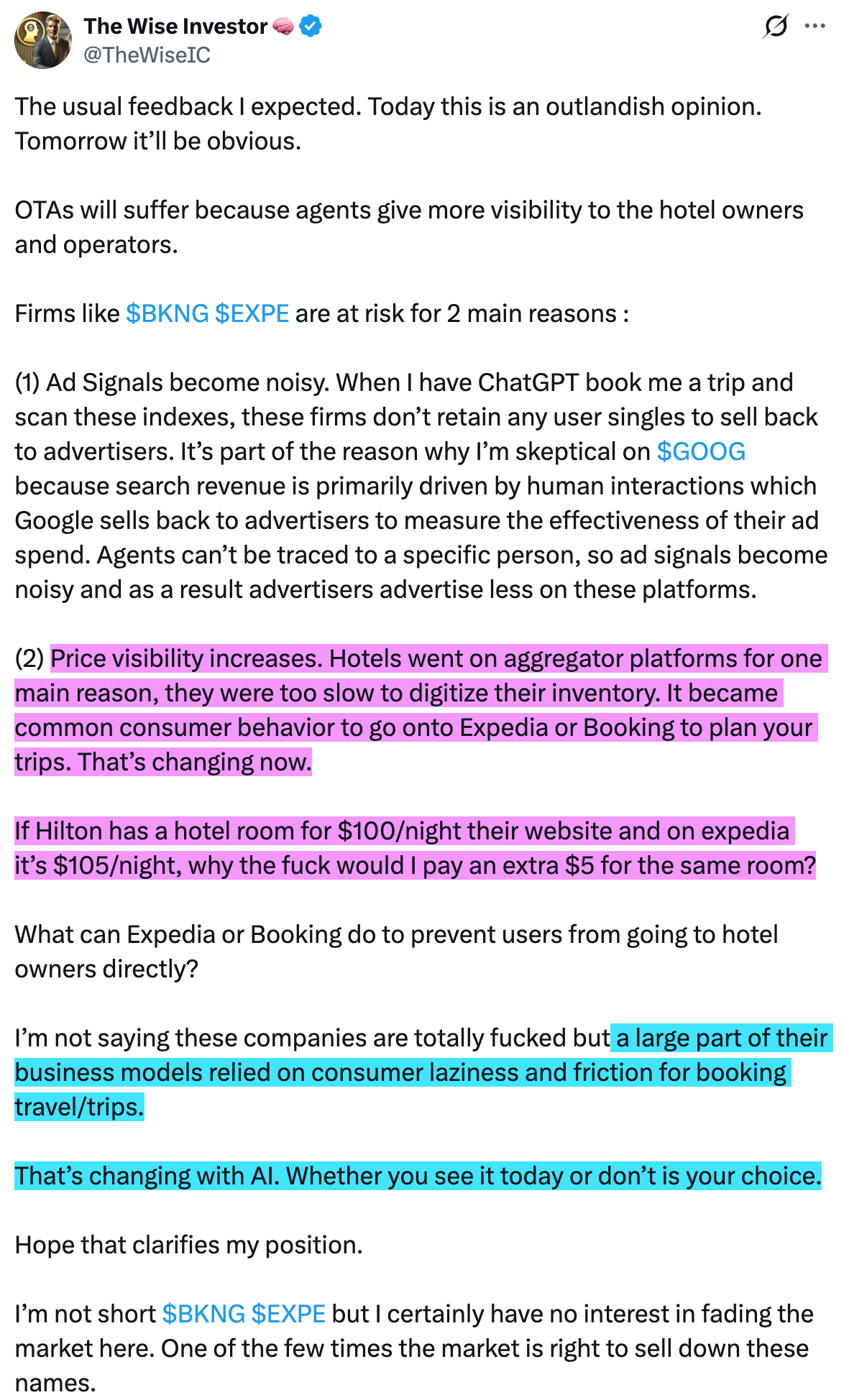
There’s also a structural reason I find this more plausible for Wise than for most companies. Wise doesn’t necessarily need to be chosen by name. Through Wise Platform, its fastest-growing product, it already sits underneath Nubank, Monzo, Ramp, Brex, Standard Chartered and Morgan Stanley. If an agent picks the cheapest route through one of those providers, it may well end up on Wise’s rails without the agent or its owner ever knowing. That’s the kind of infrastructure exposure I like: the volume grows regardless of which agent wins.
Now let me stress-test my own idea. The first problem is that, in most consumer purchases, the agent doesn’t choose the rail at all. When Muse books a hotel in NYC with my card, the currency conversion is handled by my card issuer or, worse, by dynamic currency conversion at the merchant. The agent only gets to pick Wise if it has access to a Wise card or account and is allowed to choose which funding source to use. And that decision is made by whoever controls the agent’s wallet. That brings us back to the knobs. If Meta, Google, or Apple control which payment method their agents default to, Wise has to win them over as partners, and that’s a somewhat different sales process from being picked purely on price, even though it gives Wise an edge in negotiations.
“We are excited to announce that Wise will be joining Google’s new remittance experience as one of the key providers. Consumers in the U.S. will soon be able to access Wise's services, powered by Wise Platform, Wise's global infrastructure for banks and enterprises, on Google Wallet online or by searching for select currency exchange rates on Google Search. This feature will be rolled out as a test to Google users in the U.S.“ - 2025 announcement by Wise
The second problem is stablecoins, which are the most natural competitor in an agent-driven world. An agent paying another agent may simply default to on-chain dollars, and for the transfer leg alone, it’s hard to beat a stablecoin on speed and cost. Wise’s argument is that the transfer leg is the easy part. The customer ultimately needs local currency in a local bank account, which means paying the cost of converting into and out of the stablecoin, plus the FX spread, plus compliance. Management says that, measured end to end, its network still offers a better price and speed in many cases.
Deep Dive: Revisiting Wise ($WISE)

A few days ago, a subscriber reached out and asked whether I’d ever written a full deep dive on Wise. I told him, truthfully, that I hadn’t – and probably wouldn’t. Not because Wise isn’t fascinating (it is), but because there are already lots of excellent pieces out there that cover the key pillars of the business and investment thesis in great depth. And two in particular:
Remitly’s new CEO, too, has described stablecoins as a targeted solution rather than a universal one.
It’s also worth noting that cost-plus pricing makes Wise relatively indifferent to which rails it uses underneath. If stablecoin legs become cheaper in certain corridors, nothing stops Wise from routing through them and passing on the savings. Whether it would execute that pivot fast enough is a fair question.
The third problem: Agents remove habit, and that includes the habits that currently benefit Wise. Today many customers stick with Wise out of satisfaction and familiarity, even when a competitor is marginally cheaper on a given corridor.
An agent offers no such loyalty. If a stablecoin-based provider undercuts Wise by ten basis points on the GBP-to-USD corridor, the agent switches instantly.

Wise’s advantage would have to be maintained on price every single day, in every corridor. Wise’s whole strategy is built on that bet, but it would raise the stakes.
The fourth problem, and the one the whole thesis rests on, is timing. All of this assumes that agentic shopping takes off, and I’ve already argued that it could take the better part of a decade. But here’s where I think the Wise case is actually stronger than it looks, because cross-border payments are much more than consumer shopping. Wise is increasingly focused on businesses, which naturally transact across borders - especially in a globalized world. They pay foreign suppliers, run international payroll, and collect from overseas customers.
Finance departments are adopting agents faster than consumers. They’re cost-driven, they’re used to automation, and they don’t care about the thrill of shopping.
An agent in accounts payable that pays a thousand invoices a month in twenty currencies has every reason to compare the total cost, including the cost of converting in and out of a stablecoin. It will also never pay a bank’s hidden FX markup out of habit. If my tweet suspicion out to be right, I suspect it will be thanks to B2B agents long before shopping agents.
So my verdict on payments is mixed. Agents should reward whoever owns trust and lowest-cost infrastructure. Today that favors Visa and Mastercard, with their liability machinery, and cost leaders like Wise, with a cost advantage agents can actually see. The long-term risks are the same for both. The first is that the agent owners decide to route payments through their own wallets. The second is that machine-to-machine commerce settles on stablecoins, where neither card networks nor today’s money-transfer leaders have an inherent advantage. If I had to name one thing to watch going forward if you own payment stocks it would be which payment method Muse and its rivals choose as their default (or if they default to any provider at all). That decision may say more about who wins the agentic economy than any app download chart.
Banking, Insurance and Subscriptions: What Happens When Inertia Stops Paying?
Earlier I argued that agents will win first where the purchase is a chore, and that this flips the obvious ranking of who is most exposed. This section is where that argument gets tested. Banks, insurers and subscription businesses share an uncomfortable secret: a meaningful part of their profits comes from customers who never get around to leaving. Economists call it consumer inertia.

Most people don’t shop around for a better savings rate, cheaper car insurance, or a forgotten streaming subscription, because comparing is tedious and the savings feel small in the moment.
Across millions of customers and many years, those small amounts add up to very large profit pools.
The market seems to understand this. On September 22, two weeks after Muse launched, JPMorgan and Wells Fargo each fell more than 2.5%, Allstate and Charles Schwab dropped more than 5%, and the S&P 500 financials index slid 2.4% to its lowest level since July. Wolfe Research estimates that AI agents could capture somewhere between $30 billion and $50 billion in transaction value across travel and finance. And unlike travel, these are businesses where Instinct, at least, already advertises exactly the tasks that hurt: shopping for insurance and negotiating bills.

Banks
Let’s start with banks, because the profit pool there is the largest. A big US bank pays next to nothing on most checking accounts while investing those deposits at market rates. The gap between the two is the core of its earnings. That spread survives because moving your money is a hassle and most people don’t bother. Now imagine an agent with access to your accounts that checks every month whether your idle cash could earn more elsewhere and moves it automatically. For the customer, it’s free money. For a bank whose model rests on cheap, sticky deposits, it’s a slow leak in the foundation. I suspect that’s why Schwab fell harder than the big banks that day. A good part of its earnings depends on client cash sitting in low-yielding sweep accounts, exactly the kind of balance an optimizing agent would move first.
There’s a darker version of this that I don’t see discussed enough. Silicon Valley Bank showed in 2023 how quickly deposits can leave when a bank run spreads through group chats and is executed through mobile apps. Agents that move money automatically, in response to the same signals, could make deposits even faster to leave.
If that sounds like a regulator’s nightmare, it is. And regulators are one reason I’d be careful with the bear case on banks. Deposits are sticky for more than just inertia. They’re tied to direct deposit of your paycheck, automated bill payments, your mortgage, the trust that comes with deposit insurance, and the simple fact that changing banks breaks a dozen things at once.
Banks also control the doors. Just as Amazon won an injunction to keep Perplexity’s agent out, banks can make it very hard for third-party agents to log in and move money, and they’ll argue, with some justification, that they’re protecting customers from fraud.
Whether open banking rules eventually force those doors open will decide how much of this threat materializes. My guess is that banks lose some of the deposit spread at the margin over the next decade, especially with younger and wealthier customers. Fintechs and banks that already pay competitive rates gain share. A collapse of the deposit franchise seems unlikely.
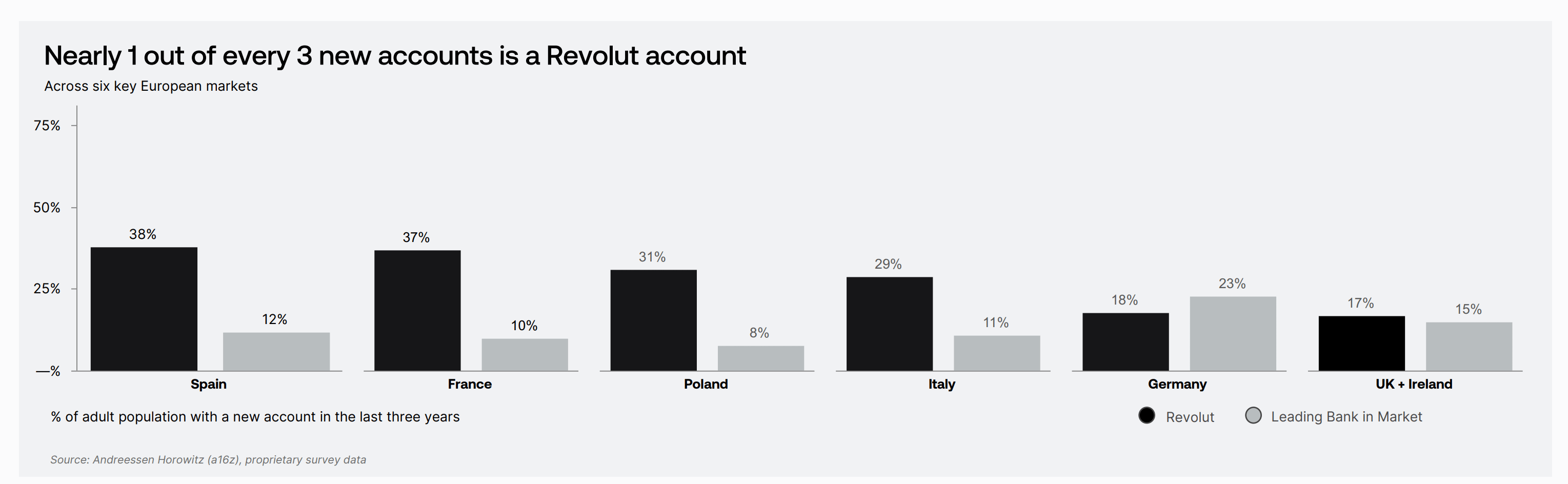
Insurance Businesses
Insurance is where I think the bear case is actually stronger, and it’s a little surprising that it gets less attention than travel. Personal auto and home insurance are renewed every year, and for many policyholders the renewal premium creeps up a little more than it should. The industry has a name for this: price walking.
It’s profitable precisely because so few people shop around at renewal. The practice became so widespread in the UK that the Financial Conduct Authority banned it outright in 2022.
An agent is essentially that ban, applied privately and in every market at once.
Renewing car insurance is the archetypal chore. Nobody enjoys it, nobody values the process, and the product looks like a commodity on the surface. Every one of my filters points the same way here.
We’ve already had a preview. When OpenAI allowed customer-facing insurance apps inside ChatGPT in February, insurance broker stocks fell 9% on average, and Willis Towers Watson dropped 13%. Goldman Sachs called the selloff overdone, noting that the apps mostly targeted personal lines. JPMorgan countered that, over time, agents in platforms like ChatGPT could completely displace human brokers in personal lines.
I think both are right. The threat is concentrated in personal lines, which is exactly where brokers and insurers that rely on retention pricing are most exposed. Commercial insurance, where policies are complex and relationships matter, is far better protected.
Bull would argue that insurance only looks like a commodity until you file a claim. A policy that’s 15% cheaper but handles claims poorly, or quietly excludes something important, is not a good deal, and a price-optimizing agent may not know the difference. In most jurisdictions, selling insurance also requires a license, which means agents will have to route through licensed intermediaries such as Insurify rather than act as brokers themselves. That slows things down and creates a new layer of winners. My read: the losers are insurers whose profitability depends on loyal customers paying too much. The winners are low-cost, data-rich underwriters, who can offer the best price to every customer and still earn a return. Agents don’t eliminate the need for good underwriting. They just stop subsidizing bad pricing.
Subscription-Based Models
Subscription media is the third piece of the inertia puzzle, and the most entertaining one.
Almost everyone has a subscription they forgot about. I remember getting angry with my wife because she had a 200€ subscription with some kind of sports-based app that she totally forgot about for two years.
The industry has historically known this very well, which is why canceling is often harder than signing up (my worst experience ever was with the WSJ where I had to literally call someone in the States).
An agent that reviews your bank statement, spots the three streaming services you haven’t opened since spring, and cancels them (and it might even do the WSJ call for me …) is the stuff of nightmares for subscription businesses that live on passive renewals.
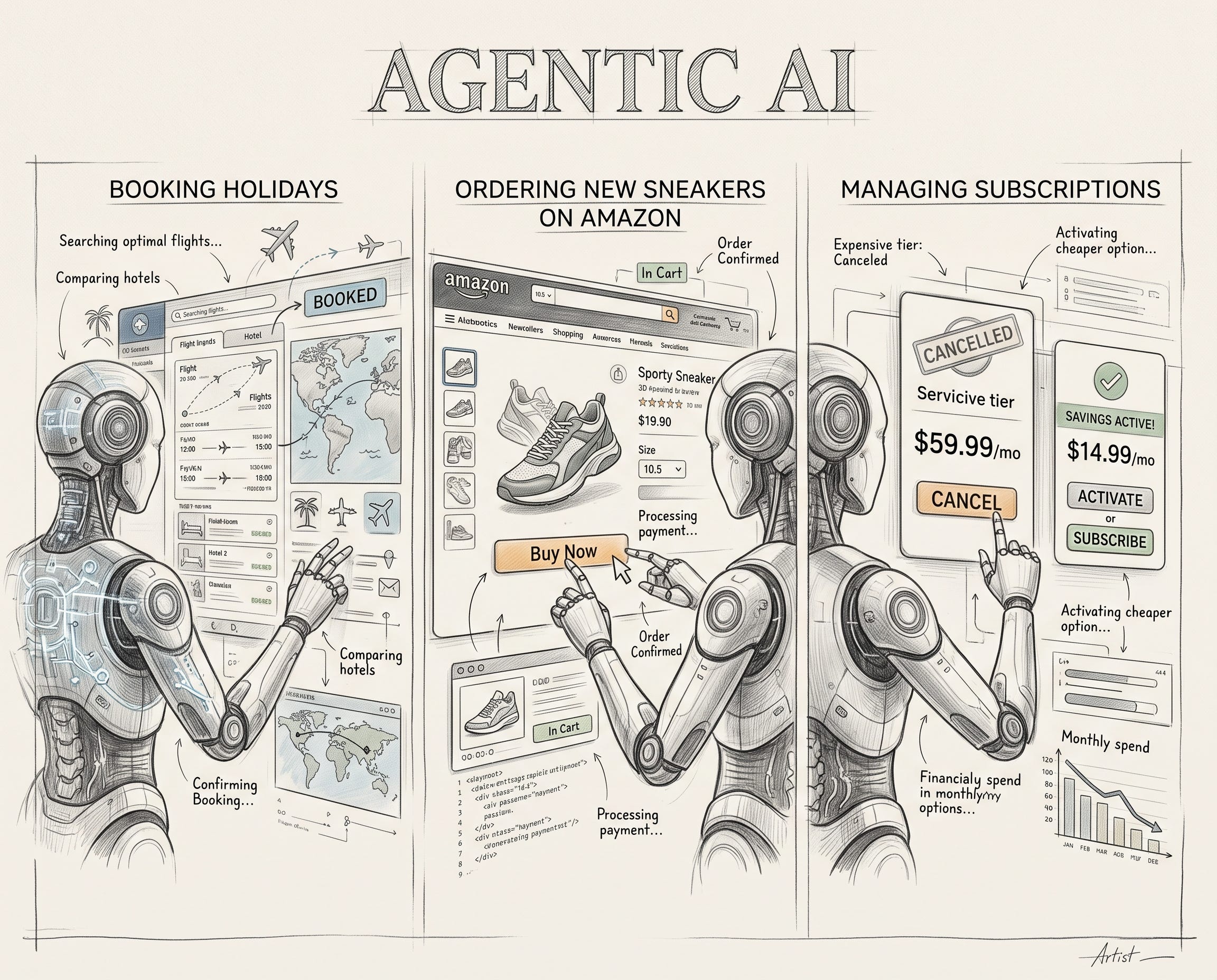
You can easily imagine agents taking this further. They could rotate subscriptions every month or at every new subscription interval – like some hobbyist savers already do –, so for streaming, for instance, you keep only the service with the show you’re actually watching, and resubscribe when a new season drops.
Churn and return is already common among savvy consumers. Agents would make it the default behavior of the lazy majority.
So far, reality is less dramatic than the theory. Many chatbots today can only identify which ones to drop and walk the user through the steps. But they cannot finish the cancellations on their own, because the streaming services requires secure logins and the user has to confirm each one personally. That authentication wall is the subscription industry’s first line of defense, and I’d expect it to get higher before it gets lower. But then again, it seems only a matter of time until agents are capable of this too (they might very well be already).
As for regulation, the US is unlikely to force the issue soon. The FTC’s click-to-cancel rule was struck down in court in 2025, and while the agency restarted the rulemaking process in March 2026, a new rule is still likely years away.
The FTC’s "Click-to-Cancel" rule was a federal regulation designed to make ending recurring subscriptions, memberships, and free trials as simple as signing up for them.
I’d also distinguish between types of subscription businesses. A service people use every day and actively value, such as Netflix for many households or Spotify, with its years of personal playlists and listening history, has little to fear from an agent that cancels unused subscriptions.
As discussed with regard to other sectors, companies providing a lot of value are likely going to be safe from agents, whereas those benefitting from inertia while adding little value or exploiting customer stickiness get more exposed.
If anything, cancellations of weaker services free up budget for the ones people care about. The exposed ones are the long tail: the fourth and fifth streaming services, the apps people downloaded for one show, and the news and magazine subscriptions that renew mostly out of habit.
News publishers are hit from both sides. Bots read their articles without subscribing, as Prince pointed out, and agents may cancel the subscriptions of readers who never open them.
What ties these three industries together is that they’re the most exposed in theory and among the best defended in practice. They’re the most exposed because some of their profits depend on inertia, and agents are inertia killers. They’re often defended because they control authentication, they’re protected by regulation and licensing, and they can argue convincingly that keeping agents out protects consumers from fraud. That makes them a strange inversion of travel. Online travel agencies are exposed in the headlines but well protected by product economics. Banks, insurers and subscription businesses are protected by the doors they control, but structurally exposed if those doors open.
If I had to pick the single most vulnerable profit pool in this entire post, I’d choose the renewal premium of personal lines insurance over Booking’s commission. The market reacted the other way around in September.
What Did We Miss?
If you’ve made it this far, let me ask you a question to wrap up:
Did we miss anything?
I think we did. Of course, we did. And the TL;DR answer is we missed A LOT. And we won’t be able to cover every sector in this write-up, which already ended up rather long.

But here are some more thoughts regardless:
Some of what’s missing is more exposed than the sectors that dominated the September selloff. Here are the ones I’d add, starting with the one I’d worry about most.
The most obvious omission may be comparison and lead-generation sites. If an agent’s core skill is comparing offers, then the businesses whose entire product is comparing offers are directly in its path. We’ve already had a test run. On February 10, when Insurify began offering car insurance comparisons inside ChatGPT, shares of MoneySuperMarket fell 13% to their lowest level in 13 years. These businesses do the job an agent does natively, and they get paid per lead or per click, which is the toll agents are designed to avoid. To be fair, the library argument from the travel section by Drew Cohen applies here too. Comparison sites have spent years building integrations with insurers, energy suppliers and lenders so they can pull live quotes, and an agent may find it easier to use those integrations than to rebuild them. MoneySuperMarket has launched its own app inside ChatGPT, which is a sensible move. But being a supplier to the agent is a much weaker position for a comparison site than for Booking. Booking owns supply that agents can’t easily reach elsewhere. A comparison site owns an interface, and the agent is a better interface. Of all the categories in this post, this is where I find the bear case hardest to argue against.
Welcome to Compound with René. You can find an overview of the companies I shared a deep dive on in the visualization below.
If you haven’t subscribed, you can join 5,000 readers who enjoy the quality of the deep dives, the process-oriented pieces, the analytical insight, and the valuation discipline, here:
A second category is local services and delivery. On October 1, DoorDash launched an AI agent in beta that takes food orders by text in Apple Messages, remembers your preferences, finds deals and coordinates group orders. Co-founder Andy Fang described agents as a new app paradigm, and DoorDash is openly positioning the agent against Instinct and Muse.
A third category is the mirror image of the first, and I’d frame it as a principle: exclusive supply is the best defense. I mentioned Airbnb in the travel section. Its listings largely exist only on Airbnb, so there’s nothing for an agent to compare. The same logic applies to ticketing companies with exclusive venue contracts, marketplaces for unique or second-hand items, and any business whose inventory isn’t available anywhere else.
Deep Dive: CTS Eventim ($EVD.DE)

Imagine possessing a business that effectively acts as a digital checkpoint for every major live event across Central Europe.
An agent can tell you that a hotel room is €20 cheaper direct. It can’t tell you that a concert ticket is cheaper elsewhere if there is no elsewhere.
When I look at a potentially exposed business, the first question I now ask is how much of what it sells can be bought somewhere else. The higher that share, the more an agent can squeeze it. How differentiated is the product or service offering? How much proprietary data does the company possess?
A fourth category is enterprise software, and here I want to qualify Eisman’s distinction. He’s right that agents shopping for flights won’t rip out ServiceNow or a vertical software business owned by Constellation. But that’s only one kind of agent. Software sold per user, per seat, faces a different threat that’s beyond the scope of this post: agents that do the work humans used to do. If a company needs fewer people to process invoices, it needs fewer software licenses for them. That’s not agentic commerce, but it’s the same technology, and investors shouldn’t confuse “safe from shopping agents” with “safe from agents.”
Investing in Software When AI Agents Arrive – A Framework for Who Gets Disrupted

Software stocks are getting crushed. Not selectively. Not tactically. Almost indiscriminately!
Finally, there are the beneficiaries that rarely make the headlines. Every transaction an agent makes requires compute, identity, fraud prevention and a payment rail. Cloudflare is building a toll gate for bot traffic. Card networks and processors are positioning themselves as the identity layer for agents. The hyperscalers sell the compute that makes all of it possible, whichever agent wins. The CapEx requirements are truly mind-blowing (see Cortue chart below).
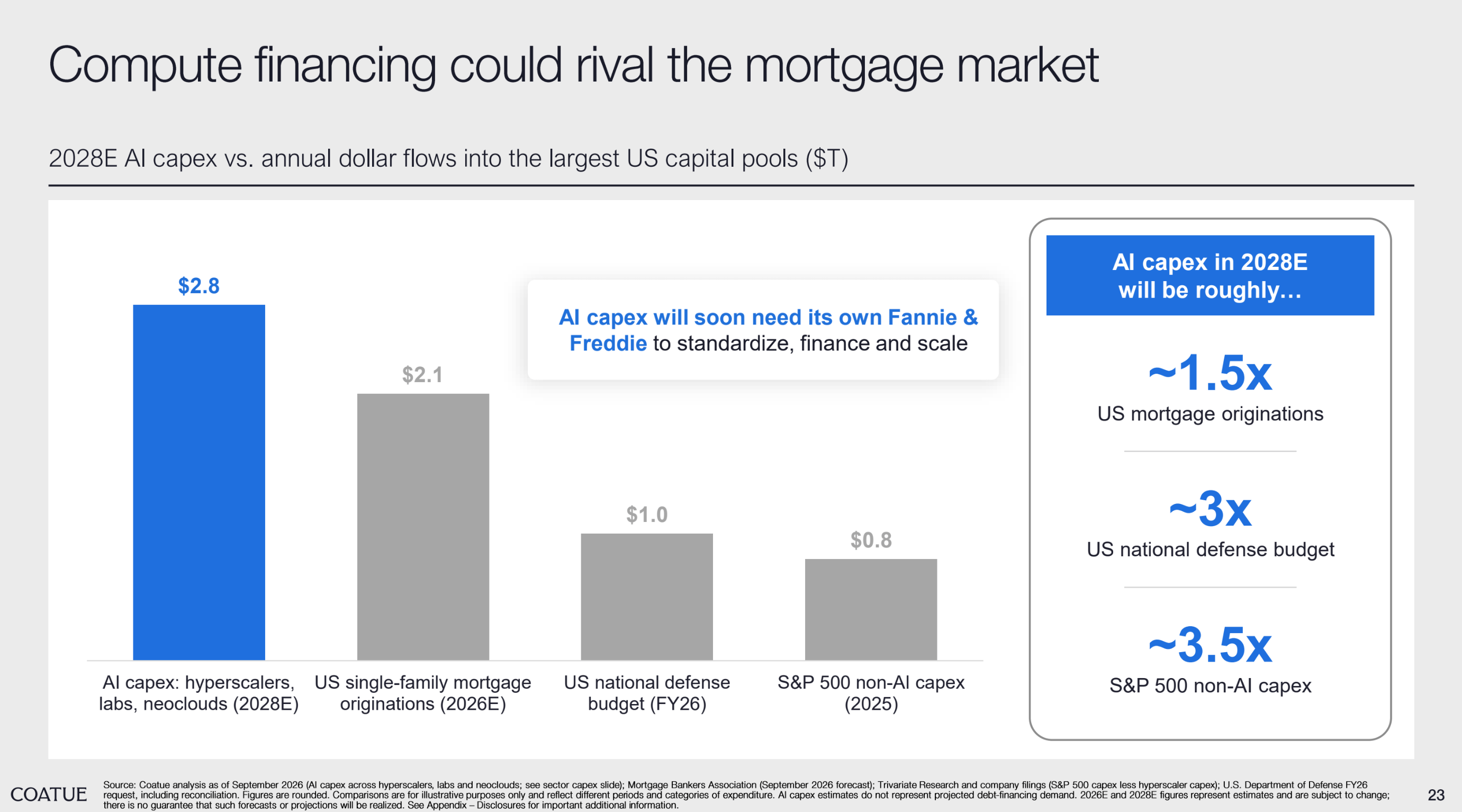
These are the picks-and-shovels plays of the agentic economy. They’re less exciting than betting on who wins the agent war, but they don’t require you to know the answer.
Put all of this together and the list of potential victims looks different from the one the market drew up in September. The most exposed businesses aren’t the ones with the most famous brands. They’re the ones whose value lies in an interface that agents can replicate, in a comparison agents can do themselves, or in inertia agents can break. The best protected are the ones with exclusive supply, physical logistics, or trust and liability machinery that agents need to borrow.
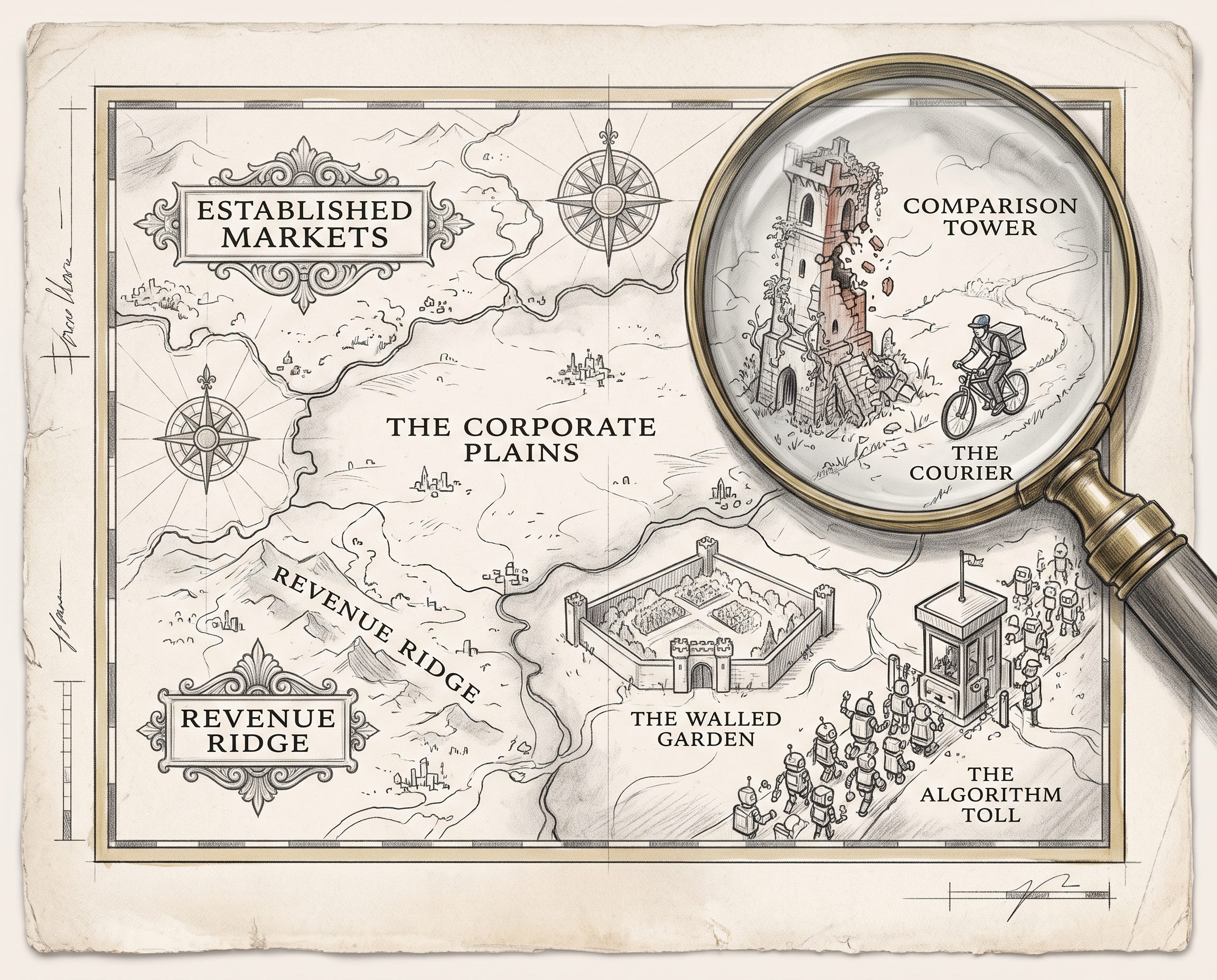
The Bigger Prize May Be Behind the Counter
Almost everything in this post so far has looked at agents from the consumer’s side of the counter: the traveler, the shopper, the policyholder - with payments and the underlying rails being the exception. That’s where Muse/Instinct/Grok Bot play, and it’s where the market panicked.
I’ve come to think, though, that the more consequential and quite possibly more lucrative market is on the other side, with the businesses doing the selling.
Grab’s CFO Peter Oey made this point on X this week with a framing I liked. His test for agents is whether they help more people earn a better living. Southeast Asia, in the case of Grab, is home to some of the smallest business owners in the world. A street food vendor in Manila or a family restaurant in Ho Chi Minh City is its own finance, marketing and operations department, often without any business tools at all, and some are only just coming online.
Grab’s Merchant AI Assistant lives inside the Grab Merchant app and recommends and executes tasks on the merchant’s behalf. It updates menus, runs marketing campaigns, and analyzes sales, orders and financials.
According to Grab, merchants who engage with it have seen a 15% boost in GMV since it launched in 2024, with the Philippines, Myanmar and Vietnam among the markets driving adoption.
Merchants are now asking for more, from personalized replies to reviews to benchmarking against competitors.
Deep Dive: Grab Holdings Ltd ($GRAB) – Master Piece

Over the last few weeks, I released my Grab Holdings deep dive series. As always, to make this research as accessible as possible, I’ve woven all four parts of the series into this single, unified resource, making it easier for you to “ctrl + search” for specific elements of the research. I hope my paying subscribers will find it useful. Also, keep in mind that in the Substack App, you should be able to access an audio version of the analysis, so you can conveniently listen to it on the go.
Toast tells the Western version of the same story. Toast IQ, its AI layer for restaurants, had around 40,000 weekly active locations in the first quarter. Its marketing agent, Toast IQ Grow, launched in May and builds campaigns across email, text and social media from a restaurant’s own sales data.
“And so one of the things that's been powerful already is people are using Toast IQ to load all of their data and get insight about what are the drivers of profitability in their business, which for an SMB operator is a big deal because historically, a lot of the data is not as accessible and hard to use. […]
Toast IQ Grow is the first example of it, where -- so what Toast IQ Grow is, all of our guest-facing products, right? So things like online ordering, websites, loyalty, CRM, marketing, advertising. And what we're doing is leveraging the data and leveraging AI to actually do the work of figuring out how to make sure your website is optimized for SEO, to make sure that your online ordering is set up such that it maximizes conversion. Your marketing and advertising campaigns are set up, again, I think, to drive engagement with your guests.” - Toast at Goldman in September
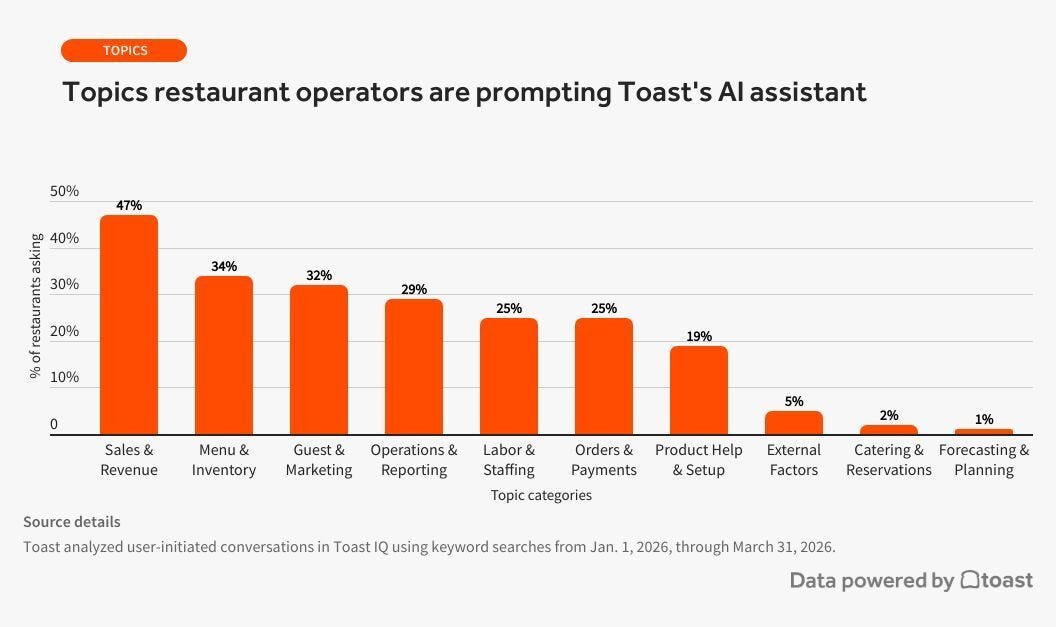
In pilots, participating restaurants saw sales rise about 8% compared with similar restaurants, and management says it’s on track to become Toast’s fastest product ever to reach $10 million in ARR. One family restaurant in Louisiana cut its spending on a marketing agency by 70%.
Deep Dive: Toast Inc. ($TOST)

Most great businesses don’t announce themselves. They get dismissed early on, repeatedly, by people who later wish they’d looked harder.
Shopify shows the same pattern at a larger scale. Merchants had nearly 34 million conversations with its Sidekick assistant in the second quarter, and the number of merchants using it daily grew 3.6 times year over year.
Why do I think this side could be the bigger prize? Run it through the filters from earlier and almost every one turns in its favor:
If the return is there, the products will be built (and the threshold seems smaller on the B2B side)
The agent operates inside the platform that already holds the menu, the sales history, the customer list and the payment data, so nothing has to be scraped or rebuilt from scratch.
Nobody values the process: no restaurant owner has ever enjoyed writing a promotional email at midnight or reconciling the books.
Trust is a much smaller hurdle, since the agent comes from a platform the merchant already runs the business on.
And addtionally, willingness to pay is of a different order. A consumer will grumble at $20 a month for an assistant. A business owner will happily pay hundreds (Toast IQ, for instance, is a $499-per-month AI marketing agent) or even thousands of dollars (I imagine Workva’s AI capabilities run in the tens of thousands) for a tool that brings in more sales (or time savings in Workva’s instance) than it costs, and that return can be measured to the dollar (well, mostly).
There’s also a strategic twist that ties back to Eisman’s distinction in the travel section. Consumer agents threaten incumbents because they sit outside the platform and pull the customer relationship away from it. Merchant agents work the other way around. They sit inside the platform, raise the switching costs, and make the merchant more dependent on it.
The same technology that may squeeze Booking’s take rate could widen the moats of Toast, Shopify and Grab.
If you’re looking for the second-order winners of the agentic era, I’d start with the platforms that put agents in the hands of their sellers.
Full disclosure, I own Grab, so I’m reading Oey’s post with a very favorable prior. A 15% GMV uplift for “engaged users” is a self-reported number with an obvious selection bias. The merchants who adopt a new tool early tend to be the most motivated and fastest-growing ones to begin with, and they might well have grown faster anyway. Toast’s pilot data comes with the same caveat. The revenue is also still small. $10 million in ARR barely registers next to Toast’s total ARR of $2.2 billion.
Competition matters even more. Once every platform offers a capable merchant agent, it becomes table stakes. The payoff may then show up as lower churn and higher GMV instead of a new line item, which is good for the business but harder for investors to see and price.
The platforms also don’t have the field to themselves. The same general-purpose agents I’ve discussed throughout this post could eventually operate a merchant’s tools from the outside, just as Muse operates a consumer’s.
Finally, the B2B story has a darker side for some listed companies. Agents that do the work of a marketing agency, a bookkeeper or a call center are great news for the merchant and bad news for whoever used to sell those services. Per-seat software vendors and outsourcers belong in that group, as I mentioned in the previous section.
On balance, I think the business side of agentic AI is underappreciated in the current debate. It’s less visible than a consumer app topping the App Store charts.
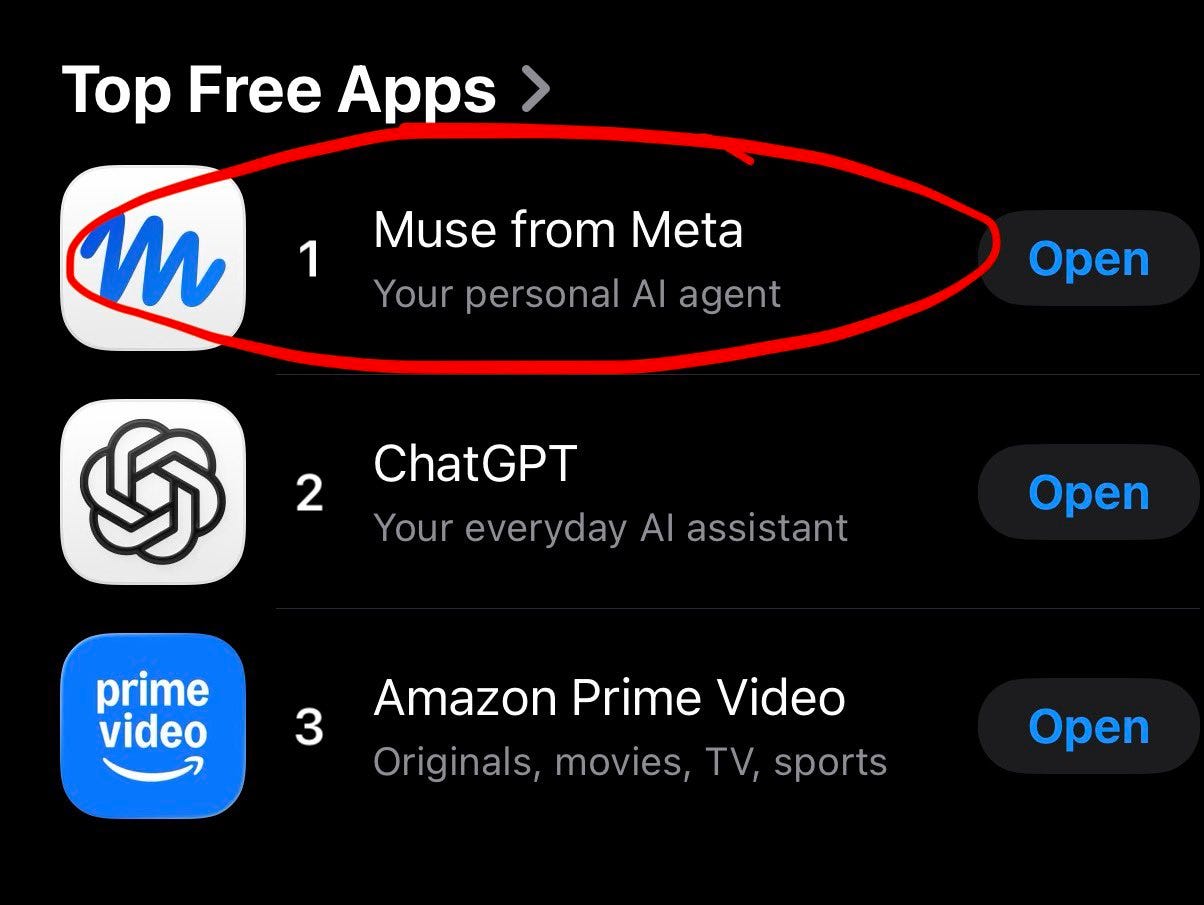
Yet it’s where agents already generate measurable revenue, where the economics favor the incumbents, and, as I argued in the Wise section about accounts payable agents, where adoption is likely to come first.
So when I ask who wins in the agentic era, I now ask a second question as well: which companies are handing agents to their own customers?
So, Existential Threat or Just Another Risk?
Let me go back to the question Drew Cohen posed and that I borrowed for this post and that is top of mind for many investors right now:
Is agentic AI an existential risk for the companies the market sold off this autumn, or just one of the many risks every business faces?
After working through each sector, my answer is that it depends much less on the sector than the September selloff suggested. It depends much more on what a company actually does, sells, and owns.
Businesses that own an interface, a comparison or a customer’s inertia are exposed, because those are exactly the things agents replicate or dissolve. Businesses that own exclusive supply, physical logistics, a cost advantage or the machinery of trust and liability are far better protected, because agents need to borrow those things to work at all.
If I were to rank the profit pools discussed in this post from most to least exposed, I end up with an order that differs noticeably from how the market traded in September:
Comparison and lead-generation sites, whose entire product is the step agents are built to perform.
Inertia-driven profits: renewal premiums in personal lines insurance, passive subscriptions, and the cheapest deposits at banks that pay their customers too little.
The advertising layer on top of commerce: retail media, last-second performance ads, and the most lucrative commercial queries in Google’s search auction.
Online travel agencies, where the threat is a slow squeeze on commissions and placement rather than disappearance, and where much of that squeeze already appears to be priced in.
Retailers and marketplaces with unmatched logistics, such as Amazon and MercadoLibre in their core commerce businesses, along with delivery networks like DoorDash.
Businesses with exclusive supply, card networks, low-cost infrastructure players like Wise, and the picks and shovels of the bot economy, which could end up on the winning side.
The order is debatable, and I’d welcome readers telling me where they disagree. But two observations hold up however you shuffle it. First, travel was hit first and hardest, yet in my view it’s somewhere in the middle of the exposure list. Second, the companies near the top of the list are generally not the ones that dominated the headlines.

On timing, I side with the patient camp. Markets move quickly, but human habits move slowly. The history of the iPhone, Amazon, and Netflix suggests that it takes years, not quarters, before a new technology shows up in an incumbent’s financials. At the same time, I don’t want to hide behind slow adoption. Eventually people will get used to agents, just as they got used to typing their credit card numbers into websites. I’d love to tell you that most people will care enough about privacy to keep their financial details away from Meta and the rest of Big Tech, but history suggests otherwise. Convenience usually wins. Slow adoption protects a few more years of earnings. It doesn’t protect the terminal value, and the terminal value is where most of the value in these “growth stocks” sits.
Either way, agentic AI is a risk worth taking seriously, and in some corners of the market it’s being taken too lightly. For most of the companies that sold off hardest, though, I’d call it one risk among many rather than an existential one, at least for now.
Your Turn!
That brings me to the main reason I wrote this piece. I’m sure I’ve gotten some of these calls wrong. My hope is that you leave with a set of questions to run through your own portfolio:
Which of your companies are directly exposed to agents, either as the interface an agent could replace or as the platform an agent could plug into?
Which are exposed only through a second-order effect? Think of an advertiser whose customer acquisition channel shifts, a software vendor priced per seat, a payment rail that could gain or lose volume, or a merchant platform whose sellers suddenly have an agent working for them.
On balance, which look like net winners, and which look like net losers?
For each name, I’d ask what the company actually owns. Is it an interface, a comparison, or a customer’s inertia? Or is it exclusive supply, logistics, a cost advantage, or trust? That one question did more to sort my own thinking than all the reading I’ve done about the technology itself.
Now I’d love to hear from you. Drop two or three names from your own portfolio in the comments, along with how you think agentic AI will affect their businesses, for better or worse.
Further Reading / Material
I haven’t listened to these, but I’m sure they add more context and insights:
I don’t think the episode is out as of today (September 9), but as noted above, I think Chit Chat Stocks planned to record an episode on agentic AI too.
Any other interesting resources? Please share them below.