

You can read this article entirely for free. If you find value in this research, consider becoming a Premium Member for less than €1/day to support my work and unlock our full archive and join our growing circle of investors (I highly recommend checking out “The Library” to see what’s inside; you can find it right on the homepage).
Why join the community, you may ask? Our library is fast approaching 70 comprehensive deep dives, providing institutional-level research on some of the world’s most fascinating businesses. Most recently, we’ve dissected companies like Mercado Libre ($MELI), Grab Holdings ($GRAB), Fair Isaac ($FICO), and Topicus.com ($TOI).
As a member, you get:
Complete Access: Every deep dive in our library (65+ and counting). The most thorough analyses you will be able to get your hands on (including downloadable models).
Slide Decks: Every deep dive now comes with a companion slide deck. It’s the whole argument in compressed form – the hypothesis, the business, the competitive position, the valuation, and the case against – for the days when you don’t have an hour to spare but still want the shape of the thing. Paid subscribers get both, the long piece and the deck.
More Content: Company updates; powerful valuation spreadsheets, frameworks, and processes; regular portfolio updates (insights into my investing decisions); market commentary; etc.
The WhatsApp Community: Real-time discussion and networking with like-minded investors.
Digital Investing Conferences: About three times a year, we also hold digital conferences where members present and share stock ideas, and discuss broader themes, and we’d love for you to join in!
Incredible Value: Full access to all of this for less than 1€/day.
If you want to see the level of research we provide before committing, the following deep dives are, for instance, free to read (access them via The Library):
InPost ($INPST) - generated an IRR of >400% as an acquisition offer emerged 2-3 months post write-up
DigitalOcean ($DOCN) - up 5x in less than a year post write-up release
Wise can’t catch a break!
There are stretches in the life of a business where everything that can go wrong seems to arrive at once, and Wise is living through one of these moments it seems.
On the first of June, Belgian prosecutors confirmed they were investigating Wise Europe over roughly €500 million in suspicious transactions, drawn from hundreds of criminal files that had reached Brussels through European Investigation Orders from more than thirty countries.
The stock fell as much as twenty per cent that day before closing down eight.
Then came the chatter about a platform partner, NuBank, reconsidering its relationship, which I have not been able to verify anywhere and which I mention only because it circulated widely enough to shape sentiment.
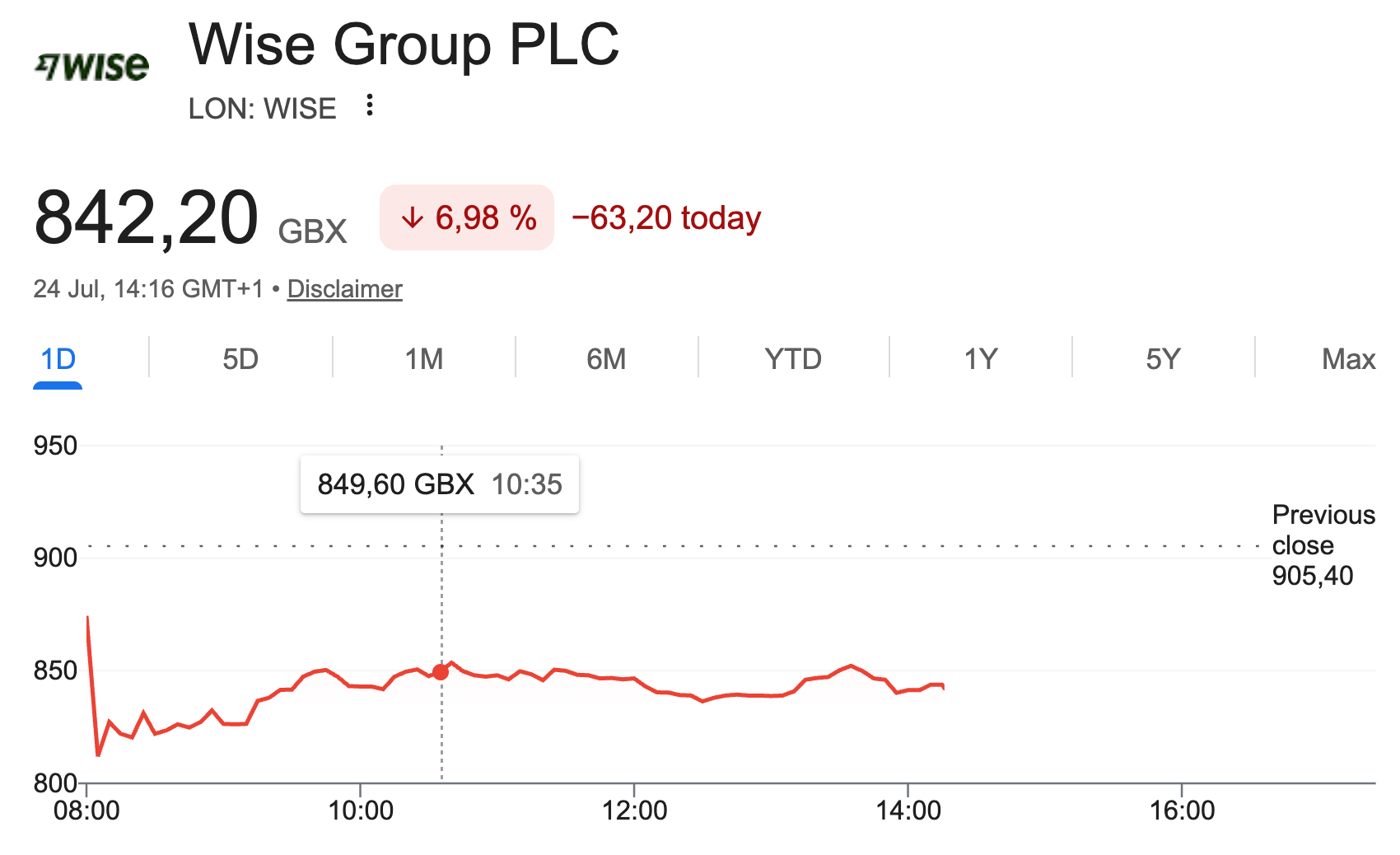
And now this: On Thursday, the U.S. Office of the Comptroller of the Currency denied Wise’s application for a national trust bank charter, and by Friday morning in London the shares were down around ten percent at the open (as I type this, Wise’s LSE shares are down 7 percent).
Three blows inside two months, all of them landing on the same nerve.
The timing is what makes it sting. Wise moved its primary listing to Nasdaq in May, keeping London as a secondary venue, and the stated rationale was that the United States represented the biggest market opportunity in the world for its products.
You do not relocate your primary listing to a market and then get told by that market’s chief banking regulator that your management and board have demonstrated a persistent inability to manage money-laundering risk without the symbolism registering.
Goldman Sachs, which is still Buy-rated with the stock on its Conviction List and a twelve-month target of 1,450p against a current price below 850p, put it plainly enough in its note on the denial: with the OCC decision layered on top of the Brussels investigation, they expect the shares to stay under pressure while the regulatory overhang persists. Sixty percent implied upside and an explicit warning that the stock may go nowhere for a while.
That is an unusual pair of statements to hold together, but it captures the situation and current sentiment reasonably well.
I want to do something more useful here than either panic or reassurance. Both are on offer elsewhere.
What I want to work through instead is a set of questions that I think matter more than the headline:
What the OCC actually said as opposed to “what Wise said the OCC said,” and why the gap between those two accounts is the most important thing to understand about this event first.
Then, why Wise wanted a charter in the first place, given that its founder spent years explaining why not being a bank was a deliberate choice rather than an accident.
Why Circle applied two weeks after Wise, to the same regulator, for the same category of charter, and walked away with final approval fourteen days before Wise was rejected.
What the reapplication path actually looks like once you account for a Federal Reserve policy process that has a stated end date, and for the fact that the American banking lobby has been filing formal letters against this charter since the summer of last year on grounds that have nothing to do with anti-money-laundering controls at all.
And finally, what any of it does to a business that grew cross-border volume thirty-one per cent last year while deliberately cutting its own prices.
The uncomfortable part, and the part I think most of the commentary is skipping, is that the reason for the denial is more specific and more fixable than the “regulators are being difficult” story, and also more damning.
Here’s everything I have ever written about Wise:

Disclaimer:
As of the date of publication the author owns shares in the company; but that may change. The analysis presented in this blog may be flawed and/or critical information may have been overlooked. The content provided should be considered an educational resource and should not be construed as individualized investment advice, nor as a recommendation to buy or sell specific securities. I may own some of the securities discussed. The stocks, funds, and assets discussed are examples only and may not be appropriate for your individual circumstances. It is the responsibility of the reader to do their own due diligence before investing in any index fund, ETF, asset, or stock mentioned or before making any sell decisions. Also double-check if the comments made are accurate. You should always consult with a financial advisor before purchasing a specific stock and making decisions regarding your portfolio.
What the regulator said, and what Wise said the regulator said
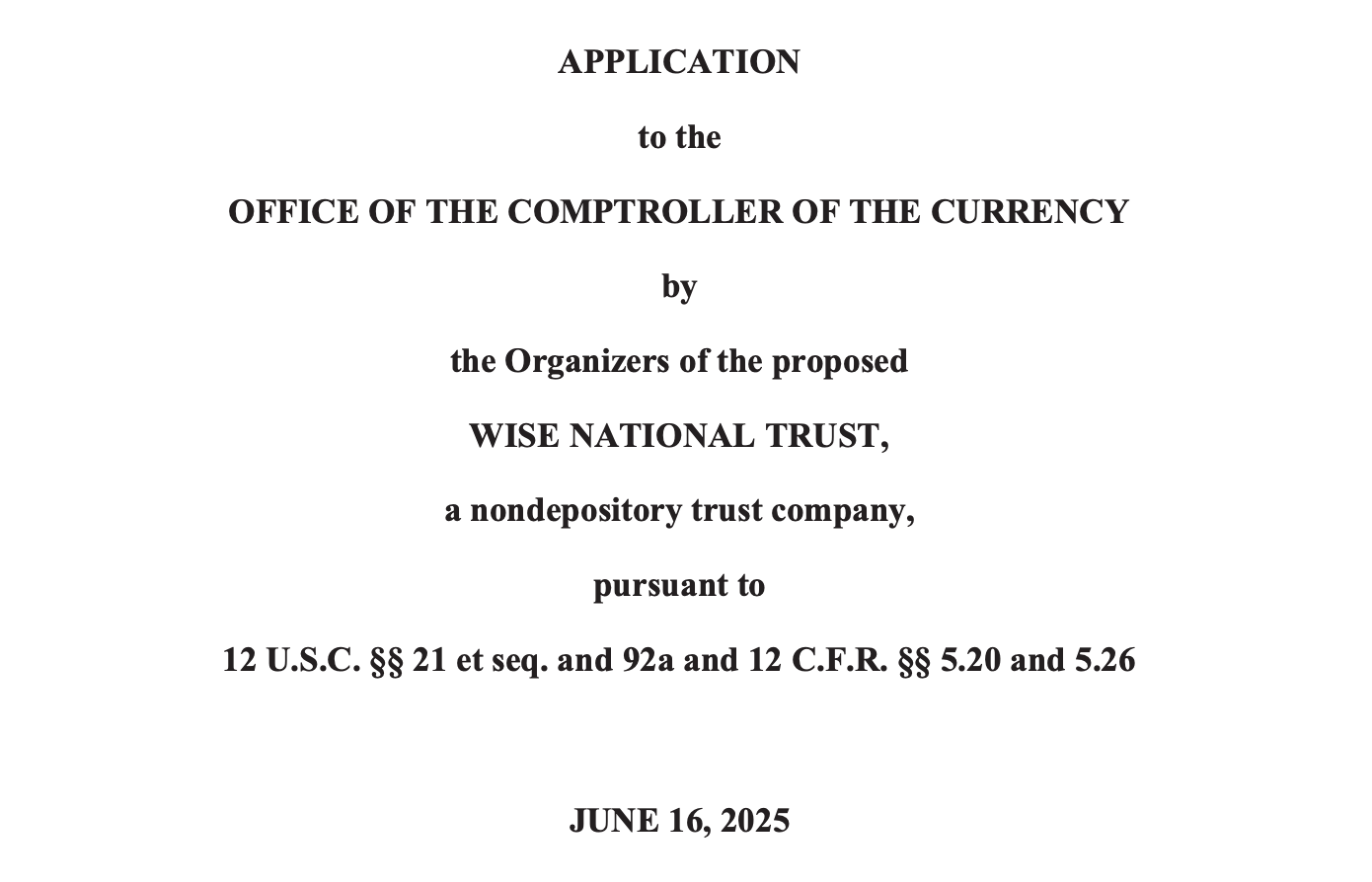
The bare facts first. Wise US Inc. filed for a national trust bank charter on 16 June 2025, under the proposed name Wise National Trust.
A national trust bank charter is a specialised federal licence issued by the OCC. It does not permit deposit-taking in the ordinary sense, it does not come with FDIC insurance, and it does not allow commercial lending.
What it does allow, at least in the shape Wise wanted, is nationwide payment clearing, custody and settlement under a single federal supervisor rather than under fifty separate state regimes.
The application stated openly that the new entity would seek membership with the Federal Reserve Bank of Dallas in order to obtain a master account and, through it, a direct connection to the Federal Reserve payment systems. That was the point of the exercise.
On Thursday, the OCC denied it.
Wise’s announcement to the market is a careful document and worth reading closely. It says the decision relates to an application submitted over a year ago, that the business and its compliance maturity have evolved significantly since then, and that the OCC’s letter refers to historical issues that Wise has been addressing.
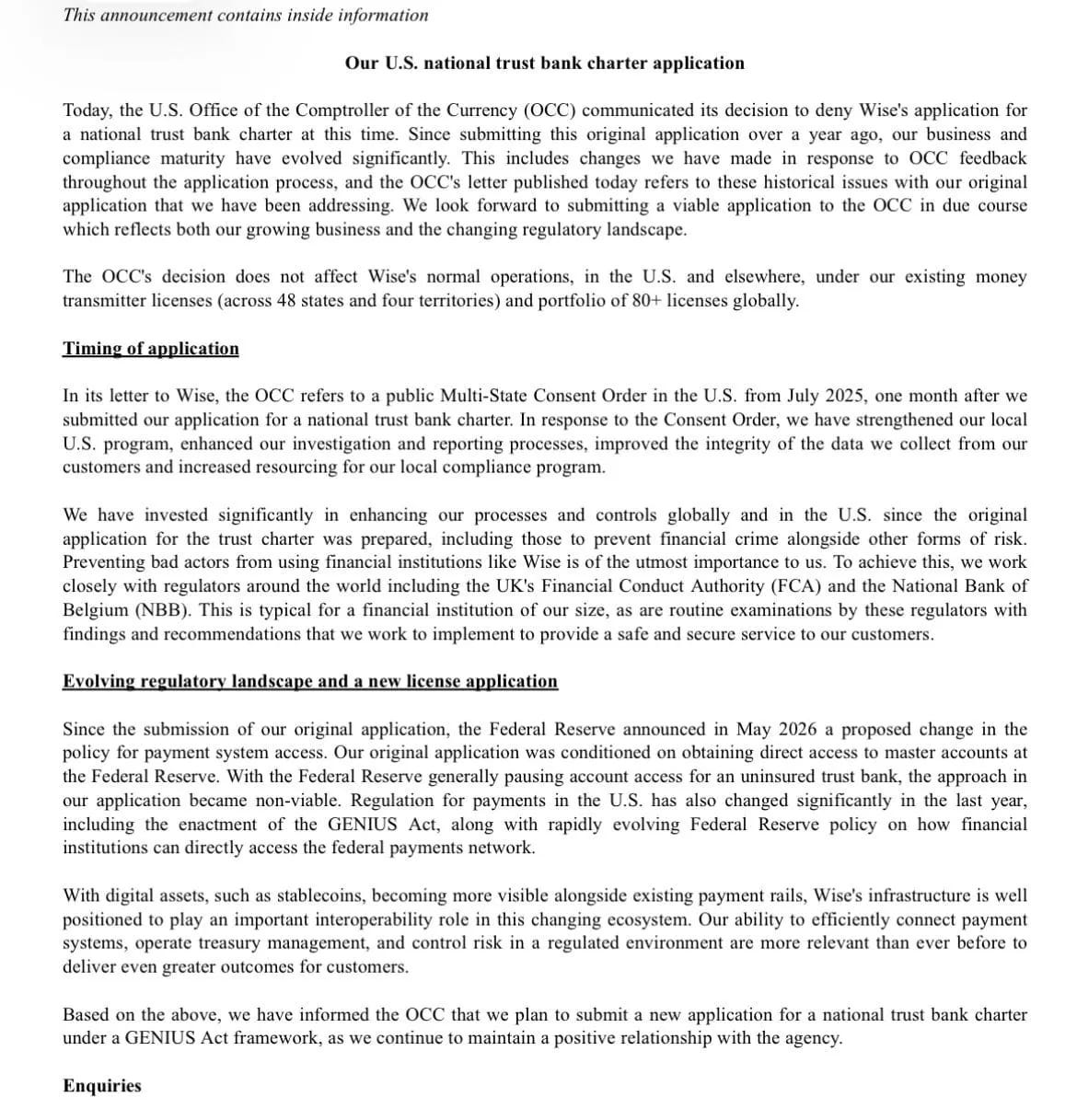
It notes that the OCC cited a public multi-state consent order from July 2025, one month after the application went in. It says that the Federal Reserve’s May 2026 proposed change to master account access policy rendered the original approach non-viable, since the application was conditioned on obtaining a master account and the Fed has been pausing access for uninsured trust banks. It confirms that operations continue untouched across 48 states and four territories, alongside a portfolio of more than eighty licences globally. And it says Wise will submit a new application under a GENIUS Act framework in due course.
Read on its own, the announcement describes a company overtaken by a shifting regulatory landscape, judged on a stale snapshot of itself.
The OCC’s letter – which I believe has not been publicly published on the Office of the Comptroller of the Currency's official website yet, so I’m referencing second-hand resources – reads differently. Apparently, the regulator said the application …
presented significant supervisory and compliance concerns (ouch!), and
that Wise’s proposed management and board had demonstrated a persistent inability to manage money-laundering and terrorist-financing risks (ouch!).
That’s not the language of a technical mismatch between an old filing and a new framework. Persistent inability is a judgement about people and governance, not about paperwork. And the word choice was not accidental. The OCC published a policy statement in June clarifying that when it denies a filing it must notify the applicant in writing of the reasons, and that it intends to make denial decisions public precisely so the industry can see those reasons.
So these are the two accounts of the same event, and an investor’s first job here is to notice that they are not the same account. I do not think Wise is being dishonest. Everything in the RNS appears to be factually accurate, and the point about the Federal Reserve pausing master account access for uninsured trust banks is entirely true and genuinely material, as I will come to.
But there is a difference between a company saying the road was closed and a regulator saying it did not think you should be driving. Wise’s statement emphasises the first. The letter emphasises the second.
When those two framings diverge, I generally place more weight on the regulator’s reasoning, because the regulator has no incentive to be harsh and every institutional reason to be measured, and because the OCC in 2026 has been anything but obstructive toward this category of applicant.
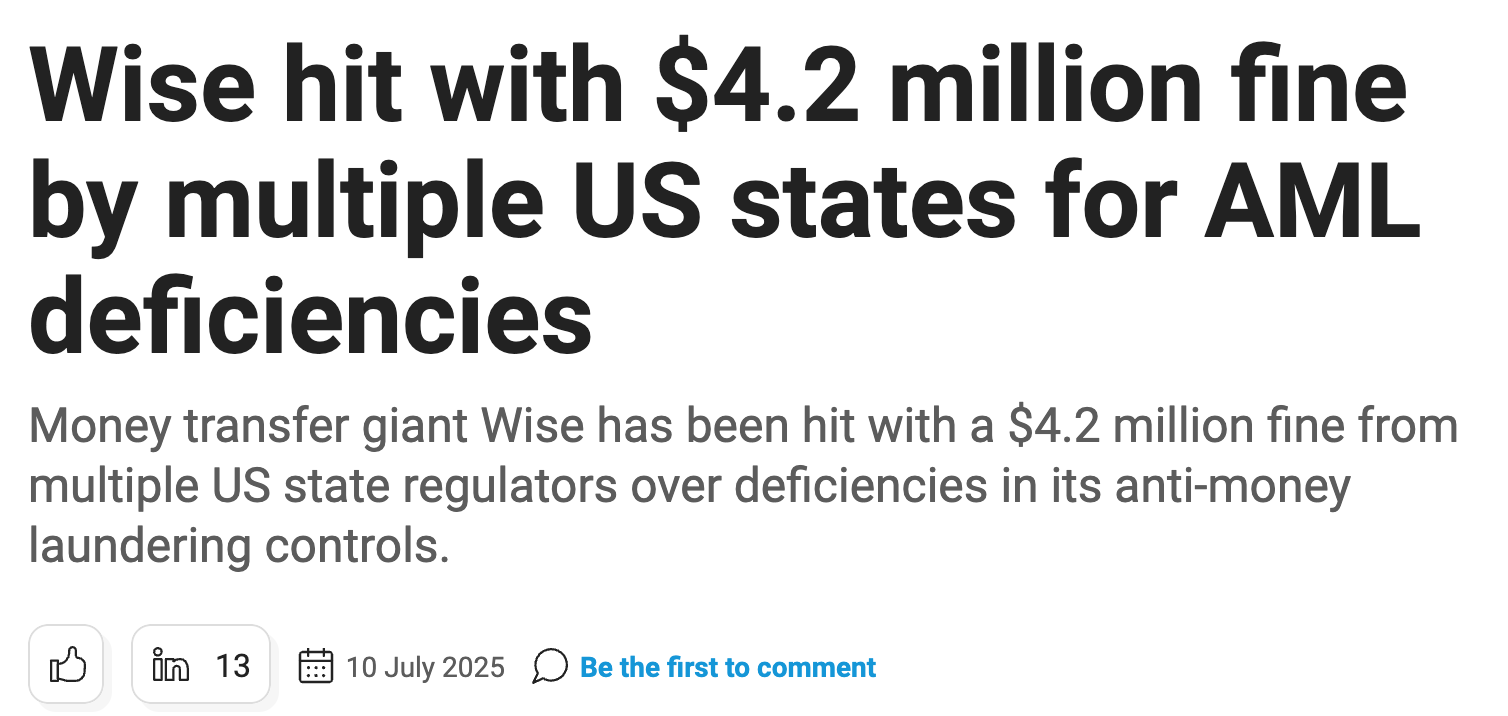
Which brings us to the consent order, because it is the hinge on which the whole disagreement turns. In July 2025, one month after Wise filed, the New York Department of Financial Services announced a coordinated action with regulators in Massachusetts, Texas, California, Minnesota and Nebraska, extracting a $4.2 million settlement from Wise US over inadequacies in its Bank Secrecy Act and anti-money-laundering programme.
Wise’s framing is that this is historical, that it responded by strengthening the U.S. programme, improving investigation and reporting processes, fixing the integrity of customer data and adding resources to local compliance.
All plausible, and probably all true.
The regulator’s framing, however, is that a firm which entered a six-state consent order for fundamental AML deficiencies thirty days after asking for a federal charter has not yet demonstrated it can be trusted with one.
Also plausible.
Then there is Belgium, which does not appear in Wise’s charter announcement at all and which the OCC would have been aware of. Wise Europe is based in Brussels and serves the rest of the European Economic Area through passporting, which means law-enforcement requests from across the bloc are routed to Belgium rather than handled nationally. Wise argues, with some justification, that this concentrates requests in a way that would not happen for a bank with branches in each country, and that receiving law-enforcement requests is a normal part of operating at scale rather than evidence of wrongdoing in itself. Fair. But the Brussels prosecutor is reportedly preparing a direct summons, which in Belgian procedure takes a case straight to criminal court without an investigating judge, and the investigation covers more than half a billion euros across fraud, corruption and drug trafficking. No charges have been filed and no findings have been shared with the company. Even so, this is now the third jurisdiction to question Wise’s controls (not to mention CEO Kristo Käärmann’s personal tax compliance troubles with HMRC), after the U.S. states and, going back to 2024, the National Bank of Belgium’s finding that Wise lacked proof of address for hundreds of thousands of customers.
Three separate regulators reaching for the same file is a pattern.
You can dispute what the pattern means. Denying that there is one is harder.
The market reaction, in that light, looks proportionate rather than panicked. Seven percent down, having touched ten at the open. It is the market pricing a longer wait, higher compliance spending, and a raised probability that something worse arrives from Brussels.
Wise is right that nothing operational changed on Thursday. It is also true that something informational did.
My latest deep dive:

Before we dive back in, a quick note…
Want to compound your knowledge – and your wealth? Compound with René is for investors who think in decades, not headlines. If you’ve found value here, subscribing is the best way to stay in the loop, sharpen your thinking, avoid costly mistakes, and build long-term success – and to show that this kind of long-term, no-hype investing content is valuable.
PS: Using the app on iOS? Apple doesn’t allow in-app subscriptions without a big fee. To keep things fair and pay a lower subscription price, I recommend just heading to the site in your browser (desktop or mobile) to subscribe.
Why did Wise want a banking licence when it spent years explaining why it didn’t need one?
This is the part I found most interesting when I first sat down with the story, and it is where I think a lot of readers will get confused, because Wise’s own leadership has been unusually articulate about why the company deliberately chose not to be a bank. Here is Kristo on an earnings call in early 2025, and it is worth quoting at length because the reasoning is more careful than the summary versions suggest.
“Being a bank really only gives you mostly one thing, which is the ability to lend your business’ holdings to people on this side of the room. And none of our customers are really asking us for that. So you’re not calling and saying, hey, I have this money here, you’re paying interest, but I’d actually want you also to lend it to someone else. So that’s why banking as lending deposits is not really that relevant for us. Of course, because you would be taking, as a customer, huge amount of risk of holding your money with us if we were to lend your deposits. Therefore, this concept of deposit insurance is devised to give you comfort that you should do something as reckless as giving us your money and us lending it. Of course, if we’re not lending your money, you don’t need the deposit insurance.”
That is a genuinely good argument, and it holds up. Wise safeguards customer money rather than lending it. The holdings sit in government-issued or government-guaranteed assets, customers can switch on interest and receive something close to what a central bank pays, and the protection covers the entire balance rather than the £85,000 or €100,000 that a deposit guarantee scheme would cover. Kristo’s point is that a customer is better off, not worse off, for Wise not being a bank in the traditional sense. Read that alongside the charter application and it looks like a contradiction. It isn’t one, and unpicking why gets you to the heart of what this denial actually cost.
The thing to understand is that a bank charter bundles together two entirely separate privileges that have no logical reason to travel together. One is the right to take insured deposits and lend them out. The other is the right to plug directly into the national payment system. For most of modern financial history you could not have the second without accepting the first, and that historical accident is precisely what Kristo was complaining about on the H1 2025 call.
“It was a really weird regulatory setup, let’s say, 5, 10 years ago in the world, where you had to be lending customer deposits to access the payment system. So most regulators have now moved on from that, kind of recognizing that payment companies should have access to payment systems. It’s a relatively fresh change that nonbanks are able to connect. For example, in the U.K., we were the first nonbank to connect to the faster payments. In Japan we were last week the first nonbank to join Zengin as the payment system. So these regulatory limitations used to be in place. They’re now being lifted everywhere in the world, and that has kind of given us the opportunity to join.”
So there is no pivot. Wise has been consistent throughout. It does not want to lend your money and it never has. What it wants is the plumbing, and the trust bank charter was simply the vehicle available in the United States for getting the plumbing without the lending. That is why the application was for a national trust bank rather than a full-service FDIC-insured national bank, and why it was explicitly conditioned on obtaining a Federal Reserve master account. Strip away the word “bank” and the application was a request for a wire into the Fed.
Why does that wire matter so much? Because Wise has done this eight times already and the results are not subtle. It holds direct connections to domestic payment systems in the UK, Hungary, the euro area, Brazil, the Philippines, Singapore, Australia and Japan. Each one means an account with the relevant central bank and the ability to clear payments without a partner bank taking a cut and adding a delay. In Australia, the share of instant transfers went from 24 per cent to 83 per cent after direct integration. In Brazil, bank fees fell 40 per cent. In the UK, bank costs dropped roughly ninefold post-integration and customer contacts fell 75 per cent, which tells you the connections improve reliability as well as price. In Japan, 99 per cent of transfers now settle instantly. This is the single most tangible expression of what Wise means when it talks about a mission to move money cheaper and faster, and it is also, not coincidentally, the deepest part of its moat. Every direct connection is a piece of infrastructure a competitor would need years and a regulator’s blessing to replicate.
Now consider that the U.S. dollar sits on one leg of an enormous share of Wise’s volumes, that the United States is the market Wise itself calls the largest opportunity in the world, and that there are roughly four thousand banks there as potential Wise Platform partners. And then consider that this is the one major market where Wise still routes its dollar flows through correspondent banks, paying middleman clearing fees on volume it already controls end to end everywhere else. Estimates of what those fees represent circulate in the range of twelve to fifteen basis points of volume, which if accurate would be a meaningful share of net revenue, though I have not been able to verify that figure from a primary source and would treat it as an order-of-magnitude guess rather than a number to build a model on. The direction is what matters. Wise pays a toll in its most important market that it has already eliminated in eight others.
There is a second-order benefit that gets less attention and may end up mattering more. A federal charter would have replaced a patchwork of state money-transmitter licences with a single supervisor. Wise currently maintains licences across 48 states and four territories, each with its own renewals, examinations, reporting formats and interpretations. That is a permanent tax on management attention and a structural drag on how fast the company can ship new products in its largest market. Every state that has to be persuaded separately is a state that can say no separately. Consolidating that under one federal regulator would have simplified the operating model considerably, and for a business whose entire strategy rests on driving unit costs down toward zero, structural simplification compounds.
So the charter was never about becoming a bank. It was about removing the last major toll booth in the world’s most important currency corridor, and about trading fifty-two supervisory relationships for one. Both prizes are still there. They are just further away than they were on Wednesday.
Businesses don’t move in straight lines
Investors like straight lines. We build models in spreadsheets where each column is slightly larger than the one to its left, and something in the presentation of that arithmetic persuades us that reality will cooperate. It rarely does.
You might forecast a topline CAGR of 13% over the next four years. A 1% margin expansion each year. The reality looks different. Maybe 18% next year, followed by 7% the year after.
Real businesses sprint, stall, take a step backward, hit an obstacle nobody modelled, and then sprint again. What separates a temporary setback from a broken thesis is not the size of the stumble. It is whether the destination changed.
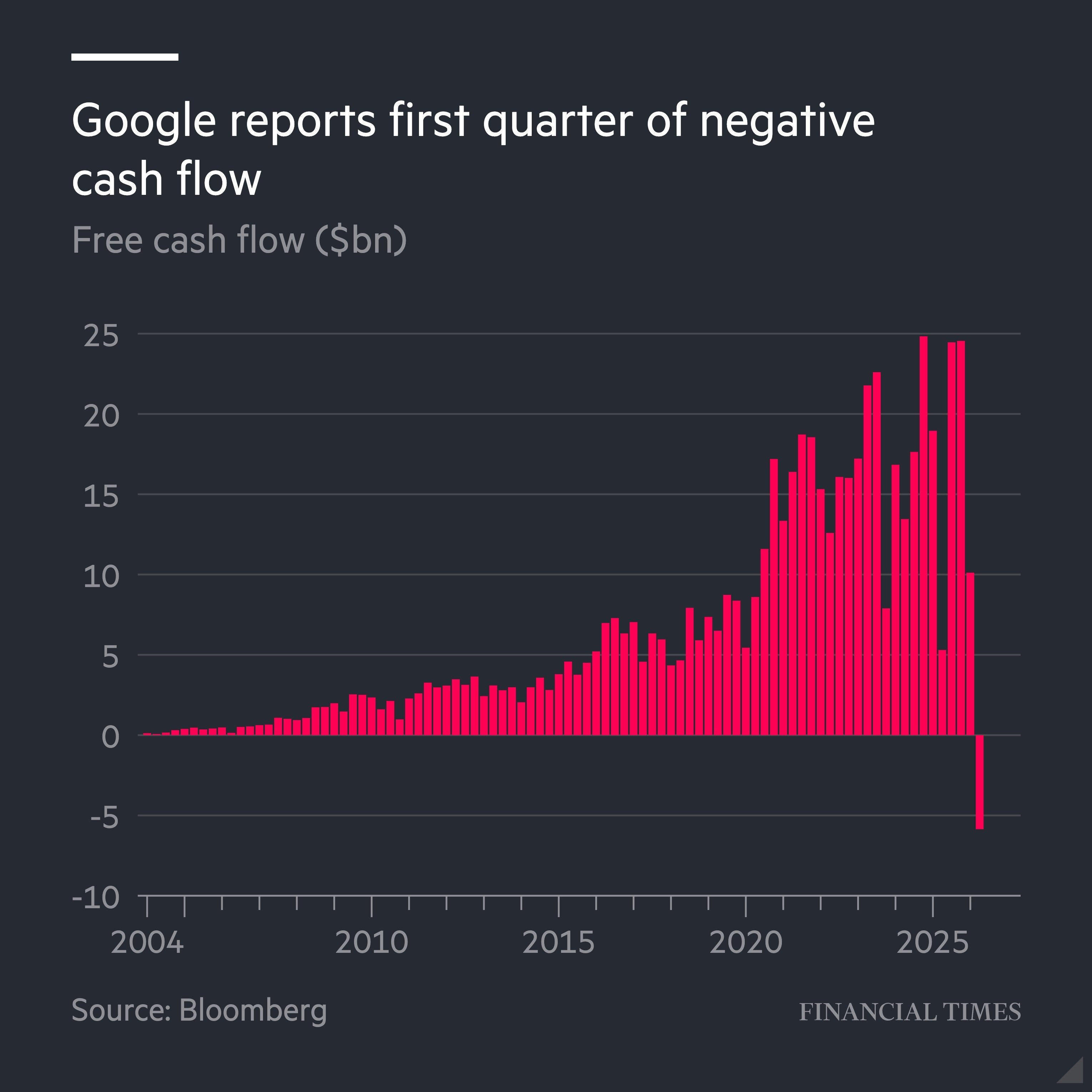
Example? Google’s FCF just went negative for the first time in history. Show me an analyst who had this in his 10-year model back in 2016!
The Power of Destination Analysis
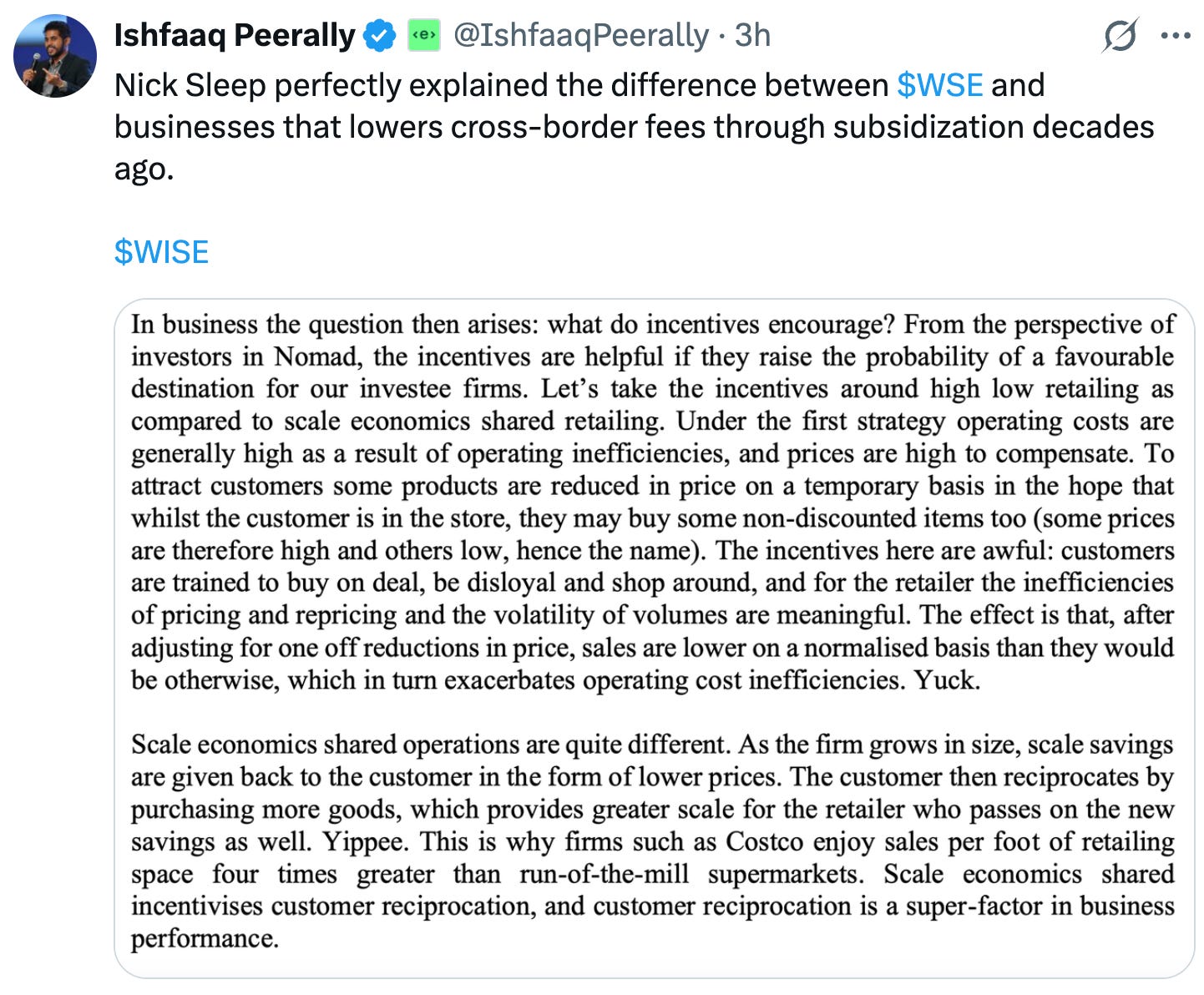
The above framing owes something to Nick Sleep, whose destination analysis I keep returning to in my thinking.
Sleep’s idea was that most investors spend their energy forecasting the next few steps of a journey when the useful question is where the company ends up if it succeeds at what it is trying to do.
“It is an interesting psychological phenomenon to observe that if our annual results were reordered, we might feel differently about them. For example, place the results in descending order (+80%, +22%, +10%, +9%, +1%) and one is depressed by the decline; place them in ascending order (+1%...+80%), and we tend to think of them more favourably, even though the end result (the destination) is identical. Recent success feels better than distant success, as the brain perceives recent rewards more vividly. Psychologists call this the “availability heuristic” and it is this phenomenon that has sold a thousand mediocre mutual funds that appear, momentarily, to have a pulse! But that is not the way to invest.” - Nomad Partner 2005 Letter
Ask what Wise looks like in ten years if the mission works? Then ask whether Thursday’s news moved that endpoint?
The destination Wise is walking toward is one where it moves trillions rather than hundreds of billions, …
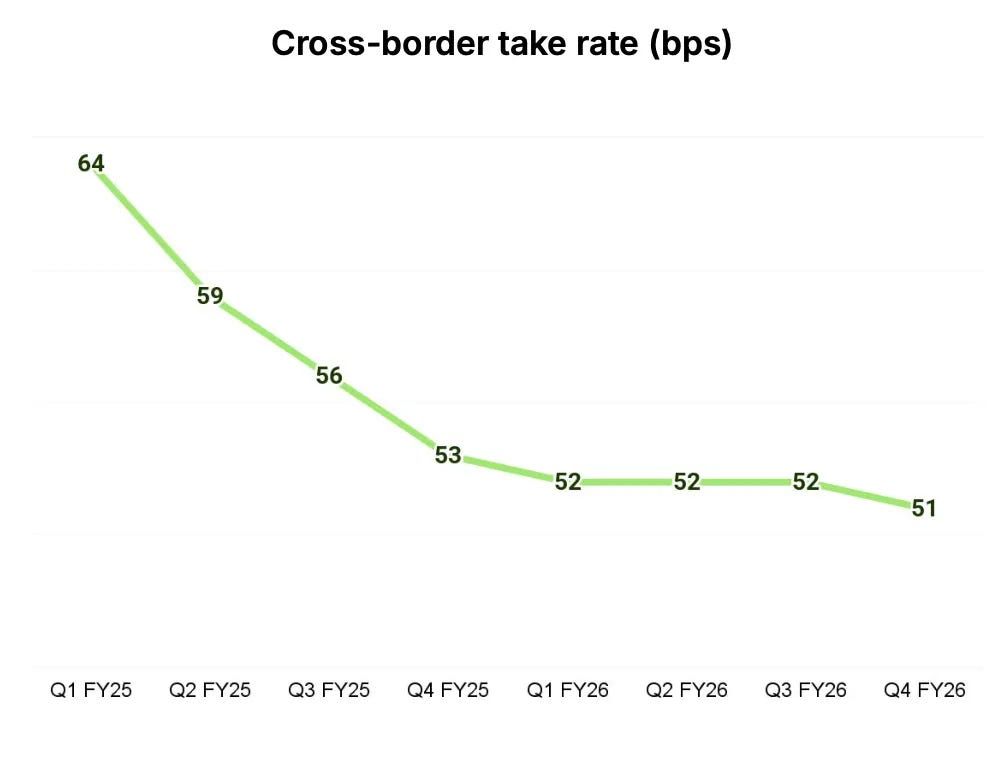
… at a take rate approaching zero, over infrastructure it owns directly in every major currency corridor, with a platform business embedded inside thousands of banks that have concluded it is cheaper to rent Wise’s rails than to maintain their own.
Nothing about a denied trust charter at a single point in time alters that endpoint I believe.
It alters the arrival time.
Sleep described this as well:
“Annual results will bounce around all over the place, and for Nomad more so than more diversified funds. But does that matter if the destination is secure? Indeed, if we could turn U$1 into U$16, does it matter if it takes 18 years or 22 years? There is a difference in the annual compound rate of appreciation (over 3% per annum, and I do not wish to make light of that), but securing the destination is also important. […]
To our way of thinking the question is, what good habits and techniques ensure that the destination is secure (even if the ride is bumpy), and that U$16 will be realised?“ - Nomad Partner 2005 Letter
So this is a no for now rather than a never, I believe.
That distinction is highly relevant, and iny my view it is not just a comforting phrase. The OCC did not rule that Wise’s business model is incompatible with a federal charter, and it did not close the door to a future application. It said this application, from this management team, with this compliance record, at this moment, does not clear the bar.
Every element in that sentence is a variable rather than a constant.
Impact on Wise’s Brand?
Having said that, I want to resist the temptation to wave this away, because there is something genuinely new here and it deserves to be named:
For most of its life Wise enjoyed a kind of regulatory halo. It was the good fintech, the one lowering prices and publishing its fees and beating banks at their own game, and regulators around the world responded by letting it through doors that had been closed to everyone else or at least many others.
First nonbank into UK Faster Payments. First nonbank into Zengin in Japan.
In 2026, that halo has dimmed. Three jurisdictions have now examined Wise’s controls and come away unimpressed, and you would fool yourself believing that these regulators do not talk to each other.
The OCC letter did not emerge from nowhere; it emerged from a file that includes a six-state consent order and, almost certainly, an awareness of what Brussels is doing. Wise now gets the hard look rather than the benefit of the doubt, and that is a change in operating conditions rather than a one-off event.
Time to roll up its sleeves and get to work! Time to do better.
Short-Term Costs
What does the hard look cost?
Start with precedent. Lookback reviews and remediation programmes of this kind are not rare, and the UK provides two useful comparisons in Starling and Monzo, both of which went through extended compliance remediation under regulatory pressure.
Broadly, one of our community members estimate the profit impact ran to something like ten to fifteen per cent for eighteen months to two years.
Now adjust for Wise’s specific situation, and the adjustments cut in both directions. Wise has far more transactions than either, which means the variable cost of additional human review scales unpleasantly. It also has far more profit, which means the denominator is much larger and the same absolute spend hurts proportionally less.
And the biggest single component, redesigning the compliance architecture itself, is largely a fixed cost that gets amortized across a volume base growing 20-30% percent a year.
The exact one-year impact does not really matter in my opinion. 5%, 8%, or 13%? Who cares? Call it a pause in profit growth for around a year, assuming Wise does not throttle customer acquisition to protect margins, which I do not think it will and would not want it to. I want Kristo to remain laser-focused on Wise’s destination. Invest aggressively in internal controls and whatever else is needed to make sure no regulator can derail you from your long-term destination.
Added Friction
There is a subtler cost that does not show up in that calculation. Wise’s cost advantage comes substantially from automation. Its whole architecture is built on doing at machine cost what banks do at human cost, and that applies to compliance as much as to payments.
If remediation forces more human review into the onboarding and monitoring flow, it adds friction in precisely the place where friction is most expensive, both in unit economics and in customer experience (e.g. speed of transaction). Slower onboarding is lost customers. Slower transfers.
More frozen accounts (apologies for the size of the screenshot below; not a good look).
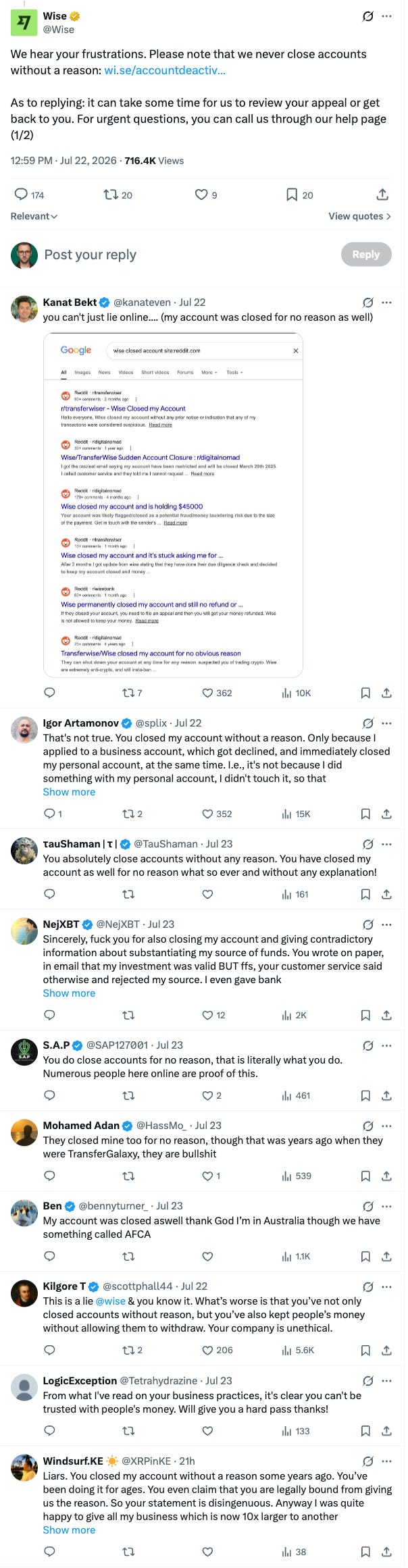
That is the version of this cost that would worry me if it persisted, and it is worth watching in the business-customer numbers over the next several quarters, since business onboarding is where Wise has previously paused growth to fix exactly this kind of problem.
Brussels might even demand Wise to slow customer onboarding to fix internal and AML/KYC controls first.
Scale Will Solve a Lot of the Concerns Discussed Above
Even so, I am not especially worried about the cost structure over any horizon that matters.
This is a business whose entire logic is scale economics shared, and scale solves cost problems if you let it run.
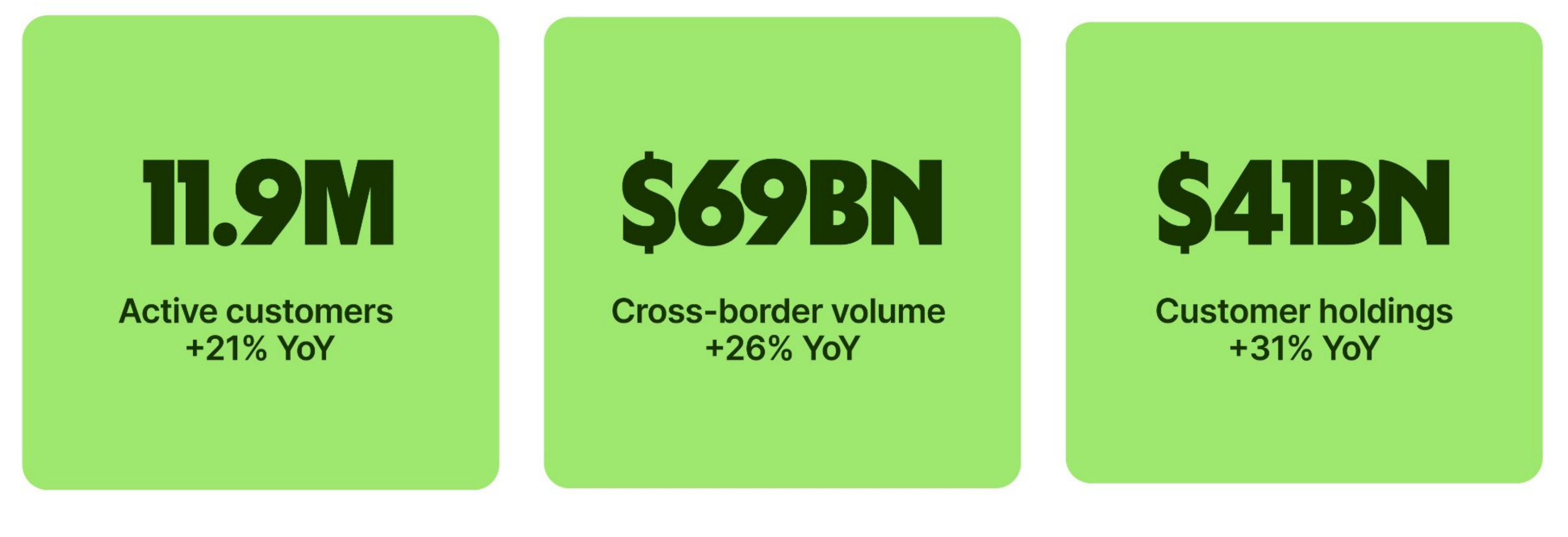
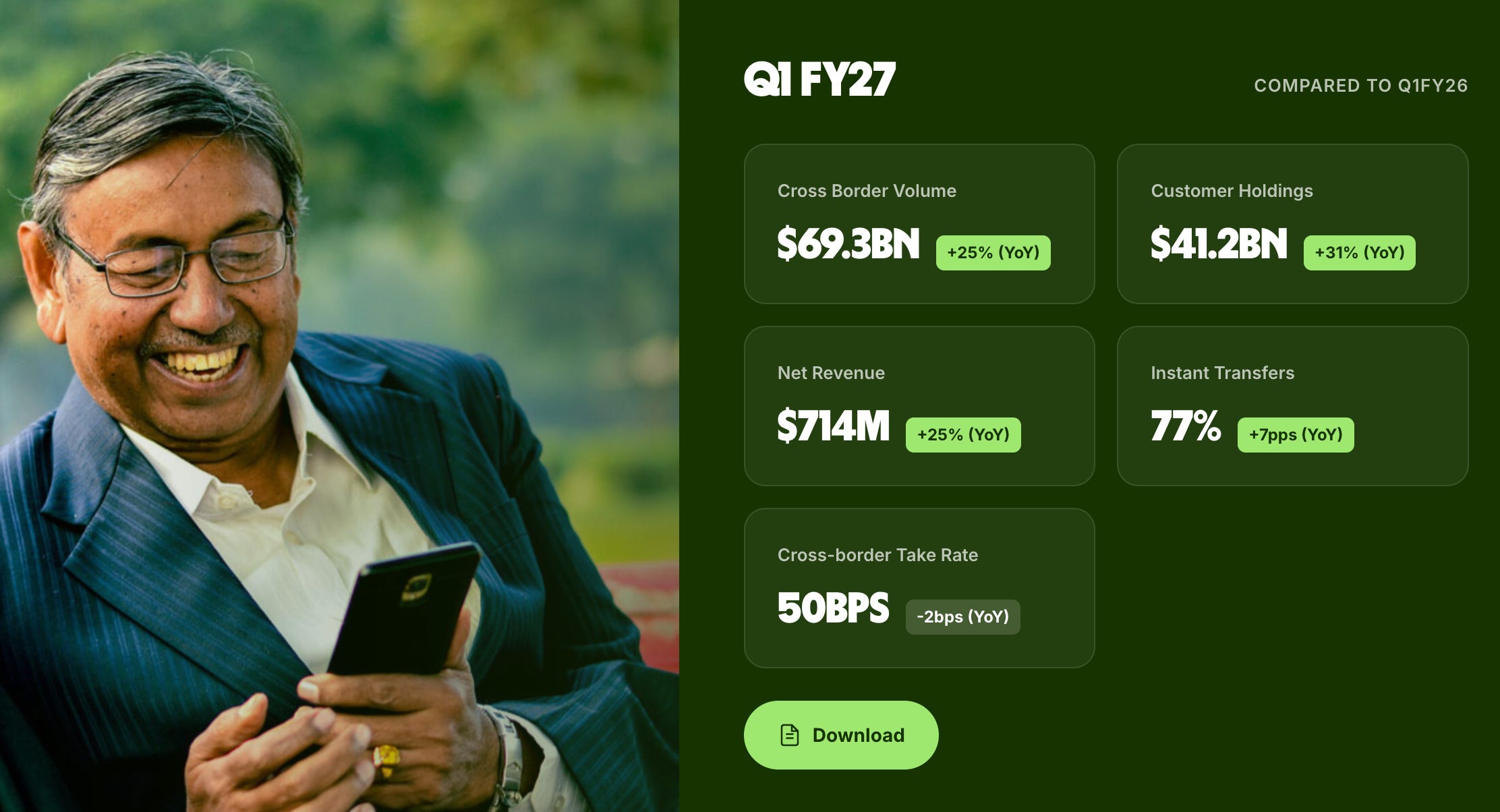
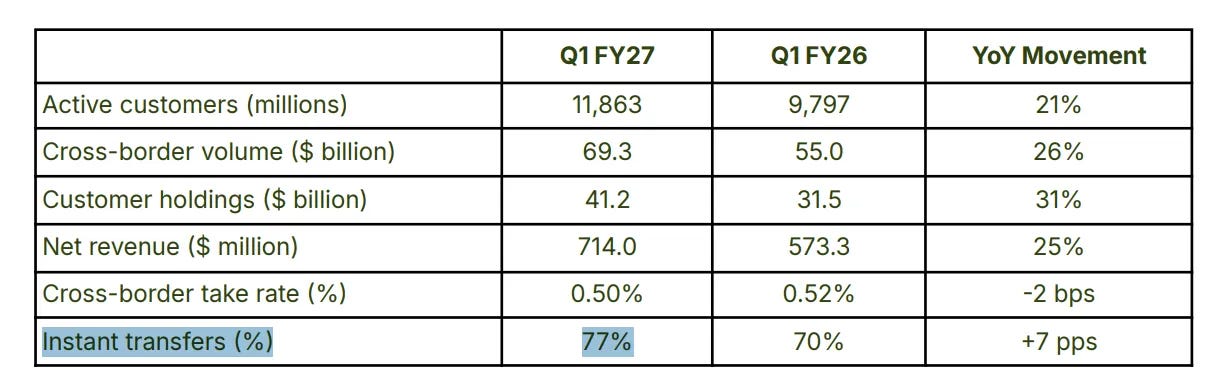
Wise grew cross-border volume at a very high clip last financial year to $243 billion, grew active customers to 19 million, and did that while deliberately cutting its own take rate to 52 basis points. It generated $2.5 billion of net revenue, up nineteen percent, and $660 million of income before tax at a 26.4 percent margin, above its own target range. It announced a buyback exceeding $500 million.
A company with those characteristics can absorb a three-year compliance programme without anyone needing to reach for the smelling salts.
I went through why I think the last set of results was substantially better than the market understood in my recent live stream …
,… and I laid out the broader case for the massive embedded operating leverage in Wise’s model as the company scales in the article below:
“Second, the consensus believes that Wise’s unique cost-plus pricing strategy naturally limits its ultimate profitability, but in this write-up, I argue that the business might reach a point where it will post long-term profit margins vastly superior to current market assumptions – potentially reaching 40% (or more!) as its massive operating leverage unlocks. Why should Wise not achieve 40% pre-tax margins once it captures a dominant share of the global money movement market? The consensus assumes that aggressive price cuts destroy terminal value, failing to recognize that lowering fees is actually a powerful customer acquisition tool that widens an unassailable structural moat.“
In light of today’s news, this sounds like a moonshot prediction, and I agree that that’s the absolute bull case, but I still think the logic I outlined in the piece is sound.
Deep Dive: Wise Plc. – Betting on the Unexpected?!

Investing at an elite level is an exercise in understanding embedded expectations in a stock price rather than simply identifying strong companies (they may be too richly priced!) OR optically cheap stocks (they may be cheap for a reason!).
Here is the reframe I keep coming back to, and I recognize it is the optimist’s reading, so treat it accordingly: Read what’s shared about the OCC letter again. Persistent inability to manage financial crime risk, at a company processing 4.7 million transactions a day across 160 countries. If that assessment is even partially accurate, Wise needed to hear it. A firm on a mission to move trillions cannot get there with compliance infrastructure that three separate regulators have found wanting, and it is better to be forced to rebuild that at nineteen million customers than at ninety (indirect) million.
Painful, expensive, embarrassing in fact, and probably necessary.
Zoom out five to ten years and I suspect this period gets remembered as the one where Wise was made to grow up!
Base Rate Analysis: What usually happens to applications like this?
Before I offer an opinion on whether Wise gets its charter eventually, I want to do the thing that opinions are usually a substitute for, which is to look at what happened to everyone else who stood in the same queue.
Base rates are unglamorous work, but they are almost always more informative than any inside view. I did that work with the help of my Claude “AI superforecaster.”
Build Your Own AI Superforecaster: Base Rates, the Outside View, and the Prompt I Use

Every investor I know has a version of the same experience. A piece of news breaks, the stock drops fifteen percent, and within about ninety seconds you have a view.
So … here a brief summary (I shared the entire output in my community): applications by non-bank fintech, payments and crypto firms for an OCC national trust bank charter, 2020 to 2026, the modern wave of non-depository chartering. Nineteen named applicants, eleven with resolved first decisions, five still pending, three lapsed or withdrawn.
That is the tightest comparison set available to Wise, and it is worth noting up front how small it is (weight of evidence).
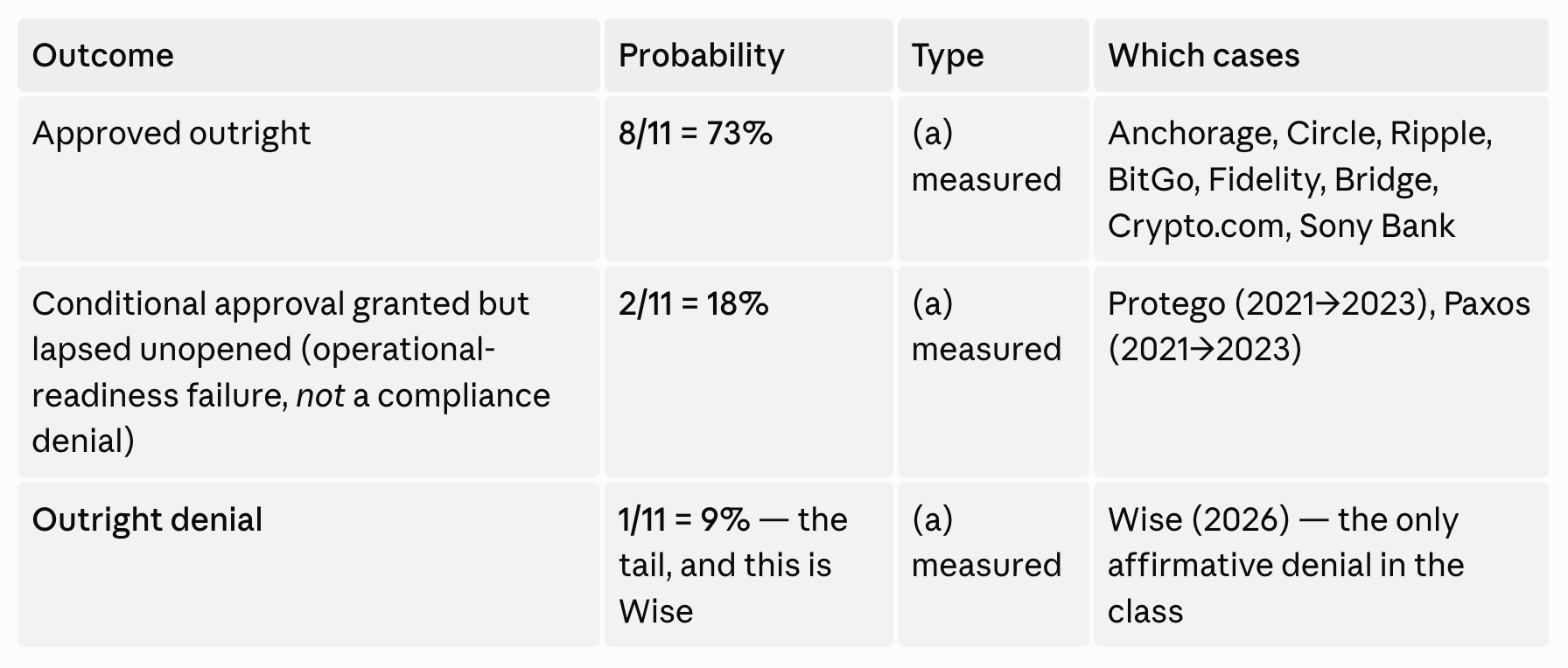
Of the eleven resolved cases, eight were approved outright. Anchorage, Circle, Ripple, BitGo, Fidelity, Bridge, Crypto.com and Sony Bank all cleared.
Two received conditional approval and then let it lapse without ever opening, Protego and Paxos, both having missed an eighteen-month build-out clock.
And one was denied outright. That one is Wise.
Oops.
Embarrassing.
Read that again, because it inverts the story most people are telling themselves this week. The modal outcome in this class is approval, at roughly seventy-three per cent, and the general reading that the OCC is hostile to fintechs seeking federal charters is simply wrong on the evidence.
Under Comptroller Gould the agency approved five national trust charters in a single day in December 2025 and ten inside eight months, a pace with no historical precedent. There are structural reasons for that. A national trust charter carries no deposit insurance, which keeps the FDIC out of the decision entirely, and the FDIC has historically been the harder veto point. The OCC’s own judgement is close to dispositive, and the OCC has signalled it wants more of these, not fewer.
Which means the comforting version of this story is unavailable. Wise is not a casualty of a closed door. Wise is the only outright denial in the entire modern wave. Every other non-approval in the class was a self-inflicted operational lapse rather than an adverse finding about the applicant.
That is a genuine tail, and it is worth pausing on what it implies about the regulator’s process.
The OCC had two softer off-ramps available and used neither. It could have negotiated toward a conditional approval with conditions attached. Or it could have let Wise withdraw quietly, which is the route problematic applicants normally take, as Figure Bank did under litigation pressure from state regulators.
Instead the agency issued a formal, public denial with a fitness finding attached. Regulators do not generally reach for the most confrontational instrument available when a gentler one would do the job.
There is a hole in that arithmetic, though, and it is worth digging into before anyone takes seventy-three per cent to the bank. We just hinted at it. Approval rates measure the applicants who stayed in the queue. They tell you nothing about the ones who were encouraged to leave it, and in federal chartering the encouraged exit is the normal way a weak application dies.
Monzo withdrew its U.S. national bank charter application in 2021 after the OCC signalled disapproval over governance structures and a limited Community Reinvestment Act footprint, and it never got back in, eventually exiting the U.S. market entirely.
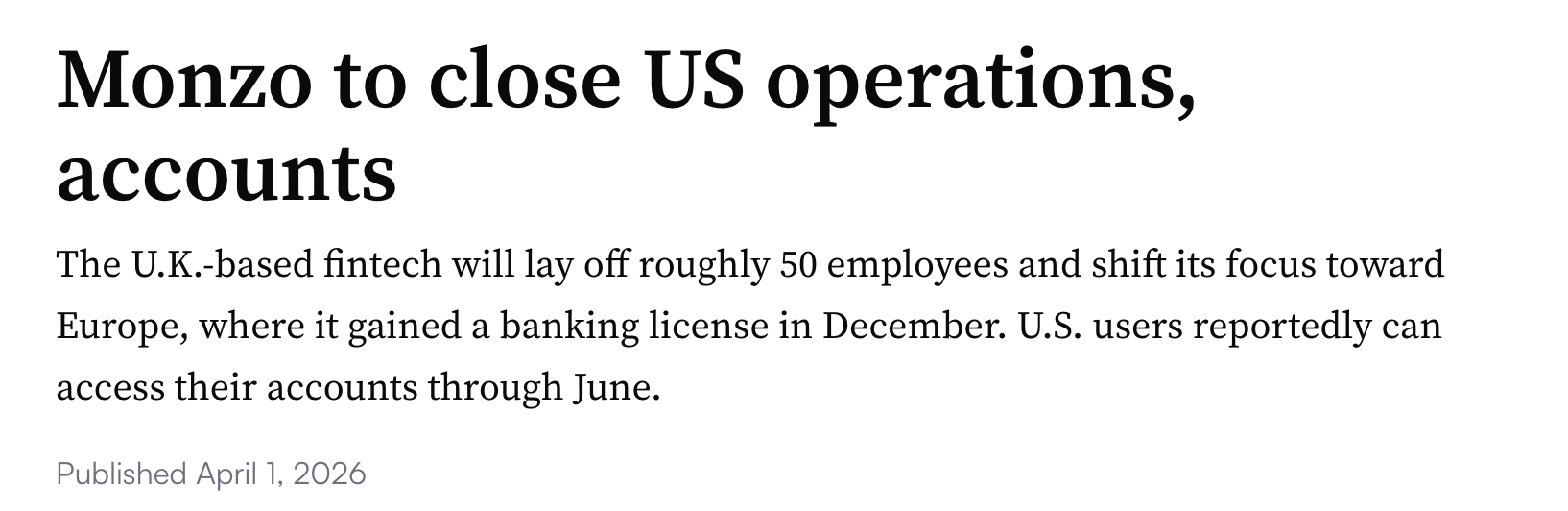
Robinhood abandoned its application in 2019 amid regulatory pushback on risk management controls. Brex and Rakuten each withdrew industrial loan company applications with the FDIC after years of delay. Figure Technologies gave up its uninsured nonbank charter path under aggressive legal opposition from state bank regulators and pivoted back to a conventional FDIC-insured structure.
Five firms, five different flavours of no, and not a single formal denial among them.
Those cases sit outside the tightest comparison set, since Monzo and Robinhood wanted full deposit-insured national charters and Brex and Rakuten were dealing with the FDIC rather than the OCC.
The instruments differ, which is why they arguably do not belong in the tightest reference class. What they do establish is the mechanism, and the mechanism is what makes Wise’s outcome strange.
Regulators generally prefer the quiet exit. It spares the applicant a public record, spares the agency a written justification that can be litigated, and leaves the door open for a future conversation. The withdrawal is the polite door.
Wise was not shown that door, or was shown it and did not take it. If the OCC never offered the off-ramp, the agency wanted the finding on the public record. A formal denial is the loudest available outcome in a process that offers several quieter ones, and Wise received it while eight comparable applicants were being waved through.
To wrap up, again, if withdrawals under regulatory pressure are counted as failures rather than as absences, the real difficulty of the federal chartering gate is meaningfully higher than eight out of eleven suggests, and the modern trust-charter wave looks less like an open door and more like a door that opens for applicants with clean files.
Reapplication Base Rates
Now to another question that matters, which is what happens on reapplication. Here the data thins out to almost nothing. Two firms in this class reapplied after a first-attempt non-approval, Protego and Paxos, and both eventually succeeded.
Two out of two. A hundred per cent success rate on a sample of two, which is the kind of statistic that should make you nervous rather than reassured.
Protego took around three years. Paxos took around two and a half. So the timeline precedent for a successful second attempt is closer to thirty months than to the eighteen-to-twenty-four many commentators are throwing around today.
And there is a caveat here that must not get smoothed over. Both Protego and Paxos failed the first time by missing a build-out deadline. Neither was denied on management fitness or anti-money-laundering grounds. There is no precedent in this class for what happens after a denial of Wise’s specific type. Not a thin precedent. Zero. Any probability anyone attaches to Wise succeeding on reapplication, including the one I am about to give you, is a constructed judgement rather than a measured frequency, and it should be treated with corresponding suspicion.
With that caveat out of the way, my own directional estimate is that Wise probably does eventually get a federal charter of some kind within about three years, either as a national trust bank or under a GENIUS Act framework. Moderate confidence, driven by the strongly pro-charter posture of the current OCC and by the fact that the agency has approved almost everyone else who asked. Being denied again or stalling indefinitely is a meaningful possibility rather than the base case, driven by the fact that the underlying finding is about recurring cross-jurisdiction AML deficiencies that remain unresolved.
Three reasons this case might break the base rate
The first is the one I have already circled. A denial citing a persistent inability of management and board to manage financial crime risk is a fitness finding rather than a clock miss, and fitness is qualitatively harder to cure on a fixed timeline than operational readiness. You cannot schedule your way out of an assessment about judgement. What you can do is build a record, and there is an observable that tells you whether it is working: the state regulators’ two-year monitoring period under the July 2025 consent order runs through mid-2027, and whether that produces clean progress reports is the single most useful confirming or disconfirming signal available. Watch also whether any subsequent OCC statement frames the deficiency as remediable.
The second is the framework switch, and this is where I part company with the more relaxed readings of Wise’s announcement. Wise says it will reapply under a GENIUS Act framework. Every single approval in the comparison set, Circle, Sony Bank, Ripple and the rest, was granted under the pre-existing national trust bank statute, before the OCC’s GENIUS Act implementing rule was even finalized in February 2026. The GENIUS Act nonbank pathway has produced zero completed approvals to date. So Wise would be a first mover in an untested process with no timeline precedent whatsoever, having just been denied under the tested one. There is an argument that this is clever, that it sidesteps a statutory objection the banking lobby has been pressing, and I will come to that objection shortly. There is also an argument that it swaps a known process for an unknown one at precisely the moment when predictability has value. The observable to watch is the first completed GENIUS Act nonbank issuer decision from any applicant, whoever it is, because that sets the real clock.
The third is the one that should temper enthusiasm about a successful reapplication even if it arrives. An OCC charter is necessary but not sufficient. The Federal Reserve paused decisions on payment and master account access for Tier 3 institutions, meaning uninsured trust banks without a Fed-regulated holding company, which is precisely Wise’s category, through the end of December 2026 while it finalizes the payment account framework. Circle, Paxos, Anchorage and BitGo are all already OCC-chartered and all sitting in that same queue. Getting the charter does not get you the wire. Watch the Fed’s final payment account rule, comments on which closed on 27 July, and whether the Tier 3 pause lifts, extends, or hardens into something permanent.
Same kind, or different kind?
There is one more question a base rate cannot answer and that I think determines everything, which is whether Wise’s regulatory problems are a series of unrelated stumbles or one recurring problem wearing different hats.
In 2021, the National Bank of Belgium forced Wise into a remediation plan after finding it lacked proof-of-address documentation for hundreds of thousands of customers.
At some point before 2025, Abu Dhabi’s market regulator fined Wise $360,000 for gaps in its AML systems.
In July 2025 six U.S. states fined it $4.2 million for AML and Bank Secrecy Act programme deficiencies covering an examination period from July 2022 to September 2023, specifically citing inadequate independent review frequency and deficient suspicious activity investigation and reporting.
In June 2026 Brussels prosecutors confirmed a criminal AML investigation into roughly €500 million of transactions.
In July 2026 the OCC denied the charter, citing persistent inability to manage AML risk.
Same kind. Every entry on that list is the identical underlying finding, deficient customer due diligence, transaction monitoring and suspicious activity detection, recurring across four regulators in four jurisdictions and across two legal postures, civil consent orders and now a criminal investigation, over five years. This is not a one-off that happened to land during a charter review. It is a documented pattern in the exact domain the denial is about.
Which brings me to what I think is the genuine misreading in this week’s coverage. The loud risk this week, the one in every headline and already in the share price, is the charter denial. Based on our base rate analysis, denial is the tail outcome and the class strongly favours eventual approval on some timeline.
The other risk is Belgium, and it is structurally worse. A criminal AML finding in the EU could produce standing supervisory constraints, transaction monitoring mandates, capital add-ons, growth caps, that throttle the compounding rate of Wise’s core European volume for years.
Belgium is where Wise Europe is licensed and it is the passport that lets Wise serve the entire EEA, which is a larger share of global transaction volume than the U.S. trust charter would ever have touched.
There is a rough analogy in MoneyGram, which settled a deferred prosecution agreement with the DOJ in 2012 over AML failures, only for deficiencies to persist and the agreement and monitorship to extend through 2018 with an additional $125 million penalty, years after the original headline had faded. I flag that as a directional analogy rather than a verified case study, since I have not gone back through the primary documents.
So if you are going to watch one thing over the next twelve months, watch Brussels rather than Washington. Any statement from the prosecutor’s office on charges, a settlement or a closure, and any parallel move by the National Bank of Belgium on Wise Europe’s licence conditions.
The charter is a slow-burn story about American growth optionality. Belgium is a live risk to the large revenue base Wise already has.
Wise remains still completely misunderstood
I have a private test for whether someone has actually done the work on Wise, and it takes about thirty seconds. Ask them who the competition is. If the answer comes back Revolut, or Remitly, or Nubank, the conversation is over, because those three comparisons each fail for a different reason and the fact that people reach for them tells you they are looking at the app rather than the business underneath it.
Revolut is a neobank assembling a full financial product suite for consumers, monetizing through interchange, subscriptions, trading and increasingly lending. Its charter application in March 2026 was for a de novo national bank with FDIC insurance, personal loans and credit cards, because that is what its model requires.
Remitly is a remittance business, serving a specific corridor pattern with a specific customer, competing largely on distribution and brand in the migrant-worker market.
Nubank is a Latin American consumer bank of enormous quality whose economics run on credit.
None of these is what Wise is. Wise is closer to infrastructure than to any of them, a company that has spent fifteen years building direct connections into national payment systems and is now renting that plumbing out to the banks it was once positioned against. UniCredit, Raiffeisen, MBSB and Capitec did not sign up because they liked the consumer-facing app.
The confusion gets worse when people look at the take rate. Wise cut its average take rate to 52 basis points last year, and management has told the market it intends to take out another one to two basis points per quarter through FY27, with one already gone in Q1. To a conventional Wall Street analyst, this reads as margin erosion under competitive pressure. It is the opposite, and the CFO volunteering the cadence unprompted on a call is the tell. Management teams in trouble do not pre-announce that they will compress their own pricing every quarter for the next year.
Only two kinds of company do that: the inept, and the ones executing so well that lower prices are a weapon rather than a concession. Wise invests in lower prices.
You could call this the Jensen paradox, after the pricing philosophy of deliberately giving away performance gains to expand the addressable market rather than harvesting them. Wise lowers its take rate, which makes it more attractive to customers, which brings volume, which lowers unit costs through scale and through the direct connections that volume justifies building, which funds the next price cut.
That flywheel is well understood by people who have studied Costco or Amazon and almost completely misunderstood when it appears in financial services, where the reflex is to treat every basis point of take rate as sacred.
The customers are not the only audience for those cuts, either. A bank evaluating whether to build its own cross-border capability or rent Wise’s is doing a cost comparison, and every basis point Wise removes from its own pricing moves that decision further in Wise’s favour.
Lower take rate is a customer acquisition tool for the platform business.
A VIC write-up put it well a while back, and it has stuck with me:
“Wise Platform is already established as a serious partner for retail FX, especially for challenger banks serving tech savvy and wealthier clients. But the commercial market is 20x bigger. Massive traction in the commercial market is the only way Wise has a chance to be a £100+ billion company. I think a lot of investors are skeptical that they can take significant share in the B2B space – in the quarter ending March 2024, Business volumes only grew 10% Y/Y. It was very ‘explainable’ – a pause in taking new business customers while they invested in better KYC/UBO onboarding. In the most recently reported quarter, that growth rate is back up to 20%, but a lot of doubts persist. With sub 1% market share, it seems like a world beating company could easily be posting 50% growth rates.”
That skepticism was reasonable when it was written. I think it has been answered. Business volumes have been the engine of the last several quarters, and the reacceleration is exactly what the bull case required.
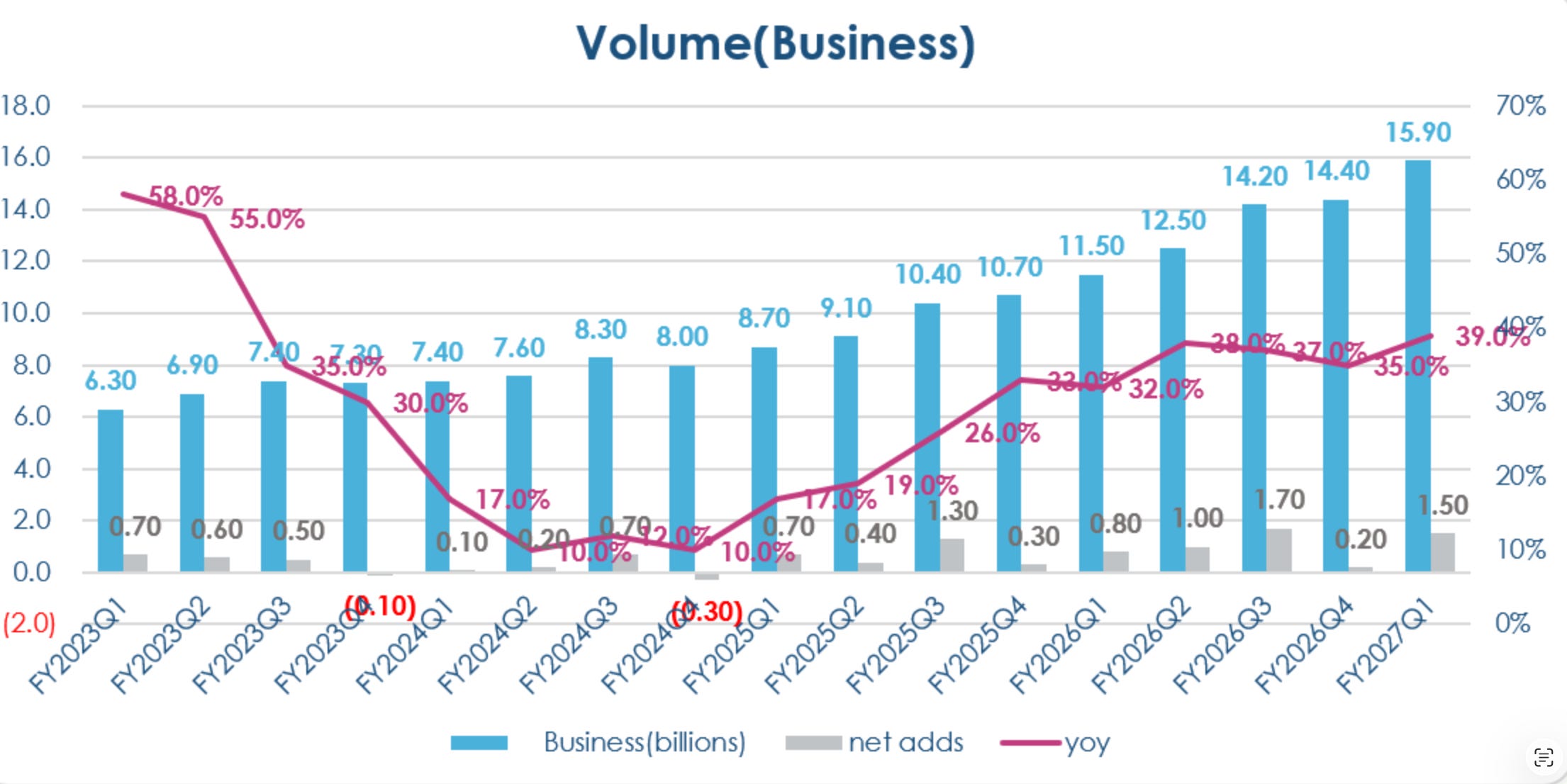
Note also what caused the original slowdown: a deliberate pause in business onboarding while Wise rebuilt its KYC and beneficial-ownership processes. Which is to say, the same category of compliance investment that the OCC has now demanded, producing the same temporary optical damage, followed by faster growth on better infrastructure.
That is not proof the current episode resolves the same way. It is a precedent worth holding in mind, and it is one reason I am reasonably calm about the next eighteen months.
Then there is the question of what else gets built on top. Wise has been debit-only and low-margin by design, and the assumption that this is all it will ever be strikes me as a failure of imagination.
Mike Kytka’s scuttlebutt work on Wise’s job boards is the most useful primary research I have seen on this, because hiring tells you where a company is spending energy months before it announces anything:
“One of my favorite research things I do is finding scuttlebutt and reading job boards for companies I’m researching. It’s a real-time snapshot of where they’re actually putting money and energy before they officially announce it to the public. Five things Wise is building:
Accepting card payments. Wise made its name on sending money abroad. Now they’re building the opposite. Letting businesses and online stores accept card and wallet payments through Wise in 17+ currencies. That’s Stripe and $ADYEN territory, and they think they can do it 30-50% cheaper.
Stablecoins (for real). Last year it was one crypto role. Now it’s a licensed stablecoin and digital-asset team in Dubai under VARA. They play crypto down in public. The hiring says otherwise.
A US bank charter. They’ve applied to charter ‘Wise National Trust’ to land a Federal Reserve master account and plug straight into US payment rails. Investing, coming to North America.
Wise Assets already holds ~$9B. They’re building the US broker-dealer and a Canadian investment dealer to bring it over. Fee income that doesn’t ride interest rates.
Auto-collecting subscriptions. A new product letting businesses pull recurring payments automatically, built on a direct-debit engine. Wise Business is becoming a full business bank account.”
Read that list and then reread the market’s reaction to the charter denial. Four of those five initiatives are entirely unaffected by Thursday. Card acquiring, stablecoin infrastructure, Wise Assets in North America and direct-debit collection all proceed regardless of what the OCC decided, and each is a higher-margin revenue line stacked on top of infrastructure that already exists and is already paid for to some extent.
There is also growing evidence Wise will offer credit cards, most likely as a program manager rather than an issuer, which would let it undercut banks on the FX rate while running the programme more profitably than the incumbents. High-margin revenue on top of cross-border rails. That is the shape of the next decade, and none of it requires a charter.
Downside Risk Thought Experiment
I want to close this section with a thought experiment rather than a valuation, because I find it more useful for thinking about downside than any multiple I could construct.
Ask what Wise’s infrastructure is worth to somebody else. Not what the equity is worth on the market today, but what a JPMorgan or a Citi or an HSBC, institutions moving trillions across borders for corporate clients over correspondent networks they know are expensive and slow, would pay to Wise’s network and growing list of platform partners?
My honest guess is a number that makes the current market capitalisation look silly.
Kristo controls the company and would never sell in my view – he loves building the company too much – so this will not happen and is not a thesis. But it is a floor of sorts, and floors are worth knowing about on days when the stock falls ten per cent on news that changed the timeline rather than the destination.
Disclaimer:
As of the date of publication the author owns shares in the company; but that may change. The analysis presented in this blog may be flawed and/or critical information may have been overlooked. The content provided should be considered an educational resource and should not be construed as individualized investment advice, nor as a recommendation to buy or sell specific securities. I may own some of the securities discussed. The stocks, funds, and assets discussed are examples only and may not be appropriate for your individual circumstances. It is the responsibility of the reader to do their own due diligence before investing in any index fund, ETF, asset, or stock mentioned or before making any sell decisions. Also double-check if the comments made are accurate. You should always consult with a financial advisor before purchasing a specific stock and making decisions regarding your portfolio.
Great article, WISE choosing not to withdraw is odd but I'd emphasize that the OCC decided to make decisions public as of Jun'26. WISE is the first decision to be published since this change, and perhaps their communication to applicants changed as well, maybe as an effort to show the new baseline. The next data point is the large early-2026 cohort of applicants coming up on the ~120 day mark, (especially Payoneer and Revolut's (2nd app)). We should get much more color on the OCC's new standards in the coming weeks
Assuming the worst case scenario (license delayed 3-5 years, profits affected by increased regulatory requirements, short term impacts in the form of fines, remedial work, reputational impact…) the market reaction might be an underestimate. We might be completely correct about the long term trajectory of the business, but how much those FCFs are being discounted to the present day matter just as much if not more than the intrinsic valuation of the business. What I want to say with this is that if you have a stock whose intrinsic valuation is 5x at a certain discount rate, but the forecast period is 20 years and the implied discount rate is 13%, and another one where the stock is worth 3x but cash flows are being discounted by 20%, the second might be the better option.
As capital allocators, we should consider the risks Wise is facing with caution, regardless of how bright the long term future looks. I don't feel like this small dip is an opportunity to buy more, but a reality check, even though the very long term opportunity is unchanged. I like your nuanced take on the second order consequences. Having said all of that, the last time that I heard that a stock was dead money it went up 40% and the last time I heard not to sell it crashed 50%. Fortunately I didn't take that advice in either case. What happens in the next 6 months is anyone’s guess. We can manage risks, but not returns.