

Dear compounders,
Recently I started this series for a very practical reason. Ember Infrastructure Management put a 615p per share proposal on the table for Ashtead Technology, a company I own and have written about at length.
That forced me to think about something most long-term investors prefer to postpone: what would I actually do with the money if I end up selling? I didn’t want a deal to make that decision for me under time pressure. So I decided to work through the seven highest-ranked companies on my watchlist one by one, each through the lens of my perception change framework.
We’ve covered Grab, Novo Nordisk, and LVMH so far. Today is idea #4.
New here? Join 5,100+ subscribers and get 3 FREE GIFTS when you subscribe:
📈 Valuation Spreadsheet
📚 eBook: Investing Visualizations
💡 eBook: 250 Thought-Provoking Quotes
First: A Quick Update on Ashtead
Before we get there, a quick update on Ashtead, because the situation has become more interesting since my last post. On September 30, Sun Mountain Partners, a Boston-based fund that owns Ashtead shares, published a letter it had sent to the board six days earlier.
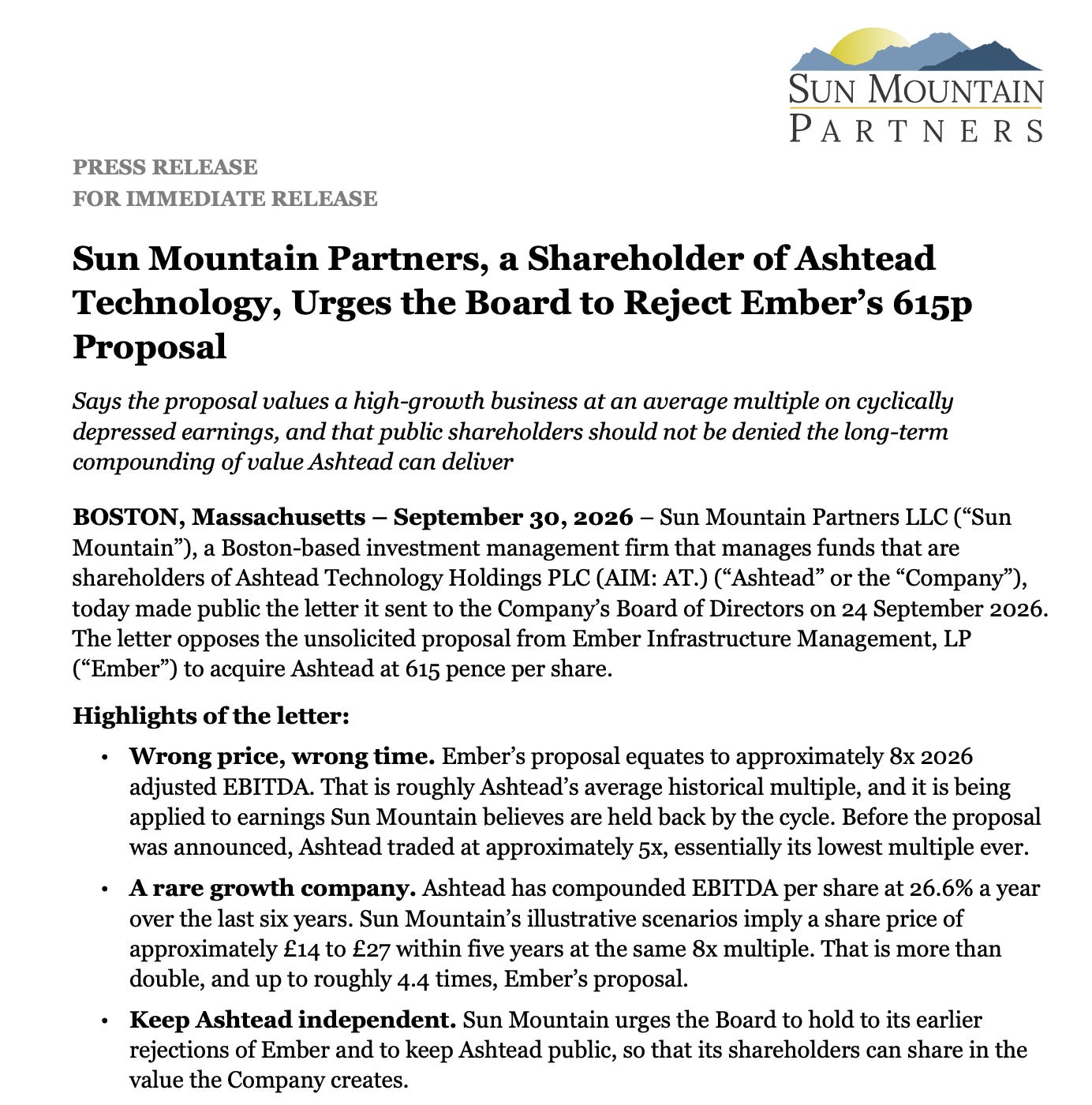
The message is blunt. Reject Ember’s offer and keep the company public.
I want to share the main arguments with you. They overlap with my own view, and they’re a textbook example of how a long-term owner thinks about a takeover price.
The first argument is timing. According to Sun Mountain, Ember’s 615p equates to roughly 8x 2026 adjusted EBITDA, which is about Ashtead’s average historical multiple. Before the proposal surfaced, the stock traded at around 5x, essentially its lowest multiple ever. The fund also believes that earnings were cyclically depressed after the Iran conflict slowed demand. An average multiple on below-mid-cycle earnings is a great deal for the buyer. In the letter’s own words, the headline premium “flatters the proposal only because the starting point is so depressed.”
The second argument is growth. Ashtead has compounded EBITDA per share at 26.6% a year over the last six years. Sun Mountain runs two simple five-year scenarios with an 8x exit multiple and net debt at 1.5x EBITDA. If the last six years repeat, the shares would be worth about £27, roughly 4.4x the offer. If growth halves to around 13.5%, they would still be worth about £14, more than double the offer. A return toward Ashtead’s historical high multiple of 11.6x would push both numbers higher. The fund supports the case with three land-based rental businesses that have similar economics. Ashtead Group returned 80x on invested capital, United Rentals 38x and Herc 4.7x.
The third argument is the most pointed. Sun Mountain says it isn’t writing to help the board squeeze a higher price out of Ember. In its view, no price a private equity buyer is realistically willing to pay would beat the value of keeping Ashtead public. It urges the board to stick with its earlier rejections.
I expressed similar views in my update on Ashtead from August before the proposal was made public:

I agree with the core of the letter. As I wrote in my last update, I believe Ashtead’s intrinsic value sits above 615p. Buying a great business at an average multiple on trough earnings is precisely what a patient private buyer wants to do.
A few caveats are worth keeping in mind, though. The scenarios assume growth comes back after a year that included a profit warning. The fund itself revised the “appropriate” exit range from 40x EBITDA in the original letter to 20–30x in the published version. It also admits that the offer would hand it a very high annualized return after a short holding period.
My own stance is where it was. I still believe the offer undervalues the business, and I remain open to selling for opportunity-cost reasons if the share price moves close to the offer level.
The letter also contains a lesson that goes well beyond Ashtead, and it’s why I put it at the top of this post. Ember’s proposal is perception change investing from the buyer’s side. It arrived when Ashtead traded at its lowest multiple ever, earnings were under pressure and sentiment was as bad as it gets.
That’s the kind of moment I’m trying to identify for every idea in this series. It leads directly to today’s company.
Idea #4: Hermès
If you had told the investing community two years ago that Hermès would show up in a series about perception changes, most would have laughed. Hermès was the one stock where perception never seemed to change. It compounded at about 26% a year for 17 years, turning €51 in early 2008 into €2,781 at the February 2025 peak, roughly a 54x.
Every time it looked expensive, it grew into the multiple and then some.
Then 2026 happened. The stock now trades around €1,280, 54% below its peak. That’s the deepest drawdown since my price data begins in 1994, worse than the Asian crisis in 1998 and the financial crisis in 2009. It’s also the first time Hermès has had two losing years in a row over that period. Investors who bought five years ago are roughly flat in nominal terms and behind after inflation.
Hermès is also the natural follow-up to LVMH. Some of LVMH’s problems are self-inflicted, especially around how it managed exclusivity. Hermès is widely seen as the company that got exclusivity right. So if even Hermès gets derated this hard, I need to understand why. It could be the luxury cycle, macro and tourism, the unwind of the quality-momentum trade, or the first crack in a moat that looked untouchable.
In this post, I’ll look at what the price is telling us and which new insights change how I think about the business. Then I’ll place Hermès in my perception buckets and close with a verdict and a concrete plan.
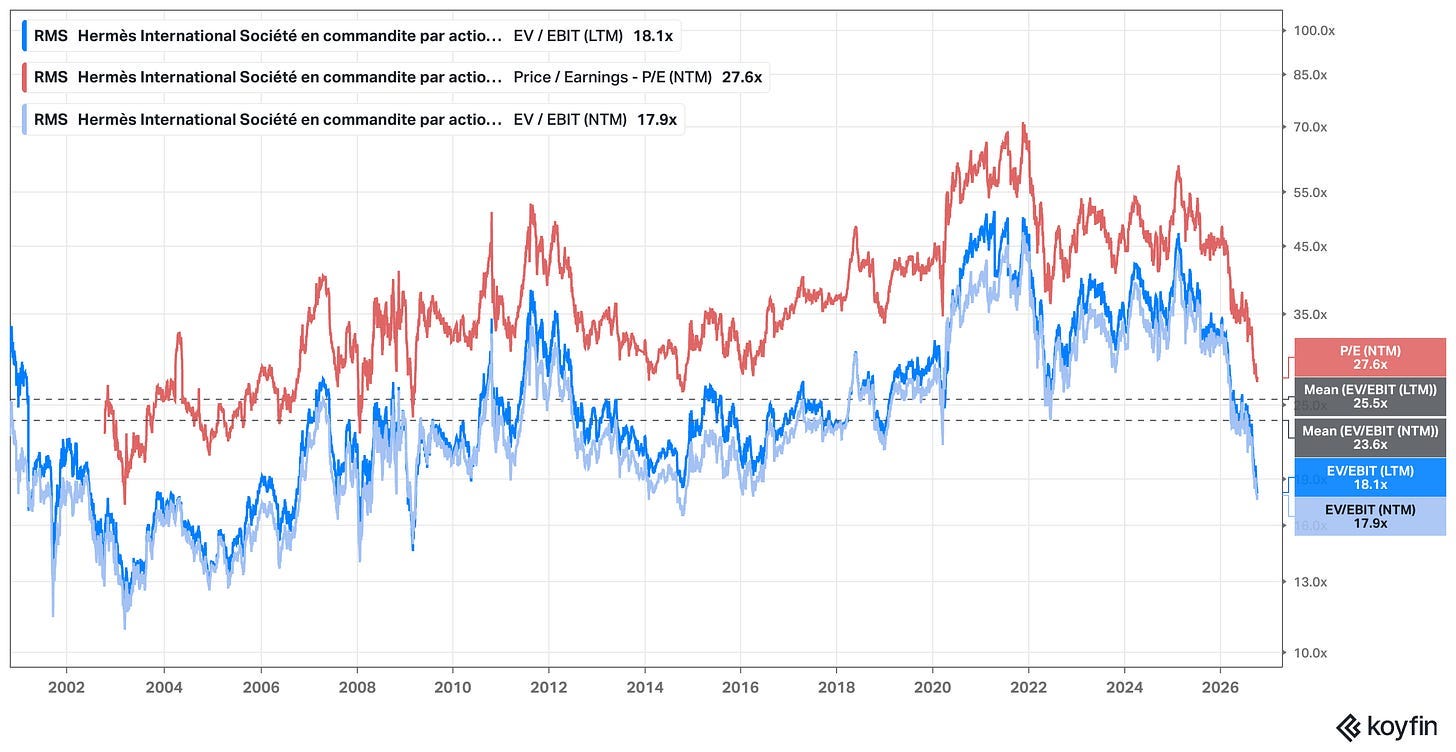
Sun Mountain argues that you should never sell a great company at an average multiple on depressed earnings. Hermès now trades at about 18x EV/EBIT, below its 25-year average, even though its earnings haven’t fallen.
The question is whether the buyer’s side of that argument applies here too.
I wrote about Hermès before here:
What is the price trying to tell us?
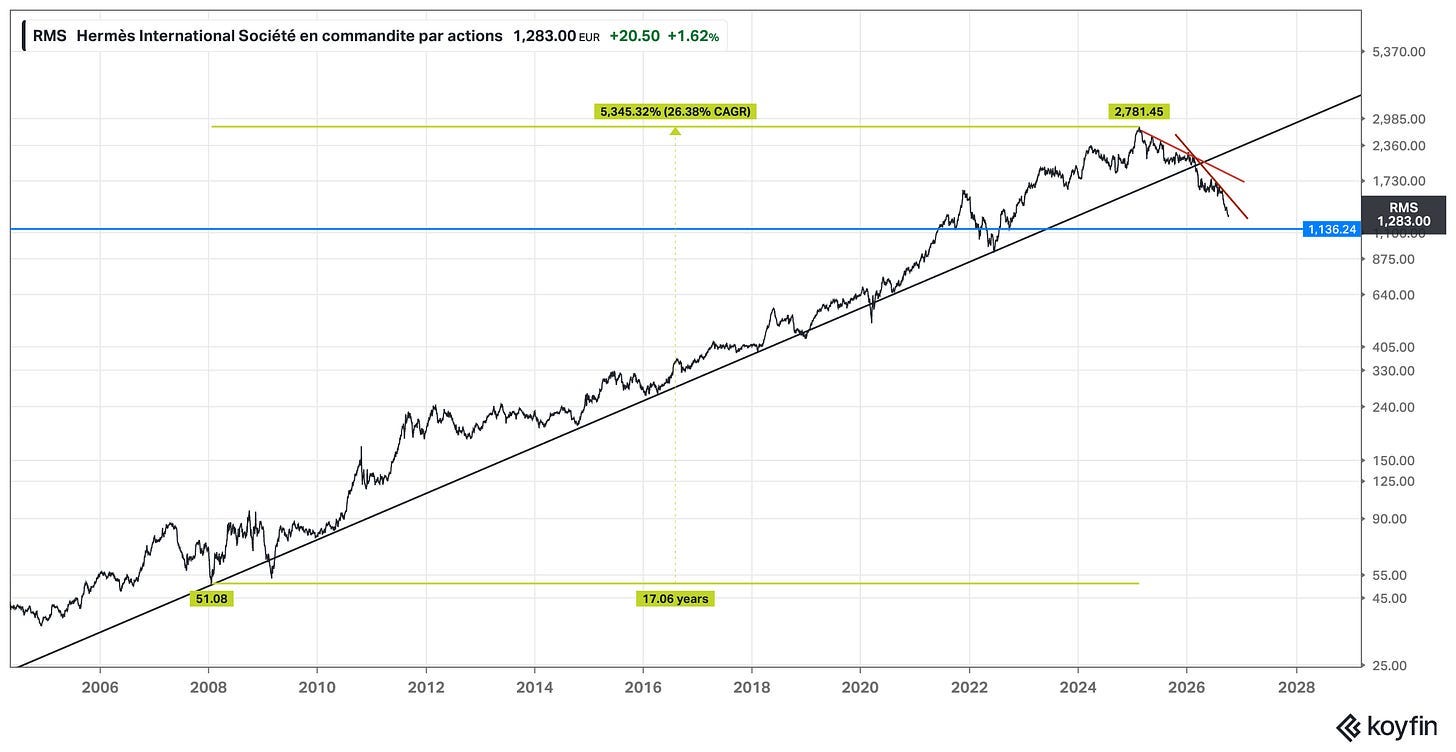
The long-term trendline broke. And it broke hard. Hermès CAGR-ed at 26.4% for 17 years, which is roughly a 54x, from €51 in early 2008 to the €2,781 peak in February 2025. Incredible stock performance. But that long-term trend line has been broken now.
What makes this break different from the 2022 wobble is that price never came back to retest the line from below. It sliced through it in the spring sell-off and has kept falling since, which is textbook behavior for a long, steep and very clean uptrend that finally gives way. That’s the CSU and Diageo pattern from Part 3 of my perception change framework. The longer and cleaner the trend, the more holders anchor to it, and the harder the unwind once it breaks.
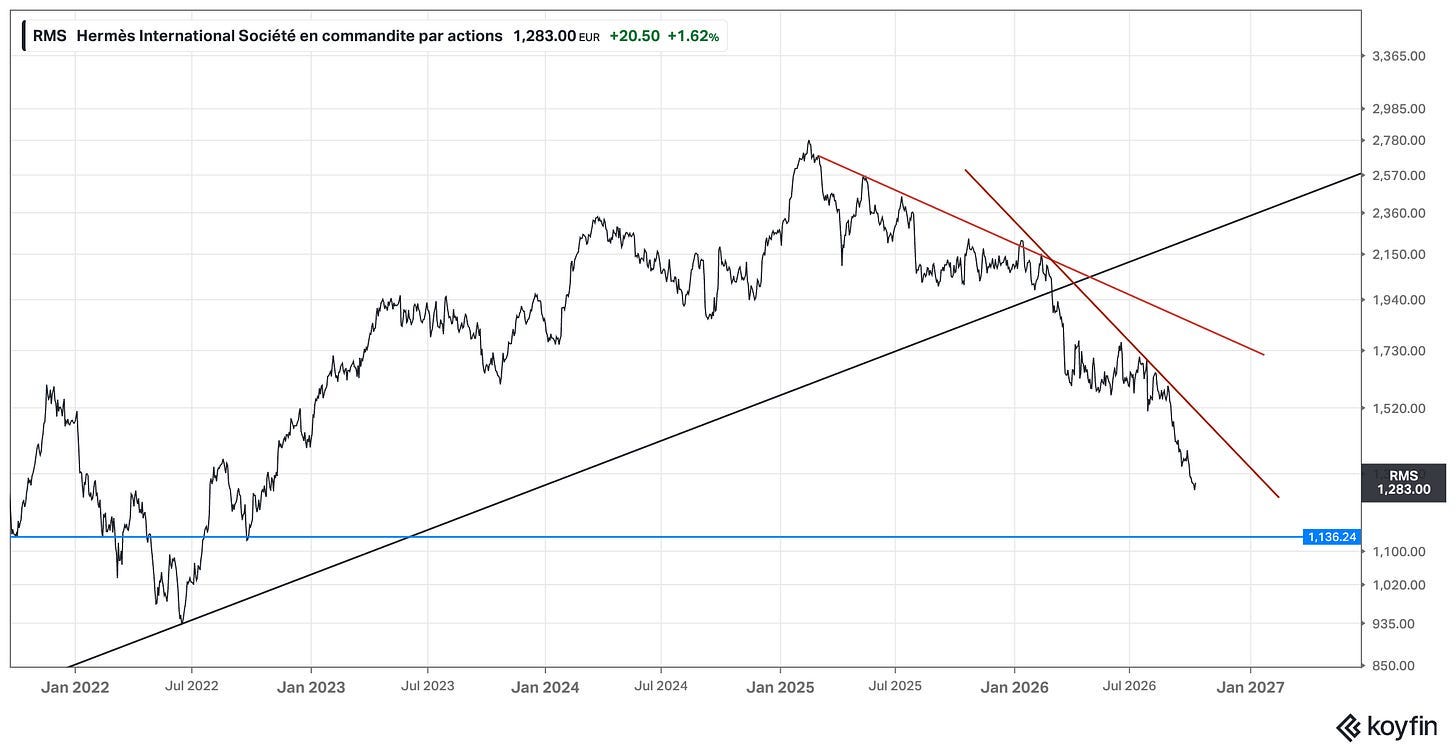
The next support level sits at around 1,135€ per share. We’ve significantly fallen below the initial downtrend with 4-5 touch points. In the shorter term, there is an even steeper trendline that started earlier this year and we are even significantly below that line now too.
There’s a lot of downward momentum for now and no clear indication this will change anytime soon. Price hasn’t touched either line since the summer, so we aren’t anywhere close to the confirmation-from-the-other-side test I’d want to see.
Two things make the €1,135 level more interesting than a random line on a chart. A 60% drawdown from the February 2025 peak lands at roughly €1,113, almost exactly on that support, and 60 to 70% is the zone where my “just buy the puke” exception from my framework starts to apply.
And when UBS downgraded the stock to Sell on October 5, it set its new price target at €1,168. The sell side is now pointing at the same area the chart does. I wouldn’t treat that as a floor, though. If €1,135 gives way, the 2022 low around €935 is the next level I see, which would mean a drawdown of about 66%.
Is sentiment bombed out, or is there still some air left to let out?
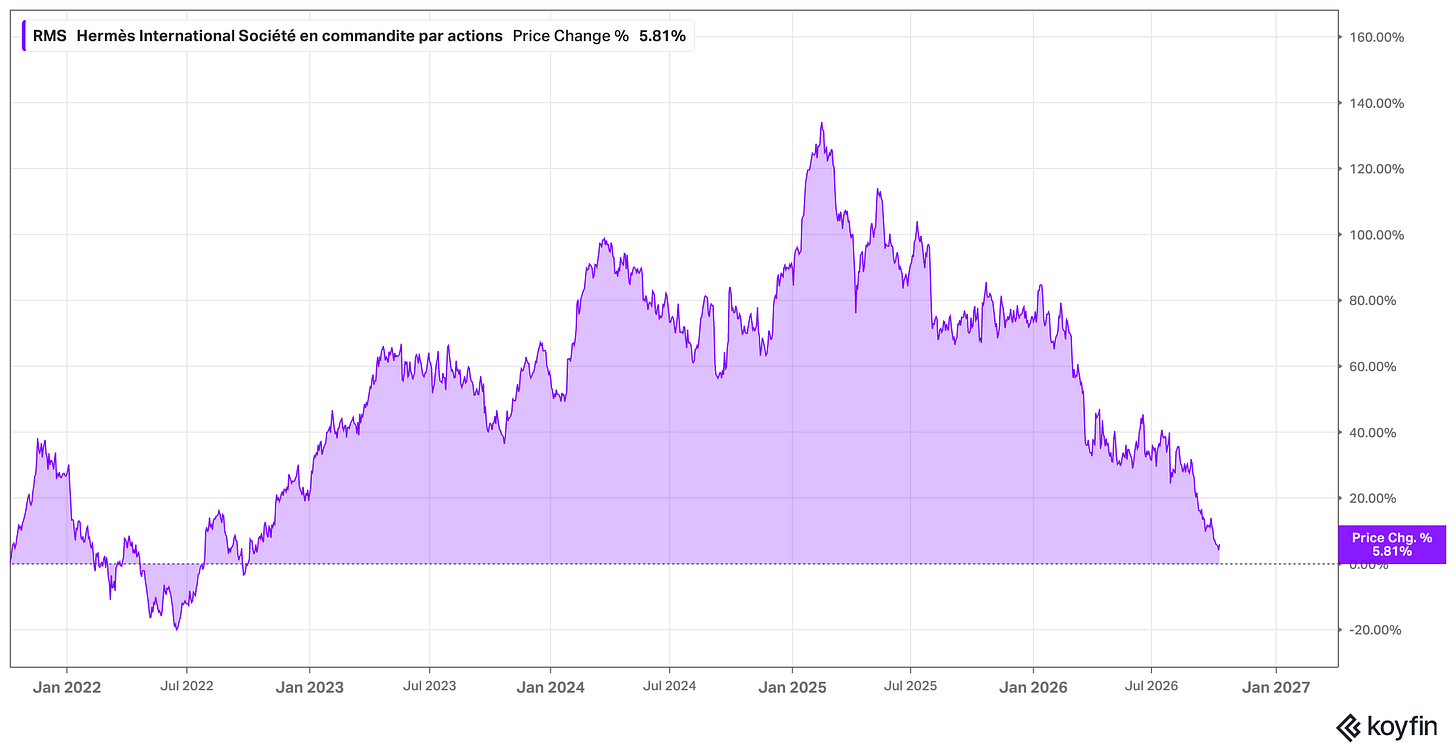
Hermès is now entering half a lost decade. When you factor in the inflation levels of the past five years, the stock has been a complete disappointment and lost you real purchasing power.
The share price is up only about 6% over five years, while cumulative eurozone inflation over the same stretch ran at roughly 20%.
Even with dividends added back, anyone who bought in late 2021 is behind in inflation-adjusted terms.
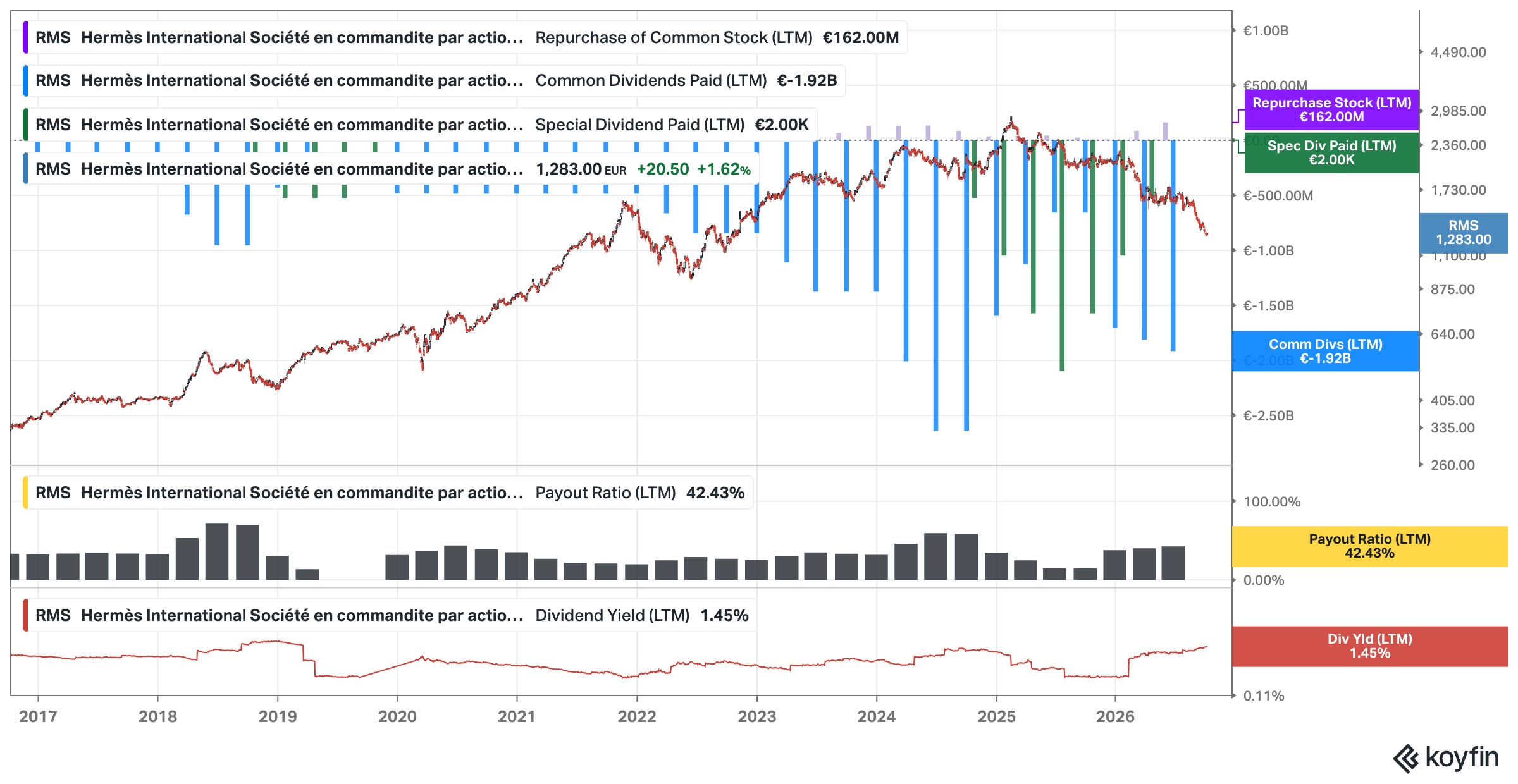
That’s the “half a lost decade” pattern I described in my piece carrying that title. And it matters for perception.
Five years of dead money is long enough for a whole cohort of holders to give up, and that cohort is exactly the kind of seller I want to see exhausted before I step in.
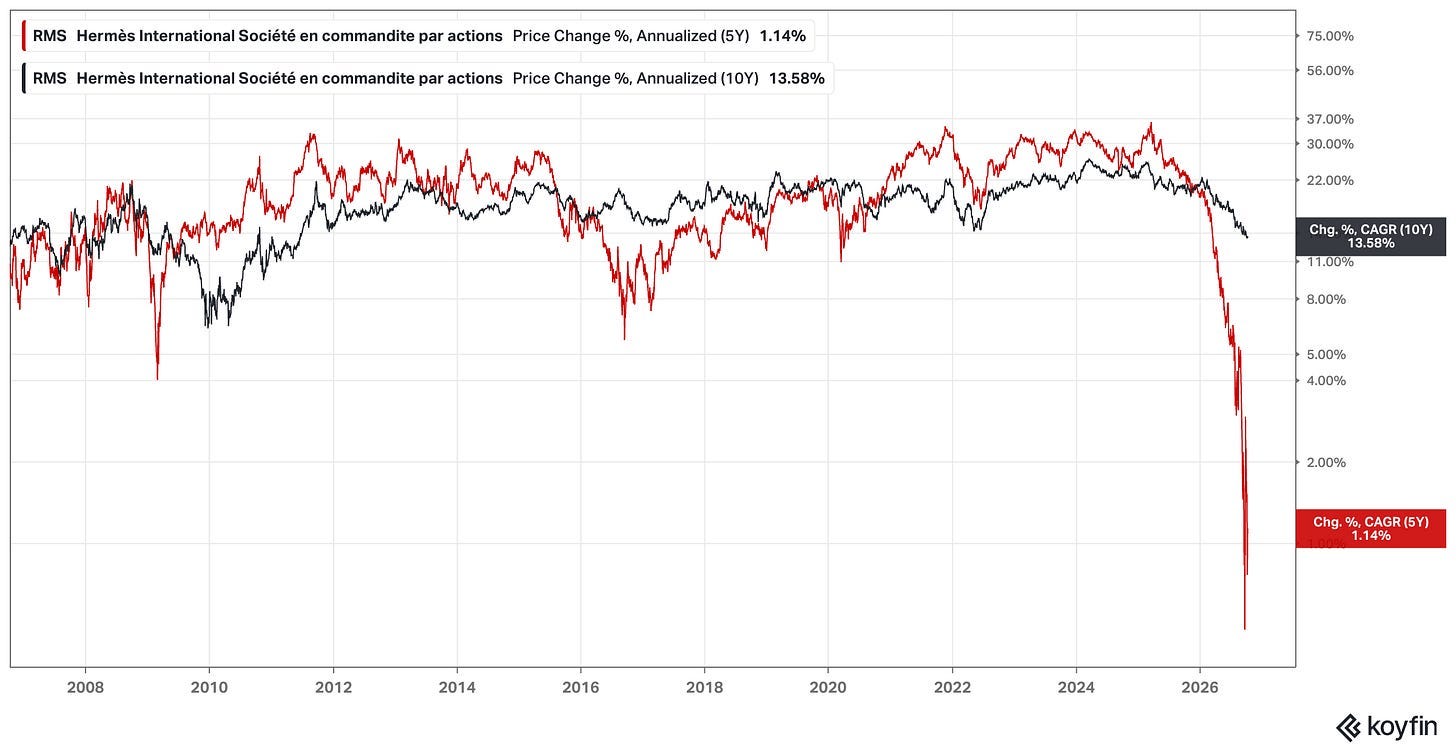
As a result, the 5-year CAGR dropped significantly throughout 2026. The 10Y CAGR is still in market-beating territory, though. The 5-year figure went from above 30% in early 2025 to about 1% today, while the 10-year figure still reads 13.6%.
Still, a 1% five-year CAGR on the former poster child of quality compounding is the kind of figure that triggers exits from funds that have to justify every position to their own clients.
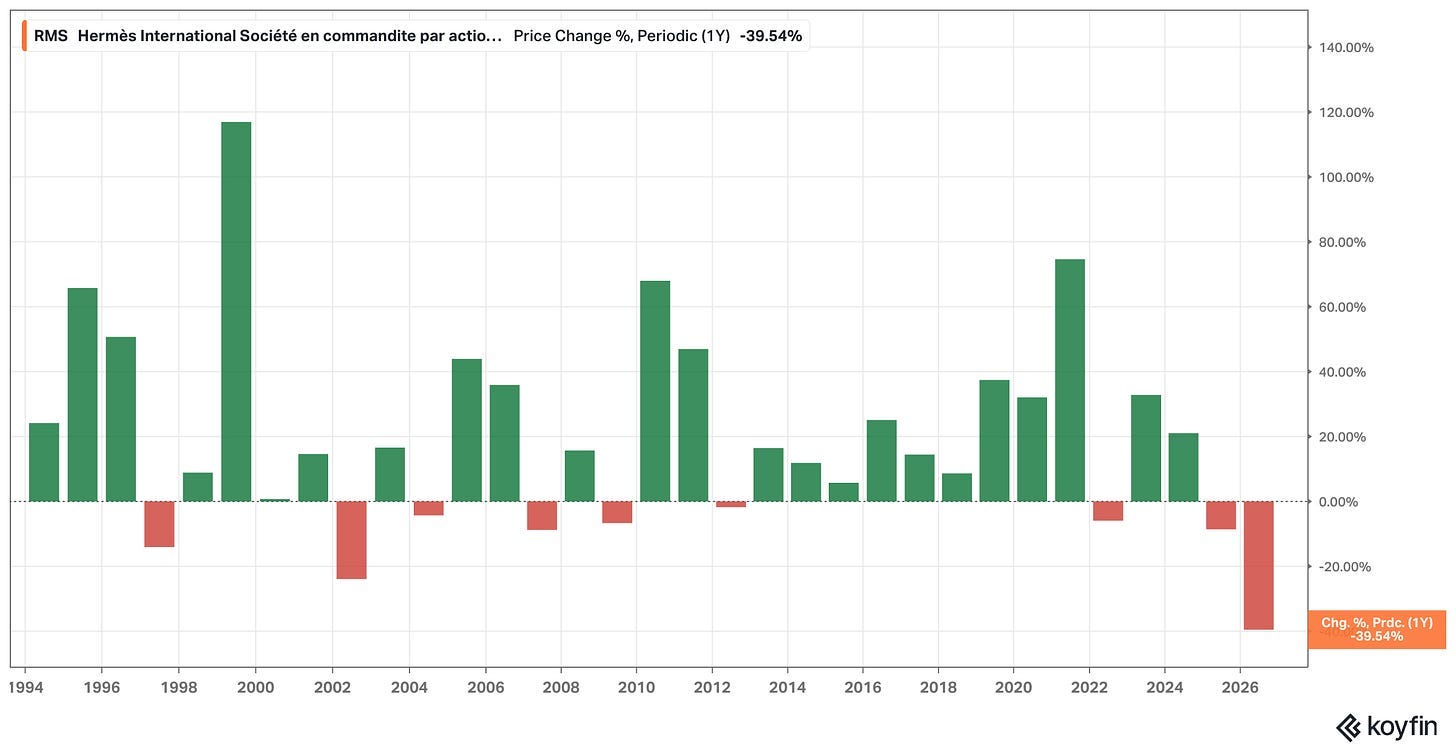
Moreover, Hermès experienced two down years in a row now. Hermès hasn’t had back-to-back losing years at any point since the data in this chart starts in 1994. The roughly 40% loss in 2026 so far is also the worst calendar year on record by a wide margin. The previous worst was 2002 at around -24%.
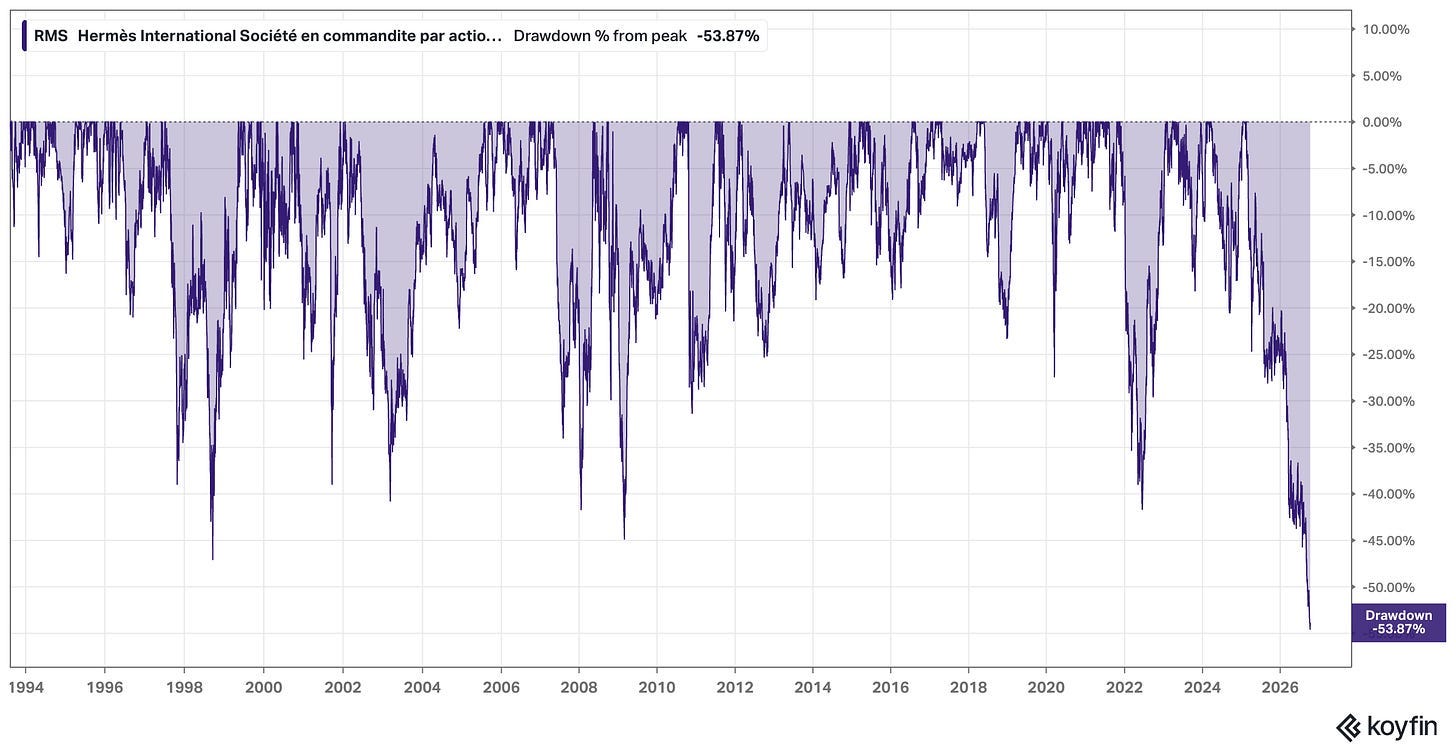
Biggest drawdown for Hermès on record. At -54% from the peak, it is now deeper than the 1998 Asian crisis (about -47%) and the 2009 financial crisis low (about -45%), and it has lasted 20 months already. In 1998 and 2009 a global shock hit the business and the stock recovered once the shock passed. This time the shocks are narrower (the Middle East, tourism into Europe, China, a strong euro), while the multiple compression is broad. Recurring operating profit was still slightly up in H1 2026. Most of this drawdown is a rerating of what investors are willing to pay for Hermès.
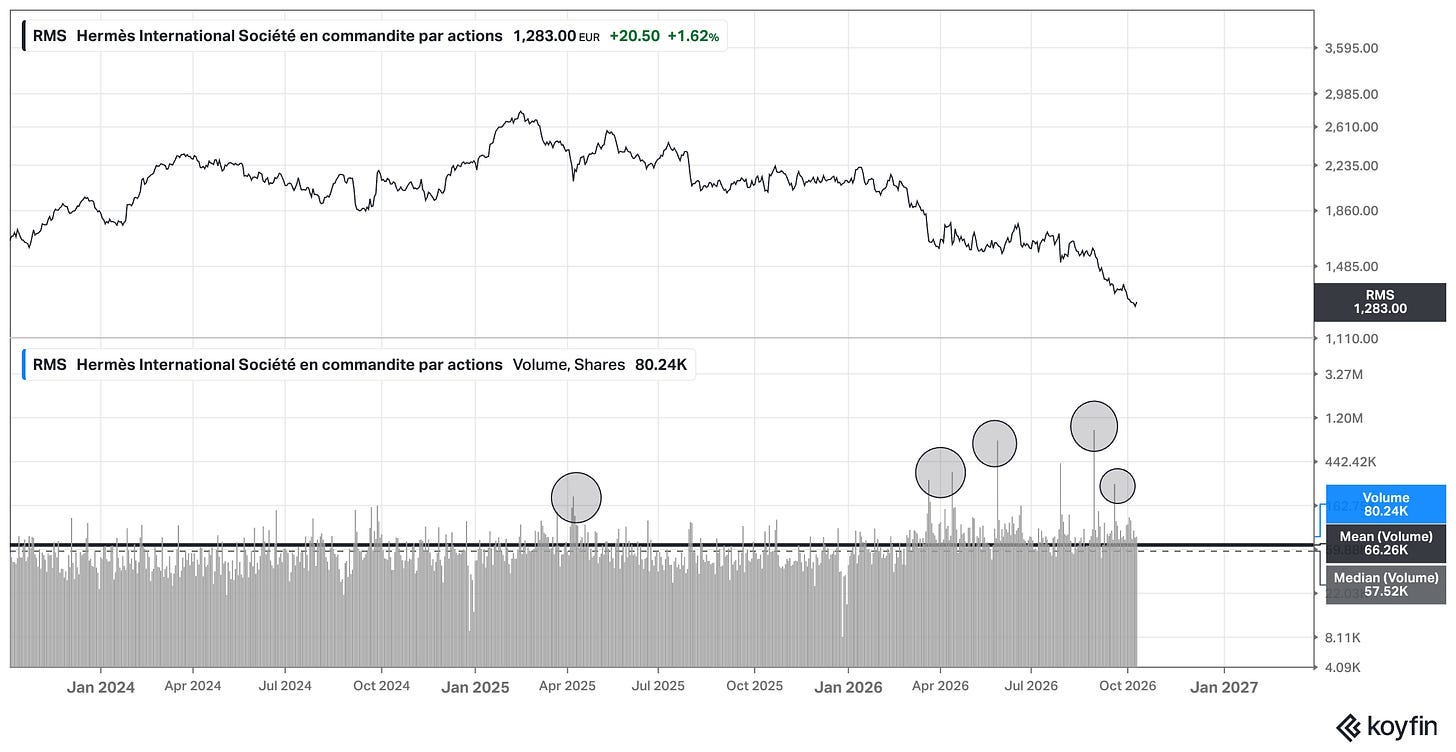
Multiple major volume spikes, none of which marked a bottom. The largest spikes came around the record 14% one-day drop on April 15 after the Q1 sales miss and during the wave of downgrades in late September and early October, when Rothschild & Co Redburn, Citi and JPMorgan cut their views, and UBS downgraded to Sell on the same day Goldman Sachs initiated at Sell.
What I’m missing is the classic capitulation signature, a huge volume day followed by price refusing to go lower.
Every spike so far was followed by lower prices, so sellers are still in control. Volume on the latest leg down has only been modestly above average, which looks more like steady distribution than panic.
Two confirmation signals from Part 3 are worth adding. Insiders have been buying all year, and only buying. According to the AMF filings, members of the Hermès family and of the management and supervisory boards bought close to €40m of stock across multiple transactions in 2026, from €1,900 in March down to about €1,350 in late September, with no sales at all.

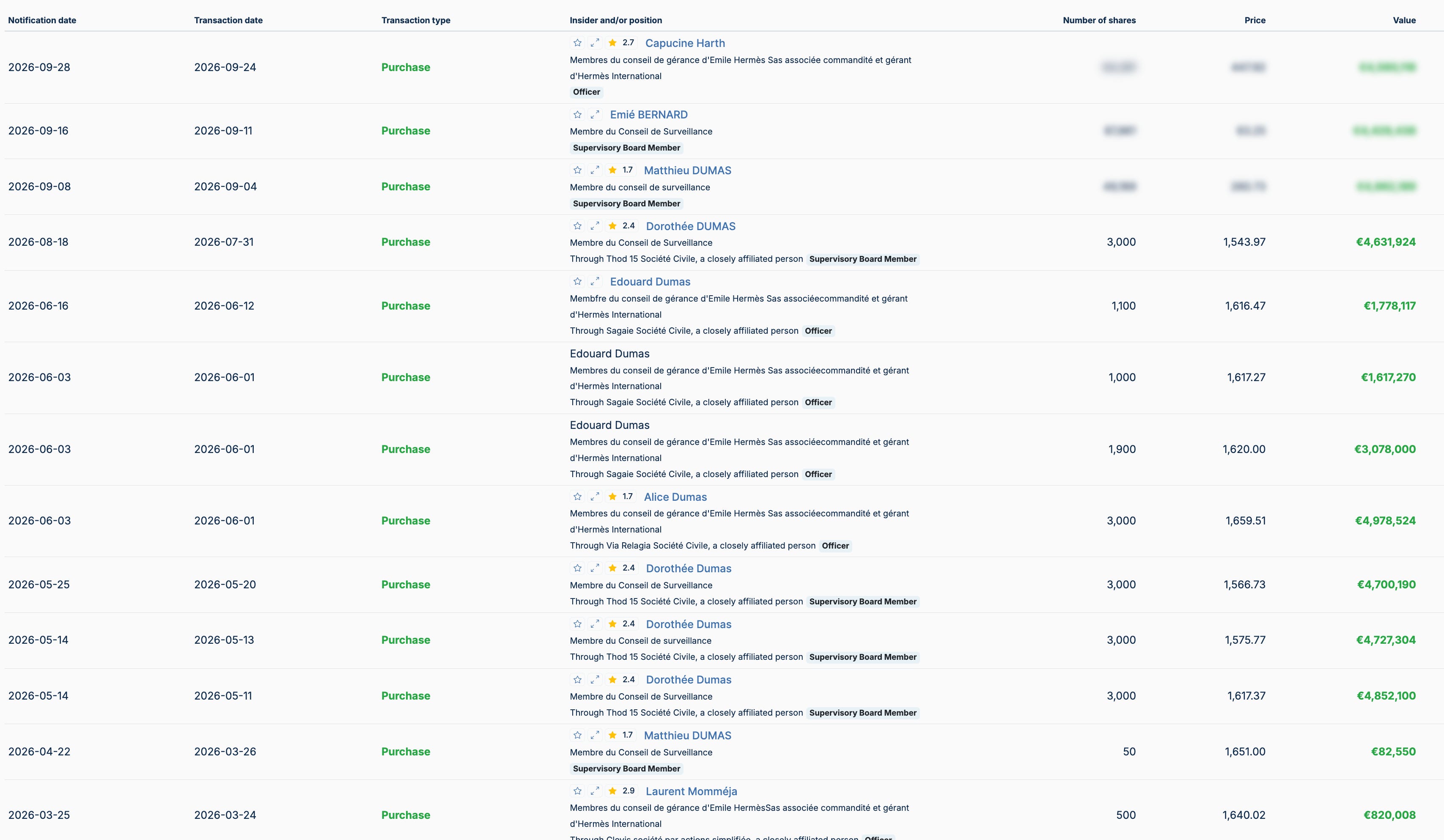
The people closest to the business think the price is wrong. They were also early, which is the frequent pattern with insider buying and the reason I treat it as confirmation only.
The second signal is sell-side sentiment. Within about a week, five major brokers cut ratings or targets, and UBS lowered its long-term growth assumption from 5% to 3%. Analysts tend to capitulate after the stock has already done the work. When the consensus turns bearish only after a 50% decline, I read it as a contrarian marker.
TL;DR: What is the price trying to tell us?
The price is telling me that the market no longer believes in Hermès as a perpetual double-digit grower, and that the people who owned it for that reason are still leaving. The trend is down on every timeframe I look at, both trendlines broke without a retest, volume hasn’t produced a capitulation day, and the drawdown is already deeper than in 1998 and 2009.
Running it through the appendix checklist of my framework, the trend is clean and negative, and there is no stabilization yet. No base. No higher low. On price alone, this is an “avoid” or at best a “watch.”
What makes it interesting is that the drawdown, the sentiment, and the valuation have reached levels that rarely coexist in a business of this quality.
Qualitative Perception Analysis + Other Qualitative Thoughts
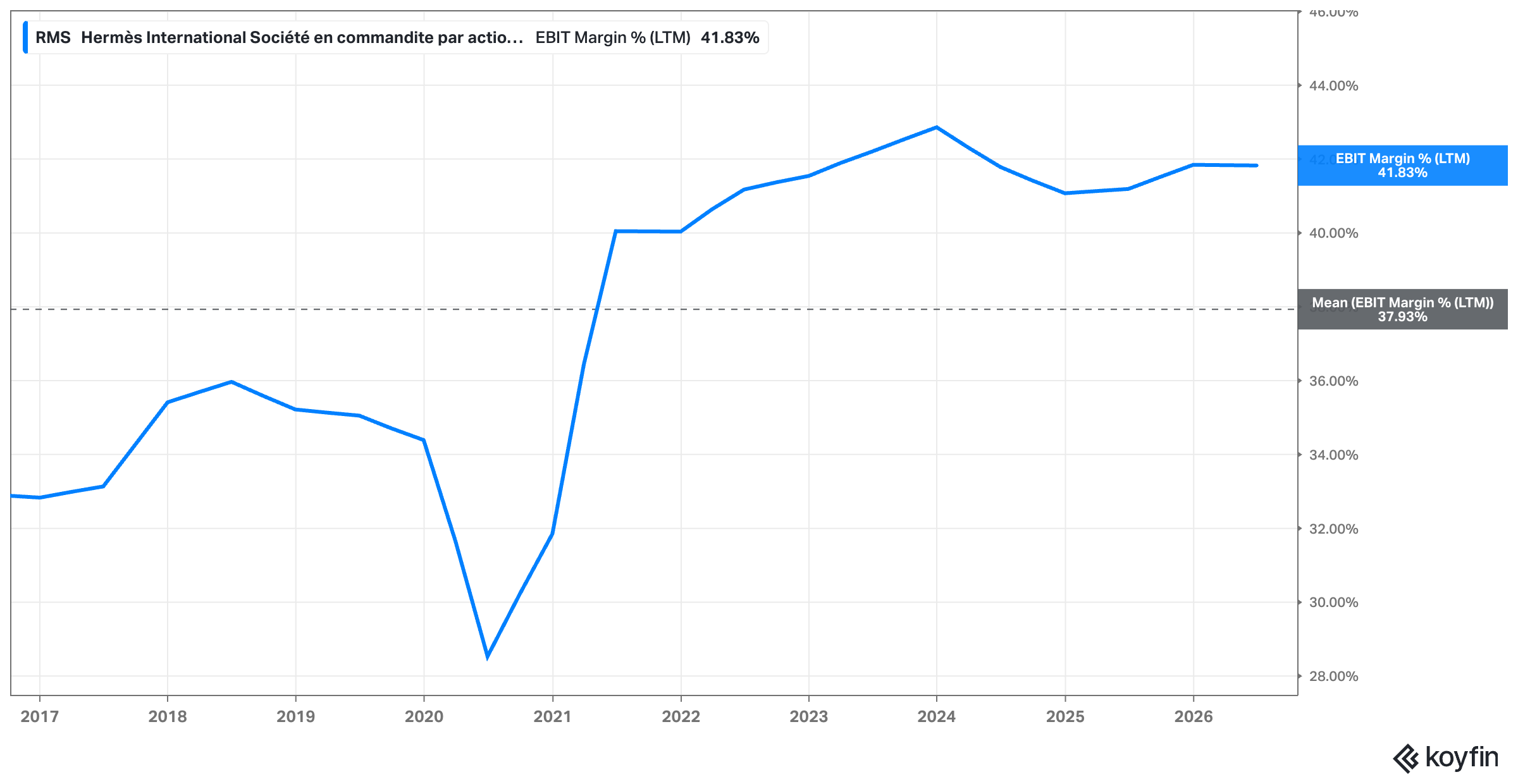
There isn’t all that much to say about Hermès as a business and its quality. It’s a standout business, one of the best in the world, pure luxury with a lot of pricing power. In short: clearly an above average business that most investors would like to own at the right price, that is now entering a rougher macro environment and also, just like LVMH, suffering from some pull-forward dynamics from COVID still. The H1 2026 numbers back up the quality part. Leather goods grew almost 10% at constant currency, management says demand still exceeds production capacity, and the recurring operating margin held at 41.0% despite a currency hit of more than €360m to revenue.
Based on this, this is more about finding the right timing to own it. As an investor, your main job is to be patient, and you cannot own every great business because great businesses rarely trade at stupid prices.
If you look at the historical valuation multiple chart, Hermès interestingly never looked cheap, but given the CAGR over the last 20 years, that high optical multiple was always misleading investors and Hermès was, in fact, cheap throughout. Today it trades at about 18x EV/EBIT and 27.6x forward earnings. That’s the lowest EV/EBIT multiple since 2016 and well below the 25-year mean of roughly 25x.
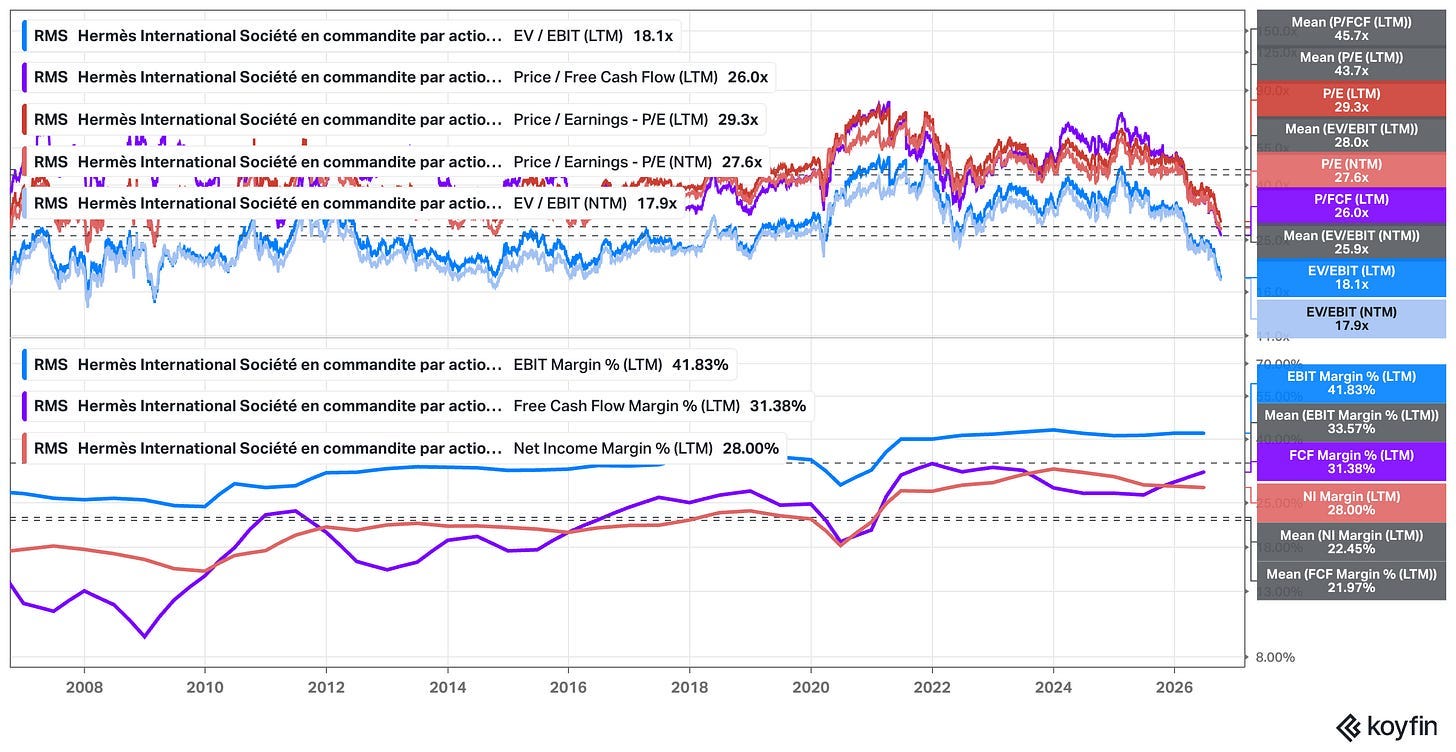
I believe what investors always underestimated about Hermès is the value in its terminal period and the length of its competitive advantage period. If you followed a textbook approach of valuing Hermès with a DCF and modelled some kind of growth in the first two growth stages before returning to a 3% terminal growth rate, of course you misvalued Hermès. You have to switch your brain on. I think the biggest strength of Hermès over many companies in the “quality compounders opportunity set” is exactly the length of the CAP and the predictability and forecastability that comes with it. I’m pretty sure that Hermès will still be around in 2050. I’m less certain about that for Booking, as I discussed in my recent piece on agentic AI. And if there is a low degree of predictability, valuing a business becomes much harder; you have to demand a much higher margin of safety, and you might just as well pass on it entirely because you cannot value it properly. This is where today’s price gets interesting. At €1,200-1,300 Hermès has a market cap of around €134bn and about €10-12bn in net cash, so the enterprise value is roughly €122bn, maybe a little higher (napkin math).
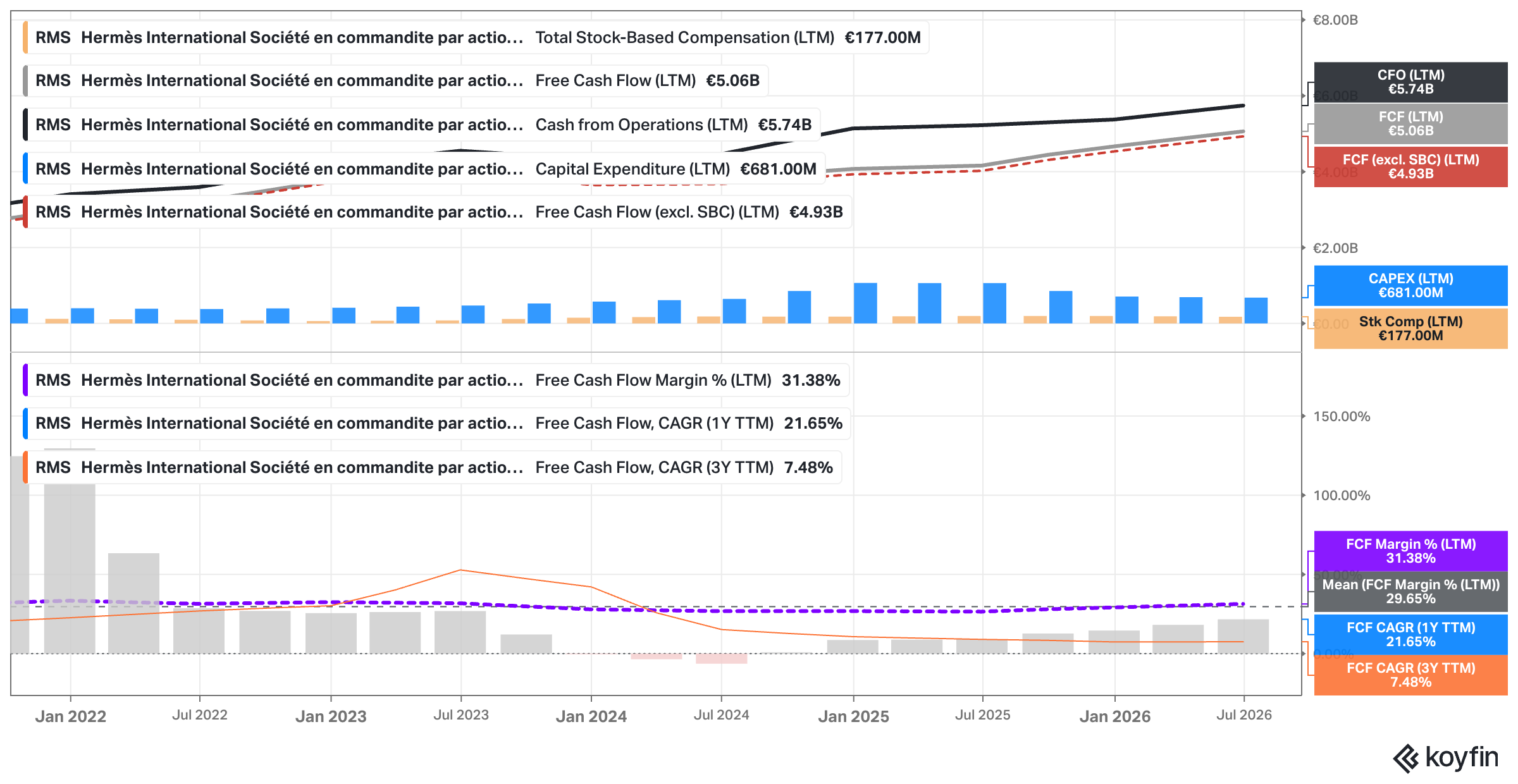
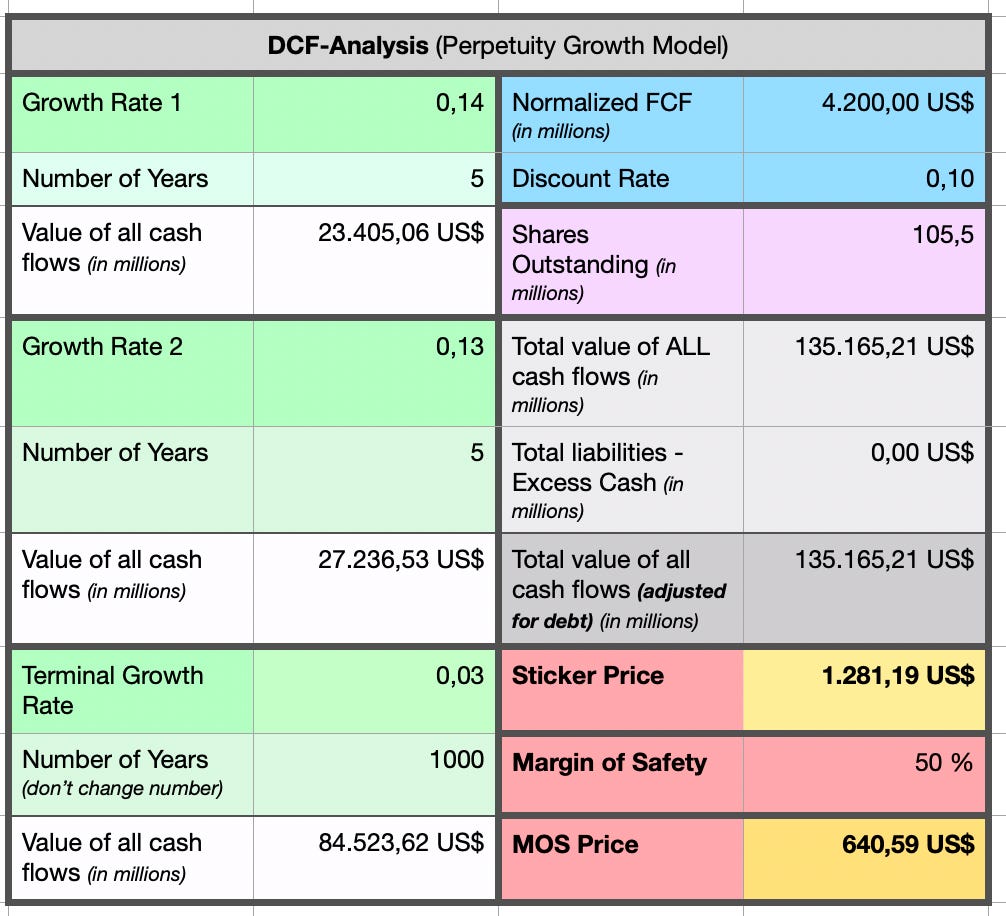
I ran a simple reverse DCF (Hermès is one of the few companies where I think a DCF makes sense; for the reasons discussed above) on trailing free cash flow of about €4.2bn (FY2025 (€3,880m) plus H1 2026 (€2,182m) minus H1 2025 (€1,847m); note: Hermès’s “adjusted free cash flow” already deducts lease repayments as well as capex. So it is closer to an owner-earnings figure than the naive operating cash flow minus capex you’d get from a data provider, which would come out a few hundred million higher) with a 10% discount rate and a 3% terminal growth rate (which, as outlined, is likely too conservative!) after ten years.
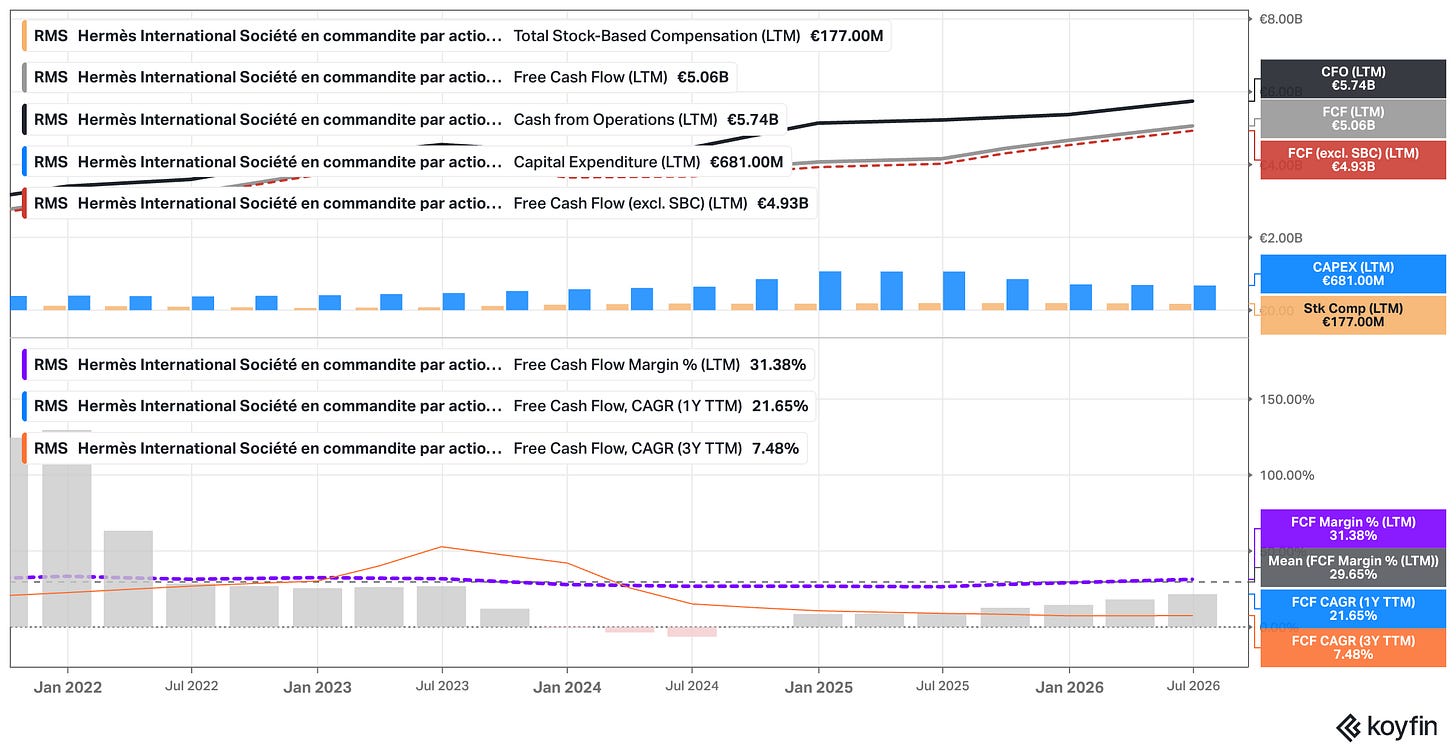
The market is pricing in about 13-14% annual FCF growth for the next decade and an ordinary company growth rate forever after that.
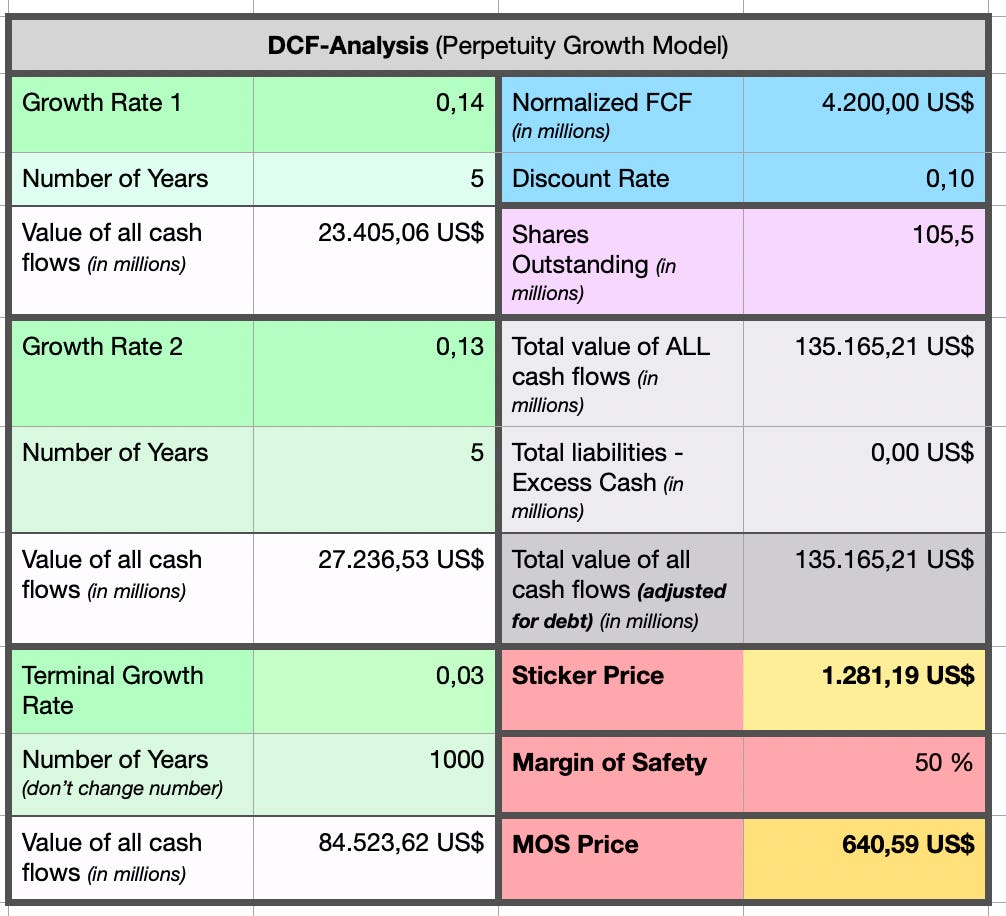
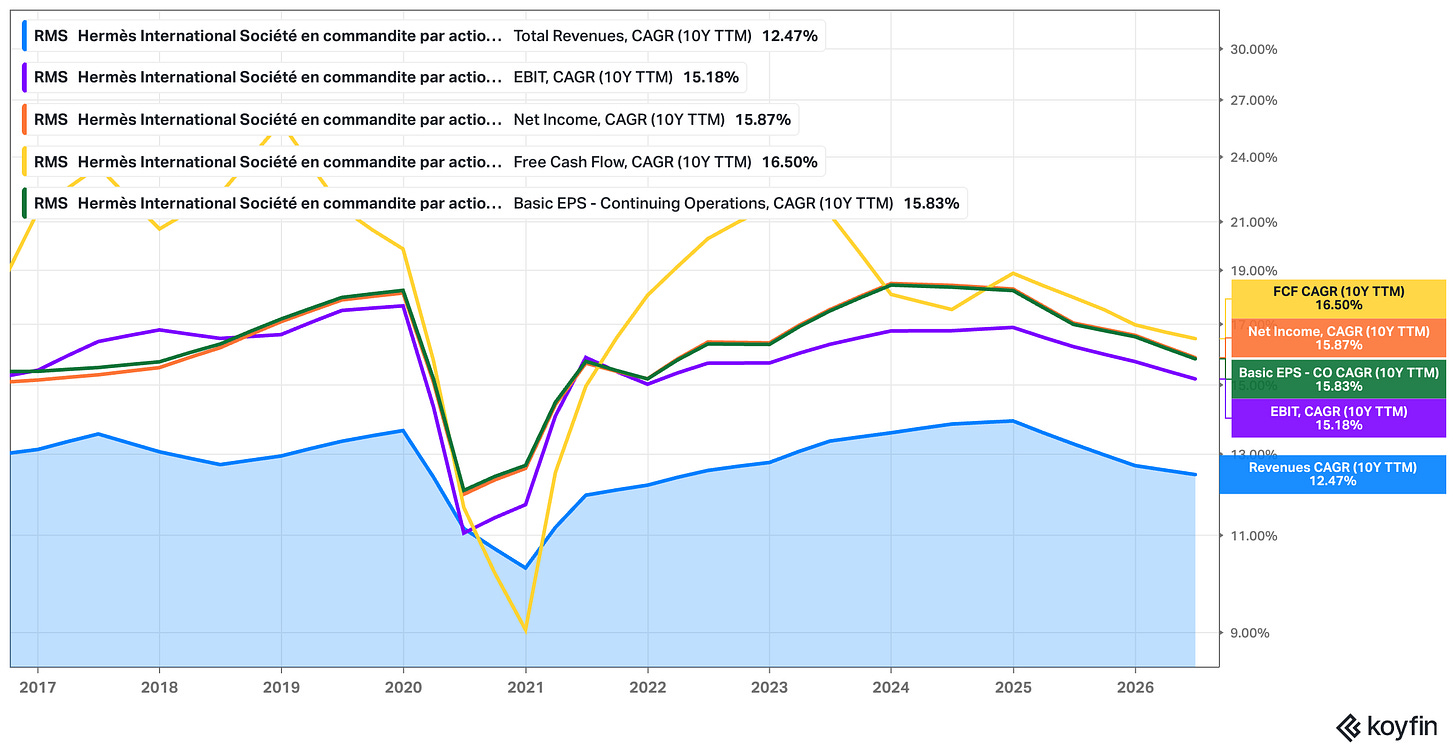
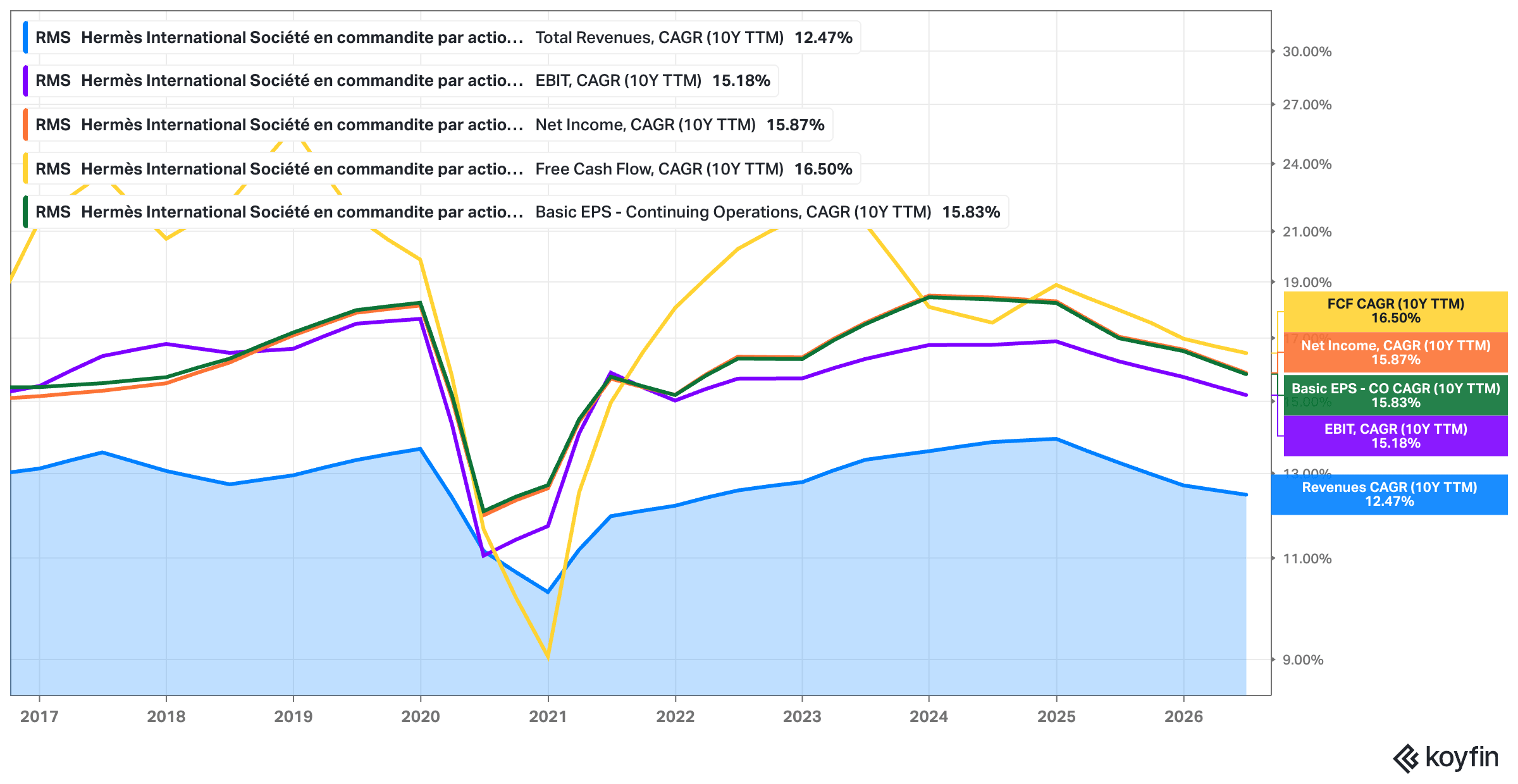
Replace USD with Euros (I didn’t bother fixing it) Revenue compounded at almost 13% a year over the past decade, and even in this soft patch the business grew 6% at constant currency in H1.
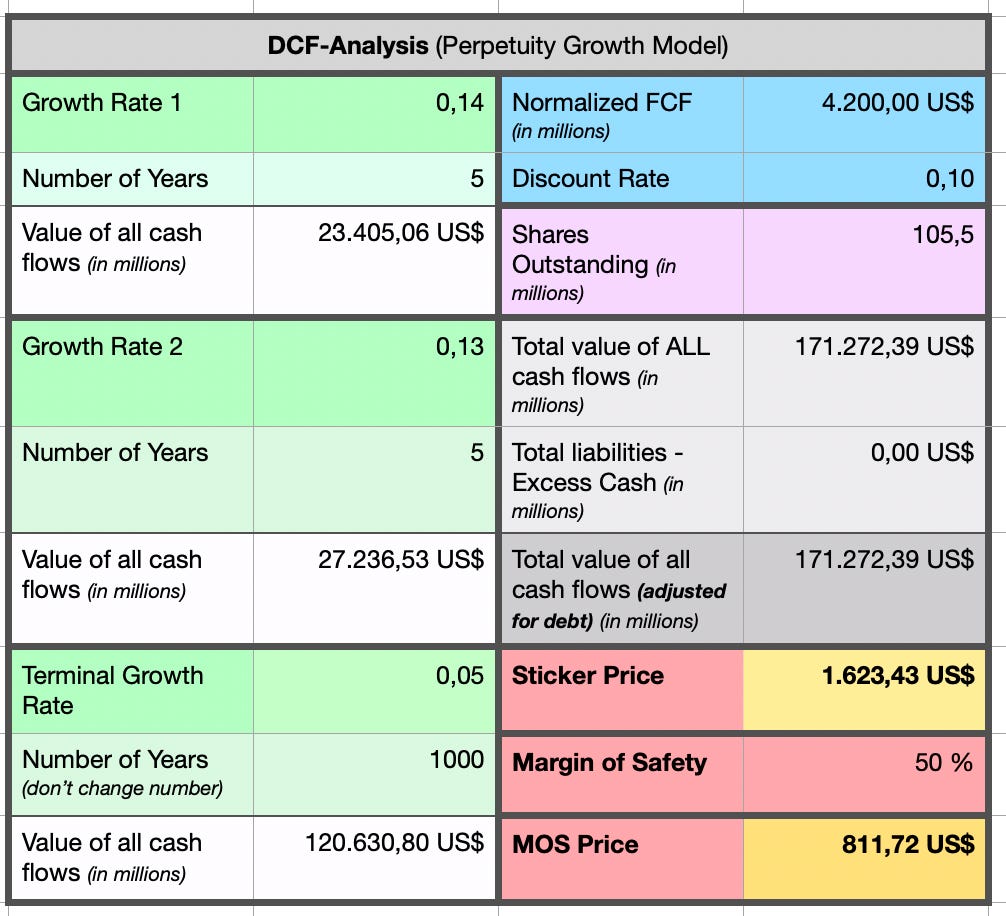
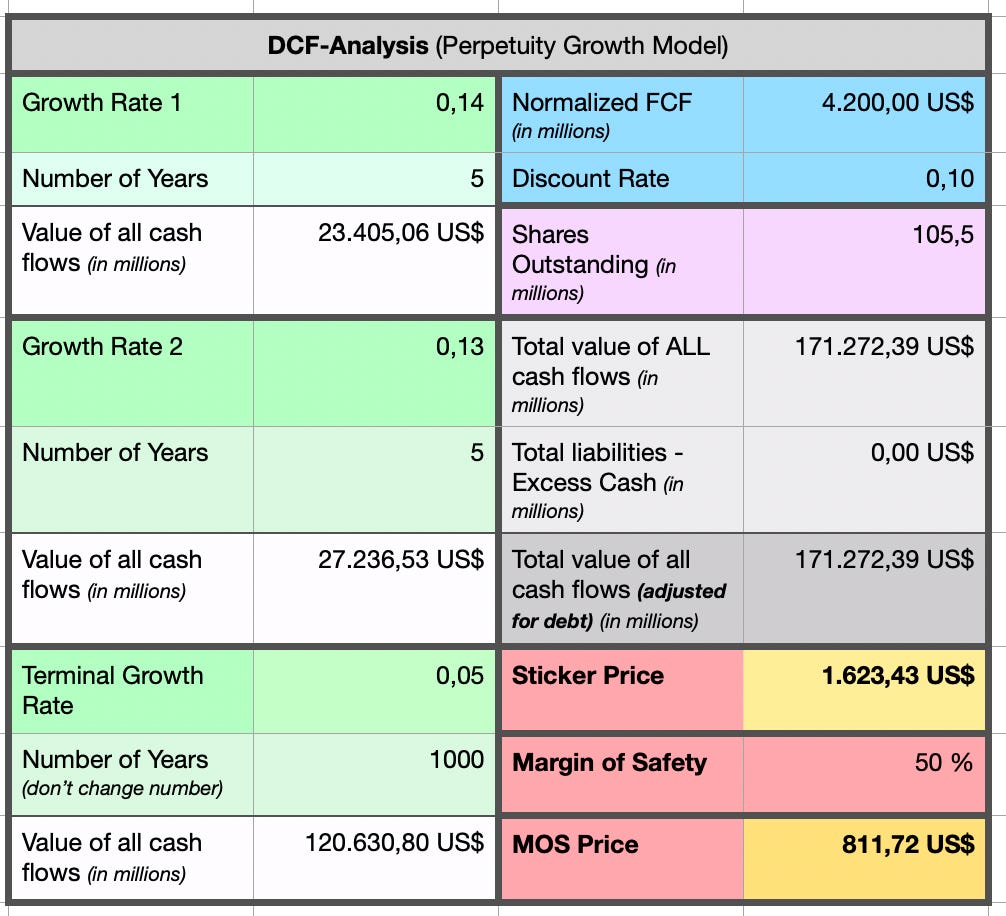
If the competitive advantage period really runs to 2050, the terminal value is what I get for free at this price. If you bump up the terminal growth rate to 5%, the shares start looking as if they trade below intrinsic value, but still above a margin of safety price.
Compared with LVMH, Hermès has two clear strengths and one clear weakness. It is true luxury in the narrowest sense, and it has managed exclusivity far better. Like Ferrari, it is one of the very few luxury companies where you cannot simply walk into a store and buy the product you want. A Birkin requires a purchase history and a relationship with a sales associate, and the wait is part of the product. The weakness is concentration. LVMH spreads its risk across more than 75 distinguished Maisons rooted in six different sectors, across fashion and leather goods, wines and spirits, perfumes and cosmetics, watches and jewelry, and selective retailing through Sephora. Hermès relies on leather goods for close to half of its sales and on a single brand for all of it.
Let’s discuss!
If you disagree with the thesis, think I have mispriced something, or know this business better than I do, leave a comment below. The sharpest corrections I get come from readers, and they usually arrive in the comments rather than my inbox.
Hermès is the natural comparison to LVMH, and it has always fascinated me. In my community, I also learned that there are literally resale companies dedicated solely to Kelly and Birkin bags, where you can sell immediately above retail – which didn’t surprise me at all to be fair. It has just always traded at silly multiples. I am also cautious about whether it can hold margins at current peak levels. The operating model in leather goods requires roughly 5–6% volume growth plus 5–6% pricing each year, and anything less leads to operating deleverage. The H1 numbers let me test this. Leather goods grew 9.8% at constant currency, and with price increases of around 6% at the start of the year, that implies volume growth of roughly 4%, slightly below my threshold. Deutsche Bank went further and called Q1 “zero underlying sales growth” at group level once pricing is stripped out. Management also said 2027 price increases will be slightly lower than in 2026. Lower pricing with volume capped by workshop capacity (one new leather workshop a year through 2030) is the most direct route to the operating deleverage I worry about, and it’s what UBS models with a 38.3% operating margin for 2027.
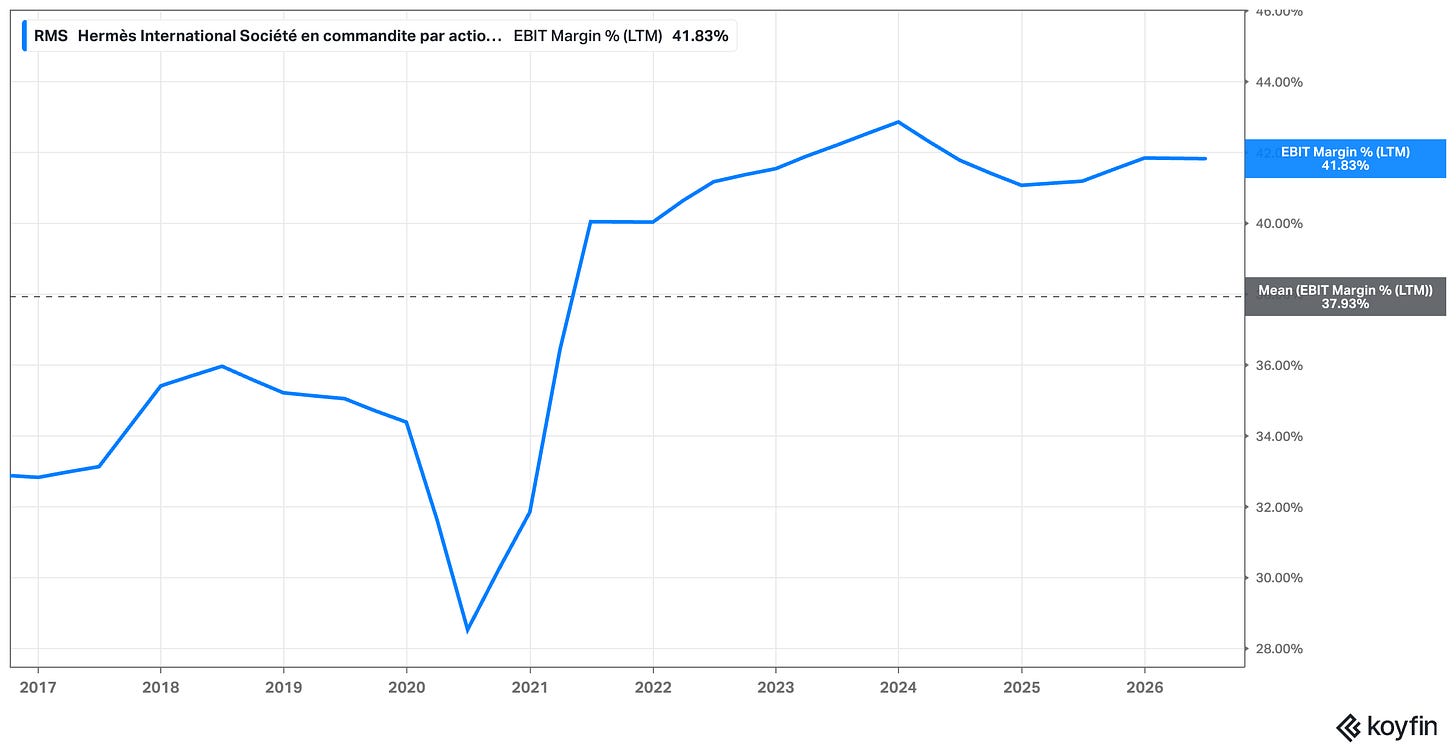
Given the currency reversal in Asia and a slow first half, I still think Hermès leans expensive, and a meaningful pullback is possible if margins compress. That said, a good part of the pullback has already happened, and so far without any margin compression. At 18x EBIT the question has shifted to whether that 41% margin is at risk. The large-company surtax in France will almost certainly become permanent given the fiscal and political situation, and Hermès is one of the more Asia-Pacific-skewed names in the sector. In H1 alone, the exceptional contribution cost Hermès about €270m, more than three percentage points of net margin, and UBS explicitly cited a higher long-term tax rate in its downgrade. I am also always a bit skeptical when a company drives too much of its growth through pricing power. Ferrari is a similar case, and while both have outperformed the S&P 500, there seems to be a point where even wealthy customers get annoyed at queuing for an allocation and look elsewhere. UBS makes a related argument. As Hermès scales, non-quota bags now account for most of its leather goods sales, which dilutes the scarcity that justified the pricing power in the first place.
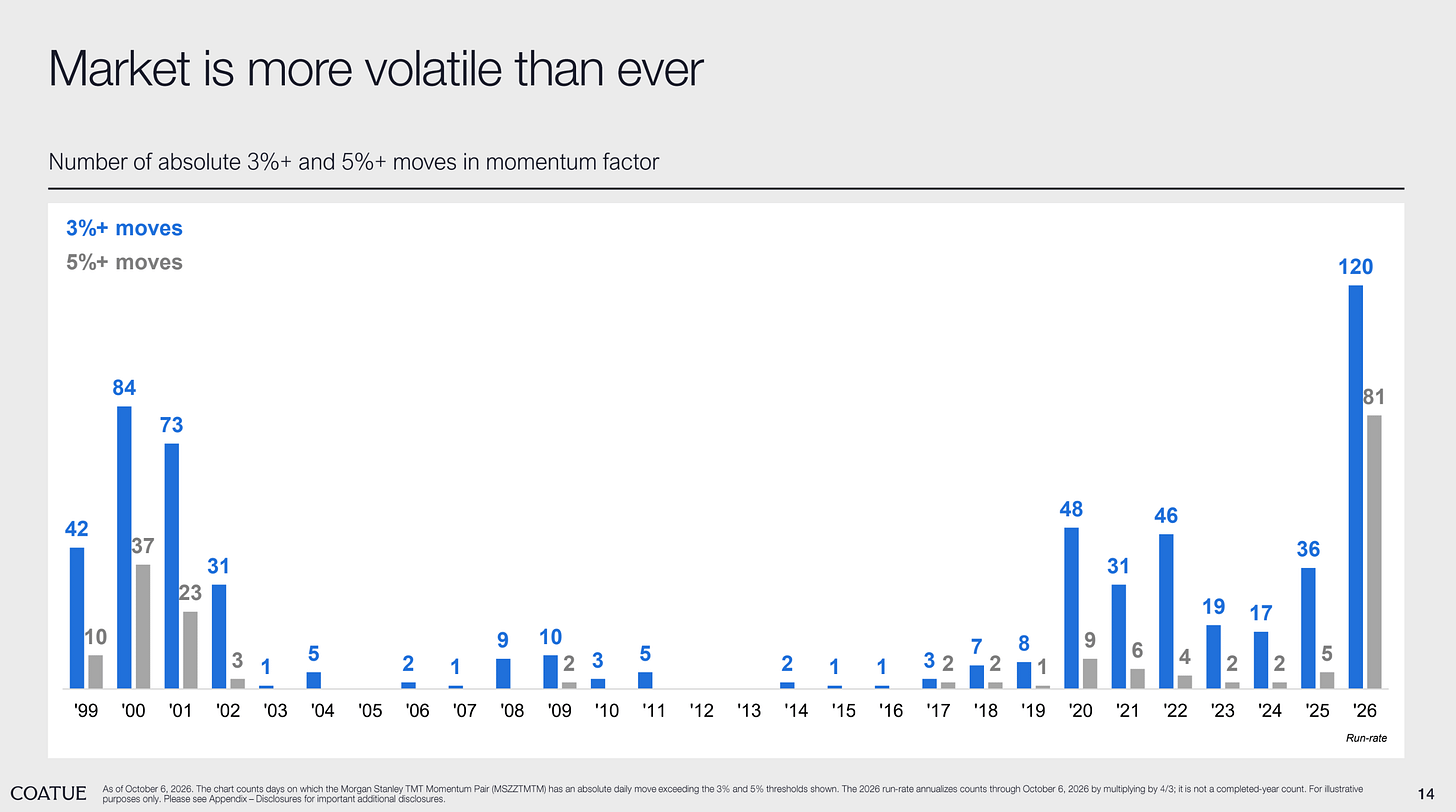
So back to the timing question. In all honesty, I won’t be able to predict the next few quarters of either LVMH or Hermès with any accuracy. I just read a take from Intern Pierre again this morning who covered his LVMH shorts but remains bearish on the near-term fundamentals (“From store checks, speaking to people, credit card spend etc. I’m not very confident. As I said it’s more-so my wife and I have an agreement relating to risk etc.”) based on his store checks and scuttlebutt research. My strength is rather assessing the long-term durability of the business and its trajectory, understanding ROIIC and reinvestment rates, valuing the business intelligently, and then trying to find great timing and trying to exploit a) an analytical edge set-up where time arbitrage is the edge I lean into, and which I believe has become more available in the current market (see also slide by Coatue below) and b) leaning into a behavioral edge setup.
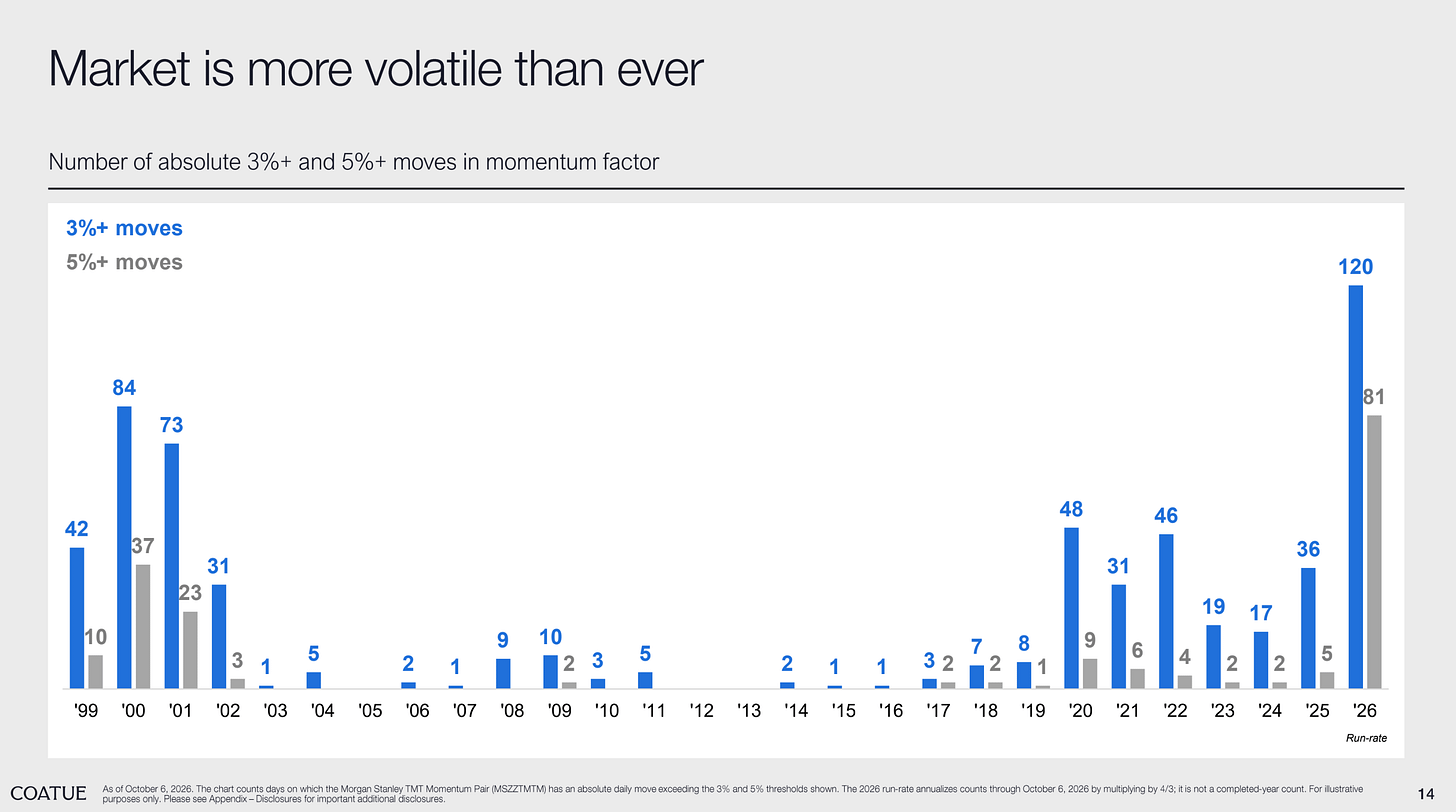
Bill Ackman spoke about exactly this pattern (pattern a)) too (see clip below):
And I myself wrote a blog post on this phenomenon in April:
The Golden Age of Stock Picking? Why Today's Volatility Explosion Is an Active Investor's Dream
·
You can read the majority of this article entirely for free. If you find value in this research, consider becoming a Premium Member to unlock our full archive and join our growing circle of investors (I highly recommend checking out “The Library” to see what’s inside; you can find it right on the homepage).

Speaking of the behavioral edge setup and the contrarian mindset: Generally speaking, the time to get interested from a qualitative POV in names like LVMH and Hermès is when people question the space and the companies, and their pricing power. They start questioning whether luxury is an attractive space entirely, they start comparing LVMH the brand to regular fashion brands, they cannot stop pointing out the current challenges (macro headwinds, COVID pull forward dynamics, China weakness, up-and-coming Chinese brands, working conditions being criticized / greenwashing where a product is manufactured). Most of these are now being said out loud about Hermès too. The newest one is that scale is killing scarcity, and Goldman Sachs initiated coverage at Sell arguing that the era of steady double-digit growth is over.
If we look at the current valuation setup, while getting interesting, I see no reason for strong support for the price to stop the momentum. Stocks can trade at silly prices and while the current drawdown was unthinkable to most at the top, I could see a world where we go down another 30-50% from here. To put numbers on that, another 30% would take the stock to about €900, or roughly 12x trailing EV/EBIT, a level Hermès has only ever seen around 2003. Another 50% would mean about €640 and 8x EV/EBIT, below every data point in the 25 years I have. I don’t rule out the first scenario. The second would require the earnings power itself to break, and other risks to surface, and nothing in the numbers points to that yet. Then Hermès may clearly be in dirt-cheap territory where you’d load up the boat, but those are the moments you as a value investor wait and hope for. A stock price that is completely detached from the intrinsic value.
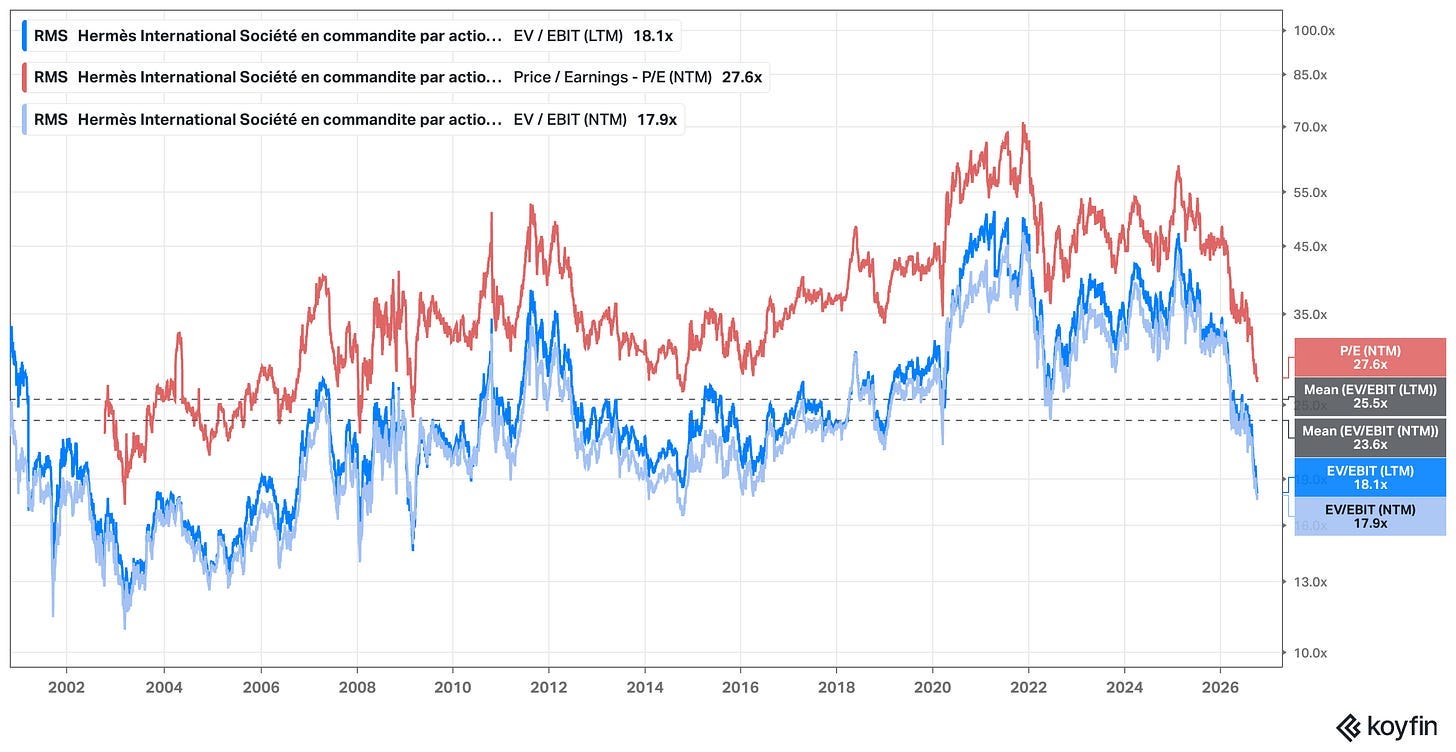
The current multiple looks cheap relative to the near past, but longer term, it’s not a completely unreasonable outlier and we’ve been in similar multiple territories before when the near-term outlook was arguably clearer and better. Hermès stock is one of the stocks that definitely benefited from the quality momentum trade that started in the early 2010s and lasted until recently. Don’t get anchored to the multiple of the last 5-10 years.
Points I made in my LVMH write-up about the physical store overexpansion, potential inverse operating leverage dynamics, the special tax situation, and whether it proves permanent apply (to some extent) to Hermès too, of course. The structural challenges of the continent too, of course. One difference is worth stressing. Hermès hasn’t overexpanded its store network the way LVMH has, and most of its investment goes into workshops and craftsmen. The inverse operating leverage risk at Hermès therefore lies in pricing and workshop capacity. Rent and an oversized store base are an LVMH problem.
Enjoyed This?
These articles take time to write. If you learned something from this write-up, please …
❤️ like this post and leave a comment with your thoughts
🔁 share it with your investing friends to spread the message to others
✅ subscribe to the newsletter for more investing content
Thank you.
Is this a cyclical dent or a crack in the moat?
Using the four buckets from my perception change framework, Hermès touches all of them at once, which is unusual for a company of this quality.
The first is the industry cycle: The post-Covid luxury boom is unwinding, the aspirational customer has pulled back, and China has stabilized without recovering.
The second is macro: The Middle East conflict hit the Gulf region and tourist flows into Europe, French sales fell 2.8% in Q1 because more than half of them go to tourists, and the strong euro against the yen, dollar and won took more than €360m out of H1 revenue.
The third is factor and style rotation: Hermès was one of the purest expressions of the quality-momentum trade of the past decade, and as the Coatue chart above shows, the momentum factor is now more volatile than at any point since the dot-com bust. Investors want to own semis and AI stock. Luxury plays? Not on vogue right now!
The fourth is micro: whether scale is eroding scarcity, and whether the French surtax becomes permanent.
Who is selling, and why? My read is that the marginal seller is the quality and growth investor who owned Hermès as a bond-like compounder, yielding a safe 10%-ish (even at high starting multiples), and now sees mid-single-digit growth, plus momentum-driven money following the broken trend.
So far, the buyers are the family and the board.
What is the market extrapolating? That the soft patch of 2026 is the new normal: 5% organic growth, margins drifting toward 38% and long-term growth of 3%. With leather goods still growing near 10% and demand exceeding capacity, I think that extrapolation is too harsh for leather goods and roughly fair for the rest of the portfolio.
What would improve perception even slightly? A Q3 print on October 22 that simply meets the lowered 5% expectations, a stable margin in the full-year results on February 11, 2027, signs that tourism into Paris recovers, or a weaker euro. LVMH reports today and may serve as a catalyst too.

None of these needs to be dramatic. How long could the pressure last? LVMH has been in its drawdown since 2023 and Hermès joined the rerating late, so a 12- to 36-month window is not unrealistic. What am I paid to wait? A 1.4% dividend yield, a free cash flow yield around 3%, €12bn of net cash that removes any balance sheet risk, and a business that should still compound earnings in the high single digits if not higher longer term.
That’s the strongest part of this setup. The weakest is the price action, which shows no sign yet that the selling is done.
Final Verdict:
Watch, with a predefined plan. On my appendix checklist, Hermès fails the trend and stabilization questions and passes almost every fundamental and paid-to-wait question.
That combination is exactly what my “watch” category is for. I won’t buy into a stock that sliced through two trendlines, hasn’t produced a clear capitulation day (even though there were some minor ones), and still has its most important near-term data point, the Q3 sales update on October 22, ahead of it. Sure, I might miss a solid entry point for a great compounder, but I’m looking for no-brainers with exceptional entry opportunities.
Two paths could theoretically change my stance. The first is the “buy the puke” path: a flush into the €1,000 to €1,100 zone (maybe today after LVMH reports?), where the 60% drawdown, the horizontal support, and the UBS target converge, on heavy volume and with a reversal from there. I might open a starter position in that zone even without a confirmed trend change, because at roughly 16x EV/EBIT the valuation might do the heavy lifting for a business of this quality, but my default would be to wait for an even cheaper entry level.
The second is the confirmation path: a base, a higher low, and a break of the steeper 2026 downtrend that holds on a retest, ideally alongside a Q3 or full-year print with leather goods near 10% and a margin at or above 40%.
Disclaimer:
As of the date of publication the author owns no shares in the company; but that may change. I own Hermès in the portfolio I manage for my partens though.
The analysis presented in this blog may be flawed and/or critical information may have been overlooked. The content provided should be considered an educational resource and should not be construed as individualized investment advice, nor as a recommendation to buy or sell specific securities. I may own some of the securities discussed. The stocks, funds, and assets discussed are examples only and may not be appropriate for your individual circumstances. It is the responsibility of the reader to do their own due diligence before investing in any index fund, ETF, asset, or stock mentioned or before making any sell decisions. Also double-check if the comments made are accurate. You should always consult with a financial advisor before purchasing a specific stock and making decisions regarding your portfolio.