Dear compounders,
Ember Infrastructure Management's 615p proposal for Ashtead Technology has put one of my positions in a new light.
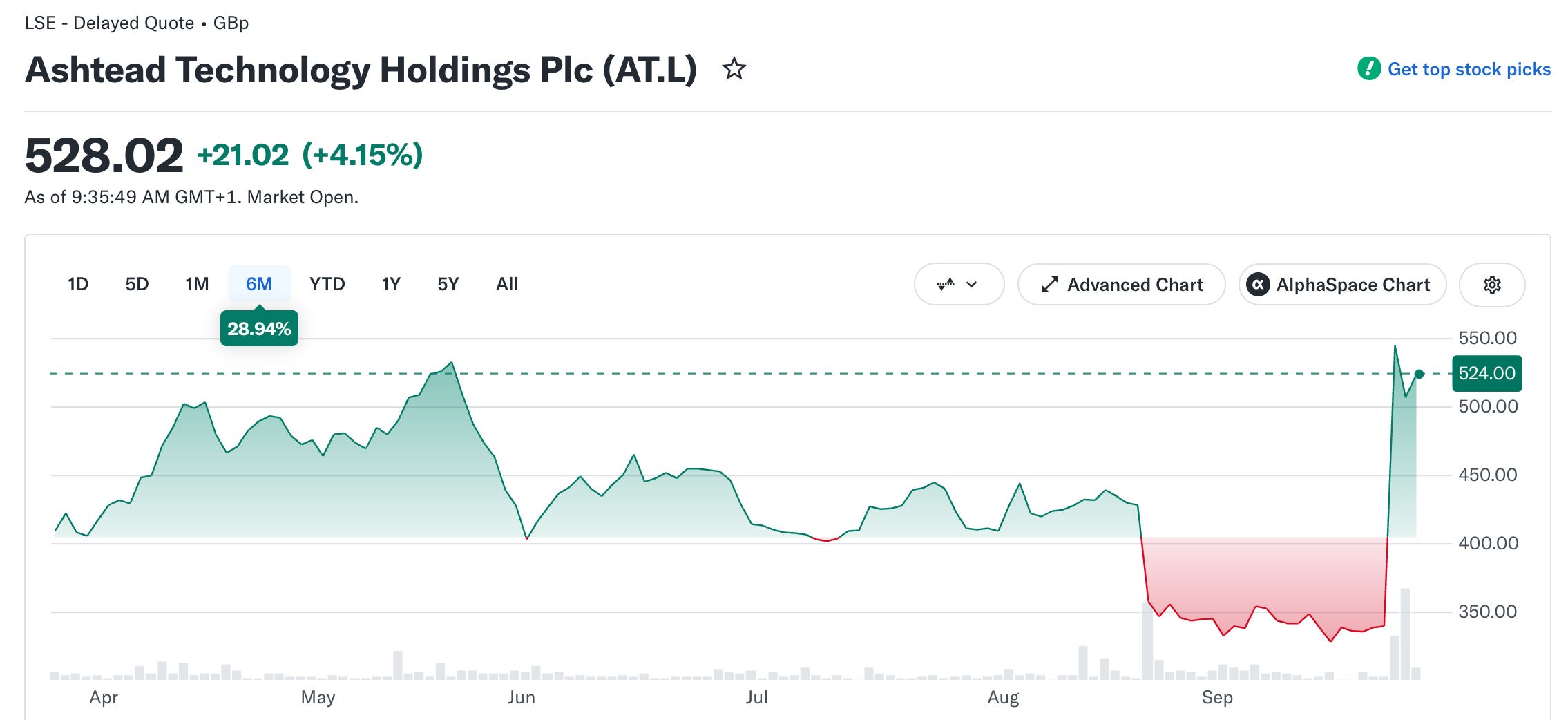
For now, the market is treating the approach with caution. The shares still trade at a noticeable discount to the indicated level, which tells me investors see the odds of a completed deal as moderate at best and expect any timeline to stretch well beyond twelve months.
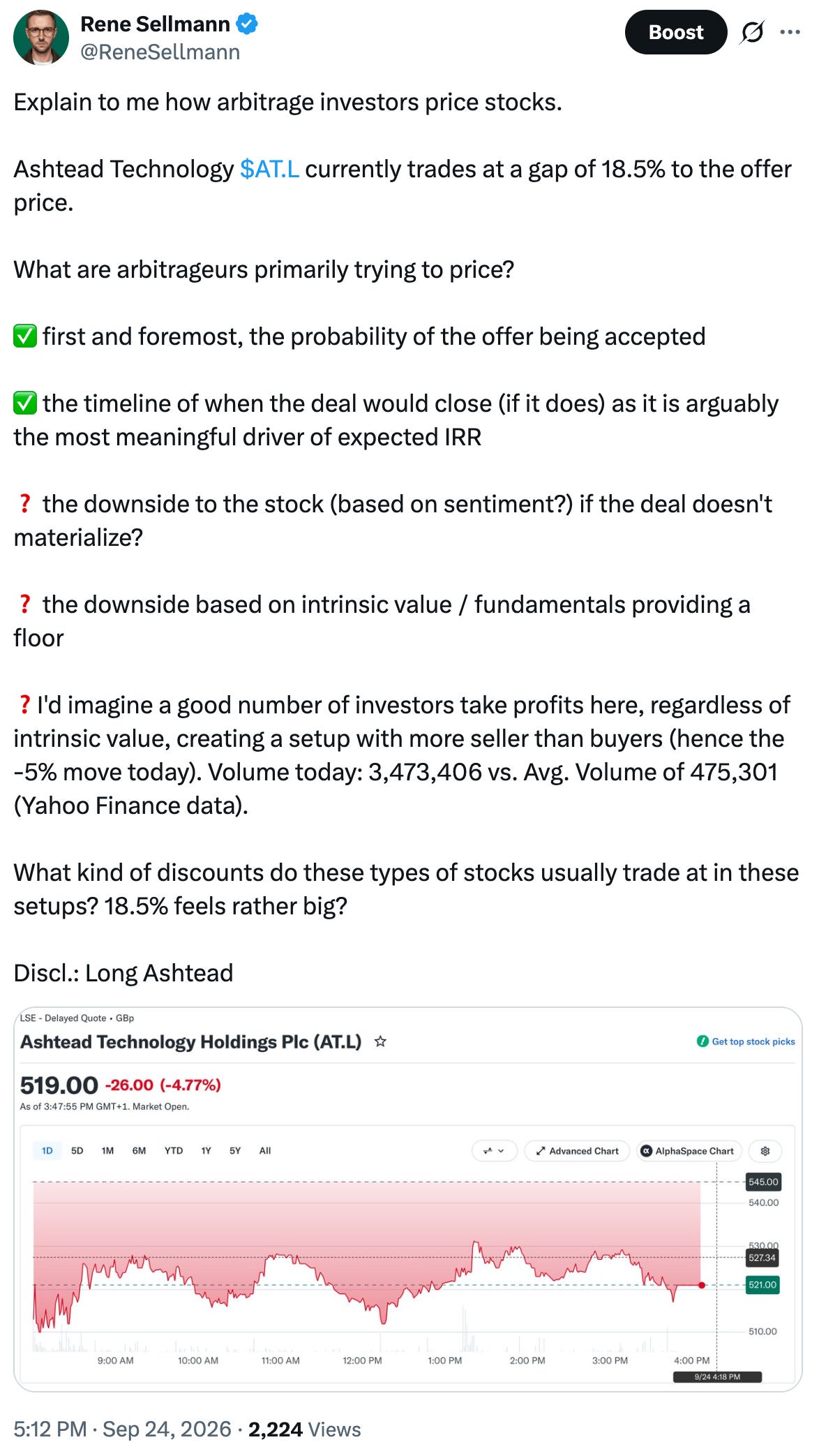
I believe Ashtead's intrinsic value is higher than 615p, so I have not made up my mind yet on what to do exactly. Should the gap narrow, though, decreasing the expected forward return, opportunity cost starts to matter more and more, and selling could become the rational move, especially because I have some interesting-looking ideas on my radar.
In that case, a meaningful chunk of capital would need a new home, and I could also see myself diversifying the new funds across multiple ideas (Ashtead is now >20% of the portfolio).
As an investor, you always have to be ready. Opportunity rarely sends a calendar invite.
New here? Join 5,000+ readers and get 3 FREE GIFTS when you subscribe:
📈 Valuation Spreadsheet
📚 eBook: Investing Visualizations
💡 eBook: 250 Thought-Provoking Quotes
So I have started mapping out capital allocation scenarios. Seven companies currently rank highest on my watchlist, and in this new series I will walk through each of them using my perception change framework.
My Perception Change Framework:
2026-01: My “Perception Change” Framework – Technical Analysis (Part 3) - ($)
2026-01: My “Perception Change” Framework – Qualitative Instruments (Part 2) - ($)
2026-01: Playing a Different Game: When Fundamentals Aren’t Enough Anymore! (Part 1)
Every idea gets the same set of questions:
Could now be an opportune moment to buy?
Is sentiment bombed out, or is there still some air left to let out?
What is the price trying to tell us?
And beyond the supply and demand dynamics of the stock, which new qualitative insights have I picked up that change how I think about the business?
My original plan was to cram all seven into a single post. The further I got, the clearer it became that this would turn into a monster few people would ever actually finish. I sometimes wonder how many people actually read my 10,000-word+ deep dives. If you look at the cold, hard data of the number of 10-Ks that are actually downloaded by all investors globally (spoiler: it’s shockingly low), the actual number of readers of my deep dives may be disappointing.
Fun fact: Using the SEC's own server logs, Loughran and McDonald found that the average publicly traded company had its annual report requested only around 28 times by investors right after filing.
Anyway. Each idea now gets its own piece, short enough to read in one sitting over your morning coffee or on the train to work.
Two and a half of them are already written, so the rest of the series should land over the next seven to ten days.
Idea number one is a company where the CEO just put roughly $30 million of his own money on the line, and where I added to my own position only a few days ago.
Disclaimer:
As of the date of publication the author owns shares in the company; but that may change. The analysis presented in this blog may be flawed and/or critical information may have been overlooked. The content provided should be considered an educational resource and should not be construed as individualized investment advice, nor as a recommendation to buy or sell specific securities. I may own some of the securities discussed. The stocks, funds, and assets discussed are examples only and may not be appropriate for your individual circumstances. It is the responsibility of the reader to do their own due diligence before investing in any index fund, ETF, asset, or stock mentioned or before making any sell decisions. Also double-check if the comments made are accurate. You should always consult with a financial advisor before purchasing a specific stock and making decisions regarding your portfolio.
Idea #1: Grab Holdings
What is the price trying to tell us?
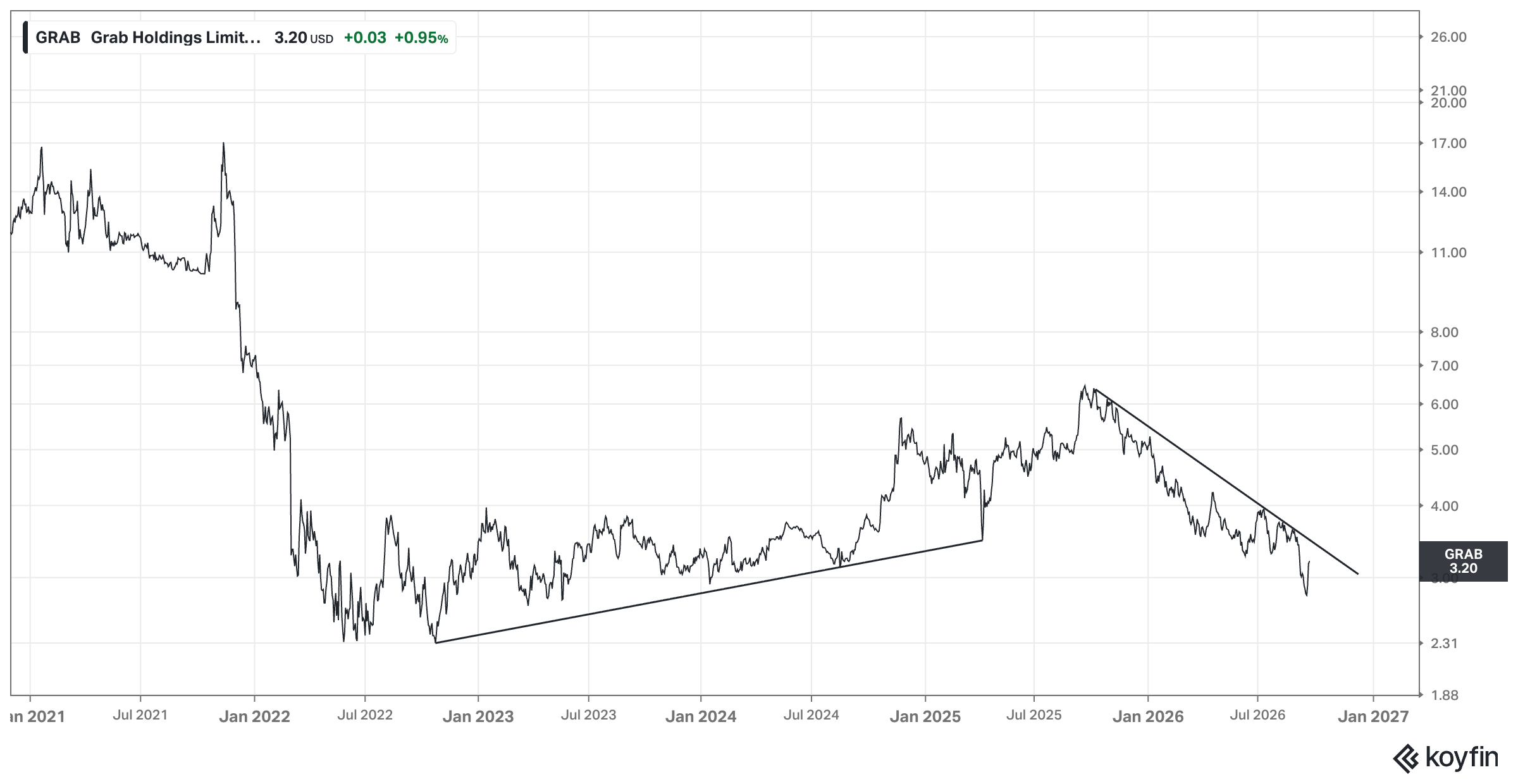
Grab lacks a clean multi-year trend to lean on. After collapsing from its post-SPAC highs in 2021 and 2022, the stock built a slow uptrend off the late-2022 low of around $2.30, which eventually carried it to roughly $6.40 by September 2025. Nearly all of that advance has since been handed back.
The downtrend that started in September 2025 is the more useful line. It has multiple touchpoints, and it has not been broken, let alone tested and confirmed.
Even after the mid-teens rebound from last week’s low, the share price would need to climb roughly another 10% just to reach it.
What catches my eye is where the selling stopped. At $2.74 this months, Grab traded at its lowest level since May 2023.
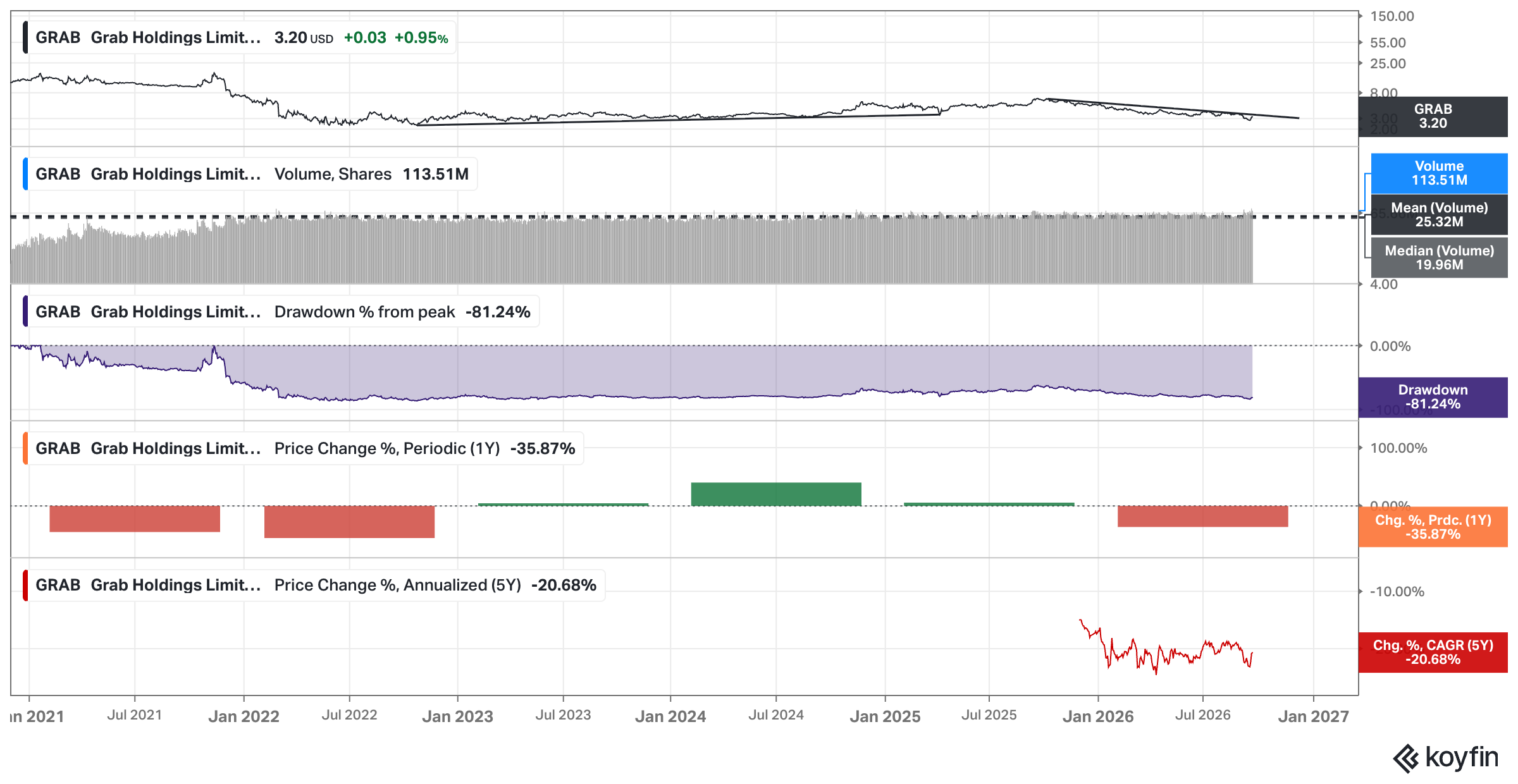
Grab has punished its shareholders for a long time. The stock sits more than 80% below its all-time high, the five-year annualized return stands at roughly minus 21%, and even the three-year CAGR is negative.
The current down year, roughly minus 36%, followed three positive years, however, which makes the damage look less one-sided than the drawdown alone suggests.
Anyone who bought Grab during 2023 or 2024 was still sitting on a gain as recently as last fall.
That is why sentiment in 2026 strikes me as rather bad, though not completely bombed out.
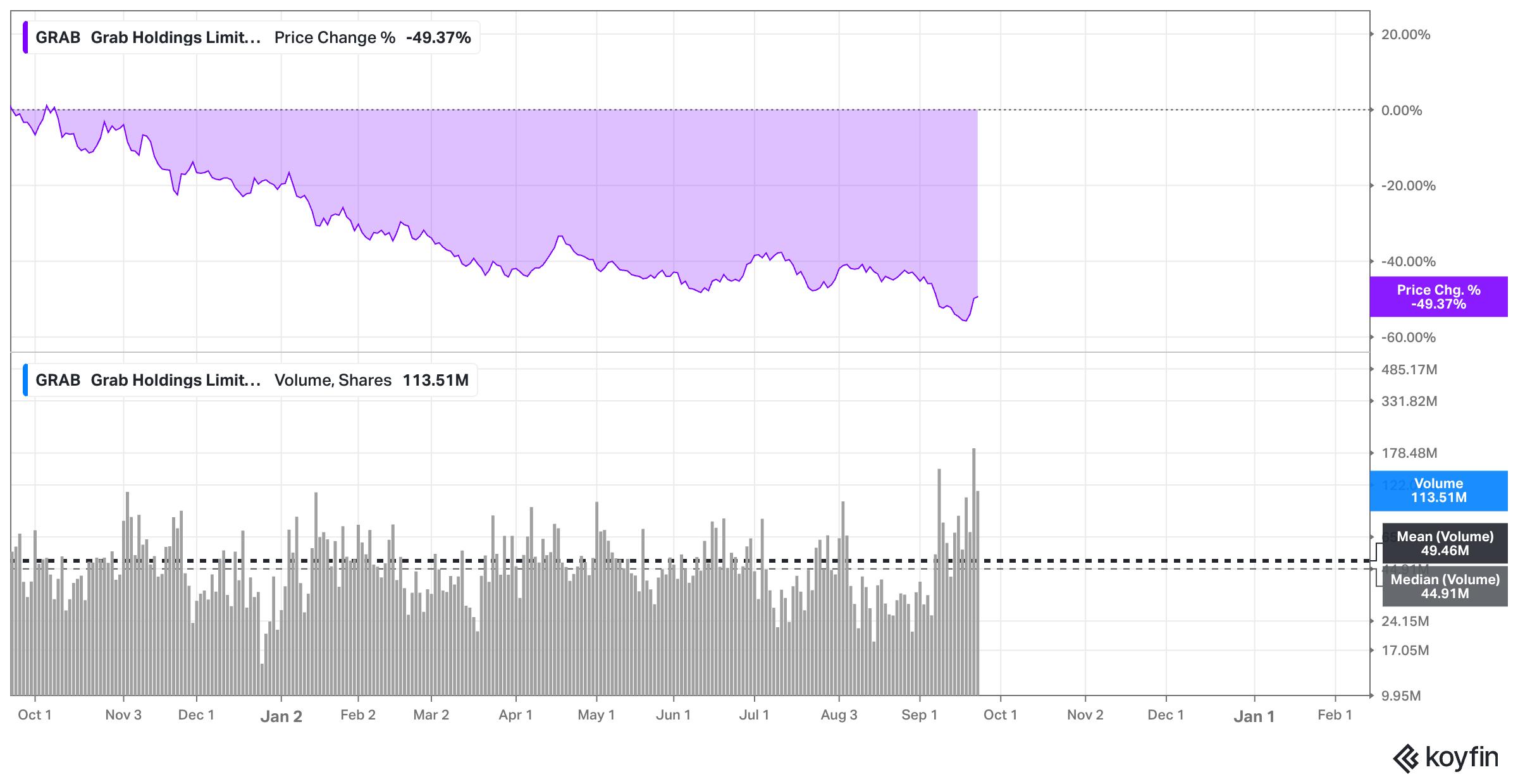
Volume is the more encouraging signal. September brought the heaviest trading of the past twelve months, with several sessions well above 100 million shares against a one-year average of roughly 50 million, and the spike clustered around the low.
As I argued in my perception change series, high volume near a trough is what capitulation tends to look like, so this might signal a bottom in the making. One heavy week does not confirm a reversal, though.
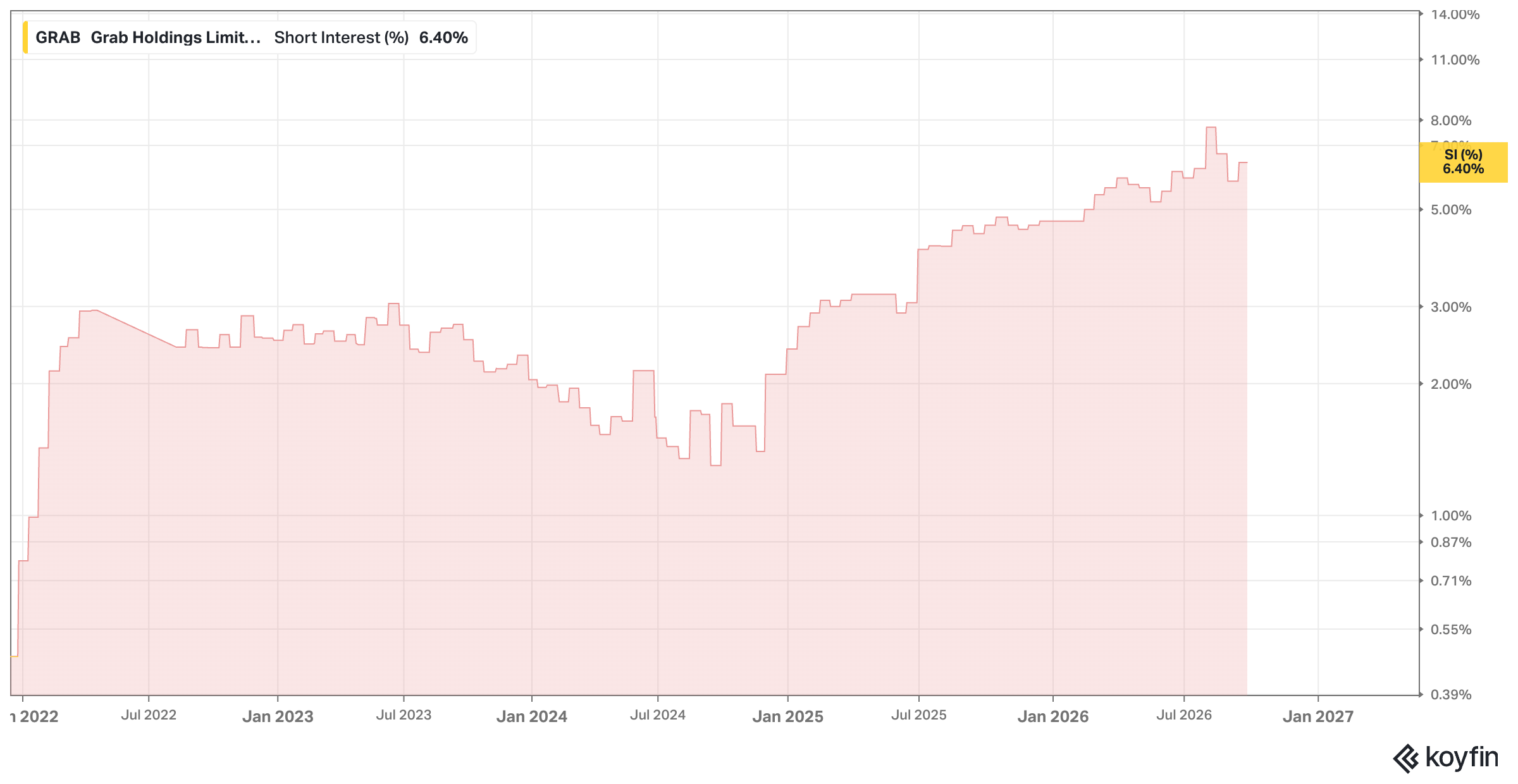
Short interest supports the negative sentiment read. At about 6.4%, it has more than tripled since mid-2024 and peaked at close to 8% this summer, which is notably high for Grab, although not extreme in absolute terms.
Should perception turn, that positioning could become fuel for the move.
All my prior analyses of Grab:
2026-05: Valuing Grab Holdings Post Foodpanda and Stash Integration - ($)
2026-05: Grab’s Q1 Paradox – Record Profits Meet the Indonesian Regulatory Wall - ($)
Which new insights change how I think about Grab qualitatively?
The full analysis starts here!
Become a paying subscriber to read the rest of this post (and access the next six ideas too), and get access to all of my other deep dives, my global watchlist, the WhatsApp community, the digital conferences, and more!