

I own Tiger Brokers, and I’ve probably written about it enough times that regular readers know where I stand.
And they might in fact be getting tired of me bringing it up again. So I’ll keep this one short. And even if you are not interested in the business of Tiger, the post may still reveal how I think about downside protection.
Check out my recent summary of Seth Klarman’s book “Margin of Safety” in which he discussed the concept of downside protection at length:
As I’ve said before, my view is that the downside here – especially at these price levels – is unusually well protected, while the upside is wide open. If Hong Kong keeps functioning, if the CCP doesn’t suddenly decide to step in in some shape or form over the next ten years (which I think is pretty unlikely), this is one of the most asymmetric setups in my portfolio. If Beijing eventually decides otherwise, most of what I’m about to lay out will turn out to be misinformed. Well, at least to some extent. Because even in that worst-case scenario, though, Tiger is less exposed to HK than its peer, Futu Holdings, and at the current price, Tiger might “earn back its current EV” over a relatively short period of time.
Before looking at the new angle on the limited downside, a quick nod to the old ones I have discussed – I’ve valued this company in many ways in the past: First, simple multiples. Then, a more careful version adjusting for all the weird items that make a broker’s reported earnings look misleading, the recent comments on normalized tax rates, etc, etc. I’ve of course conducted some multi-scenario valuation analyses.
And the ones I actually enjoyed doing most were the creative approaches. I tried to figure out the replacement value of their customer network using customer acquisition costs (CAC) – essentially asking what it would take in dollars and years to rebuild what Tiger has already built. And CAC in this industry and the region Tiger operates in only ever seems to move in one direction: up.
Access my latest update on Tiger’s Q2 here
Then I flipped the telescope around and valued that same network forward, discounting a range of lifetime value assumptions across customer cohorts.
Different methods, different assumptions, but they all pointed to a similar conclusion: Tiger is too cheap.
Disclaimer:
As of the date of publication the author owns shares in the company; but that may change. The analysis presented in this blog may be flawed and/or critical information may have been overlooked. The content provided should be considered an educational resource and should not be construed as individualized investment advice, nor as a recommendation to buy or sell specific securities. I may own some of the securities discussed. The stocks, funds, and assets discussed are examples only and may not be appropriate for your individual circumstances. It is the responsibility of the reader to do their own due diligence before investing in any index fund, ETF, asset, or stock mentioned or before making any sell decisions. Also double-check if the comments made are accurate. You should always consult with a financial advisor before purchasing a specific stock and making decisions regarding your portfolio.
Three cents in Bangkok, one cent in Singapore?
That brings us to what actually prompted this post. Webull closed its acquisition of Pi Securities in Thailand at the end of August, paying around $100 million for roughly 99.36 percent of the company. Pi has somewhere around $3.1 billion in client assets, according to what Webull Thailand’s CEO told the local press at the closing briefing.

That means the buyer paid about three cents for every dollar of client assets they took on. Put differently, Webull paid about 3 percent of acquired client assets.
That’s real cash, an actual arm’s-length price agreed on by two motivated parties, not some random number I plugged into a spreadsheet.
Now hold that up against Tiger. Based on my estimate of Tiger’s enterprise value – roughly $600 million – the market is valuing its $60.7 billion in client assets at under one cent on the dollar. This means, if you could acquire all of Tiger’s shares outstanding without moving the stock price, you could acquire the current asset base for 1% of the asset value.
Spread across 1.32 million funded accounts, you’re basically being asked to pay about $455 per funded account for the entire business.
Meanwhile, Webull went shopping in Bangkok and “paid up” precisely because decent-quality accounts are expensive to acquire and take forever to pile up (that build-up time has a real cost too). Management basically admitted as much on their Q2 call, describing the deal as a way to grab active funded accounts at a fraction of the organic acquisition cost, compressing years of building into a single move.
“We recently announced the acquisition of Pi Securities in Thailand, which is expected to close at the end of August. This acquisition will increase our AUM in the region significantly and positions us for further growth in Thailand as we combine Pi’s expertise in the local market with our best-in-class technology platform. […]
And I think we’re still only in the early innings of that. In terms of the Pi Security acquisition, that is a strategic opportunity that we saw in Thailand. We do have a small but aggressively growing business organically in Thailand. And looking at this opportunity with Pi Securities, not only is it immediately accretive for us in terms of growing our APAC AUM, but it also introduces us to a significant amount of high-quality active trading funded accounts for a very low customer acquisition cost that we normally would have to pay a high price for that quality of account, and it would take a very long time to organically grow that over time. So it’s like a little boost of, I guess, I’m of the age. So a little testosterone replacement therapy for us in, I guess, in a casual way to say it.”
It’s the exact same argument I was making to myself a few weeks ago with my CAC work – except this time, someone actually wrote the check.
To be fair, the comparison isn’t totally apples-to-apples. Webull wasn’t just buying assets under custody. They got member seat number three on the Stock Exchange of Thailand, a top-five spot in TFEX volume, depositary receipt issuance capabilities, over 300 investment consultants, and a licensed platform that saved them years of waiting on greenfield approvals.
Control transactions always carry a premium. Plus, Pi’s assets sit inside an advisor-led wealth model with fatter take rates per dollar. So yeah, in theory, three cents for every dollar of AUC isn’t a magic ratio I can slap onto every broker out there.
But then again, I built the overview below with the help of Claude to get a feel for where other brokerage businesses actually trade on this metric. And a) the spread is very wide and b) the 3% is toward the lower end of the spectrum.
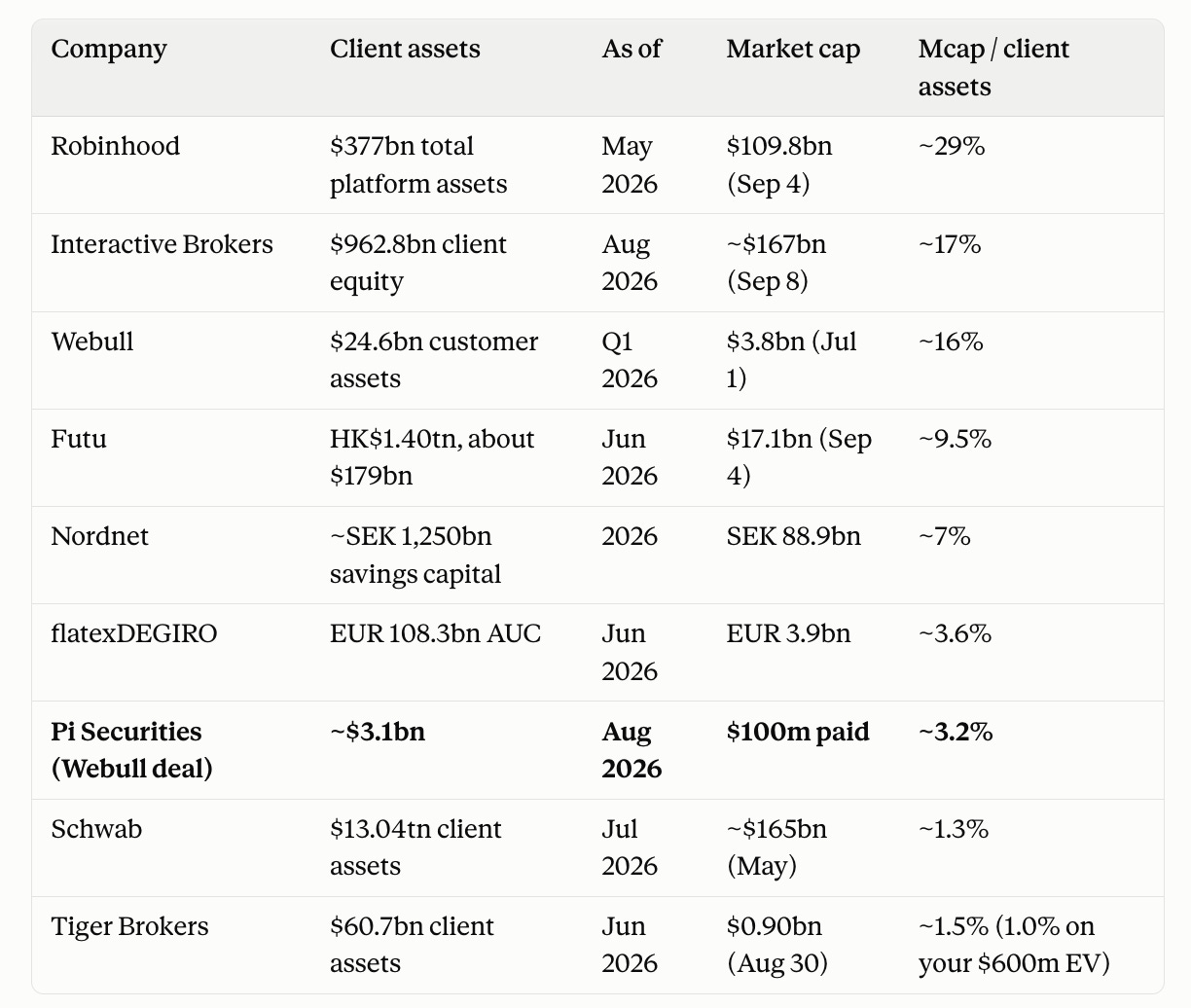
A caveat is that these are not the same asset pools. Robinhood’s total platform assets include crypto held on acquired platforms like Bitstamp and WonderFi, but exclude TradePMR’s advisory assets – which Robinhood non-custodially reports separately and does not count toward its core retail asset total. Schwab’s trillions are largely RIA custody and workplace plans, which is a custody utility rather than a trading platform. Nordnet’s savings capital includes pensions and funds. So comparing Tiger to IBKR and Futu is fair game. Comparing Tiger to Schwab is not.
The row I find hardest to look away from is Webull’s own. The market capitalizes Webull at roughly 16 percent of its customer assets while Webull turned around and paid 3 percent for someone else’s.
Tiger sits at the bottom of the table regardless, a third of where flatexDEGIRO trades and roughly a sixth of Futu, which is the closest structural comparison in the whole group given the shared Hong Kong exposure and the shared regulatory scar tissue.
That brings me to the second cut, because a dollar of custody is not a dollar of custody. A dollar attached to a $200,000 account, on average, churns less, brings in more revenue, is more likely to buy wealth products, and stays put through drawdowns. A dollar sitting in a $2,000 account does none of that reliably. So here is the same universe measured by assets per funded account.
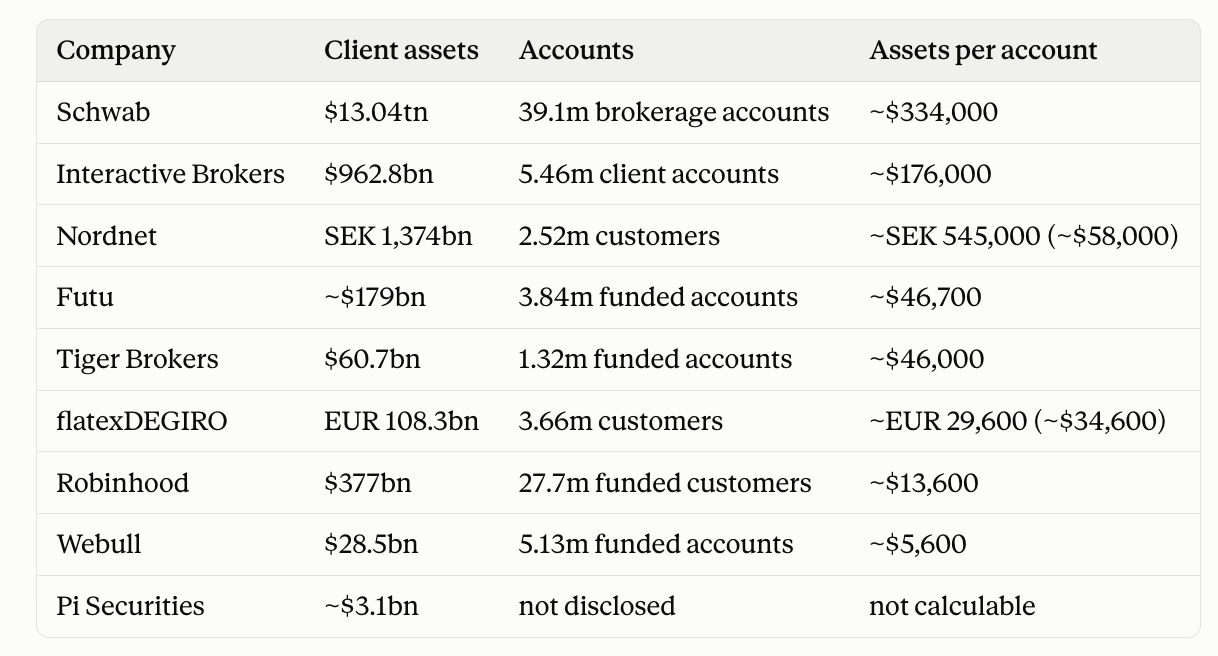
By far the best metric to measure how valuable the asset base is, is arguably the brokerage firms’ revenue yield on AUC.
The rest of this post is FREE to read. I only ask that you subscribe, which costs nothing and can be undone with a single click whenever you like.
The wall also helps keep my writing from being freely scraped by AI crawlers, so I hope you understand the small extra step.
In return, you get every deep dive, earnings review, and process piece I publish, straight to your inbox.