

Dear fellow compounders,
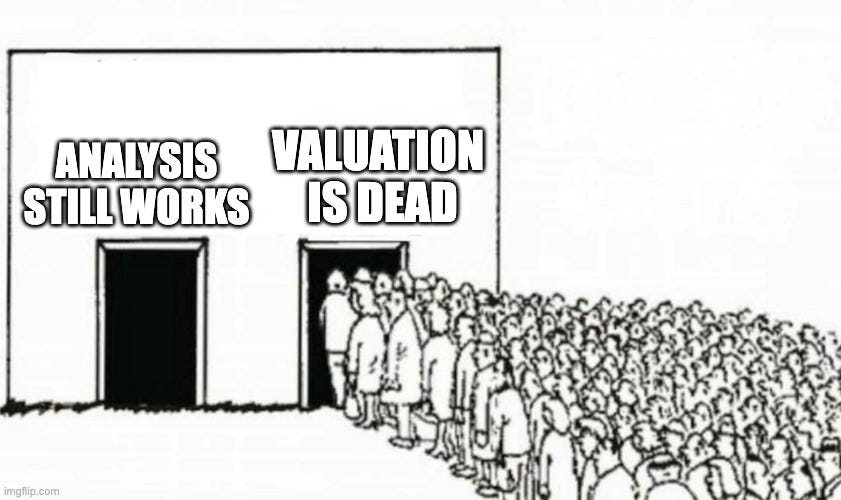
Valuation is finished. The tape now runs on sentiment and flows, the index is a machine that buys whatever it already owns, and anybody still building valuation models will be left behind. Full stop.
I have read some version of that argument many, many, many (!) times in recent weeks and months, each time written by somebody whose work and process is good enough that waving it away would be lazy.
Terry Smith turned over 51.8% of Fundsmith Equity in six months after fifteen years of telling investors to do nothing.
My German friend FJ Research put it more bluntly on Substack just yesterday.
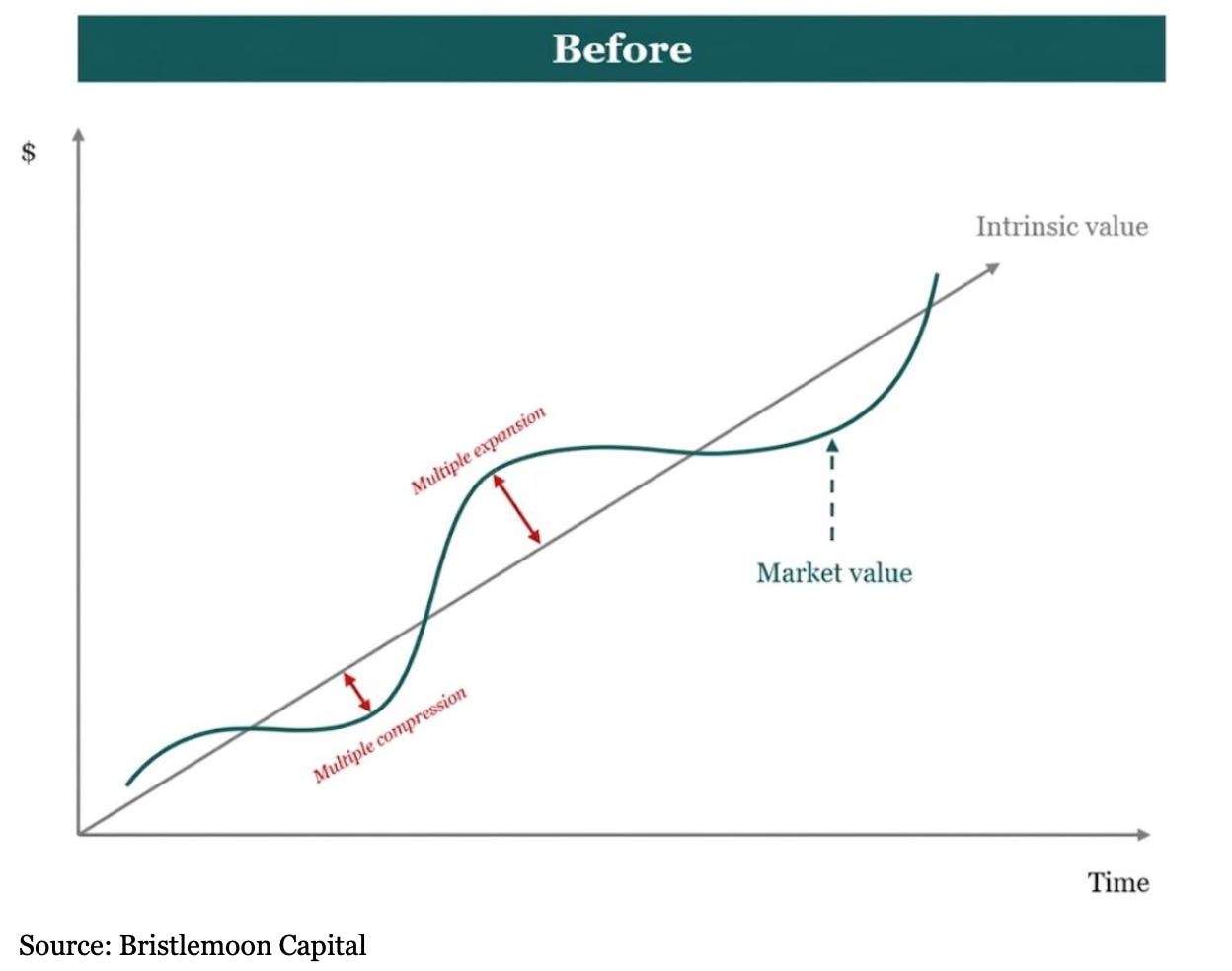
Bristlemoon Capital devoted a chunk of their June letter to the same idea, complete with two diagrams showing how price used to orbit intrinsic value and how it orbits now.
Before I get into any of it, I should say where I stand, because my position is uncomfortable:
I agree with all three of these people. I also disagree with all three of them.
Both at once.
If that sounds like a dodge, hold the contradiction for a few minutes and try to resolve it yourself before you read my resolution, because working it out yourself, forcing yourself to think this through, dealing with that cognitive disonance may worth more than being handed it.
Three people who are far too good at this to wave away
Start with fellow writer FJ Research, since he states the currently popular perception of the market rather succinctly. His argument is that today’s market is governed by sentiment and flows whether or not we approve, that this is the “hand we have been dealt,” and that anyone responding to it by investing as though the year were still 2003 is fooling himself.

Bristlemoon made a similar case in June, illustrated with two stunning pictures. A shrinking slice of the market prices stocks on long-term fundamentals, they argue, and the growth of multi-manager pods, passive investing, retail participation, and systematic strategies has produced far more volatility than we have historically seen.
“There have been market structure changes – some of which we touched on here – which are resulting in stocks trading differently to how they have historically. More specifically, a shrinking portion of the market is pricing stocks based on long-term fundamentals. The rise of multi-manager firms (a.k.a. pods), retail investors, systemic investment strategies, and passive flows has changed the way that some parts of the stock market trade, and our belief is that we won’t see a return to the way markets previously used to function.“
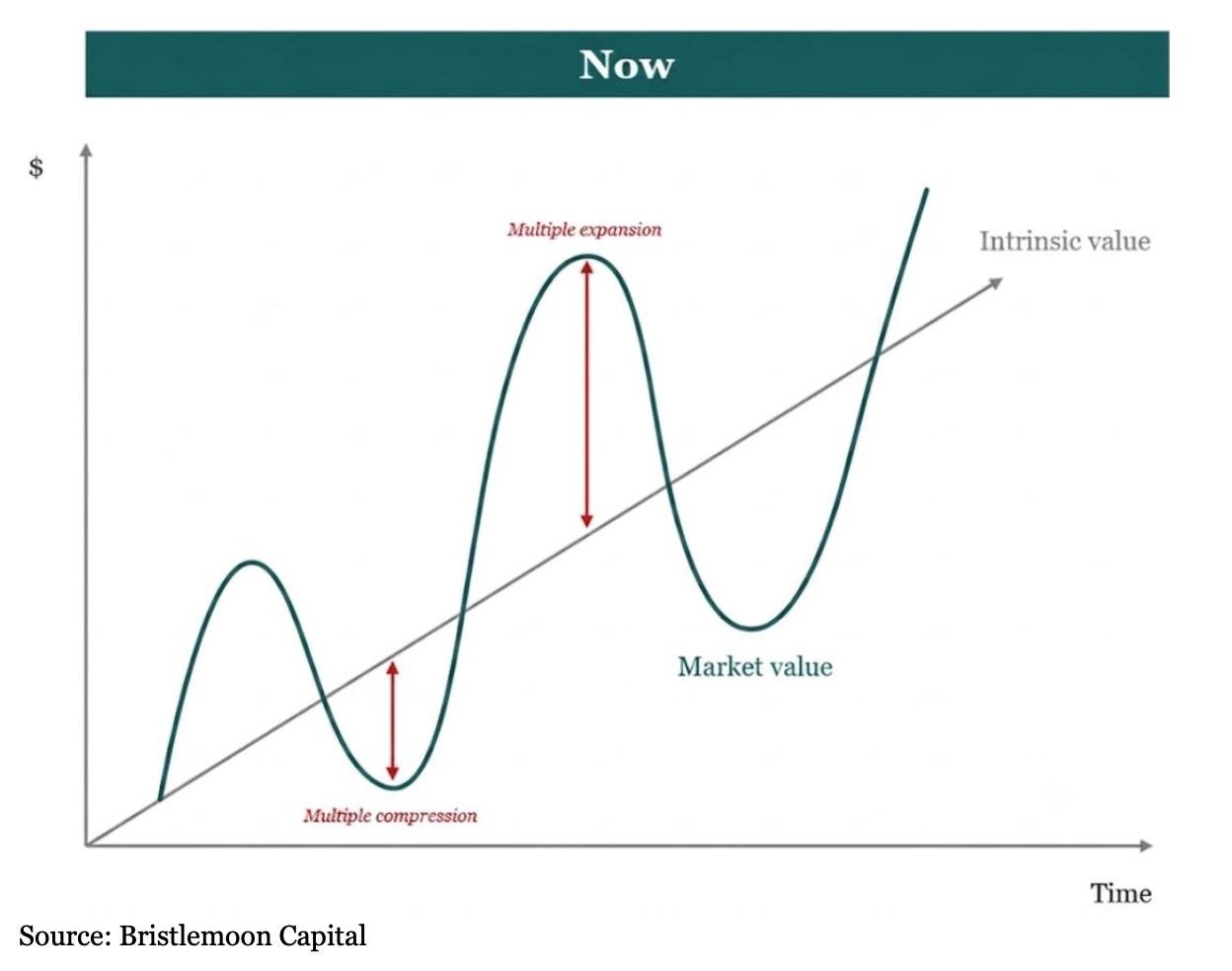
Their two embedded charts maybe illustrate it better than any written paragraph could. In the old regime, the market value line wandered above and below a rising intrinsic value line within a fairly narrow band.
In the current one, it swings violently, expanding on any positive change in the second derivative of the narrative and refusing to find a floor when a cheap stock has no earnings acceleration to point at. Their conclusion is measured. The stock still tracks the underlying business over time, yet the ride to the same destination has become far bumpier.
Fundsmith Equity lost 2.9% in the first half of 2026 against 11.2% for the MSCI World, a gap of 14.1 percentage points, and that came on top of underperformance stretching back to 2022. Turnover in those six months hit 51.8%, against a historic average below 10%. He sold Unilever, Novo Nordisk, Nike, Zoetis, LVMH, Coloplast, and seven others. He bought AppLovin, Uber, Netflix, TSMC, Mastercard, GE Vernova, and six more. He told his investors he will take more account of momentum, both fundamental and share price.
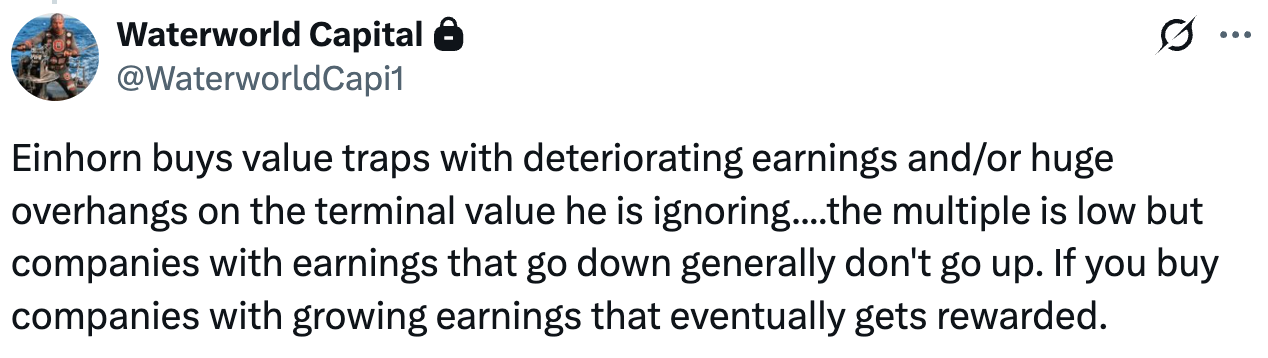
The financial media and community read that as the British Warren Buffett capitulating. I attached my take below:
Buy Good Companies, Don't Overpay, Do EVERYTHING ...

“I think people who study the psychology of investment will tell you that, you know, you can't have an end to certain types of market until the last hope is given up. I mean, I presume after that the entire UBS funds were switched into something which tracked the the Nasdaq index, bought all those things. And oh dear, there we are.“ - Terry Smith at thi…
Smith is changing a fifteen-year winning process after four consecutive years of underperformance and a fall in assets from roughly £29bn to £12bn, which is historically the moment when changing nothing has paid best. The stocks he bought trade at a median forward multiple around 24x against roughly 17x for the ones he sold, so even granting the higher growth and the much better returns on equity, he might be paying up.
Turnover of that magnitude also costs money and forfeits the compounding advantage that low turnover gave him for a decade.
Please restack the post or share it with friends if you find this article useful. Leave a comment to start a discussion.
He would even concede most of this. He wrote that he has no idea how or when this passive-led momentum market ends, other than that it ends badly.
“You know, if I go and sell Microsoft this evening and put it all into PepsiCo tomorrow, it doesn’t aQect the valuation of either Microsoft or PepsiCo. It’s unaffected. However, these people have looked at the data and discovered that the actual market impact for a dollar going from one security to another in recent years has been a multiplier of somewhere between three and eight times. So when you took your money out of us and the dollar went into Nvidia, the effect on the Nvidia price was somewhere between $3 and $8 on average $5 between those. That’s a startling number.
And the reason for it is, as I tried to explain in the in the title, the inelastic markets hypothesis, because the well, if you take the dollar out of their out of our fund and put it in the passive fund, it doesn’t make any difference. works providing there are people in a in a position to take the opposite view. So if you think that something is vastly overvalued uh it can by being driven by the momentum of index funds that will be bought down to earth by people who are running active funds who will sell it or even short it in the case of hedge funds. What they’re pointing out is there are increasingly fewer of those people because of the rise of index funds. There are increasingly fewer active funds to do that. And even within those active funds, there are an awful lot of people who’ve become index closet index trackers. They’re running an active fund, but they stay pretty damn close to the index for for survival reasons.” - at the 2026 AGM

David Einhorn’s “Value Investing Is Dead” Take
David Einhorn has been making the same structural diagnosis since 2021, and considerably more loudly. His version is that most capital in the market either does not care about valuation, is simply incapable of valuing businesses (properly), or has chosen to ignore it, that passive vehicles have become price makers rather than price takers, and that the people doing fundamental work have shrunk to the point where their valuations register as noise instead of signal.
He has called the market broken so often that the phrase has become a running joke on financial television.
And then he did sort of the opposite of what Smith did.
He kept the framework and changed what he demands from a cheap stock. But he is sticking to cheap stocks.
His letters describe the same conditions everyone else calls a crisis as an unusually attractive opportunity set, on the logic that stocks which underperform for long enough become ridiculously cheap. His answer to the problem of a re-rating potentially never materializing (or only very slowly) is to own businesses that hand the money back through dividends and buybacks, so that the outcome does not depend on other investors changing their minds (I wrote a long thread on this here).
On July 1, 2026, the same week Smith’s letter went out, Greenlight closed to new investment.
“We believe that the U.S. equity market is the most expensive we’ve seen since we began managing money and arguably in the history of the United States.”
Two managers, one diagnosis, opposite prescriptions.
The variable that explains the divergence has little to do with analysis and a great deal to do with capital structure. Smith runs open-ended money that walks out the door when he trails the index, so his effective holding period is to some extent set by his investors rather than by his research. I believe SMith has not pivoted because he no longer believes in his principles, but because he considered his career risk (AUM dropping further like a brick)
Einhorn runs a locked, now-closed fund and can, in some capacity at least, wait out whatever he likes.
Neither of them is winning at the moment, incidentally. Greenlight fell 4.3% in the second quarter while the S&P rose 15.2%.
“We’re not sure how best to characterize the $1.75 valuation: as a massive ‘meme-ification’ of the market, as yet another piece of evidence that the markets are ‘broken,’ as a remarkable manipulation of the IPO process—including the release of less than 5% of the company’s shares into free float while simultaneously convincing several index providers to ensure early inclusion in their indices—or simply as yet another insult to value investing. Of course, that doesn’t mean the stock won’t continue to rise. After all, an absurd price multiplied by two doesn’t seem twice as absurd. We believe that, in time, we’ll look back on this IPO as a sign that the market was on the verge of a massive speculative peak.” - Einhorn in his Q2 letter on SpaceX
Most of my readers face no redemptions. Nobody is going to pull your capital in month eighteen of a thesis because you trail a benchmark you never agreed to be measured against.
One structural advantage, besides being small, available to a private investor is the ability to be early and wait for the thesis to play out – “whatever it takes,” to use Mario Draghi’s famous words.
Joel Greenblatt promised 2-3 years … But …
Joel Greenblatt used to tell his students that prices fluctuate far more than values do – which goes back to Bristlemoon’s illustrations – that this is where the opportunity comes from, and that if you do good valuation work and you are right, Mr. Market will pay you back in something like two to three years.
“Prices fluctuate more than values—so therein lies opportunity. Why do the prices fluctuate so widely when values can’t possibly? I will tell you the answer I have come up with: The answer is I don’t know and I don’t care. We could waste a lot of time about psychology but it always happens and it continues to happen. I just want to take advantage of it. We could sit there and figure it all out, but I like to keep it simple. It happens; it continues to happen; the opportunities are there.
I just want to take advantage of prices away from value.. If you do good valuation work and you are right, Mr. Market will pay you back. In the short term, one to two years, the market is inefficient. But in the long-term, the market has to get it right—it will pay you back in two to three years. Keep that in mind when you do your analysis. You don’t have to look at the next quarter, the next six months, if you do good valuation work ... Mr. Market will pay you.”
I have believed that for most of my investing life. Lately, even I find myself sometimes questioning it.
He talked about the concept of volatility and the discomfort that comes with it being the entry price for outperformance here:
My doubt is somewhat narrow. I believe that in the current market environment the payback – the valuation gap closing – still happens, in my view, but the “distribution of waiting times” has widened, particularly in the obscure corners of the market (microcaps, some emerging markets) or the out-of-favor sectors where cheap can remain cheap for much longer as markets are less efficient.
Arguably, the US market is more efficient than it was in 1929 or than in the 1970s, because it is more global, more liquid, and has better price discovery.
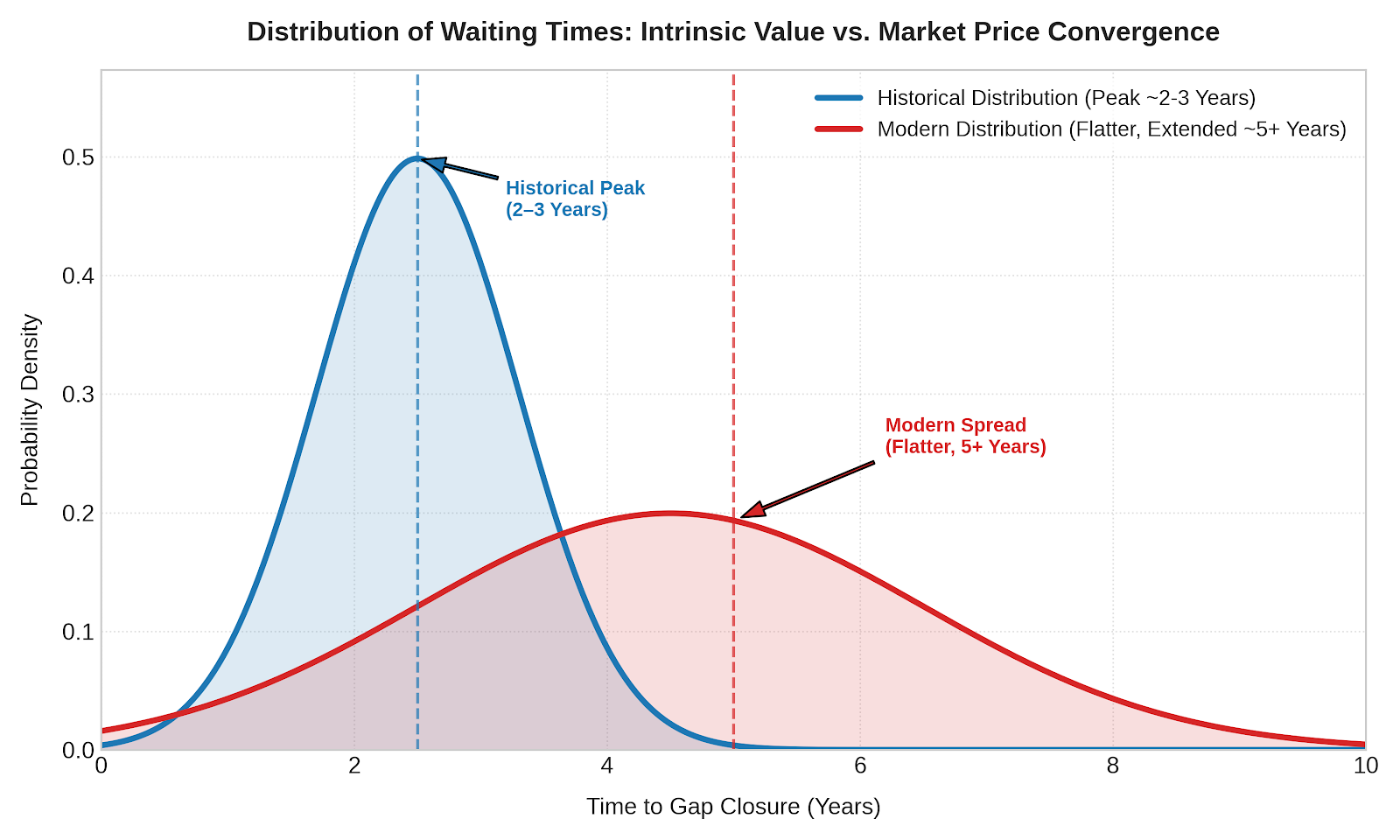
So let’s talk about that from a return perspective. What does patience cost, in return terms, when the calendar stretches?
Can You Afford to Be Early?
The table below shows the CAGRs earned from a “value gap” closing over a specific time frame; it assumes a static fair value and no dividends or buybacks.
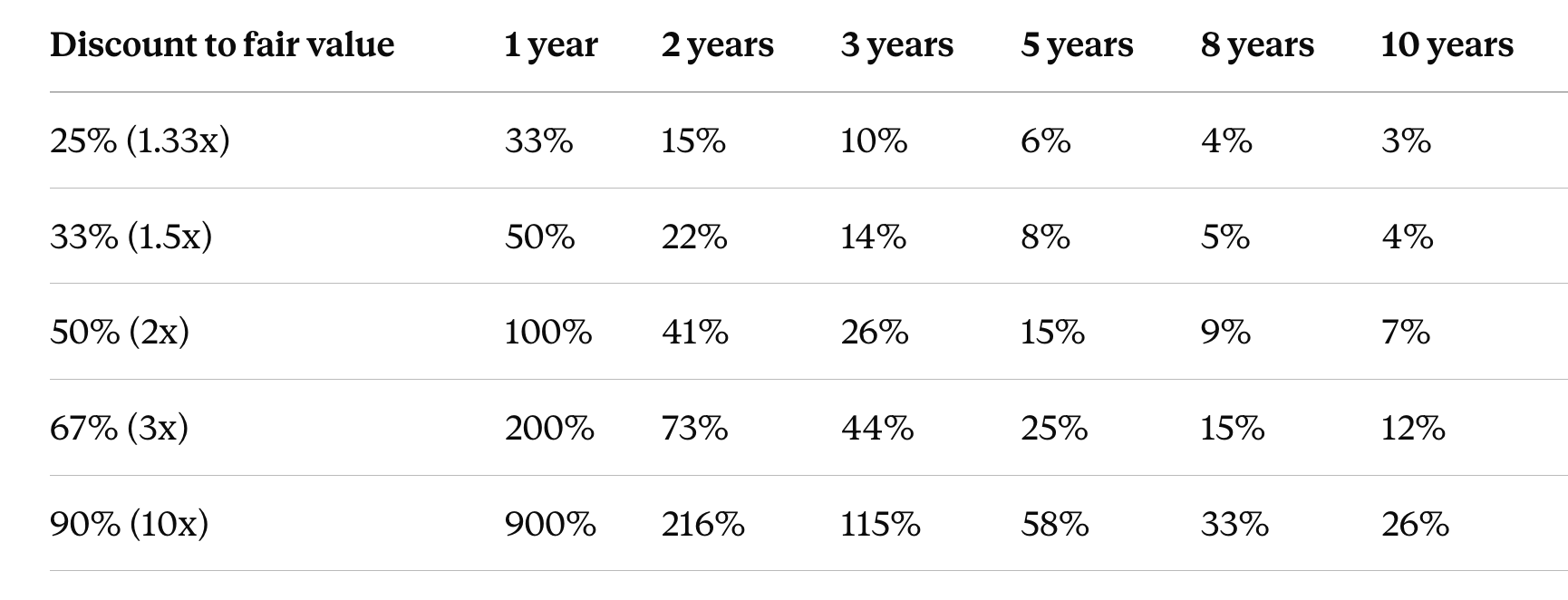
Look at the 50% row, effectively a multiple doubling (from 5x to 10x, from 10x to 20x, from 15x to 30x, etc.) because that is where most die-hard value people believe they are operating when they buy something trading at half of what they think it is worth (assuming they also demand a big margin of safety).
Closing in a year doubles your money already, without any earnings growth contributions, without dividends or buybacks adding to the return profile.
Closing in eight delivers 9% a year, roughly a market return earned with concentrated single-stock risk, a research burden, and eight years of looking “wrong.”
As noted, those figures assume the fair value stands still. If the business compounds intrinsic value while you wait, you get that on top, so a company growing value at 8% a year that closes a 50% gap over five years returns about 24% annualized instead of 15%.
A similar logic applies to a company retiring 6% of its shares a year at a discount, since every buyback executed below value transfers value to you whether or not the multiple ever recovers.
Disclaimer:
The analysis presented in this blog may be flawed and/or critical information may have been overlooked. The content provided should be considered an educational resource and should not be construed as individualized investment advice, nor as a recommendation to buy or sell specific securities. I may own some of the securities discussed. The stocks, funds, and assets discussed are examples only and may not be appropriate for your individual circumstances. It is the responsibility of the reader to do their own due diligence before investing in any index fund, ETF, asset, or stock mentioned or before making any sell decisions. Also double-check if the comments made are accurate. You should always consult with a financial advisor before purchasing a specific stock and making decisions regarding your portfolio.
When the market becomes unreliable in closing “value gaps,” part of your result is luck
If you are a value investor in 2026, much of your work is the same as two decades ago. Read the public filings, study management, understand the unit economics and the competitive field, scrutinize the balance sheet, form a view on normalized earnings, gain valuable insights, hold it up against the price.
Somebody who does that carefully still ends up with a better estimate of value than somebody who does not.
What has changed is what the market does with a correct estimate.
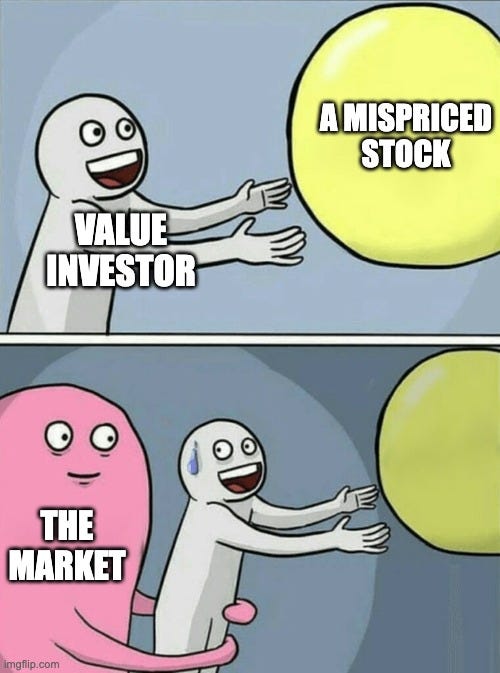
Einhorn describes the mechanism from the other side of Greenblatt’s past promise in his recent public appearances: find a 50% gap and, under the old regime, the market would generally close it within two to three years (as Greenblatt promised decades ago) and hand you the return for your trouble.
Today the closing is less dependable.
Plenty of gaps stay open (almost) indefinitely, and the ones that do close tend to close fast, sometimes in one violent move set off by an index inclusion, a shift in the second derivative of the narrative, or a single quarter that gives the momentum crowd permission to buy.
So fundamental analysis still gets you to the right answer, and you will be rewarded eventually. However, collecting the reward has turned into a separate problem, and momentum is often the force that decides when you collect.
Mauboussin & Taleb
That loosens the link between the quality of your work and the quality of your result, which is where Mauboussin earns his place in this discussion. He describes activities as sitting somewhere on a continuum between pure skill and pure luck, and his practical advice is that the further an activity drifts toward the luck end, the more weight you should put on process and the less you should read into any individual outcome.
My hypothesis in this write-up is that this particular activity (stock picking) has drifted along that continuum over the past decade. The drift has little to do with investors becoming worse at valuation (although that’s probably true too) and more to do with a market that settles up on valuation less predictably.
Two people can do identical work, buy at identical price discounts, and post wildly different results because one gap closed in eighteen months (and the capital could be reallocated right away) – and the repricing may even overshoot –, and the other is still open in year six. If you are buying a business that’s not growing in intrinsic value, and your bet was primarily on the price-to-value gap closing, you are sitting on flat returns (negative real returns) for more than half a decade.
Ouch.
Two investors. Same skill, different draw.
Taleb’s contribution in Fooled by Randomness is to insist that you judge a decision by the distribution of outcomes it could plausibly have produced rather than by the single path that happened to occur.

Name the decade when sentiment and flows were not in charge at some point
My friend Tiho Brkan put a question to me recently that I kept chewing on for quite some time: Which period was all of this not true of?
Think about that!
He mentioned a couple of examples where the sentiment (valuation does not matter anymore) dominated before:
The late nineties were flows and sentiment. So was the three-and-a-half-year bear market afterward, when valuations got cheap in 2001 and then kept getting cheaper into October 2002.
In the first half of 2008, nobody could explain why the market was falling, and it was put down to flows and sentiment.
After Lehman, Buffett started buying; the market fell for another five months, and that was flows and sentiment too.
Through 2009 and 2010, stocks rallied hard while unemployment stayed brutal and earnings stayed weak, and everyone said the rally made no fundamental sense.
The whole zero-rate decade got dismissed as liquidity.
In March 2020, the market bottomed within about four weeks of the world shutting down, with GDP still collapsing.
The 2021 growth mania was flows and sentiment; Cathie Wood crushed the market on a hype and momentum-based investment framework; and so was the crash that followed it.
No era in the record exists where a serious person could not have written a similar article like I do today. Here’s another overview I had Claude generate for me today:
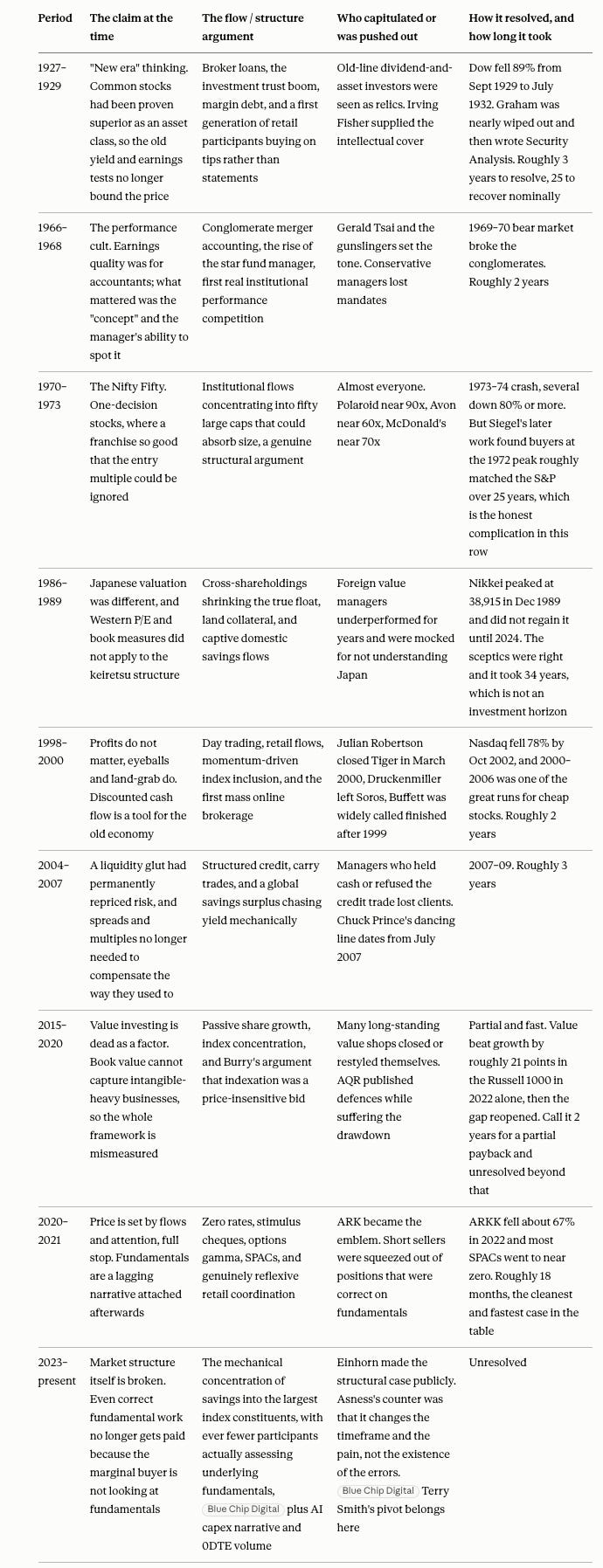
Tiho argues the market is always ruled by sentiment and flows, and it is always ruled by fundamentals and structure. The difference is the timescale. Structural forces play out over generational trends of roughly 15 to 20 years in each direction.
Think about that … Secular trends lasting 15-20 years can feel like a lifetime. I mean in some way, it is.
Tiho’s chart below illustrates that point with another recent example in a certain pocket of the market (namely Chinese tech):
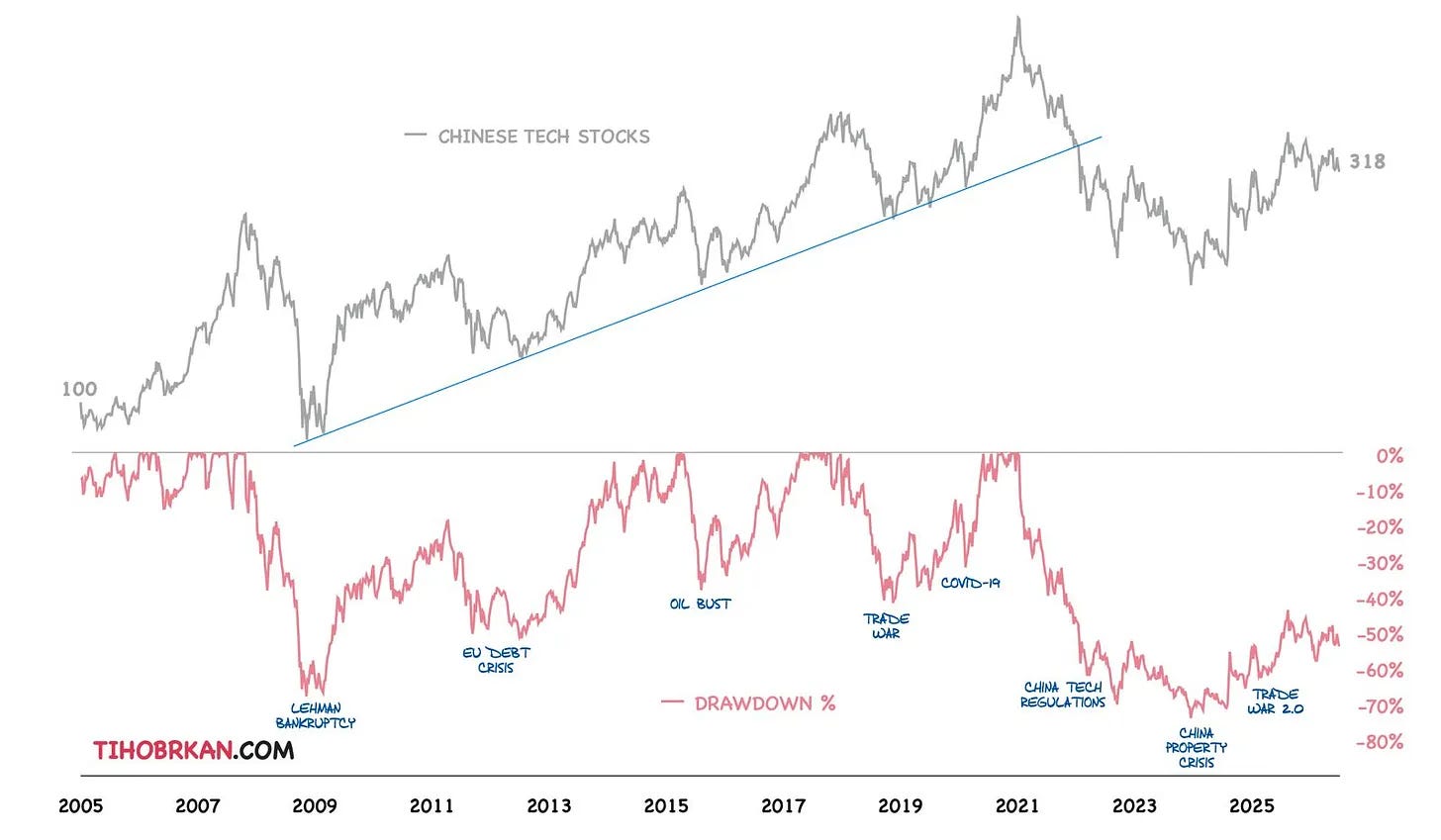
Chinese tech ran in a structural uptrend from the 2009 low to the 2021 peak, and over those years the narrative moved from unloved to deserving a decent multiple (especially between 2019 and 2021 the narrative flipped) – ironically, Charlie Munger first bought Alibaba stock in the first quarter of 2021.
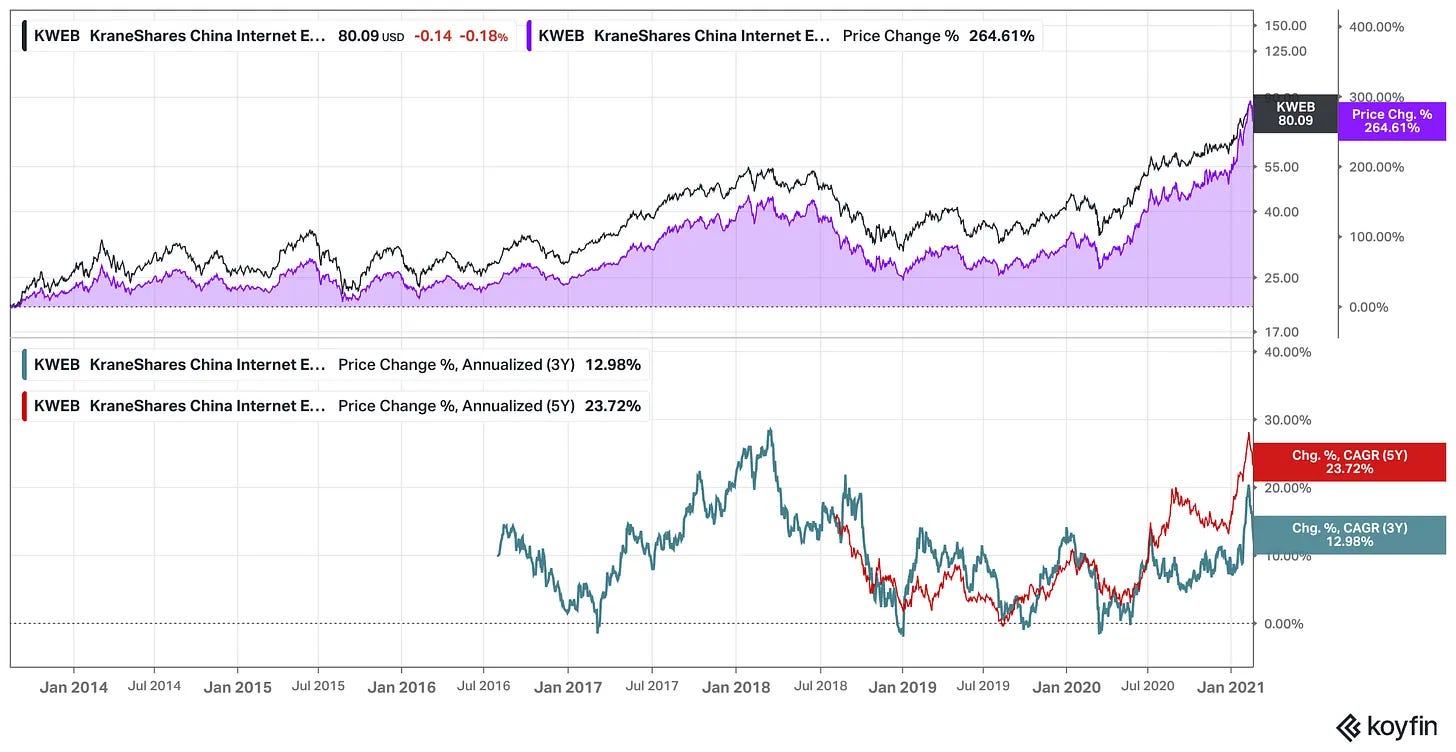
After the 2021 top, the tech regulations, the property crisis, and the trade war, a China discount became received wisdom (again), and the phrase “China drag” entered the mainstream Wall Street vocabulary as though it described a permanent feature of the assets; notice that nobody used it in 2019.
The multiple moved first, and the explanation followed.
Price drives narrative. It always does.
Which brings up the statistical point underneath all of this. In judging evidence, humans systematically overweight strength of evidence and underweight weight of evidence. A vivid, recent, salient pattern feels like a signal, and a small sample feels sufficient. Flip a coin fifty times, get thirty-five heads, and the signal looks overwhelmingly strong. But placing too much emphasis on it reflects an error in your process and judgment; it’s driven by insensitivity to sample size. Flip a coin ten million times (much greater weight of evidence), and the signal will be much stronger.
Four years of observations about how the market treats cheap stocks is maybe twenty or thirty flips, enough to form a hypothesis and nowhere near enough to declare a permanent change in the physics of the thing.
You need large sample sizes, base rates, history, and a large volume of analogies before drawing conclusions. Months, years, or even a single decade of observation is not enough.
Tiho argues there is some order underneath the chaos you witness superficially. Patterns never repeat exactly, but they rhyme (the famous Mark Twain quote), because human nature does not change.
Valuation will make its comeback. I’m sure of that too. Just like Chinese equities will stage a comeback that few believe in today.
Resolving the Cognitive Dissonance
Here is my resolution to my simultaneous agreement and disagreement with FJ Research’s observation:
The claim that market structure has changed bundles together two categories of change that behave completely differently in my view.
The Plumbing
The first category is best described as “plumbing.” Passive vehicles now hold more than 60% of fund assets. On figures Smith cites from Cboe, active managers accounted for about 80% of trading volume in the 1990s and account for roughly 10% today. Index providers set inclusion rules and funds must follow, which is why the Nasdaq-100 could waive its seasoning period and float requirement to accommodate the SpaceX listing, and why David Booth described index funds as trading desks run by somebody with no fiduciary duty to you.
Multi-manager platforms operate tight risk limits that force selling into weakness. Execution is algorithmic.
Terry Smith’s own examples of Snowflake closing at a $60bn valuation and opening at $82bn, or Dell closing at $205bn and opening at $273bn, are consequences of that plumbing.
Widen your expected range of interim price outcomes accordingly, permanently.
Which brings me to my own uncomfortable recent exhibit (which partly made me want to write this today). Tiger Brokers, which ticks of many of the boxes of a stock operating in obscure markets (China label, Singapore-headquartered, small (<$1 billion market cap)), reported on a Wednesday before the open, in my reading a very solid quarter. The stock did essentially nothing that trading day and then dropped more than 7% on Thursday, the next day.
Make it make sense (with your value investor hat on).
Arguably, emerging markets are more volatile precisely because price discovery is less efficient and more than fundamentals moves them.
I would have underwritten Tiger’s fundamental results hand over fist back in May when the regulatory news shocked the market.
Yet, other participants are clearly in control of the near-term price here, and the stock may stay mispriced for years.
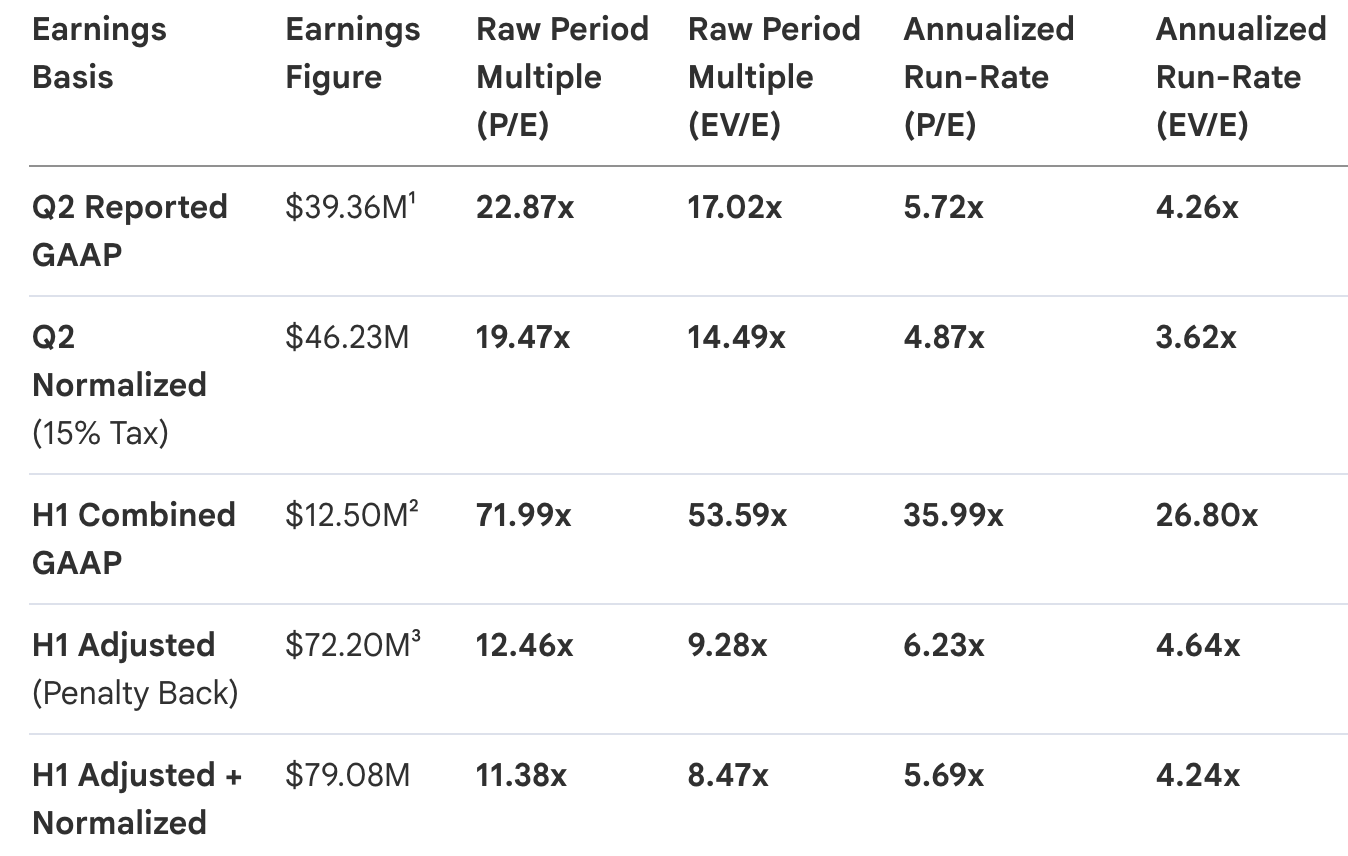
Based on my calculations below (and please note that I’m biased since I own the stock), the company that just reported 30% revenue growth (and grew its funded accounts base at 10-11%; which is arguably the better metric to assess long-term intrinsic value growth) trades at 14.5x this quarter’s (tax-normalized) earnings, and a single-digit multiple if you combine Q1 and Q2 earnings.
The Mood
The second category is mood, dressed up as structure by people who should know better. Momentum has been the driving force of 2026.
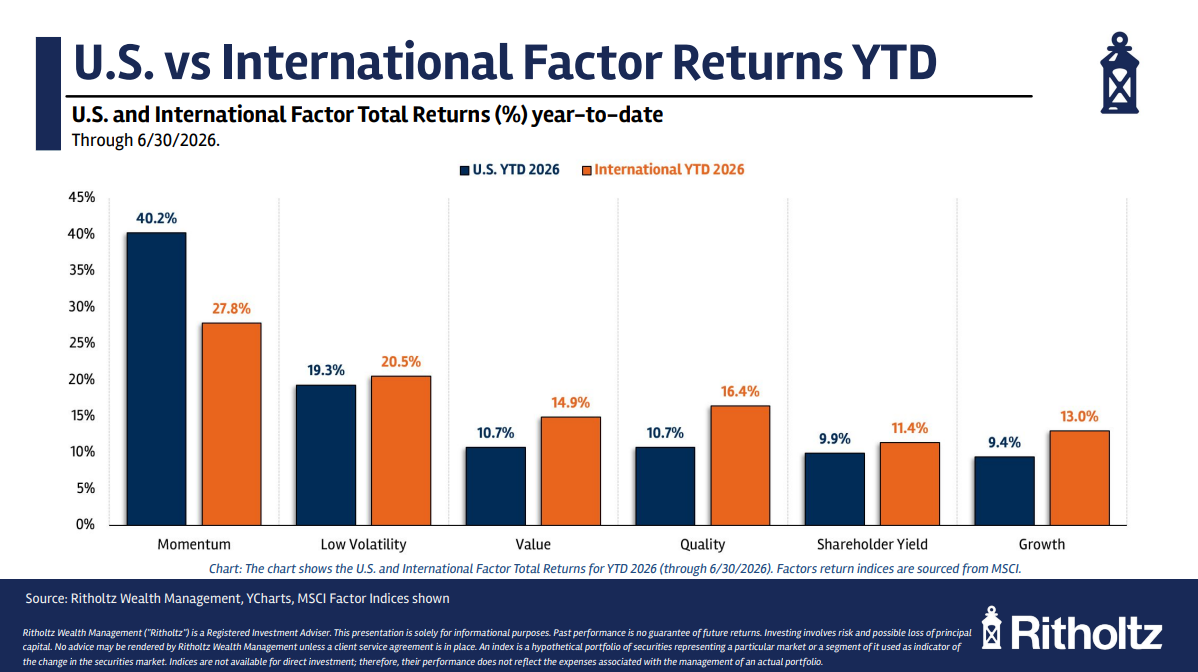
“Momentum was the clear winner. It delivered one its strongest quarter since the dot.com era, outperforming by 31.4% in the US and an extraordinary 40.7% in EMs. However, the gap between Momentum winners and losers is now very wide by historical standards, increasing the risk of a sharp reversal.“ - Wisdomtree
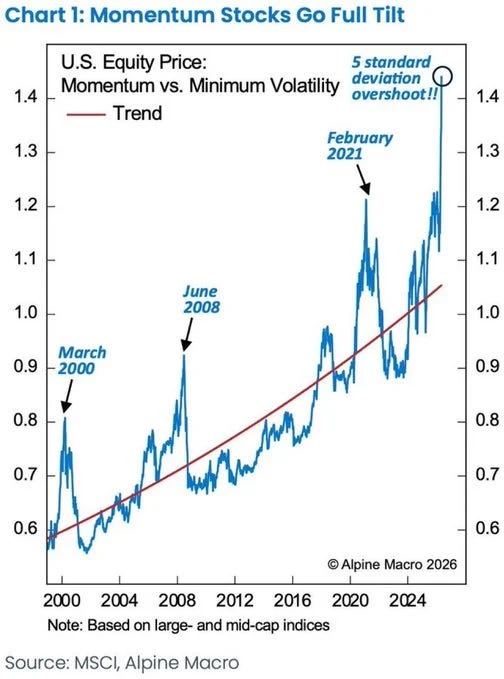
And the momentum factor sits at a thirty-year extreme, more stretched than late 1999.
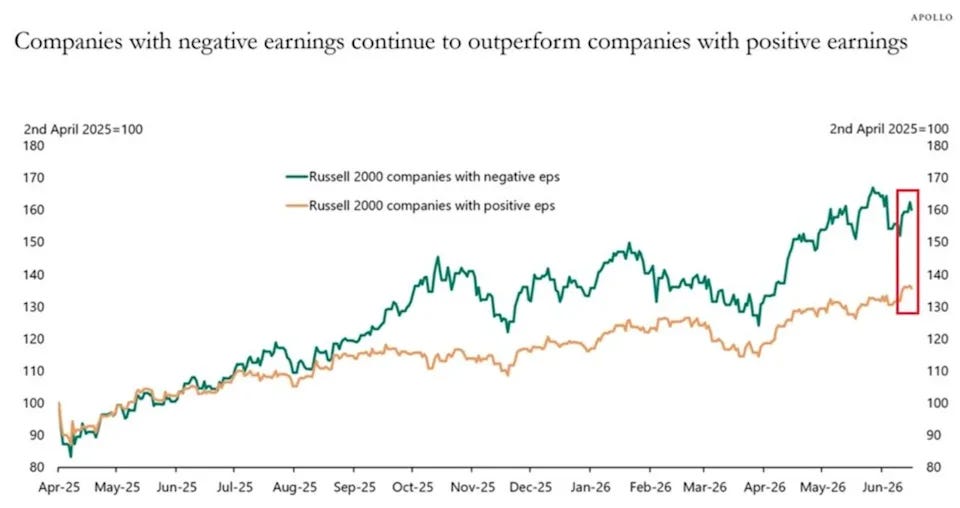
Unprofitable companies in the Russell 2000 are outperforming profitable ones.
Index concentration has reached levels that have appeared five or six times in two centuries and resolved the same way each time.
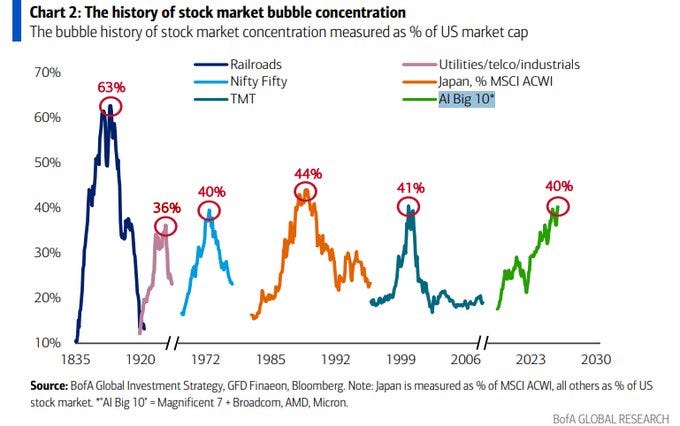
Those conditions have reverted on every previous occurrence, and the last decade of observations tells you nothing about whether this one is different.
Remember: weight of evidence vs. strength of evidence!
The practical consequence of splitting them is that you may underwrite the plumbing changes and question the sentiment changes.
Assume volatility is elevated for the time being, assume the waiting may take longer (or may resolve faster), stop expecting a re-rating on Greenblatt’s schedule. Keep buying cheap.
Dirt cheap.
Everybody agrees now, and that is the part that gets my attention
Ole posted a list on X last week that seems quite fitting here.
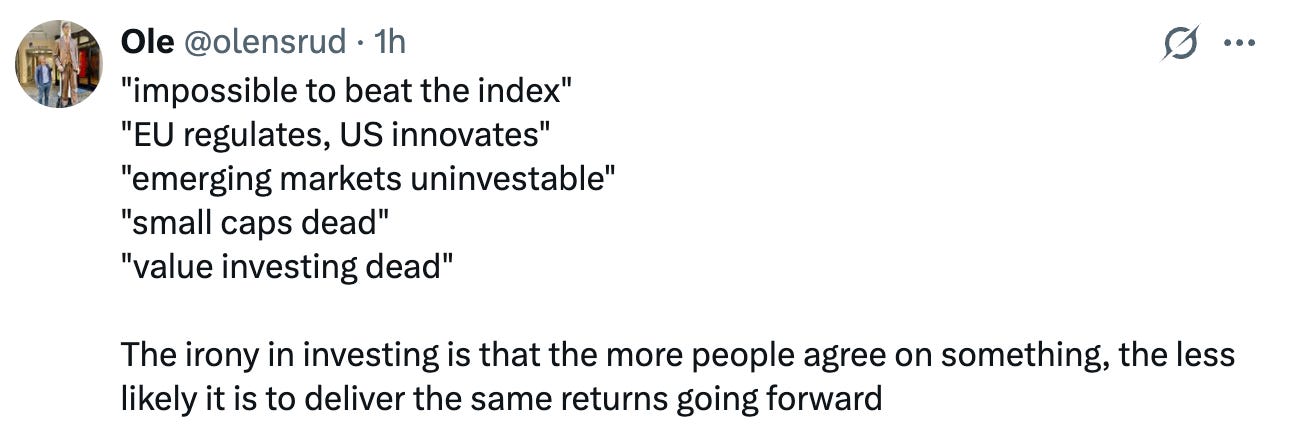
Impossible to beat the index. Europe regulates while America innovates. Emerging markets uninvestable. Small caps finished. Value investing dead.
Every one of those is currently perceived as permanent wisdom. His observation is that the wider the agreement on any of them, the less likely the thing keeps delivering what it has been delivering.
I couldn’t agree more
Of course, reflexive contrarianism is its own way of being stupid. Consensus is often correct, and it can stay correct for a decade while you lose money betting against it. Passive vehicles crossing 60% of fund assets is consensus and also a fact.
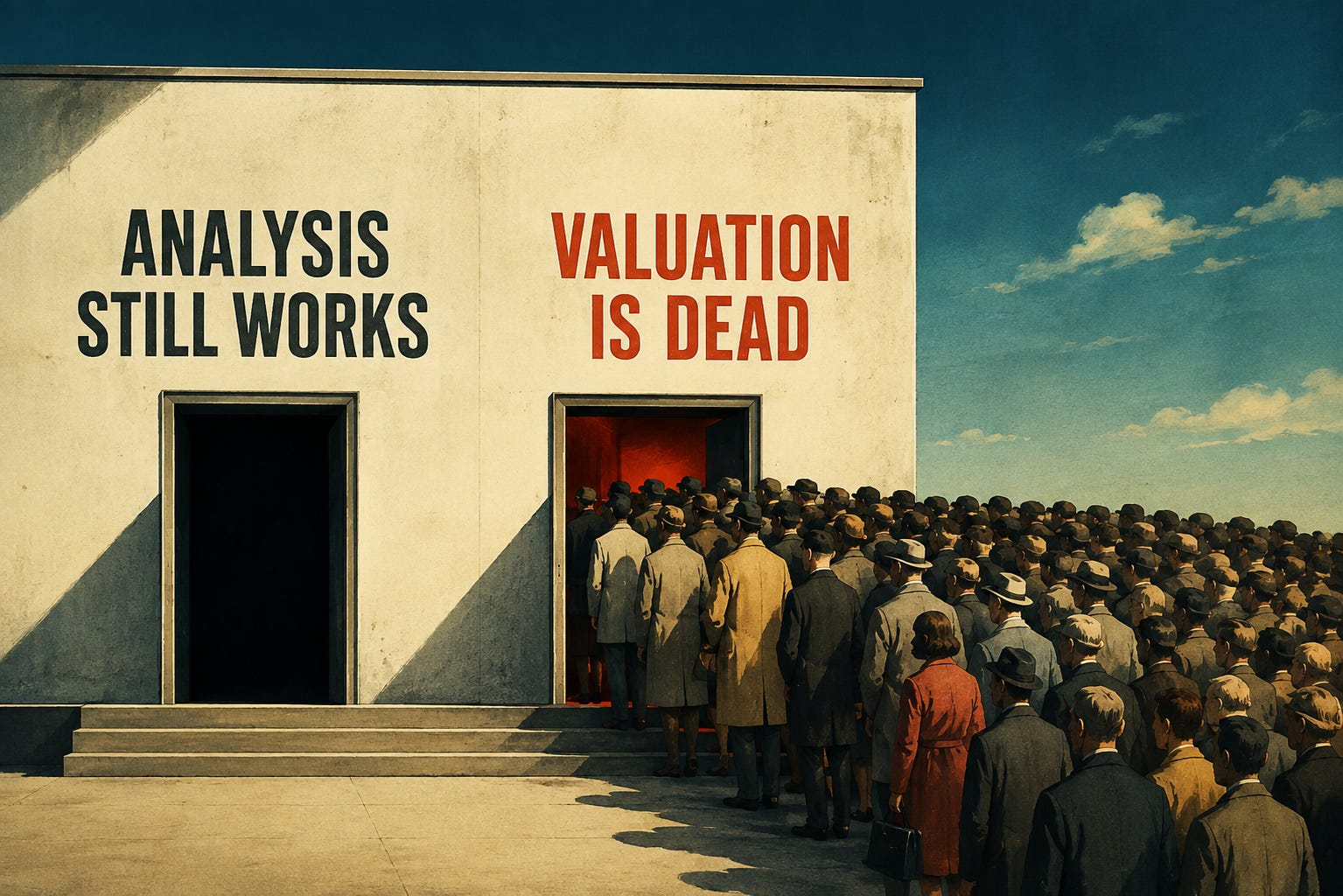
Still, five years ago the death of valuation-focused investing was argued by a handful of managers having a bad run. Today it appears in the shareholder letter of the most respected quality investor in Europe, in the US, in Asia. In the timeline of practically every serious investor I follow. Everywhere!
The identity of the people holding the view has changed, not merely the headcount. Late-stage adoption by the careful and the previously skeptical is the phase of an idea I have learned to treat with suspicion.
Nobody has ever announced a permanent regime change at the beginning of a regime. The announcements come when the regime has run long enough that resistance has been exhausted, which is usually late.
Dylan Marrello made a point recently that fits this environment too when he tweeted:
“Looking a little further out than the crowd is an enormous edge in the present environment where the duration of most capital has become comically truncated and the competition for long-dated information is thus slim. Time arb used to be framed as 3-5 years out; today looking just a year out is often enough. Lot of people seem to forget that a stock that doubles in three years is a 26% CAR, independent of which year the returns actually come. The game gets a lot easier when you cease insisting on immediate payoff. Something can be dead money for a couple years and still produce a great outcome.”
Dead money for twenty-four months followed by a violent re-rating still produces an excellent outcome.
Look at Bristlemoon’s second chart above again with that in mind and it stops being a picture of a broken market. Wider oscillation around a rising intrinsic value line is an opportunity, provided (!) your capital cannot be taken away from you at the wrong moment.
That has pushed me toward things I used to consider beneath a fundamental investor: What story is the market currently telling about this business, and what specifically would have to happen for the story to change? Who the marginal buyer would be. Where the stock sits in its own trend and whether that trend has begun to turn. Call it perception analysis, and it belongs alongside the valuation work rather than instead of it.
Read my 3-part perception change framework next:
Playing a Different Game: When Fundamentals Aren’t Enough Anymore! (Part 1)

This will be a 3-part series. If you don’t want to miss the follow-up pieces, make sure to subscribe to the blog.
Druckenmiller describes his own version of it:
“A lot of my style is you [first] build a thesis, hopefully that no one else has built. You sort of put some positions on… Then when the thesis starts to evolve and people get on & you see the momentum start to change in your favor, then you really go for it. You pile into the trade. […] It’s what my former partner George Soros was so good at, and we call it, if you follow baseball, it’s a slugging percentage as opposed to batting average.”
He builds a thesis nobody else has, takes an initial position, and then waits for the thesis to be validated and for momentum to swing his way before he piles in.
There is a serious warning I want to articulate here, though: Druckenmiller can reverse a position in a morning and feel nothing about it. Most investors, myself included on my worst days, anchor to the view we published and defend it. Bolting momentum onto a process without his willingness to abandon a thesis on new information produces buying high and selling low with extra steps, which is why I think the excellent investors should study Druck and the average ones should be careful with trying to copy his approach.
The rest of what changed follows from the math outlined earlier in this piece:
I might have to underwrite a longer horizon than Greenblatt’s when it comes to valuation gaps closing, and check that the return clears my hurdle at year five and year eight.
This can partly be accomplished by placing more emphasis on businesses growing intrinsic value at a very high rate. That’s basically the idea we covered in the recent “Half a Lost Decade Stocks“ piece.
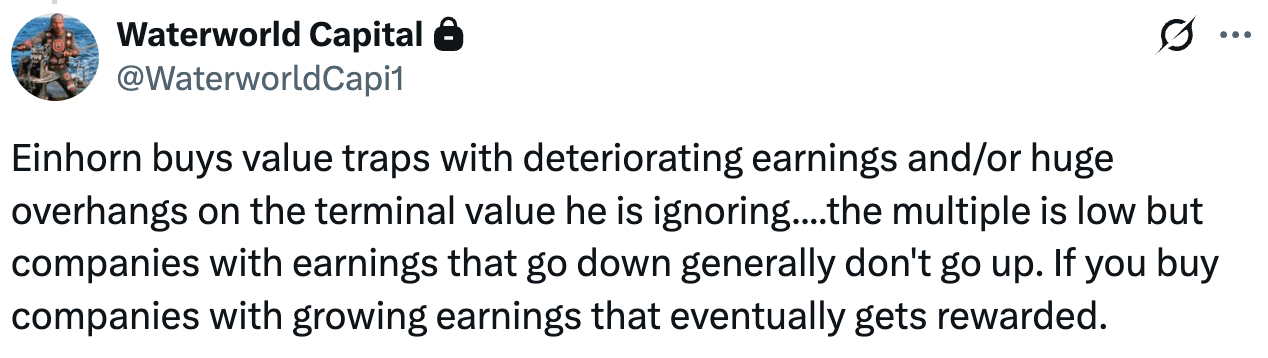
I strongly prefer businesses (read: business operators) that close (or at least exploit) the gap themselves, through large buybacks executed below value or big dividend checks (relative to my purchase price) I can reinvest, over ones that depend on other investors changing their minds.
In theory (and I still struggle with this), I should size for the possibility that a position stays dead for years, since the widening of the payback distribution means luck plays a bigger role.
And I keep in mind that a five-year wait is not necessarily indicative of a poor fundamental process (but rather indicative of poor timing skills): a 50% discount on a business compounding intrinsic value at 8% still pays roughly 24% a year if it takes until year five to close, which is a home run that would have felt like an error for four of those five years.
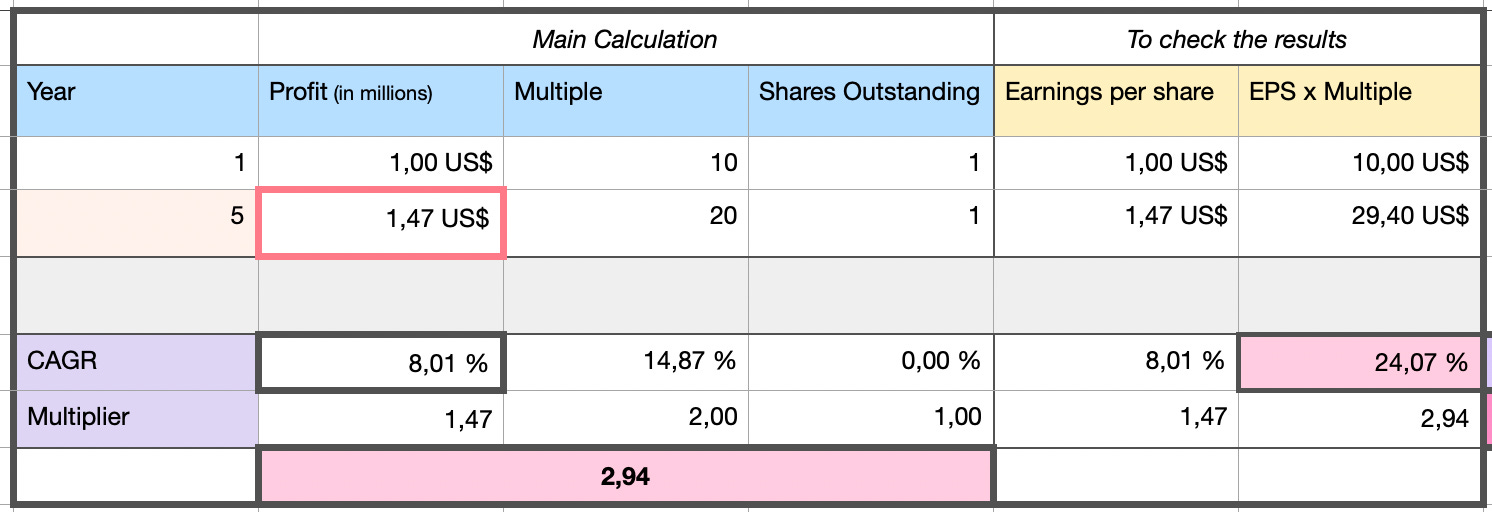
What I refuse to change is compromise on the price paid; it still determines long-term returns.
Every previous announcement of the death of valuation has been followed, on a delay long enough to be painful, by the resurrection. Consider the real Barron’s article from 1999:
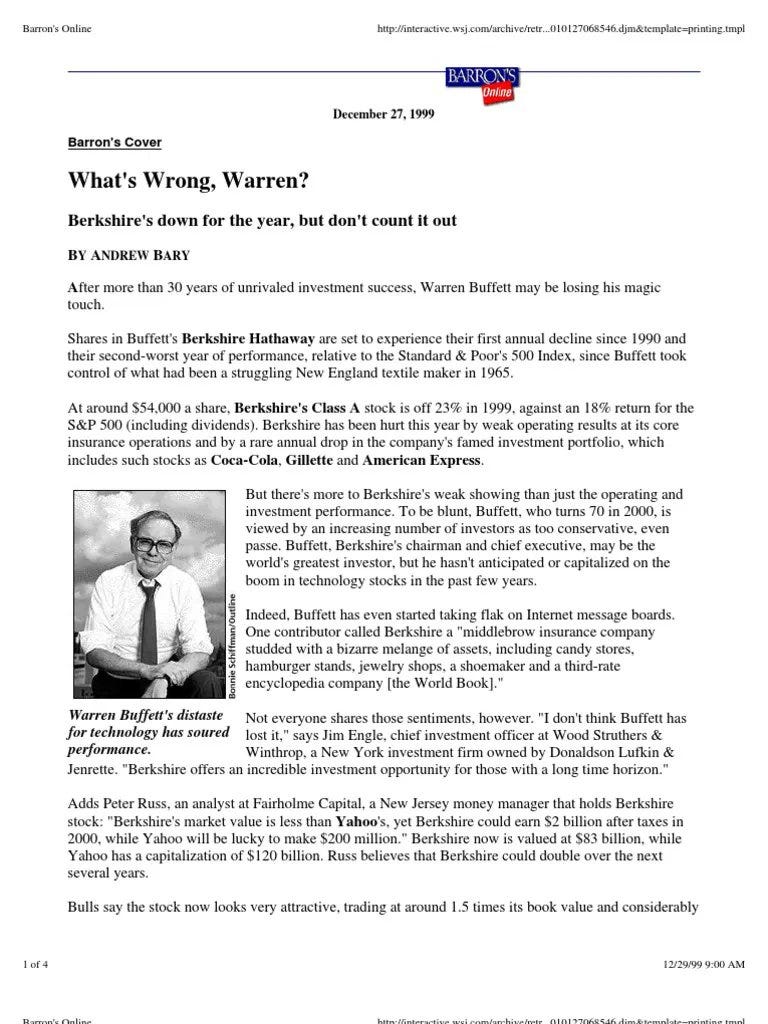
The delay is the part that has gotten worse. Plan for it, get paid while you wait, learn to read the mood well enough to know when the payment is coming, and stop treating the length of the wait as evidence that your framework is flawed.
Let’s discuss!
Disclaimer:
The analysis presented in this blog may be flawed and/or critical information may have been overlooked. The content provided should be considered an educational resource and should not be construed as individualized investment advice, nor as a recommendation to buy or sell specific securities. I may own some of the securities discussed. The stocks, funds, and assets discussed are examples only and may not be appropriate for your individual circumstances. It is the responsibility of the reader to do their own due diligence before investing in any index fund, ETF, asset, or stock mentioned or before making any sell decisions. Also double-check if the comments made are accurate. You should always consult with a financial advisor before purchasing a specific stock and making decisions regarding your portfolio.
As a 30 year value investor I found this article to be the best thing I have read in some time. My conclusion is not that value investing is dead, but that patient value investing
works best with your own money. Impatient value investing requires luck as well as skill. More rapid style rotation may yet come to the rescue.
Thank you for writing this! As you know, I grew up on Buffett, Munger, Klarman, and still think like an owner. I just stopped being religious about the old rulebook. Markets got faster, flows got larger, and selloffs resolve in weeks. So I adapted.What I appreciate most is that you did not pick a side. You actually practiced the discipline of holding two opposing forces in tension long enough for something true to come out of the collision. This is one of the best pieces I have read in the Substack finance community. Everyone should read it carefully, word for word.