

A quick note before you dive in: This piece originally ran as a guest post I wrote for The Dutch Investors, whose patient, quality-focused approach lines up closely with my own. I'm republishing it here in full in case you missed it over there, because I think it delivers real value and I don’t want any of my subscribers to miss out. It's a condensed look at three businesses I've already covered in full-length deep dives for paying subscribers – Germany's CTS Eventim, Singapore's Grab, and the US holding company Boston Omaha – distilled down to the high-level overview and the things I'd most want you to know about each: what the business does, where its edge comes from, why the stock is down, and how I think about valuation.
One housekeeping point: I wrote this a little while back (about 12-14 days ago), so share prices and a few figures may have potentially moved slightly since. Grab in particular is up some 15% since and also reported its latest quarter this week – I thought the results were fantastic fwiw – so keep in mind that the numbers in that section predate the print.
With that, enjoy.

Disclaimer:
As of the date of publication the author owns shares in Grab Holdings but not in the other two companies (Boston Omaha and CTS Eventim); but that may change. The analysis presented in this blog may be flawed and/or critical information may have been overlooked. The content provided should be considered an educational resource and should not be construed as individualized investment advice, nor as a recommendation to buy or sell specific securities. I may own some of the securities discussed. The stocks, funds, and assets discussed are examples only and may not be appropriate for your individual circumstances. It is the responsibility of the reader to do their own due diligence before investing in any index fund, ETF, asset, or stock mentioned or before making any sell decisions. Also double-check if the comments made are accurate. You should always consult with a financial advisor before purchasing a specific stock and making decisions regarding your portfolio.
Germany: CTS Eventim ($EVD.DE) – A Digital Tollbooth on Sale?
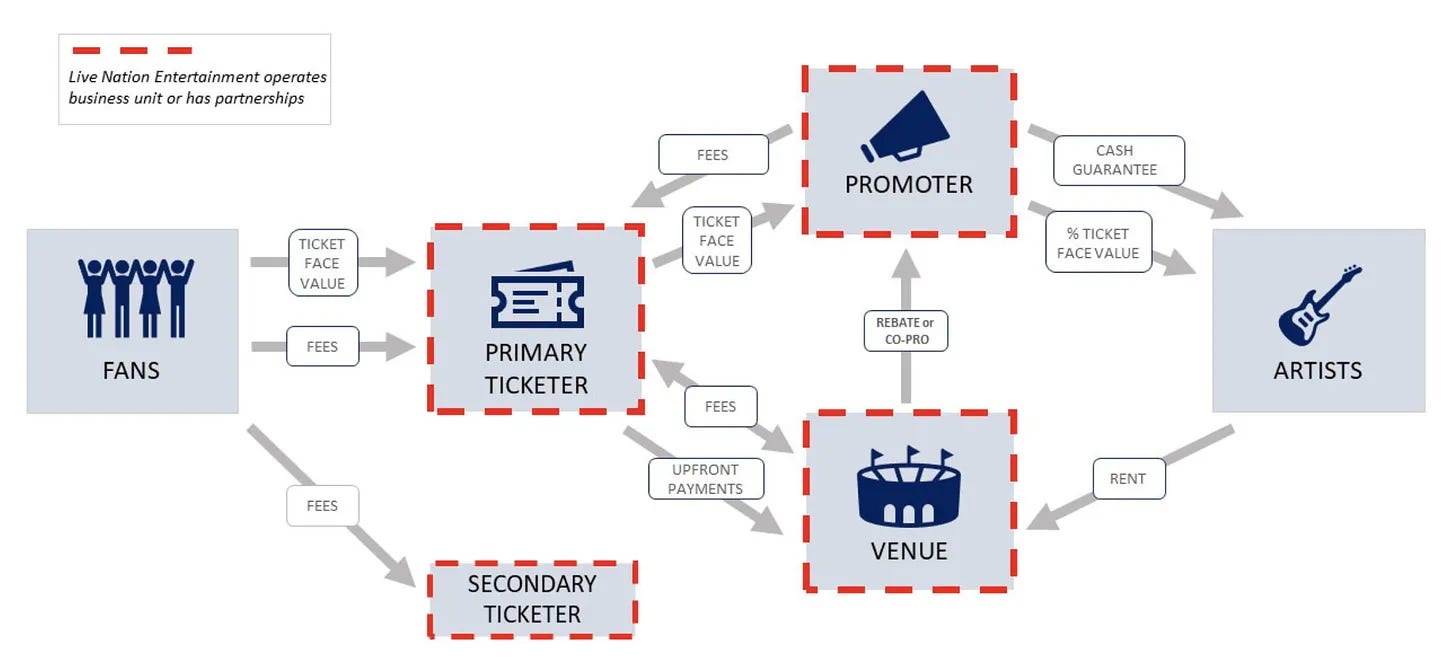
Let me start close to home. CTS Eventim is the undisputed heavyweight of European live entertainment and the second-largest ticketing provider on the planet, trailing only Live Nation.
Billionaire founder Klaus-Peter Schulenberg took the reins of a distressed 83-person Munich software firm back in 1996, relocated it to Bremen, and rebuilt it around a proprietary technology platform.
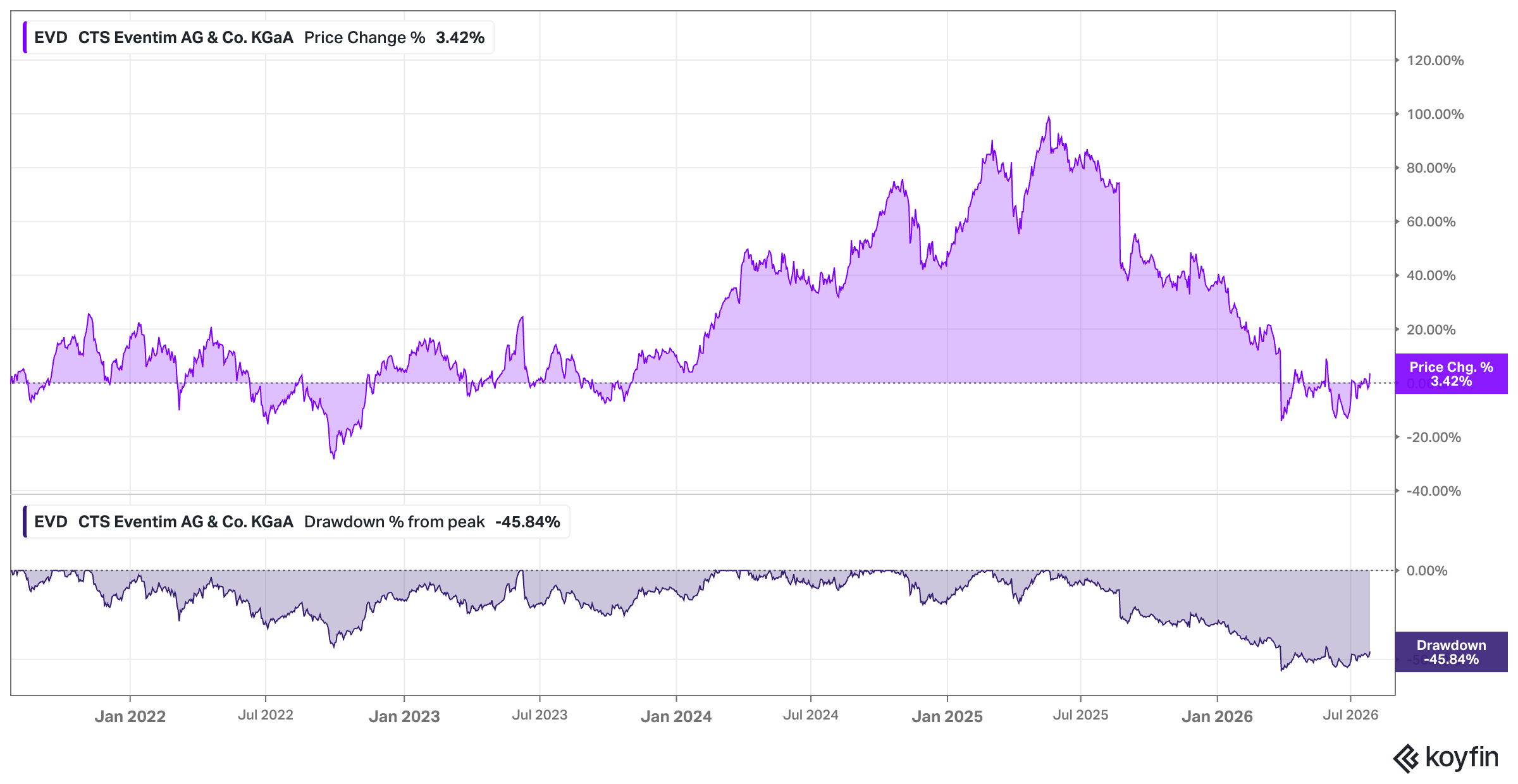
Since the IPO in February 2000, the stock has returned a staggering 2,350%, roughly 13% a year for more than two decades. And yet pull up the chart today and you meet a very different mood. The shares have been dead money for five years, and they sit around €56, down close to 50% from the peak they touched in May last year. So what happened to the tune?
How Eventim Makes Money
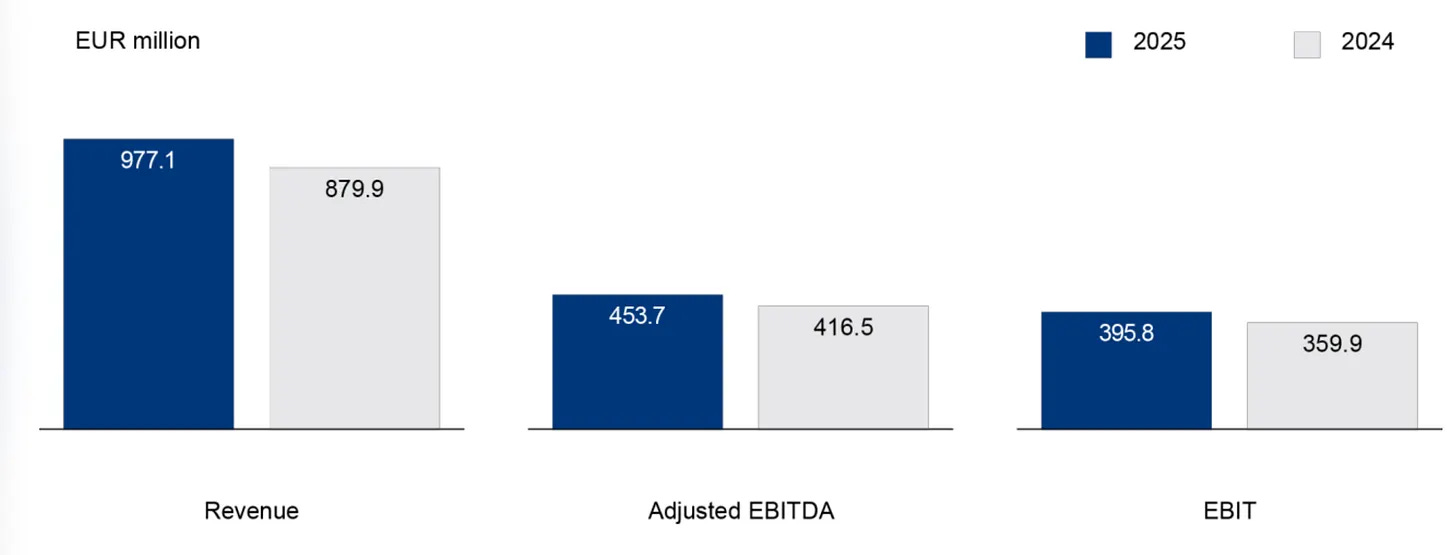
Eventim runs two segments that look like one entertainment powerhouse on paper but behave very differently underneath. The first, Ticketing, is the crown jewel. It contributes only about a third of group revenue yet throws off more than 77% of adjusted EBITDA and roughly 83% of operating profit.
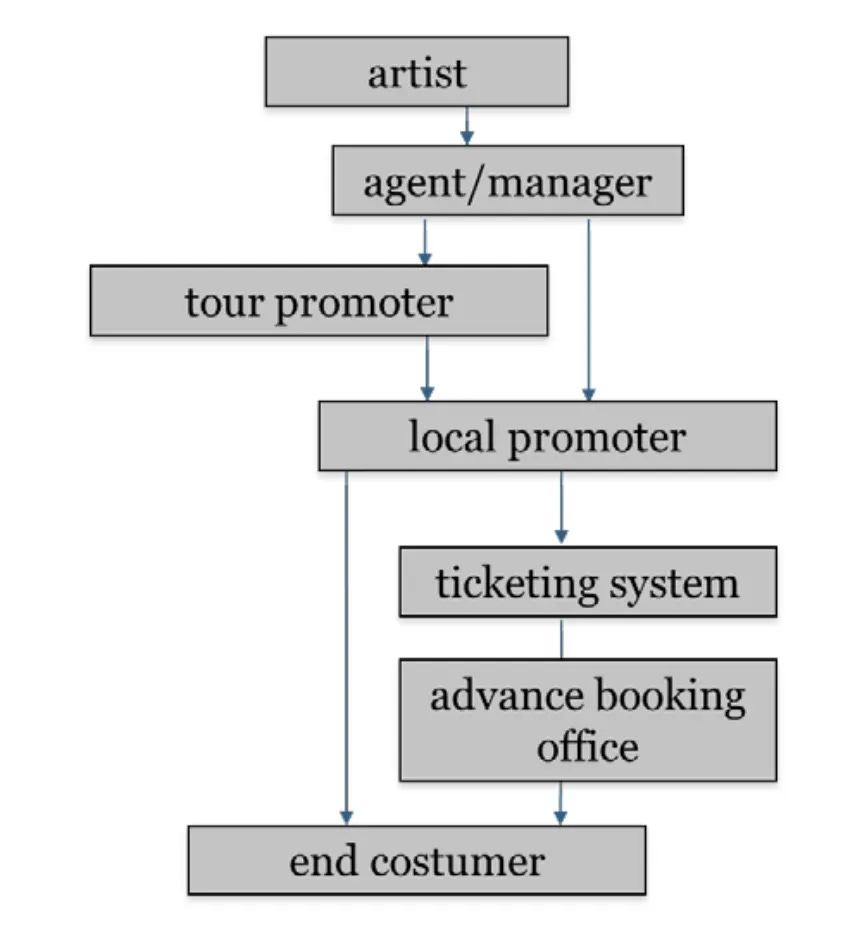
Think of it as a digital tollbooth. For every ticket sold, the company collects a fee worth something like 10% to 15% of the face value, and because the infrastructure is already built, each additional transaction costs almost nothing to process.
The economics of a 100€ concert ticket could look roughly like this:

In 2025, that meant close to €9 billion in gross transaction value across nearly 178 million retail tickets, at an effective take-rate near 11%. Margins in this segment have topped 40% at the EBIT line for years.
The second segment, Live Entertainment, is the operational counterweight. Here Eventim acts as the principal risk-taker: through its Eventim Live network of nearly 40 promoters, it books artists, funds tours, and stages the shows.

This side carries much thinner margins and roughly 70% of group revenue, but it feeds the machine. The promoters route their high-profile tours exclusively through Eventim’s own software, self-sourcing the very inventory that the high-margin tollbooth then processes.
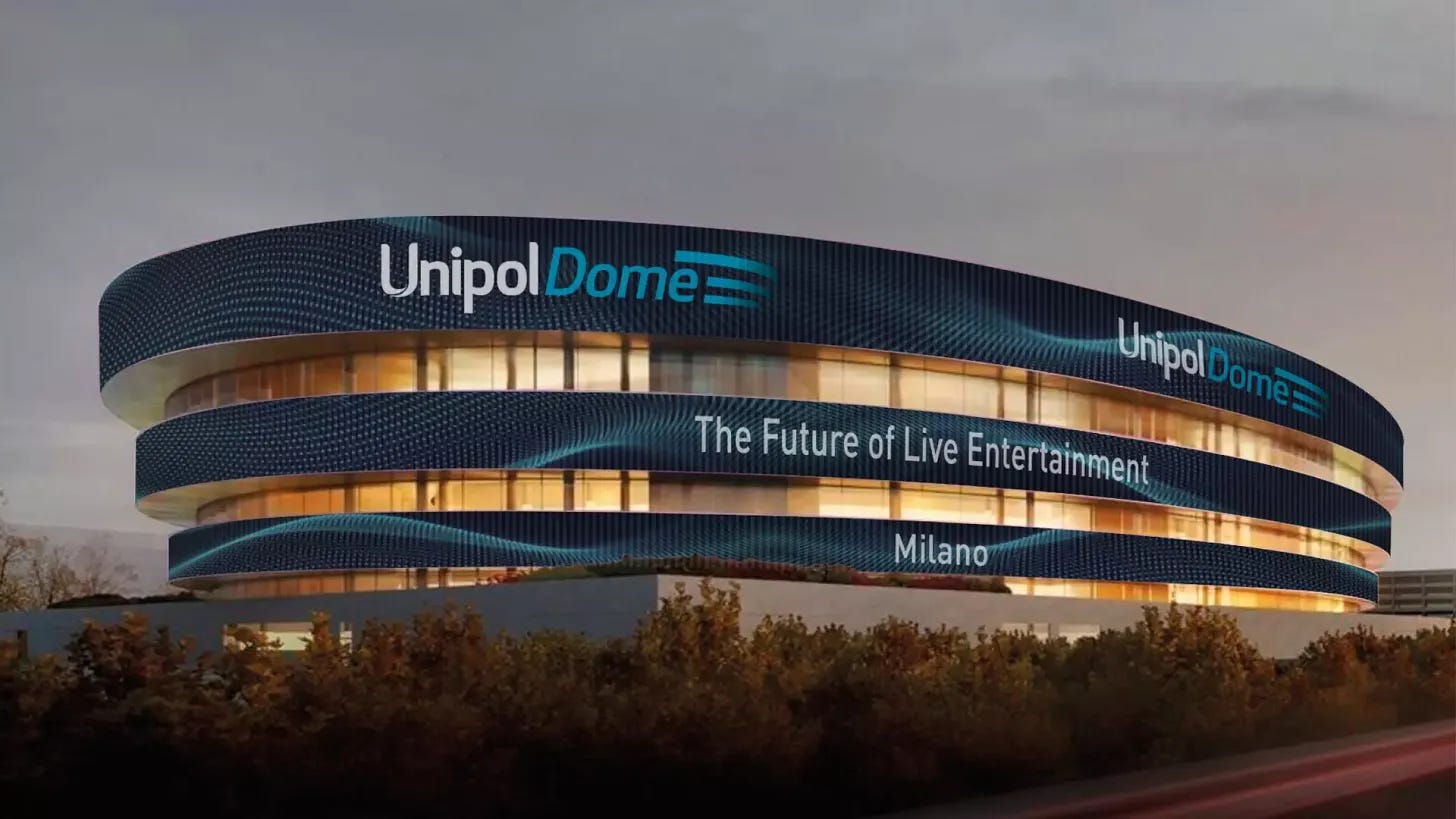
Add the physical venues the group manages or owns – the LANXESS Arena in Cologne, the Eventim Apollo in London, the new Unipol Dome in Milan – and you get a company that captures a margin at nearly every touchpoint, from promoter fee to venue rental to ticketing commission to the beer sold at the concession stand. Group revenue hit a record €3.1 billion in 2025.
Why It’s So Hard to Dislodge
Eventim’s grip on its core markets is the thing bears consistently underestimate. Estimates vary, but the company holds something like a 50% to 60%-plus share of primary ticketing across Germany, Italy, and Austria. In its home market that figure runs even higher; the German Federal Cartel Office itself established, in its 2017 abuse-of-dominance proceedings, that Eventim controlled 60% to 70% of ticketing system services for promoters. That dominance has only grown since. If you want to see a major touring act in Central Europe, you have virtually no route to your seat that doesn’t clear through Eventim’s portal.
That moat rests on a few reinforcing pillars. There’s the vertically integrated flywheel I described above, where owning promoters and venues forces high-margin volume through proprietary channels.
“Being vertically integrated enables Eventim to produce more concerts, which in turn drives high-margin ticketing revenue. More revenue in the industry drives artists to tour more, which further feeds the flywheel. Eventim’s revenue has grown at a low-double digit rate for many years with attractive margins and returns on capital. The business is asset-light, has a net cash balance sheet, and generates a lot of free cash flow. We are pleased to be shareholders and to be able to own this outstanding business with a substantial margin of safety.“ - Vulcan Value Partners
There’s the technology: EVENTIM.Net can absorb more than a million concurrent users during a stadium on-sale for the likes of Taylor Swift or Ed Sheeran without buckling, a feat regional rivals can’t match, and building that industrial hardening in-house is cost-prohibitive for any single promoter.
There’s the data, over 260 million user profiles that let promoters target buyers with a precision smaller players can only envy. And there’s the demand itself, which is stubbornly price-inelastic. A live concert can’t be digitized, simulated, or streamed into the same thing. During the 2008–2009 financial crisis, while industrial sectors were being flattened, Eventim’s ticketing revenues actually rose 29%. Fans guard their concert budgets even when times are tight.
One more signal worth weighing. Schulenberg already controls roughly 38.8% of the company through his family vehicle, and as the stock cratered in early 2026 he deployed about €20 million of personal capital into two open-market purchases, at €54.37 and then €50.85. Insiders sell for all sorts of reasons; they generally buy for only one.
What Went Wrong
If the business is this good, why is the stock cut in half? A few anxieties are doing the work. The loudest is venue execution. When Eventim signed up to build the Milan arena for the 2026 Winter Olympics, the budget was pencilled in at €180 million. Global inflation, energy prices, supply-chain snarls, and design changes ballooned the final bill to nearly €400 million. Free cash flow took a visible hit, and the market began re-rating the company from an asset-light digital compounder into a lower-return, capital-heavy real estate operator. A new 20,000-seat arena committed in Vienna only sharpened that fear, though management insists venue ownership isn’t the primary objective and that it intends to keep only a minority stake in the property vehicle under a PropCo/OpCo structure.
Then came a cautious 2026 outlook in late March, guiding for roughly flat profit growth against analyst hopes for double digits, which knocked the stock down as much as 21% in a session. Part of that guidance reflected a structural change in the long-standing Stage Entertainment contract, which looks like Stage Entertainment insourcing its backend software. The relationship wasn’t lost entirely; the retail ticketing partnership was extended across four countries in April, protecting the high-margin point-of-sale volumes. There’s also a genuine margin-mix effect, since the lower-margin Live Entertainment segment has been growing faster than Ticketing, plus integration costs from the See Tickets and France Billet deals.
I won’t wave away the longer-term worries either. Regulation is a live risk: the Cartel Office already forced promoters to be able to distribute at least 20% of volume through third parties, and further fee interventions could follow. A well-argued short thesis frames the 2022–2023 boom as a post-COVID sugar high that should normalize. And Spotify, sitting on the music discovery funnel, could in theory disintermediate primary ticketing over time.
I happen to think Eventim’s vertical integration and the sheer localness of the business keep it defensible, and it’s telling that Q1 2026 came in strong – group revenue up 23%, EPS up 38%, like-for-like ticketing up 6% once you strip out the Stage accounting artifact. But these are the cracks worth pressure-testing.
What You’re Paying
Here’s where it gets interesting, and where you have to be careful. Most research terminals get Eventim’s valuation wrong, because they pull the total consolidated net result and ignore that a chunk of those profits belongs to minority partners in non-wholly-owned subsidiaries. Strip out that leakage and use the net result actually attributable to shareholders, and the picture sharpens. At the May 2025 peak, a €10.8 billion market cap put the business at a demanding 36.6x attributable earnings. After the drawdown, at a €5.7 billion market cap, that multiple has compressed to roughly 19x, up roughly ten to fifteen percent since I initially covered the company in June.
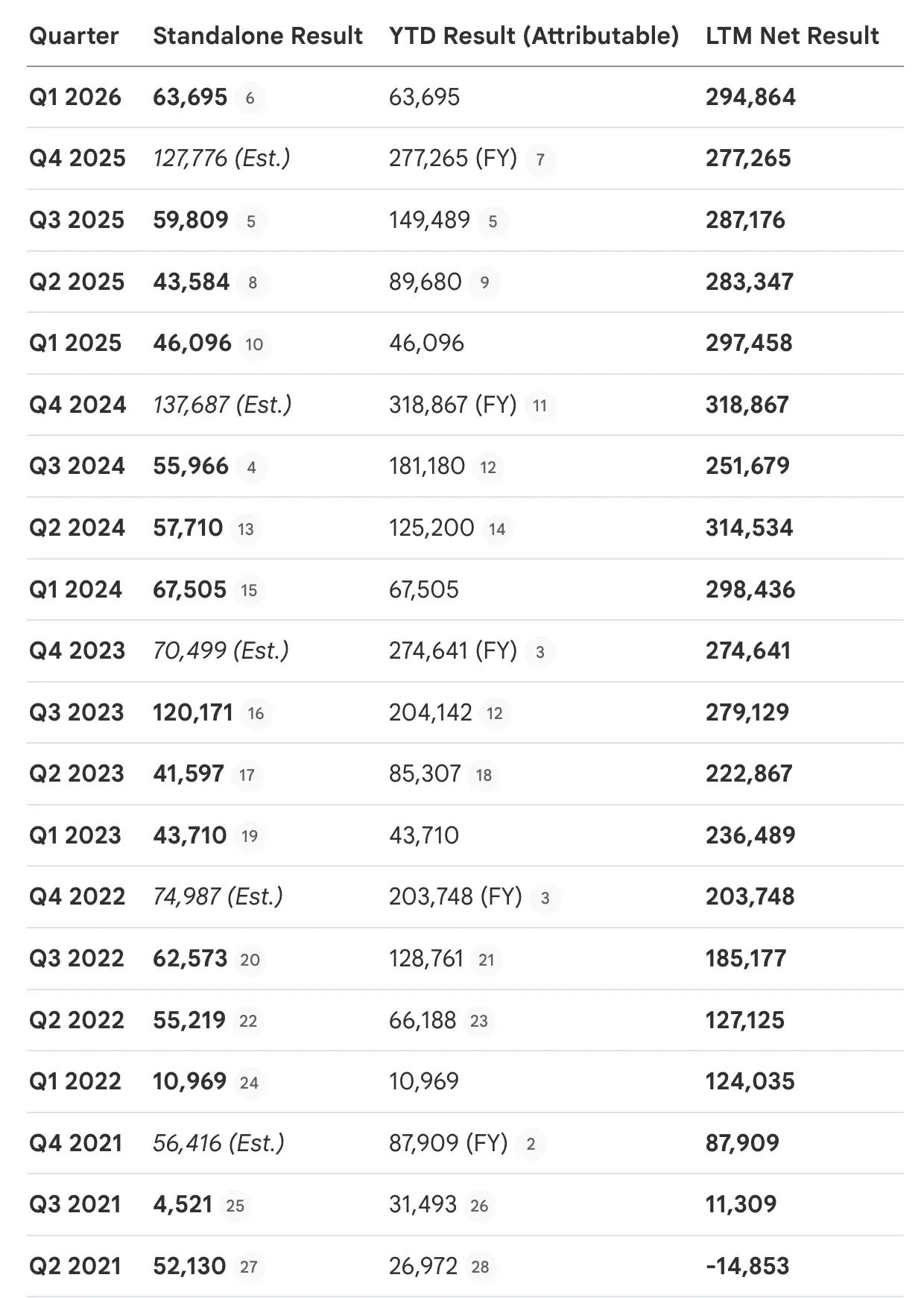
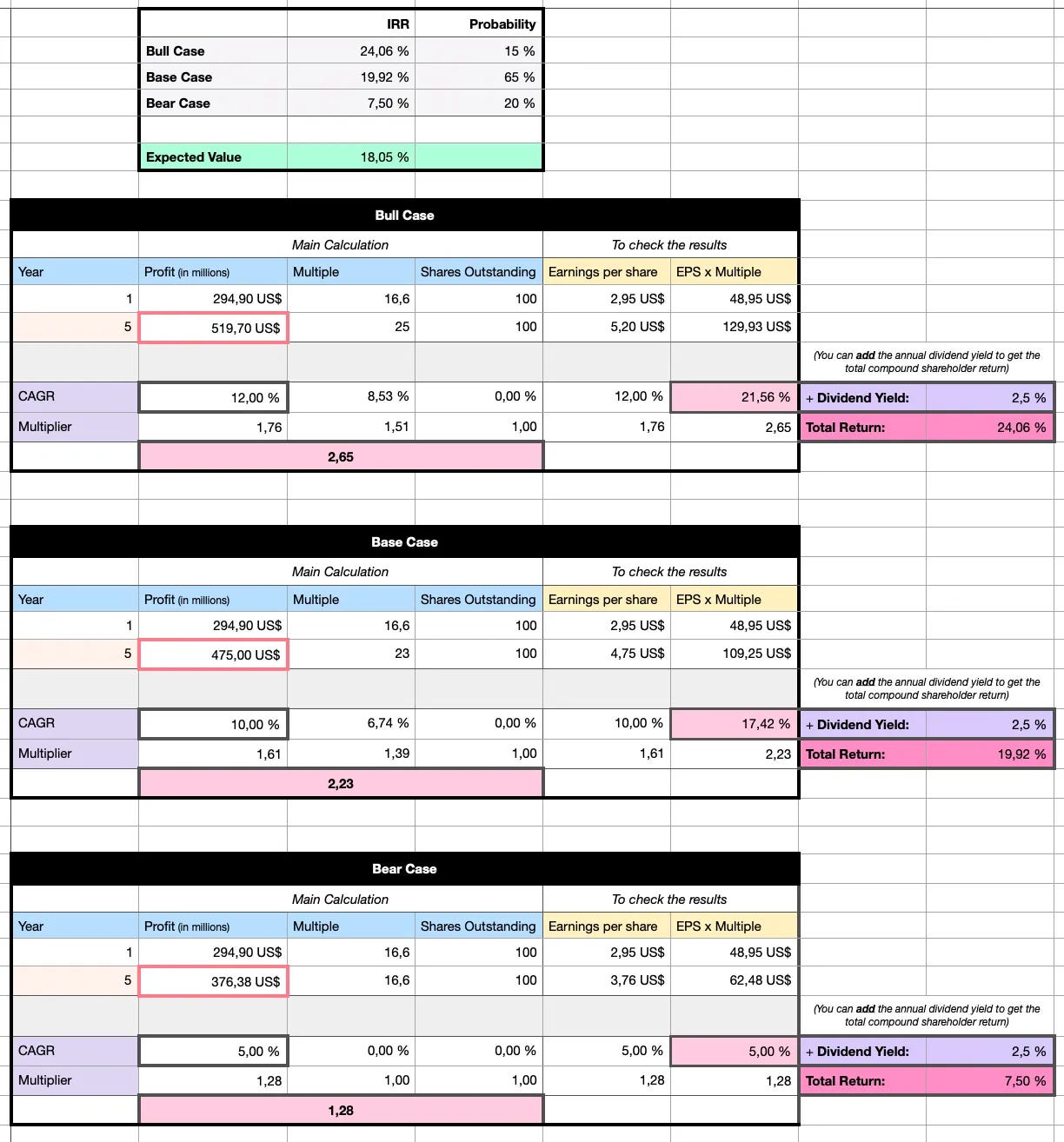
I don’t think the business is meaningfully over- or under-earning, and I treat the shift toward some venue ownership as structural rather than a one-off distortion. So 19x strikes me as a fair read of today’s setup. The question is what it’s worth. A monopoly-like franchise growing at solid rates arguably deserves something closer to 25x; one respected German fund noted it historically traded at 30 to 35x and treats a sub-20 multiple as an opportunity. Re-rate from 19x back to 25x over five years and the multiple alone adds about 5.6% a year. Layer high-single-digit earnings growth on top, and you’re underwriting slightly market-beating returns without heroic assumptions. My own five-year exit-multiple model that I ran in June (at a slightly lower price), across three scenarios, lands on a weighted expected IRR around 18%, and you collect a dividend near €1.44 (a payout of roughly 50%) while you wait.
The core question, then, is simple. Is the market right to re-value Eventim as a capital-heavy infrastructure play? Or is it handing patient investors a monopolistic, recession-resilient compounder at a discount to its own history because of a temporary construction bill and a conservative guide?
Singapore: Grab Holdings ($GRAB) – The Operating System for Daily Life in Southeast Asia
Now travel about 10,000 kilometres east.
Grab began in 2012 as a fix for one of the world’s least reliable taxi systems, dreamed up by two Harvard Business School classmates who wanted Malaysians to reach their destinations safely. Fourteen years on, it has become something closer to the operating system for daily life across Southeast Asia.
In several countries, the name is a verb: people say they’ll Grab to the mall or Grab some dinner without a second thought. The company outlasted Uber in the region, bought its rival’s local operations in 2018, and now serves more than 50 million monthly transacting users across eight countries. Earlier this year, Grab made two moves that most investors are (of course) aware of, but that might fly under the radar in terms of Grab’s valuation if you’re only glancing at headline numbers shared by the company (both the backward-looking numbers as well as the current guidance). The acquisitions of foodpanda Taiwan and Stash Financial were both announced in Q1 2026, but if you check the latest Q1 earnings, you won’t see these deals reflected anywhere in revenue yet.

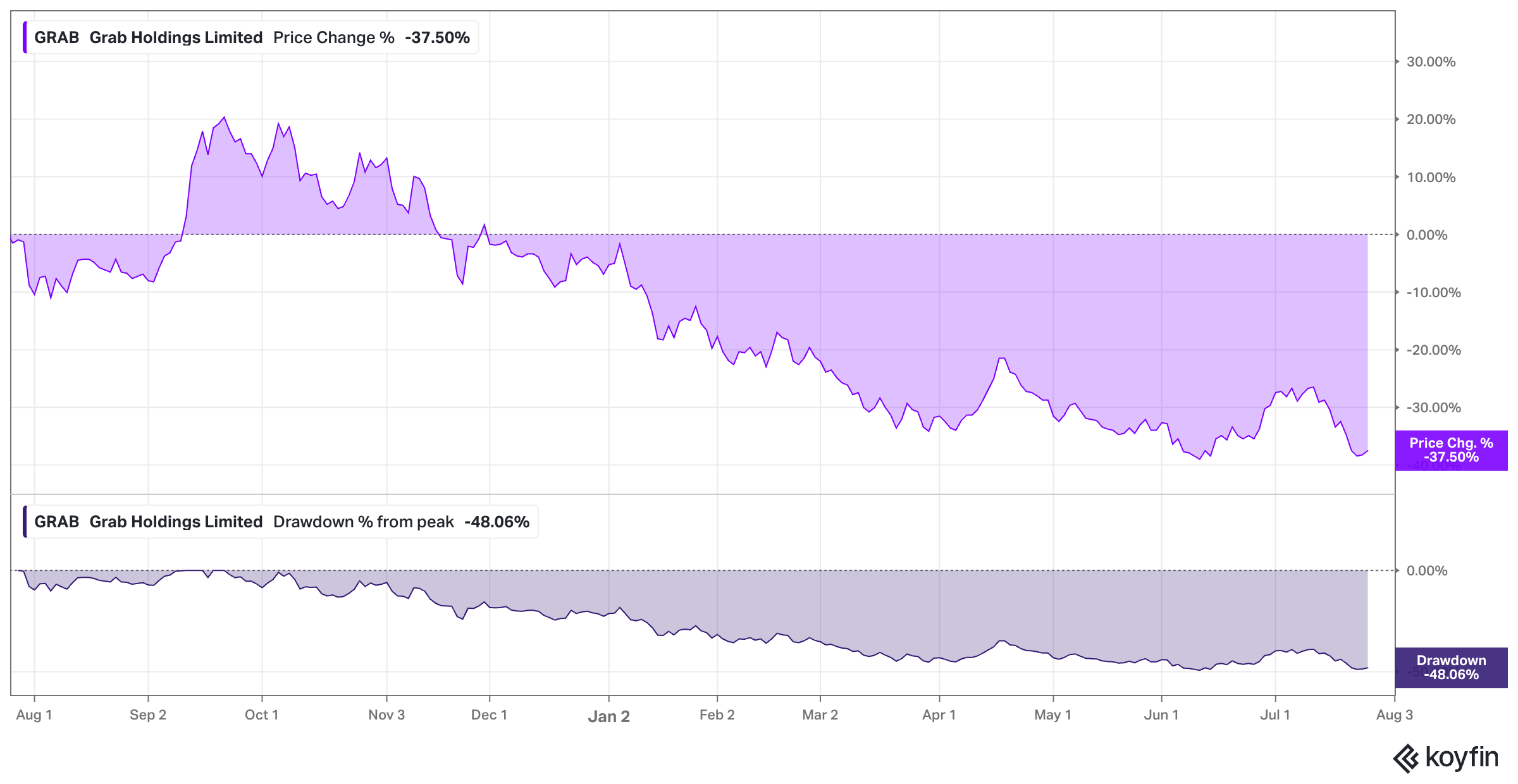
Despite all these developments, the stock tells a bleaker story. It trades around $3.3, down roughly 48% over the last 12 months, and close to 80% below its 2021 debut.
Three Engines Under One Roof
Grab runs a superapp with four reporting segments, and the economics differ sharply beneath the surface.
Deliveries is the revenue engine, home to GrabFood, GrabMart, and GrabExpress, and it generated about $1.8 billion in 2025.
Mobility is the profit engine: ride-hailing across cars and, importantly, motorcycles, which account for roughly three-quarters of all trips in the region’s congested cities. That segment produced $1.22 billion in revenue and $690 million in adjusted EBITDA last year, a 56% margin that funds much of the rest.
The third engine is the one I find most interesting. Financial Services – payments, lending, insurance, and three digital banks – grew 37% to $347 million in 2025 and still runs at a loss, but management expects it to hit EBITDA breakeven in the back half of 2026. Its loan book crossed $1 billion in 2025 and is on track to pass $2 billion by year-end 2026.
The fourth segment, Others, is mostly GrabMaps, the proprietary mapping stack Grab built because global providers couldn’t handle Southeast Asia’s narrow alleys and motorcycle shortcuts, now licensed to the likes of Amazon and Microsoft.
Underneath all of it sits a toll-booth model. Grab takes a cut of each transaction, roughly 13% of order value in deliveries and about 15% in mobility, and layers on a fast-growing, high-margin advertising business.
GrabAds already runs at a $236 million annualized rate, up 45% year on year, at an estimated 60% EBITDA margin, and it has only penetrated about 1.7% of deliveries volume against a ceiling closer to 4%.
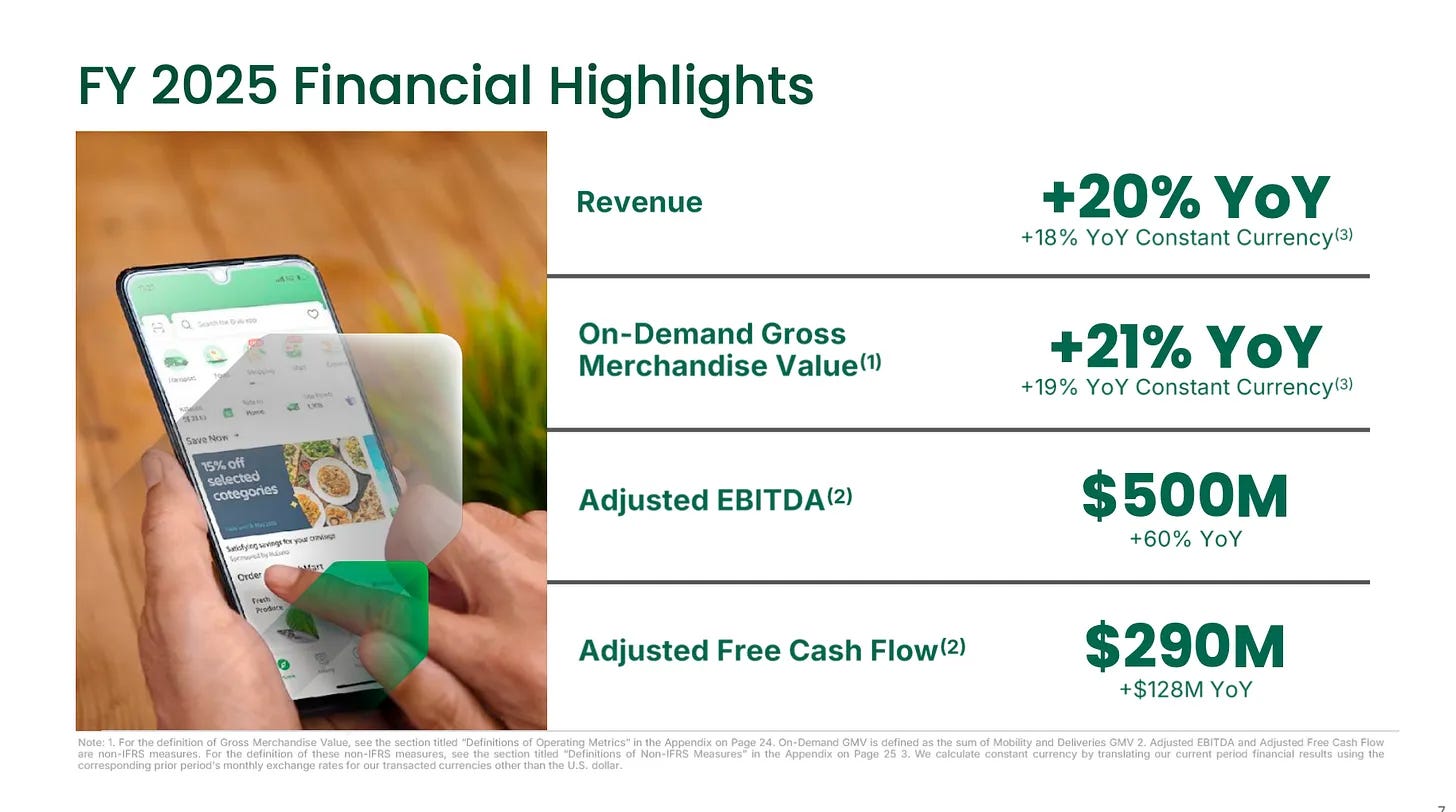
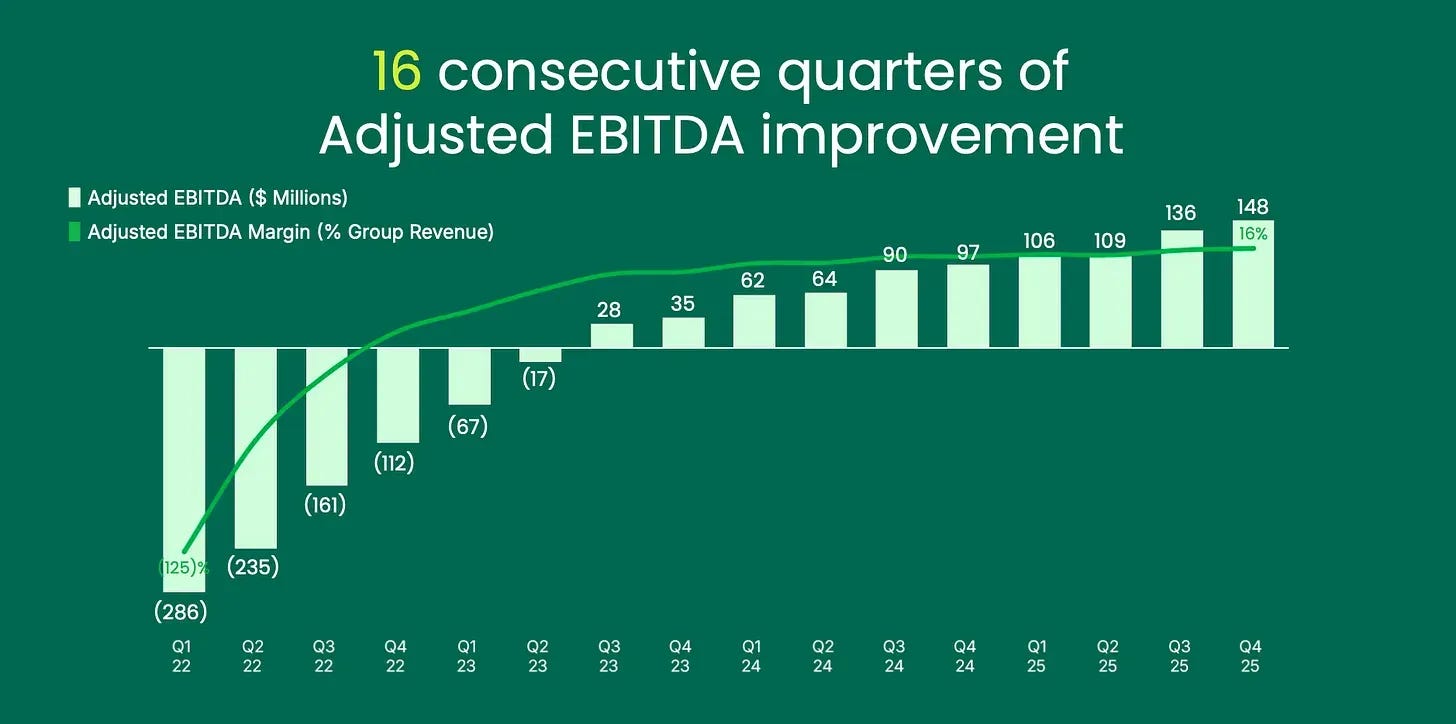
The headline milestone came in 2025, when Grab posted its first full year of net profit, $200 million, after 16 straight quarters of improving adjusted EBITDA.
Why the Flywheel Is Hard to Copy
The bear frame is that a car ride is a commodity and margins in this business are structurally capped.
There’s truth in that.
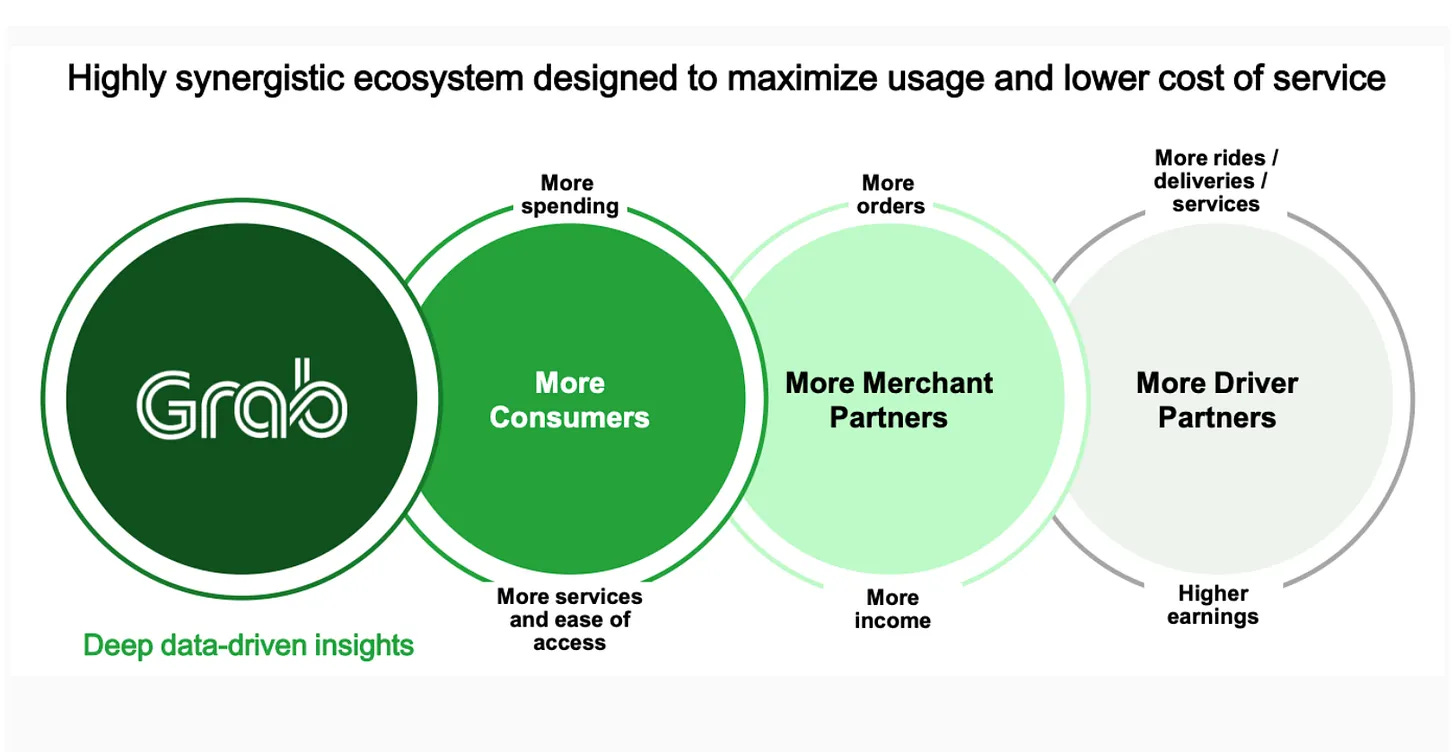
So the question that decides everything is whether the superapp can lift Grab above a commoditized utility, and the evidence, I believe, increasingly says it can. Start with scale: Grab holds a dominant 71% share of Southeast Asian mobility and 65% of deliveries, running three to three-and-a-half times the size of its next regional rival. That density lets it spread fixed technology and corporate costs across an enormous transaction base.
Then there’s the flywheel. Around two-thirds of users engage with more than one service, and here’s the number that matters most. A customer using a single service in 2021 had a one-year retention rate of 37%; a customer using three or more services retains at 88%.
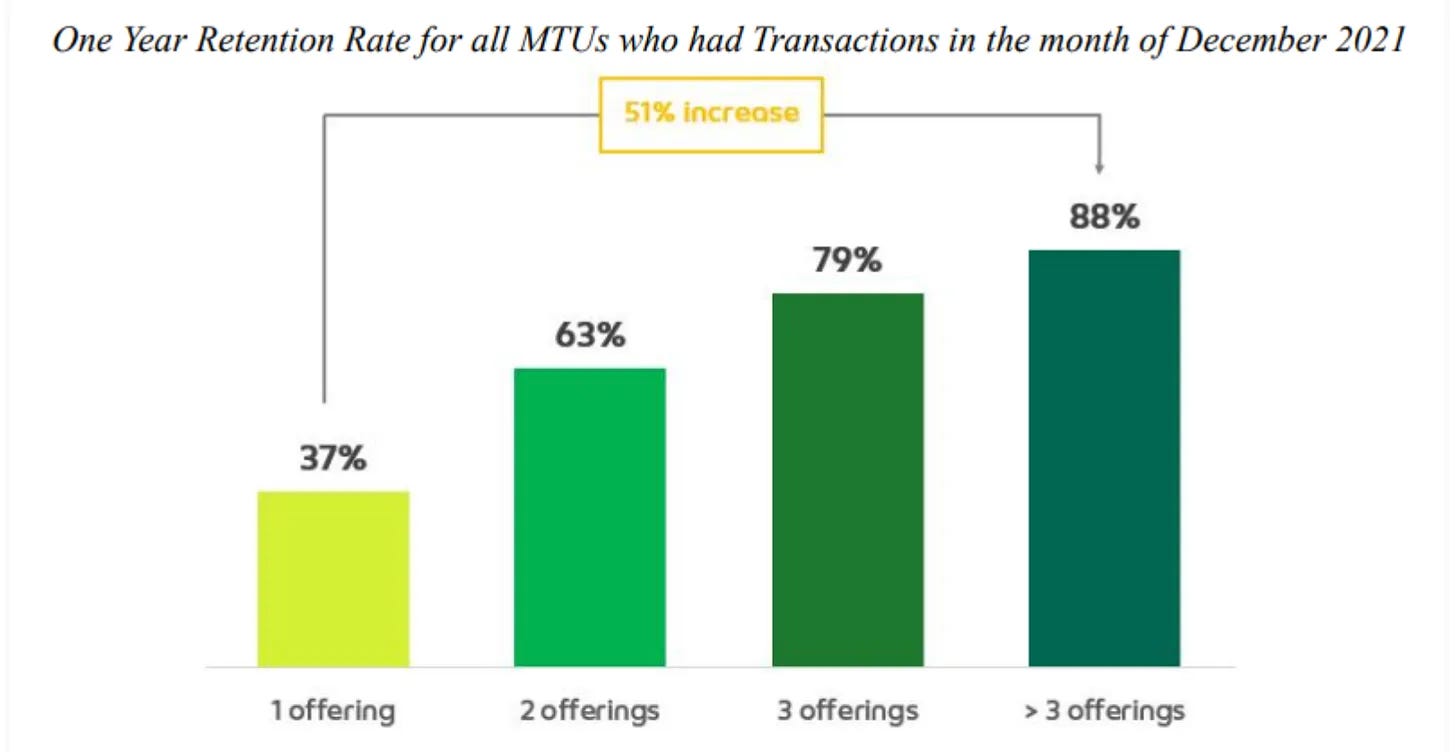
The more of the ecosystem you touch, the less likely you are to leave for a fifty-cent discount elsewhere, especially once your money, your loan, and your loyalty points all live inside the app. Layer on the data loops – billions of trips feeding better routing and sharper credit underwriting – and you get advantages that compound quietly across verticals.
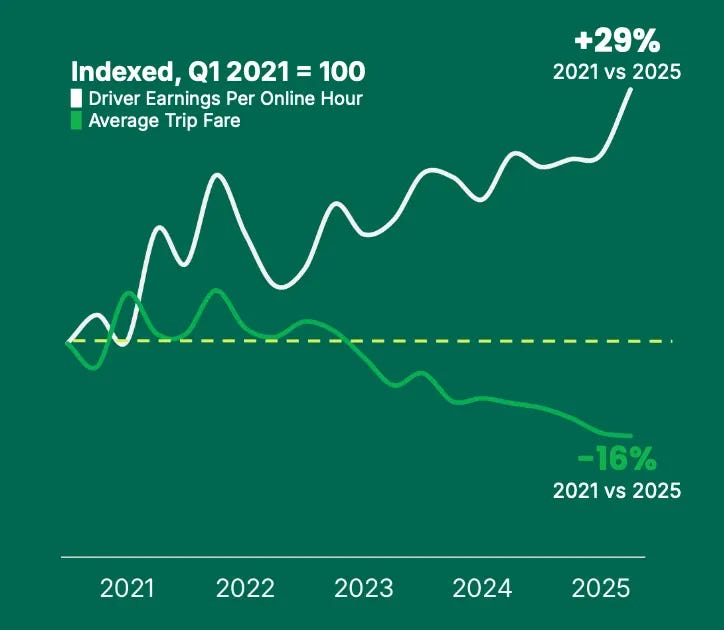
Two harder barriers deserve a mention. First, regulation cuts both ways here: Grab spent more than a decade and roughly $12 billion securing digital banking licenses in Singapore, Malaysia, and Indonesia, and those licenses are extremely difficult for a challenger to replicate. Second, the AI-driven cost structure. Grab doubled its revenue between 2022 and 2024 while holding headcount essentially flat, deploying over 1,000 proprietary models, with more than 90% of mobility rides now dispatched by AI. I’d also flag a scale-economies-shared instinct that I like: since 2021 average fares have fallen 16% while driver earnings per hour have risen 29%. Management seems to be widening the ecosystem rather than squeezing it, which tends to be the durable way to build a moat.
Some selected comments on the focus on affordability from earnings calls:
“… a powerful strategic roadmap, focused on affordability, ecosystem-led lifetime values and Gen AI efficiency.“
“Now that is going to translate into also absolute margin expansion and absolute margin dollar in the business. We are driving cost down so we can lower the cost of serving the business. That affordability that we’re working on so focused on is working, and we’re going to continue to extend that.“
“We’ll continue to do this because both ourselves and the government have aligned interest to develop a sustainable platform that operates reliably for our customers and affordably for our customers to enable us to continue to create and enhance livelihoods for driver partners and micro SMEs across Indonesia.“
“So despite the macroeconomic headwinds, we have driven affordability as a key part of our strategy. and the product-led strategy in Indonesia.“
“Affordability drives a lot better frequency“
“We still have work to do also in affordability. We’re not stopping on affordability. There’s still a lot of things that we want to do on the ride side of the house as well as on the Deliveries side that will continue to also fuel the momentum on the growth business of our On-Demand.“
“This increases our affordability and grows the overall user base, as you saw in our numbers, which is our key strength. Also, our focus on affordability is paying off. So this isn’t new. Our focus on affordability, which we began in 2023, with products like Saver delivery, Saver transport, that was explicitly designed for this purpose. These services are now essential for users, enabling them to manage their wallets effectively. So this makes us a must-have service not a nice to have, which protects us from a pullback in discretionary spending. Look, but the reality is we may not be immune to macro trends, but our strategy is designed to be resilient and even opportunistic in this landscape. So we continue to reinforce this by partnering with governments as well. For instance, in Indonesia, we’ve been running what we call the Kota Masa Depan, which is a future cities program in partnership with the Ministry of Micro, Small, and Medium Enterprises, where we have worked to support small businesses and digital upscaling across nearly 20 cities. And in Vietnam, our AV launch is really to design to drive better NPS and also lower partners costs. These on-site projects, they strengthen our ecosystem and create a more sustainable, profitable business for the long term. So we are confident in our strategy and our outlook.“
What Went Wrong
So why has the stock been such a disappointment?
A big part traces back to how Grab came public. It listed in December 2021 via a SPAC at a $40 billion valuation, right at the peak of the pandemic tech mania, which left a generation of early investors deep underwater as the market pivoted from growth-at-all-costs to profitability. For most of the prior decade, Grab was also viewed as a bottomless pit for venture capital, and that reputation as a loss-making juggernaut has been slow to fade even as the numbers turned.
The live worries are more concrete. Regulation and labor sit at the top: Indonesia has floated commission caps, and gig-worker reclassification proposals in several markets threaten the low-cost economics of a contractor-based model. Governance is a genuine knock too, since the dual-class structure hands founder Anthony Tan outsized voting power and limits minority-holder influence. Add a high and rising short interest through 2026, plus an $80 million settlement in 2025 over disclosures around the SPAC process, and you have a stock the market still prices mainly as a mobility-and-delivery outfit.
What that framing potentially overlooks is the high-margin optionality stacking up in advertising, digital banking, and eventually autonomous vehicles, none of which is close to fully reflected in long-term cash-flow expectations.
Those are the falsification points I keep testing: whether Indonesian regulation or a scaling loan book could derail the profitability inflection.
What You’re Paying
Here’s where the setup gets compelling. At a market cap near $14 billion, and against management’s guidance for more than $1.2 billion of free cash flow by 2028, Grab trades at roughly 11.5x that 2028 number. Strip out the balance sheet, though – as the company sits on an enormous cash pile; on a conservative read, net liquidity of about $5 billion puts enterprise value near $9 billion – and the EV-to-2028-FCF multiple drops to something like 7.5x. For a business growing revenue in the high teens with expanding margins, that’s an interesting number.
The path to get there rests on management’s North Star: a 20% revenue CAGR from 2025 to 2028, adjusted EBITDA tripling to $1.5 billion, and free-cash-flow conversion climbing from 58% to 80%. Those targets are backed by 16 consecutive quarters of margin improvement, so they read as ambitious rather than fanciful.
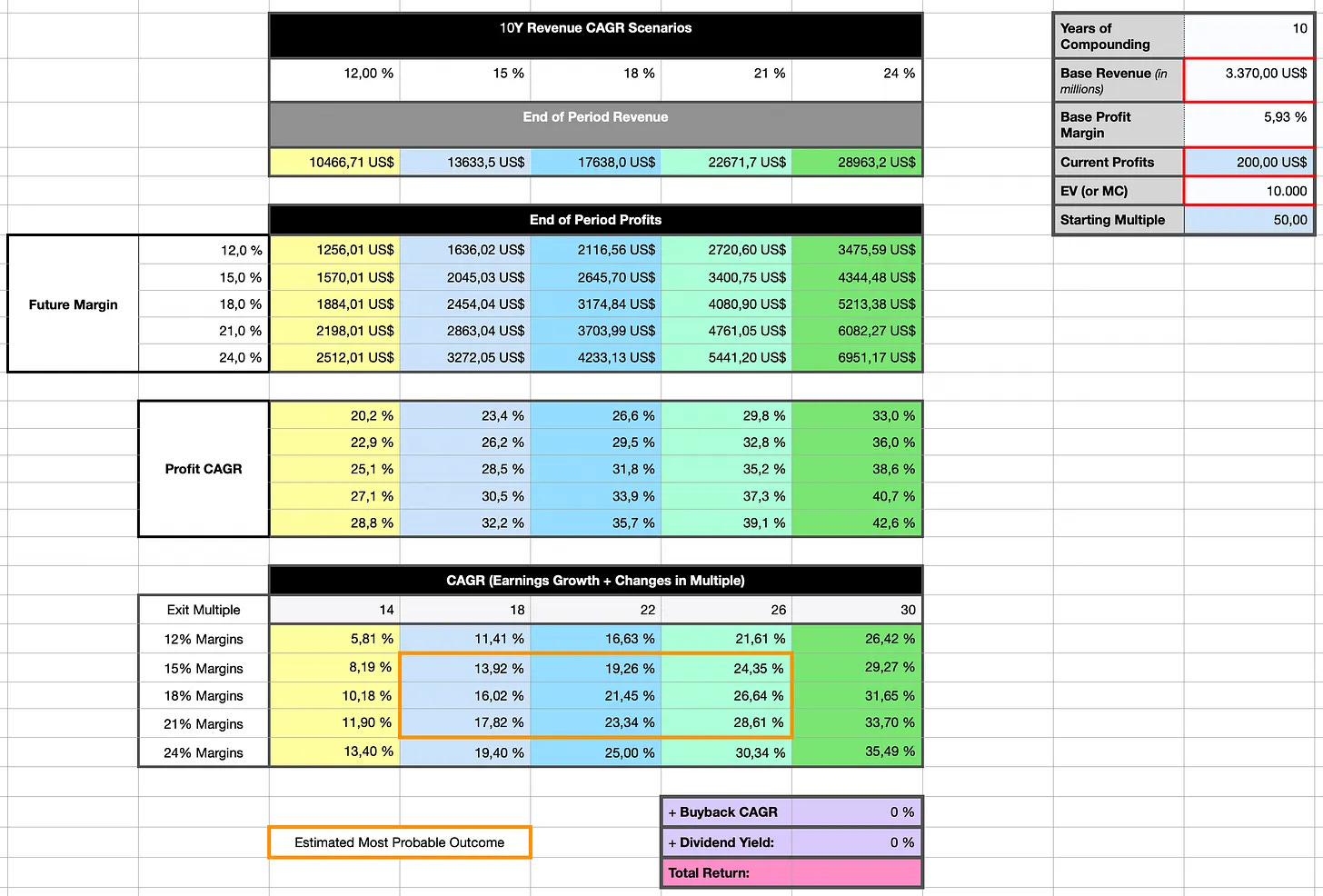
My own ten-year scenario work from May, starting from a $10 billion enterprise value and $200 million of net profit, spans revenue CAGRs from 12% to 24%. The base case, mid-teens to low-twenties growth with similar net margins and an 18–26x exit multiple, points to compounded returns somewhere in the 14% to 28% range, though I’d shave a few points off for dilution.
United States: Boston Omaha ($BOC) – A Baby Berkshire Nobody Wants?
The last stop for today’s blog is the company that took me the longest to write up, since I effectively had to study three (!) businesses in one.
Boston Omaha began its current life in 2015, when Adam Peterson and Alex Rozek (Warren Buffett’s grandnephew, for the trivia fans) bought a tiny Houston shell company whose only asset was a building housing a sushi restaurant. They had a plan: build a holding company that compounds intrinsic value per share over decades. Roughly $480 million of capital raised and 50-plus transactions later, that’s what they’ve assembled. The comparisons to a young Berkshire write themselves, which is both the appeal and the burden (how many “mini-Berkshires” have actually delived shareholder value?).
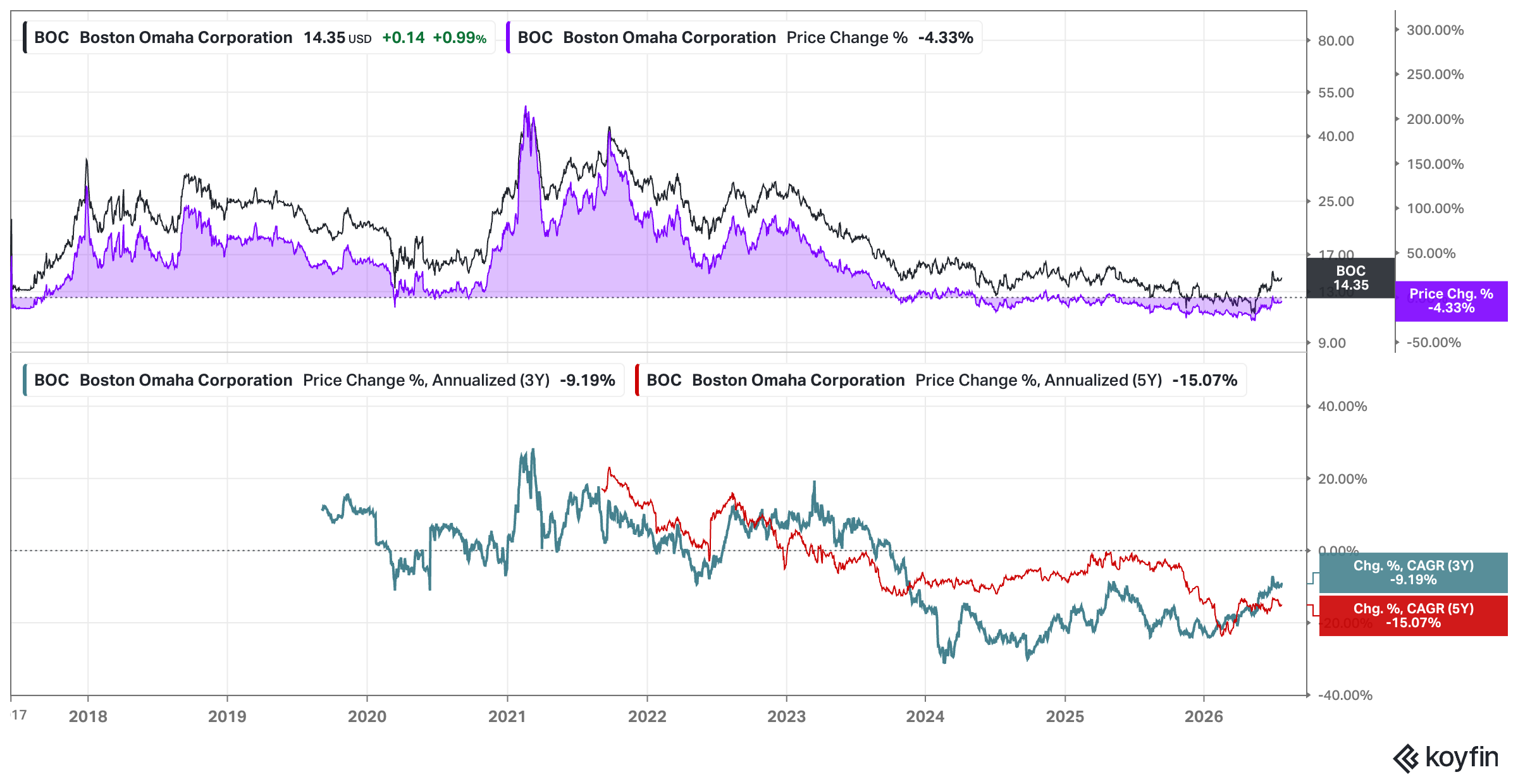
The stock, meanwhile, has been miserable. It IPO’d at $13 in 2017, touched the high $20s in early 2022, and now trades in the low to mid teens.
A Holding Company and Its Locomotives
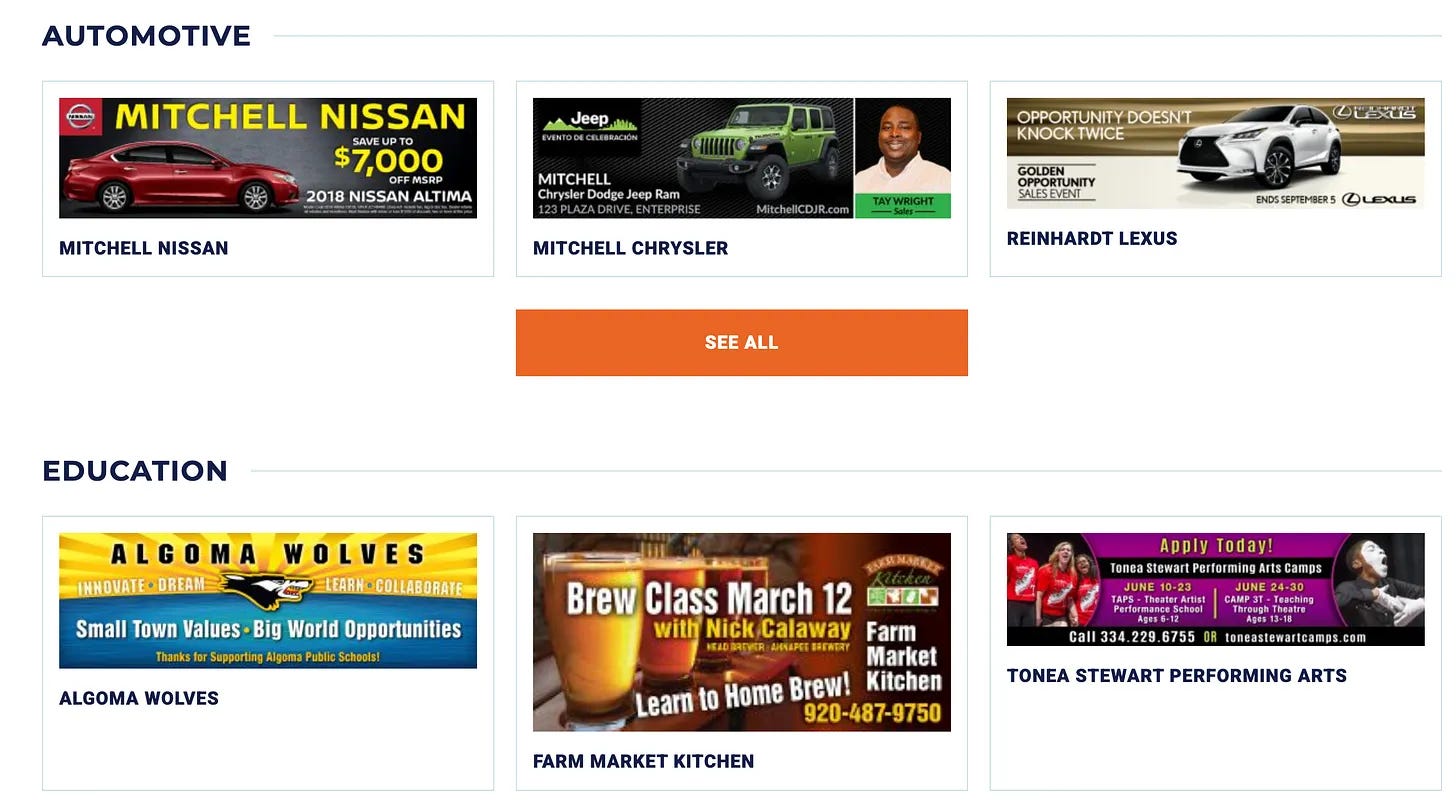
Management likes to describe Boston Omaha as a train pulled by four locomotives. The first is billboards, run through Link Media, now the sixth-largest outdoor advertising operator in the country with roughly 4,000 structures and 7,600 faces.
“From our first acquisition in 2015 to today, Link has grown to be the 6th largest owner of billboard faces in the country.“ - 2022 letter
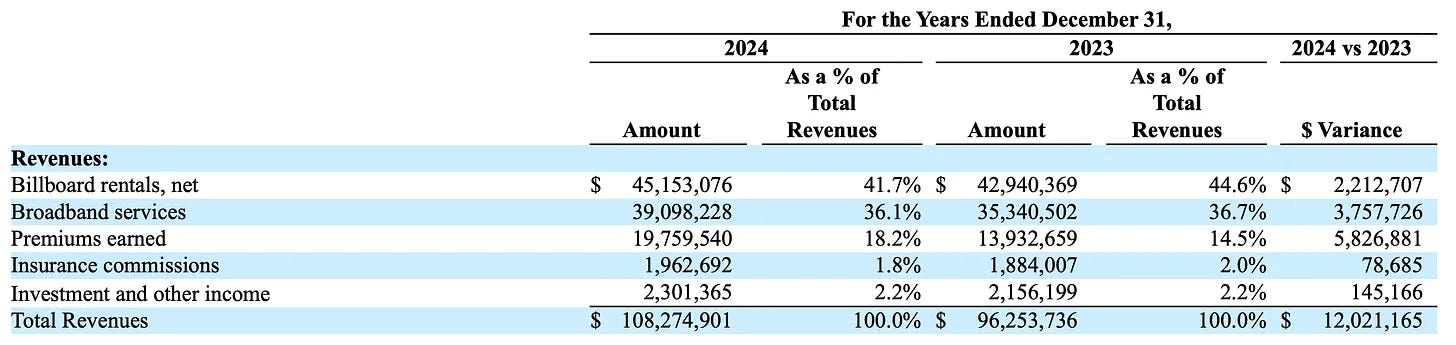
This is the cash cow: about $45 million of revenue in 2024, margins around 45%, and, crucially, very little capital needed to keep it running once the structures are up.
The second is broadband, a fiber business across Utah, Arizona, and Nevada with about 46,900 customers. Its cleverest feature is the “protected build” model, where an HOA or developer signs a decade-plus contract and every home in the community pays a bulk fee whether or not the resident uses the service, which produces near-100% take rates and guaranteed cash flow.
The third had been (!) insurance: surety bonds written through General Indemnity Group, licensed in all 50 states, a niche where written premium grew from $9.3 million to $26.4 million while averaging a remarkably low 14.6% loss ratio. I say “had been” for a reason. In May 2026, Boston Omaha agreed to sell the entire surety unit, GIG together with its United Casualty & Surety carrier, the BOSS Bonds agency, and the SuretyBonds.Market platform, to CopperPoint Insurance for $84.3 million in cash – Boston Omaha’s market cap is $475 million as I write this –, a deal expected to close by year-end 2026. So the four-locomotive train is on its way to becoming a three-locomotive one, and I’ll come back to what that does to the math.
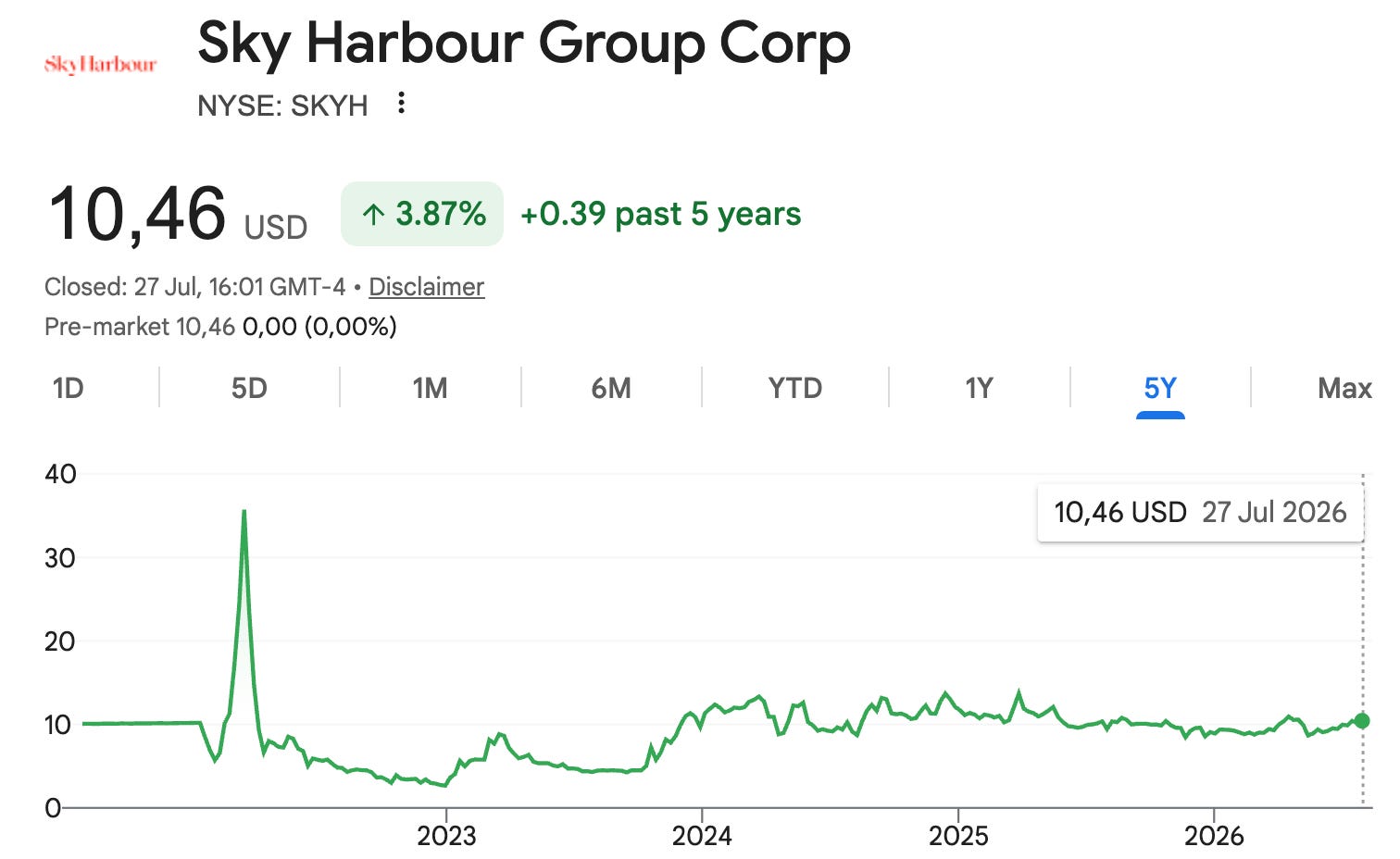
Sitting alongside those is Boston Omaha Asset Management, whoch enables BOC to be a holder of concentrated minority investments in companies Boston Omaha does not control but believes can compound value. The jewel there is a roughly 15% economic stake in Sky Harbour – about 46% of the publicly traded Class A shares – a company that builds and leases private-aviation hangars at capacity-constrained airports. As of the latest Schedule 13D/A filings (spring 2026), Boston Omaha directly holds about 8.67 million Sky Harbour Class A shares, plus another 2.67 million held inside its United Casualty & Surety subsidiary, so roughly 11.3 million shares in total, plus warrants on another 7.72 million. That's down modestly from the ~11.94 million shares cited in my January write-up, since they've been selling small tranches throughout 2025 and into 2026.
It’s yet another asset-heavy, regulation-shielded, slow-to-build infrastructure play, which tells you something about the house style.
What ties the whole thing together is capital allocation. Cash from the steady billboard business gets recycled into the higher-growth, hungrier segments, and the scoreboard management actually cares about is intrinsic value per share.
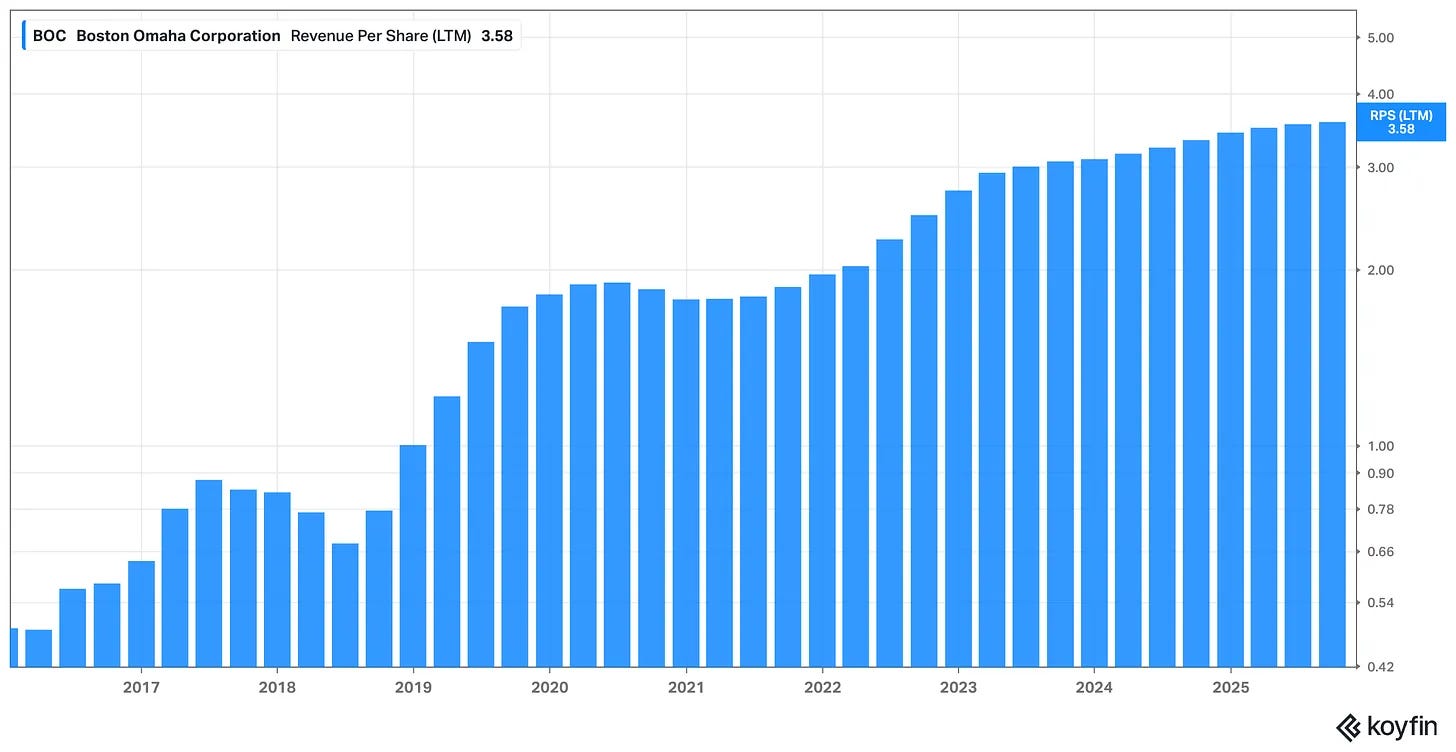
On my preferred proxy, revenue per share, the record is tangible: it compounded from $0.58 in September 2016 to $3.58 in September 2025, a 22.4% clip.
Toll Booths, Pipes, and Underwriting Desks
Let me be honest about the moat, because Boston Omaha isn’t a textbook wide-moat business and pretending otherwise would mislead you. What it owns is a set of narrower, segment-specific advantages that happen to be annoying and uneconomic for anyone else to replicate.
Billboards are the clearest case. You can’t simply erect new structures in prime locations however much capital you have, because zoning, permitting, and community resistance choke off new supply. That regulatory friction protects the incumbent, and Link earns a cash-flow return on tangible capital north of 30%. Pricing power is local and situational rather than absolute, but in strong locations rents can rise without losing tenants.
Broadband works on a different principle, closer to a railroad. Once you’ve laid fiber to a few thousand homes in a small town, a second provider rarely finds it worth the money to overbuild you, so the network becomes a local near-monopoly. Layer on the switching friction of installation and downtime, and you get durable retention.
Insurance was always the weakest of the three, and I’d say so to anyone. There’s no brand, switching costs are thin, and the whole industry is crowded with people who were “disciplined” right up until they weren’t. What made the surety niche defensible is that it’s small enough to be ignored by the big carriers and carries structurally low loss ratios, because a surety bond is designed to prevent a loss rather than pay one. It’s probably no accident that this is the leg management has now chosen to cash out.
The thread running through all of it is cultural: a patient, per-share-focused capital allocator in Peterson (I recommend reading all of his annual letter), who is also the company’s largest shareholder.
What Went Wrong
So why does a business with a 22% revenue-per-share CAGR trade down 74%? Because the market can see the costs and can’t yet see the payoff. Consolidated free cash flow has been meaningfully negative, yet, arguably that’s by choice: broadband soaked up nearly $30 million of capex in 2024 against just a couple million in billboards, on the theory that today’s build becomes tomorrow’s high-margin subscriber base. That’s a defensible trade, but it means reported numbers look ugly, and after a decade the company still shows no clean consolidated profit.
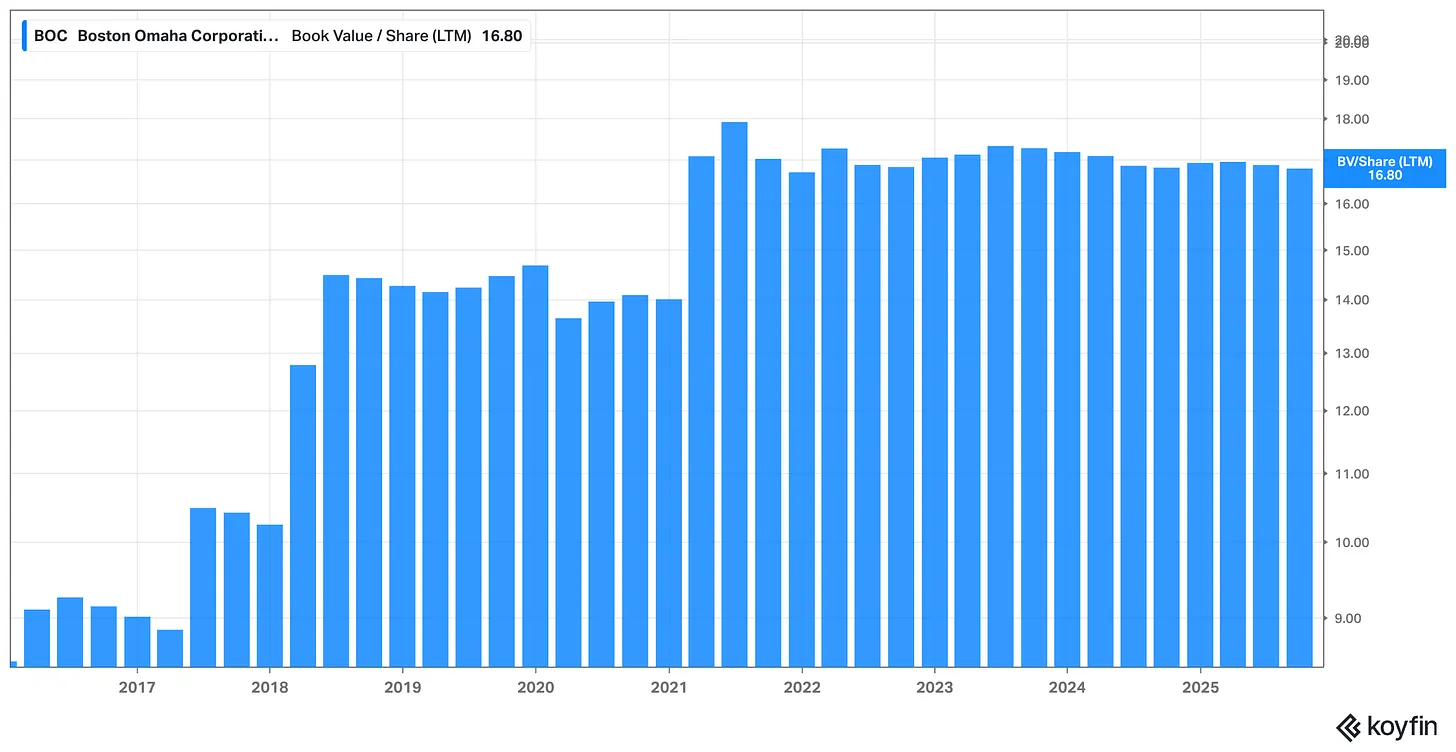
Book value per share, the metric a Berkshire-style vehicle is supposed to compound, has grown at only about 7% since 2016 – even though management clearly explains in their letters why due to certain accounting regulations, this has become a less useful metric (again, I encourage you to read the letters yourself)..
For a lot of investors, that’s the whole story, and they’ve walked away.
“On the eve of Valentine’s Day in 2015, present management fell hard for a small company in Houston whose only business was a single building that housed a sushi restaurant. Over the past six years, approximately $480mm in capital was raised and over $280mm has been deployed in operating businesses in over 50 transactions to build Boston Omaha into what it is today.“ - 2020 letter
Governance added fuel. When co-founder Rozek left in 2024, ending the co-CEO structure, the company repurchased his shares, including super-voting Class B stock, at prices far above the market, roughly a $19 million cash cost that landed as the stock was already depressed. An independent valuation firm blessed the price as fair to intrinsic value, and avoiding litigation over super-voting control probably was the lesser evil, but it stung and it dented trust.
Add a macro backdrop where higher rates punish any “invest now, earn later” story, and you get a stock that short-horizon and mandate-constrained investors simply can’t hold.
The bear case, which deserves respect, is that this is a serial reinvestment machine that keeps deferring the moment of truth, and that the inflection is always next year. My read is that these headwinds are temporary rather than terminal, but the burden of proof sits squarely with management to be fair.
What You’re Paying
This is where the complexity becomes the opportunity. Boston Omaha’s market cap is around $475 million. Strip out the roughly $115 million Sky Harbour stake and about $30 million of other minority investments, and you’re paying something like $330 million for the operating businesses. Against roughly $25 million of current underlying free cash flow, a figure management itself cited back in 2022 and that outside analysts corroborate, that’s about 13x, or a 7.5% yield. And that cash flow isn’t static. Next year points to about $28 million, and one analyst I respect projects roughly $35 million by 2027 as broadband matures, which would compress the multiple further.
The GIG sale sharpens the picture rather than muddying it. Insurance was throwing off only about $1 million of free cash flow, so losing it barely dents the ~$25 million, yet it converts that sleepy leg into $84.3 million of cash, the bulk of which flows to Boston Omaha to fund buybacks or redeployment. Fold that incoming cash into the sum-of-the-parts and the stub you’re paying for the billboard-and-broadband core looks cheaper still.
Management is effectively simplifying the story and handing itself dry powder at the exact moment the stock trades well below its own estimate of intrinsic value.
The downside is what makes it interesting, because you don’t need a fancy sum-of-the-parts model. The billboard business alone anchors a floor: on about $18 million of estimated segment free cash flow at a normal 10–12x takeout multiple for scarce outdoor inventory, Link is worth something like $180–216 million by itself. Value the 44,500 fiber passings at the $3,000–5,000 per passing that recent private deals imply, and broadband adds another $130–220 million, before you count the fixed-wireless customers or any of the minority stakes. In other words, the pieces you can value conservatively already cover most of today’s price, with the reinvestment upside thrown in for free. Management clearly agrees the stock is cheap; they authorized a $20 million buyback in 2024 and a fresh $30 million program in late 2025, which is decently accretive when you’re retiring equity at about 13x FCF, or a 7.5% yield; in Q1 2026, Boston Omaha actually repurchased 375,286 Class A shares for $4.8 million..
I’ll be straight with you: I haven’t bought this one yet and it’s no slightly more expensive than when I first wrote it up in January this year. Part of that is currency risk, since I invest from Europe and have my reservations about the dollar, and part is that I want to see broadband’s inflection show up in reported cash before I fully commit. But intellectually I’m optimistic the business is worth more than the market says, the downside looks well protected by the billboards alone, the insurance business sale make the story easier to decode for outside investors, and Peterson strikes me as a thoughtful allocator being punished for a build phase rather than for structural weakness.
This is the kind of setup that tends to feel exactly like this right before it works.
Closing Thoughts
Please don’t read this as a buy list. It isn’t one. Each of these three carries risks I’ve tried to lay out honestly, and two of them I haven’t even bought myself yet.
What ties them together is a pattern I keep circling back to. All three are down heavily, each wearing a kind of temporary disguise that makes it awkward to own today: a doubled construction bill and a cautious guide at Eventim, a SPAC hangover and a gig-economy label at Grab, a decade of heavy reinvestment with little to show on the income statement at Boston Omaha. Look past the surface, though, and you find businesses shielded by something that took years to build, be it a regulation-protected tollbooth, a superapp flywheel, or scarce physical assets in industries that barely change from one decade to the next.
And importantly, in every case, the person steering capital has been doing it for a long time and has real money riding on the outcome (yes, I do have a very strong bias toward founder-led businesses!).
That mix – a durable edge, an aligned operator, and a share price the market has temporarily written off – is what I spend my days hunting for, wherever in the world it happens to live. Germany, Singapore, the US. It seldom turns up where everyone is already looking.
If this is your kind of investing, I’d love for you to come read more of it over at Compound with René.