Dear compounders,
Thursday was a brutal day for some people in our investing community. Innoscripta, the Bavarian company that helps German businesses claim the government’s research allowance (the Forschungszulage), released an ad-hoc statement disclosing that investigators had searched the premises of several group companies in connection with a criminal tax investigation.
The authorities suspect that the company helped clients obtain tax benefits they were not entitled to. According to management’s preliminary understanding, the matters described in the search warrants concern possible misconduct by individual employees on specific client mandates. The company says it is cooperating with the authorities, that operations continue without restriction, and that a final assessment of any financial consequences isn’t possible at this stage.
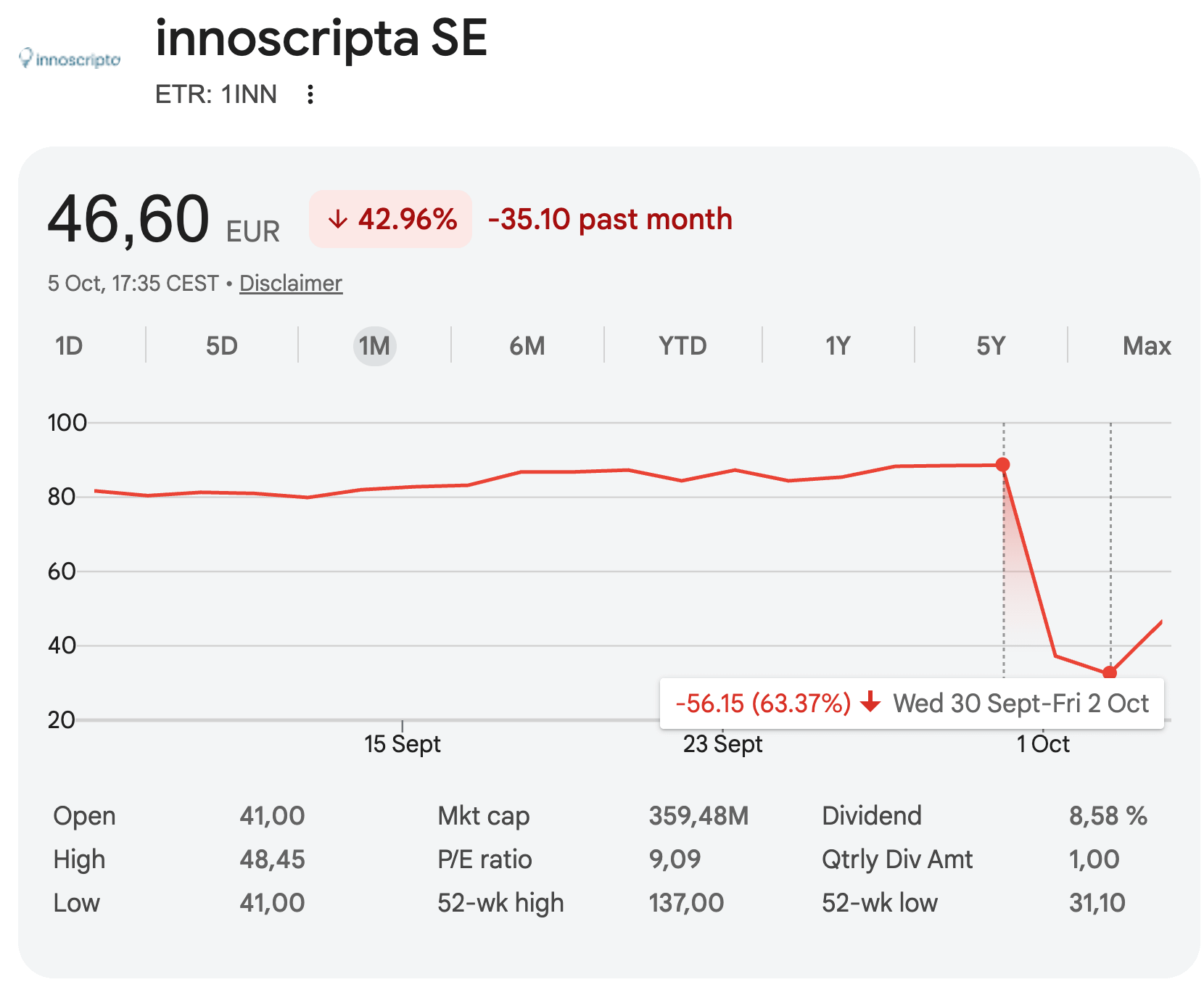
The market did not wait for one. The stock fell roughly 57% on Thursday from a prior close of about €89 and slid further on Friday, at one point trading around €33 to €34, down some 63% over two trading days (fwiw the stock is up 40%+ today as the company provided more context on the incidents on Friday). Warburg Research suspended its rating and price target. For perspective, Innoscripta went public in 2025 at €120 a share.
I think several members of our community own the stock, and a few of them own a meaningful amount. I watched the messages come in over the course of the day, and you could feel the gut punch through the screen.
I’m not going to use this post to guess what the investigation means for the business. Nobody knows that yet for sure, and an honest answer is probably that it might take months for outsiders to fully grasp the magnitude of the investigation. Instead, I wanted to use this example as a discussion starter, an event that prompted me to sit down and write this post.
I want to write about the other thing that happened on Thursday, the part that played out inside the heads of everyone holding the stock, because I shared a thought in our community that day that I’d like to expand on here.
Let’s discuss!
If you disagree with the thesis, think I have mispriced something, or know this business better than I do, leave a comment below. The sharpest corrections I get come from readers, and they usually arrive in the comments rather than my inbox.
What does a high-stakes poker player think about?
A few of us in the community play poker, so let me start there. When I first got into the game in my teens (yes, that’s been a long time ago …), I spent a somewhat unhealthy number of evenings watching high-stakes poker, both on the major TV networks and live on the big online sites, where anyone could rail the nosebleed tables in real time.
Those were the days when a then-anonymous Swede called Isildur1 stormed up the stakes on Full Tilt all the way to $500/$1,000, playing the same relentless, seemingly reckless style at the highest limits that had carried him through the lower ones, while pots worth more than a house swung back and forth on my screen.
Over on High Stakes Poker, a young Tom Dwan was toying with the old guard, thinking in ranges and hunting for theoretically sound plays years before solvers turned GTO into everyday poker vocabulary.
What struck me most, watching both of them, was how little the money seemed to register. Their attention went to ranges, pot odds and the best available move given what they knew. When they lost a monster pot, they shrugged, took the next hand and played it exactly the way they would have played it an hour earlier.
The clip below illustrates the thinking (optimal play (Dwan) vs. outcome-based thinking (Hellmuth)) of the young vs. the old guard back then best (even though it’s not from a high-stakes cash game):
Some of that is temperament. Most of it is training. Some probably DNA. They have learned that the money is a distraction from the one question that matters at the table, and once the dollar amount enters the thought process, decisions start getting made for the wrong reasons. You play scared to protect your stack. Or you chase to win back what you just lost.
Poker players call the second one tilt, and it has ruined more bankrolls than bad cards ever will.
New here? Get 3 FREE GIFTS when you subscribe: 📈 Valuation Spreadsheet 📚 eBook: Investing Visualizations 💡 eBook: 250 Thought-Provoking Quotes - Join 5,000+ subscribers.
Why does a bigger portfolio make this harder?
I think managing the behavioral side of investing too gets more difficult as the stakes rise, and in our world the stakes are the size of the portfolio and the individual position within it.
When you start out with a few thousand euros, a 50% drop in a position is annoying. Ten or fifteen years later, the same percentage move in a position of the same weight can equal a new car, a year of a child’s education, or a good chunk of your mortgage.
The percentage is identical, and yet the number attached to it now carries weight in your everyday life.
I’ve caught myself doing exactly this. After a bad day, I have translated a loss into months of my regular income, as in “that drawdown just cost me x months of salary.” It’s a natural reflex, and I suspect most of you have done it too.
I also think it is close to useless.
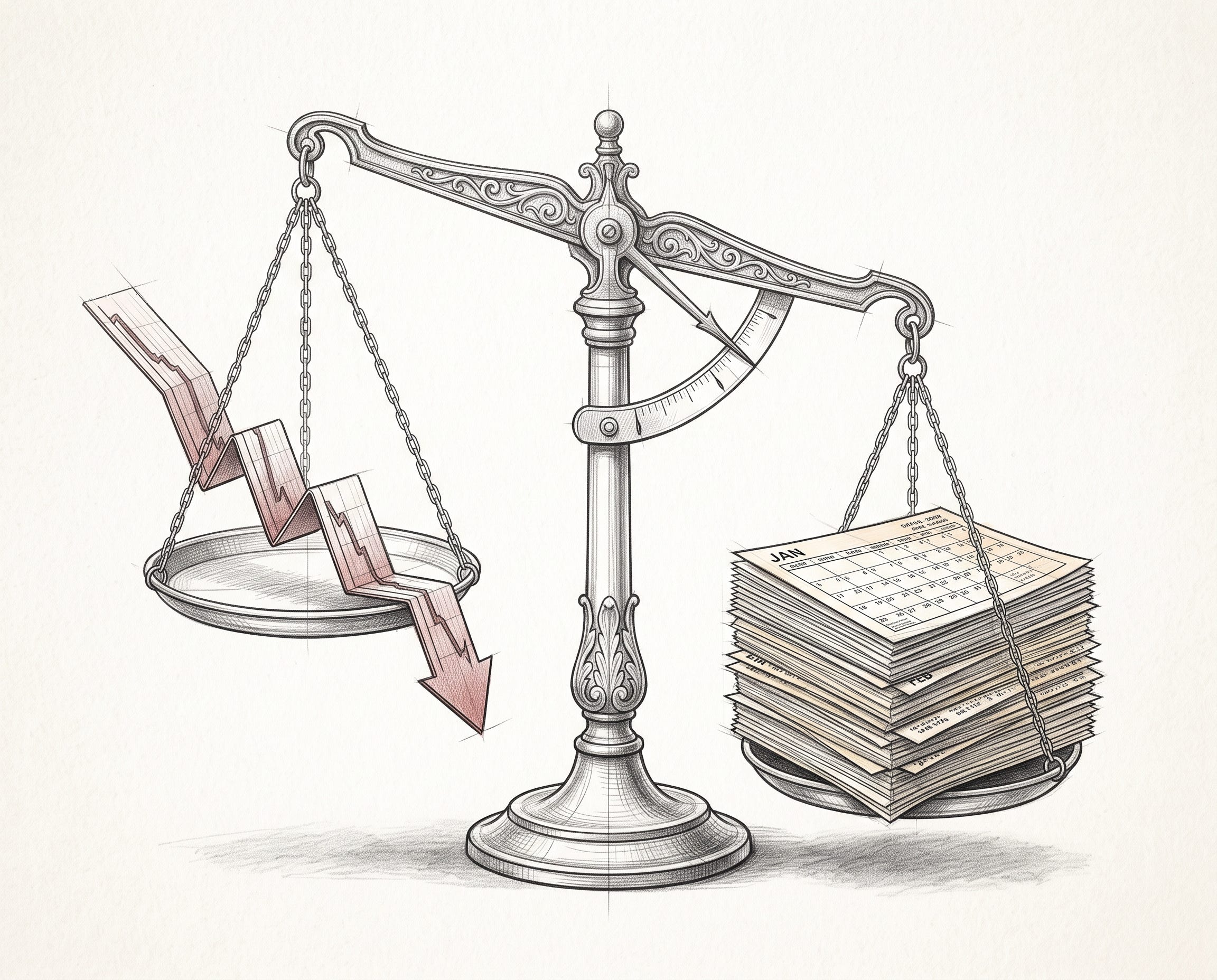
Converting a market loss into salary-months tells you nothing about the business, nothing about the quality of your original decision, and nothing about what you should do next. It only makes the pain more vivid.
Behavioral economists would file it under mental accounting, and it pushes you toward precisely the moves poker players train themselves to avoid: selling to make the hurt stop, or freezing when you should be thinking.
Daniel Kahneman offers a sharper explanation for why this happens. I recently spent some time with his Nobel Prize lecture, Maps of Bounded Rationality, and one of its central ideas is that people judge outcomes as gains and losses relative to a reference point, with total wealth playing a surprisingly small role, and that a loss on that scale hurts roughly twice as much as an equivalent gain feels good.
The salary-months habit is a textbook case. It swaps the relevant reference point, the size of your portfolio and the weight of the position within it, for the one that feels most personal, your monthly paycheck. Measured against a paycheck, a loss worth a few percent of your net worth suddenly looks enormous, and loss aversion takes care of the rest.
Kahneman also wrote extensively about a related trap he called narrow framing. When we evaluate each decision in isolation, every single loss gets its full emotional weight, and we end up far more risk-averse than our long-term interests would justify. His remedy was to frame broadly and treat any one outcome as part of a long series of bets, which is exactly how a poker pro thinks about a single hand within a career that spans millions of them.
Enjoyed This?
These articles take time to write. If you learned something from this write-up, please …
❤️ like this post and leave a comment with your thoughts
🔁 share it with your investing friends to spread the message to others
✅ subscribe to the newsletter for more investing content
Thank you.
Innoscripta is one line in your portfolio and one decision in what will hopefully be decades of decisions. Seen through that wider lens, Thursday remains painful, but it shrinks back to its actual size.
I do want to be honest about where the poker analogy starts to break down, though. In poker, and in online poker in particular, the broad frame eventually rescues you. Even in a notoriously high-variance game like Pot-Limit Omaha, where the best hand is rarely more than a 60–65% favorite, a serious online grinder can play hundreds of thousands of hands over a few years, often across several tables at once. At that volume, luck shrinks to a rounding error, and skill shows up in the results whether the player is running hot or cold.
Investing, at least the way I practice it, offers nothing close to that sample size. A concentrated, long-term investor might make a few dozen meaningful decisions over a lifetime, and Mohnish Pabrai likes to point out that even Warren Buffett's record rests on roughly a dozen truly great ones. That's nowhere near enough hands to push the role of luck down to a negligible level.
As hard as it sounds, some of us will make excellent decisions for decades and still end up with results that don't fully reflect them, and others will be rewarded for decisions that never deserved it.
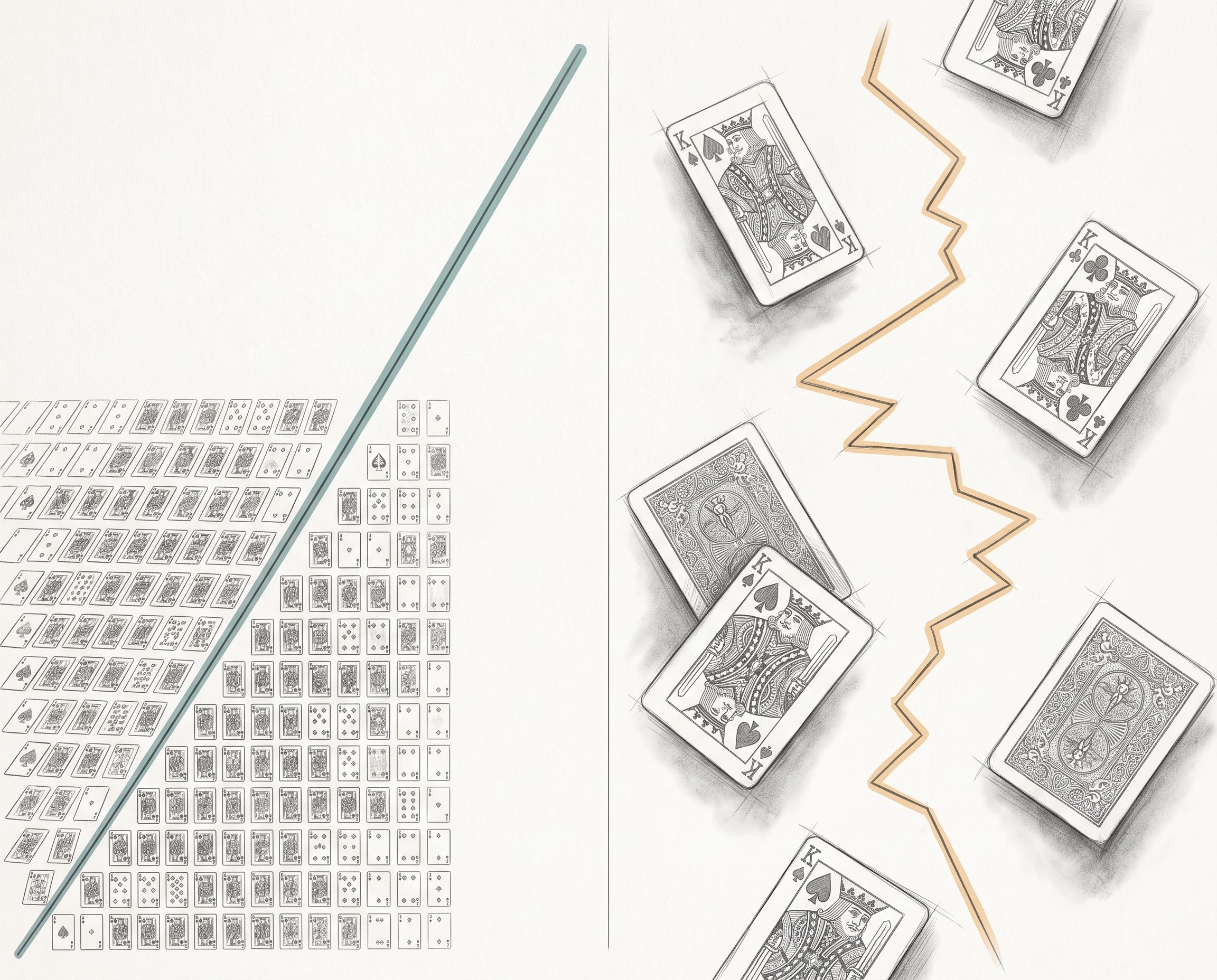
All we can do is keep making the best decisions available to us and accept that the scoreboard will always carry some noise.
We should try to be as rational as humanly possible here. That starts with asking a better question.
Bad decision or bad beat?
The question I find most useful for investors who own a stock like Innoscripta and experience a day like Thursday is a simple one:
Should I have made a different decision based on the information I had when I made it?
I wrote about this at length in Thinking in Bets: What Poker and Horse Racing Teach Us About Markets, still one of my favorite pieces I’ve ever published. The core idea is that in probabilistic disciplines, the quality of a decision and the quality of its outcome are two separate things. You can get all your chips in as a 95% favorite and lose the pot.
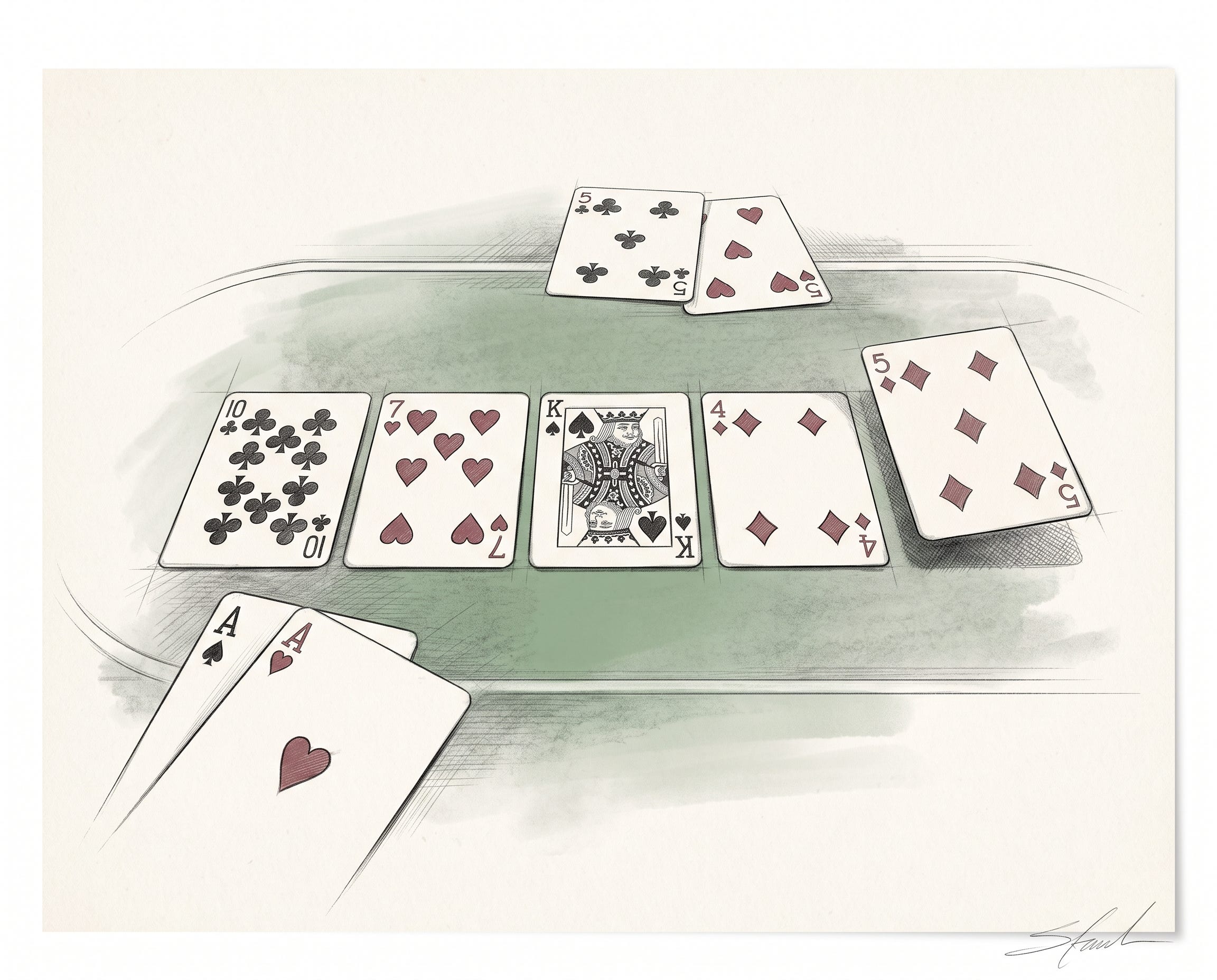
Annie Duke calls the habit of judging decisions by their outcomes “resulting,” and it may be one of the most expensive mistakes an investor can make, because it teaches you the wrong lessons from your wins and your losses alike.
Thinking in Bets: What Poker and Horse Racing Teach Us About Markets

Most people wouldn’t naturally group stock market investing, poker, and horse betting into the same category. One has billion-dollar companies and earnings calls, another is played in smoke-filled card rooms (or sleek online interfaces), and the third involves animals, turf, and betting slips.
Applied to Innoscripta, the question breaks down into a few parts.
Was the dependence on a government incentive program a visible risk at the time of purchase? I’d argue it was clearly, since any business whose revenue is tied to helping clients claim tax incentives carries regulatory and reputational risk by design.
Could you reasonably have assigned a meaningful probability to a criminal investigation into the conduct of individual employees? That one is much harder (even though I came across this article last week, which is from 2020, and suggested some dodgy practices).
And, maybe most important, was the position sized in a way that reflected the first risk, even if nobody could have foreseen the second?
Of course you can come up with more questions. Those are just three that just came to mind when thinking of this particular case.
Be careful with how you answer these questions a few days after the fact. Kahneman wrote about hindsight bias, our tendency to believe, once we know how something turned out, that the outcome was far more predictable than it actually was. Part of the subsidy risk was knowable in advance, as I argued above, but Thursday now makes it look far more obvious than it seemed to most shareholders a week ago, including people who never mentioned it before the stock collapsed. It’s almost a black swan event for investors.
The more helpful test is whether you identified and weighed that risk beforehand, ideally in writing.
This is one of the best arguments I know for keeping an investment journal. It is the only record of what you knew and believed before the outcome rewrote your memory of it.
If the answers point to a flaw in your process, there is something to learn, and Thursday was an expensive tuition payment. If they don’t, you took a bad beat.
That hurts. It still says very little about your skill.
There’s a second, forward-looking question, and it deserves to be kept apart from the first. Whatever you paid for the stock is irrelevant to what you should do with it now.
What matters is how today’s price compares to your updated view of the business given everything that became known on Thursday. Your cost basis is a sunk cost in the most literal sense. Blending the two questions is how people end up holding on to “get back to even” or dumping a position just to escape the pain, and neither of those is an investment decision.
Stan Druckenmiller is arguably the best investor in the world in terms of keeping the two apart.
What else can investors borrow from the poker table?
My friend Michael, a very active member of our community who writes the Personal Finance Without Borders Substack and contributed to the recent Dino Polska article, takes his poker seriously, and he shared a few other crossovers with the group that I liked so much I want to pass them on here as well (I hope Michael, you don’t mind 😉).
The first is composure during large downswings. Poker helped Michael when he first started investing, and these days the relationship has flipped. The investing “downswings” he has lived through now help him stay calm when the cards run cold. I love that the lesson travels in both directions.
The second is respect for sample size and timeframe. A poker pro needs tens of thousands of hands before results say much about skill. An investor gets far fewer meaningful decisions in a lifetime, which means a single position, good or bad, tells you even less about your ability than one session tells a poker player. We discussed this above too.
The third is the bad beat itself. Getting comfortable with losing as the favorite at the poker table helped Michael accept adverse stock performance when things “should” have gone his way, without letting it distort his next decisions or put him on tilt.
“A very important principle in investing is that you don’t have to make it back the way you lost it.” - Warren Buffett
The fourth is bankroll management. Poker players often cite the Kelly criterion or a modified version of it. Michael doesn’t run a Kelly formula on his portfolio, but he applies the principle in a modified way that explicitly factors in risk of ruin, and he finds that it translates well across both disciplines. This is where the behavioral side and the mathematical side meet. Position sizing decides whether a 57% drop in one stock is a bad week or a life-altering event, and the investor holding a sensibly sized position has a far easier time thinking clearly on a day like Thursday. Good sizing is sort of emotional insurance (if you need it – and most investors do).
Why you should take a few days off
All of this is easier said than done, and I don’t want to pretend otherwise. Rationality doesn’t arrive on command, least of all a few hours after a position has been cut in half.
Personally, I find the gut-punch feeling eases after a few days. Usually not much new information arrives in that window, so the improvement comes entirely from my ability to look at the facts calmly after a good night of sleep (or multiple nights).
Kahneman would probably say I’m describing the handover between his two systems.
System 1 is fast, automatic and emotional, and it produces the gut punch, the urge to sell and the vivid picture of everything the loss could have bought.
System 2 is slow and deliberate, and it is the only one capable of asking whether the thesis still holds.
In his Nobel lecture, he put a lot of weight on accessibility, the idea that whatever comes to mind most easily dominates our intuitive judgments. On the day of a 57% drop, nothing is more accessible than the red number in your brokerage app. A few days later, the business, the new facts and your original thesis finally get a fair chance to compete for your attention.
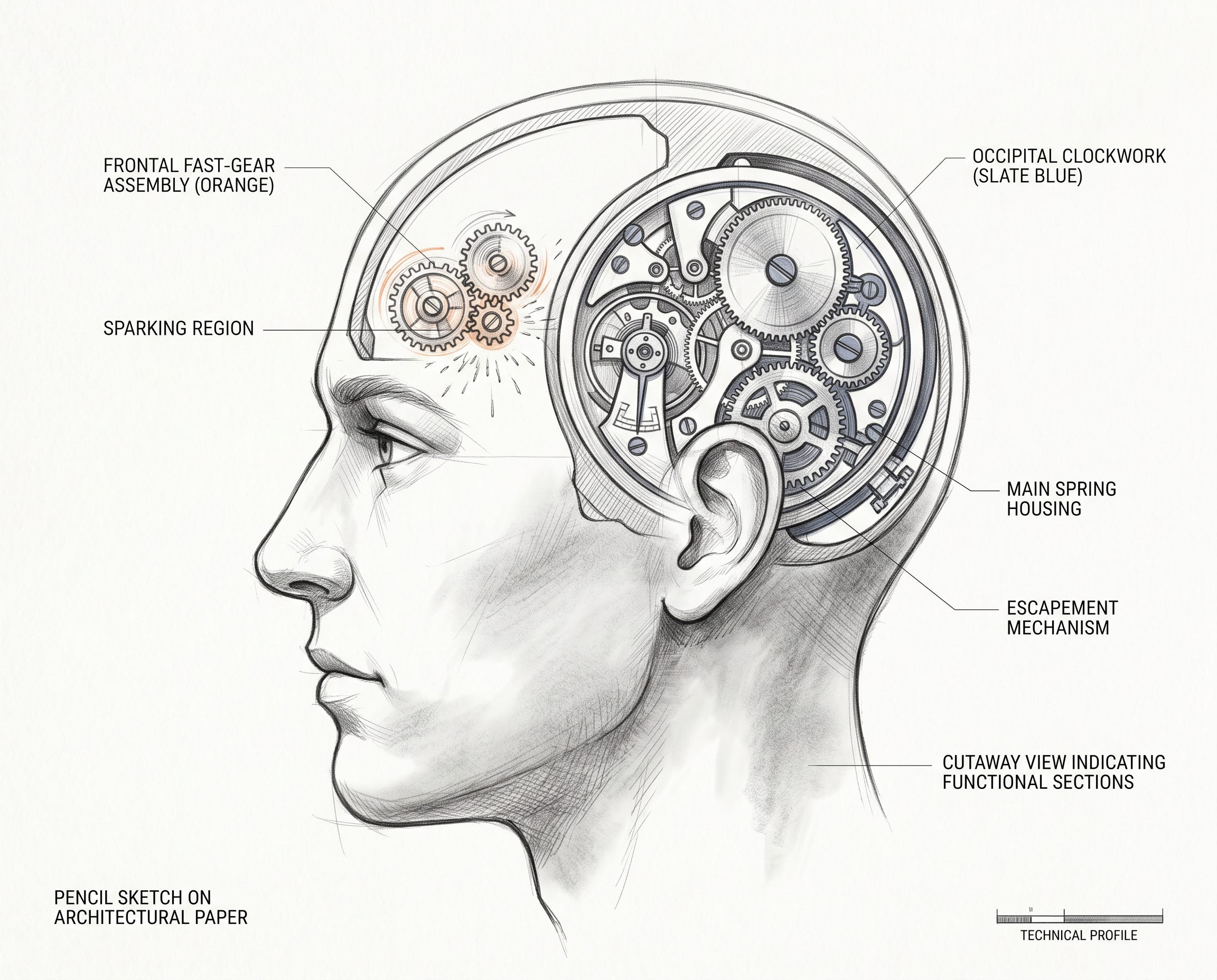
There’s one more finding from this line of research worth borrowing. Richard Thaler and Shlomo Benartzi, building on Kahneman and Tversky’s prospect theory, called it myopic loss aversion. The more often you look at your portfolio, the more losses you see, and because losses weigh roughly twice as much as gains, frequent checking makes you feel worse and act more timidly than the underlying results justify. Kahneman himself advised investors to look less often for exactly this reason.
So my practical advice is unspectacular. Don’t make big decisions on the day. Close the app. Take a few days off (or a few months if you need to; again, learn from Druckenmiller (see below)) and do something nice, whether that’s a long walk, a good dinner or an afternoon with the people you love.
When you come back, pull up your original thesis next to the new facts and ask the two questions again. Knowing what I knew back then, would I make the same call? And knowing what I know now, what is the best move from here?
That’s what the best poker players do after a brutal hand. They take a breath. Then they play the next one on its merits.
If you haven’t read it yet, Thinking in Bets is the natural companion to this post.
Learning from Druck again:
“I’ve also found as an investor, I believe in streaks, you see it in baseball, you see in everything else. I see it investing. Sometimes you’re seeing the ball. Sometimes you’re not one of my number one jobs is to know whether I’m hot or cold. And when I’m hot, I’m supposed to turn the dial way up. Not not say, okay, I’m up 40% this year. Let’s go. This will look good at the end of year, go take a break. No, you gotta make hay while you’re hot. And then when you’re cold, the last thing you should do is try and make big bets to get back to even you should, you should tone yourself down. So believe it or not, that’s, that’s part of the, all your eggs in one basket. Not only do I have to see the, see the investment that really excites me, I also have to see myself sort of being in a good, in a good trade trading rhythm.“