

Dear compounders,
On July 13, I published my deep dive on Dino Polska. The stock is up 27% since. That is pleasant to see. My estimated 5-year CAGR was in the range of 11-26%, with a weighted average of 16-17%, so it seems like that estimate is, as of today, well on track.
Despite the recent rally, if you zoom out a little, over five years, the stock is still pretty much flat.
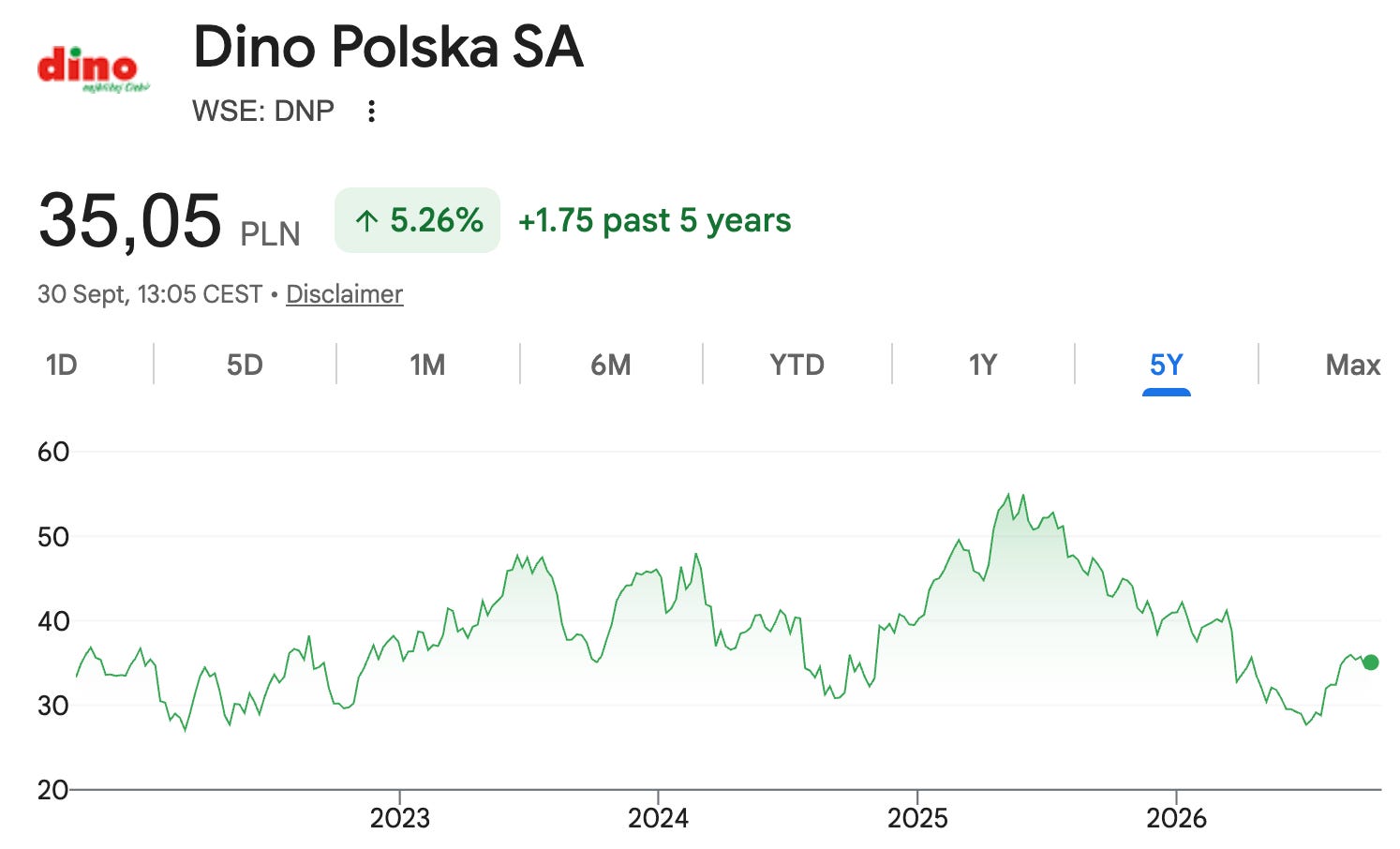
And of course, eleven weeks of price action could just as quickly reverse and tell me almost nothing about the intricacies of the business and the customer experience.
My research from a few weeks ago was also built from annual reports, store counts, demographic tables, expert interviews, and management commentary.
What it lacked was the view from inside the store. I have never stood at a Dino meat counter in a village of 2,000 people. I have never had to decide whether to walk to the nearest shop for a pack of butter or drive twenty minutes to a Lidl. My thesis leaned heavily on assumptions about how rural Poles shop, what they value and whether any of that is shifting, and I had no way of testing those assumptions from my desk in Düsseldorf.
For companies that operate in a region where you don’t live, that “understanding gap” is enormous. I have come to believe that understanding customers, what they need, what they appreciate and what slowly wears on their patience, should be a core pillar of every investment framework.
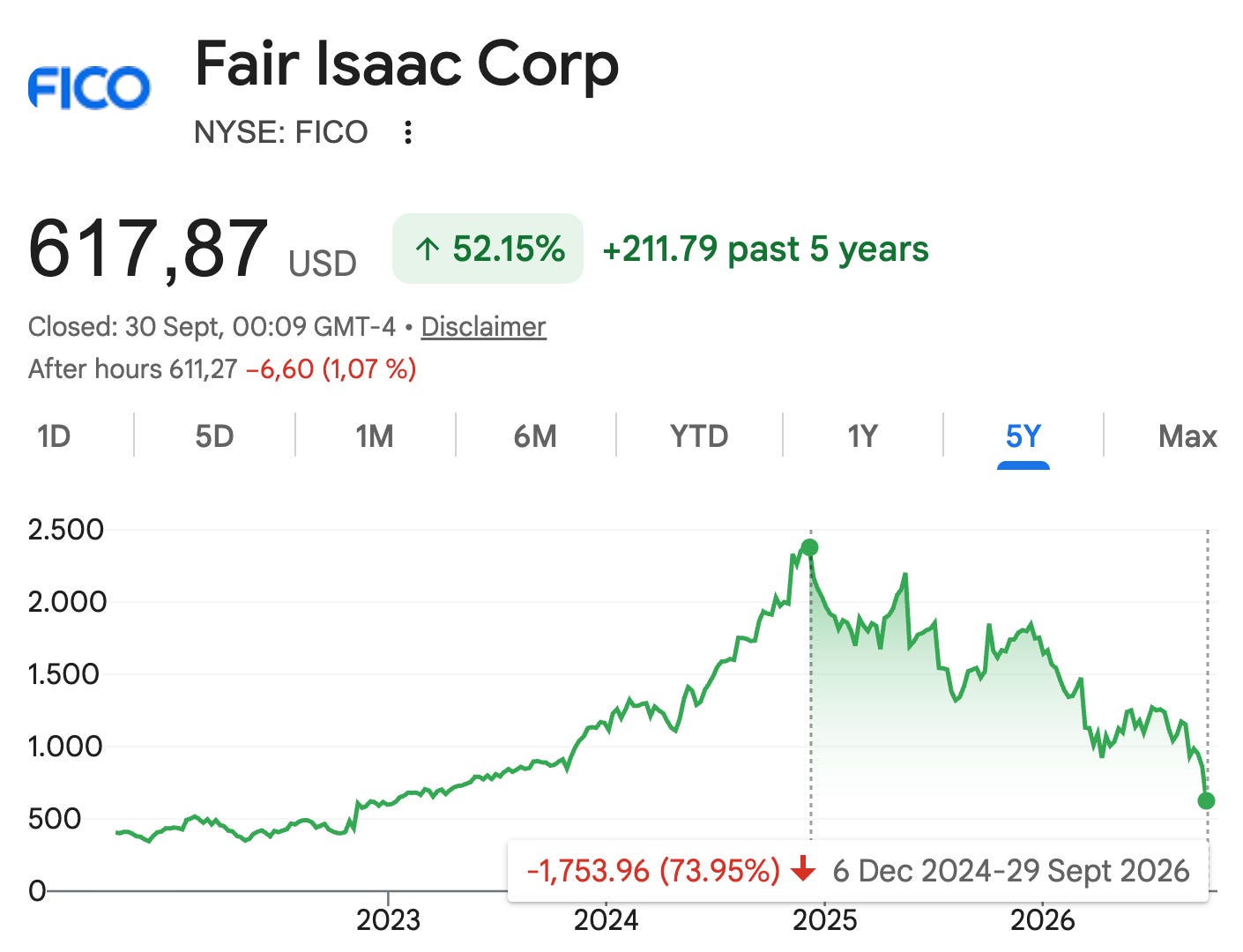
FICO is perhaps the freshest reminder. A business that looked like it had untouchable pricing power has lost almost three-quarters of its value, but it seems like it flexxed that pricing power muscle too much. Cracks in a thesis very often show up first among customers and the people (or regulators in this case) closest to a company’s products.
By the time they reach the income statement, the market has usually moved on.
Tiho Brkan shared a chart the other day on X, and privately, that has stuck with me and came to mind when writing this intro (see below).
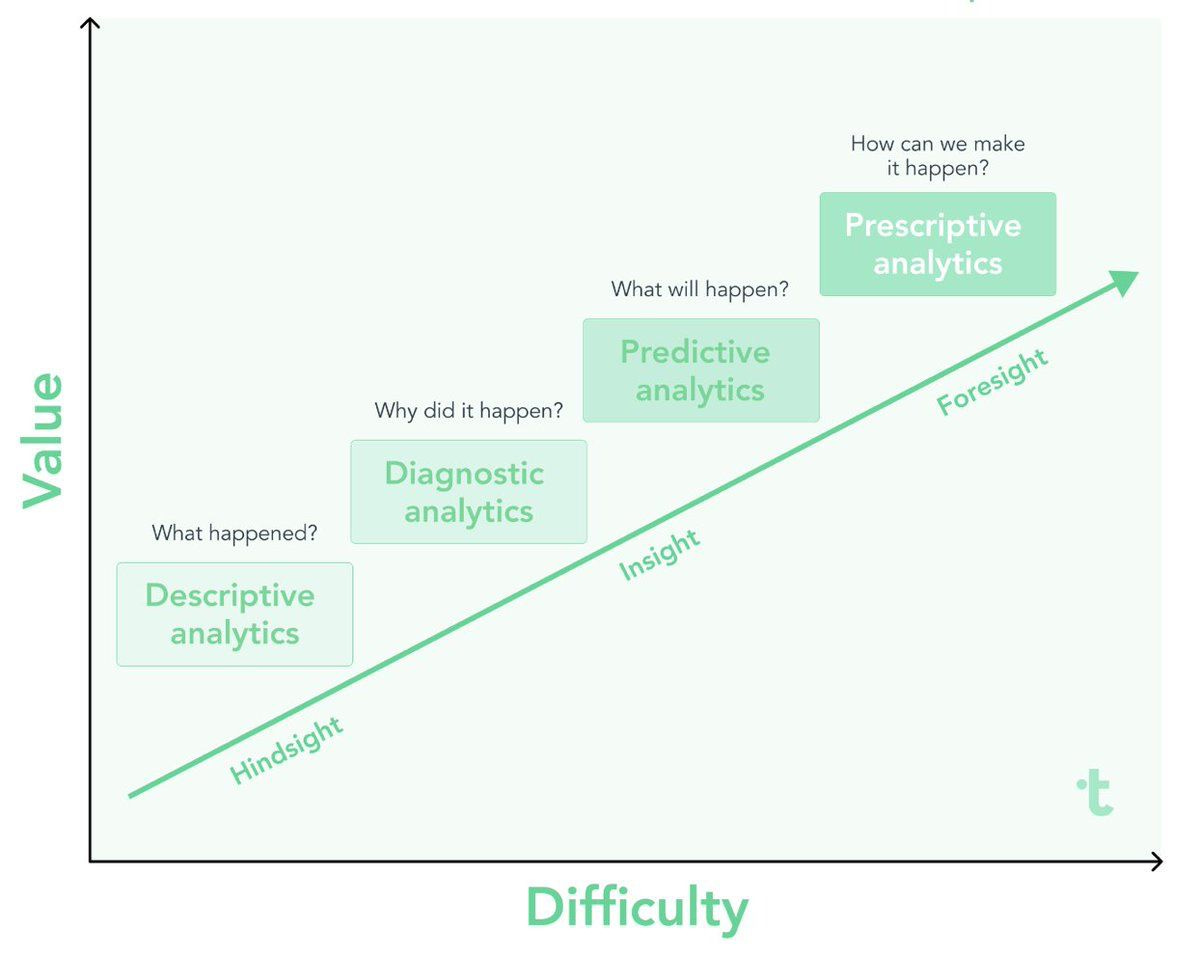
His commentary on it is worth quoting in full:
“Fundamentals are forward-looking expectations. They project what might happen in the future, and the wisest of investors have several case scenarios (rookies anchor to one plausible future only). Here, it is all about the future, and when discussing fundamentals, we are reasoning with foresight. What is the key takeaway? Financials are what everyone gravitates to, as their difficulty is manageable. However, they have very little value and are often already discounted or baked into the price. Fundamentals are what everyone shies away from (or probably cannot even distinguish from financials), as they are extremely complex. However, that is where all of the value sits, as they are not discounted or baked into the price.”
Again, I bring up Tiho's take because it gets at why this follow-up arrived in your inbox today. In July I did the backward-looking work, and I also laid out where I think Dino is heading: the store rollout, the reinvestment runway, margin durability and the risks that could derail all of it. That is the foresight Tiho describes, the part of the chart where the value is. Foresight rests on assumptions, though, and mine were built from filings, industry data and demographic tables that I studied at my desk in Düsseldorf. They assume rural Poles will keep choosing proximity and a good meat counter over everything else, that the labor pool will hold up and that the competitive landscape looks the way the reports describe it. If any of those assumptions starts to crack, customers, employees and locals will notice long before it appears in a quarterly report, just as FICO's customers, lenders and regulators did. I wanted to hear from those people directly, to find out whether the future I sketched matches what they see on the ground.
New here? Join 5,000+ readers and get 3 FREE GIFTS when you subscribe:
📈 Valuation Spreadsheet
📚 eBook: Investing Visualizations
💡 eBook: 250 Thought-Provoking Quotes

Thus, this brief follow-up to me deep dive is my attempt to understand Dino a little better, so I sent a list of questions to three people with boots on the ground or local roots or connections. Many of you will know:
Michael from our community, where he is one of the most active voices, and he also writes Personal Finance Without Borders on Substack. He passed my questions to his partner, who grew up in Kielce and still has family in the Polish countryside, so those answers come straight from someone who knows these villages firsthand.
Mathijs is one third of The Dutch Investors. He has owned Dino for two years and has visited five of its stores across two separate trips. I owe the connection to his fellow Dutch Investor Siem, who I joined on his podcast recently and was supposed to sit down with me again tomorrow, a conversation we had to push back because of the events I shared in my email yesterday.
Jakub (Marlowe on X) needs little introduction for regular readers. He is a Polish independent analyst who studied at Jagiellonian University, started investing in the middle of the 2006 construction bubble and still talks to Dino staff when he is back home. He was spot-on about InPost, and I will never forget that our bullish podcast episode on the company went live one day before the acquisition offer was announced. You can’t plan timing like that. If you don’t follow his work yet, you can find him on X (link above).
Their answers confirmed parts of my thesis, complicated others, and raised a few risks I hadn’t even thought to worry about. You will learn why every shopper seems to bring up the meat counter unprompted, why one employee described working at Dino as “hard, hard bread,” who Dino is actually taking market share from (hint: it’s mostly not Biedronka), and why a demographic detail about who leaves rural Poland might matter more than any store count.
This is also the first post in a format I plan to repeat. Whenever I publish a deep dive, I might go back to people with firsthand expertise and run a short follow-up interview that pressure-tests what I wrote. Feel free to message me if you think a follow-up interview would fit to one of my prior (or future) deep dives. The next one is already lined up with Joe from Goldman Won’t Cover This on Intuitive Surgical.
Let’s start with the people who actually shop there.
Disclaimer: As of the date of publication the author owns shares in the company; but that may change. The interview guest may hold positions in the companies discussed. The analysis presented in this blog may be flawed and/or critical information may have been overlooked. The content provided should be considered an educational resource and should not be construed as individualized investment advice, nor as a recommendation to buy or sell specific securities. I may own some of the securities discussed. The stocks, funds, and assets discussed are examples only and may not be appropriate for your individual circumstances. It is the responsibility of the reader to do their own due diligence before investing in any index fund, ETF, asset, or stock mentioned or before making any sell decisions. Also double-check if the comments made are accurate. You should always consult with a financial advisor before purchasing a specific stock and making decisions regarding your portfolio.
Intro
Thanks for taking the time to share some of your thoughts on Dino Polska. Maybe we could start by you just giving a short introduction to who you are and your background that may give you a unique perspective on Dino Polska specifically.
Mathijs: My name is Mathijs, co-founder and analyst at The Dutch Investors. Generally, I’m looking for companies with a strong market position, that structurally outperform competition, that generate high returns on capital and where management’s incentives are well aligned with shareholders. Dino Polska has been on my radar for around two and a half years now and I took my first stake two years ago. In the past two years, I have visited five Dino Polska stores in two different time periods to do research for myself and as part of research for The Dutch Investors.
Michael: Responses from my partner who grew up in Kielce (eastern Poland)
Jakub: Thanks for having me, René. I’m an independent equity analyst and investor, and I’ve published research since 2021. I’m Polish, I studied at Jagiellonian University, and I’ve been based in the UK since 2014, so I know Poland from the inside, though I now follow it from a bit of a distance.
I started investing in 2006, right in the middle of the Polish construction bubble. I remember watching pizza companies turn into construction companies, which tells you everything about where that cycle was. I sold about half my portfolio in August 2007, then watched the rest fall, with some stocks down 90%. I bought again in early 2009 and doubled my money, helped a lot by how cheap the market was. After that I spent about five years running my own businesses rather than following the market.
I came back to investing properly in 2019 with a quality-focused approach: high returns on capital, low debt, owner-operators. Since then, I’ve kept refining the strategy and the analysis, and the InPost work is where it showed up most clearly.
That history shapes how I look at Dino. I’ve seen what a boom in Poland looks like when balance sheets are weak, and Dino is the opposite of that. And the timing is interesting. At around 35 PLN a share, Dino has a market cap of roughly 35 billion PLN, about where it was in 2020. Since then, the business has grown a lot in stores, revenue and earnings, and the market has paid essentially nothing for that growth. That gap is what I want to talk about.
On the actual shopping experience
When you or your family or your friends (or whoever has a preference for Dino) decide to shop at Dino versus Biedronka or Lidl, from your perspective, what’s the real reason you pick one over the other? Is it genuinely price, or is it something softer, like the meat counter, staff familiarity, the brand, or just habit?
Mathijs: So, I’m not from Poland myself. However, the company I work for does have a large production location in Poland, so I also spoke to some colleagues from there. The main reason is location, which probably connects to the habit reason you’re referring to. From what I heard and saw, consumers shop there for daily groceries. So yes, meat, vegetables. Need toilet paper on Tuesday? Rush to Dino. Of course, the location-reason only applies to people living in rural areas. In cities, you will find more Zabka’s and Biedronka’s.
Michael: The main reason for choosing one over another is most likely the proximity, and then how well stocked they are. But for the basic day-to-day shopping, you get to choose from Dino, Lidl, Biedronka, Kaufland, Auchan, Tesco. I think these are the main supermarkets, and then sometimes also Netto. But yeah, for day-to-day stuff, usually you would just go to the one that is the closest because honestly, the price differences are not so much on the day-to-day products. And then if you are doing a bigger shop, or you need something specific, then this is where you would go to any of the supermarkets that would have it. I think for some of the young people who are now into the healthy lifestyle and eating fit, high-protein diet, then this is where they may prioritize Lidl and Biedronka because these discount shops have a lot of products that are basically their brand. And they have, yeah, they are those fit products for a very good price.
Jakub: Honestly, the biggest single factor is proximity, not price. There are two different shopping modes going on in a small Polish town. There’s the actual weekly shop, where you take the car and load up at Lidl, Aldi, Biedronka, Kaufland or Dino, and there’s the top-up trip: you ran out of cigarettes, or beer, or cream, or your kid wants crisps, and you just walk to whichever shop is closest. A lot of small local chains, the Globi’s, Zabka’s and Groszek’s of this world, live almost entirely off that second kind of trip. I’ve done it myself, popped into a Globi for pierogi because Dino was too far from where I was staying, even though I’d normally choose Dino given the option.
Is there a difference in perceived quality between Dino and its competitors, or does it feel interchangeable with any other discount grocer?
Mathijs: I don’t think so. If I had to choose, I would think Lidl and Biedronka offer more perceived quality of their products. Shops look nicer and are more modern.
Michael: Dino is known for having high-quality meat counter items. But everything else are products that are available in other shops.
Jakub: Where Dino does win on something other than proximity is the meat and dairy counter. Every person I’ve spoken to who shops there volunteers the same thing unprompted: the meat is good, it’s Polish, and the cheeses are good. That’s not marketing language, it’s what people actually say. And it’s backed by something real: Dino carries around 5,000 SKUs per store, roughly double what Biedronka or Lidl carry. So it doesn’t feel like a discounter to shoppers, it feels like a proper one-stop supermarket that happens to be priced competitively. That’s a real structural difference from the hard-discount model, not just a perception thing.
Do younger Poles in rural areas shop the same way their parents did, or is there a generational shift toward something else, city migration, online grocery, quick-commerce apps, that a five-year growth forecast might be missing?
Mathijs: Again, I’m not from Poland. However, I do think Dino is less vulnerable to a shift to online grocery shopping, because people go there multiple times a week and do weekly shopping at Lidl or Biedronka (wider assortment, larger space).
Michael: From a perspective of someone who lives in a big city and has parents and siblings in the countryside, I think that there is a big divide between how younger people in the city versus younger people in the countryside shop. I think the city is very much bought into the crave of this healthy lifestyle, and maybe not healthy lifestyle, but just high protein and fit and so on and so forth. While in the countryside, in order to get these products, you would have to get out of your way. So I think that younger people in the countryside shop like their parents, just because of the infrastructure, the shopping infrastructure that is available in the countryside. The majority of them would not be using any e-commerce or online delivery apps, because the cost of that service in the countryside is more expensive, and so that often will be perceived as a waste of money to pay for the delivery as opposed to go and shop, unless you are in a certain social group that doesn’t really care about the cost of the food.
Jakub: On generational shift, I’ll be honest, I don’t have a real insight there. I can tell you how the two shopping modes work, but I don’t have evidence either way on whether younger rural Poles behave differently from their parents. I’d rather say that plainly than guess at a trend I haven’t actually seen.
On local reputation and brand perception
What’s the general sentiment toward Dino as an employer in these small towns? Is it seen as a good place to work, or has the labor dispute I mentioned in my “what went wrong” section in my deep dive actually damaged its local reputation?
Mathijs: I don’t know to be honest.
Michael: Don’t know
Jakub: On the labour dispute specifically, I did some digging myself, I spoke to staff at three different Dino stores in one town. Nobody brought up the dispute unprompted, and when I nudged the conversation toward working conditions, the answers were mixed but not alarmed. It’s physically hard work, long shifts, constant restocking, cross-trained across meat, bakery and till, and there’s essentially no benefits package beyond base pay. What makes it bearable, by their own account, is the local team and manager, not anything the company provides structurally. One phrase has stuck with me: one worker called it ‘hard, hard bread,’ and said the only reason she liked her store was that she liked her colleagues, not because of how Dino treats them as a policy matter. So it’s not glowing, but it’s also not the picture of crisis you’d get from the strike headlines. My read is that this is as much a sector-wide rural labour shortage as a Dino-specific failure. In the same conversations I heard that Lidl locally is so desperate for staff it reversed a rejection and accommodated a candidate’s preferred shift two months later.
Is there any regional or generational stigma attached to shopping at a “discount” grocer versus a more established chain, the way there sometimes is in other countries? Or is that not really a factor in Poland?
Mathijs: I definitely don’t think that’s a factor in Poland.
Michael: They are all reasonably cheap. Dino isn’t perceived as a budget option. It really is about proximity.
Jakub: On stigma, I haven’t seen any. Nobody treats shopping at Dino, or at any of these discount-adjacent chains, as something to be embarrassed about. People shop wherever’s closest without a second thought, and that includes people who could clearly afford to shop elsewhere.
Is Tomasz Biernacki a known or discussed figure at all outside investing circles, or is he genuinely invisible even within Poland?
Mathijs: Don’t think so. I remember one media appearance when he allegedly crashed his Ferrari. So, that might have given him some (unwanted) attention.
Michael: The answer was who is Tomasz Biernacki? :D He is very low profile.
Jakub: On Biernacki, he’s genuinely invisible. Most Poles outside investing or retail circles wouldn’t recognize his name, let alone his face. He does no politics, no media, no personal branding. I actually find that refreshing, especially coming from following InPost, where Brzoska is constantly in the press and occasionally wading into political territory. It removes a lot of headline risk. The tradeoff is that it also means very little visibility into his intentions long-term, but as a day-to-day matter, he’s a non-factor in public life.
On competitive dynamics I can’t see from outside
Are there local or regional grocery chains, ones too small to show up in any report I’d find, that compete with Dino in specific areas? Is the “only Biedronka and Lidl” competitive framing actually complete, or is it missing something?
Mathijs: Apart from Biedronka, Lidl, Dino and Zabka, I noticed a supermarket chain called Eurocash. They seem to be struggling and not keeping up with growth.
Michael: There are others: Stokrotka, Netto, Lewiatan. Then also larger scale ones like Auchan and Kaufland. On the smaller scale you have Zabkla (more in cities) and ABC (in countryside).
Biedronka and Lidl focus on towns while Dino can be in the middle of nowhere. Lewiatan is the real direct competitor in rural areas although this may differ in other parts of the country.
Some small towns also have one-off family-run supermarkets.
In many countries, the population is concentrated in towns or villages or cities, while Poland has this specific type of a village or a human settlement, whereby the population is not concentrated in one geographic area, but it may be concentrated along the road-front, which basically gives you long spread-out human settlements that may be far from the nearest village or the nearest town, but still needs to go and shop somewhere. This is very characteristic for Poland.
Jakub: The ‘just Biedronka and Lidl’ framing misses a whole layer. In my own small town alone there’s also Aldi, Lidl, Kaufland, Żabka, and then a long tail of smaller names: Lewiatan, Delikatesy Centrum, Groszek, PSS Społem, Wizan, Globi, Netto, Euro Market, Delfin. But I’d draw a sharp line between the first group and the second. The small local chains aren’t really competing with Dino in the way Biedronka is, they’re the ones getting displaced by it. Most of them are franchise networks or old cooperative structures with weak central buying power and aging stores, and Dino’s standardized, owned-real-estate format is eating their volume year after year. That’s a big part of where Dino’s growth actually comes from, not stealing share from Biedronka, but absorbing what used to go to a Społem or a small Lewiatan franchisee.
Have you noticed delivery apps or quick-commerce services (Glovo, Bolt Food, or similar) making inroads into smaller towns, and could that eventually erode the proximity advantage Dino has built its whole model around?
Mathijs: No. And I don’t think these companies can ever be profitable in rural Poland. The distances are too long and population is too spread. Similar companies even went bankrupt in major cities like Amsterdam and Rotterdam. Different country, but still.
Michael: No – haven’t noticed this for shopping.
Jakub: On quick-commerce, I’ve seen zero evidence of Glovo or Bolt Food or anything like that making any inroad into rural Poland. That’s a big-city phenomenon. The population density and income levels in these small towns don’t support a delivery-rider business model, so I don’t see it as a threat to Dino’s proximity advantage any time soon.
On demographics and regional nuance
Is rural depopulation, younger people leaving small towns for Warsaw, Krakow, or abroad, a trend that’s actually accelerating, and could that undercut the “stable rural demographics” assumption my thesis leans on?
Mathijs: Or turn it around, Dino’s are profitable in villages with just 2,000 inhabitants. Lidl and Biedronka are not. So, if villages become too small to them and they leave, this will offer more potential customers for Dino?
Michael: Better to use data for this as it would just be anecdotal.
Jakub: On depopulation, I don’t have strong ground-level insight into east versus west specifically, but I’d flag something that complicates the simple ‘young people leave for the cities’ story. There’s been noticeable return migration of Poles who’d been working in the UK, and Ukrainian settlement reaching even small towns, not just the big cities. So whatever outflow exists is being offset, at least partially, by two different inflows. I wouldn’t assume net population in these towns is falling as cleanly as a simple depopulation model suggests.
How does eastern Poland actually feel different from western Poland on the ground? I’ve assumed the regions are demographically similar enough that Dino’s model translates directly east, but is that a fair assumption or an oversimplification?
Mathijs: To be honest, I didn’t notice any difference. Have been to Krakow and surrounding villages, between Krakow and Auschwitz. Not that different compared to the ones around Leszno in the West.
Michael: Eastern Poland is different from Western Poland. Eastern Poland historically has been poorer and more underdeveloped. And even though there has been some progress, it still remains like that, specifically at the eastern border, and now also with the Ukrainian conflict. These areas are depopulating faster. So that may impact whether shops can actually sustain themselves.
Do you have a view on the likelihood of Dino Polska being able to successfully expand its business to adjacent countries. Serving underserved small towns with a standardized, owned-real-estate format, isn’t Poland-specific. Lithuania, the Czech Republic, and Slovakia all share broadly similar demographic patterns.
Mathijs: I don’t dare to answer this question. Really have no clue. My thesis is fully based on expansion in Poland.
Michael: No idea
Jakub: On adjacent-country expansion, I’ll be honest about where I stand: I haven’t seen any real signal from management that they’re planning to move into Lithuania, the Czech Republic or Slovakia. The whole model depends on owned real estate built specifically for this format, and a captive meat and logistics supply chain built around Agro-Rydzyna, which is very Poland-specific. That’s a harder thing to export than just replicating a store layout. My honest hope for this stock is much less exciting than international expansion, it’s that they keep doing exactly what they’ve been doing in Poland for another decade, the way Lidl and Aldi have done across their home markets, and that I get to just hold it. If, however, they decide to expand to other markets, I will gladly watch it unfold and hold through it. The alternatives are buybacks or dividends, each can be good ten years from now. I would hope for international expansion eventually though.
On regulation and local politics
Are Sunday trading restrictions actually well enforced and respected, or is there more nuance or workaround in practice than the law suggests on paper?
Mathijs: I think these are well enforced and respected. Just like in Germany in my experience.
Michael: They do apply but Some shops like Lewiathan and Jablka have a way around it due to their model whereas Dino and other big companies are closed on Sundays.
It comes down to this: by law, company-owned shops cannot open on Sundays and “owner-operated” shops can. Because of their franchise model most leviathan shops are owned by independent entrepreneurs – these can open on Sunday. I think some Lewiatans are owned by companies (who own several franchised stores) and these ones can’t open on Sunday.
In theory, under the “owner-operated” exemption, the owner must personally work in the store on that Sunday. In practice that doesn’t happen for Lewiatan and Jablka (the same normal employees work on Sundays as other days)
Jakub: Sunday trading is properly enforced, not a paper rule with workarounds. Some Sundays are legally designated as trading days and the stores are open, others are closed, and Dino doesn’t have any way around that given its size. The only shops that can open on a closed Sunday are genuinely small, owner-operated ones where the owner is physically working the till themselves.
Is there any friction, politically or locally, around Dino’s land acquisitions in small towns, zoning disputes, resistance from existing local shop owners, that wouldn’t show up in a filing but might show up in local news or gossip?
Mathijs: Don’t know
Michael: No idea
Jakub: On land and zoning friction, I haven’t come across anything, no disputes, no resistance from local shop owners showing up in local coverage. That’s a non-finding rather than a confirmed clean bill of health, since I haven’t gone looking specifically, but nothing has surfaced.
Closer
If you had to bet on whether Dino is still the dominant grocer in your town in ten years, what would actually make you doubt that, something a foreign investor sitting outside Poland would have no way of knowing to worry about?
Mathijs: I’m a foreign investor myself :)
Michael: Depopulation/rural to urban migration is the main worry and it is happening everywhere.
It seems that more women have left rural areas for cities than men so you have a mismatch with more young single men than young single women in rural areas. If it continues like this, then depopulation could be even more of a problem.
Jakub: I’d push back on the framing a little. I’ve never needed Dino to be dominant. My thesis isn’t that they’ll own the Polish grocery market, it’s that they can keep opening owned-real-estate stores at a high return on capital in a fragmented space full of weak legacy competitors, for a long time. So the question I ask myself isn’t what threatens their dominance, it’s what breaks that reinvestment machine.
A few things would genuinely worry me. First, labour. Rural Poland’s labour pool is tighter than people assume, I’ve heard first-hand that Lidl is having to bend over backwards to staff a small-town store. If wage inflation keeps climbing there, that shows up in margin before it shows up in any headline.
Second, Biernacki himself. He’s completely invisible, no media, no politics, nobody in Poland even knows what he looks like. I actually like that, it removes a lot of the key-man drama you get with someone like Brzoska at InPost. But it cuts both ways: nobody outside the company has any real visibility into his succession plans or long-term intentions for a 51% stake.
Third, simple saturation. The easy small-town white space won’t last forever. Once it’s gone, growth capex either slows or moves into harder, more marginal locations, and that’s the point where you’d see whether the returns hold up. Who knows, maybe we’re there now?
If I had to name what would break the thesis rather than make me nervous for a headline or two, it’s one of those three.
Outro
A big thank you to Mathijs, Michael and Jakub, and to Michael's partner, for taking the time to answer my questions so openly and honestly. I have read their answers several times now, and each round left me with a sharper picture of Dino.
Several of them were comfortable saying "I don't know" when they didn't, and I value that just as much as the insights. If you enjoyed their perspectives, please support their work. You can find Michael at Personal Finance Without Borders, Mathijs and his partners at The Dutch Investors, and Jakub on X (I linked their respective online presences in the intro). I am looking forward to the next edition of this format with Joe on Intuitive Surgical, and if you have firsthand expertise on a company I have covered and would like to take part, my inbox is always open.