

Dear Compounders,
Warren Buffett once said that when memos from Howard Marks arrive in his mail, they are the first thing he opens and reads, and that he always learns something from them.
“When I see memos from Howard Marks in my mail, they're the first thing I open and read. I always learn something, and that goes double for his book.”
I understand the impulse. Over the years, I have noticed that Marks’s memos come in two flavors:
Some revisit timeless principles about risk, psychology, and price, and reading them feels like returning to a favorite book.
Others are dispatches from the current environment, in which Marks tells you what he sees in the market right now and what worries him about it.
Both are valuable. They are valuable in different ways, though. The first kind sharpens your framework, mental model database, and thinking. The second shows how to apply that mental toolbox to the real world, or it might confirm or challenge your views on the current environment and opportunity set.
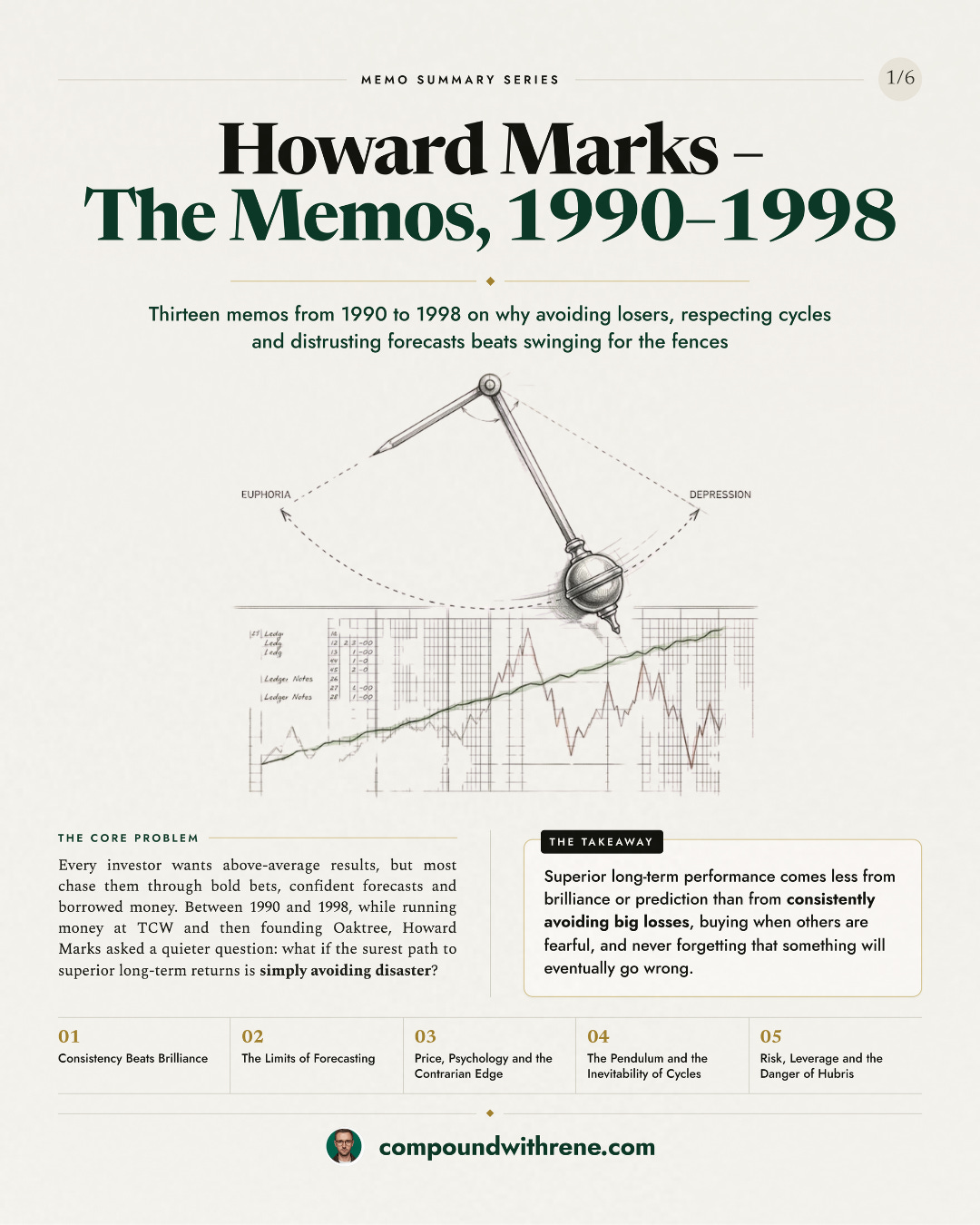
For this Blueprint I went back to the very beginning: thirteen memos written between 1990 and 1998, first at Trust Company of the West (TCW) and then at the newly founded Oaktree.
I expected a pleasant history lesson. What I got was a week of uncomfortable déjà vu, because some of the present-day, 2026 headlines I am reading alongside these memos these days could have been footnotes to them.
What Can a Memo From 1990 Possibly Tell Us About 2026?
A fair question. These memos predate the internet economy, index funds as a dominant force, unheard of zero interest rate environments (well, that’s been changing fast anyhow…), and anything resembling artificial intelligence.
Marks writes about convertible bond funds with a few hundred million dollars in assets and quotes economists’ forecasts for the yen. The hedge fund names he mentions belong to a different era. Read them as historical documents, though, and you miss the point.
Even back then, Marks was writing about mechanics: how losses compound, how forecasts are formed, how leverage turns small mistakes into fatal ones. Mechanics and timeless principles do not expire. The vocabulary changes. The machinery stays the same.
So in what follows I want to unpack three of those mechanics, each through a lens that feels current to me in October 2026.
Why Did My Worst Investment Teach Me More Than My Best?
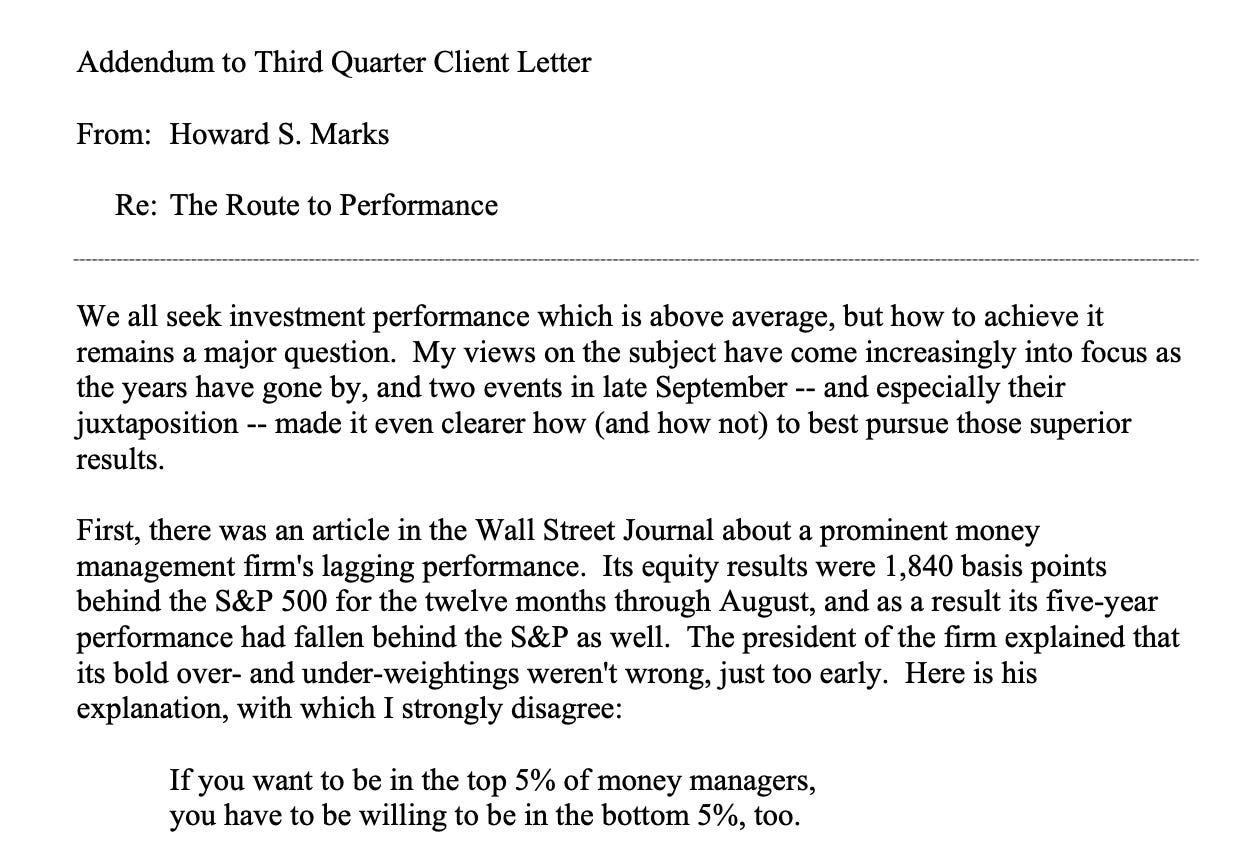
The very first memo in the collection opens with an argument. A money manager, trailing the S&P 500 by more than eighteen percentage points over a year, defended himself with a line many investors would nod along to:
If you want to be in the top 5% of managers, you have to accept the risk of landing in the bottom 5% too.
Marks rejected that bargain.
His counterexample was a pension plan whose equity portfolio never ranked worse than the 47th percentile or better than the 27th in any single year, and yet over fourteen years it compounded into the 4th percentile. No spectacular years. No disasters either.
“the best foundation for above-average long term performance is an absence of disasters.”
I learned this lesson the expensive way. My position in Endor, a German tech hardware maker, ended in a permanent loss of capital, and what stung most was the opportunity cost, more than the number on the screen. A total loss does more than subtract from a portfolio. It removes capital that would otherwise have kept compounding for decades, and at the time it brought the compounding of my broader portfolio to a halt.
My winners over the years, some of which went up two times or more, did their job. They did not undo the damage in the way I once assumed they would.
The arithmetic is brutal and familiar: a 50% loss needs a 100% gain to break even, and a 100% loss needs a miracle.
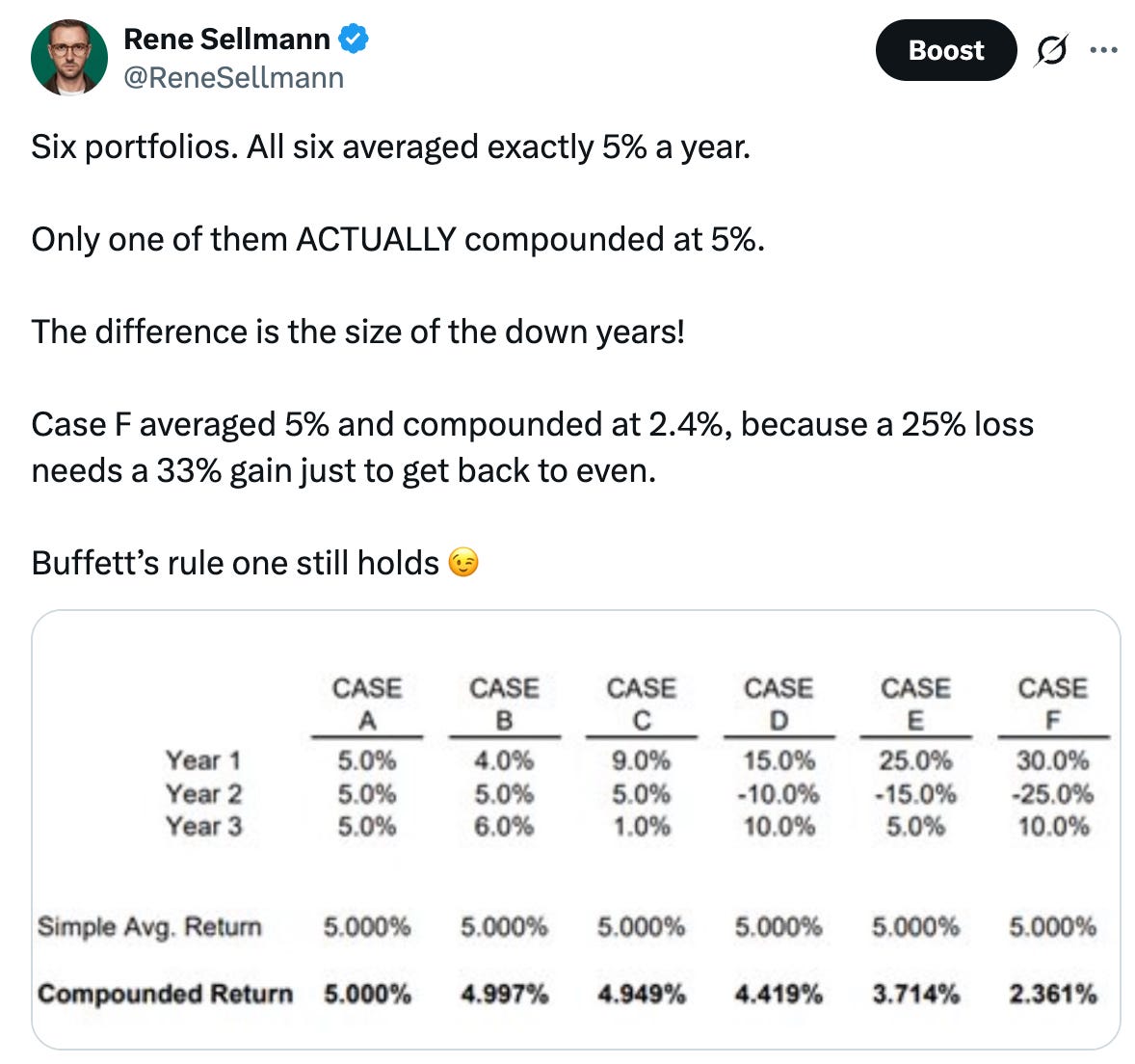
That is why Marks frames the goal as avoiding the losers and letting the winners take care of themselves. It sounds defensive. It is in fact the most aggressive long-term strategy available, because it keeps the base intact for the compounding that does the heavy lifting.
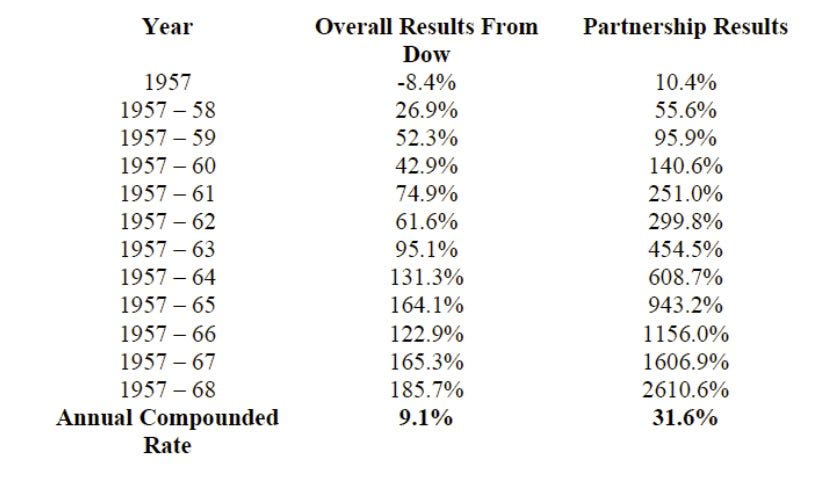
Buffett’s early partnership years illustrate this very well:
Average annual return: 30.4% vs. Dow’s 8.6%
Most importantly, not a single negative year (!), even when the market fell -15.6%
Outperformed the index by more than 22% compounded annually
Downside protection paired with consistent alpha is how to get filthy rich.
Marks makes the same point in a sports metaphor I love. When he and his partners left TCW to found Oaktree in 1995, he contrasted Babe Ruth’s home-run credo with golfer Tom Kite, who had earned more career prize money than anyone in the history of the sport before ever winning a major.
Consistency over headlines. Batting average over the occasional home run.

There is a behavioral layer to this too, and Marks touches on it with an old poker adage about scared money never winning. I wrote about that dynamic recently, when the stakes rose, and a sharp one-day drop hit several members of our community. Read it here:

Is Forecasting Pointless, or Just Done Badly?
Marks’s 1993 memo on predictions is one of his most quoted for good reason. He builds his case like a proof. The value of a forecast equals the payoff from being right multiplied by the probability of being right.
The Expected Value of a Forecast = Value of Correct Forecast x Probability of Being Correct
Most forecasters have roughly average ability, and the consensus forecast is already embedded in prices, so being right along with everyone else earns you an average return.
Only a forecast that is both non-consensus and correct produces superior results. And those are rare for an obvious reason: outcomes cluster near the consensus most of the time.
“non-consensus forecasts are hard to make, hard to make correctly and hard to act on.”
Three years later, he tested the idea against the Wall Street Journal’s economist surveys he had stashed in his desk drawer. The consensus missed by about 15% on average. Simply assuming that rates and currencies would stay where they were missed by about 16%. The forecasts tracked the current level of each variable almost perfectly and anticipated none of the major turns.
The economists were extrapolating. Marks’s verdict: stay away from the macro future and focus on what is knowable.
I agree with most of this, and I also think it needs an update for 2026. One of my favorite projects this year was building an “AI superforecaster,” grounded in the research of Philip Tetlock and Barbara Mellers on what separates the best forecasters – the superforecasters – from the rest.
Their findings do not contradict Marks. They explain why the forecasters he studied failed. Look again at those survey results. The economists anchored on the present and adjusted a little. In Tetlock’s language, they started with the inside view, the specifics of the current situation, and never looked outward. Superforecasters reverse that order. They anchor first on the outside view, the base rate of the relevant reference class, and only then adjust using case-specific information.
Sequence matters more than weighting. They establish what usually happens to situations of this kind before reasoning about this one. They look for other perspectives on how the question should have been framed in the first place. They aggregate across several models and reference classes. They express the result as a number, fifteen percent rather than “a small chance,” because a forecast in words cannot be scored, and a forecast that cannot be scored cannot improve you. Then they update, mostly in small steps, occasionally in a large one when something breaks, and they keep a record. That’s the TL;DR version of their approach.
That last point lines up neatly with a complaint in Marks’s 1993 memo: nobody ever publishes a forecaster’s track record. Can you imagine hiring a baseball player without knowing his batting average? So my takeaway is a little more nuanced than “don’t forecast.” Ultimately, investing is all about forecasting. Marks is right that confident point predictions about rates, currencies, and GDP add little value. Tetlock and Mellers show that disciplined, probabilistic, base-rate-first estimates can be calibrated and improved. You can try. Just know which kind of forecasting you are doing.
"There is a danger of expecting the results of the future to be predicted from the past.” – John Maynard Keynes

Where Is the Lender This Time?
The memo I keep thinking about this week is the last one in the collection I looked at for this Blueprint.
“Genius Isn’t Enough,” written in October 1998, dissects the collapse of Long-Term Capital Management.
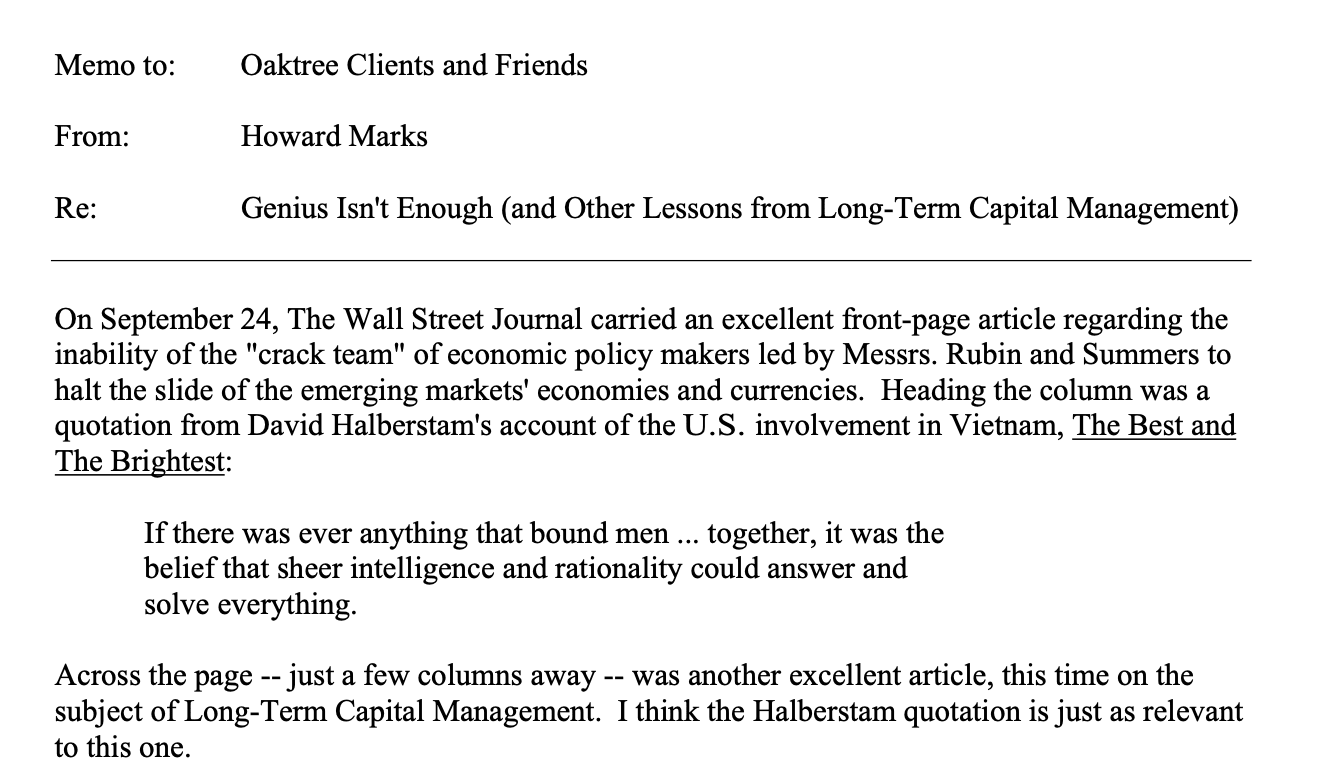
LTCM had Nobel laureates, a former vice chairman of the Federal Reserve and Salomon’s best bond traders. By Marks’s account, it also had roughly $4.6 billion of equity supporting around $150 billion of positions. When spreads moved the wrong way between August and late September 1998, about 90% of that equity disappeared. The individual trades were mostly sensible. The structure was not.
“Volatility + leverage = dynamite.”
Marks draws out a further lesson that I think matters even more today: the credit cycle tends to be far more volatile than the economy underneath it. Lenders sell money, the most commoditized product there is, so in good times they compete by accepting more risk, lower rates, and looser terms.
When conditions turn, all of that reverses at once.
“Look around the next time there’s a crisis; you’ll probably find a lender.”
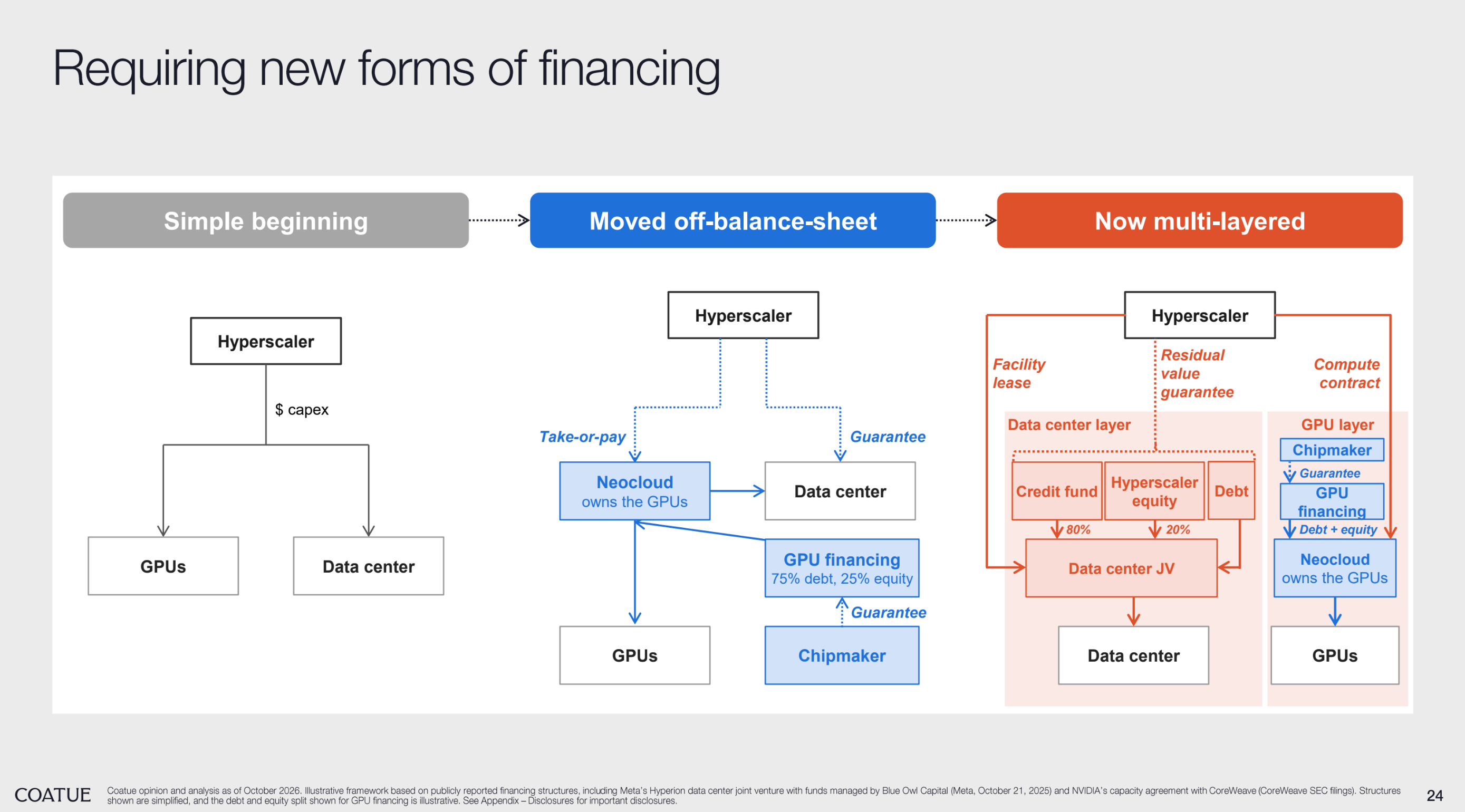
Now look at the AI trade in October 2026. I have written before that I see several warning signs, and if I had to pinpoint what could stop the trade, it would be the financing structures that have grown more “creative” over time, with off-balance-sheet arrangements and companies financing their own customers. Coatue had this nice slide in its October 2026 deck:
Last week the Financial Times reported that OpenAI had told investors its annualized revenue was nearing $50 billion, roughly $20 billion below figures reported earlier, and tech stocks fell on the news.
Part of the gap is definitional. The two leading labs calculate annualized revenue differently, with Anthropic counting sales made by its cloud partners and OpenAI excluding them. Even so, a $20 billion revision that markets learned about secondhand says a lot about how much faith is being placed in numbers few people can verify.
Marks would recognize the pattern. He wrote about LTCM’s investors accepting 40% returns without understanding what the fund did.
8 Signs the AI Bubble Is Further Along Than You Think

Let’s start with an anecdote before we move on to more structural things I’m seeing.
Then came CoreWeave. On Wednesday, its unsecured bonds due in 2032 traded below 80 cents on the dollar, a level widely considered the threshold for a financially strained borrower.
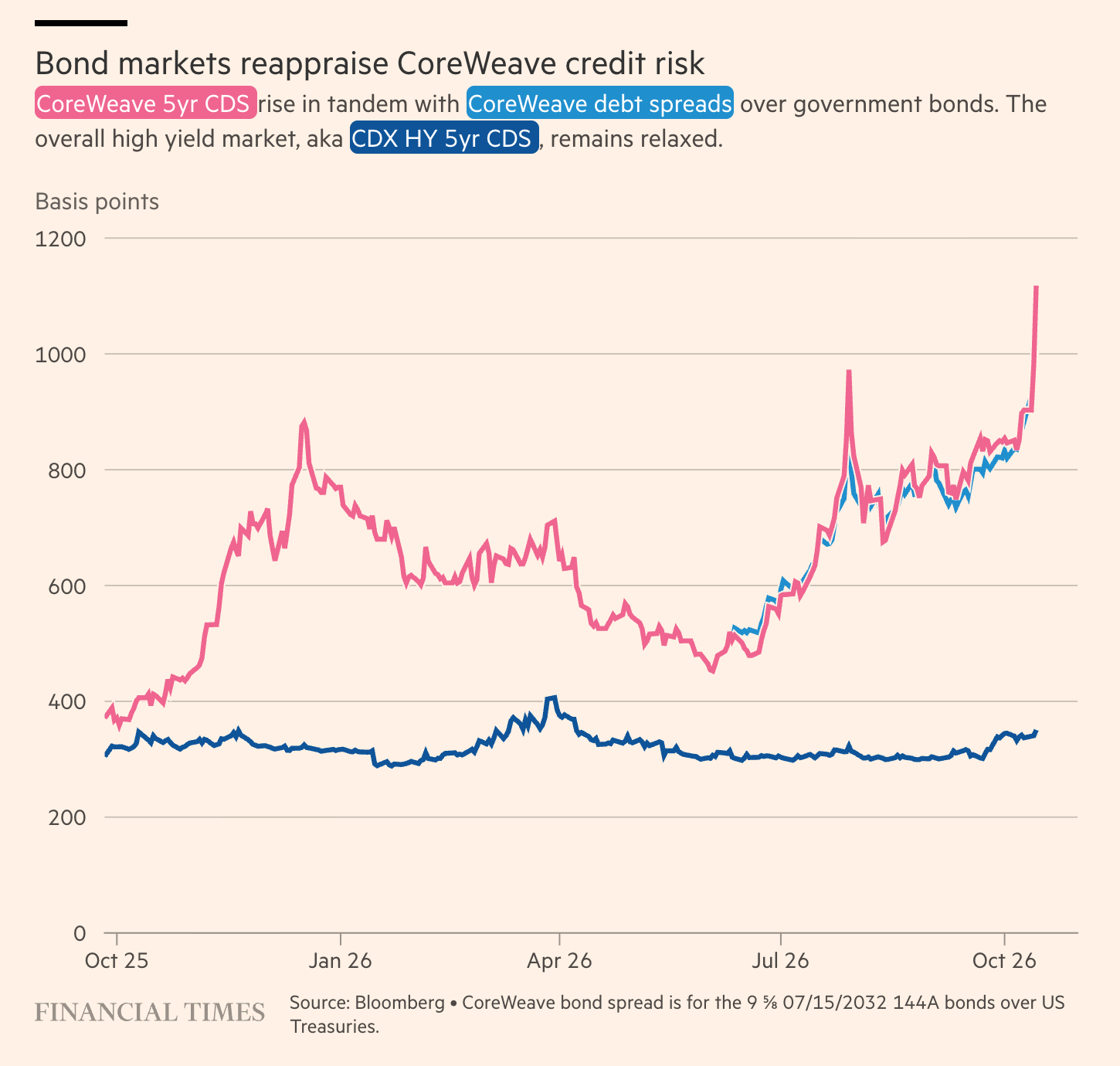
The stock fell 15% that day after Chamath Palihapitiya raised the question of a private credit bubble with a screenshot of the bonds yielding 15%.
The bull case points to a revenue backlog of roughly $104 billion at the end of the second quarter. The bear case points to second-quarter capex of $6.42 billion against free cash flow of minus $5.74 billion, and to third-quarter interest expense guided at up to $940 million. A backlog only becomes cash if the customers can pay, and many of those customers are themselves raising money on projections.
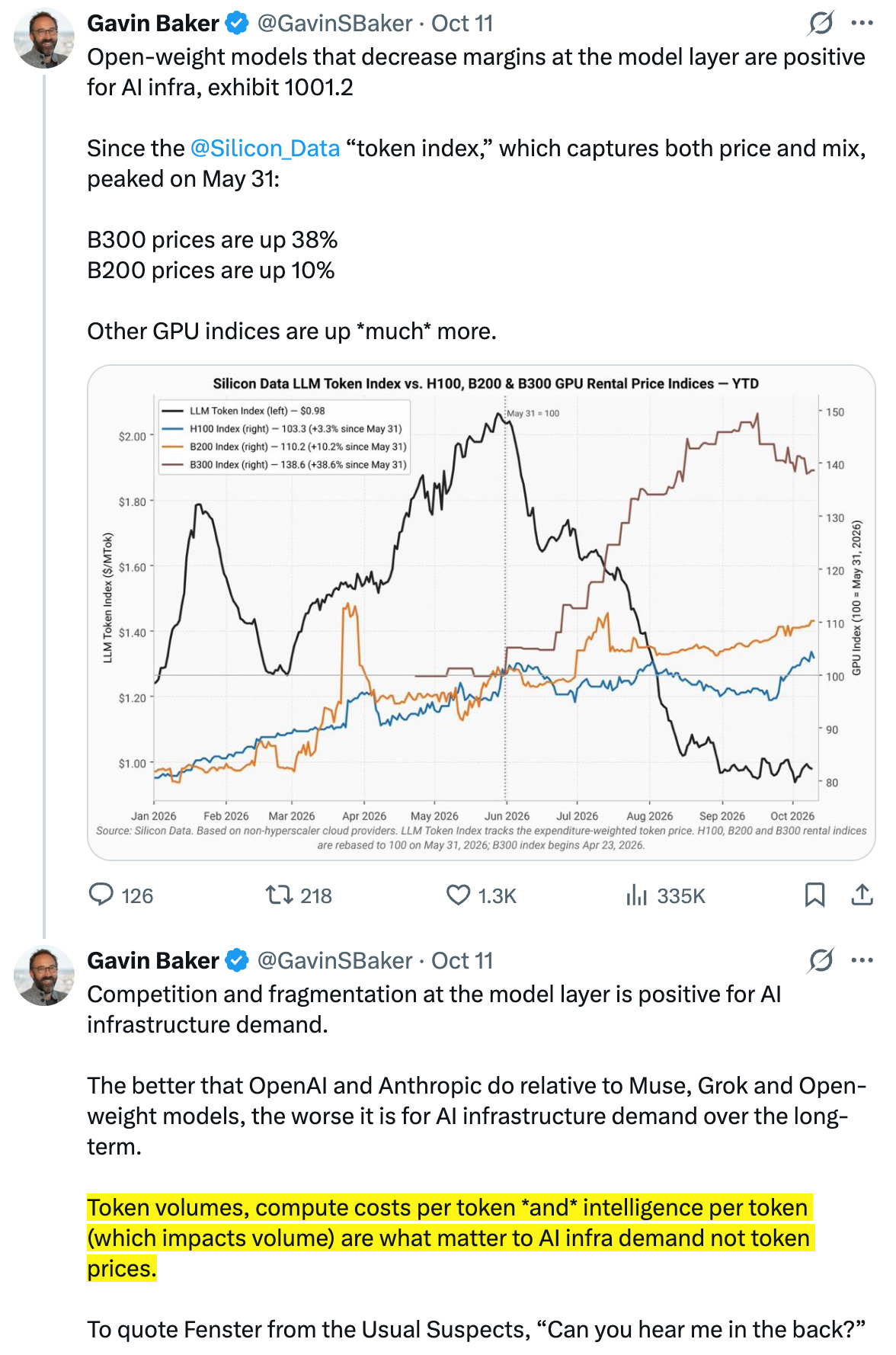
Volatile revenue, heavy debt, interlinked counterparties. Marks wrote that recipe down in 1998.
Does that mean I know what happens next? No, and Marks would warn me against pretending I do. In a 1997 memo, quoted in “Who Knew?”, he argued that the next surprise would most likely be something nobody had anticipated, including himself.
A month later, the Asian financial crisis erupted. COVID was the same kind of event in our time. Black swans are unknowable by definition.
Fragility is not.
You do not need a medical degree to see that in a system this interconnected and this leveraged, it may not take much for something to break and for the ripple effects to travel far.
I cannot name the trigger. I can assess how exposed I am if one arrives. That is the knowable part.
Why I Turned Thirteen Memos Into Six Slides
Reading these memos back to back is a different experience from reading them one at a time over the years. Themes I had filed under separate headings, consistency, forecasting, psychology, cycles, and leverage, turn out to be one argument viewed from five angles.
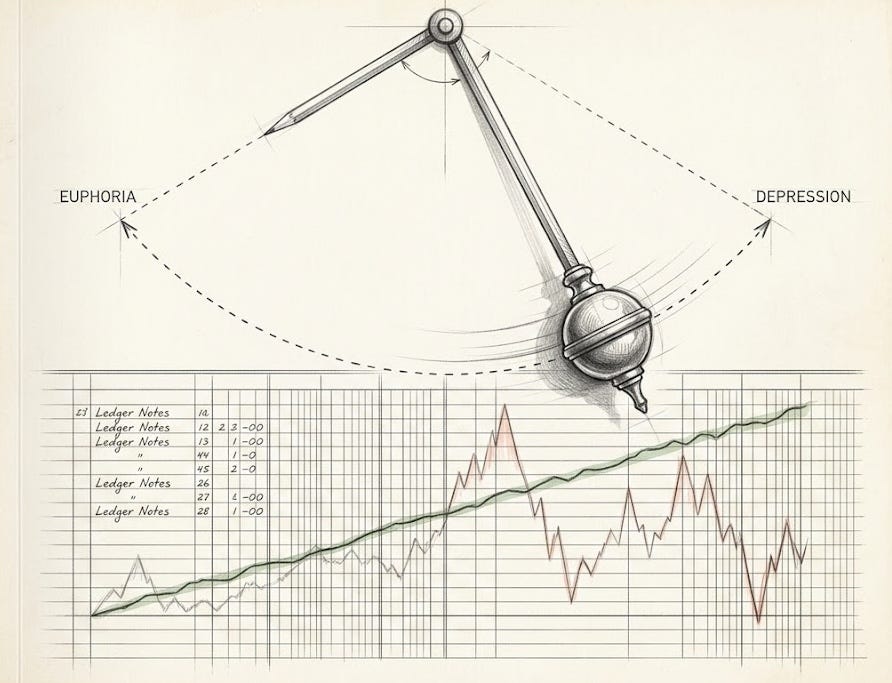
So I distilled them into a visual architecture: a cover slide with the central thesis, followed by five modules on consistency over brilliance, the limits of forecasting, price and psychology, the pendulum of market cycles, and risk, leverage and hubris.

Each slide carries the key data points from the memos, short definitions for the terms that need them, and the historical context that makes a 1990s memo readable in 2026. I also flagged a few places where the historical record differs from Marks’s numbers.
You can access the Blueprint via the note I shared with the slide deck as image files a couple of days ago:
As a small thank-you during my parental leave month, I’m also making the PDF of this Blueprint free for everyone to download. For most past and future Blueprints, the PDF remains a perk for paying subscribers.
My suggestion: create a dedicated folder on your computer – something like “Investing Blueprints” – and save this one as your first entry.

Over time, it becomes a compact reference library of the most important investing concepts, papers, and memos, ready whenever you want to revisit an idea.
Until next time, keep compounding.
Disclaimer: The analysis presented in this blog may be flawed and/or critical information may have been overlooked. The content provided should be considered an educational resource and should not be construed as individualized investment advice, nor as a recommendation to buy or sell specific securities. I may own some of the securities discussed. The stocks, funds, and assets discussed are examples only and may not be appropriate for your individual circumstances. It is the responsibility of the reader to do their own due diligence before investing in any index fund, ETF, asset, or stock mentioned or before making any sell decisions. Also double-check if the comments made are accurate. You should always consult with a financial advisor before purchasing a specific stock and making decisions regarding your portfolio.”