

I almost didn't write this one up.
Here's the thing about 13-F season. You open the filings hoping for a surprise, and mostly you get a roll call. Mastercard, Visa, Moody's, Alphabet, ASML, TSMC, over and over, across fund after fund. Wonderful businesses, all of them, which is precisely why half the quality-investing world already owns them and why seeing one show up in yet another portfolio tells you nothing.
So you scroll. And occasionally something stops you, either because you've never heard of it or because you cannot work out what it's doing in that particular portfolio at that particular size.
Today’s company, Pinduoduo, stopped me for the second reason, and then I hesitated, because it comes with a set of problems long enough that most Western investors gave up on it years ago. Regulators on two continents. Margins going the wrong way. A management team that has stopped answering the questions analysts ask. I nearly filed it under too hard and moved on.
What kept me here is that three of the most concentrated value investors I follow are all in it, and one of them just sold three of the finest compounders on earth to buy more.
Part 1 of this series covered Ashland, if you missed it:
Unorthodox Ideas From 13-F Season: Ashland

Every quarter, the 13-F filings drop, and every quarter the same names march across everyone’s screens. Mastercard. Visa. Moody’s. Amazon. Alphabet. ASML. TSMC.
Just like in my analysis of Ashland, I was trying to keep this post deliberately light, more of a rapid-fire pitch than a full 20,000-word teardown: a brief description of the business, a look at what's beating the stock down at the moment, and a high-level hypothesis for why it might be interesting from here.
But again, that was the idea, anyway… I ended up putting together 10,000 words.
Let's get into the analysis!
Disclaimer: As of the date of publication, the author owns no shares in the company discussed; but that may change. The analysis presented in this blog may be flawed and/or critical information may have been overlooked. The content provided should be considered an educational resource and should not be construed as individualized investment advice, nor as a recommendation to buy or sell specific securities. I may own some of the securities discussed. The stocks, funds, and assets discussed are examples only and may not be appropriate for your individual circumstances. It is the responsibility of the reader to do their own due diligence before investing in any index fund, ETF, asset, or stock mentioned or before making any sell decisions. Also double-check if the comments made are accurate. You should always consult with a financial advisor before purchasing a specific stock and making decisions regarding your portfolio.

Li Lu Sold Moody’s, MSCI and S&P Global to Buy More of This
The first thing worth noticing about Himalaya Capital’s second-quarter filing is what left, not what arrived. Li Lu closed out six positions entirely and increased only two:
PDD Holdings, by roughly 134%, and
Berkshire Hathaway, by about 23%.
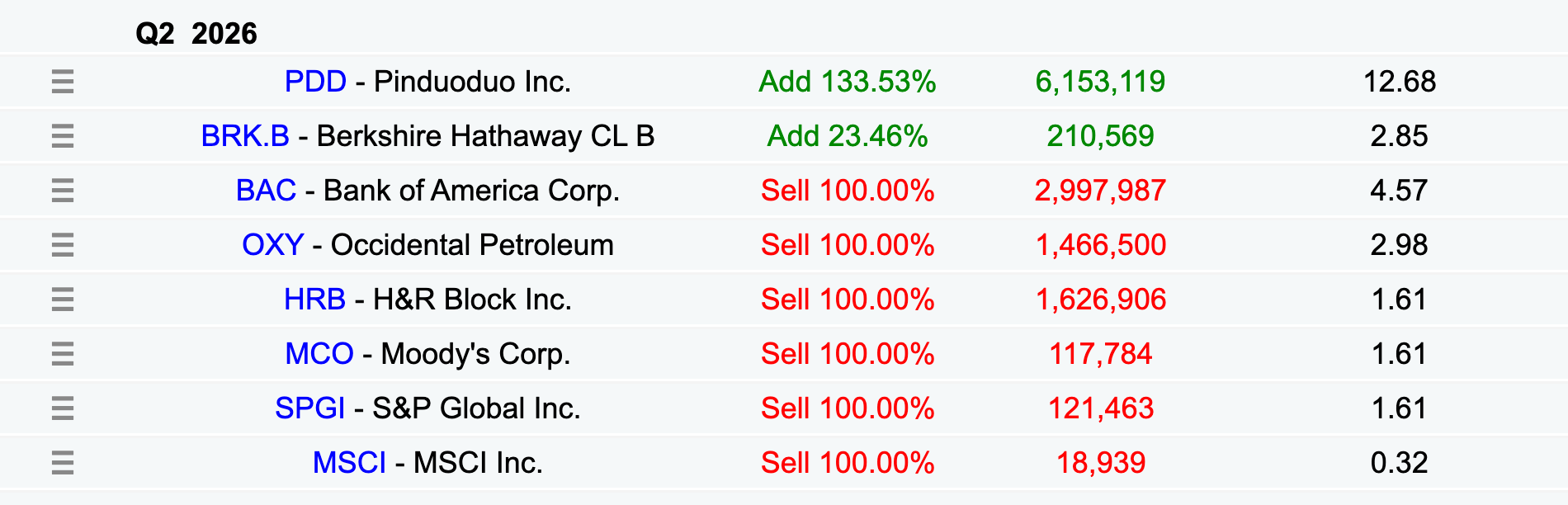
The names he exited were Bank of America, Moody’s, S&P Global, MSCI, Occidental, and H&R Block.
Read that list again. Three of those are exactly the compounders that show up in almost every “guru quality investor’s” portfolio, quarter after quarter, and he funded a doubling of a Chinese e-commerce position by selling them.
He now holds about 10.8 million ADS worth roughly $821 million, or 22% of his disclosed U.S. portfolio behind only Alphabet, which he holds across both share classes (close to 50% of the U.S. portfolio).
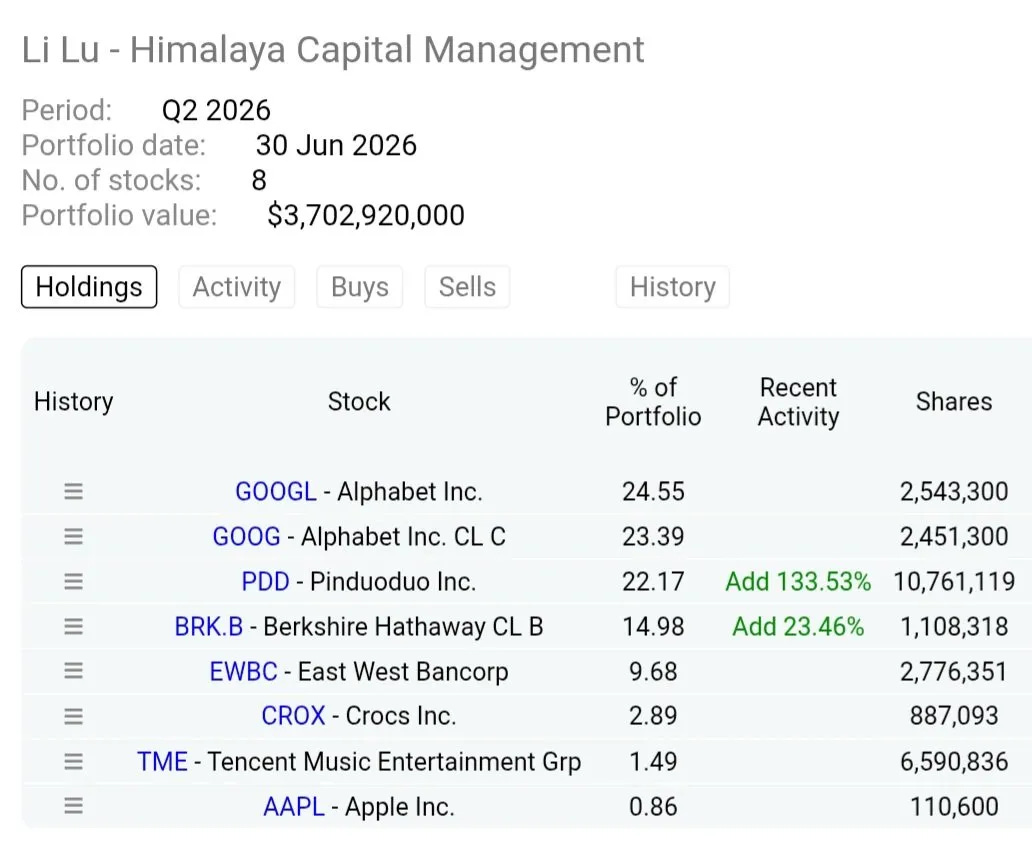
One caveat before you get too excited: a 13-F captures US-listed long positions and nothing else, and Himalaya has historically run a multiple of the $3.7 billion this filing shows, much of it in Asian markets that never appear in an SEC filing (his actual overall portfolio is estimated to be around $15-20 billion).
So this is a window into Li Lu’s bets, but not the whole book.
It’s still an incredibly interesting quarter for him. Li Lu is the investor Charlie Munger trusted with his family’s capital, and he has always been arguing that Chinese businesses get mispriced by Western investors who never do the work to understand them.
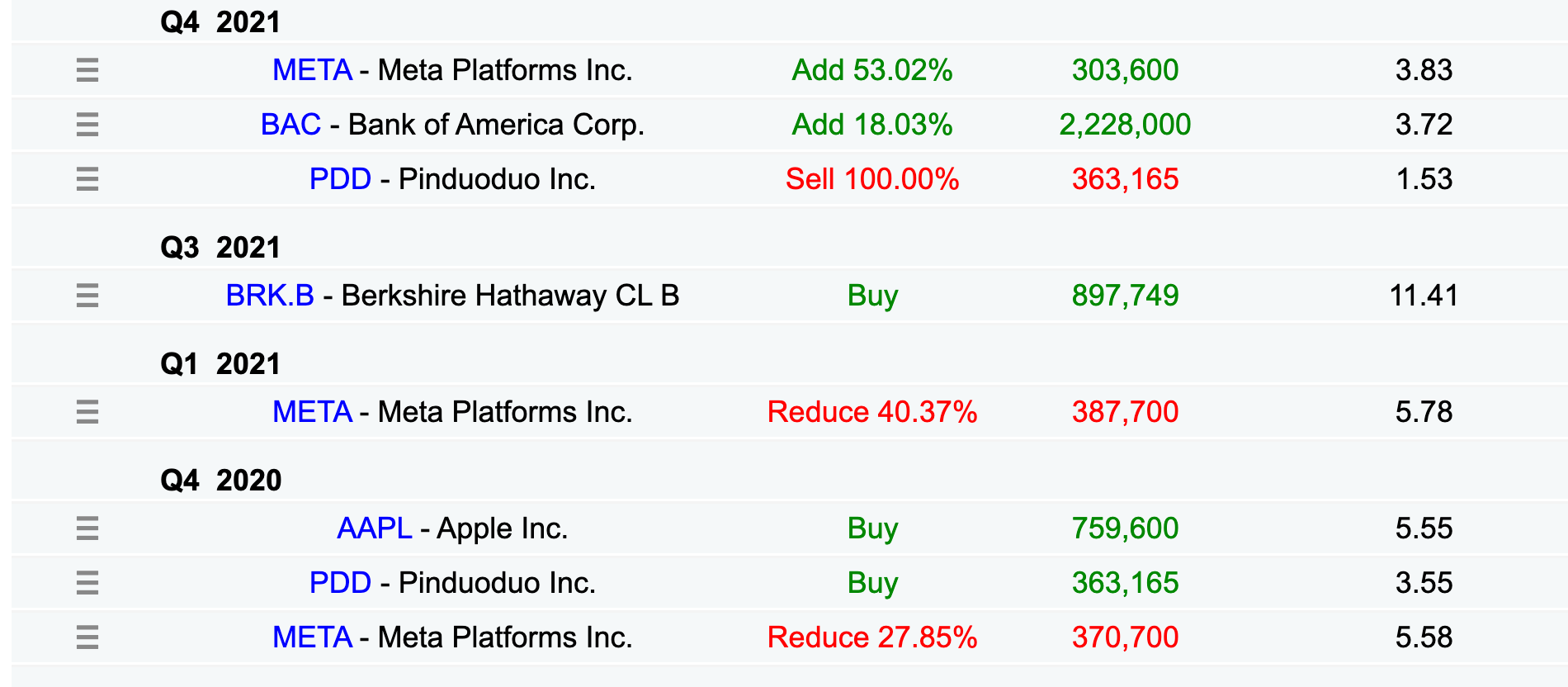
He has also owned this particular stock before. He first bought PDD in the fourth quarter of 2020, sold the position out completely in Q4 of 2021, and came back in the second quarter of 2025 (he’s still underwater on this purchase). And now he is doubling down.
And one more thing before we get to the business. Li Lu is not alone here! Duan Yongping's H&H International added 26.71% to its PDD position in the same quarter (and as I will highlight in my conclusion, this might even be the more relevant signal), and at roughly 25 million shares worth about $1.9 billion, his stake is more than twice the size of Li Lu's in dollar terms.
Norbert Lou's Punch Card Management has held it throughout, at over 12% of his book.

That's three concentrated value managers, all of whom trace their approach back to Buffett and Munger, sitting in the same unloved Chinese marketplace.
Interesting.
Duan may even be the most interesting of the three. He built Subor and then BBK, the electronics group behind OPPO and vivo, and in 2006 he became the first Chinese investor to win the Buffett charity lunch auction, paying $620,100 for it. He brought a 26-year-old along as his guest.
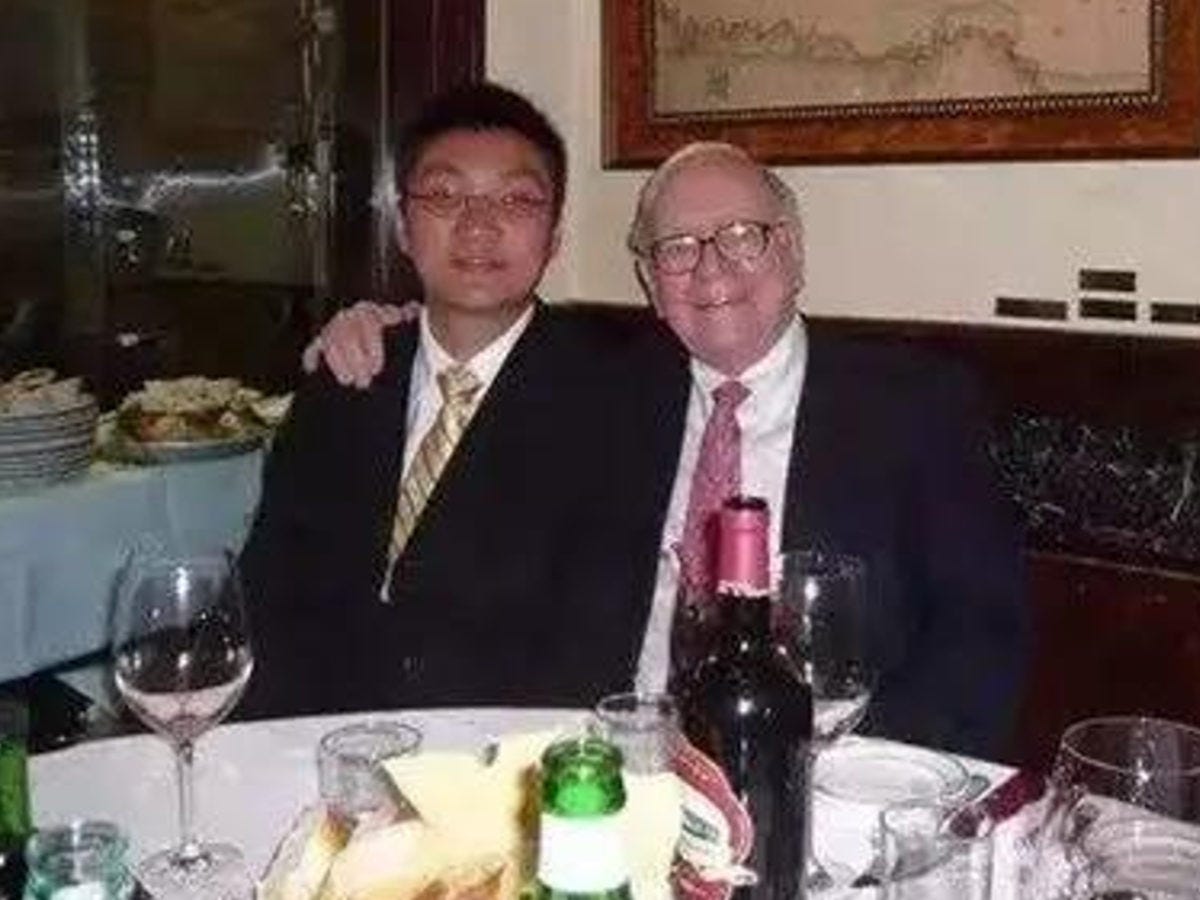
That guest was Colin Huang, who founded Pinduoduo nine years later and has since described Duan as the most important mentor of his life.
“Duan Yongping's philosophy in business and life is summed up in his saying, 'Fast is slow, slow is fast.' Doing things with a calm mind is better, but it's hard for most people to achieve that. Duan Yongping is a person who is always learning and progressing.“
“He also taught me common business sense—that prices will always fluctuate, but as long as you keep raising your value, the final price will be close to your value.” - Pinduoduo and Temu founder: my life lessons and reflections (Part 2 of 2)
Duan also backed the company early, on the condition that he would match whatever Huang put in himself. So when Duan adds to PDD, you're watching a mentor buy more of the business his protégé built, which cuts both ways. He may understand this company better than any outside investor alive. He is also about as far from a detached observer as it gets.
The superstar investors buying PDD are the ones who know the country, speak the language, and, in Duan's case, have personal history with the founder. The Western gurus have largely stayed away, and the coverage you read in English tends to treat the disclosure gaps (to be discussed below) as disqualifying rather than as a puzzle worth solving.
There are two potential readings of that: Either proximity is producing an informational edge that Western investors can't replicate (which strikes me as more likely), or it's producing familiarity bias in people who are too close to the story to price the risk properly.
Business Overview
Market Cap: ~$120 billion
Enterprise Value: ~$58 billion
Revenue: ~$64 billion
Sales 5Y CAGR: 42.5%
Employees: ~25,000
Year Founded: 2015

Colin Huang founded Pinduoduo in 2015, into what looked like a closed market (he later stepped down as CEO of Pinduoduo in 2020, handing the role to co-founder Chen Lei – Huang later resigned as chairman in March 2021 to pursue research in food and life sciences). Alibaba and JD had spent a decade building the Chinese internet’s shopping infrastructure and were generating hundreds of billions of dollars in combined merchandise volume.
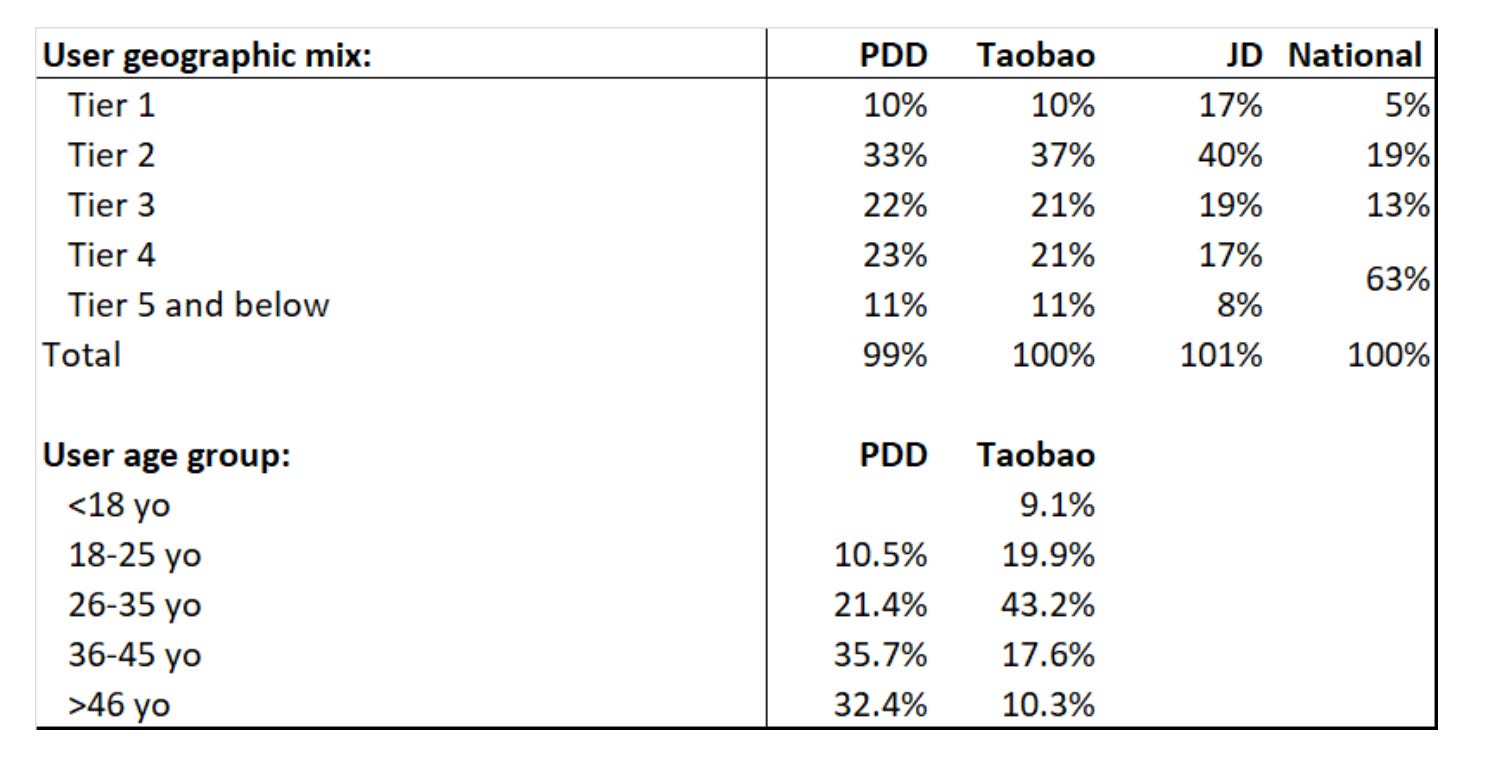
Huang’s insight was demographic rather than technological. WeChat was approaching a billion users while only around half of them had ever bought anything online, and the missing half lived in lower-tier cities and rural counties, shopped on tight budgets, and organized their social lives inside WeChat groups.
Alibaba’s penetration in some of those cities ran as low as 1%. So Pinduoduo went where the incumbents weren’t, opened in fruit and vegetables because they were cheap and bought often, and built a mechanic that turned every buyer into a distribution channel.
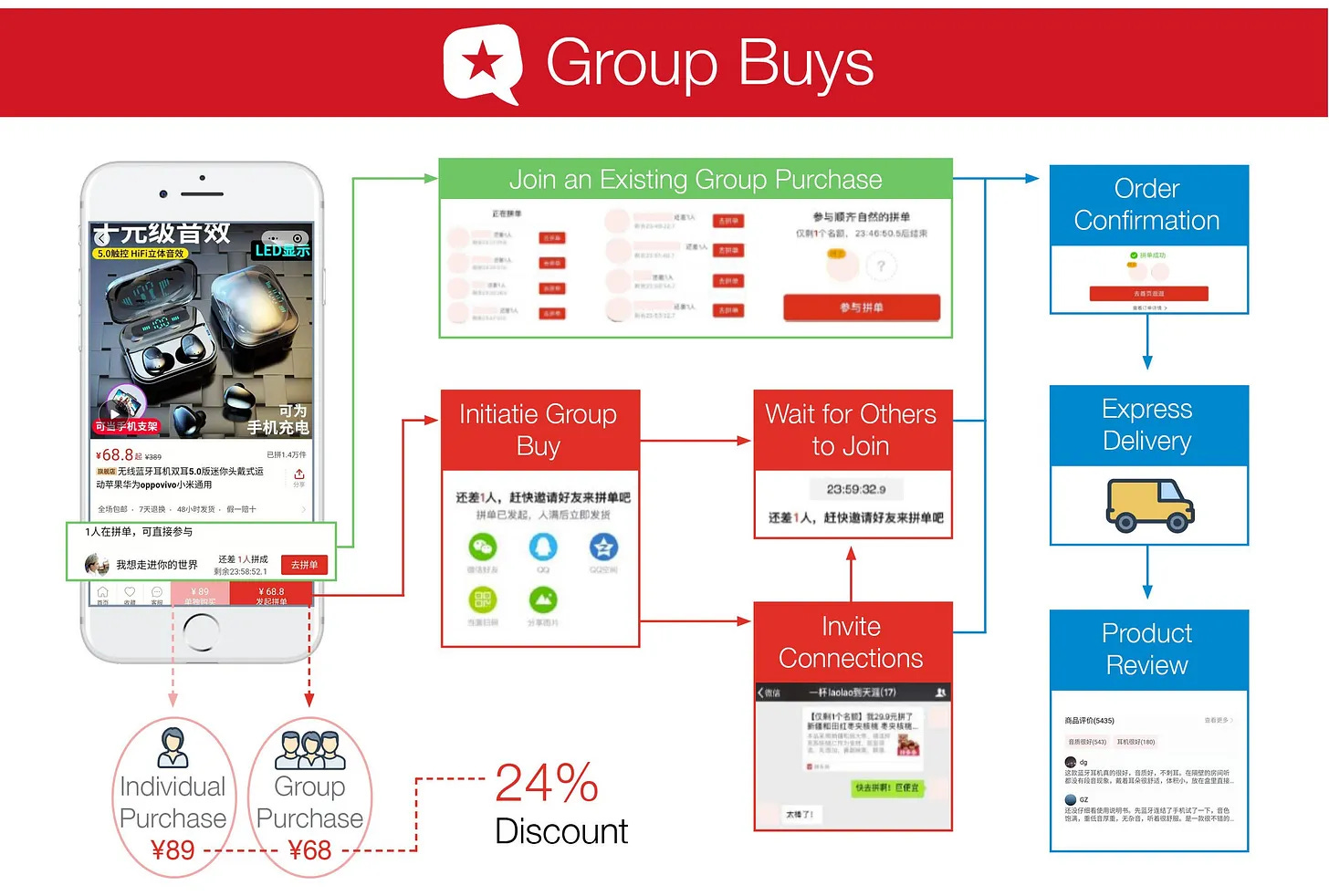
Team purchase gave each item two prices, one for buying alone and a lower one for buying as a group, with a 24-hour window to assemble that group. Users forwarded deals into family and neighborhood WeChat groups to hit the threshold. A recommendation from your cousin in a village chat carries weight that a banner ad never will, and in markets where most retail was informal and trust was scarce, that solved a problem Alibaba’s search box couldn’t.
It worked absurdly fast.
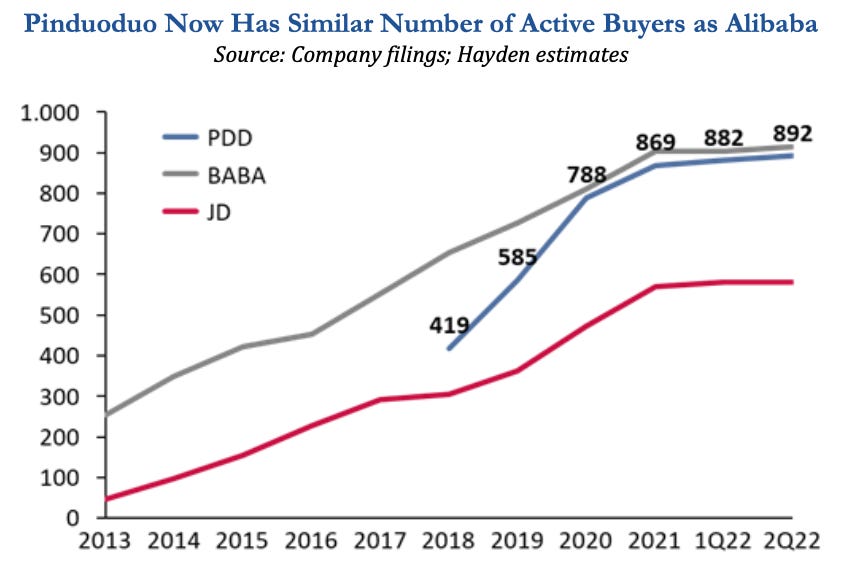
Alibaba needed roughly fifteen years to reach 500 million active buyers. Pinduoduo did it in four, and became the fastest company in history to cross a $100 billion market capitalization, growing GMV at a rate rarely seen before. Goldman Sachs estimates Temu's global Gross Merchandise Value (GMV) will exceed $100 billion in 2026.
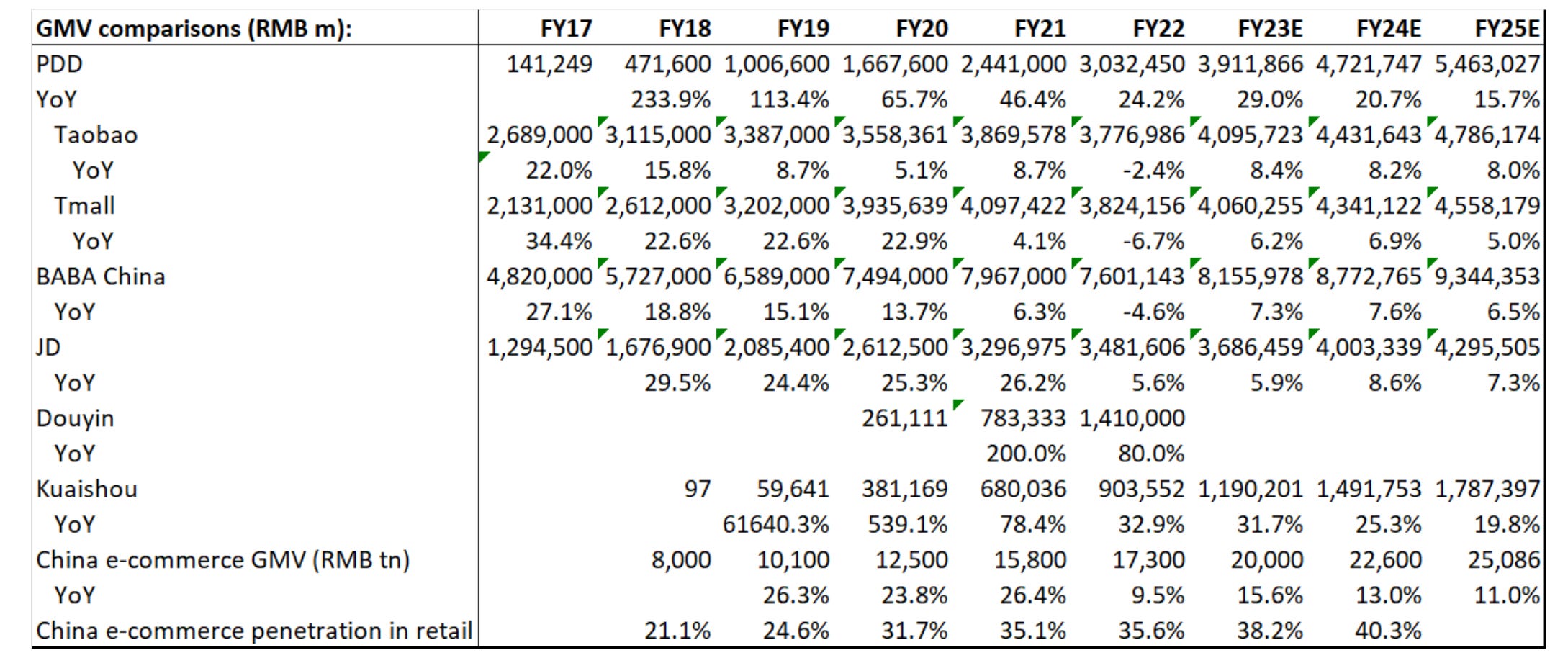
PDD went public in 2018, trading on the Nasdaq. A few years later, PDD turned profitable in 2021 and has been consistently profitable since.
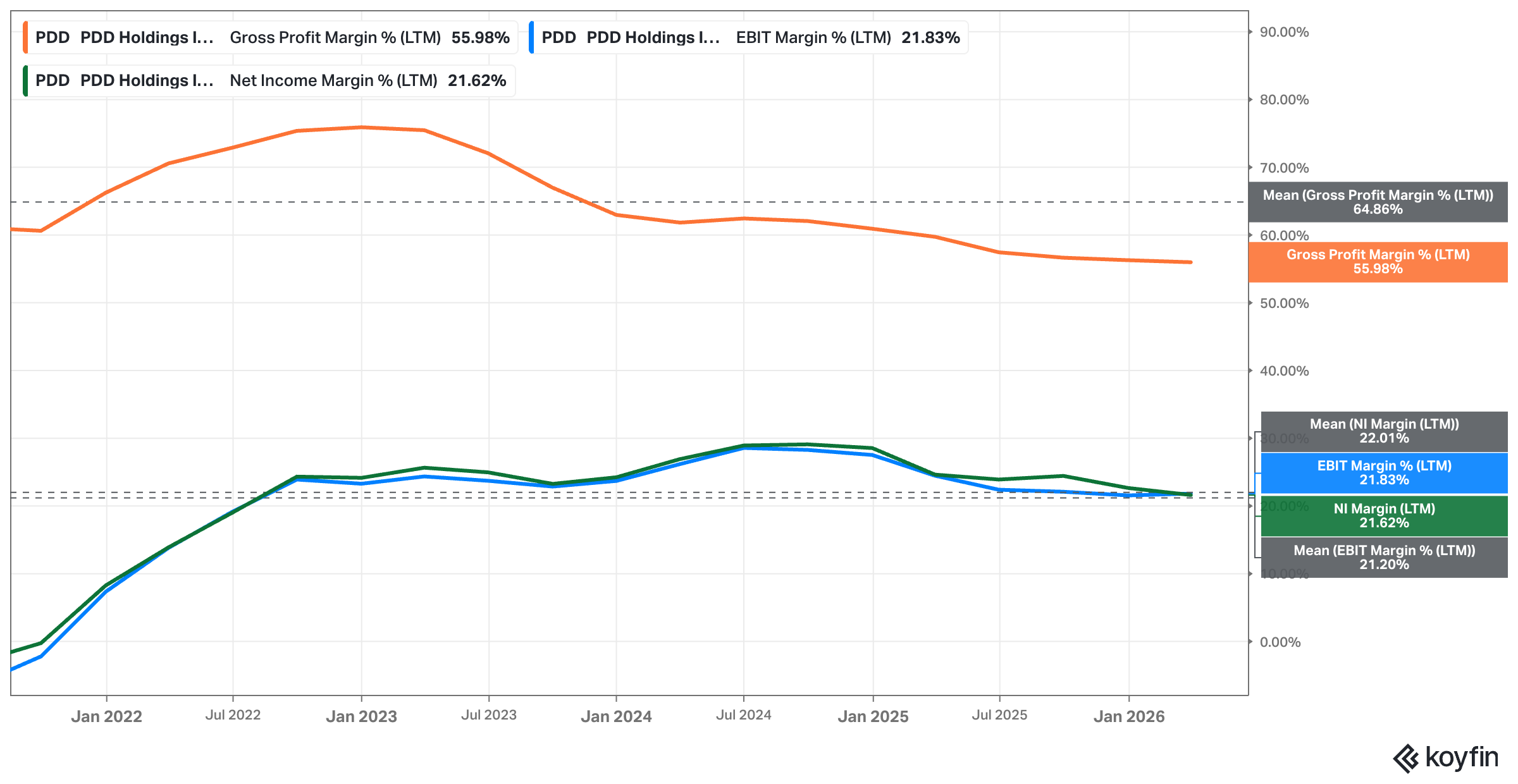
Today, three businesses sit inside PDD Holdings:
A) Pinduoduo Marketplace
The Pinduoduo marketplace is the profit engine, and as most of my readers are domiciled in the “West,” please note that it works nothing like a Western e-commerce site.
There is no meaningful search function driving traffic; PDD deliberately buried search and pushed an algorithmic feed to the top, so users browse without intent the way you’d wander a mall. There is no persistent shopping cart, which sounds like an oversight and is a design choice, since one item per order plus a countdown timer converts impulse into checkout before hesitation arrives.
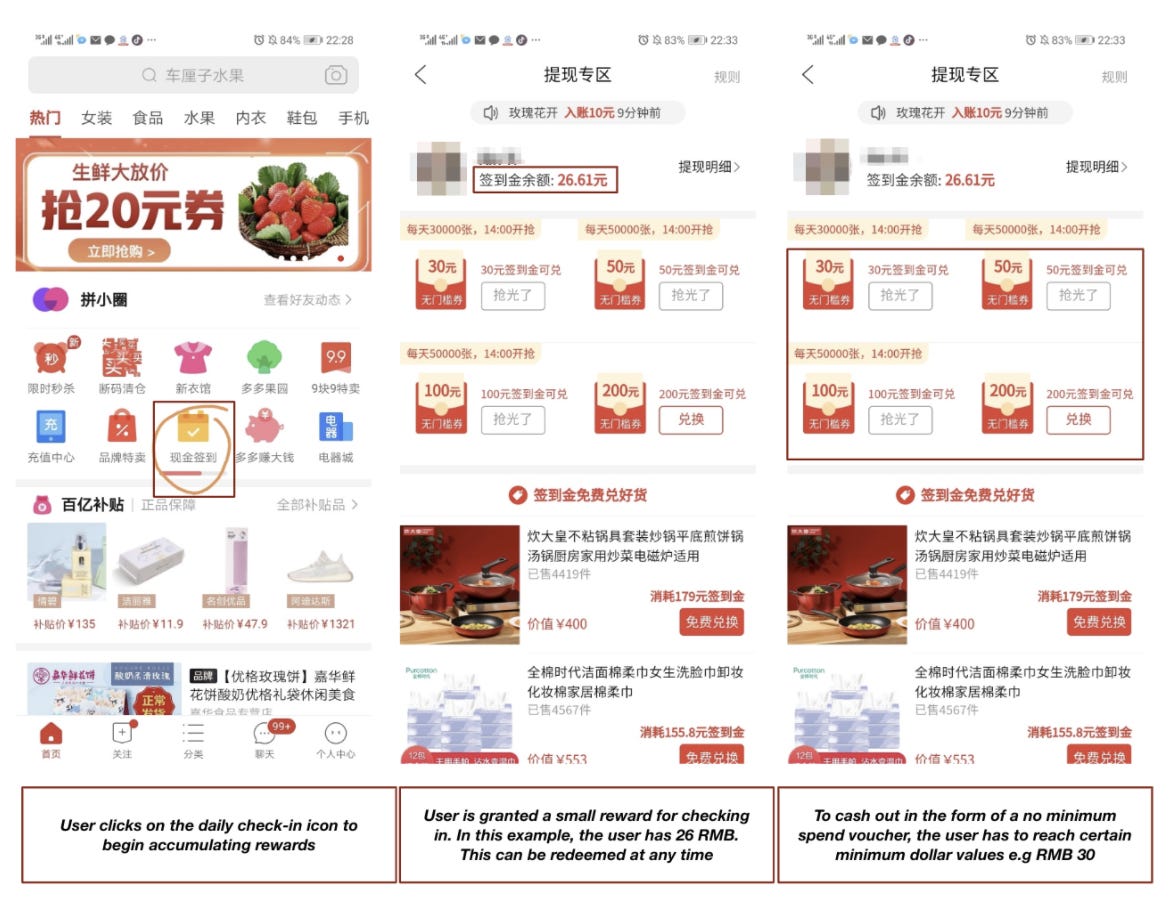
Around that sits a layer of gamification that would look ridiculous on Amazon and prints engagement here: daily check-ins that accumulate redeemable credit, a price-chopping feature where sharing a link with enough friends brings an item to zero, loyalty and brand cards, and Duo Duo Orchard, a farming game that ships you an actual box of fruit when your virtual tree matures.
Yes, you read that right. In theory, Pinduoduo’s infamous Kan Yidao ("Bargain for Free") feature allowed users to receive products shipped straight to their doorstep for absolutely zero yuan, provided they could convince enough friends to click a shared link and chop the price down to zero within 24 hours.
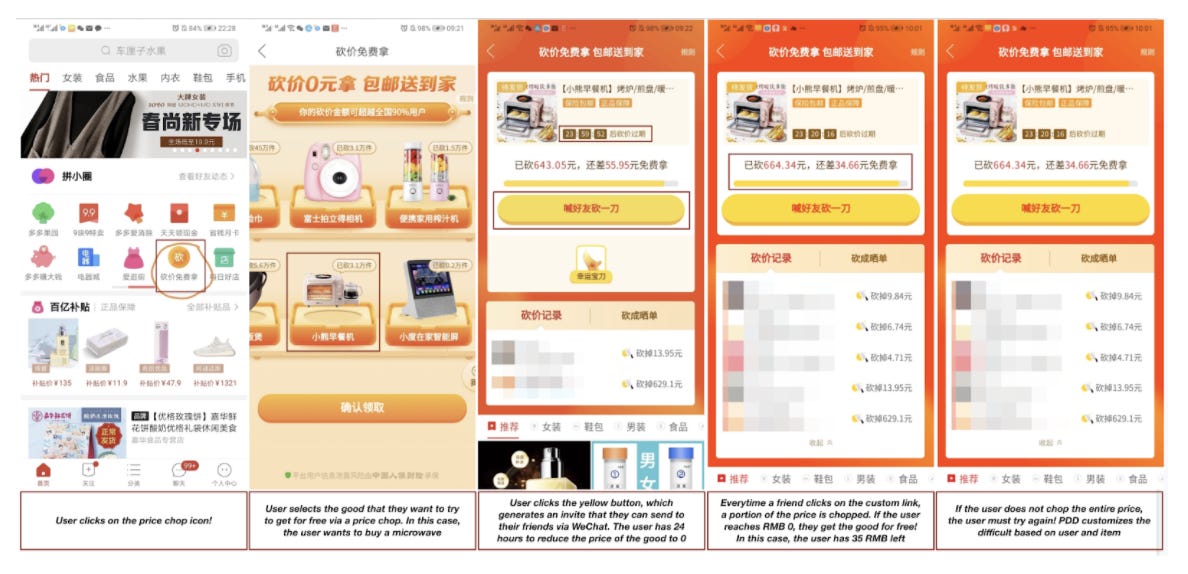
In practice, however, it was a hyper-engineered growth hack designed to turn users into unpaid viral marketing agents. The algorithm initially slashed up to 99% of an item's cost in just a few taps to create an irresistible rush of progress, only to stall as users neared the finish line by shrinking subsequent discounts down to microscopic fractions of a cent.
“PDD’s unique business model design from Day One makes it difficult for Taobao or other competitors to emulate. There are two virtuous cycles, for both the consumer and the manufacturer:
On the consumer side, it’s the unique combination of social commerce, algorithm-feeds & gamification. This promote browsing habit, aggregates demand quickly, and creates social graph data. The high frequency that users purchase on the platform and average daily user time at 20 mins show that users are highly engaged on the platform.” 2025 PDD VIC writeup
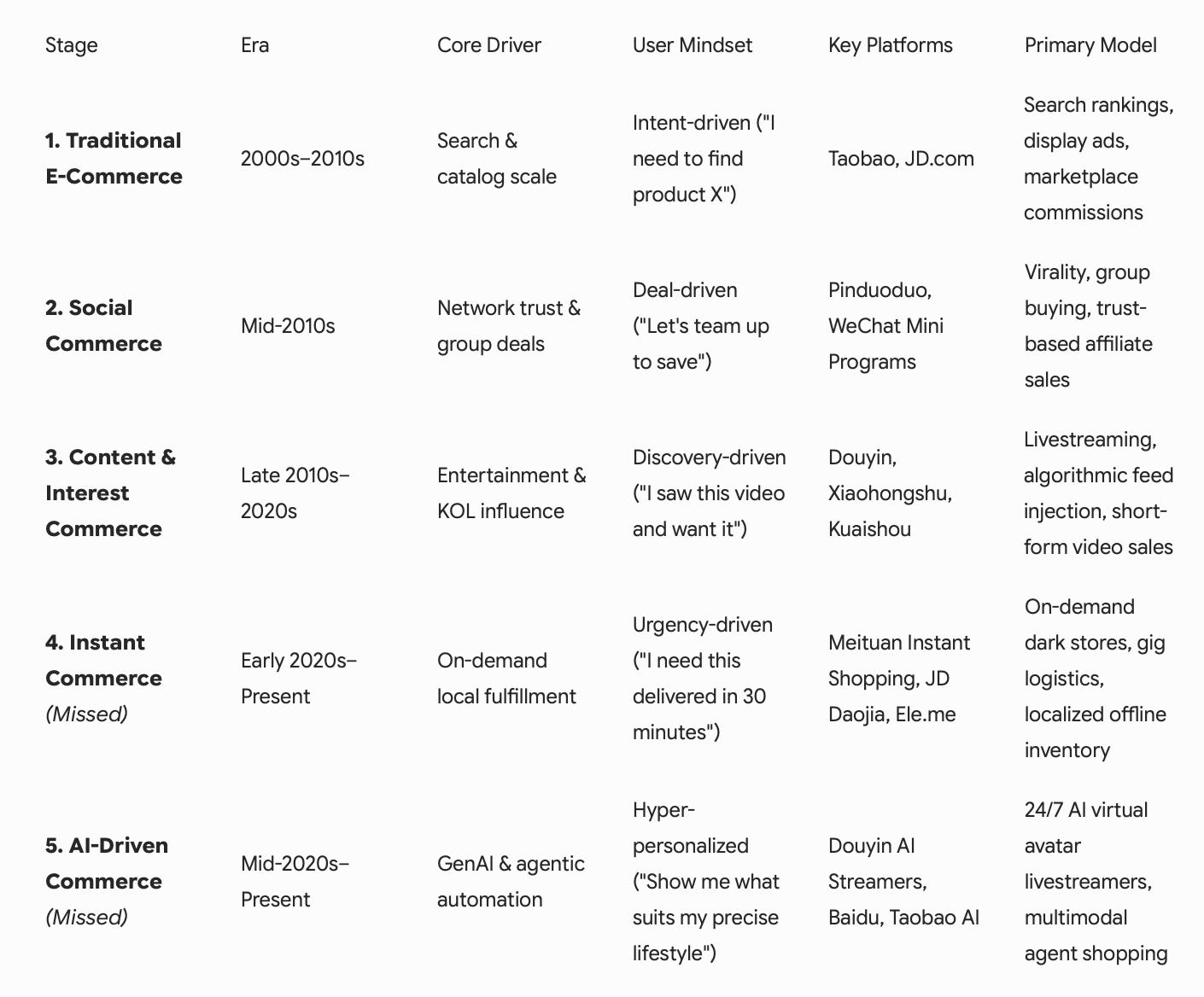
As the excerpt from the VIC analysis above jsut brought up the term “social commerce,” I figured it’s worth pausing for a second and understanding how commerce changed in China over the years, from traditional e-commerce (as most people in the West still know it) to social commerce, content commerce (more on this below) and potentially AI-driven commerce next.
If you compare the Pinduoduo experience again to your Amazon user experience, the two couldn’t be more different. Amazon is a utilitarian warehouse search engine where efficiency is king, whereas Pinduoduo functions like a high-dopamine digital night market where social pressure, gamification, and bargain hunting turn shopping into a multiplayer arcade game.
Again, open Amazon and you are executing a task. You search, you compare, you add to cart, you come back later and check out. Pinduoduo is built to prevent exactly that sequence. There is no persistent shopping cart, which reads as an omission until you understand the intent: one item per order, a countdown clock, a limited-time coupon, and the purchase completes before hesitation gets a chance to intervene. Cart abandonment is a problem PDD solved by not having a cart.
Around that sits a layer of mechanics that would look absurd on a Western retail site:
Daily check-ins that pay you a few fractions of a yuan for opening the app, accumulating toward a voucher you can only claim above a threshold.
The discussed price chop, where a countdown starts and every friend who clicks your link cuts the price further, with each additional referral worth less than the last, so the difficulty scales the way levels do in a video game.
Loyalty cards earned by leaving reviews.
And Duo Duo Orchard, where you water a virtual tree until it fruits and PDD ships an actual box of produce to your door. That last one alone had more than 11 million daily users at one point.
None of it looks like commerce. All of it exists because time spent converts, and a user who opens the app out of habit is a user who buys without intending to.
The supply side is the other half, and the mechanism is more specific than “just” cutting out the middleman. Selling on Taobao is a craft. You need a storefront, product photography, keyword bidding, search optimization, and increasingly livestream operations, which is why a layer of professional resellers grew up between China's industrial belts and the customer.
Those merchants run the shop and source from OEMs in the villages. What PDD's feed did was make the craft unnecessary. Traffic gets allocated algorithmically to individual products rather than earned by merchandising a store, so a factory with no e-commerce competence can put a single item in front of millions of buyers immediately, roughly the way TikTok lets an unknown creator find an audience without first building a following. That is what pulled manufacturers onto the platform rather than their distributors, and once they were there the volume did the rest: enough aggregated demand on one item to justify a dedicated production run, at a price no distributor could match.
“On the supply side, it’s the focus on OEM factories, C2M, high frequency product categories and high operating leverage. This allows it to offer extremely low prices, fast product iteration and diversity in product offerings. This is similar to Shein’s powerful supply chain moat which uses a “small order quick response” system, where more than 2,000 designs from suppliers are launched every day, providing an enormous A-B testing, followed by sharing the data with suppliers through a linked IT system with the supplier’s backend.
As a result, the price savings to consumers go to the extent that if a product sells for RMB 29 on Taobao, it can be sold at RMB 9.9 on PDD. The cost savings go even further when compared to international e-commerce. A closely similar organizer bag can retail for 44 Euros on Amazon, 27 Euros on Shein, 20 Euros on Temu and only 3 Euros on PDD main app.” - 2025 PDD VIC writeup
PDD has never disclosed a factory or supplier count for Pinduoduo, and the merchant base it last quantified itself stood above eleven million as of 2021, with third-party estimates now in the mid-teens of millions. The formal C2M program is a much smaller thing than the marketplace around it, running in the low thousands of enrolled manufacturers against a stated ambition of ten thousand.
C2M stands for consumer-to-manufacturer model. PDD aggregates enough demand on a single item to guarantee a factory a production run, and in exchange gets a price no distributor could match. The factory fills idle capacity, sells volume with the order already committed, and receives demand data telling it what to make next. Product development cycles reportedly halved in some categories. Alibaba, JD and NetEase all tried versions of this and all of them stayed small. The reason is structural. Their programs ran top-down, curating a short list of large contract manufacturers who already served multinational brands, which meant limited spare capacity, misaligned incentives, and no scale on either side. JD’s group deals came out 10 to 20% below its individual prices, while PDD’s ran closer to 50%. I’ve read about a cosmetics factory that is earning roughly 26% EBIT margins selling on PDD, against about 1% in its OEM business, which is both the reason merchants show up and the reason there has historically been headroom for PDD to charge more.
B) Duoduo Grocery
Then there’s Duoduo Grocery, launched in 2020, which became the largest agricultural platform in China on roughly RMB 27 billion of capital expenditure (roughly $4 billion) and outlasted every competitor that entered the community group-buying war, with Alibaba, JD, Meituan and Didi all retreating or shutting the bulk of their operations.
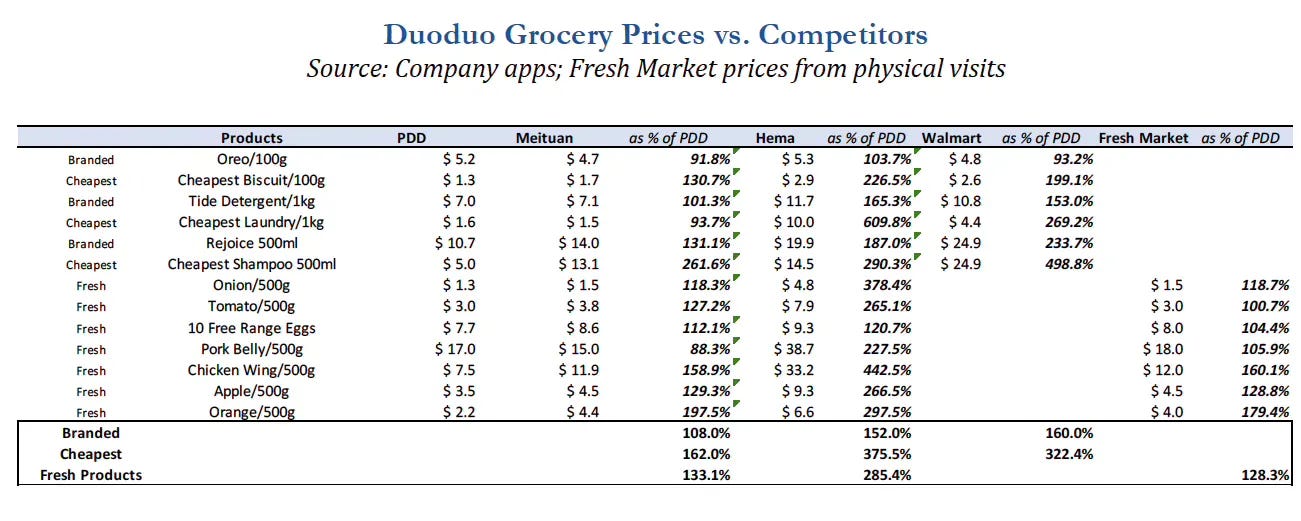
Duoduo Grocery maybe deserves more explanation than it usually gets, because the mechanics are quite unique too. Orders are aggregated through community group buying: a local leader gathers demand from a neighborhood chat group, PDD consolidates it, and everything arrives next day at a single pickup point where buyers collect it themselves.
Anyone who has looked closely at parcel economics knows that last-mile delivery is where the money goes, which is why I spent so long on the pickup-locker model when I wrote about InPost. I did not expect some insights form that analysis to Pinduoduo. But here I am.
“InPost’s automated parcel machine (APM) infrastructure dramatically reduces last-mile costs (remember, 20-30%), increases delivery density, and shifts the consumer experience toward convenience and self-service.“ - from my InPost deep dive
Take the individual doorstep out of the equation and consolidate a hundred orders into one drop, and you change the cost structure fundamentally.
PDD then layered a couple of more things on top:
Procurement runs through an algorithmic daily bidding system rather than human buyers, with suppliers competing on price and fulfillment capacity for each SKU.
And the assortment stays deliberately narrow, in the range of a thousand to fifteen hundred items against Costco's four thousand and Walmart China's hundred thousand plus, which concentrates volume and improves terms. Again, PDD does not disclose the number of SKUs (they don’t disclose anything really, which can be quite frustrating). But the credible estimates I’ve come across are all rather narrow.
Moreover, auppliers get paid the next day, against an industry norm of three to six months.
That combination built the largest agricultural platform in China on roughly RMB 27 billion of capital expenditure and left Alibaba, JD, Meituan and Didi retreating from the category with heavy losses.
C) Temu
And Temu, launched in September 2022, which took the same factory-direct playbook cross-border and now operates in what management describes as nearly 100 markets.
“Over the past few years, our global business has indeed achieved some progress, now serving nearly 100 markets and achieving meaningful scale.“ - Q4 Call
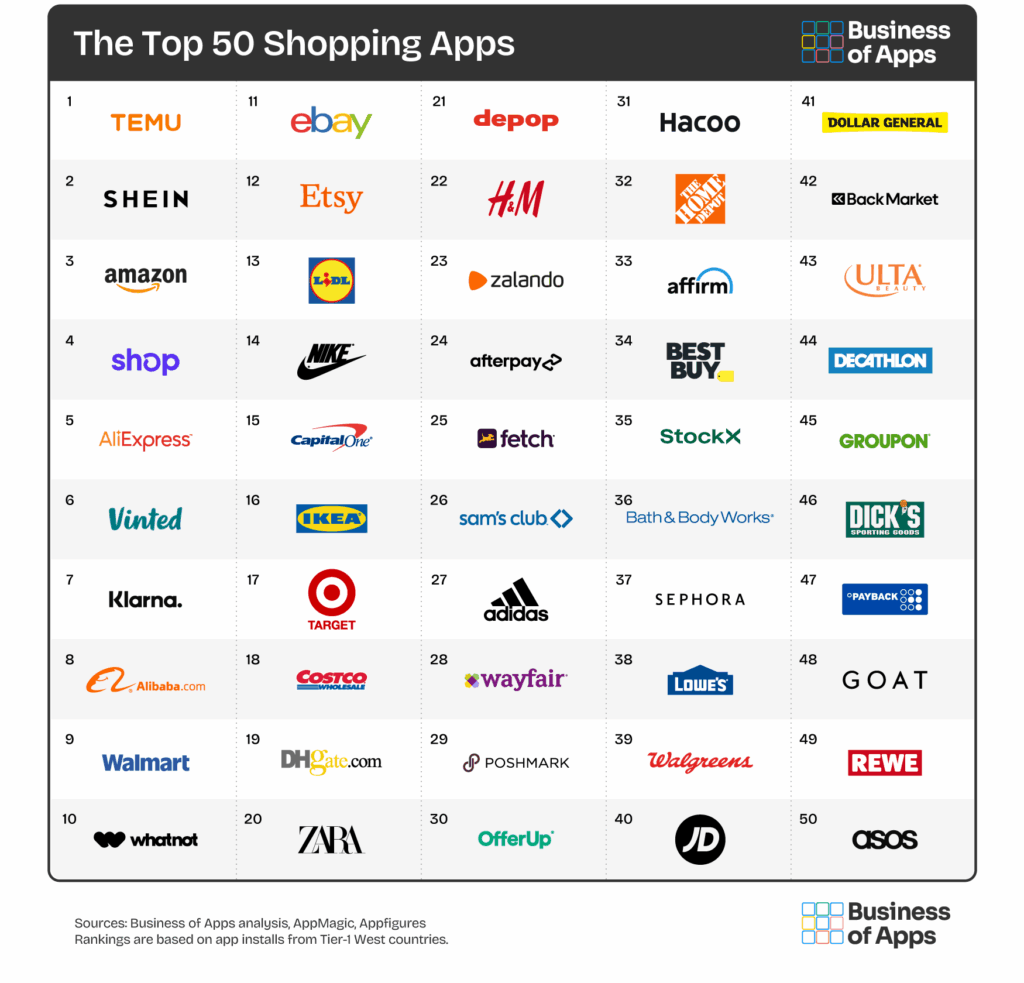
Temu became the most downloaded shopping app in the world within two years.
The recipe had four ingredients:
First, the same factory-direct sourcing that powers the domestic app, which meant Temu could list goods 25 to 50% below Amazon and still leave merchants better off, because a seller marking up 200% on Amazon to cover its roughly 28% fulfillment take, 12% commission, and 12% advertising load only needs about 50% on Temu.
Second, the gamified mechanics lifted wholesale from Pinduoduo, spinning wheels and countdown offers and referral discounts.
Third, advertising at a scale nobody in commerce had attempted from a standing start, including Super Bowl spots in both 2023 and 2024 (the 2024 “Shop Like a Billionare” tagline is a genius marketing idea).
And fourth, a category pivot that turned out to matter more than any of it. Temu started where Shein shines, in women's apparel, then moved into standardized household and personal care goods and consumer electronics accessories, which doubled the average order from roughly $20 to $40 and brought in male buyers. Bigger baskets fix cross-border unit economics in a way that discounting never can.
By 2025, the app had passed 400 million monthly active users and, by one estimate, roughly 24% of global cross-border e-commerce, which would put it within a point or two of Amazon in that specific segment.
Then Washington took the ladder away. The de minimis exemption that let sub-$800 parcels enter the United States duty-free was the structural condition Temu's original model assumed, and its removal in 2025 hit immediately. Reported US daily active users fell around 48% between March and May of that year. Temu pulled its Google Shopping advertising in April, and its App Store ranking dropped from third to fifty-eighth inside three days. That is about as violent a demand shock as a consumer platform can absorb, and it explains why so many investors wrote Temu off as a regulatory arbitrage that had run its course.
What happened next is worth paying attention to, though, because Europe is now carrying the business. By the third quarter of 2025, Europe had overtaken North America as Temu's largest revenue source, with the company running tens of thousands of ads across Meta's platforms there against almost none in the United States. Fulfillment moved with it. Temu has been building continental warehousing with the stated aim of serving the large majority of European orders locally, alongside a semi-managed model that lets sellers hold inventory in-market rather than shipping each parcel from Guangdong.
“Goldman Sachs has released a new report expressing optimism that Pinduoduo is entering a new growth phase. The report’s core thesis is that its cross-border e-commerce platform Temu has completed its transition to a “local-to-local” model in the US and Europe, with a profit inflection point (EBIT turning positive to 3.2 billion yuan) expected in 2027. Concurrently, growth in domestic transaction service revenue is accelerating. Coupled with the company’s launch of the “Xin Pin Mu” trillion-yuan (~$145 billion) investment plan to deepen its supply chain, these factors collectively drive growth.“ - BigGo
However, Europe then set its own de minimis change for July 2026, removing the €150 threshold, yet the early evidence is that demand kept climbing into it. Transaction data through May of this year showed European growth accelerating past 60%, with France near double that.
If that holds, it tells you something important: the loophole was an accelerant rather than the entire engine, and the factory-direct cost advantage survives duties that the original design was built to avoid.
Weigh that against what Europe is charging for the privilege. The Commission found Temu in preliminary breach of the Digital Services Act in July 2025, consumer testing found the overwhelming majority of sampled toys failing EU safety rules, and the €200 million fine landed in May.
This is where it gets interesting!
Become a paying subscriber to read the rest of this post and get access to all of my other research, including valuation spreadsheets, deep dives (e.g. well-known mid- and large caps such as LVMH, Duolingo, Meta, Edenred as well as more hidden gems such as Digital Ocean, Ashtead Technologies, InPost, Timee, and MANY more), and powerful investing frameworks.
As a member, you get:
Complete Access: Every deep dive in our library (65+ and counting). The most thorough analyses you will be able to get your hands on (including downloadable models).
Access to my 150+ Global Watchlist: And How To Use It to Outperform the Market!
Slide Decks: Every deep dive now comes with a companion slide deck. It’s the whole argument in compressed form – the hypothesis, the business, the competitive position, the valuation, and the case against – for the days when you don’t have an hour to spare but still want the shape of the thing. Paid subscribers get both, the long piece and the deck.
The WhatsApp Community: Real-time discussion and networking with like-minded investors.
Digital Investing Conferences: Around three times a year, we also hold digital conferences where members present and share stock ideas, and discuss broader themes, and we’d love for you to join in!
Incredible Value: Full access to all of this for less than €1/day.