

Every quarter, the 13-F filings drop, and every quarter the same names march across everyone’s screens. Mastercard. Visa. Moody’s. Amazon. Alphabet. ASML. TSMC.
Boring!
I get why. They’re wonderful businesses, and half the quality-investing world owns them, so seeing them show up in yet another fund’s holdings tells you approximately … nothing.
Nothing you didn’t already know.
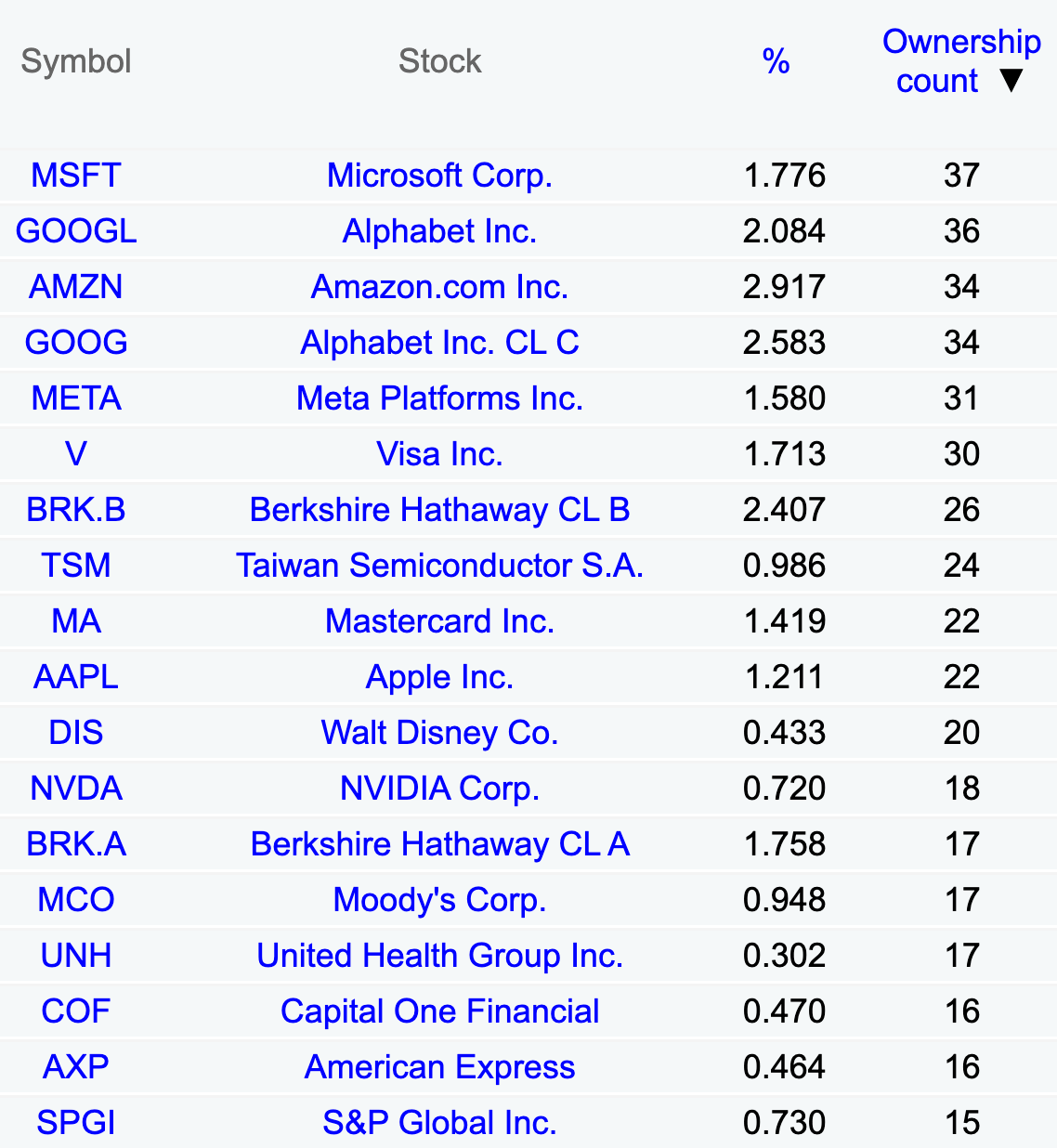
Scrolling through the latest batch for Q2 2026, I found myself skipping past all of it, looking for the names that made me stop and think …
“Wait! What is that doing in there?” or “Wait! I have never heard of THIS company!“
So that’s what this series is about. I went digging through the latest 13-F filings for the ideas that felt genuinely unorthodox, the ones tucked into portfolios where they don’t obviously belong, or sized in a way that tells you the manager actually means it.
Not the consensus quality darlings guru investor added 2% too. No. The odd ones (probably the stock we cover today fits that profile). Maybe the truly hated ones (the second idea I will present fits into this category). Or the underfollowed ones. The stocks I’d actually want to pull the thread on and possibly move high up my own watchlist for a proper deep dive. I’m going to release them one at a time, one idea per post, so each gets a bit of room to breathe.
A quick note on format before we start. I’m keeping these deliberately light, more of a rapid-fire pitch than a full 20,000-word teardown: a brief description of the business, a look at what’s beating the stock down at the moment, and a high-level hypothesis for why it might be interesting from here.
That’s the idea, anyway…
In practice, I blew past my own word count goal on the very first one, and I did on the second one too, so take “quick pitch” as an aspiration rather than a promise.
Let’s get into it.
Disclaimer: As of the date of publication, the author owns no shares in the company discussed; but that may change. The analysis presented in this blog may be flawed and/or critical information may have been overlooked. The content provided should be considered an educational resource and should not be construed as individualized investment advice, nor as a recommendation to buy or sell specific securities. I may own some of the securities discussed. The stocks, funds, and assets discussed are examples only and may not be appropriate for your individual circumstances. It is the responsibility of the reader to do their own due diligence before investing in any index fund, ETF, asset, or stock mentioned or before making any sell decisions. Also double-check if the comments made are accurate. You should always consult with a financial advisor before purchasing a specific stock and making decisions regarding your portfolio.
Ashland: The Stock Alex Roepers Sold and Then Bought Back at 17% of His Book
Alex Roepers runs Atlantic Investment Management, and he is one of the investors I follow somewhat closely while accepting that I will never clone him.
Why? He trades too much. Positions come and go inside of two or three quarters, which makes his 13-F a poor “shopping” list and an excellent idea generation list.
You can borrow ideas, but you cannot borrow conviction.
What I like about him is that his book looks nothing like everyone else’s. Twelve names, AUM of about $192 million, mid-cap industrials and materials that most “quality investors” have never looked into. No Visa. No ASML. No Meta. Nothing you have already read four hundred million X posts about.
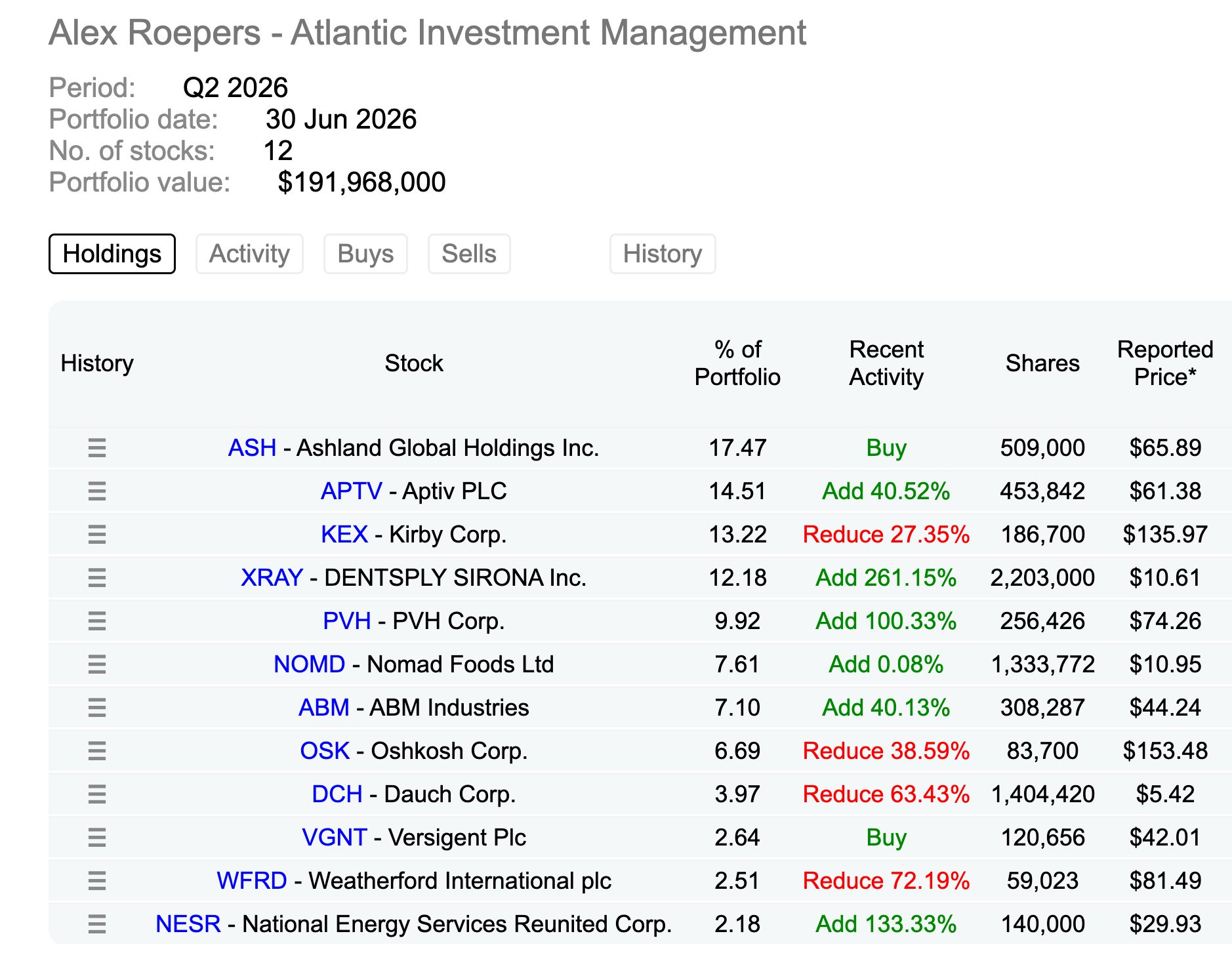
His largest position as of June 30 is Ashland, 509,000 shares marked at $65.89, worth $33.5 million and 17.47 percent of the portfolio. It shows up as a new buy.
I never heard of that company.
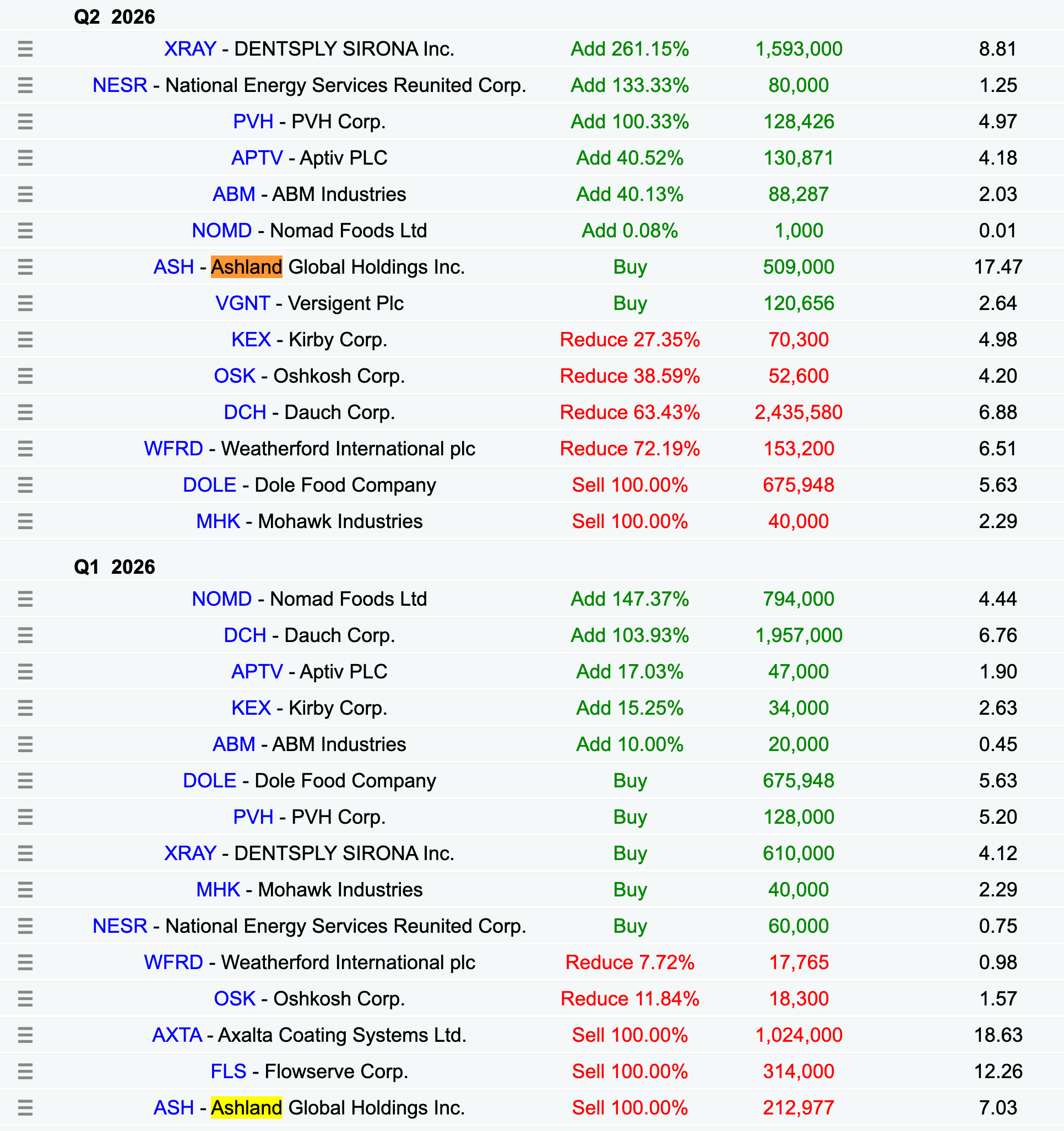
That last detail – the size of the bet and the fact that it’s a new position – is the one that made me stop scrolling, because when I dug deeper, I noticed Roepers has owned this company on and off since at least 2012, when he held over two million shares, and the filings also suggest he was out of it entirely three months earlier. He sold it in Q1, trimmed it in prior quarters, then watched it apparently, and came back at the largest weight in the fund.
That is a different signal than a new idea weighted at 2%. It also signals that he knows the company very well.
Business Overview
Market Cap: ~$3.4 billion
Enterprise Value: ~$4.4 billion
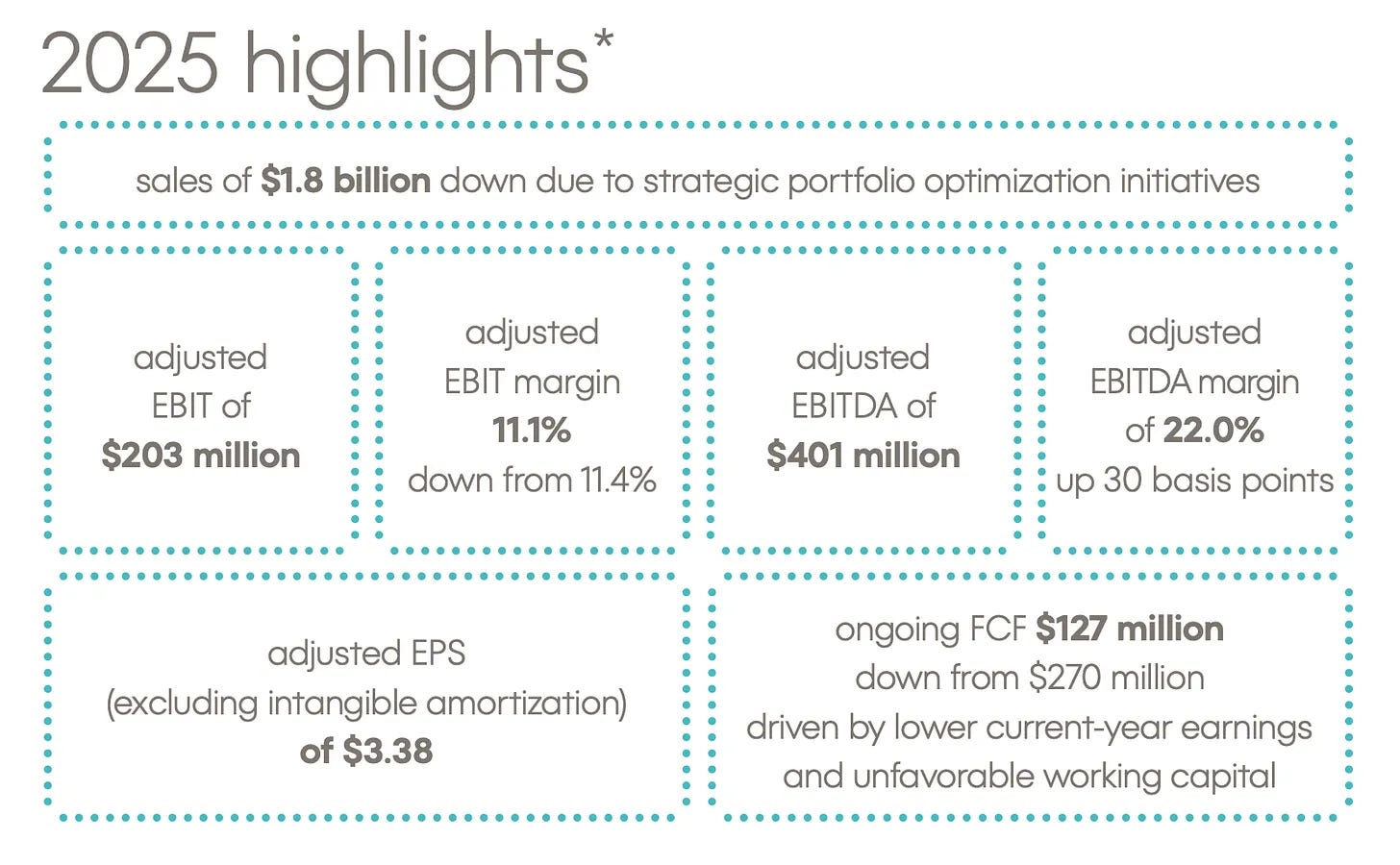
Revenue FY25: ~$1.8 billion
Sales 5Y CAGR: 0.25%
Employees: 2,900
Year Founded: 1924

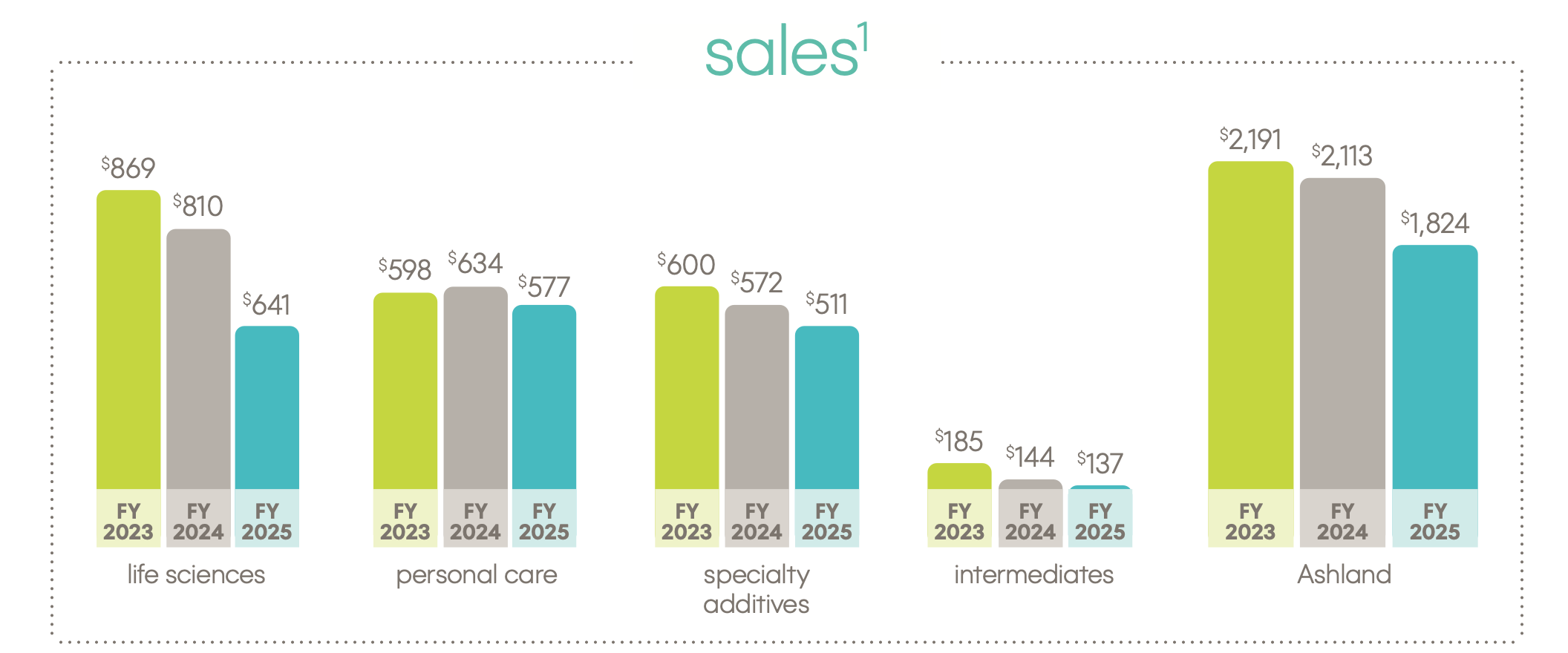
Ashland makes the ingredients that make other people’s products work. Roughly $1.85 billion of sales, 2,900 employees, and customers in more than a hundred countries.
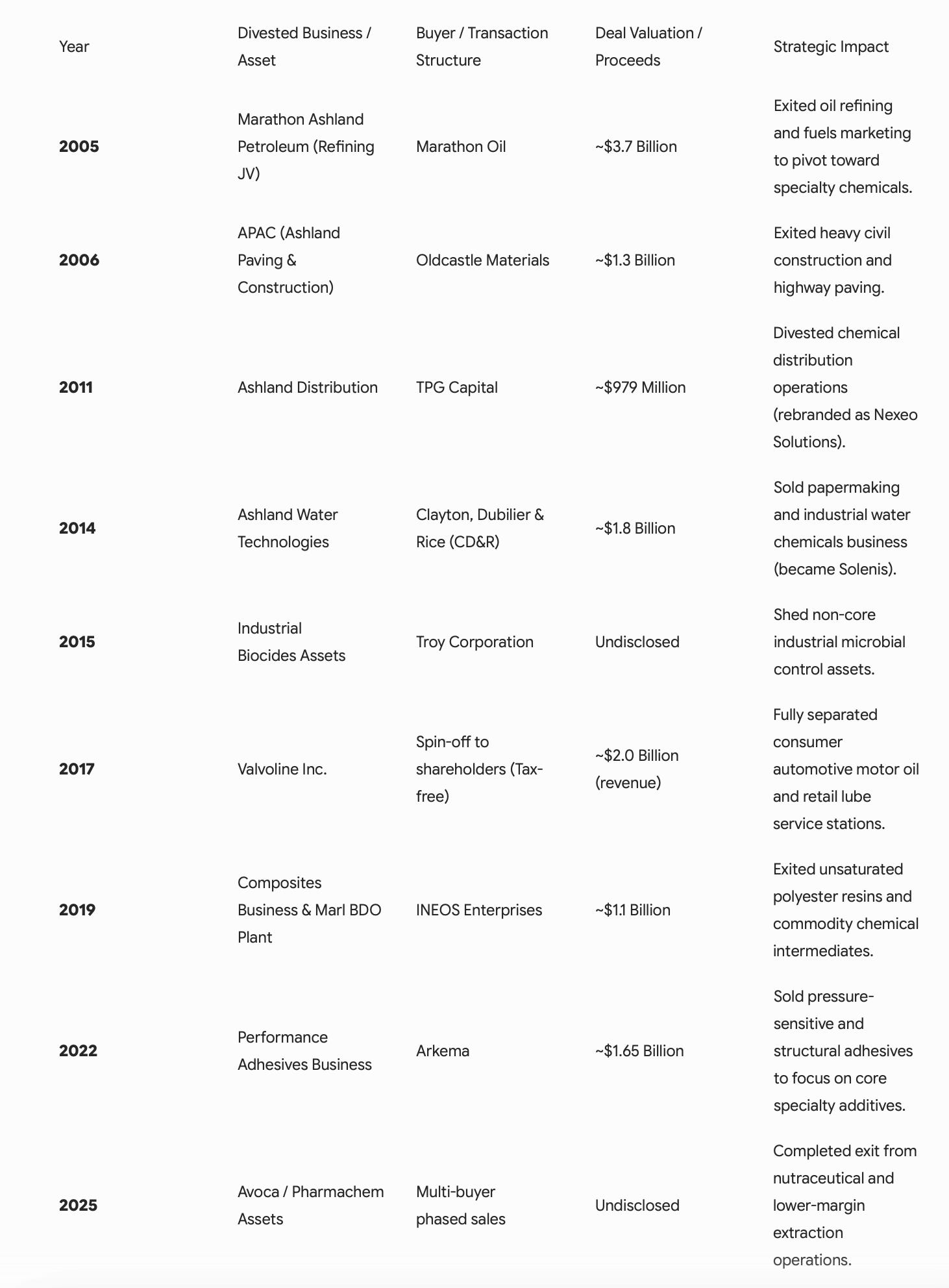
A portfolio that has been cut down from a $9 billion conglomerate over fifteen years of divestitures. Valvoline went. Composites went. Adhesives went.
What remains is four segments. And two of them primarily carry the company.
Life Sciences
Life Sciences may be the best of the segments. The core of it is pharmaceutical excipients, the inactive ingredients that surround an active molecule and determine how it behaves once you swallow it (binders, disintegrants, coatings, and controlled-release polymers).
It is powder held together by a binder, usually Klucel hydroxypropyl cellulose in Ashland's case, so that it survives compression and shipping without crumbling in the bottle. If the tablet is supposed to act quickly, a painkiller or an antihistamine, it contains a superdisintegrant like Polyplasdone crospovidone, which swells on contact with water and breaks the tablet apart in seconds so the drug can dissolve. If it is supposed to act slowly, a twelve-hour metformin or an extended-release pain medication, it contains Benecel hypromellose, which forms a gel layer on the tablet surface and erodes at a controlled rate over the course of the day. The colored shell is a film coating system, sold fully formulated under the Aquarius name, and it does the unglamorous work of masking taste, keeping moisture out and making the tablet identifiable.
One of the most interesting products in the portfolio may be AquaSolve, a hypromellose acetate succinate used to hold poorly water-soluble molecules in an amorphous dispersion so the body can actually absorb them. A large share of the compounds coming out of discovery today fail on solubility, and this is one of the standard tools for rescuing them, which ties Ashland's growth to the direction the industry's chemistry is already moving.
Outside the oral tablet, there is Viatel, a platform of bioresorbable polymers used in long-acting injectables and medical devices, which the body absorbs over a defined period so nothing has to be surgically removed.
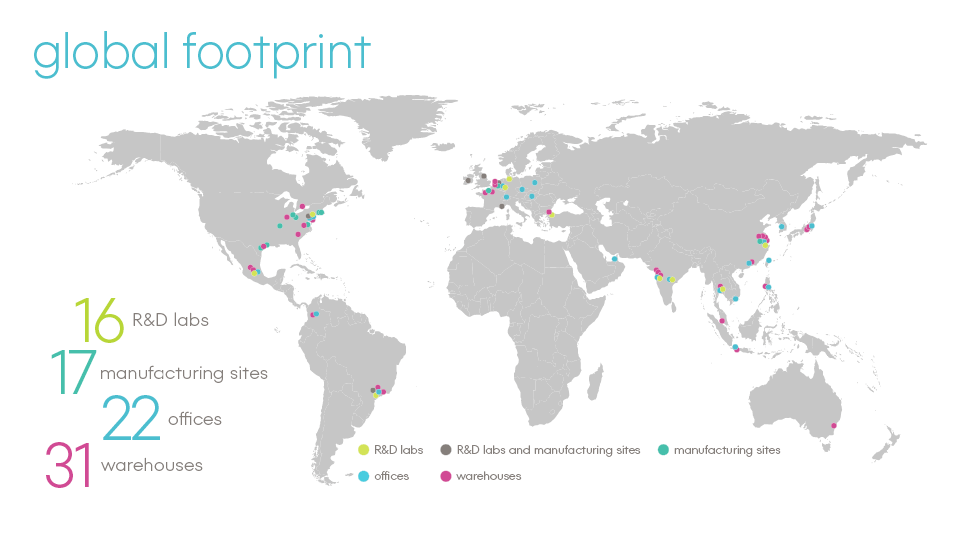
The customers are the drug manufacturers themselves. Ashland does not name them, which is standard for an ingredient supplier, but the manufacturing map tells you most of what you need. Wilmington and Calvert City for North America, Mullingar in Ireland for injectables, Cabreúva in Brazil, and Hyderabad and Nanjing sitting directly inside the Indian and Chinese generics industry. The buyer is as likely to be a large generics manufacturer or a contract development and manufacturing organization as a branded pharma company, which is great, because then generic volumes keep running long after the patent cliff has done its damage to the branded pharma company.
The excipient and its grade are written into the drug's regulatory filing, and changing either one is a formal change control that can require fresh stability data, sometimes a bioequivalence study, and depending on how material it is, a supplement the agency has to approve before the product can be sold again. No formulation scientist volunteers for that on a molecule that is already generating revenue, and the excipient is a rounding error in the cost of goods anyway, so there is nothing to be saved by trying. The competition happens once, at the formulation bench, years before the drug reaches the market. After that, the position is held for the life of the molecule.
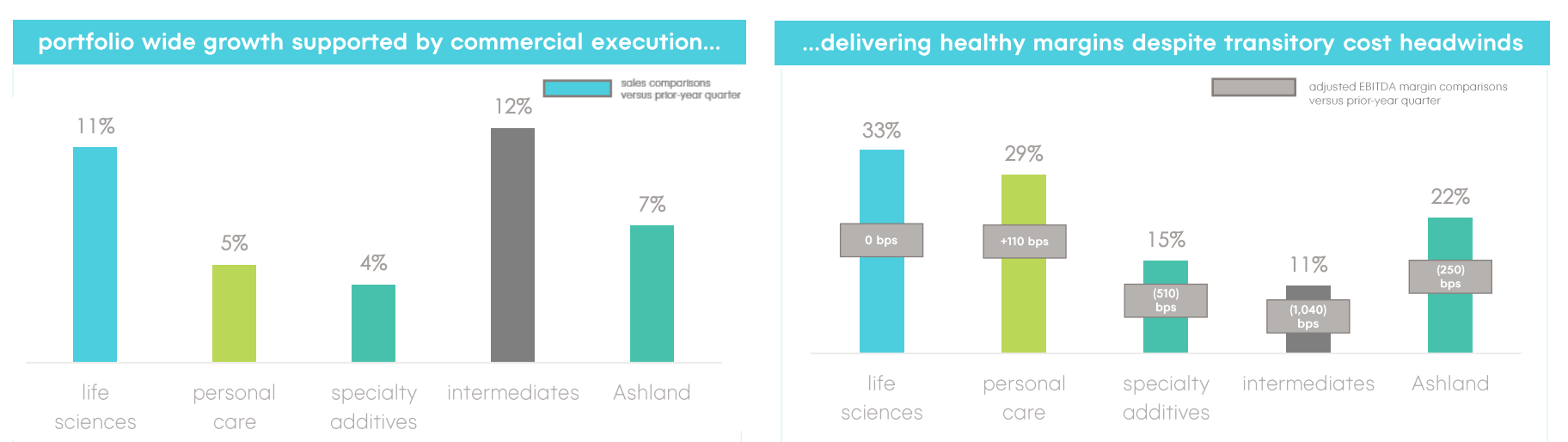
Financially, Ashland posted third-quarter sales of $180 million in this segment at a 33 percent EBITDA margin, with pharma volumes up year over year for five consecutive quarters.
This is where it gets interesting.
Become a paying subscriber to read the rest of this post and get access to all of my other research, including valuation spreadsheets, deep dives (e.g. well-known mid- and large caps such as LVMH, Duolingo, Meta, Edenred as well as more hidden gems such as Digital Ocean, Ashtead Technologies, InPost, Timee, and MANY more), and powerful investing frameworks.
As a member, you get:
Complete Access: Every deep dive in our library (65+ and counting).
More Content: Company updates; powerful valuation spreadsheets, frameworks, and processes; regular portfolio updates (insights into my investing decisions); market commentary; etc.
Slide Decks: Every deep dive now comes with a companion slide deck. It’s the whole argument in compressed form – the hypothesis, the business, the competitive position, the valuation, and the case against – for the days when you don’t have an hour to spare but still want the shape of the thing. Paid subscribers get both, the long piece and the deck.
The WhatsApp Community: Real-time discussion and networking with like-minded investors.
Digital Investing Conferences: Around three times a year, we also hold digital conferences where members present and share stock ideas, and discuss broader themes, and we’d love for you to join in!
Incredible Value: Full access to all of this for less than €1/day.