

Dear compounders,
This post contains no valuation model, no moat analysis, and not a single mention of free cash flow conversion. Twelve days ago my wife and I welcomed our daughter into the world, and I want to write about the first two weeks of being a father.
Before I do, I owe you a short explanation of why a blog called Compound with René suddenly turns into a parenting diary (at least for this post).
Part of the inspiration comes from Vitaliy Katsenelson, the CEO of the Denver-based value shop IMA and someone whose writing I have admired for years (and who I actually briefly chatted to to discuss InPost late last year; the investing world is small).
His newsletter, The Intellectual Investor, started out as a home for his thoughts on markets and the stocks his firm analyzed. Over time it grew into something broader and now reaches more than 100,000 readers. He has said that fatherhood probably nudged him in that direction, and today you’ll find essays on classical music, travel, parenting and Stoic philosophy sitting right next to his investing pieces.
Somehow, the mix works. Reading one of his essays about a walk through Santa Fe with his son and his father, I never once thought, “I subscribed for stock picks, why is he telling me this?” If anything, it made me trust his investing work more, because I had a better sense of the person producing it.
Why would an investing writer write about diapers?
So why would I, an investing writer, write about diapers? I have two reasons, and the first one is fairly selfish. I enjoy writing. I enjoy the act itself, the slow process of turning a vague feeling into sentences that hold up. And I have noticed a clear pattern in my own output over the years: my best work happens when I feel a strong intrinsic pull to put something on “paper” – well, digital paper I guess.
On the rare occasions when I have forced myself to write about a company I didn’t find interesting, the result was noticeably worse. You can probably tell which posts those were. I certainly can.
And right now nothing in my life pulls harder than the small person sleeping a few meters from my desk, so this is the post that wants to be written.
The second reason has to do with you. Writing is a strange medium for building a relationship. Think back to the early days of the internet, when people recorded vlogs from their bedrooms. You heard their voice, saw their facial expressions and the mess in the background, and after a few videos you felt like you knew them. Text strips most of that away. And stock research as a niche doesn’t help either (it might be more natural in other niches). You see my arguments, my spreadsheets and my charts, but much less of the person who made them.
When I was still more active on YouTube, someone told me that a channel needs three ingredients to blow up: personality, great content and a large addressable market.
I have thought about that framework a lot since. Readers obviously care about the quality of the research, the depth of the analysis, and how it’s packaged. That part is non-negotiable. But many of you, I believe, also care about the person behind the account, and I suspect that matters more than most finance writers realize.
So every once in a while I want to share something more personal (as I did in On The Power of Digital Relationships! in August for instance), a success, a failure, a lesson learned outside the market. Together with the live streams and the podcast, I hope it gives you a better sense of who the author behind these posts actually is.
A BIG Thank You!
Which brings me to the part of the last two weeks that surprised me most.
The day after our daughter was born, I sent you an email explaining that I would go on parental leave for one month and that I had paused billing for paid subscribers during that time. I didn’t expect a single reply. I very rarely get any replies to any posts I sent out as emails.
This time, however, what I got was a flood.

People congratulated us. People told me about the birth of their own children, sometimes decades ago, with a level of detail and warmth that caught me completely off guard. Others simply took a minute out of their day to send a few kind words. One exchange in my DMs made me laugh out loud, for instance, and I’ll share it here without naming the sender, just to illustrate what kind of messages. received:
Reader: Hi Rene, I wanted to send you a quick note to congratulate you and your wife on the arrival of your baby girl. We have 4 kids... I’m not sure I can recommend this amount for you but welcome to parenthood!
Me: Thanks so much for reaching out! Means a lot. Your message made me laugh out loud actually. I’m 36, so I guess the odds that we end up with fewer than four are decent, but who knows.
Reader: Never say never... […] I had my first at 35 which isn’t that different that your age now! But yes, if I had to handicap it I would not bet a lot of $$ on you having 4! Enjoy this time with your family!
Me: Haha love it! And then there’s always the wild card of having twins I guess.
I found all of this incredibly encouraging. I knew there was a strong sense of community among the paying members and especially in the WhatsApp group, which is probably the innermost circle of this little ecosystem. What I hadn’t fully appreciated was that something similar exists beyond that circle too. Readers I had never interacted with before wrote to me as if we had known each other for years.
Maybe the most important effect was a simple reminder. There are actual human beings behind the subscriber count in my Substack analytics tab. That sounds obvious, I know. But writing can be a lonely endeavor. You spend days or weeks on a piece, you hit publish, and then, usually, not much happens. The default number of comments on my posts is zero (I have made my peace with this). Likes and restacks trickle in slowly. I can see how many of you opened the email, but an open rate tells me nothing about who actually read the 7,000 words I sweated over.
Most of the time it feels like writing into a void.
So seeing that so many of you read that particular email, and then took the time to respond, meant the world to me.
I should also apologize. I haven’t managed to reply to everyone yet. Some messages landed in spam, a few DMs slipped through the cracks, my email client displayed some replies in bizarre ways, and, more than anything, life got a lot busier. If you wrote to me and haven’t heard back, please know that I read it and that it mattered. Thank you.
So, how is it?
Honestly? I love it.
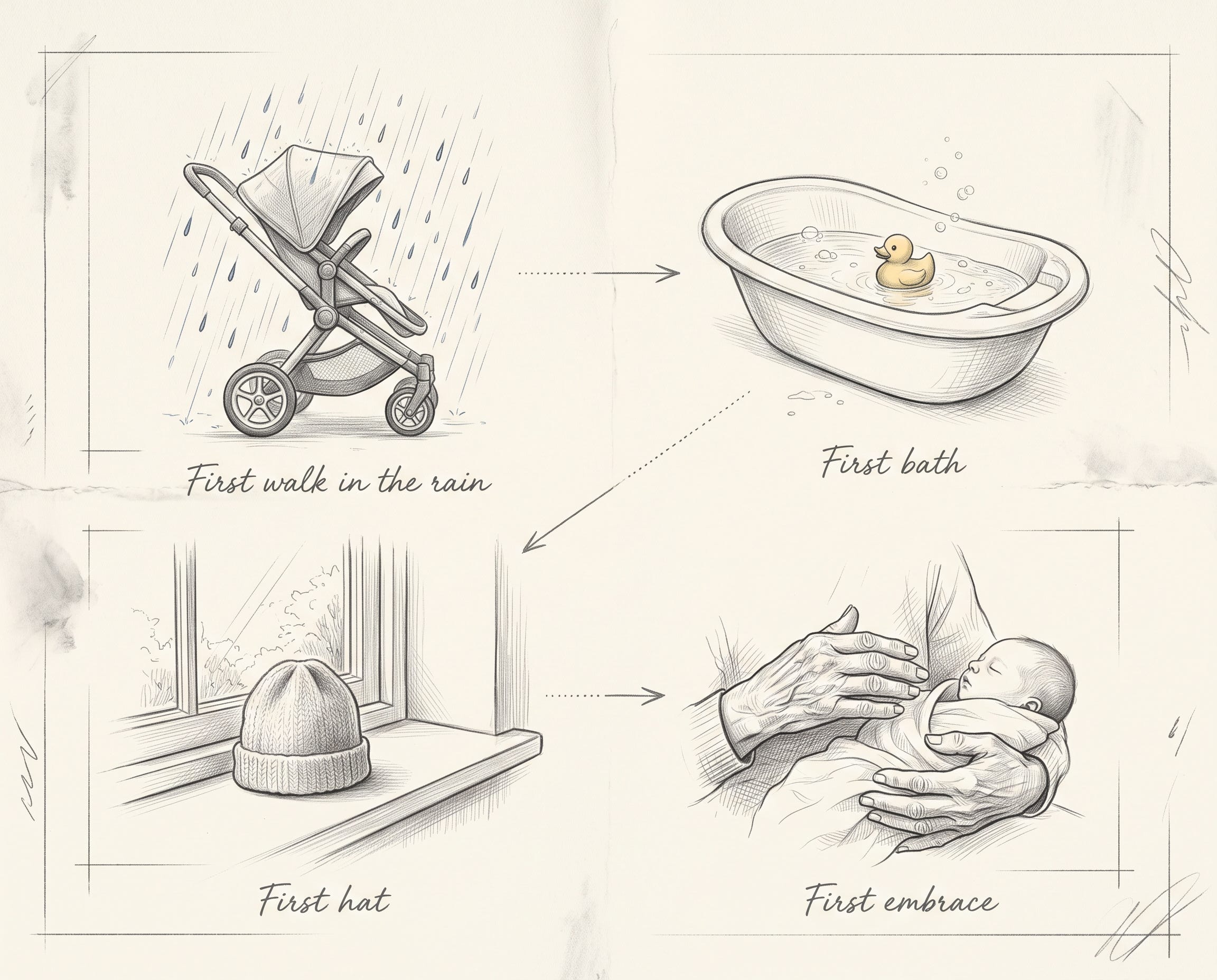
I love the diapering (as odd as this may sound). I love the night feedings when it’s my shift, the dim light, the tiny (and weird) sounds. I love changing her clothes, even the third outfit of the day after an incident I’ll spare you the details of. And I love what I have started calling the “showing her the world” part, which means watching all the tiny firsts. The first time outside. The first rain to observe. The first bath. The day the umbilical cord fell off. Today she meets her grandmother, my mom, for the first time, and I am probably more excited about it than anyone else involved.
That joy was also the common thread running through almost every message you sent me. Most of you said some version of the same thing: it is tough, and it is enormously rewarding at the same time.
A very good friend of mine (shoutout to you Daniel!), someone I have known since school for about 25 years, coincidentally became a father just five days before I did. When I talked to him on the phone the other day and asked him how it was going, he said it’s something so special that you can’t compare it to anything else; something incredibly unique. I think that’s the best way to describe the experience.
I also found myself thinking about Charlie Munger, who seems to have figured out most aspects of life, from investing to marriage to how to grow old with your wits intact. Munger raised a large family, nine children across two marriages (7 biological children and 2 stepchildren), and he always spoke about family with an unusual seriousness. In one interview with Becky Quick if I recall correctly (I couldn’t find it when preparing this post), he explained that he never built a fancier house partly because he didn’t think it would be good for the children. That’s the kind of decision you only make when you take the long-term well-being of your kids as seriously as the long-term value of a business. My impression from watching him over the years is that he saw raising children as one of the most fulfilling things a person can do, even when it is hard, and he highly recommended it (despite the challenges).
After only two weeks, I can confirm the fulfilling part (as well as the challenging parts; I’ve rarely been this exhausted at 8pm 😉).
Holding a tiny human being in your arms and knowing you are responsible for her for the rest of your life (and it doesn’t end when she turns 18, does it?) is a feeling I struggle to put into words. It brings me an enormous amount of joy so far.
What I inherited from a doctor who always showed up
My relationship with my own father is complicated. I’d like to think I have a fair amount of clarity about it by now, about his weaknesses, where I need to keep my distance, and about his strengths, which I can draw on as a source of inspiration. One of those strengths has become very visible to me in the past two weeks somehow.
My father is a doctor. He still practices and will retire in a couple of months. Naturally, the job demanded long hours. Yet I don’t remember him as an absent father. It was always a priority for him to be present, to spend time with my sister and me, and to be there whenever he could make it. I can already feel how much that example shapes my own instincts as a father, mostly on a subconscious level. I think I’m wired the same way, and I hope I stay that way.
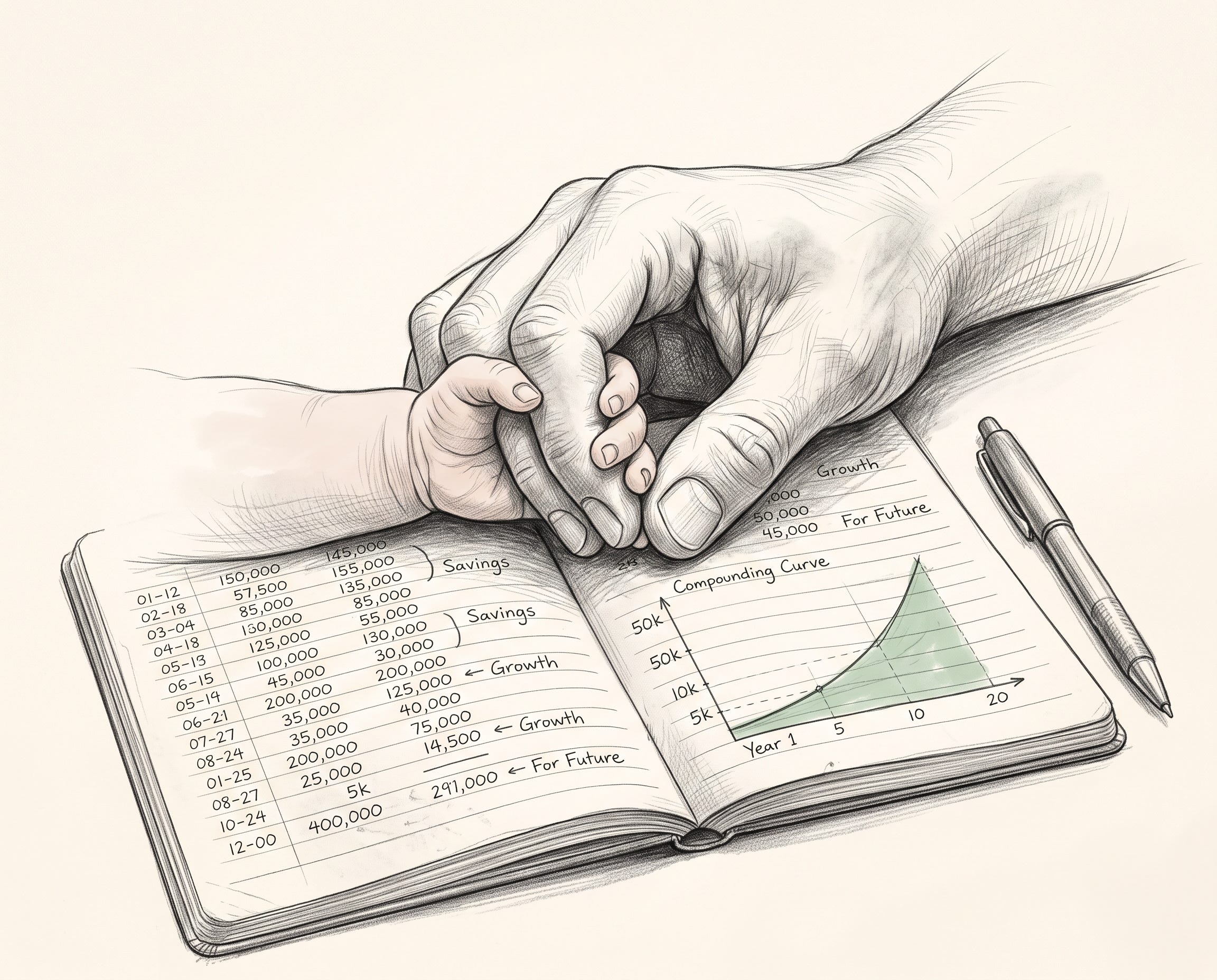
Katsenelson wrote an essay in 2018 called “Being a Father” that has stuck with me ever since. A client of his had lost her husband to cancer. He had built a fortune of roughly $100 million, and he had done it by working sixteen-hour days, seven days a week, coming up from his basement office for dinner and disappearing again. His son, about to become a father himself, told Vitaliy he had grown up feeling raised by his mother alone, and that he wanted to be there for his own kids. Vitaliy’s conclusion was that what you leave your children in memories matters far more than what you leave them in money. He also admitted that his love for investing could at times compete with his love for his family. As investors, we spend our lives obsessing over compounding.
It’s worth remembering that time with your kids compounds too, and it’s the one asset you can’t buy back later.
Being present will come with its own set of challenges. I work hard, and I’m ambitious about building this blog, the podcast, and everything around it. I also hold myself to high standards as a teacher. The good news is that I’m efficient with my time, and I have already accepted that I will have to deprioritize some hobbies. I simply won’t be able to pursue all of them for a while, and that’s fine.
And sometimes you just have to get a little creative.
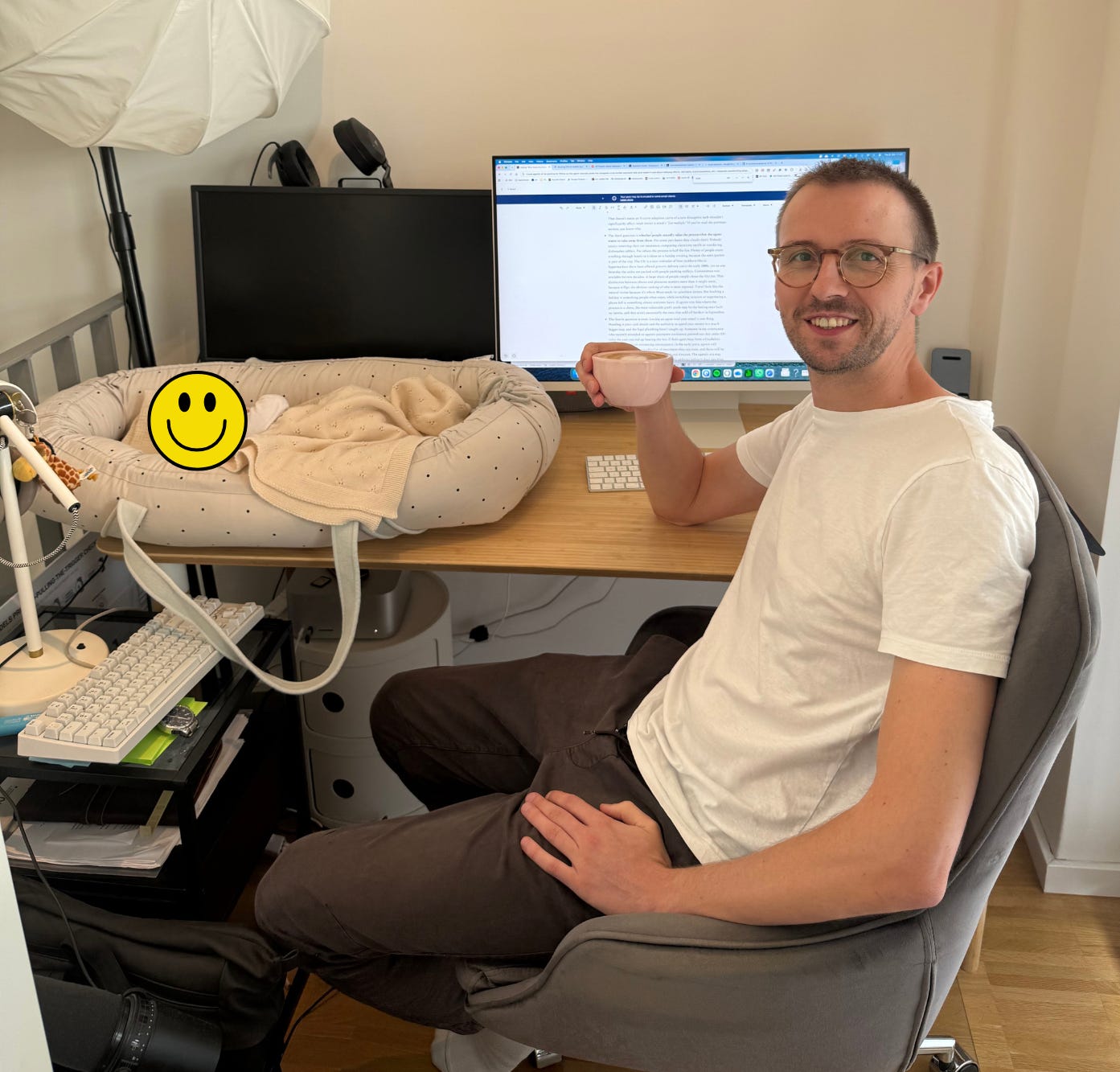
Jordan Peterson, who has spoken and written extensively about parenting, too, makes a point I find useful here. He argues that a meaningful life is found in voluntarily taking on responsibility rather than chasing happiness, and he describes parenting as the most challenging and most rewarding thing you’ll ever do, with the highest highs and the lowest lows. One of the rules in his book 12 Rules for Life is that you shouldn’t let your children do anything that makes you dislike them, which sounds harsh at first but is actually about protecting the relationship over the long run. I’m a long way from needing that one. My daughter is currently incapable of doing anything that would make me dislike her, unless you count the 3 a.m. outfit change. Still, the underlying idea resonates with me.
Responsibility, taken on willingly, is a source of meaning, and I have rarely felt that as clearly as I do now.
Your turn: Any tips?
I’d love to end this one with a question, and I hope you’ll break my zero-comment streak.
If you’re a parent, what is the number one piece of advice you’d give a new father? It can be practical, philosophical, or something you wish someone had told you.
Leave it in the comments or reply to this email. I’ll read every single one, even if I probably won’t be able to respond to all of them.
Thank you for reading, for your messages, and for being part of this community.
René
P.S.: In case you missed it
I published a thematic deep dive on agentic AI yesterday, looking at how AI agents could reshape sectors like travel, e-commerce, search, advertising and payments, and which companies’ terminal values may be more fragile than the market assumes. I put a lot of work into that one, so if you haven’t read it yet, you can find it here:
Agentic AI: A Primer for Investors

Every market cycle gets its word. In 2021 it was “metaverse,” in 2023 it was “generative AI,” and if you’ve spent any time on financial Twitter, Substack Notes or earnings calls this autumn, you already know the word of 2026:
Let me get back to you in a couple weeks on that last question ;) our little one isn't rushing seeing the world
If I can share one piece of advise it is that kids thrive on routine and predictability, especially around bedtime. How that routine looks is different for every family and will change over time. For us it's a yoghurt, some books and always the same short book as the "closing" of the evening.
Congratulations again René! You are in for a wild and wonderful ride 🙂