

This post is a bit different from my usual deep dives. It’s closer to an evening of rambling that turned into something I wanted to write down. When the news broke today that Netflix had secured exclusive rights to every match of the 2030 World Cup in Spain, I shared a quick reaction in our community, and the thought stayed with me through dinner and well into the evening. A few numbers from Netflix’s last earnings call kept coming back to me, as did an analogy involving podcasts and old records, and a nagging sense that live sports might be changing Netflix’s economics for the worse. So what follows is me thinking out loud about the economics of live events at Netflix, testing my own first instincts as I go, and being open about where I’m unsure. If you hold Netflix, or are thinking about it, I hope it gives you a few useful questions to ask, even if you end up answering them differently than I do.
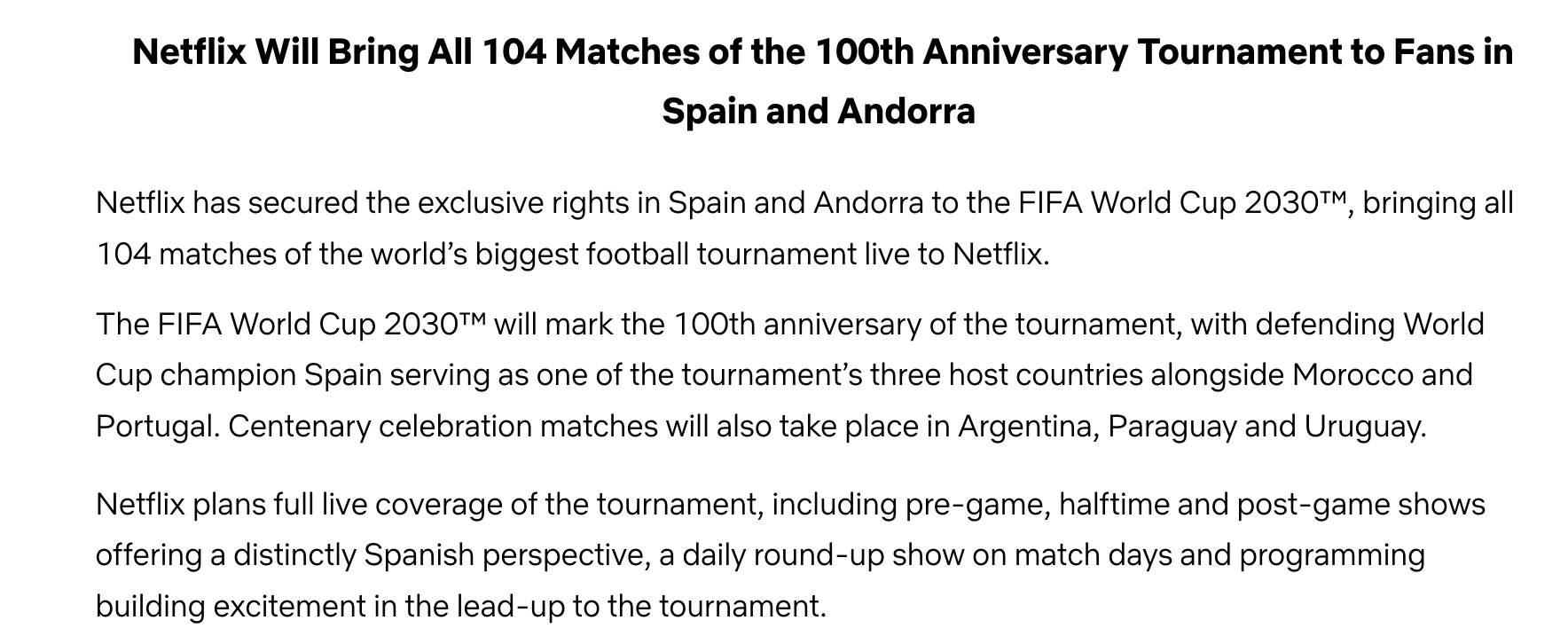
Today, Netflix announced that it will stream every match of the 2030 FIFA World Cup exclusively in Spain and Andorra.

Before I share my thoughts, I want to be upfront about what kind of post/analysis this is: Long-time readers know that I like to test an investment view along three dimensions of good decision-making:
common sense,
theory and
empirical evidence.
The more of these dimensions a view takes into consideration, the higher the quality of the assessment.
This post leans almost entirely on the first one. It is my common-sense reading of what live sports does to Netflix’s economics, built on a handful of numbers management has shared, with some theory borrowed where it helps. What it lacks is the empirical work – data on retention after live events, on returns from sports rights across the industry, and on how Netflix’s own returns change as live grows – that would turn a hunch into a conclusion.
Please read it as a hypothesis I intend to test further or encourage you to think about critically.
With that caveat, my first reaction was that this is the right strategic move. My second reaction was that it is probably also one of the least attractive dollars Netflix will spend this decade.
I think both can be true at once.
The fine print behind the headline
The headline sounds more exclusive than the deal really is. Netflix will make one match a day free to watch in Spain, and a package that includes every Spain match, both semi-finals and the final will be shown on a national free-to-air broadcaster.
In other words, the games most likely to bring in a casual Spanish viewer who would not otherwise subscribe will be available without a subscription. This follows a familiar pattern. When Netflix bought the US rights to the Women’s World Cup, FIFA reportedly agreed to sell only on the condition that some matches were sublicensed to a traditional media company.
"Few events unite people like the World Cup. I was in the stands this year as Spain lifted the trophy and witnessed the passion, the pride, the stories – they all become part of a nation's culture and are remembered for generations. With Spain set to host in 2030, we're thrilled to bring every match to fans across Spain and Andorra on Netflix. For Spanish football fans, welcoming the world as reigning champions on Netflix will make this a moment unlike any other. And, our expanding partnership with FIFA, including the Women’s World Cup in 2027 and 2031 for the U.S. and Canada, reflects our continued commitment to bringing fans closer to the world’s biggest sports moments." -Bela Bajaria, Chief Content Officer, Netflix
FIFA wants reach, and Netflix wants subscribers, so the most valuable inventory ends up shared.
That is the first thing I would hold against the bull case. The exclusivity that justifies the presumably high price is narrower than the press release suggests.
Five percent of the budget, one percent of the hours
The second issue is one management has been unusually open about. On the Q2 call, Greg Peters said live programming will take about 5% of the content budget this year but deliver only about 1% of view hours. Live events produced six of the ten biggest new-member sign-up days in the past five years, even though Netflix has only done live since 2023.
“Start by saying there is not a linear relationship between view hours and revenue and profit because all hours are not created equal. All hours don’t provide the same kind of value to the business. And a really great example of this is live programming. So live events do a lot of lifting for us for acquisition.
They’re good for monetization. They drive ad revenue, fandom. They’re also a promotional platform, but they do not yield typically as many Raw view hours. So live, we expect will be 5% of our content budget this year, but we think that will only be 1% of view hours. Having said that, 6 out of top 10 new member sign-up days over the past 5 years have come from live events.” - Q2 Call
With annual content spend of around $20bn, that is roughly $1bn a year going into live.
The comparison Peters chose himself is the important one. Kids and family animation takes about the same 5% of spend but produces about 8% of view hours. Per hour watched, live costs about eight times as much as animation and about five times the company average.
Management’s answer is that all hours are not created equal, which I accept.
“And if you compare that to another content category, take animation series, kids family TV, it’s also about 5% of our content spend, so the same amount of spend, but it’s going to drive, we expect 8% of view hours. So same spend and 8x the Raw view hours. You can see the differences there, even though because as indicated by the amount that we’re investing in both those categories being the same, we think they’re doing the same value for the business. So we’re constantly looking to improve across every dimension of engagement. We look at these as 3 dimensions: quality, variety, quantity, because they, taken collectively, drive acquisition, they drive retention, they drive the value that our consumers and our advertising partners ascribe to our service.
We described in the last few earnings calls the progress that we’ve made on quality over the years. We’re not going to go into the details of that quality metrics because, frankly, it’s taken years for us to develop it and vet it and assess it and improve it, and we think that those details are a competitive advantage. We’re also continuing to expand the variety of our entertainment offering. You see us launch new types of content like live, like video podcast, cloud TV games. Those are all doing things, different things in our portfolio to support different needs from our members.” - Q2 Call
I would still note that this is an argument Netflix now needs to make, and companies usually only need to make it when the simpler metric stops looking good.
One analyst put it well, saying the measure management now emphasizes alongside view hours is one the company will not detail. It does not help that Netflix will move its “What We Watched” report from twice a year to once a year starting in 2027, explaining that it wants the focus to stay on revenue and operating profit.
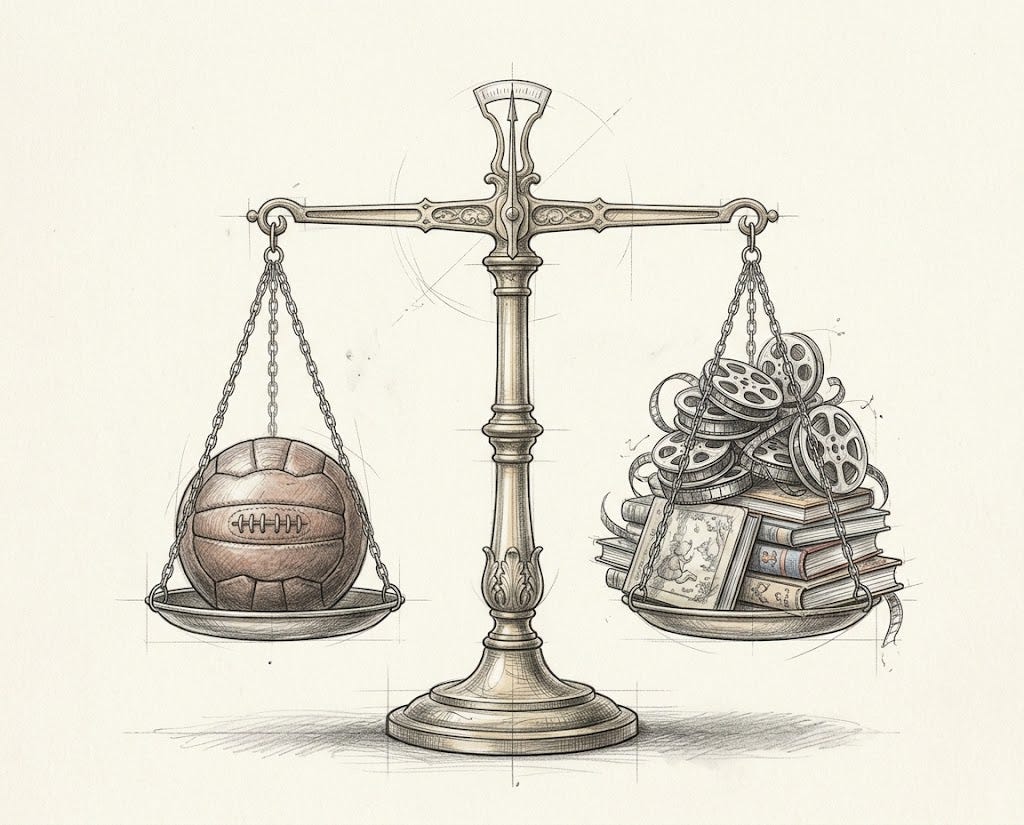
The way I explain the economics to myself is through shelf life. Consider podcasts vs. evergreen music as an analogy. I rarely listen to a podcast episode that is more than a few weeks old. There are exceptions, like Business Breakdowns or a good Acquired episode, but for most podcasts the value falls sharply within days. Music is the opposite. The industry calls it catalog, meaning tracks older than 18 months, and it is the asset that makes a company like Universal Music Group so durable. In 2025, catalog accounted for more than 75% of all US audio streams for the first time. A song recorded once can earn money for fifty years.

A scripted Netflix series falls in between. I might start watching a great show from 2021 tonight, and that is why Netflix’s library works as a moat: every subscriber who joins today gets fifteen years of accumulated content at almost no additional cost to Netflix.
A series is still worse than a song, though, because almost every episode is watched once, while a favourite song is replayed hundreds of times. And the older the series, the less likely it is that people choose it in the library. The shelf life might only be a handful of months for most series, and some years for others.
Live sport sits at the far end of this range, below even the podcast. The value of a World Cup group match is concentrated in about two hours. A replay the next morning is worth almost nothing, and in four years it has no library value at all.
Renting moments instead of building assets
Which brings me to the main point – and it’s about a lot more than just shelf life. With live sports, Netflix is renting an asset instead of building one. When Netflix makes a hit original, it owns the IP, keeps the economics of sequels and spin-offs, and spreads one production budget across more than 190 countries. That global amortization has been the core of its cost advantage over every local broadcaster for a decade.

A regional sports deal like Spain-only World Cup rights removes that advantage. The cost is local, the benefit is local, and when the contract ends, Netflix keeps nothing. Netflix also does not set the price. FIFA, the NFL and WWE are sellers with real pricing power, and every renewal goes back to auction. The US rights for the same 2030 tournament show the direction clearly. Reports say media companies are budgeting $1.5bn to $2bn for the package, compared with the $485m Fox paid for this year’s World Cup.
In a market where the supplier is a monopoly and buyers compete for scarce rights, the surplus usually goes to the supplier. That is what happened to ESPN for twenty years, and I see no structural reason Netflix would be exempt.
Renting has a second problem, and it has less to do with shelf life than with who else wants the same content. The events that drive sign-ups are prestige events, and everyone knows which ones they are. The World Cup is the clearest case. FIFA reported a global audience of around 1.5bn for the 2022 final, which is roughly twelve times the 125m or so who watch a Super Bowl.
I would use that ratio carefully, though, because FIFA’s number measures global reach while the Super Bowl figure is a Nielsen average audience in a single country. On a like-for-like basis the comparison looks very different. Nearly 63 million Americans watched Spain beat Argentina in this year’s final, a record for soccer in the US, yet that audience was still below the nearly 125 million who watched Super Bowl LX.
The broader point holds anyway. No other event focuses as much of the world’s attention on a single evening, and every broadcaster, streamer, and big tech platform with global ambitions knows it. When something is this scarce and this sought after, bidders keep competing until the expected return drops to ordinary levels, and often below that, because the winner of an auction tends to be the most optimistic bidder in the room.
Economists call this the winner’s curse, and sports rights are one of its textbook examples.

Here I need to complicate my own argument, because the data doesn’t show sports rights inflating across the board. The Premier League’s domestic deal for 2025 to 2029 is worth £6.7bn, only a 4% increase on the previous cycle, while the number of live matches per season rises from 200 to 267, which lowers the cost per match.
By one ESPN estimate, the value of each individual game has halved once inflation is taken into account, and the latest cycles saw LaLiga up 1%, the Bundesliga flat, Serie A down 3%, and Ligue 1’s tender halted because no bid reached the minimum price.
The market looks split in two. Weekly league inventory, the staple of sports broadcasting, has largely stopped inflating, while the scarce tentpole events keep getting more expensive.
The uncomfortable part for Netflix is that its strategy sits almost entirely on the tentpole side, because one-off events are what produce those sign-up spikes. Netflix is putting its live budget into exactly the segment where competition for rights is fiercest.
Competition like this is usually good for consumers and bad for the companies involved. Sports streaming may be the rare case where it is bad for both. Rights are being split across more and more platforms, so a fan who wants to follow a single team through a whole season can need several subscriptions, each raising prices to cover what it paid for its slice. Anyone in Germany who has tried to follow football properly across domestic and European competitions knows the feeling. That fragmentation helps explain why a single, ad-supported Netflix offer appeals to viewers, but it also means Netflix is entering a market whose economics have frustrated nearly every participant.
Can Netflix handle this better than its rivals? I think it can, for the reason in the bull case. A broadcaster has to earn its money back from the match itself, while Netflix can treat the match as a customer acquisition channel and earn its money back over a member’s lifetime. That lets Netflix pay more and still earn an acceptable return.
It reminds me of the alcoholic beverage industry, where the largest players like Diageo or Campari can regularly outbid smaller competitors when a brand comes up for sale. They can afford to, because they can put an acquired brand into a global distribution network the seller never had. A craft gin or a regional aperitivo sold in a few countries suddenly reaches bars and shelves on several continents, so the same brand produces far more cash flow in their hands than in anyone else’s. The buyer pays a price that would look reckless for a standalone owner and still earns a good return.

Netflix’s version of that distribution network is more than 300 million subscription households and a recommendation engine that can turn a football fan into a viewer of its Spanish dramas.
I think the analogy is useful, but it breaks down in two places, and both matter. When Diageo buys a brand, it owns it permanently, and every year of distribution effort compounds into an asset whose value grows over time. When Netflix buys a World Cup, it rents four to six weeks of attention, and the next tournament goes back to auction, where FIFA knows exactly how much Netflix gained the last time. The distribution advantage is also weakest exactly where this deal sits. A global brand in a global network is the ideal case for a spirits company. Spain-only rights give Netflix a distribution edge only in Spain, against local bidders who know the market just as well. The analogy fits Netflix’s worldwide NFL Christmas games or its WWE deal much better than it fits a regional World Cup package.
In an auction, that is both an advantage and a trap, because the bidder with the highest willingness to pay usually ends up paying it. My hunch is that live sports will earn Netflix a positive return and still dilute the returns it has historically earned.
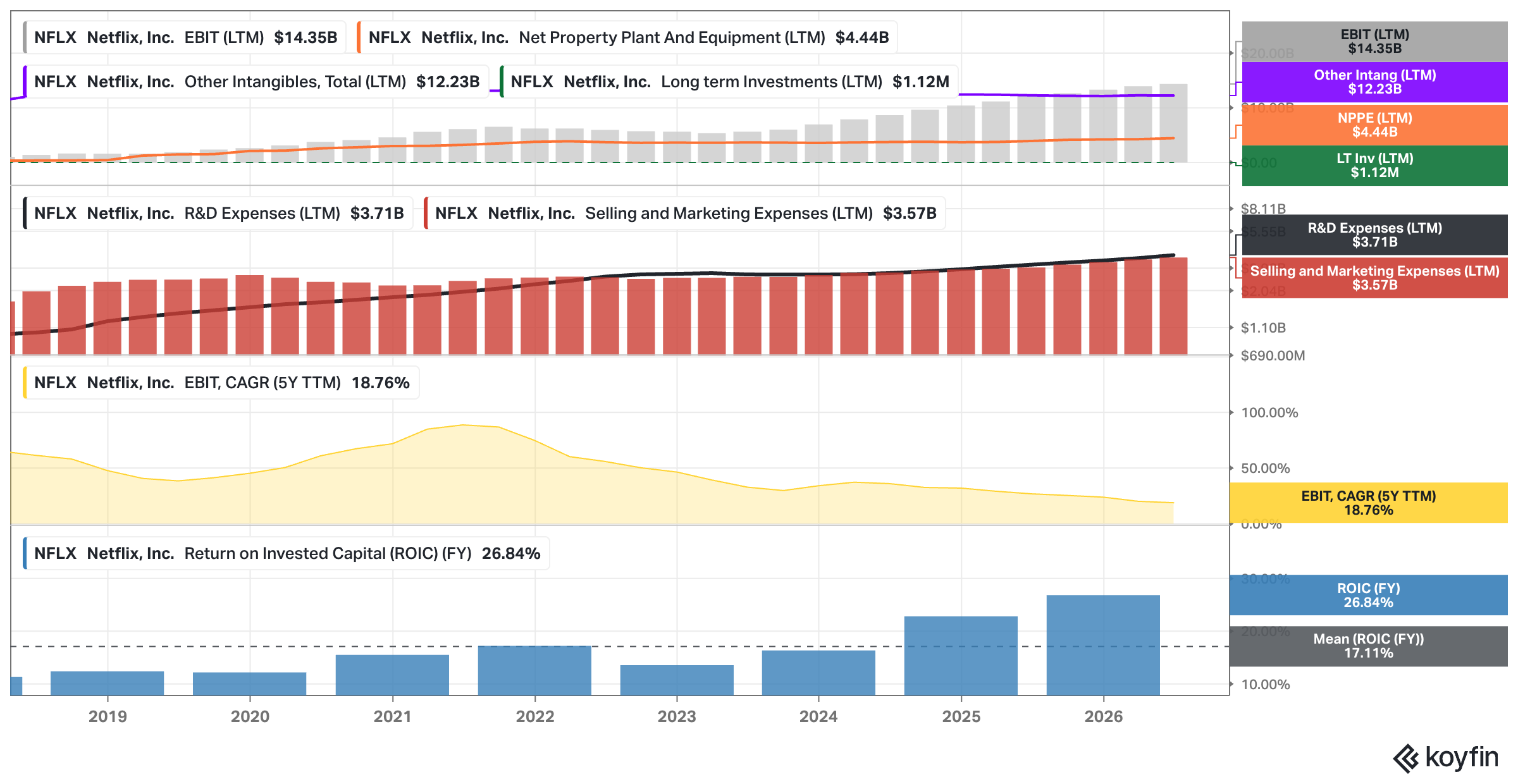
These two ideas sit together more comfortably than they first seem. A project can clear its cost of capital and still lower the company’s average return if the existing business earns far more. Netflix’s scripted library, made once and watched in more than 190 countries for years, is that kind of business, and live sports will not match it I believe.
The case for the flywheel
To be fair, the bull case deserves a proper hearing, and it is stronger than “Netflix is overpaying.” Its central argument is that Netflix earns a higher return on the same rights than any rival, because it uses them for different purposes. A traditional broadcaster has to recover the rights fee from advertising during the match and a narrow sports audience. For Netflix, the match is a customer acquisition event. The person who signs up for Spain against Portugal then finds a Spanish series, a documentary and a film, all of which cost Netflix close to nothing at the margin.
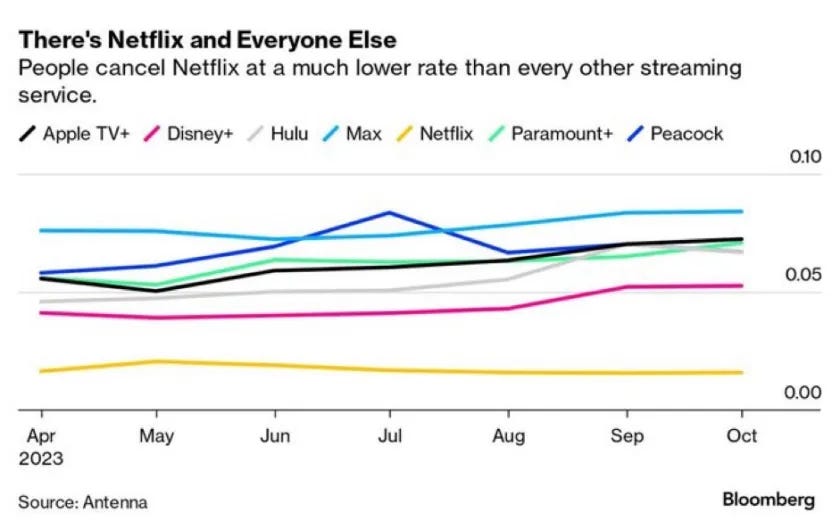
And then Netflix has a churn rate industry peers can only dream of (as Henrik Torstensson shows in the chart below).
Looked at this way, the World Cup is less a content purchase and more a marketing expense with very good targeting, and live sport is one piece in a broader flywheel.
Advertising strengthens the argument. Netflix expects ad revenue to roughly double this year to about $3bn, and live inventory is the most valuable inventory in advertising.
Spain is also a good market to test this in. It is one of Netflix’s strongest production hubs, and non-English content again drove more than a third of all viewing in the first half of the year, with Spain among the standout countries.
Netflix has also been more disciplined than people give it credit for. Its early deals were mostly time-boxed or for under-monetized properties, not the full-season packages that have strained the economics of other broadcasters.
Still, if live is a marketing expense, it should be judged like one, which means retention matters as much as the sign-up spike. On this point, management gave something away on the last call. Sarandos acknowledged that live events can show somewhat higher churn because they attract a disproportionate number of sign-ups, and said results were in line with expectations.
“It was the biggest baseball streaming event ever. World Baseball Classic is kind of like these other big live events, and they behave a lot like our returning seasons of our big shows. They drive disproportionate sign-ups. And because of that acceleration, they can exhibit slightly higher churn. But the results are exactly consistent with that trend and in line with our expectations in all of our modeling.“
A tournament that happens for one month every four years is the clearest possible setup for event-driven churn. The more Spanish subscribers Netflix gains in June 2030, the more closely I would watch September 2030. If those members stay, the flywheel argument holds. If they leave, Netflix paid World Cup prices for a month of rented attention (it’s not like we will get this breakdown, of course).
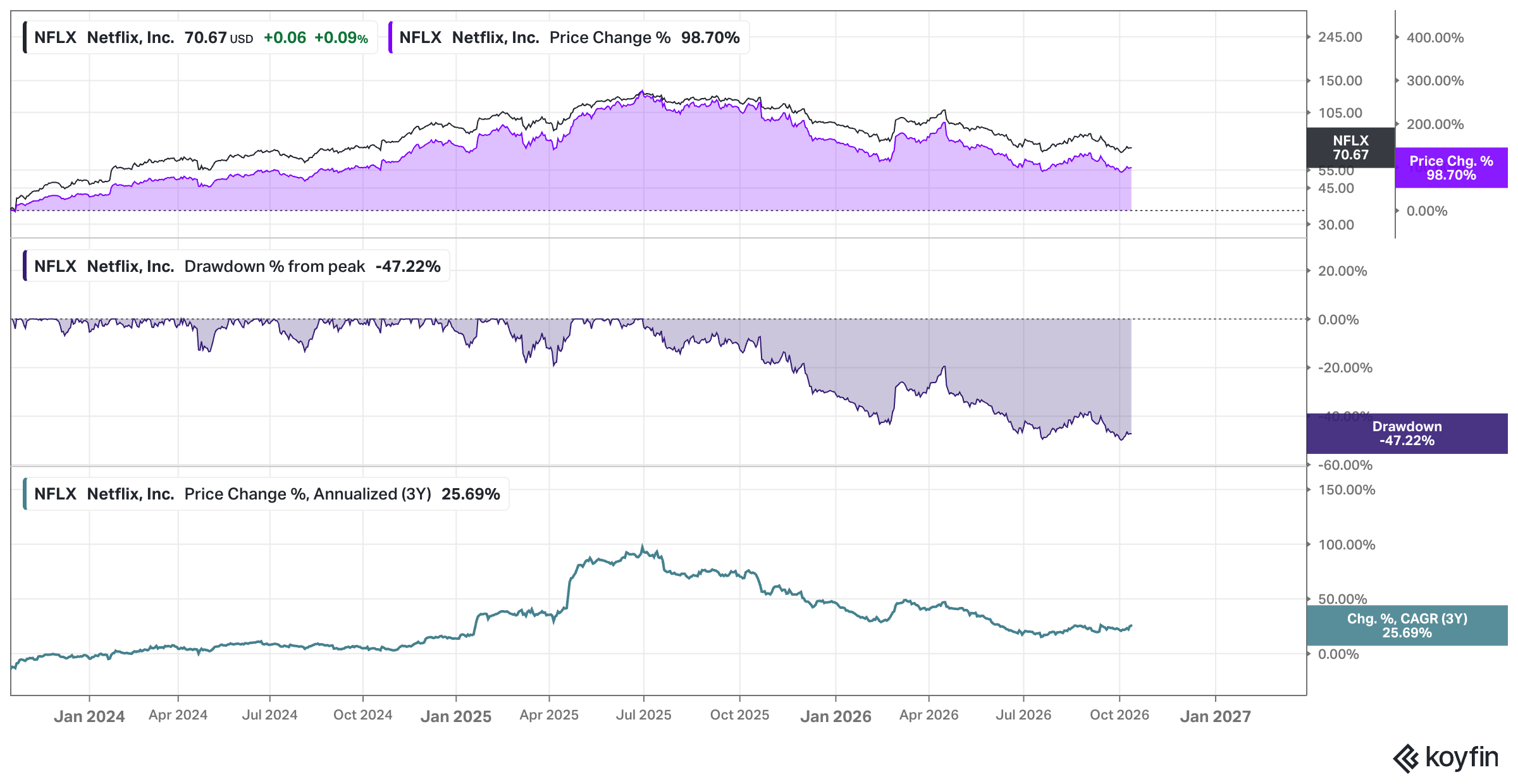
Again, my initial reaction was that live will push Netflix toward lower returns on capital, and that we were already seeing this in slowing growth, since growth equals return on incremental invested capital multiplied by the reinvestment rate. I still believe the first part.
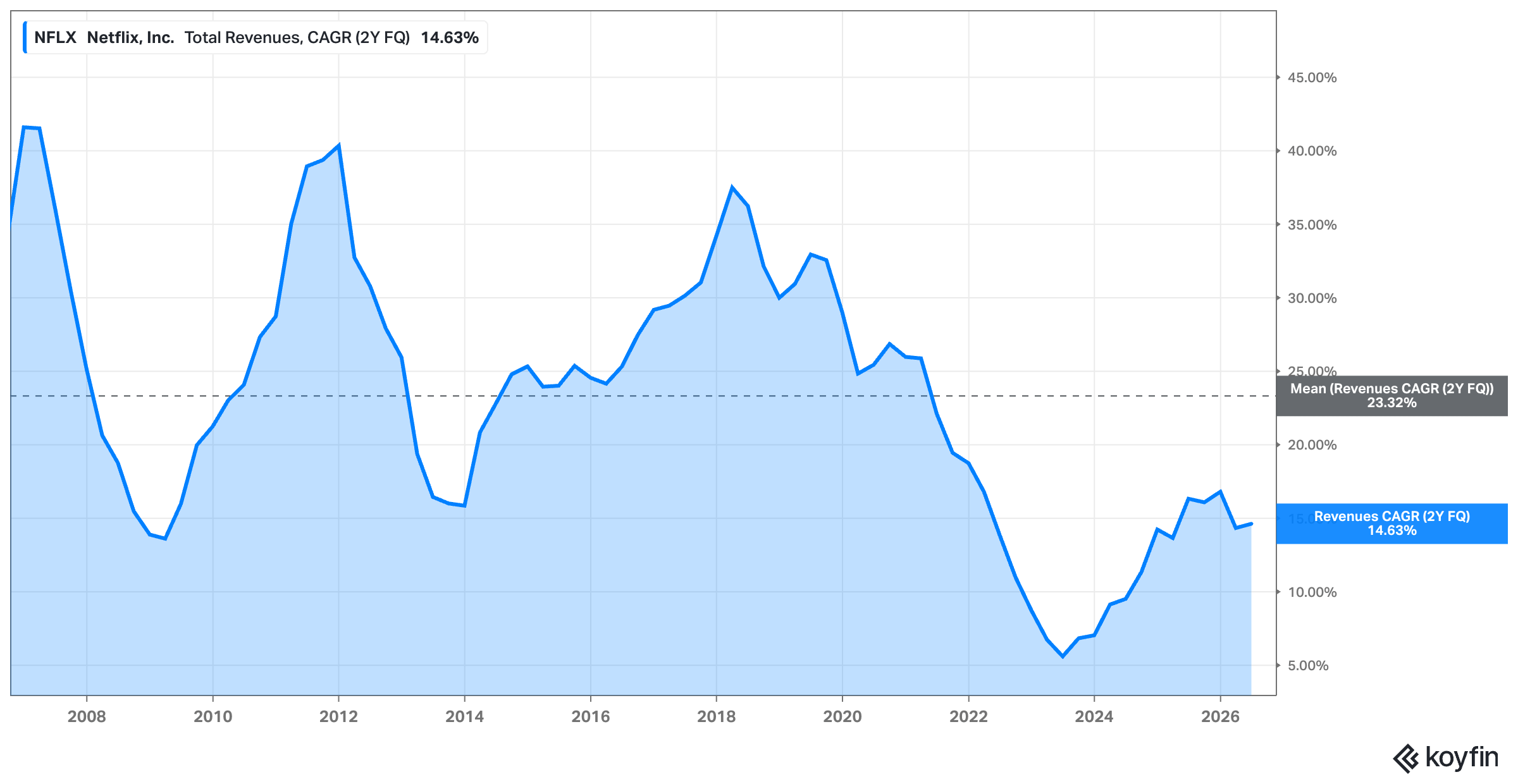
The second part is too quick. Growth has slowed, but the equation has two variables, and Netflix has been reducing the second one on purpose. It completed $5.9bn of buybacks in the first half of 2026, including $4.7bn in Q2, its largest quarterly repurchase ever. Capital going back to shareholders is capital not being reinvested, so part of the slowdown is a lower reinvestment rate, along with the normal maturity of a service that already reaches hundreds of millions of households.
Wrapping up
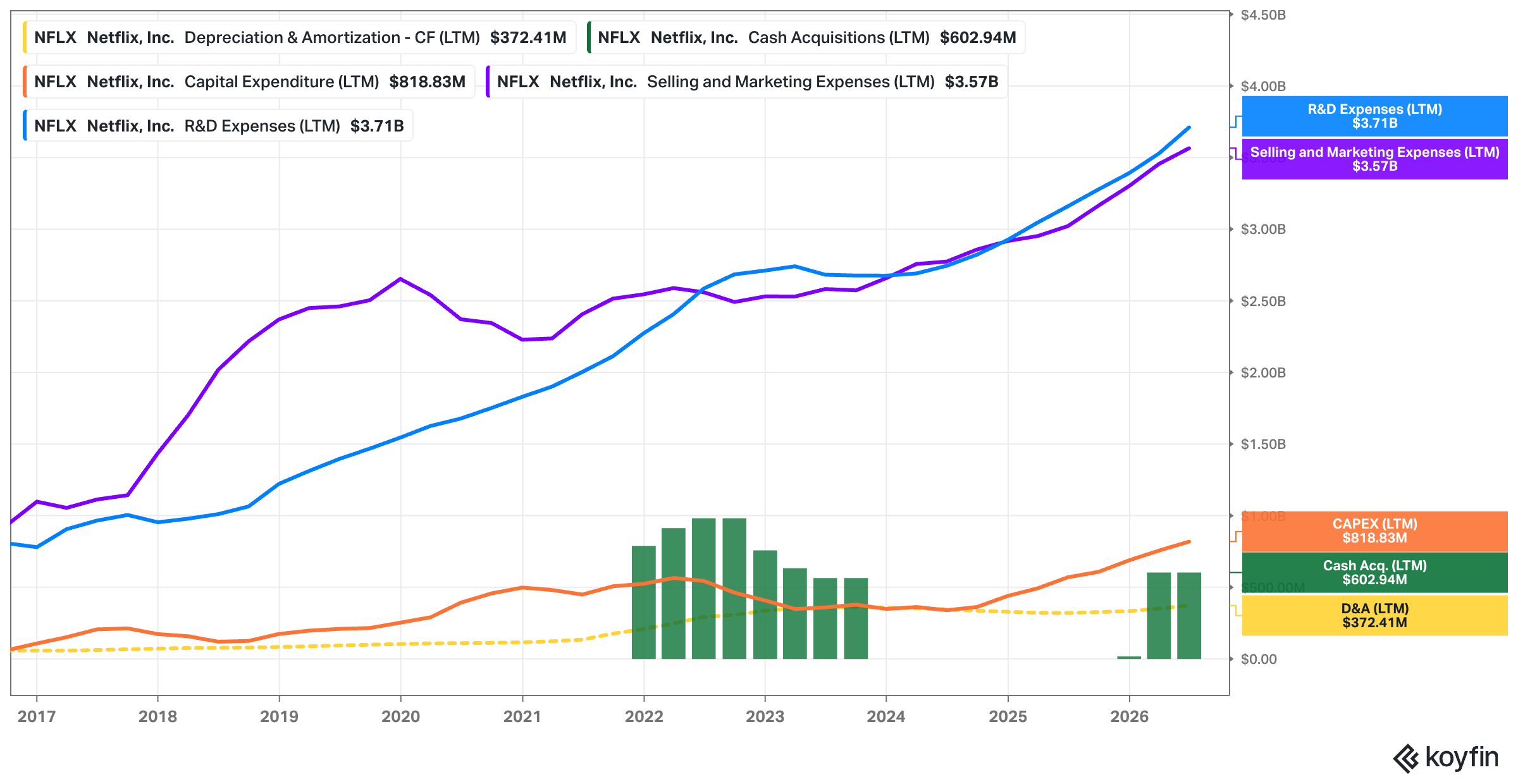
So where do I come out? I think the World Cup deal is strategically right and economically mediocre. Netflix wants to become the default place people turn on the TV, and a platform with that ambition cannot ignore the events that still bring a nation together in front of one screen at one time. That is why the bull case works at the strategy level. The bear case works at the level of unit economics: live content is rented, regional, perishable, and bought from sellers with pricing power, which is the opposite of what made Netflix’s model so attractive.
The question is how large the live share becomes. At 5% of the budget, live works as a marketing expense, and a well-run company at Netflix’s scale can afford okay returns on a small part of its spending.
If it rises to 10% or 15%, Netflix starts to look more like the broadcasters it replaced, though.
You might want to read this post next:
Netflix: Updated Valuation Model after the 50% Drawdown (2026)

In April 2025, the Wall Street Journal ran an exclusive with a headline that has aged like a carton of milk left on a radiator: “Netflix Aims to Join the $1 Trillion Club.” The piece reported that management had shared internal financial targets with staff, and the subhead described figures that “underscore its dominance.”
Good food for thought....however no real analysis can be done unless one knows what they are paying net of the broadcaster games. I believe Spain is the host also so maybe get some FIFA sponsorship value as well. For 2026 the broadcaster apparently paid 55 mm Euros for all the games.