

Two parts down, and I’ve deliberately avoided the only question most readers actually came for.
Neither piece told you whether to buy the thing. That was on purpose, because a valuation built before you understand the machine producing the cash qualitatively, understanding it inside and out, is worthless.
The bulk of what follows is a granular decomposition of the growth engine, because with a business at this stage, almost everything rests on how fast revenue compounds going forward and what falls through to the bottom line. I’ll break the advertising model into its four component levers – users, engagement, ad load, and pricing – and think through each one separately rather than reaching for a blended growth rate that hides its own assumptions.
Some of those levers fight each other, which you might only notice when you start pulling them apart.
I’ll reverse-engineer what a Pinterest-style convergence in ARPU would actually require, take a view on where steady-state margins settle over the next five years, and then work out what exit multiple I’d be willing to underwrite for a business with these economics and this concentration. Meta turns out to be the instructive anchor there, I believe, though not in the direction you might expect. Licensing I’ll think about separately.
Around all of that the rest of the diligence a decision like this deserves: Management and whether the incentives are pointed the right way. Whether insiders have been buying with their own money. The balance sheet. A base-rate check to anchor my inside view against what usually happens to companies that look like this, because narrative can be seductive and history is not.
And then my model, assumptions exposed for you to disagree with, followed by a speculative thought I keep turning over about who might eventually want to own this business outright.

Valuation
1) Future Growth – What Growth Can I Underwrite?
I want to start by developing a defensible view of how fast revenue can grow over the next five years.
And I want to build that view from the bottom up rather than extrapolating the 61% Reddit recently printed, because I have naturally a very hard time underwriting such high growth rates for multiple years. That makes me miss some fantastic winners, but it also protects my downside, because underwriting such high growth that then never materializes usually ends up with you losing a lot of money. Effectively, you often end up with a double-whammy:
The market punishes you because it assigns a lower multiple to the lower-growth stock than it did while the business posted stellar growth, and
you end up with the disappointing growth.
Remember:
Total Return = Earnings Growth x Changes in Valuation x Impact of Buybacks + Dividend Yield
So let me decompose the advertising business into its constituent parts and rebuild it. Licensing I’ll handle separately at the end, since its trajectory depends on what happens in the corporate negotiating rooms rather than on any operating lever.
The framework I find most useful here, and which I shared in part 2, treats revenue as the product of four things. Call it ABCD.
A is daily active users, or how many people show up.
B is engagement, how much they do while they’re there, which determines how many impressions each user generates.
C is ad load, the share of those impressions that carry an ad, currently running about one ad per six to eight posts.
And D is CPM, what each impression clears at, which I estimate around $6.30 today.
A and B together produce impressions, C converts impressions into ad slots, and D prices them. The ARPU figure Reddit reports is simply B times C times D.
Break the business into those four pieces, and you can reason about each one independently, which is far more granular than picking a growth rate that “feels” right.
Starting with ARPU & and the Pinterest Gap
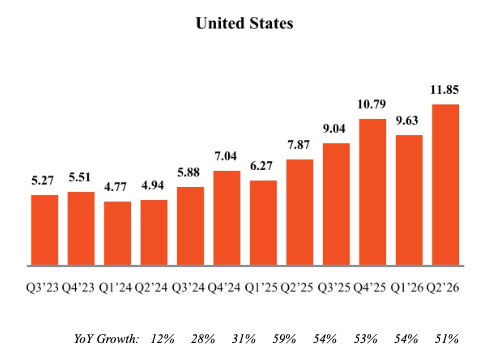
There’s a discrepancy worth flagging before we go further. Reddit’s reported U.S. ARPU (I repeat: that’s the U.S. figures only) for Q2 2026 is $11.85. BofA’s estimate for the same quarter was $10.00.
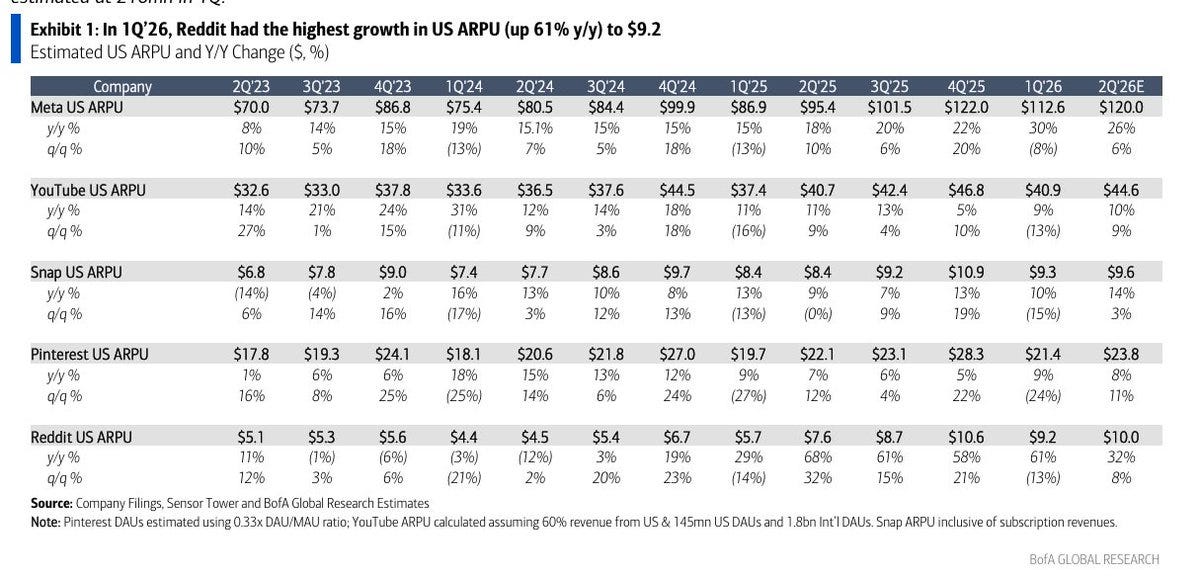
That’s a gap of more than 15%. I’m nonetheless going to use their figures as I want to understand what closing the gap to Pinteresting would do to the compounding rate.
My approach is to use company-reported figures when modeling Reddit itself, but to use BofA’s series when comparing Reddit to peers and thinking through what kind of compounding rate “closing the gap” would accomplish, because within the BofA table at least everything is measured the same way.
One thing leaps off that peer table and deserves a moment. Reddit has already passed Snap. Snap’s BofA estimated U.S. ARPU sits at $9.60 for Q2 2026 against Reddit’s $10.00, and Reddit is growing that line somewhere between 32% and 61% while Snap manages 10% to 14%. So the “massively under-monetized” story has already been half-answered against one benchmark, in a way.
The next question is whether catching up to Pinterest, sitting at roughly 2.4x Reddit’s level, is the next stop for Reddit. I think it very well might be.
If you work in marketing, I would love to hear your thoughts. What are you seeing on the ground? How durable is the ARPU trend Reddit has achieved?
So if I take the Pinterest comparison seriously, what growth rate does it actually imply? On a trailing-twelve-month basis using BofA’s series, Reddit’s U.S. ARPU runs about $38.50 against Pinterest’s $96.60. Call it a 2.5x gap. Closing the gap would compound Reddit’s ARPU at 20.2% over five years.
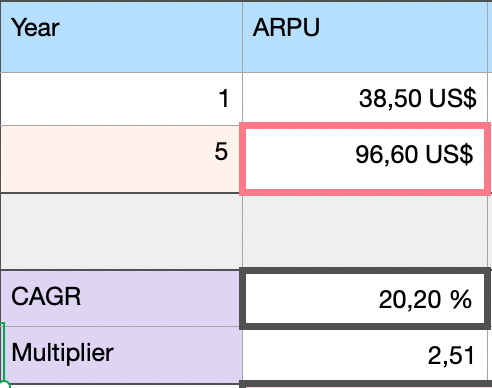
The mistake I see people make here is treating that as a fixed target, when Pinterest’s own ARPU is compounding at something like 5 to 9% a year.
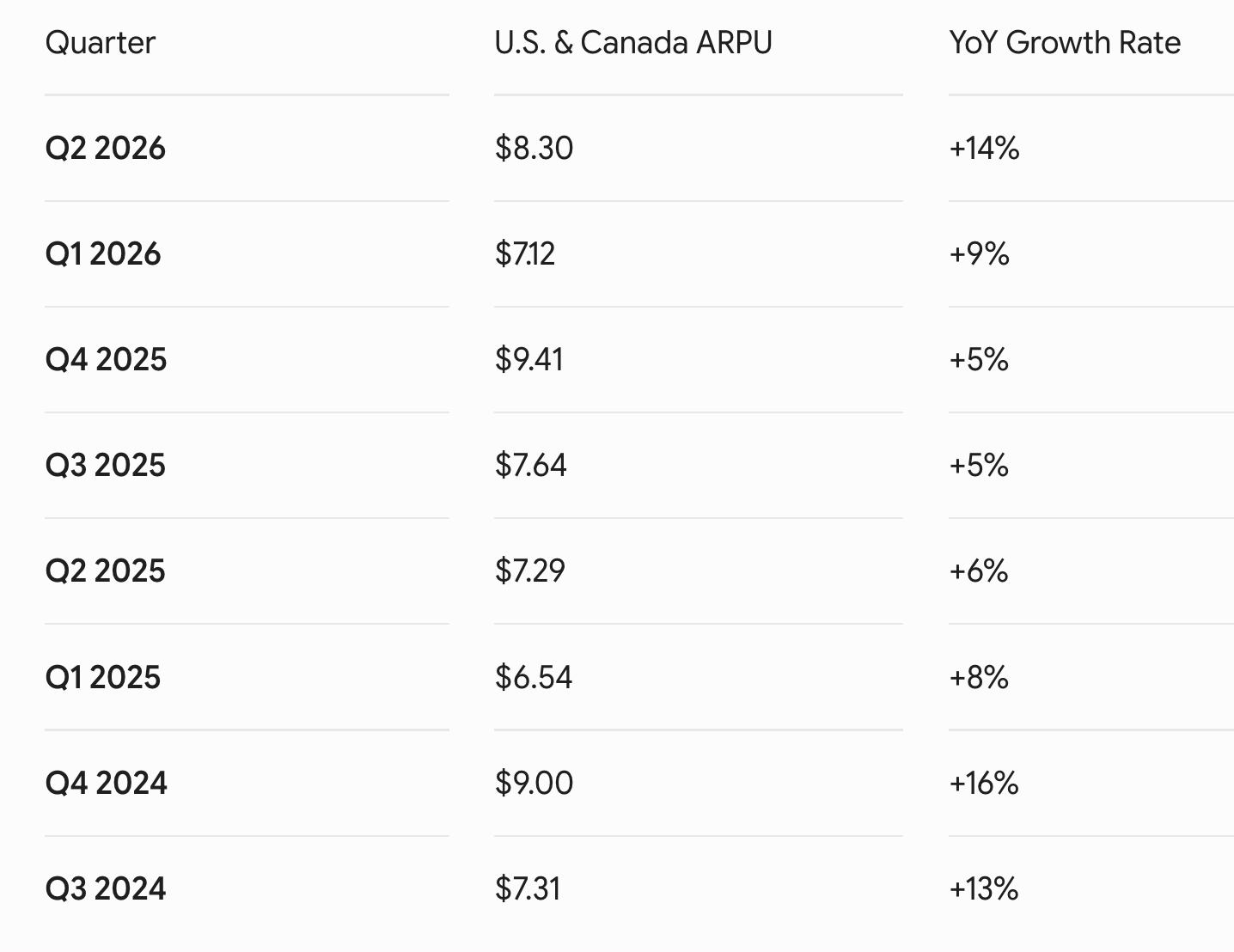
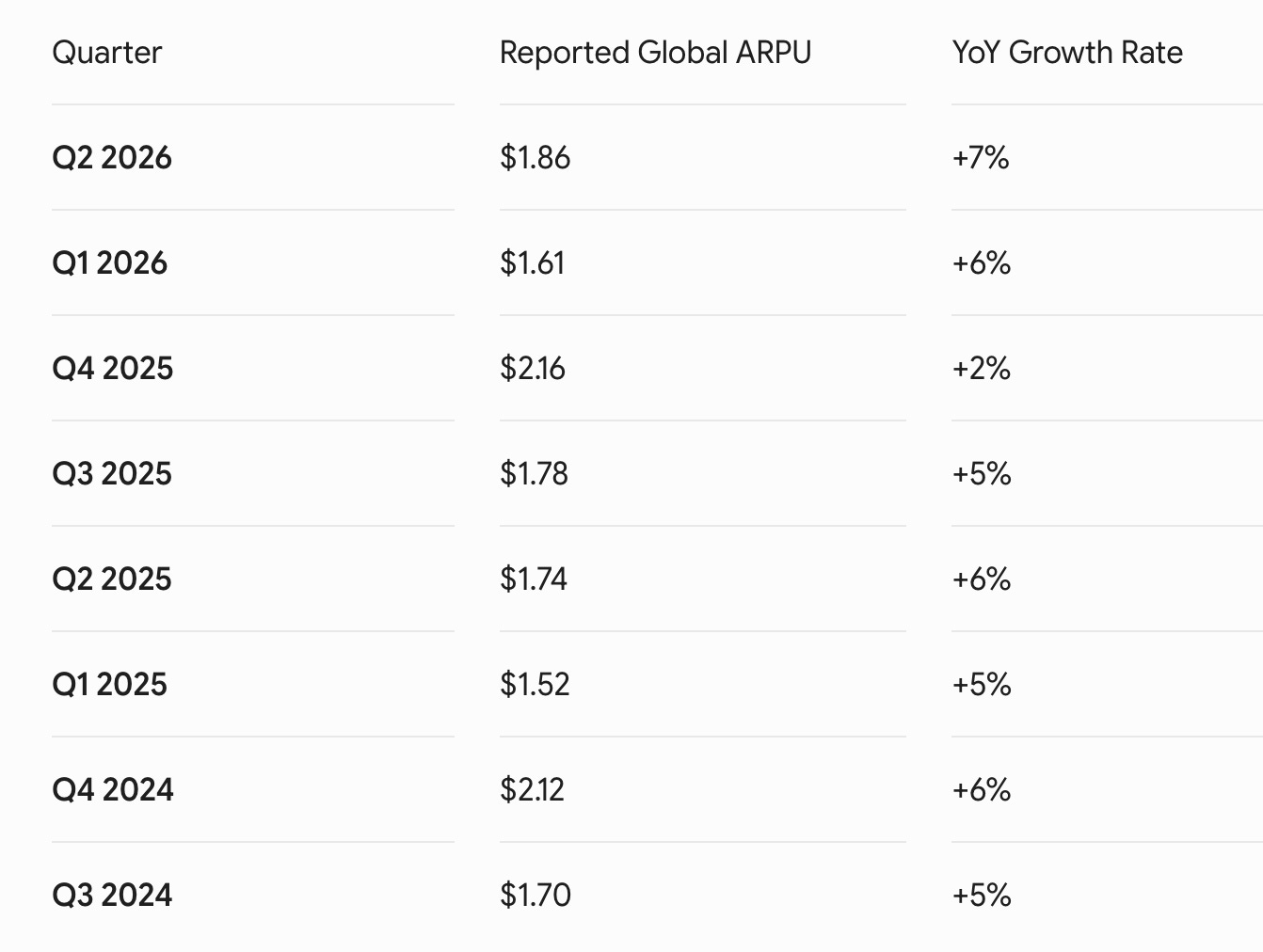
You’re chasing something that keeps moving. And it makes a difference! See for yourself.
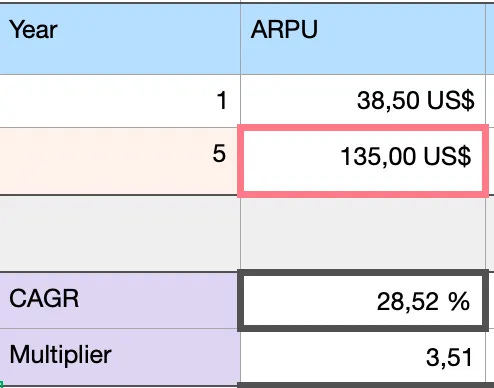
Here is a clean comparison:

The spread between those two rows makes a difference as you can see. Twenty percent a year for five years gets Reddit to where Pinterest stands today, which is a genuine achievement but not “closing the gap” (if Pinterest keeps growings its ARPU) and might not be enough to justify today’s valuation (more on this below).
Actually converging, however, means sustaining something closer to 29%, and that requires Reddit to hold roughly half its current ARPU growth rate for half a decade. Not impossible when the levers are this untouched. I’d file it as the bull-ish case rather than the base case, though.
While I’m here, let me kill an idea I initially liked and then talked myself out of. My instinct was to take a convergence figure and add 3% for inflation on top. Don’t do this. It double-counts, twice over. Pinterest’s own 7% ARPU growth, which we assumed, already embeds ad-price inflation, so the “moving-target” number has it baked in. And more fundamentally, within the ABCD framework, inflation is the D lever – CPM growth is price growth (inflation + pricing power). Layering an inflation adjustment on top of a CPM assumption counts the same thing twice. Better to choose the CPM growth rate deliberately, note that it includes ambient ad-price inflation, and stop there.
Working through the four levers
Pricing
Starting with D, since we just talked about pricing. CPMs rose 40% year over year in Q2 2026, which is genuinely spectacular, which I however refuse to extrapolate.
“During the three months ended June 30, 2026, ARPU was $6.18, an increase of 36% compared to $4.53 for the prior year period, United States ARPU was $11.85, compared to $7.87 for the prior year period, and rest of world ARPU was $2.26, compared to $1.73 for the prior year period. The increase in global ARPU compared to the prior year period was due primarily to an increase in advertising revenue driven by an increase in pricing and an increase in ad impressions delivered. During the three months ended June 30, 2026, the price of ads increased by approximately 40% compared to the prior year period driven by improved performance across the full funnel of ad objectives and higher advertiser demand. During the three months ended June 30, 2026, ad impressions delivered increased by approximately 17% compared to the prior year period driven in part by ad load optimization and improvements, including new ad placements, and by increases in the number of users and user engagement.“ - Q2 10-Q
That figure is catch-up off a depressed base rather than a multi-year run-rate. What might sustain higher pricing over five years is the mix shift toward lower-funnel performance formats – e.g. financial services bidding up 25% a year against CPG’s 3% –, and eventually search being monetized.
What caps it eventually may the platform’s its pseudonymity. Reddit will never have the identity-level targeting precision that lets the largest platforms charge what they charge, and I think that’s a permanent structural ceiling rather than a temporary gap.
I’d underwrite 8 to 12% CPM growth over the next five years, call it 10%.