

You can read this article entirely for free. I probably invested 40+ hours in putting this piece together. If you find value in this research, consider ...
leaving a comment,
subscribing,
leaving a like,
sharing it with your investing friends or community, or
becoming a Premium Member for less than €1/day (and becoming a member of our WhatsApp community!)
or a combination of the above.
All of the above supports my work. And it certainly will put a smile on my face.
I also highly recommend checking out “The Library” to see what else I write/wrote about; you can find it right on the homepage.
Welcome back to my deep dive series, where we look into Reddit! In this second installment, we shift our focus to truly understanding Reddit’s business: its segments and products, its customers, its value proposition, the industry it is competing in, and other findings.
By the end of this post, you’ll have a clear understanding of what makes Reddit an exceptional company with both a strong business model and a management team primed for long-term success.
Here’s the table of contents of the series once again:
What this deep dive series covers:
The five-part bull case (”Bam Bam Bam Bam Bam”)
What went wrong
Investment Slide Deck – the deep dive in a highly compressed + visualized form
Every deep dive now comes with a companion slide deck. It’s the whole argument in compressed form – the hypothesis, the business, the competitive position, the valuation, and the case against – for the days when you don’t have an hour to spare but still want the shape of the thing. Paid subscribers get both, the long piece and the deck, on every deep dive from here on.
The origin story
The business itself
Unit economics analysis
The customer
Legal structure, cyclicality, and operating leverage
The moat
Is it a good business in a good industry
Management and governance
Growth drivers and forecasting
Margins outlook
Valuation (including a downloadable model)
Other interesting findings
Before we start!
Before we start, I highly recommend reading part 1 first, in which the high-level hypothesis (five BAMs) is shared in around 15,000 words (packed with qualitative insights and critical thinking; arguably the most thorough analysis of Reddit’s business on the Internet).
Deep Dive: Reddit ($RDDT) – Part 1

There are certain kinds of companies that everyone has heard of, that everyone has an opinion about, yet almost no one has actually studied them in depth. Reddit might be the most recent, purest example of this.
Disclaimer:
As of the date of publication the author owns no shares in the company; but that may change. The analysis presented in this blog may be flawed and/or critical information may have been overlooked. The content provided should be considered an educational resource and should not be construed as individualized investment advice, nor as a recommendation to buy or sell specific securities. I may own some of the securities discussed. The stocks, funds, and assets discussed are examples only and may not be appropriate for your individual circumstances. It is the responsibility of the reader to do their own due diligence before investing in any index fund, ETF, asset, or stock mentioned or before making any sell decisions. Also double-check if the comments made are accurate. You should always consult with a financial advisor before purchasing a specific stock and making decisions regarding your portfolio.
Understanding Reddit!
History
Before I go further into the business, it’s worth slowing down on what this company is and how it got here.
Reddit’s history is unusually instructive, because the thing that makes it valuable now – 20 years of accumulated human conversation – is the direct product of two decades of decisions, crises, and near-misses.
You don’t get the unique asset Reddit represents today without the history, without the ups and downs and the occasional hiccups. So let me walk through it.
Founding and Early "Exit": From 25 links to the front page of the internet
Reddit began in June 2005 as a project by two University of Virginia roommates, Steve Huffman and Alexis Ohanian, in the inaugural class of the startup accelerator Y Combinator.
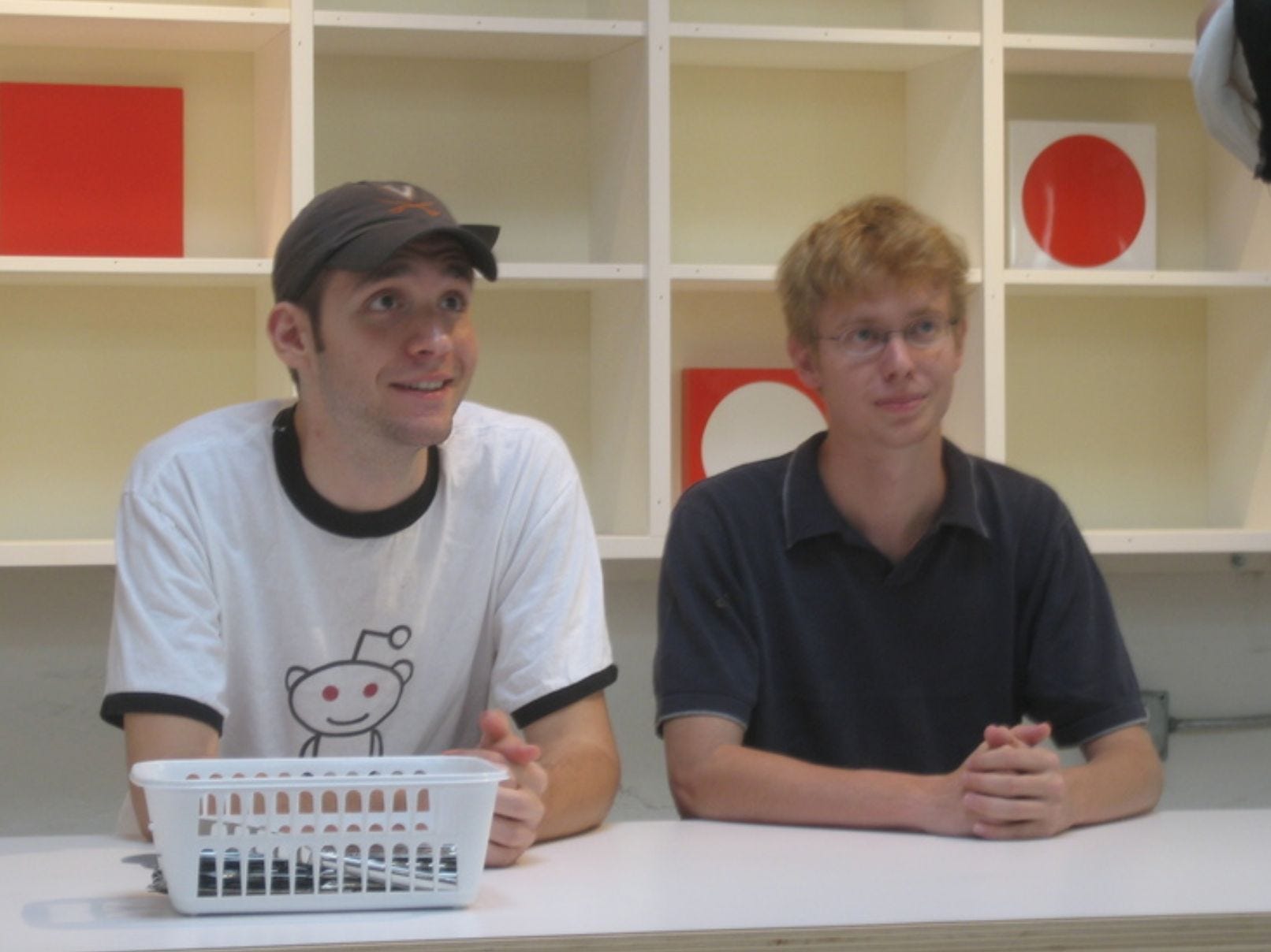
The idea they pitched wasn’t Reddit at all. It was a mobile food-ordering service called MyMenu, and Paul Graham rejected it, steering the pair toward a link-aggregation site instead.
“Their idea was bad though. And since we thought then that we were funding ideas rather than founders, we rejected them. But we felt bad about it. Jessica was sad that we’d rejected the muffins. And it seemed wrong to me to turn down the people we’d been inspired to start YC to fund.
I don’t think the startup sense of the word “pivot” had been invented yet, but we wanted to fund Steve and Alexis, so if their idea was bad, they’d have to work on something else. And I knew what else. In those days there was a site called Delicious where you could save links. It had a page called del.icio.us/popular that listed the most-saved links, and people were using this page as a de facto Reddit. I knew because a lot of the traffic to my site was coming from it. There needed to be something like del.icio.us/popular, but designed for sharing links instead of being a byproduct of saving them.
So I called Steve and Alexis and said that we liked them, just not their idea, so we’d fund them if they’d work on something else. They were on the train home to Virginia at that point. They got off at the next station and got on the next train north, and by the end of the day were committed to working on what’s now called Reddit.“ - Paul Graham
What they built was a plain page of links they liked to call the front page of the internet. On August 13, 2005, real user posts filled the home page for the first time, a small milestone that mattered because it meant the thing had users.
“I think of August 13, 2005 as the day Reddit really came to life. We had been online for a couple of months, but until then there had never been enough posts from users on any day to fill the front page. That morning, to my surprise, I opened Reddit to discover the home page was overflowing with posts from real users for the first time.“ - Reddit Co-Founder in the S-1 Filing
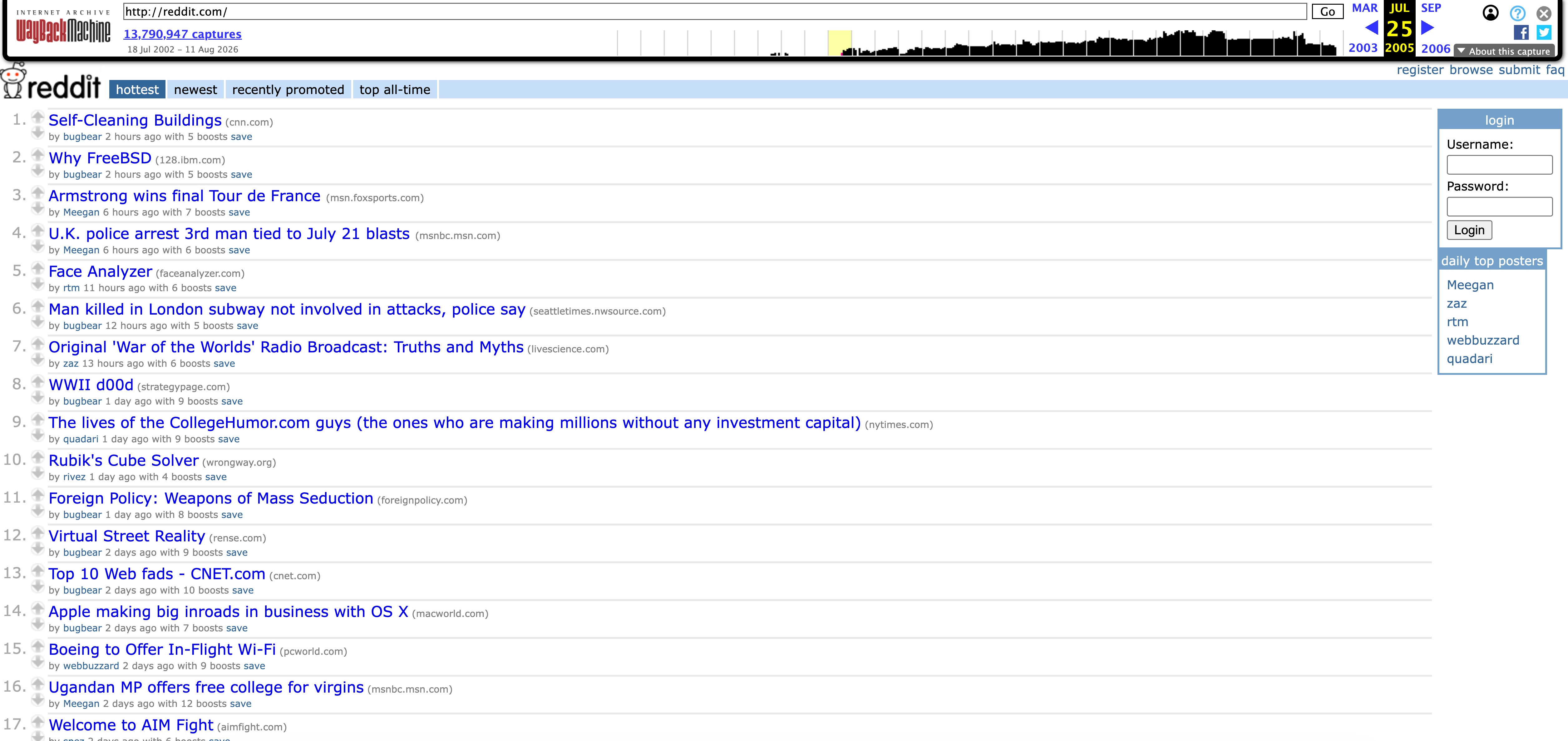
Later that year Reddit merged with Aaron Swartz’s Infogami, folding Swartz’s Python framework into the core stack and adding his architectural fingerprints to the early product.
Then came a decision that has aged strangely. In October 2006, barely a year after launch, the founders sold Reddit to Condé Nast, parent Advance Publications, for somewhere between $10 and $20 million, and left soon after.
At the time it looked like a clean win for two young founders. In hindsight, it’s cited as one of the great corporate undervaluations in tech history. The Condé Nast years did serve a purpose, though. They gave a bandwidth-hungry site the capital to survive its own growth. And in 2008, Reddit made the single most important architectural choice of its life: it launched user-created subreddits, which decentralized the platform into interest-based communities and, almost as a side effect, shifted moderation from an engineering chore into the hands of volunteer community moderators.
The self-governing city that defines Reddit today was born in that one product decision. The Data API arrived the same year, a detail that becomes enormously important 15 years later.
“Reddit has become one of the internet’s largest open archives of human experiences and Reddit data can be utilized in many ways – to both improve our platform and for commercial application. Since introducing our Data API in 2008, we have seen thousands of applications built – tools, and utilities dedicated to improving the user experience. While we recognize that many of our users enjoy using third-party applications that contribute to Reddit in many important ways, we also concluded that we needed to better manage infrastructure and opportunity costs – especially with commercial entities that require large-scale data use from our API.“ - S1 filing
In 2011, Advance spun Reddit back out as an independent company while keeping majority equity, restoring operational autonomy to a business that had grown culturally huge and financially unprofitable.

Reddit General Manager Erik Martin said in an interview back then that Reddit was getting 700,000 page views a day (about 21 million views per month) when it was acquired in 2006, and by 2011 it was getting 1.6 billion page views a month on 21 million unique users.
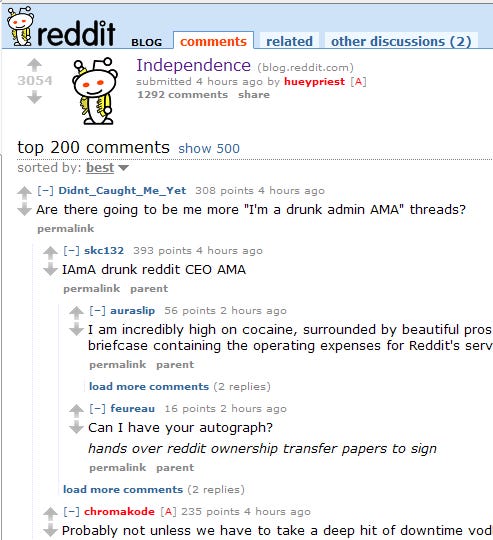
A decade of governance crises
For most of its first ten years, Reddit ran on something close to free-speech absolutism, and that stance repeatedly collided with reality. The mid-2010s were genuinely chaotic. CEO Yishan Wong, who took over the CEO role only in 2012, resigned in 2014 over, of all things, an office real-estate dispute, handing the role to interim CEO Ellen Pao. Pao absorbed the community’s fury when she banned notoriously toxic subreddits and, separately, when the company fired popular employee Victoria Taylor – an episode that triggered a site-wide moderator blackout in 2014 and 2015.
Victoria Taylor was the Director of Talent who managed high-profile Ask Me Anything (AMA) sessions on r/IAmA. She was fired without warning or a transition plan for the volunteer teams who relied on her. The sudden loss stranded live Q&As and ignited "AMAgeddon" – a massive strike where volunteer moderators locked down hundreds of popular subreddits to protest corporate miscommunication, poor moderation tools, and executive efforts to commercialize the platform. The site-wide shutdown disrupted major traffic across Reddit, forcing public apologies, the resignation of interim CEO Ellen Pao, and promises from management to provide direct support and improved resources for the platform's volunteer workforce.
It was the first time the community demonstrated, at scale, that it could turn off the lights. It would not be the last.
Then, Huffman came back as CEO in July 2015, and his return marked a strategic turn as much as a personnel one.
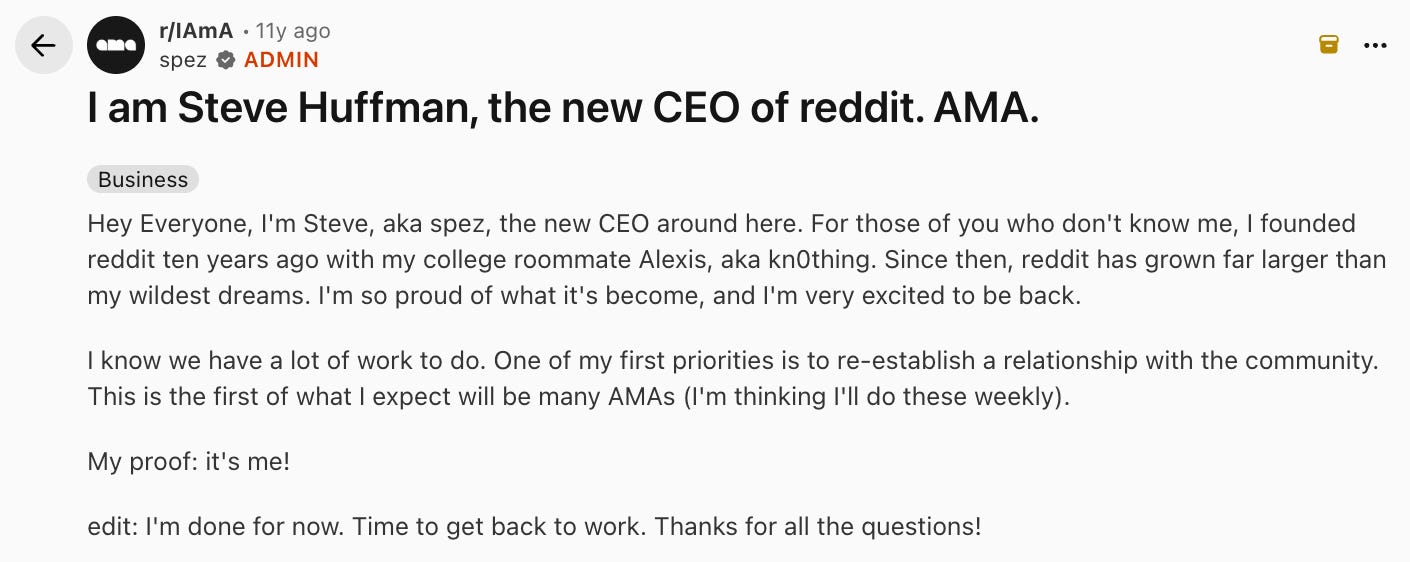
He replaced the wild-west ethos with formal content policies, systematically banning illegal, non-consensual, and explicit hate content, and he began the long, unglamorous work of modernizing infrastructure that had been neglected for years.
The political flashpoints kept coming. Subreddits like r/The_Donald became centers of platform manipulation and hate speech through the 2016 and 2020 election cycles, and in June 2020 Reddit permanently banned it, closing the book on its absolutist era.
That same month, Ohanian resigned from the board amid national unrest (at the height of the Black Lives Matter protests) and explicitly asked to be replaced by a Black director, following earlier allegations from Pao that the platform had long tolerated racism – a promise Reddit fulfilled shortly after by appointing Michael Seibel, former CEO of Y Combinator. These weren’t sideshows. They were the company slowly learning that a platform built on human speech has to decide what kind of speech it will host, and that every such decision costs it something with some part of its base.
Building the money machine, and the revolt it provoked
The commercial Reddit really starts around 2016. The company had served ads since 2009, but serious monetization didn’t begin until it started investing heavily in proprietary ad technology later in the decade; arguably meaningful monetization efforts did not begin until 2018.
“We started selling advertisements on Reddit in 2006. We began more meaningfully investing in our own ad technology and foundation in 2018. We built our advertising business by focusing on top U.S.-based advertisers, and over time we have expanded our focus towards mid-sized and smaller advertisers as well as new geographies. We believe we have a significant opportunity to increase our revenues from existing customers, as well as attract more advertisers to Reddit by enabling more ways for customers to invest to grow their business on Reddit, and intend to continue to make technological investments in this area. […]
We believe we are in the early stages of monetizing our user base, and we plan to expand our monetization efforts in ways that build on the core values of our platform. We plan to drive growth in advertising revenue by focusing on initiatives to support advertising improvements, including increased use of artificial intelligence in our advertising solutions. We also intend to open additional monetization channels for Reddit by providing our users and creators with the requisite tools and incentives to drive continued creation, improvements, and commerce. […]“ - S-1
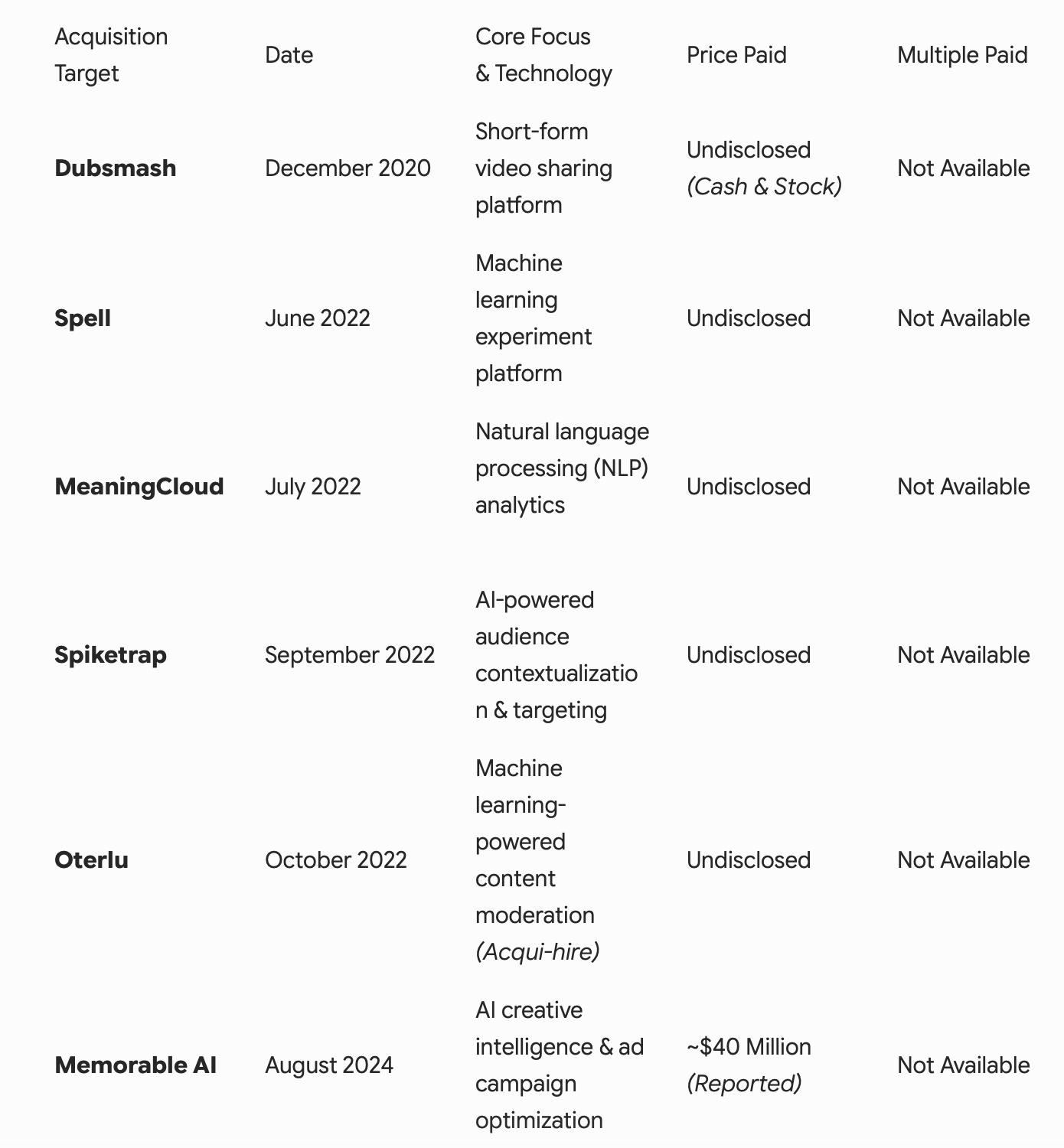
Reddit acquired the video platform Dubsmash in 2020 and contextual-ad firm Spiketrap in 2022, rebuilding its ad-bidding stack to go after the performance marketers who almost exclusively focus on Meta and Google.
Somewhere in this stretch, Reddit, somewhat quietly, won the war for online advice, outlasting Yahoo Answers and Quora to become the internet’s default forum for human recommendations – the very position that makes it indispensable to AI models today.
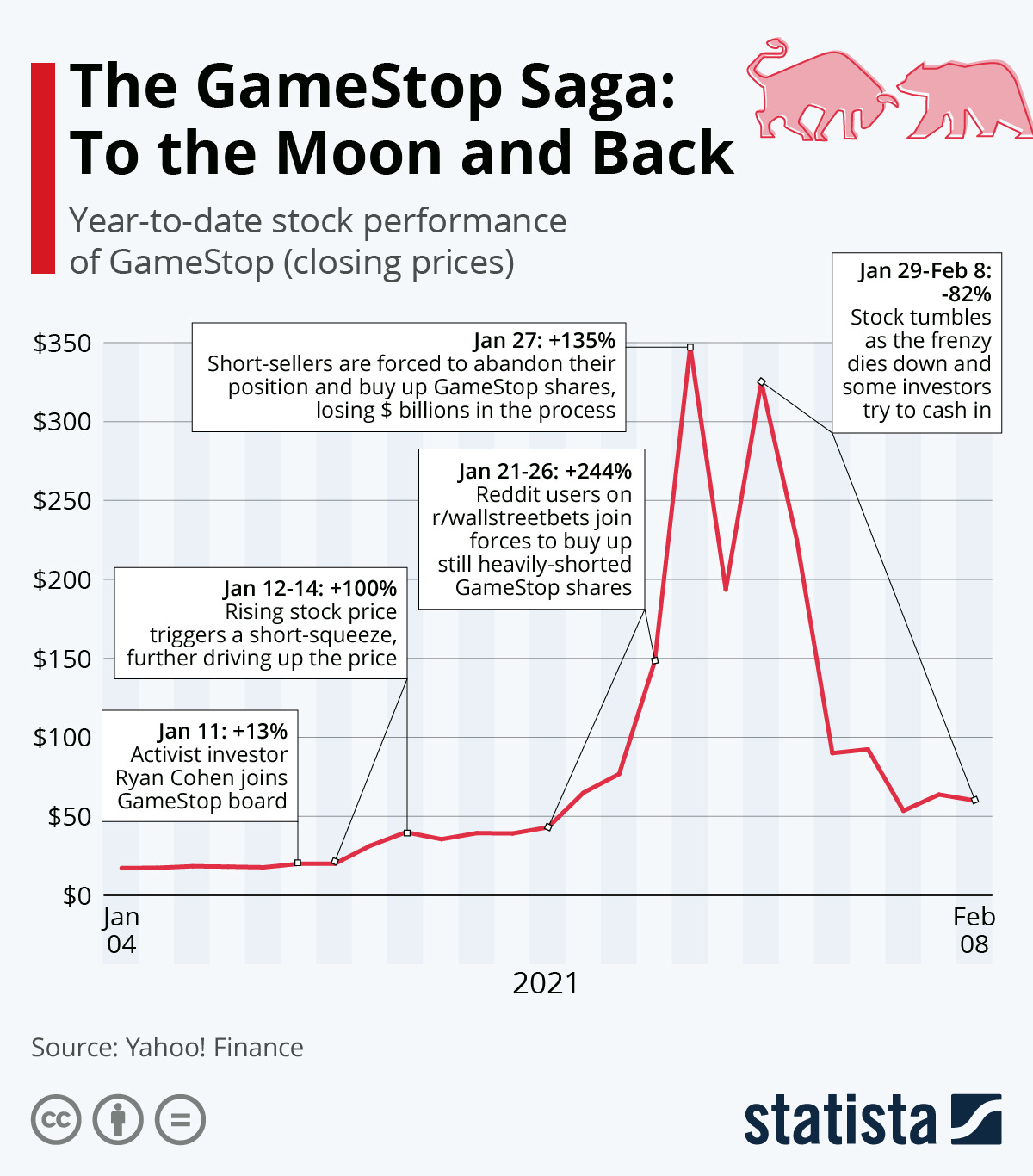
Two events in the early 2020s defined the modern company. The first was cultural proof of power: in January 2021, r/WallStreetBets drove the GameStop short squeeze, showing that Reddit could coordinate mass consumer behavior well enough to bloody actual hedge funds.
The second was the fight that set up everything we discussed in part 1 of this series quite extensively already. In mid-2023, Reddit announced paid API tiers at $0.24 per 1,000 requests, explicitly to stop AI companies from scraping its conversation data for free. The pricing was steep enough to kill high-profile third-party apps like Apollo, and the community erupted (which may be an understatement) – more than 8,000 subreddits went dark in protest.
This time Huffman refused to fold. He threatened to replace uncooperative moderators and asserted, bluntly, that the communities were corporate assets. It was an ugly, revealing moment. It was also, in cold commercial terms, the decision that made the data-licensing business possible. You can dislike how it was handled and still recognize that the API fight is why the “other revenue” line exists at all.
Reddit API Controversy Timeline
April 18, 2023: Reddit announces plans to start charging for access to its Data API (which had been free since 2008), primarily targeting tech companies using Reddit data to train large AI models.
May 31, 2023: Christian Selig, developer of the popular iOS client Apollo, reveals that Reddit’s proposed rates ($0.24 per 1,000 API calls) would cost his app roughly $20 million per year, making operation financially impossible.
June 5–8, 2023: Popular third-party applications – including Apollo, Reddit is Fun (RIF), Sync, and BaconReader – announce they will shut down permanently on June 30 rather than incur unmanageable debts.
June 9, 2023: CEO Steve Huffman (”spez”) hosts an Ask Me Anything (AMA) to address community backlash, but his refusal to walk back prices and allegations against developers further inflame anger.
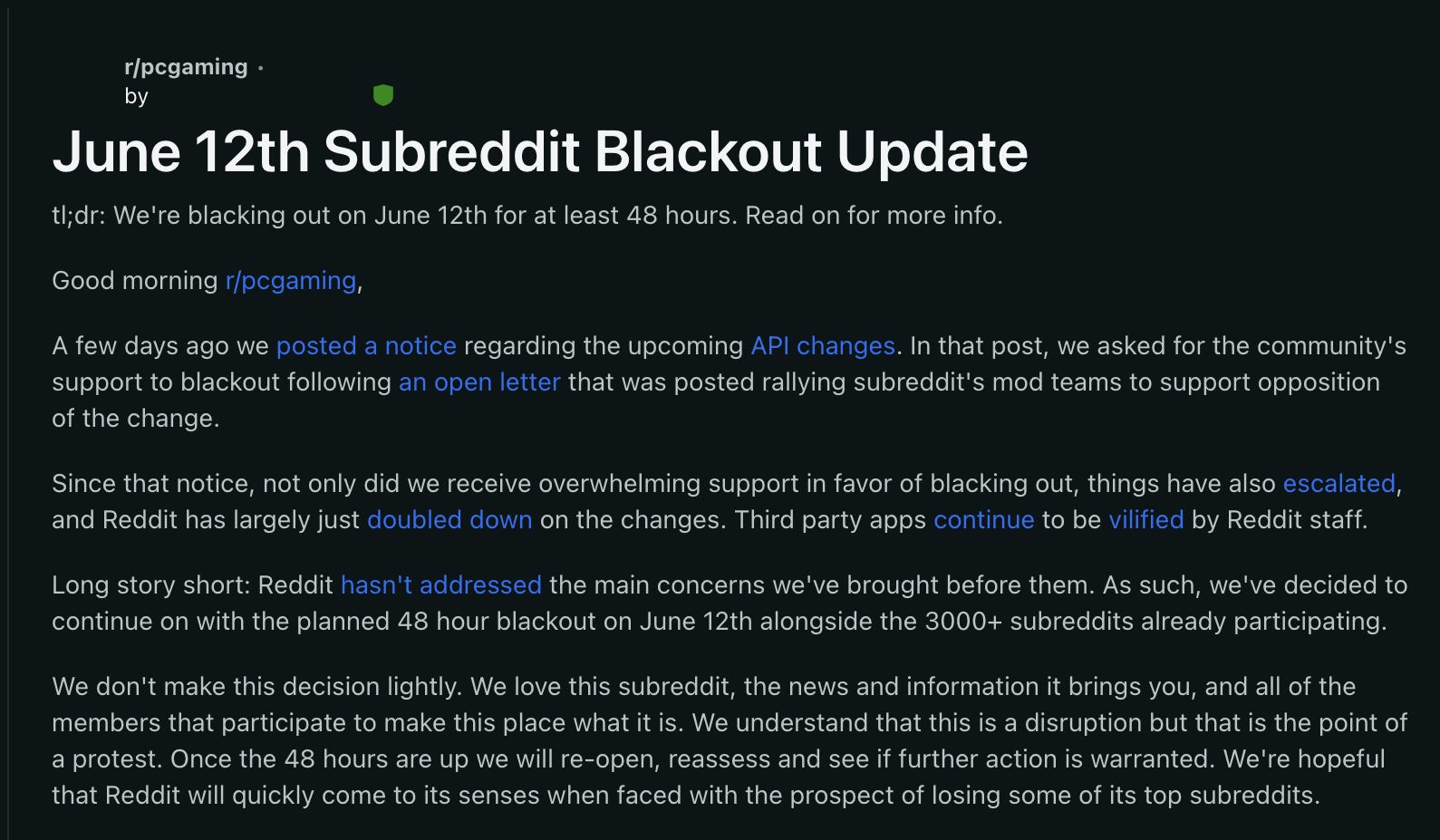
June 12–14, 2023: Over 8,000 subreddits participate in a planned 48-hour “blackout” by making their boards private or restricted, pulling down massive chunks of the site and causing temporary global outages.
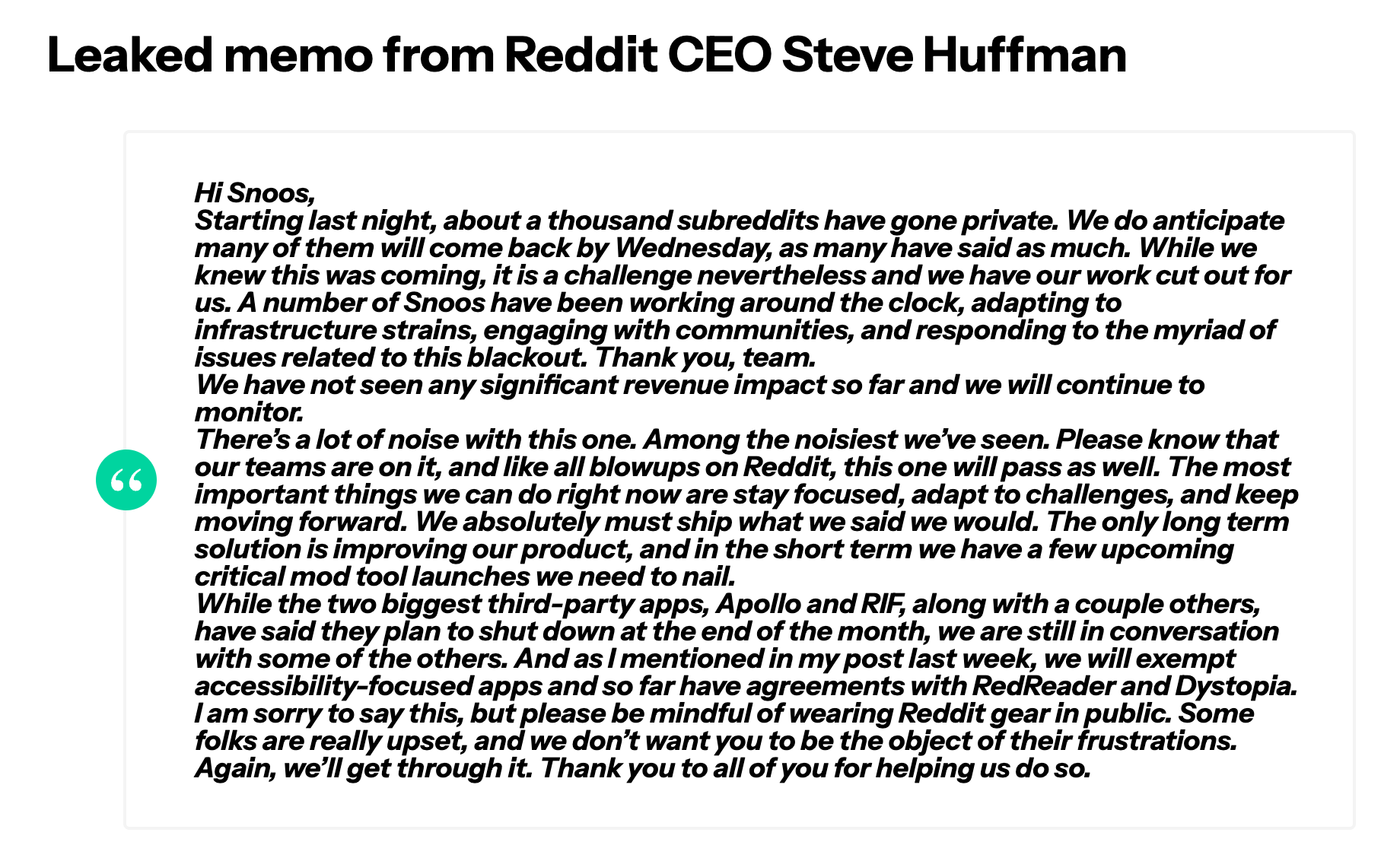
June 15, 2023: A leaked internal memo reveals Huffman telling staff that the blackout had “no significant revenue impact” and “will pass,” prompting hundreds of subreddits to extend their blackouts indefinitely.
June 16, 2023: Reddit leadership begins sending warnings to volunteer moderation teams, threatening to strip them of their privileges and replace them if they do not reopen their communities.
Late June 2023: Users adapt their tactics to avoid mod removal. Communities like r/pics and r/aww vote to post exclusively photos of comedian John Oliver, while others reclassify subreddits as NSFW to cut off Reddit’s advertising revenue.
June 30, 2023: Apollo and several other major third-party clients officially turn off their servers.
July 1, 2023: The new paid API terms officially take effect.
July 20–24, 2023: During the annual r/place digital canvas event, users coordinate mass pixel art depicting protest slogans directed at Huffman (”Fuck spez”).
The IPO and the pivot to seekers
Reddit reached the public markets on March 20, 2024, listing on the NYSE under RDDT at $34 a share, roughly a $6.4 billion valuation, raising around $748 million.
In a gesture that fit its history, it set aside a slice of IPO shares – about 8% – for its most active users and moderators through a directed share program, letting the citizens of the city become owners of it.
The commercial engine spun up fast from there. A multi-year Google data deal reportedly worth around $60 million a year gave Google real-time access to Reddit content for LLM training, and an OpenAI partnership wired Reddit data into ChatGPT, establishing the company as a core vendor to generative AI.
Revenue pushed past the $2 billion mark on the back of programmatic ads and high-margin licensing, net income turned positive for the first time in Q3 2024, and the balance sheet strengthened enough to authorize a $1 billion buyback.
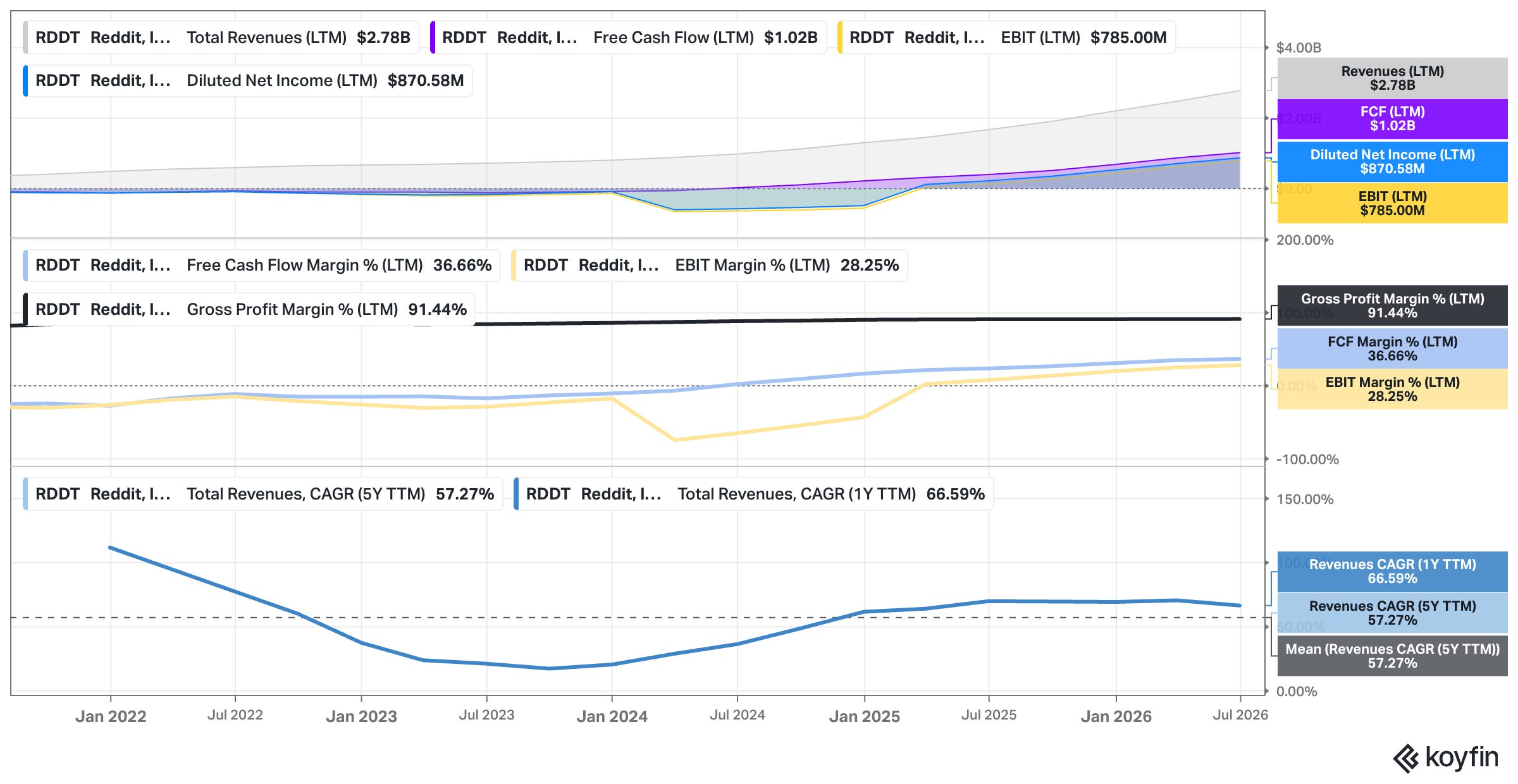
Interestingly, Reddit recently evolved its mission statement to “empower communities and make their knowledge accessible to everyone.” Read that carefully as it signals a strategy shift… The old Reddit was built for its logged-in members. The new mission explicitly embraces the seekers arriving from search engines and AI models as a core audience rather than incidental traffic – the tourists from Bam #2 in part 1, promoted to first-class citizens.
So where does that leave Reddit in its life cycle?
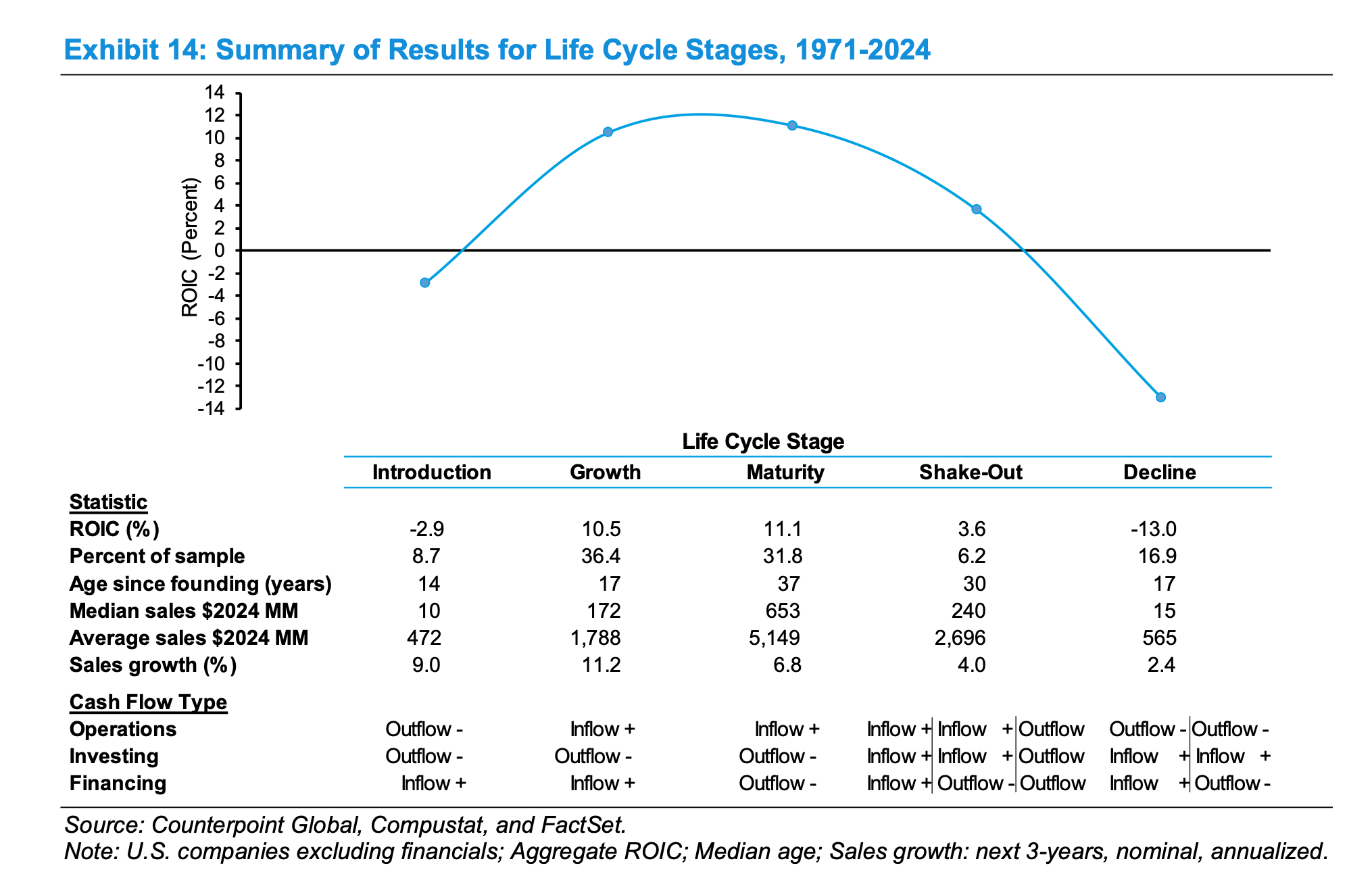
The honest answer is: it’s still to be determined. And in fact, Reddit might be in two ages at once:
As a platform, it’s 20 years old, celebrating that anniversary in 2026, mature in its culture and entrenched in its niche.
As a monetized business, it’s barely a toddler – it only became profitable in late 2024 and is still switching on entire revenue streams it has never monetized. The company is posting start-up-like growth, and it remains to be seen how durable these growth rates will prove to be.
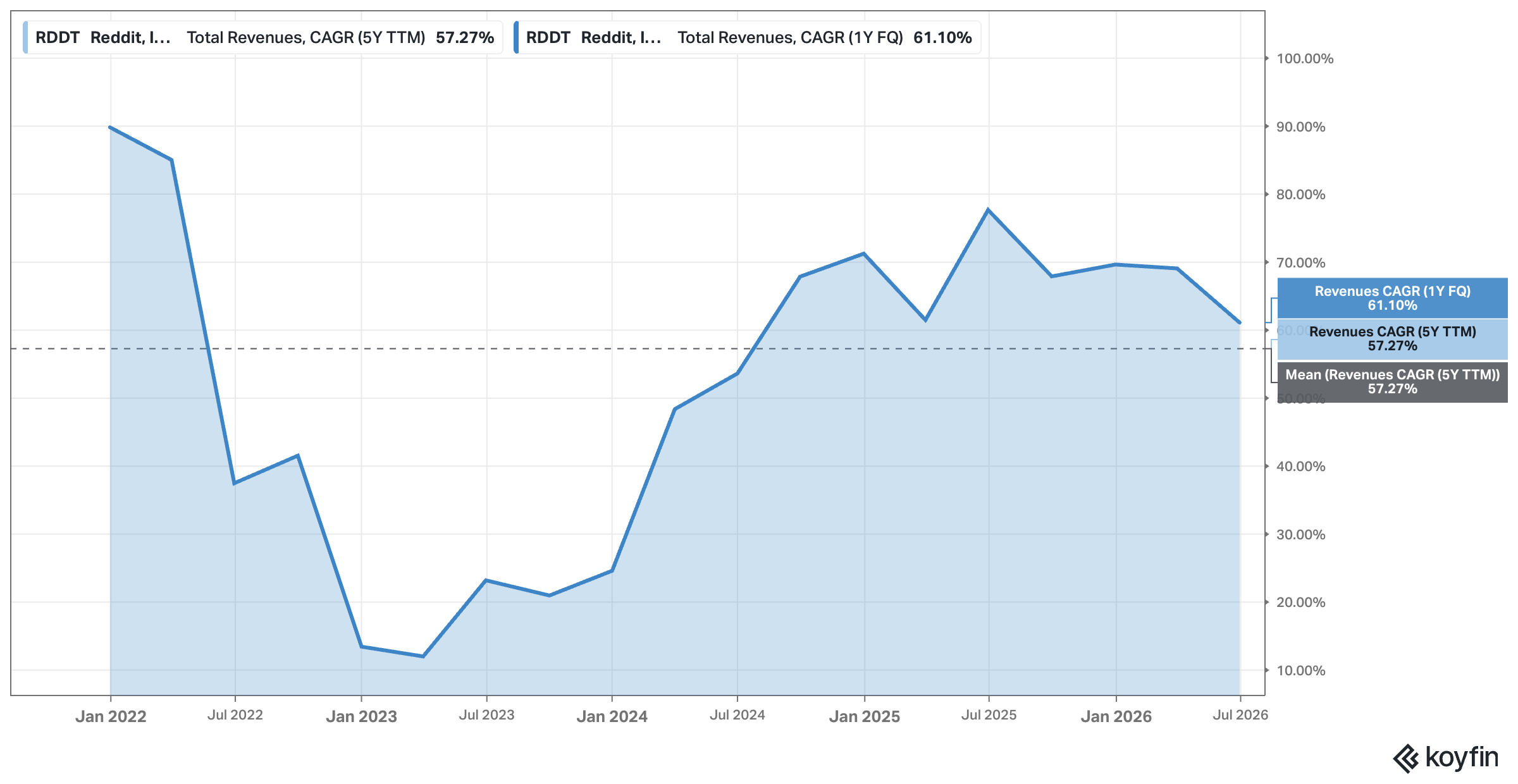
That’s the whole investment setup. An old, established asset in the early innings of learning how to make money from itself.
The history explains why the asset is so hard to replicate and took decades to build. The youth of the monetization engine is why there’s an investment hypothesis worth testing at all.
Product
Ask Reddit to describe itself, and you won’t hear the words “social network.” The company insists it’s a global digital city, a “community of communities,” and this framing is not just a marketing or branding move.
“Similar to how cities are made from cement and steel, but are really built by their citizens, Reddit is made from code and algorithms, but is really built by our users. It is a place where human ingenuity and creativity thrive. We empower users to participate and to shape Reddit by sharing content, upvoting or downvoting, and commenting. In addition, Redditors themselves not only create and build communities, but they also moderate these communities as volunteers to help keep them safe, vibrant, and true to themselves. Like cities, we design tools that give communities what they need to make their communities their own and evolve over time, rebuilding and reshaping by adapting to new technologies and reflecting new cultural trends. Newly created subreddits create a sense of belonging for their members, spurring the creation of more new subreddits to continue the cycle. In this way, Reddit’s community ecosystem grows and expands with the interests and passions of our users, keeping Reddit on trend and resilient to fading fads.“ - S1 filing
I recommend you watch this new TED Talk with CEO Steve Huffman (only uploaded one month ago), in which he expands on the “city” analogy; he also talks about what will make Reddit stand out in the upcoming AI era.
The platform is home to over 100,000 active subreddits, each functioning as a neighborhood where people talk to one another about a specific topic, from parenting to particle physics to a single television show.
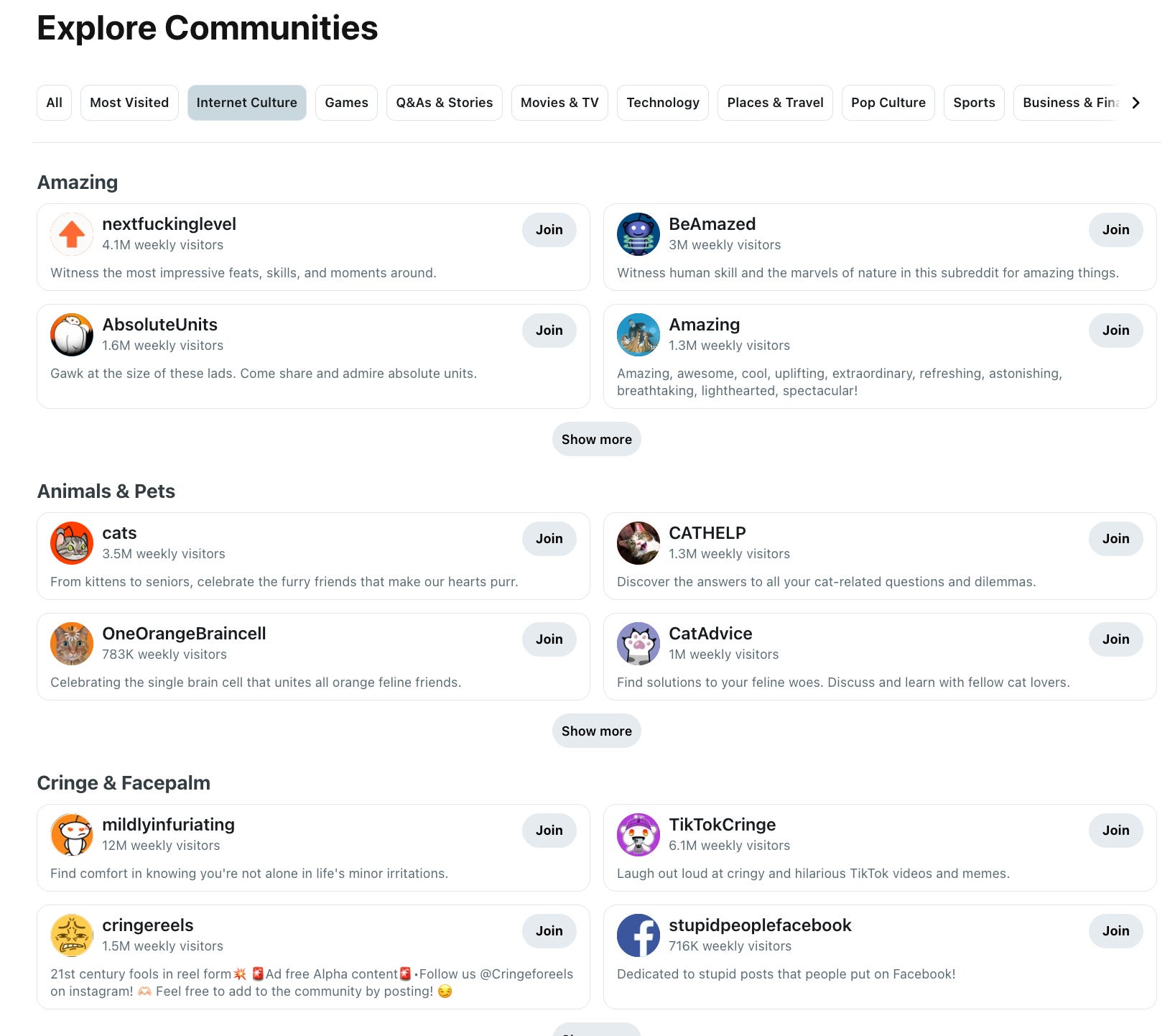
Besides the subreddits, some of the key user-facing products (to be distinguished from Reddit’s core customers (advertisers)) include:
Subreddits & Feeds: The platform is organized into over 100,000 active communities (subreddits) dedicated to specific interests. Users interact with these through a personalized “For You” feed or specific community pages.
Conversational Tools: Users participate by creating posts (text, images, video, links) and engaging in comment threads, which are considered the “heart and soul” of the Reddit experience.
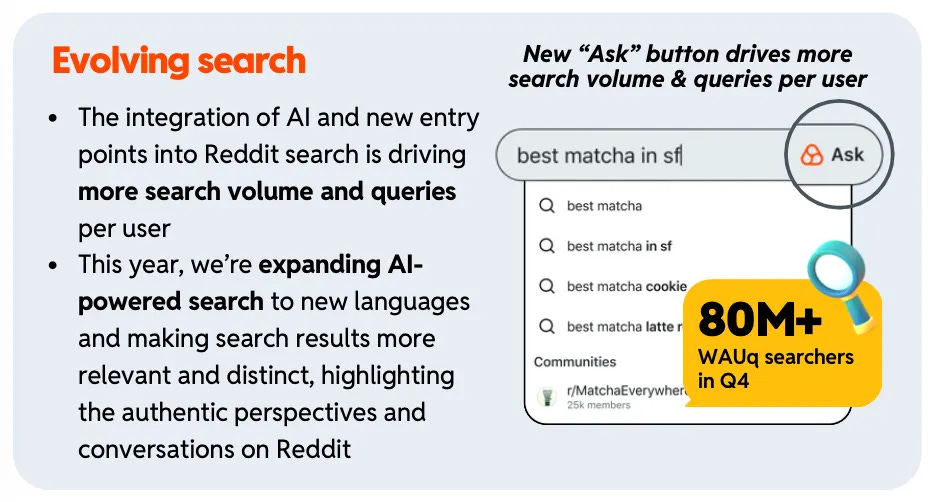
Search & Reddit Answers: Reddit is a major search destination, handling millions of daily on-platform queries (~40+ million queries per day). The company is unifying traditional search with Reddit Answers, an AI-powered tool that summarizes community discussions to provide curated responses to subjective questions.
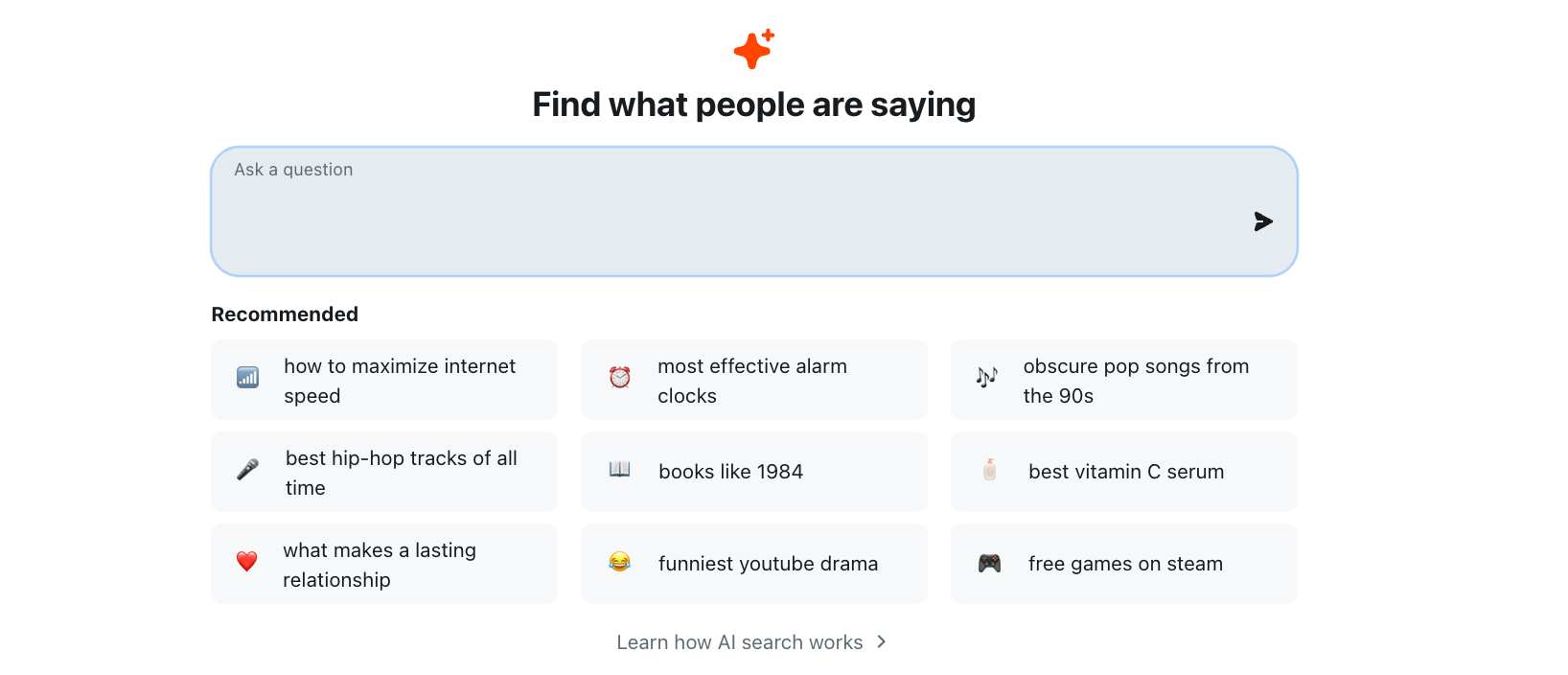
“Reddit Answers queries, I believe, were up from 1 million to […] 15 million, […] over the last year and then 60 million to 80 million overall search queries. So we're seeing nice growth there.“ - Call Transcript
“Search on the internet is evolving to become more social and shifting toward more interactive and personalized experiences as users seek authentic perspectives from real people We believe Reddit is well-positioned to capitalize on these changes with its unique advantages: a highly engaged user base, conversations with commercial intent, and the largest collection of authentic content on the internet In Q1, over 60 million WAUq used Reddit’s on-platform search, and query volume increased 10% sequentially, reaching nearly 50 million queries per day We launched our first search ML model that is driving more relevant search results, and we built modern search features, including auto-complete and auto-queries Reddit Answers, our AI-powered conversational search tool, is now available to all U.S. users and some international markets including the U.K., Canada, Australia, India, and others We are testing integrating Reddit Answers into existing surfaces where Redditors are searching on the platform, and we expect deeper integration will grow awareness, deliver more dynamic search results, and set a foundation for a differentiated search experience“
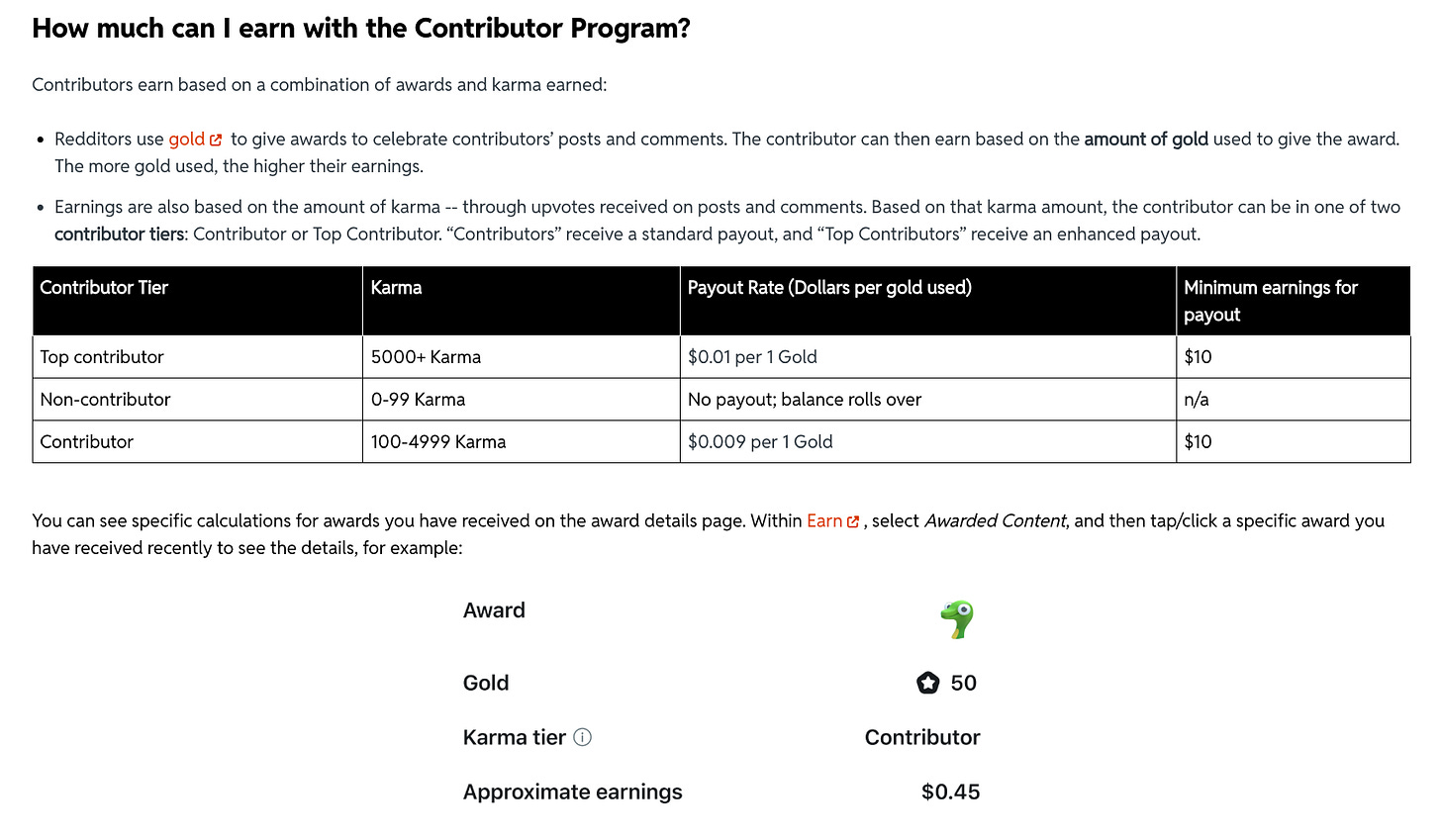
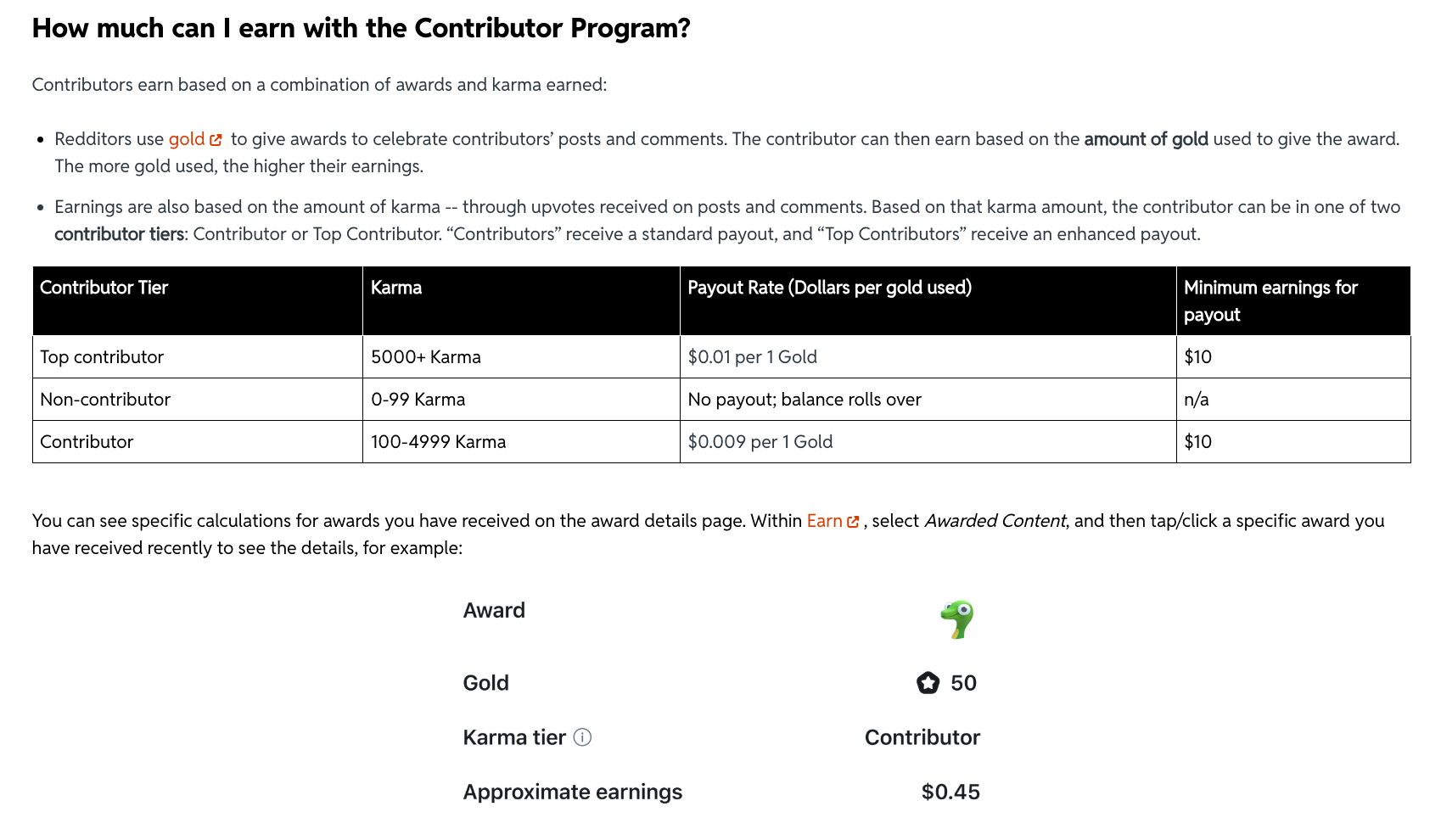
The contributor program allows eligible users to earn real (fiat) money for their contributions based on the “Gold” and “Karma” they receive from others.
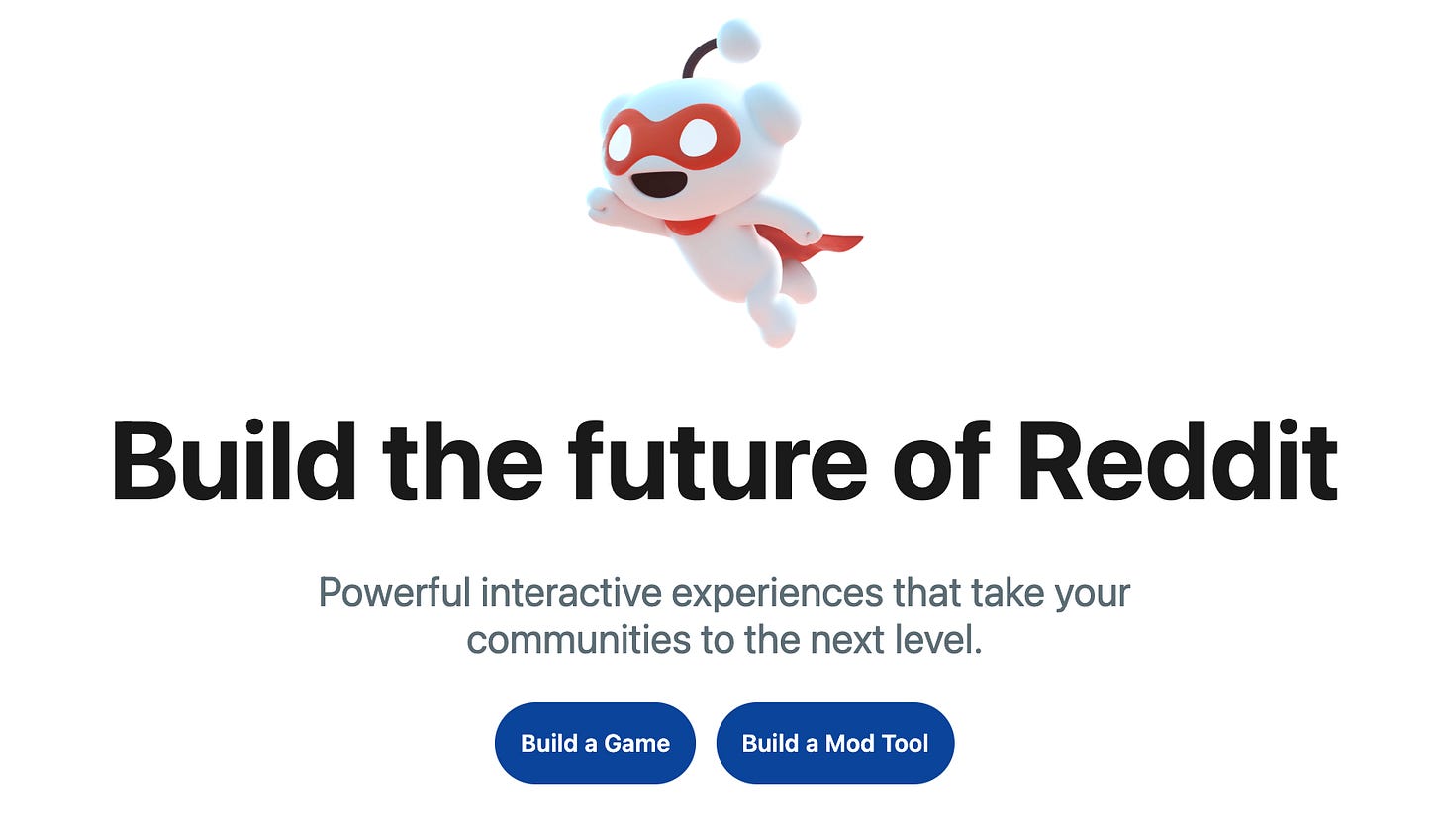
Developer Platform: Enables users to build interactive apps and games (like Flappy Goose) directly into subreddit posts.
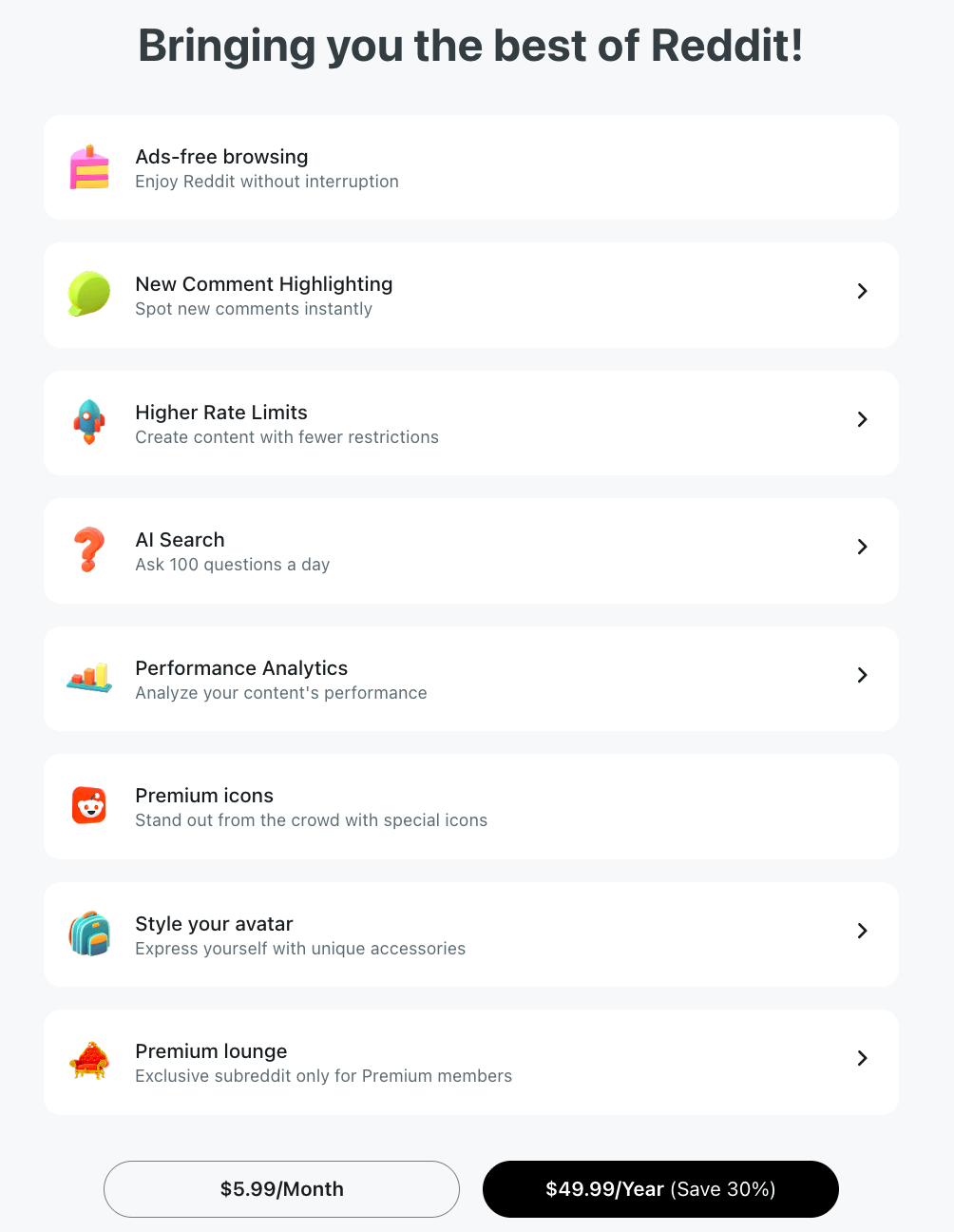
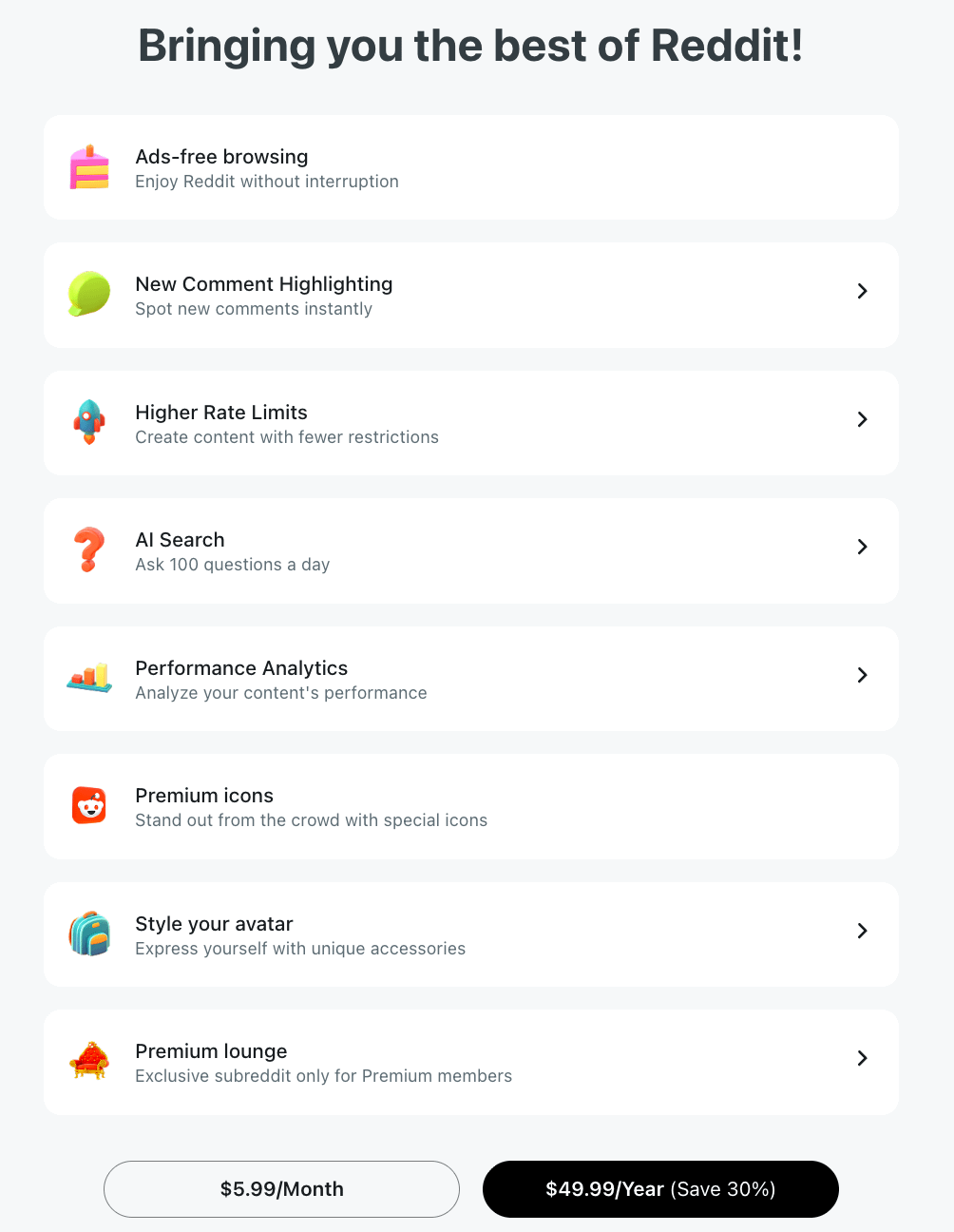
Reddit Premium: A paid subscription offering an ad-free experience, access to an exclusive “members’ lounge,” and premium avatar customization.
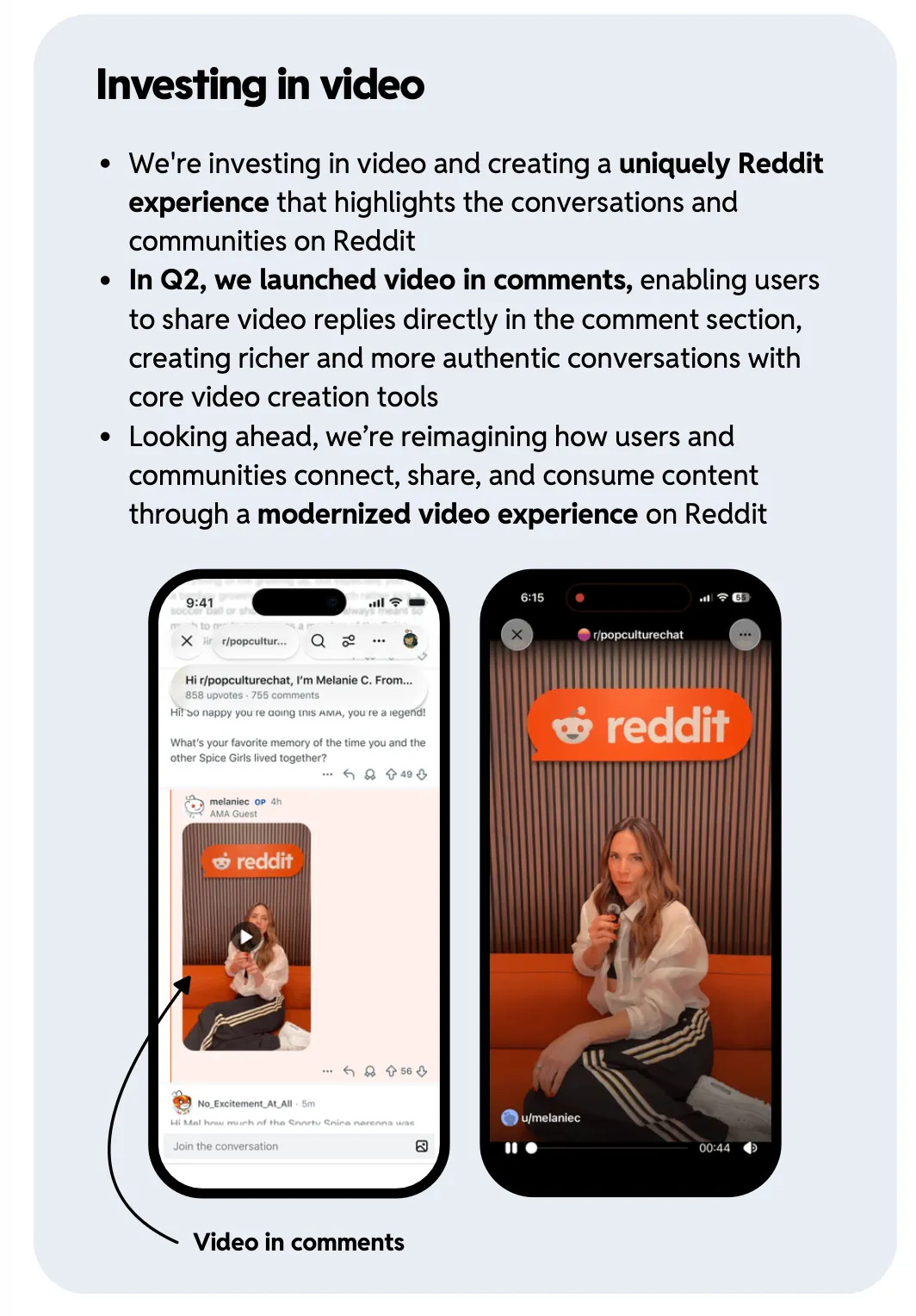
Video in Comments: A recently introduced feature allowing users to respond to threads with short video clips, enriching the conversational experience.
I also like how CEO Huffman framed the unique value proposition of Reddit (to users) at the Bank of America 2026 Global Technology Conference:
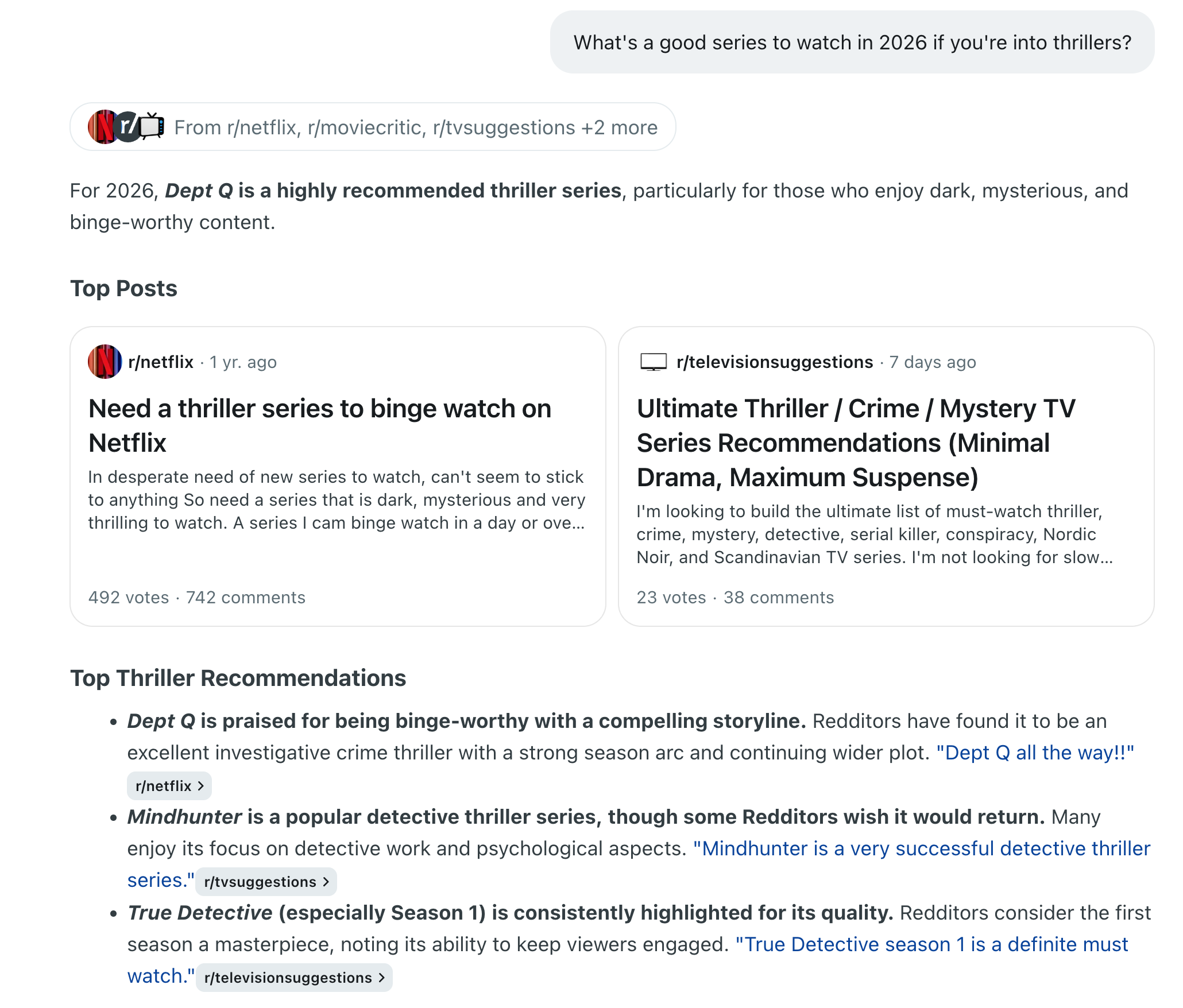
“… Reddit search, I think, is the best at questions with no answers. So you could try it right now, like what show should I watch tonight? I’d like this show, what show would you recommend? I need help with this video game. What’s the best headphone? All these things. […]
What is important for Reddit, and I think this is unique to Reddit, which is we have completely unique and differentiated content and people don’t want summaries on -- I was going to say, important questions, but sometimes it’s like what I call them questions with no answers. So let me give you an unimportant question with no answer. What should I watch tonight? People want to hear the conversation. What car should I buy? Like where should I go? What’s the best headphone? There isn’t an answer. How do I deal with XYZ issue with my kid? Like people want to hear from other parents. And so there’s plenty, I think, of commodity content on the Internet. And indeed, a few companies have been vaporized by AI, but not Reddit. And instead, I think Reddit actually becomes more and more valuable over time and people start to appreciate this, what Reddit does more and more. So we keep doubling and tripling down on our mission, communities, authenticity, Reddit being the most human place on the Internet and having confidence that however the ecosystem evolves, Reddit will be a destination.“
That value proposition, that uniqueness, that “communities within communities” structure is the whole product. Everything Reddit sells is, in one way or another, a way of monetizing the conversation those “neighborhoods” generate.
Enjoy what you are reading?
Consider becoming a Premium Member for less than €1/day to support my work and unlock our full archive and join our growing circle of investors (I highly recommend checking out “The Library” to see what’s inside; you can find it right on the homepage).
Why join the community, you may ask? Our library is fast approaching 70 comprehensive deep dives, providing institutional-level research on some of the world’s most fascinating businesses. Most recently, we’ve dissected companies like Mercado Libre ($MELI), Grab Holdings ($GRAB), Fair Isaac ($FICO), and Topicus.com ($TOI).
As a member, you get:
Complete Access: Every deep dive in our library (65+ and counting). The most thorough analyses you will be able to get your hands on (including downloadable models).
Slide Decks: Every deep dive now comes with a companion slide deck. It’s the whole argument in compressed form – the hypothesis, the business, the competitive position, the valuation, and the case against – for the days when you don’t have an hour to spare but still want the shape of the thing. Paid subscribers get both, the long piece and the deck.
More Content: Company updates; powerful valuation spreadsheets, frameworks, and processes; regular portfolio updates (insights into my investing decisions); market commentary; etc.
The WhatsApp Community: Real-time discussion and networking with like-minded investors.
Digital Investing Conferences: About three times a year, we also hold digital conferences where members present and share stock ideas, and discuss broader themes, and we’d love for you to join in!
Incredible Value: Full access to all of this for less than 1€/day.
If you want to see the level of research we provide before committing, the following deep dives are, for instance, free to read (access them via The Library):
InPost ($INPST) - generated an IRR of >400% as an acquisition offer emerged 2-3 months post write-up
DigitalOcean ($DOCN) - up 5x in less than a year post write-up release
Why I think this is worth it: Over almost two years, I’ve published 350+ posts: 65+ deep dives across ~50 companies, valuation templates, the AI tools I’ve built and shared, my Perception Change Framework, portfolio updates, and educational pieces on concepts like base rates. The deep dives get the attention, but just as much value sits in the process-oriented pieces I believe – plus the embedded thinking I reveal in every analysis.
On the commercial side, the revenue flows from four sources of very different sizes.
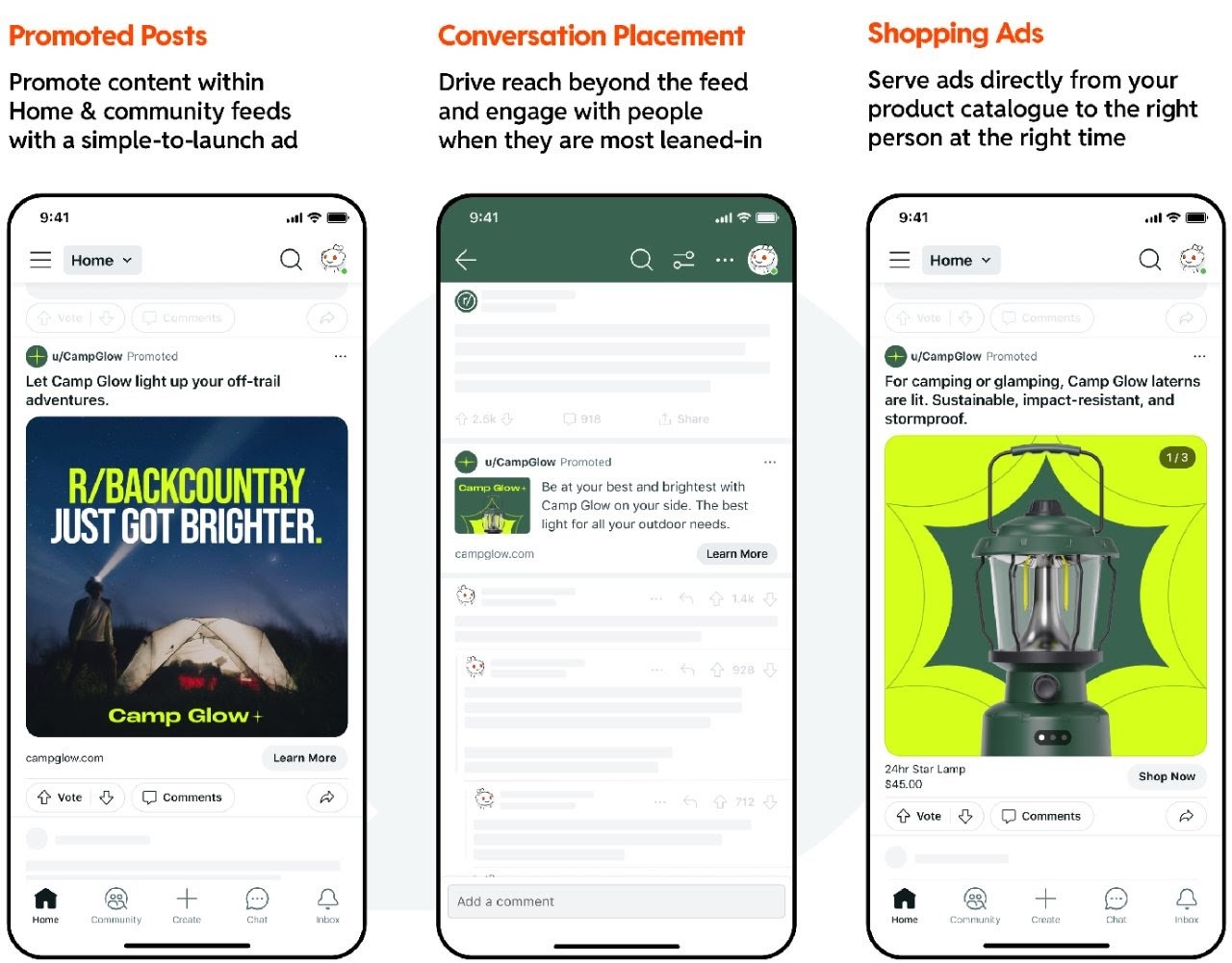
The overwhelming majority – roughly 94-95% – is advertising, and this is the business you should think of as Reddit’s core. Reddit sells access to its high-intent audience through native ad formats that are placed inside the users’ experience (without being overly disruptive, as of today). The customer-facing products (read: tools for advertisers) include:
Native Ad Formats:
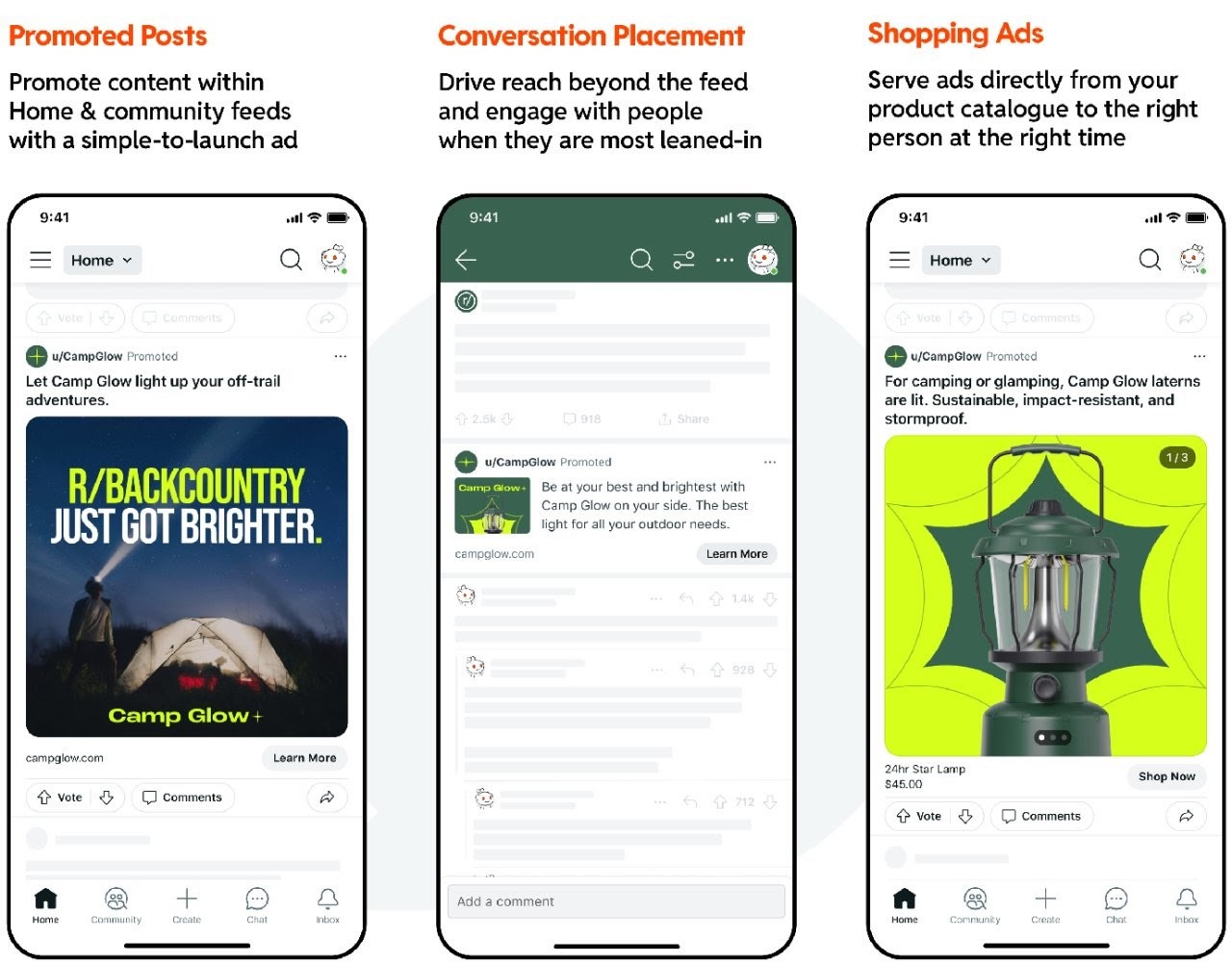
Promoted Posts: Ads that appear natively within the home and community feeds.
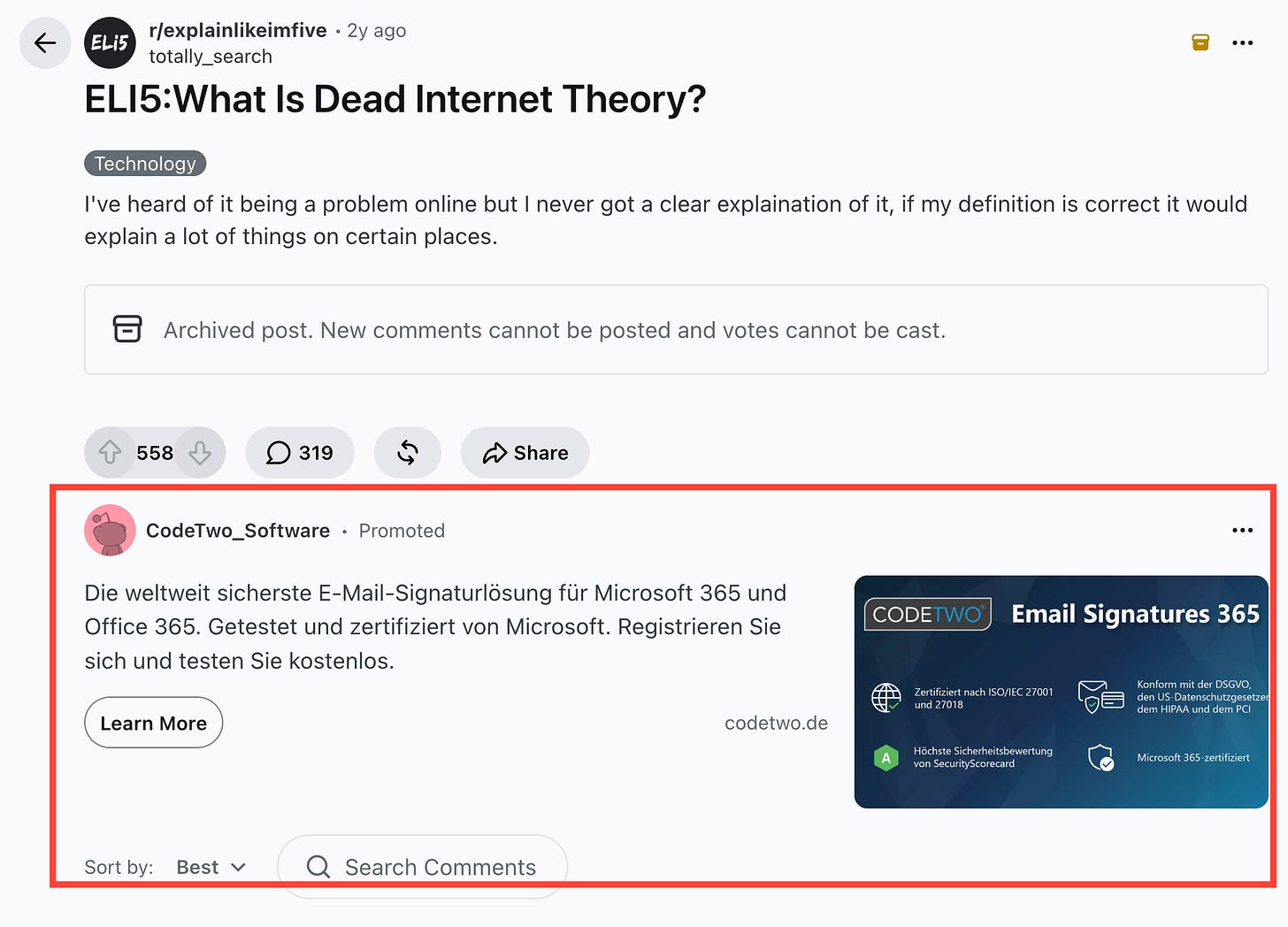
Conversation Ads: A flagship product that places ads directly within comment threads, reaching users at their point of highest engagement.
Shopping / Dynamic Product Ads (DPA): These automatically match an advertiser’s entire product catalog to high-intent conversations, often delivering a 2x higher ROAS than standard campaigns.
Shopping Listing Ads: A multi-advertiser format that matches relevant products to specific shopping-related conversations.
Takeover Products: High-impact, guaranteed reach placements (e.g., Front Page or Category Takeovers) where a brand “owns” the top of the feed for 24 hours.
Free-form Ads: Unique long-form ads that allow brands to share multimedia content and expertise in a way that feels native to Reddit.
Performance & Automation Tools:
Reddit Max: An end-to-end AI-powered automated campaign type that optimizes settings in real-time to drive better results with less manual effort.
Automated Bidding: Includes goals such as Maximize Clicks, Conversions, or Installs to help advertisers scale efficiently.
Reddit runs an auction-based model where advertisers bid for sponsored posts, conversation ads, and shopping ads, with Reddit recognizing revenue when a user clicks (CPC), views an impression (CPM), or watches a video (CPV). Nothing exotic there – it’s the same fundamental mechanism Meta and Google run, just earlier in its optimization.
Insights & Organic Presence:
Reddit Pro: A free suite of tools helping businesses establish an official organic presence, listen to community trends, and manage Verified Profiles.
Reddit Insights: An AI-powered social listening tool providing real-time visibility into brand sentiment and competitor positioning.
Conversation Summary Add-ons: An ad feature that uses AI to surface positive Reddit comments directly within a brand’s ad, providing social proof.
Measurement & Brand Safety: Reddit offers tools like the Reddit Pixel, Conversion API (CAPI), and a “Community Allowlist” to ensure ads are effective and appear only in brand-suitable environments.
The second source is data and content licensing, the archive-as-oil business I covered in Bam #1 in part 1 of this series, where Reddit licenses its 20-year, 26-billion-item corpus to AI developers and search engines for training and grounding. Small today, strategically outsized.
Then there’s what Reddit calls the user economy – digital goods like Reddit Gold, plus a Contributor Program that lets users convert quality contributions into actual money.
And finally subscriptions, through Reddit Premium, which strips out ads and adds perks like exclusive avatar gear and a members’ lounge for a monthly fee.
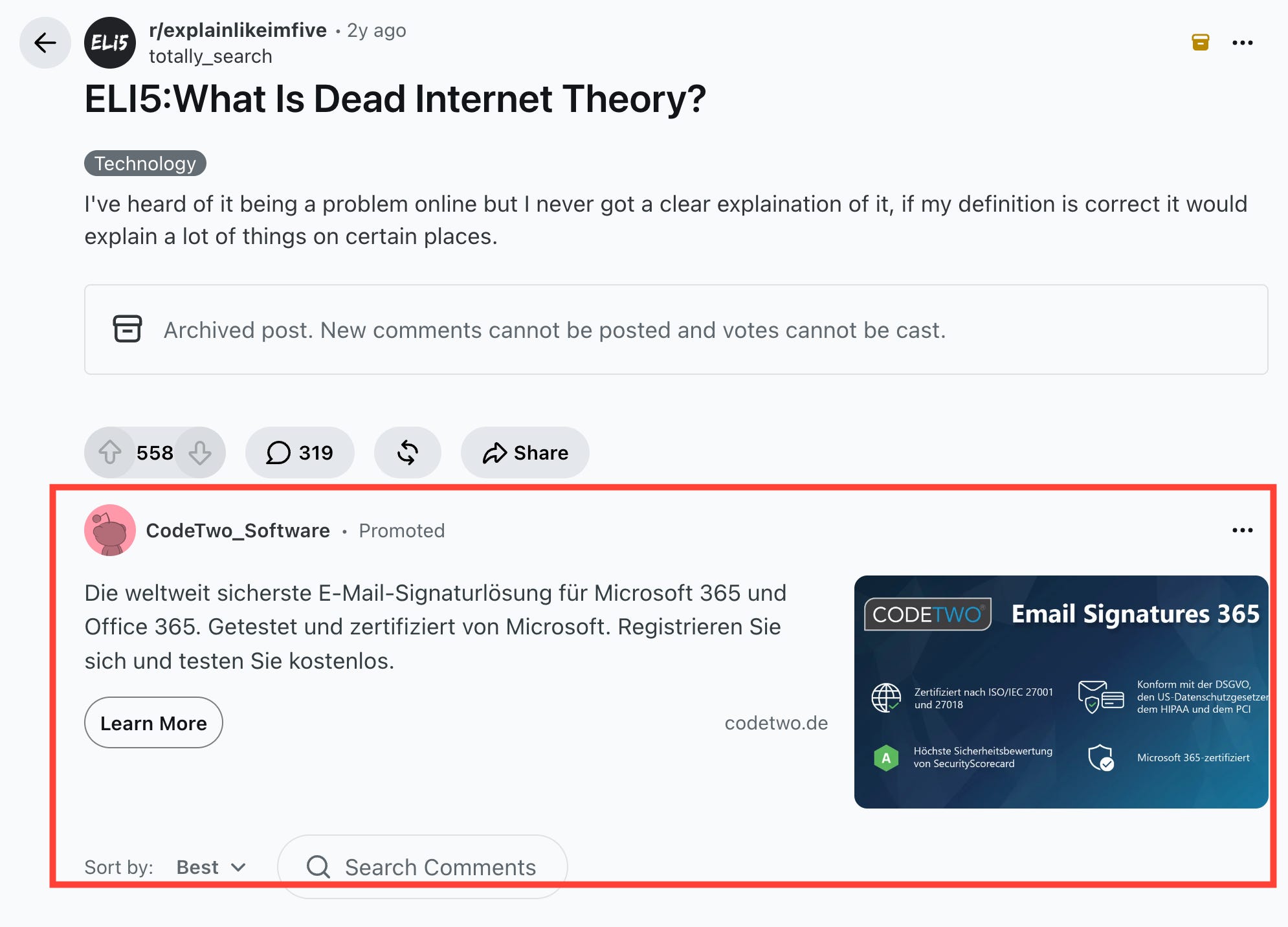
Four vectors, but make no mistake about the shape of it: this is an advertising company with three interesting side businesses, one of which happens to be growing very fast.
It’s worth pausing on what kind of “goods” these actually are, because the mix is unusual.
Advertising is a consumable service in the purest sense. An impression exists to be viewed or clicked, and once it is, that unit of inventory is gone. Data licensing works the opposite way.
The content already exists and isn’t used up by being licensed. It’s closer to a non-consumable access right, granted for a fixed or usage-based fee over the life of a contract, which is part of why the incremental margins are so extreme.
And the digital goods in the user economy are non-consumable assets that the user owns outright.
So Reddit runs a consumable business and a non-consumable one side by side on top of the same underlying asset.
Next, I always wonder whether a firm’s “product” or core feature is differentiated or just another interchangeable one (here’s Reddit’s feed) competing on price and reach. Reddit is clearly the former, and the reason comes down to a structural difference in how the platform is organized. Meta and TikTok are built on a social graph – the product knows who you follow, who your friends are, and infers what you might want from that web of relationships. Reddit is built on an interest graph. Users self-sort into communities based on what they’re thinking about rather than who they know, which means the platform captures intent directly instead of guessing at it. That’s the same declared-intent advantage discussed in Bam #2, but it’s worth restating here as a product characteristic rather than an advertising one, because it’s the root of nearly everything that makes Reddit distinctive. Reddit is a destination for seekers arriving with a specific question, not only scrollers looking to kill time.
There’s a second axis of differentiation that has grown sharper as the web has changed, and it ties back to the AI thesis. As synthetic content floods the internet, Reddit’s positioning as the largest source of authentic human perspective and lived experience becomes a genuine product feature that only increases in value as AI arrives in mainstream media.
The upvote and downvote system reinforces this – content visibility is earned through community validation rather than handed out by an opaque algorithm optimizing for watch time. You can’t easily fake your way to the top of a subreddit that a few thousand knowledgeable people are watching. That quality-control mechanism, run for free by the community, is part of what makes the output trustworthy enough for both users and AI models to rely on.
High-tier audience, mid-tier monetization
If you’re trying to place Reddit in a product segment, the honest answer requires splitting the question in two, because the platform sits in different tiers depending on what you’re measuring.
On the quality of the asset, Reddit is high-tier. The audience is genuinely attractive – as of the date of the S-1 filing, 64% of U.S. users have a household income over $75,000 – and the intent is about as good as it gets online.
On monetization, though, Reddit is mid-tier at best, still in the early innings of its monetization efforts, with ARPU still a fraction of Meta’s – we discussed this at length in part 1 (and it’s arguably the most important pillar of the thesis).
I’d frame that gap as the entire opportunity rather than a knock on the product. A high-quality audience being monetized at low- to mid-tier rates is a catch-up story. A mid-quality audience already monetized to the hilt would be a very different, and far less interesting, investment. The tier mismatch is the point.
What’s coming next?
Reddit isn’t standing still on any of this, and the product roadmap tells you a lot about where management thinks the business is going.
One of the most strategically important items is Reddit Answers, an AI-powered conversational search tool that serves up curated summaries of community discussions – the on-platform search product that turns the 80 million weekly queries from an unmonetized cost into a potential destination in their own right.
“Together, they drove more search volume and queries per user with over 80 million people searching directly on Reddit every week in Q4, up from 60 million just a year ago.“
Around it sits a widening set of tools. Reddit Pro gives businesses and publishers an organic way to build a presence, read community sentiment, and manage their reputation.
“We have seen growing adoption of Reddit Pro since expanding access to all publishers, giving them self-serve tools through auto import articles receive AI-powered community recommendations on where to share them and measure the reach and engagement of their content on Reddit. Publishers ranging from global outlets to local press like Fortune Media to the SF Chronicle and Dallas Morning News and sports brands like Arsenal FC are now using Reddit Pro. Overall, there’s a lot to be excited about this year. And every day, we see more businesses coming to Reddit it to connect with their audience and grow their business. And as the pace of change in the market grows, Reddit’s fundamental assets and value proposition built on authenticity, trust and high intent keep us exceptionally well positioned. Thank you for joining us and for your continued support.“ - Q1 Call
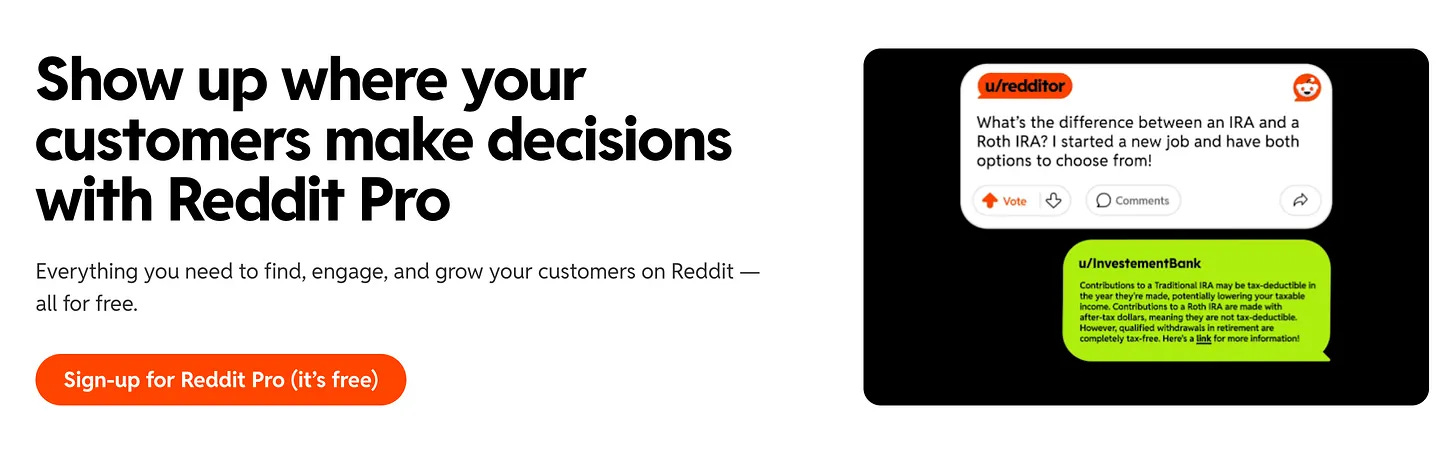
Reddit Max uses AI to automate ad campaigns for the small and mid-sized businesses that can’t staff a marketing team, which matters because SMB budgets are how ad platforms broaden beyond big brands.
“We’re executing against 3 areas: scaling automation through our ads platform and Reddit Max, delivering advertiser value across the full funnel, expanding the Reddit for Business ecosystem. Starting with automation. Reddit Max launched private beta earlier this year, and we’re seeing strong adoption and performance for mid- and lower-funnel advertisers. The number of advertisers using Max grew over 60% from Q1, while Max revenue grew over 150% during the same period. We continue to add capabilities to the Max suite.
In Q2, we added the app install objective to Max campaigns and launched tailored creatives, which uses AI to identify relevant communities and audiences then designs variants on advertiser creative to improve ad relevance and performance. Max campaigns are proving to drive better performance for advertisers and high-LTV customers. For example, Lenovo achieved 40% higher purchase value with Max than with standard campaigns, demonstrating how AI-driven optimization can turn high-intent users into high-value customers. Looking ahead, we plan to expand Max to a broader range of advertisers and make it the primary onboarding experience for SMBs. We also plan to introduce new features that simplify activation and continue enhancing our models to drive stronger performance.“
There’s video in comments to enrich the conversational core, …
“Video views was our fastest-growing upper funnel objective, more than doubling revenue year-over-year. Our 6-second engaged video views goal, which became generally available in January, helps video-first advertisers optimize for longer, more meaningful views. In testing, the objective delivered over 130% lift in 6-second view-through rate, over a 70% increase in video completion rate and an 80% reduction in cost per 6-second video view with auto bidding.“ - Q2 Call
… and Reddit Lite, a stripped-down app being tested in international markets to improve access and speed where connectivity is weaker – a direct enabler of the global runway discussed in Bam #5. I couldn’t find any updates on this endeavour ever since it was pitched at an investment conference back in March 2025, though:
“Now that said, we are building another version of our app called Reddit Lite, which we'll be testing internationally. And so we're doing 2 things here. One, we're just building a lightweight version of the app to use internationally, which is a kind of tried and true practice. But also, we're going to be experimenting with pretty big changes to the UI, making Reddit, in my opinion, much easier on the eyes, much easier to use, making a home feed that better accommodates all the different content types we have.“
And further out, potentially creator monetization (as teased in 2024): plans for paywalled subreddits and exclusive community subscriptions that would let Reddit siphon business from the likes of Twitch and Patreon.
“Your question is if we start to include other incentives in there, like monetary incentives, does that change? In my experience on Reddit, whenever we add basically a new way of using Reddit, what happens is it expands Reddit, but we’ve not seen it cannibalize existing Reddit. And so I think the existing altruistic free version of Reddit will continue to exist and grow and thrive just the way it has. But now we will unlock the door for new use cases, new types of subreddits that can be built that may have exclusive content or private areas, things of that nature. A good example of this, for example, is at Reddit, we didn’t host images back in the past. It was all text and links, and images were linked. […] So I’d look at this as an opportunity of expansion as opposed to one that is going to cannibalize the existing Reddit, which as I said, is magical. It’s something that we think is truly precious.“ - Huffman
I’d read that roadmap with a mix of interest and caution. The through-line is coherent, which is encouraging – nearly every item pushes Reddit from a passive forum toward an end-to-end utility that captures more of the value it already creates. But it’s also a lot of surface area for a company that has only recently learned to make money, and each new product is a fresh place for execution to slip.
Reddit Answers in particular carries an odd internal tension – Ii’s the product most likely to unlock search monetization, and it’s also the product most likely to keep users from clicking through to the threads that feed the ad business.
Business Operations
Reddit reports as a single operating segment, which sounds like an accounting footnote but tells you something about how the company thinks I believe.
The CEO acts as the chief operating decision-maker and evaluates the business on a consolidated basis, so there’s no divisional carve-up to analyze.
What the company does disaggregate is revenue by source, and that split is where the story lives. There are two lines:
Advertising, and
Other Revenue
… the latter bundling data licensing, Reddit Premium, and the user economy together.

“Other Revenue: In our content licensing arrangements, we provide customers with the right to access content from our platform over the contractual period. The transaction price in content licensing arrangements is generally a fixed fee or usage-based fee. We recognize content licensing revenue as our content partners consume and benefit from their use of the licensed content, which is generally ratably over the license period. Revenue from products sold directly to users, including Reddit Premium and Reddit Gold, was not material for the periods presented.“
The proportions are lopsided in a way that’s important to internalize. On a trailing-twelve-month basis through Q2 2026, Reddit did roughly $2.78 billion in total revenue. Of that, advertising accounted for about $2.63 billion, or 94.5%, with Other Revenue contributing around $153.6 million, the remaining 5.5%.
So when I talk about Reddit’s economics, I’m mostly talking about an advertising business, and the data-licensing story that gets so much attention – rightly, for its strategic weight – is still a rounding-error slice of the top line today.
That’s not a criticism. It’s a reminder to keep the near-term and the long-term properly separated.
The ad business pays the bills now. Licensing is the option on the future. But even that requires a very nuanced discussion, which we covered in Bam #1 (first and foremost, the risk licensing Reddit’s data into AI Overviews poses to potentially cannibalizing Reddit’s own traffic, and thus, its advertising business).
The economics underneath both lines are what make this a genuinely unusual company. Revenue hit its eighth consecutive quarter of 60%-plus year-over-year growth as of Q2 2026, which is a remarkable streak for a business of this size.
“… maintaining eight consecutive quarters of over 60% revenue growth shows the strength of our community model and the value we deliver to advertisers.” - Q2
And in 2026, revenue converts into real accounting AND cash profits.
Reddit crossed into consistent GAAP profitability in late 2024, incremental adjusted EBITDA margins have averaged around 55-60% over the last five quarters, …
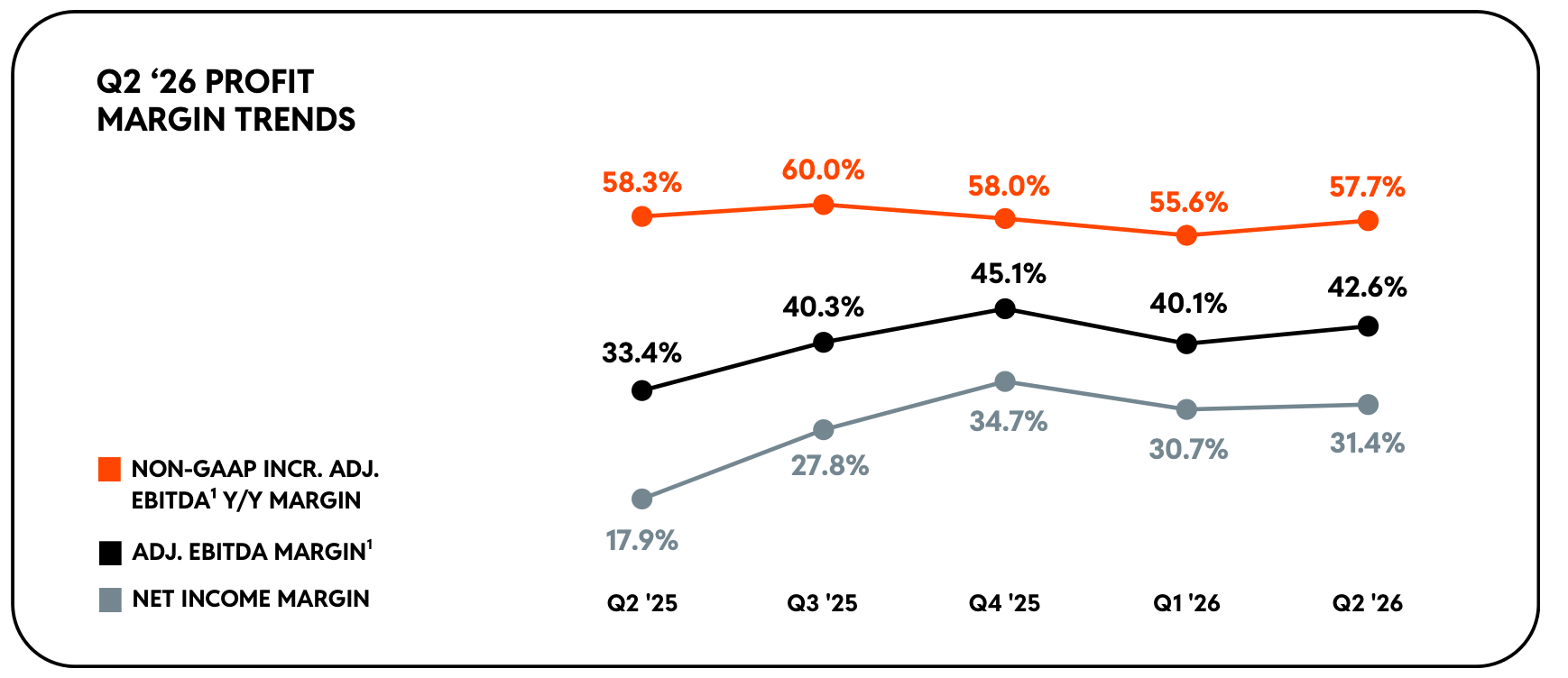
and FCF is trending only in one direction, …
… all of this shows that revenue is outrunning costs by a wide and durable margin.
Growth that fast paired with flow-through that rich is the “one-of-one” claim in a nutshell, and it’s why the a good chunk of the analysis in part 1 was focussed on stress-testing whether and how long that kind of profitable growth can last.
The KPIs to focus on
Every industry has its scoreboard, and for social platforms the metrics are fairly standardized. Reddit (and its peers) watch four in particular.
1) DAUq (1a) US + 1b) International)
For Reddit, arguably the most important KPI is the Daily Active Unique, the DAUq. Get the direction of DAUq right and most of the rest follows, which is exactly why the mid-2026 sequential dip of 300,000 U.S. uniques spooked the market so badly.
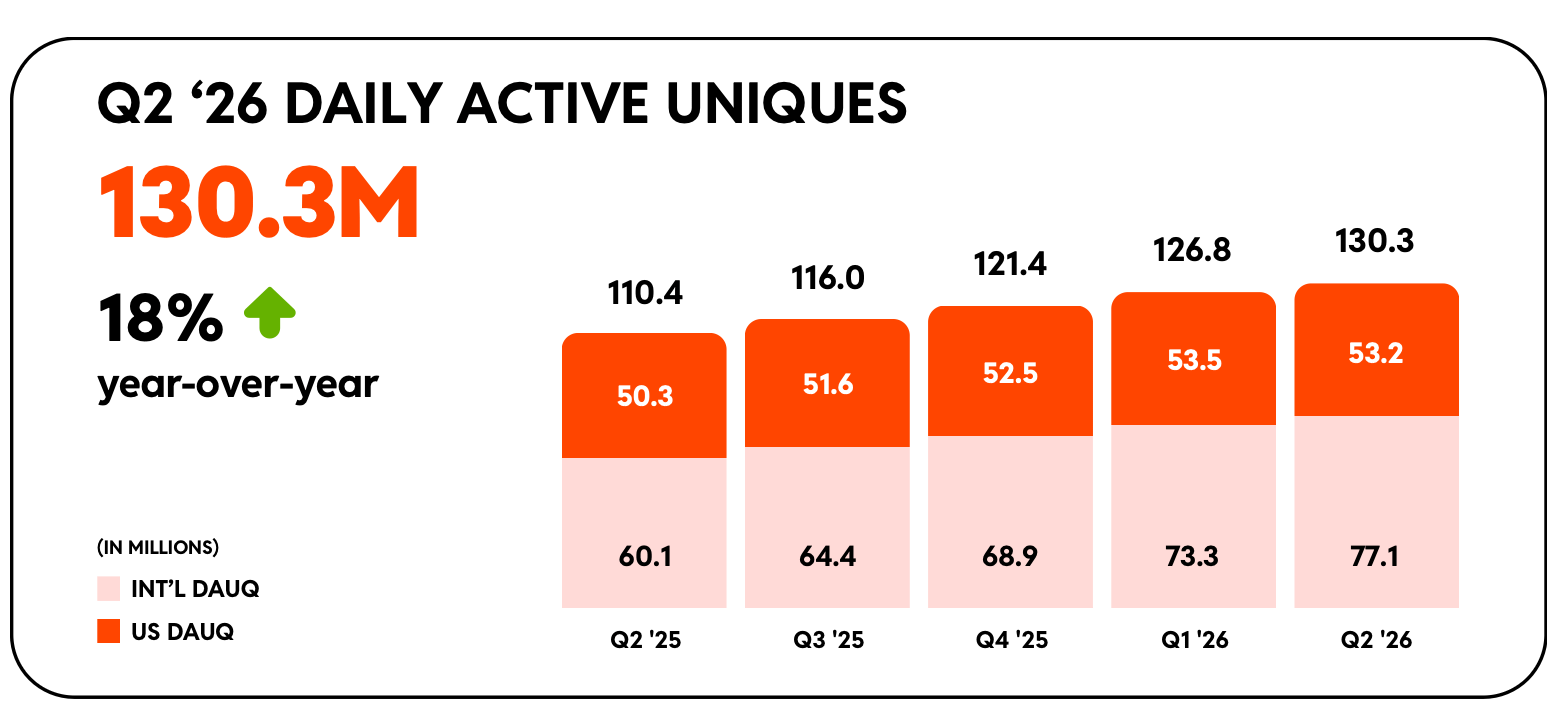
The two north-star milestones management keeps pointing at are
one billion global DAUq, and
100 million U.S. DAUq,
… the latter roughly double today’s domestic base.
Those are enormous numbers, and hitting them depends on the thing they say they’re focused on controlling – product quality, speed, and feed relevancy that drive direct, daily habit rather than drive-by search traffic. Which brings the whole KPI discussion back to where it started. The domestic user count is the number the market watches most nervously, the conversion of casual visitors into daily residents is the engine underneath it, and the recent sequential dip is exactly the kind of wobble that makes both harder to read. Watch DAUq. But watch how it’s composed, not just how big it is.
2) Engagement I (Logged-in vs. Logged out)
This is the unit to watch. But the headline number hides a distinction that, until recently, mattered enormously. Not all DAUqs are the same. Reddit has historically split them into logged-in and logged-out users, and those two cohorts behave nothing alike.
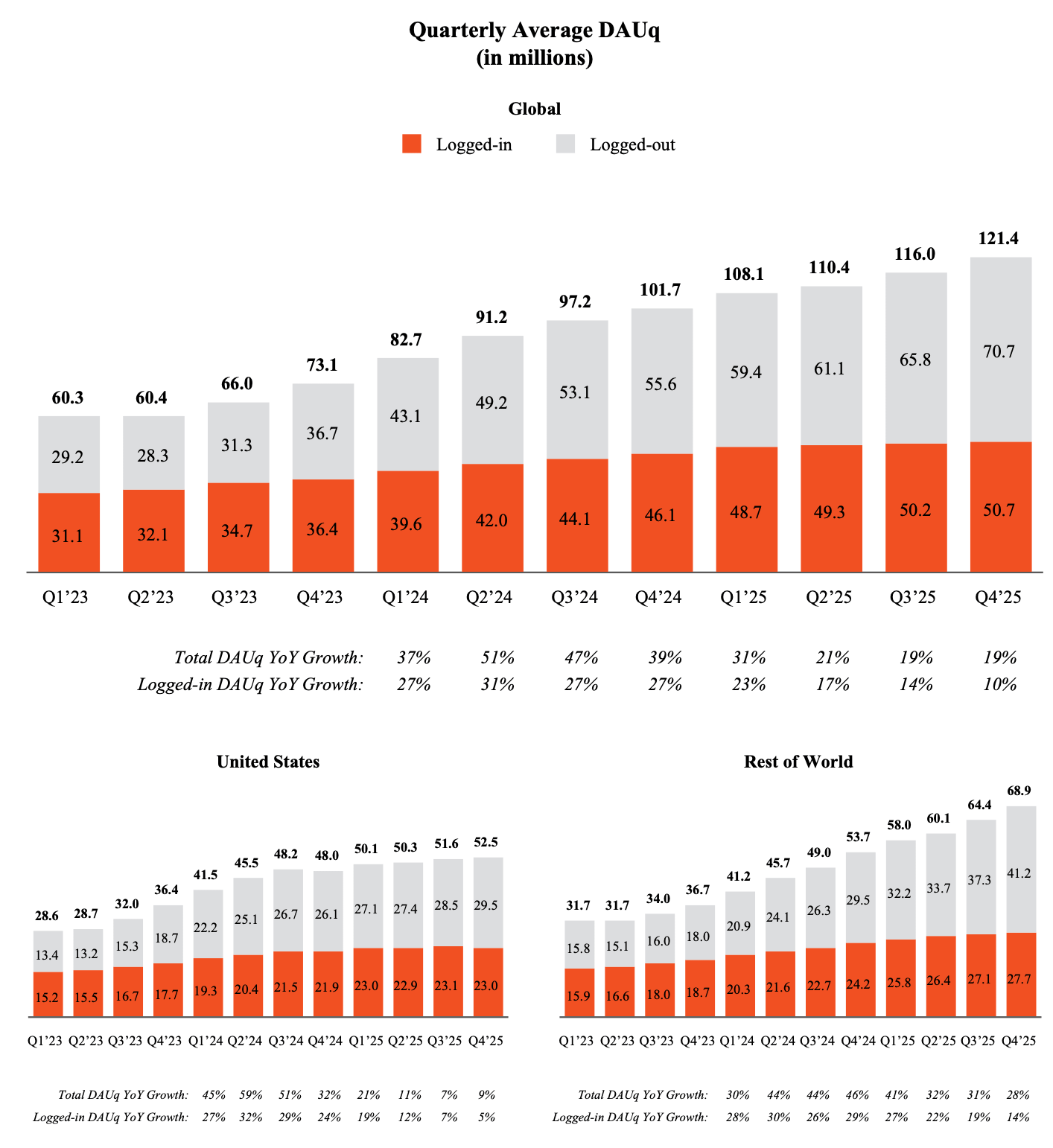
The logged-in user is the “resident.” They’re on the app, they’ve built up years of interest signals, and in the U.S. they spend something like 25 to 30 minutes a day on the platform, climbing past 45 minutes for accounts older than seven years.
The logged-out user is the “tourist,” usually arriving from a Google search with a single question, grabbing an answer, and leaving. They spend far less time on the site.
Unsurprisingly, the resident contributes a lot more to ARPU than the tourist does. What’s easy to get wrong, though, is why. The instinct is to assume logged-out users monetize poorly because their intent is weaker or their signal is thinner, and that’s not what management says at all. COO Jennifer Wong has been explicit that on an individual impression basis, the value of the two is effectively the same. Both see ads in the same surfaces, the feed and the conversation pages, and Reddit can target both using high-quality contextual signals.
The monetization gap is almost entirely a function of time spent, which is to say inventory volume, rather than any deficit of intent. The tourist is worth just as much per impression. They simply generate fewer impressions before they leave.
It’s also about converting tourists into residents – turning weekly visitors into daily ones, and logged-out drop-ins into logged-in regulars. Management thinks of this as moving people from “seeker” to “scroller,” from someone who came for one answer to someone who stays to browse their communities.
However, Reddit learned that forcing a login immediately just annoys people and doesn’t hold them, so instead the goal is to satisfy the seeker’s question first, make Reddit a genuine end-to-end search destination, and let the deeper engagement and the organic log-ins follow from a good experience rather than a nagging pop-up.
The app is the prize in this conversion, since app users are worth multiples more than search referral traffic and are far more engaged once they arrive.
“The direct users, the app users are worth multiples more than the search referral traffic. We're not building Reddit for that drive by traffic, we're building Reddit for direct usage. And that's where our business lives.“ - Call Transcript
One wrinkle worth flagging for anyone modeling this going forward: the logged-in/logged-out distinction is about to disappear from the reporting. Beginning with the quarter ending September 30, 2026, Reddit will stop disaggregating DAUq into the two categories, on the reasoning that product improvements like instant personalization and streamlined onboarding are blurring the line between the two states anyway. Management will primarily evaluate performance on total DAUq and geography from here.
I have mixed feelings about that. On one hand it genuinely reflects an evolved product where the two experiences are converging. On the other, it removes a lens investors could use to see exactly how the tourist-to-resident conversion was progressing, which is precisely the dynamic that determines whether ARPU can keep climbing. Less disclosure is rarely a gift to the outside analyst, even when the rationale is sound.
3) Engagement II (Frequency)
If DAUq is the number the market watches, the internal metrics management actually steers by tell a richer story, and one of them reframes the growth question entirely:
The “1 vs. 7” Phenomenon
When Reddit looks at how many days a week a user shows up, the distribution isn’t a smooth bell curve. It’s bimodal. The two biggest clusters are people who visit one day a week and people who visit all seven, with relatively little sitting in the middle.
Huffman describes the core product job in exactly those terms: convert the 1s into 7s. There’s a revealing implication buried in that shape. Once Reddit truly clicks for someone, they don’t drift into being a casual three-day-a-week user – they tend to become a daily habit. The platform either gets you or it doesn’t, and the product work is about pushing more people across that threshold rather than nudging everyone up a notch.
“So weeklies and dailies, themselves are both important measures of Reddit. But if we look at within our U.S. traffic, we have about 200 million U.S. weeklies and about 50 million U.S. dailies. And so when I think about that path to 100 million U.S. dailies, so roughly double from where we are today, I look at the potential of the 200 million weeklies we already have. And so if we think about the kind of 3 aspects of growth on Reddit. So reach is like the total scale.
So already in the U.S., we’re at 200 million weeklies, but how do we grow that to capture more of those as daily users. Frequency is the one that we’re really thinking about right now. So how often do users come to Reddit every week. And so if you were to look at a histogram of how many days active a user is on Reddit, the 2 biggest bars would be 7 days and then they come every single day, 7 days a week or 1 day. And so quite simply, our job is to convert those 1s into 7s.
In between, there’s actually not much. But that journey can be challenging. So really increasing the reach there.
And then depth, so this is how much time people are spending on Reddit. I think we’re actually a very healthy spot here. A U.S. logged-in user spends on average 30 minutes a day on Reddit. And the older their account is, the more time they spend on Reddit.
So a seasoned account spends more like 50 minutes a day on Reddit. And so again, this kind of tells the same story [indiscernible] once users get it, they actually go deeper and deeper over time. One of the ways Reddit is different than social media is our users don’t age out of Reddit. They age out of social media and then they age into Reddit. But because Reddit communities cover everything you’re doing or thinking about from something mundane, like what should I watch tonight, right, the never-ending problem of life to relationship challenges or kid challenges, our medical maladies, whatever it is, Reddit is there with you on your life’s journey.
So it’s really for us that -- that frequency question, excuse me, of taking that -- the potential energy we see in our weeklies and converting those into dailies.“
This is where the gap between weekly and daily users stops being a curiosity and becomes the growth story. In the U.S., Reddit has roughly 200 million weekly active users but only around 50 million daily ones.
Sit with that ratio for a second. Four times as many people touch Reddit in a given week as use it every day, which means the domestic audience that already finds Reddit useful enough to return weekly is vastly larger than the daily base the market frets about.
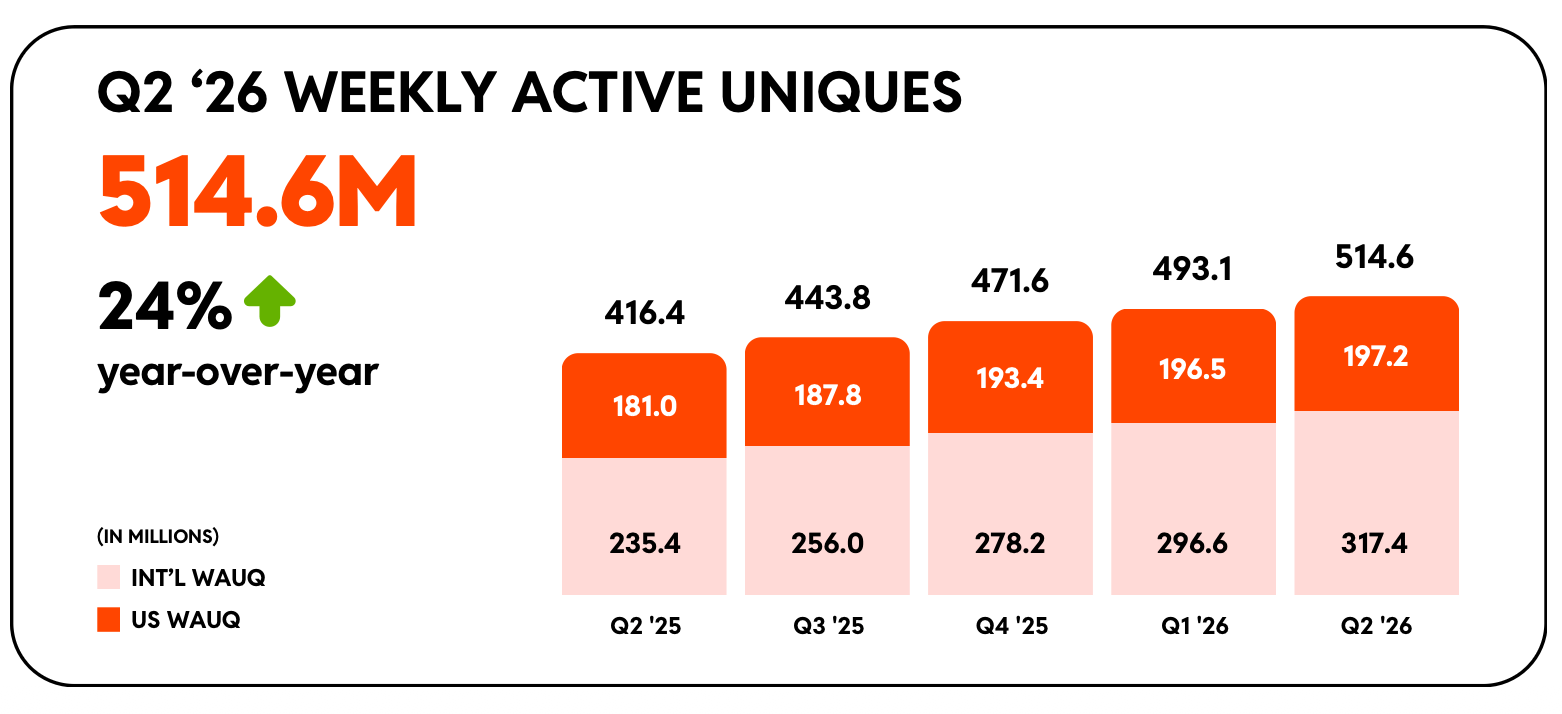
Management calls this potential energy, and I think that’s the right way to hold it. The nervous read of the recent DAUq dip assumes Reddit is bumping against a ceiling. The more optimistic read is that the ceiling is defined by that 200 million weekly figure, not the 50 million daily one, and the job is conversion rather than fresh acquisition. Converting an existing weekly user into a daily one is a very different, and far more controllable, task than winning someone who has never used the platform at all. It doesn’t guarantee the conversion happens. But it reframes what “saturated” would even mean.
I don’t want to oversell it, though, and there’s an honest ceiling on this particular strength. Reddit’s engagement is deep but not necessarily long in raw minutes, and analysts rightly point out that a text-based platform struggles to match the sheer screen time of video-centric rivals like Instagram or TikTok. Scrolling video compounds watch time in a way that reading and writing comments simply doesn’t.
Logged-out visitors arriving from search spend maybe 5 to 8 minutes a session, a fraction of the resident’s daily half hour. So Reddit wins on the quality and durability of attention rather than the volume of it, and in an ad model where inventory scales with time spent, that’s both a genuine strength and a real constraint. The vintage effect makes each resident more valuable over time. It does not turn Reddit into TikTok, and it shouldn’t be modeled as if it will.
New User Retention & Sessions Per Day
The public gets DAUq and WAUq. Internally, the team watches a more sophisticated set that gets at the quality of engagement rather than just its scale, and these are the leading indicators I’d want to track if Reddit disclosed them more fully. The one management calls the core measure of product quality is new-user retention, specifically whether someone comes back after 7, 30, and 90 days.
Alongside it sits sessions per day, a newer internal gauge of home-feed quality, and a metric Reddit calls “good visits” – a visit where the user spends more than 30 seconds actually consuming a post. Good visits jumped 30% in late 2023 after improvements to the home-feed ranking models, which is the kind of concrete before-and-after that tells you the machine-learning investment is generating good results.
And search shows up here again as a leading indicator, since users who perform any search have 30% higher week-one retention. Search volume, in other words, isn’t just an untapped ad surface. It’s an early warning system for whether new users will stick.
4) ARPU
On the revenue side, each unit is measured by ARPU, and the global figure as of Q2 2026 was $6.18.
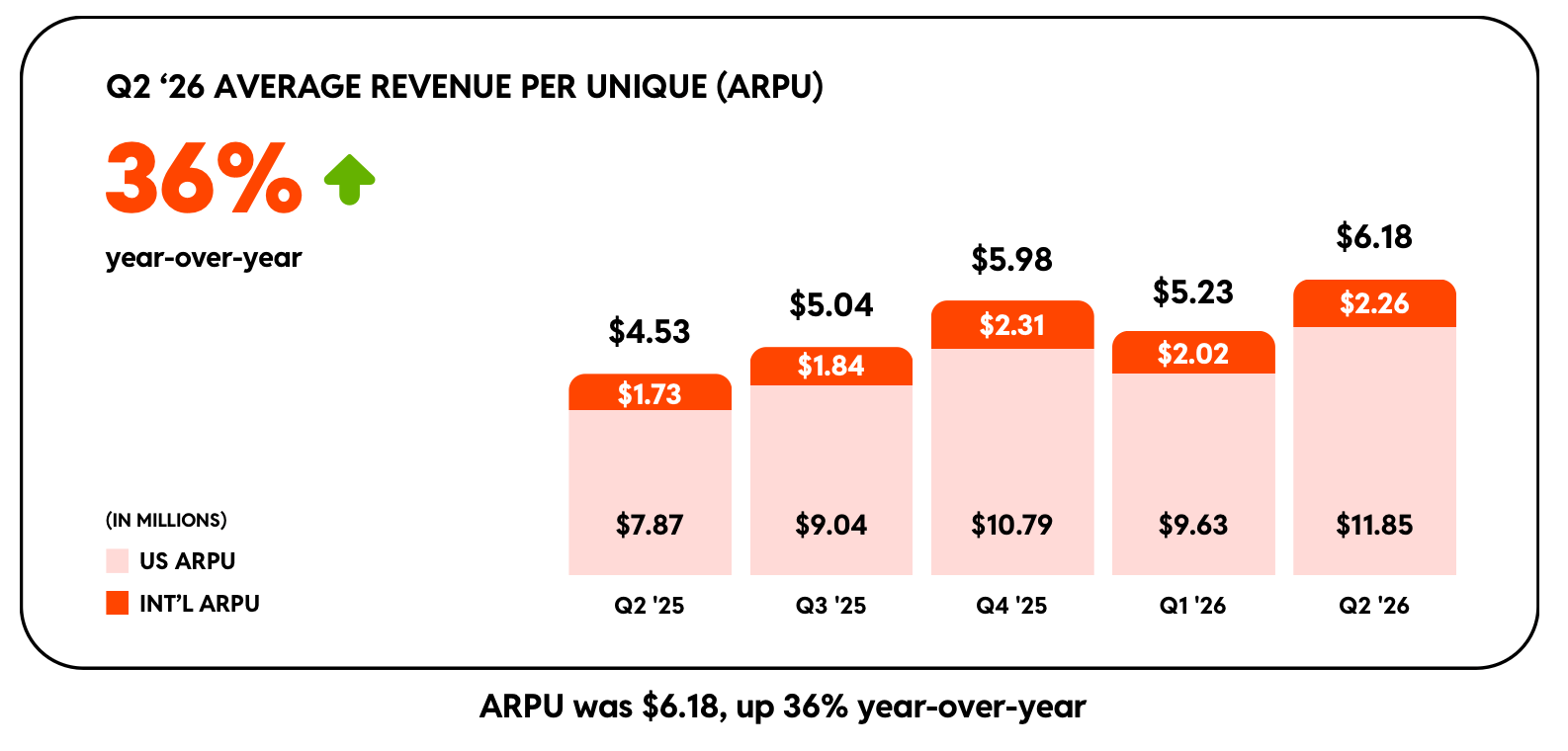
That blended number hides the disparity that defines the investment, though. U.S. ARPU stood at $11.85 while international ARPU was just $2.26 – the same coiled-spring gap from Bam #5, now expressed at the level of the individual user.
A U.S. Redditor is worth roughly five times an international one.
About four metrics is a fine scoreboard – you could add the margin profile, but given the embedded operating leverage, I see only one direction for margins if the KPIs above develop favorably –, but the discipline Buffett and others push for is narrowing further – identifying the handful of variables that genuinely drive long-term value (i.e. more cash) and asking how predictable each one is.
For Reddit, I’d argue there are essentially four levers doing the real work, and I’ll be watching them above everything else.
The first is ARPU expansion, the central bet of the whole investment: closing the roughly 10x gap between Reddit’s U.S. ARPU and Meta’s just a little bit, powered by the shift from brand advertising toward high-intent performance and search ads.
The second is international conversion, translating the English archive into 35-plus languages to wake up under-penetrated markets like France, Germany, and Brazil.
The third is headcount discipline, the unglamorous lever that determines whether incremental revenue keeps flowing through at those 95-to-99% gross margins or gets eaten by hiring.
And the fourth is data licensing, which I’d characterize as an embedded call option – a high-margin, potentially recurring and scalable, and defensive, revenue stream whose value is mostly still ahead of it.
Finally, I also like the framework/formula madis99 presented in a recent write-up on Reddit’s advertising business – it reminds me very much of how I always thought about Meta’s ad business:
“Reddit’s business should be viewed through an ABCD framework, where:
Revenue = A × B × C × D
A — Daily Active Users (DAUs). How many people show up.
B — Engagement. How much they do while they’re there (sessions, time, surfaces touched), which determines how many impressions each user generates. Logged-in users typically spend an average of ~30 minutes a day on the app, while logged-out users spend ~5-8 minutes.
C — Ad load. How many of those impressions carry an ad. Currently about one ad per 6-8 posts.
D — CPM. What each ad impression clears at. This is ~$6.30 according to my estimates.
A and B produce impressions. C converts impressions into ad slots, and D prices them. ARPU (which Reddit reports) is the product of B x C x D. We will begin with lever D.”
And that’s of course how management also thinks about its growth levers:
“Revenue growth was driven by both pricing and impressions, demonstrating the increasing value we deliver to advertisers.“ - Call Transcript
And …
Spoiler:
We will use a similar framework to value Reddit and determine its growth trajectory range in part three of the series (valuation)
Costs on a Per-Unit-Basis
Reddit doesn’t publish a formal cost-per-user figure, but you can back into it. Adjusted cost of revenue – hosting, app/website support, direct delivery, payment processing – ran $70.1 million in Q2 2026 against 130.3 million DAUqs, which works out to a direct variable cost of roughly $0.54 per daily active unique for the quarter.
“Cost of revenue consists primarily of payments to third parties for the cost of hosting and supporting our mobile applications and website. In addition, cost of revenue includes expenses directly associated with the delivery of our advertising and other services, including advertising targeting and measurement services, credit card and other transaction processing fees, and payments to our content partners. Cost of revenue also consists of employee-related costs, including salaries, benefits, and stock-based compensation.“ - Q2 10Q

Set that against the revenue each unique throws off and the picture is stark. Reddit maintains an industry-leading gross margin around 90%, which is another way of saying that nearly every dollar an additional user generates flows straight past cost of revenue toward operating expenses and, increasingly, net income. When your marginal user costs you 54 cents to serve and generates multiples of that in revenue, growth isn’t just good for the top line. It’s compounding for the bottom one. That’s the engine behind the incremental margins I keep coming back to.
Where Reddit operates, and what could go wrong there
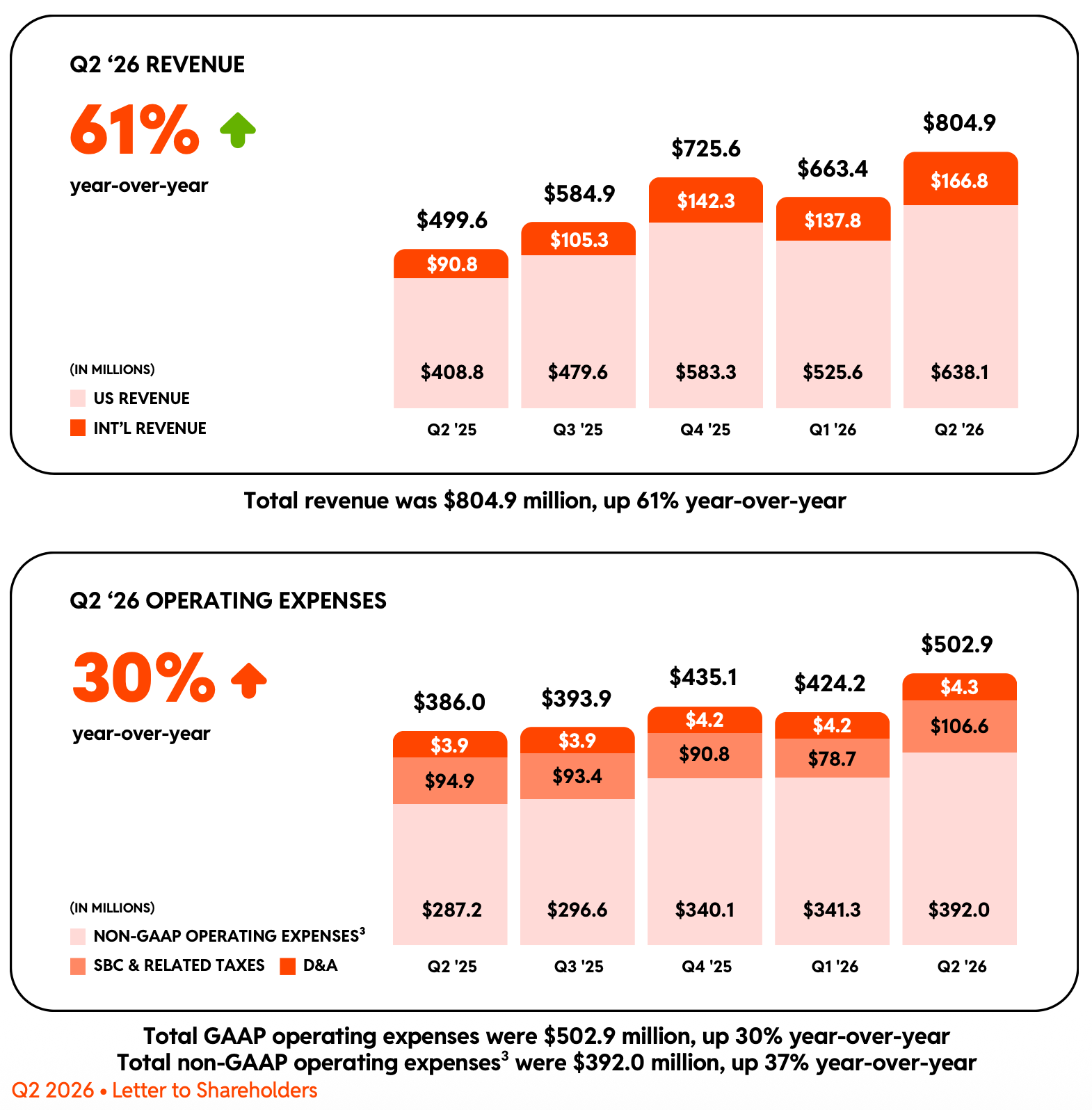
Geographically, Reddit is still very much a U.S. business wearing an international coat. The U.S. remains the mature market and contributed roughly 79% of total revenue in Q2 2026 – about $638 million of $805 million.

The rest of the world, meanwhile, accounts for 59% of the user base, 77.1 million of 130.3 million DAUqs, but only around 21% of revenue.
Hold those two facts next to each other and you’ve got the entire international thesis in a single sentence: most of the users are already abroad, and almost none of the money is yet.
Focus markets, in the near term at least, are the U.K., France, Spain, Germany, Brazil, and India.
Operating Risks
The operating risks cluster into three I believe:
The first and largest is Google dependency – roughly half of Reddit’s traffic arrives via Google, which leaves the top of the funnel exposed to search-algorithm changes and AI cannibalization. This is the concern from the drawdown section, and it’s not paranoia; it’s a genuine structural reliance on a company that is also, awkwardly, both a customer and a competitor.
The second is regulatory in nature. Reddit faces inquiries from bodies including the FTC and the Dutch Data Protection Authority over its content licensing and AI-training practices, and that scrutiny only grows as the licensing business does.
The third is geopolitical and access-related: the platform isn’t directly accessible in China and runs into intermittent restrictions or censorship elsewhere, capping parts of the global map.
A value chain built by its own users
What ties the operations together is a value chain that barely resembles a normal media company’s, because the most expensive inputs are supplied for free. The raw material – the posts and comments – is generated by Redditors at no cost, and the policing of it is done by 60,000-plus volunteer moderators, which strips out the safety and infrastructure spend that weighs on peers.
Reddit itself supplies the middle of the chain, the gears: the apps and the website that host and organize all that human output into an interest graph of 100,000-plus subreddits.
Distribution is entirely digital, through the iOS and Android apps and Reddit.com for users, and through APIs for the AI partners who license the corpus.
Form, cyclicality, and the machinery of operating leverage
The legal shell is quickly dealt with: Reddit, Inc. was incorporated in Delaware in May 2011, the same year Advance spun it back out. Nothing unusual there, and nothing that changes the analysis.
The more interesting operational questions are about how this business behaves when the economy turns, and how much its margins expand as it grows.
On cyclicality, I want to be honest about the embedded risk, because this is a place where the bull case has to concede ground. Reddit is a cyclical business. Full stop. Around 94% of its revenue is digital advertising, and ad budgets are among the first things companies cut when the macro picture darkens.
Management says as much – global economic worry, higher rates, and geopolitical instability can all push advertisers to pause campaigns or trim spend.
There’s seasonality layered on top, with the fourth quarter running strongest on holiday ad dollars and the first quarter typically softer in sequence.
“Our ARPU reflects the seasonality of our advertising revenue, with the fourth quarter typically being the strongest quarter of each year, especially in the United States, our most developed geography. United States ARPU is higher primarily due to the relative size and maturity of the U.S. digital advertising market, a dynamic we expect will continue for the foreseeable future.“
So anyone modeling Reddit as some recession-proof utility is kidding themselves. When ad markets contract, Reddit’s top line will feel it.
Here’s the distinction that matters, though, and it’s worth borrowing Chris Mittleman’s framing, which I regularly come back to as I’ve internalized the idea, to make it. Mittleman’s point about cyclicals is that he’s willing to tolerate cyclicality, but he won’t invest in cyclicals that burn cash in the downturn. You can accept a dramatic drop in sales during a bad stretch as long as free cash flow can stay positive and the business doesn’t torch capital to survive. That’s the lens I’d apply to Reddit.
The company wasn’t public in 2008, arguably the last true major global economic shock, so we don’t have a clean recessionary track record, and its self-description as having “grown through hard times before” rests partly on the idea that the human need for connection persists in a downturn – true enough, but not a substitute for audited proof.
“Ever-shifting macro environments like these create both challenges and opportunities. We’ve grown through challenging times before—people need connection and information just as much in uncertain times, and we’re well-positioned to meet this moment.
Our unique advantage is that people come to Reddit with intent—they’re not just scrolling, they’re also seeking. They come to Reddit for real opinions from real people. When you ask a question online today— whether it’s about a product, decision, or life choice—you’re not looking for generic answers or sanitized summaries. You’re looking for lived experience and personal recommendations, which is why Reddit is the #1 platform for finding “possible solutions to people’s needs or situation,” and where half of all product conversations online take place.“ - 2025 Q1 letter
What we can say, however, I believe, is that the post-IPO cost structure has moved Reddit firmly out of cash-burn mode. The capital-light nature of the business and 90%-plus gross margins mean that even in a sequentially weaker quarter, the business has levers to stay cash-flow positive.
So a recession would likely hit Reddit’s growth hard while leaving its solvency untouched.
That’s the tolerable kind of cyclicality, not the dangerous kind – provided the cost discipline holds, which management is very vocal about, when it’s actually tested, which it hasn’t been yet, though.
The operating leverage is where this business earns its unusual reputation, and understanding it requires looking at the shape of the cost structure.
Generally speaking, operating leverage refers to the extent to which a company’s costs are fixed versus variable, impacting its profitability with growing sales.
Companies with high operating leverage have higher fixed costs relative to variable costs, meaning their profits are more sensitive to changes in sales volume.
Conversely, industries with low operating leverage have a higher proportion of variable costs, making their profits less sensitive to fluctuations in sales volume.
And broadly speaking, variable costs can mainly be found above a firm’s gross income on the income statement, while fixed costs can mostly be found below the gross income line.
For Reddit, too, above the gross-margin line sit the variable costs – cost of revenue – which for Reddit is mostly cloud hosting on AWS and Google Cloud plus some advertising-measurement fees. Because Reddit rents the GPUs rather than building data centers, these scale with usage but stay low, running around 9 to 10% of revenue.
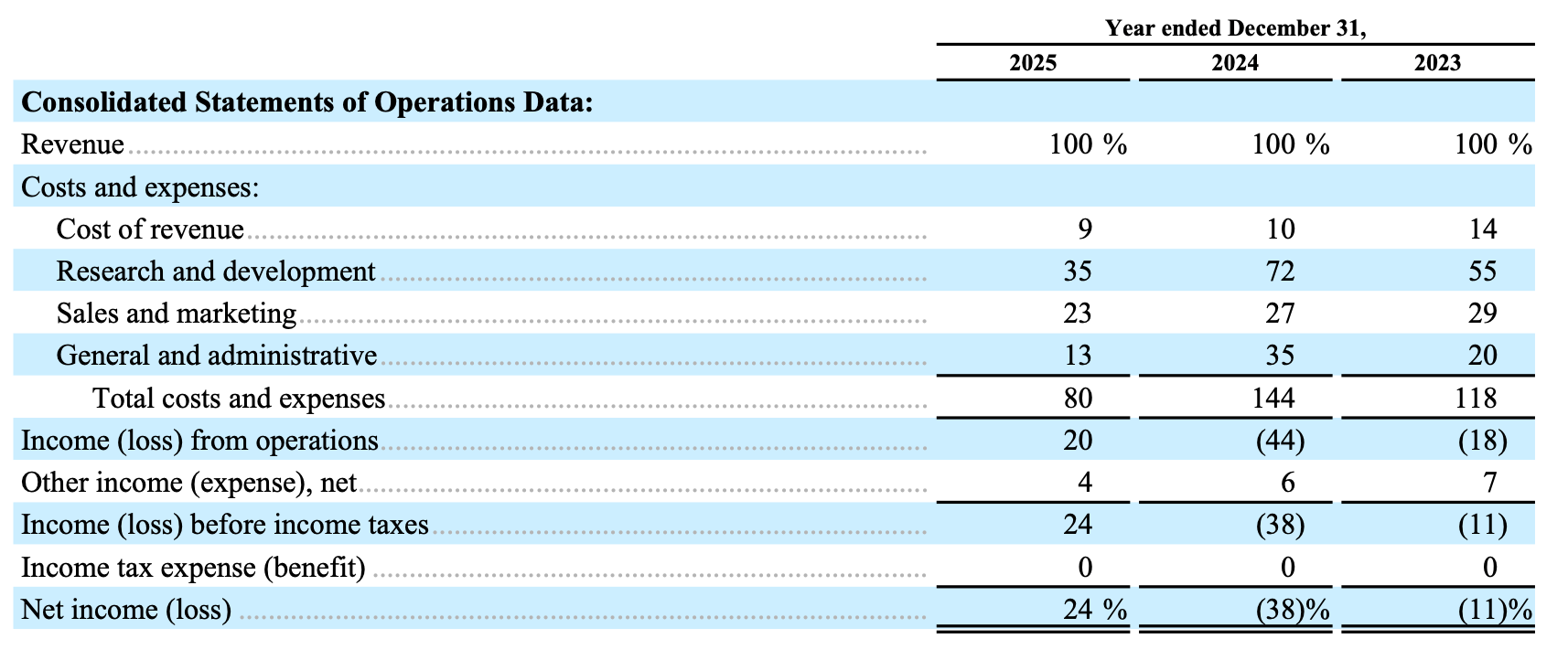
Below the gross-margin line sit the fixed costs, the far larger bucket at more than 80% of adjusted costs, and they’re overwhelmingly headcount – R&D, sales and marketing, and G&A.
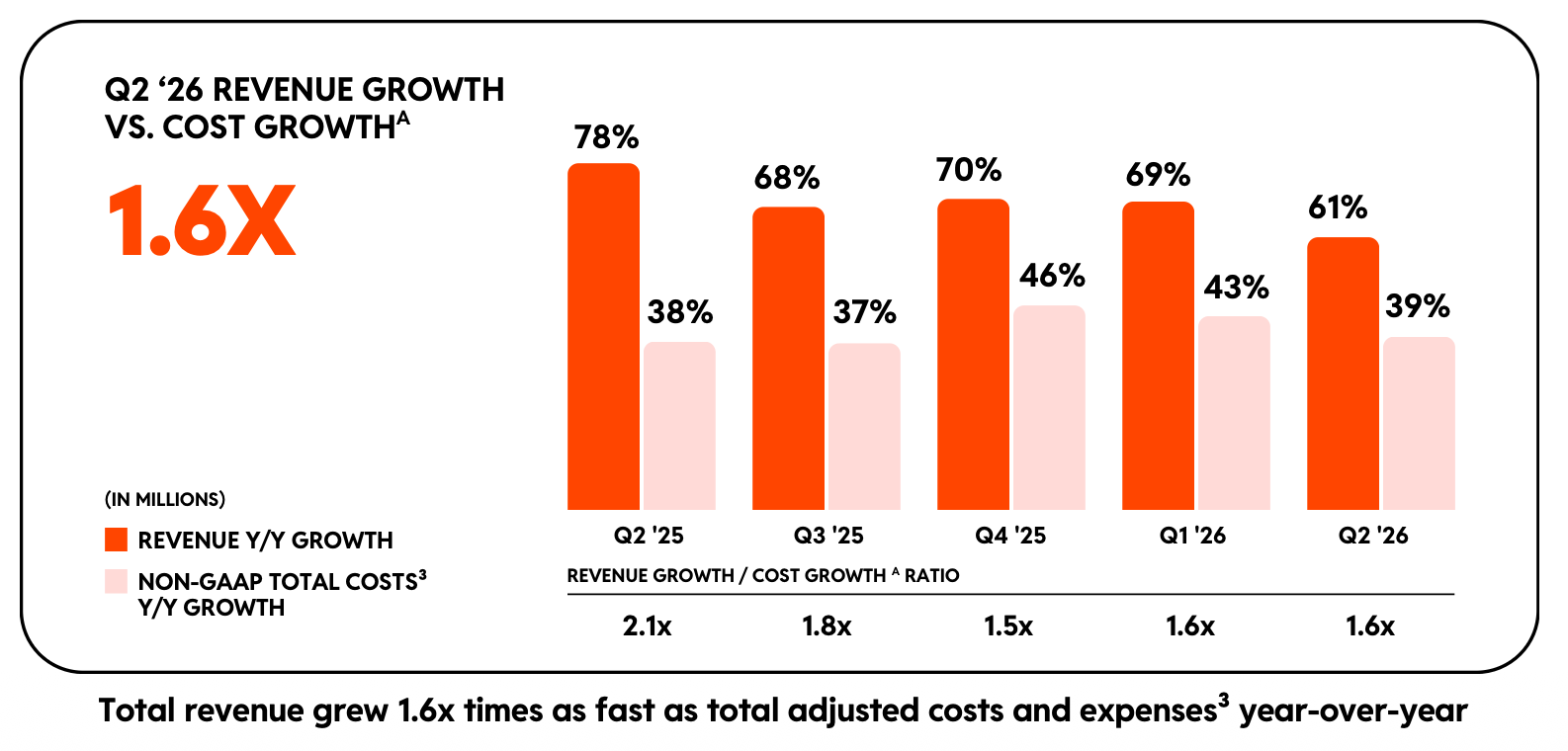
When revenue grows, the variable costs barely move as a percentage, and the fixed headcount costs grow far slower than the top line as long as management holds hiring discipline. The result is the revenue-to-cost ratio I covered in Bam #3 in part 1 of this analysis, where the North Star is to grow revenue twice as fast as costs and the early inflection phase ran at 5x.
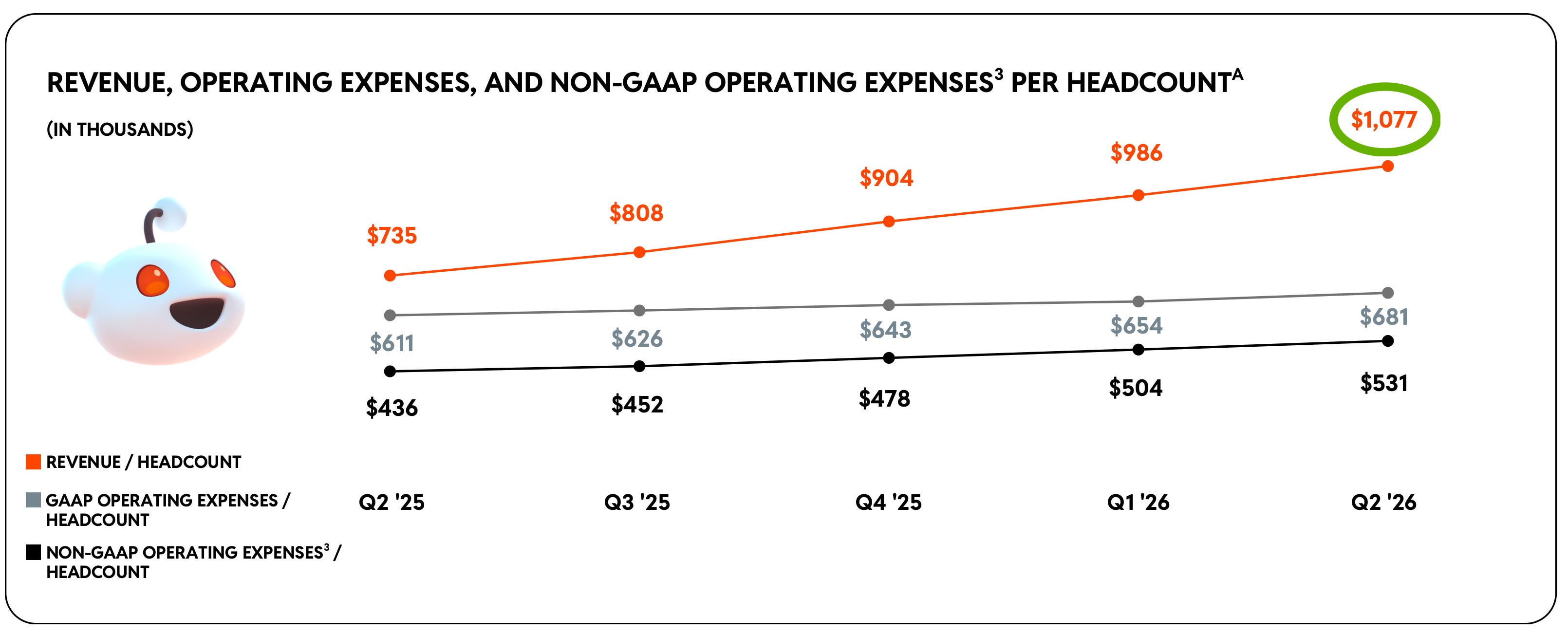
Play that forward and the margin question gets interesting. Management has set a long-term adjusted EBITDA margin target of 50%, and by Q4 2025 Reddit was already at 45%, which suggests it’s approaching that goal well ahead of the implied schedule.
“The long-term goal is 50%. And so that's what we're focused on right now. And I think most of that will come from just leverage off of incremental revenues. There aren't huge pockets of costs that we're sort of staring at right now and say we could take that out. That would be my take on your question.“ - Call Transcript
I’d treat the 50% target as a floor on ambition rather than a ceiling on possibility. Against a mature comparable like Meta, Reddit’s leverage looks almost absurd, because it hits elite gross margins without any of the multi-billion-dollar infrastructure spend that weighs on companies who own their own data centers.
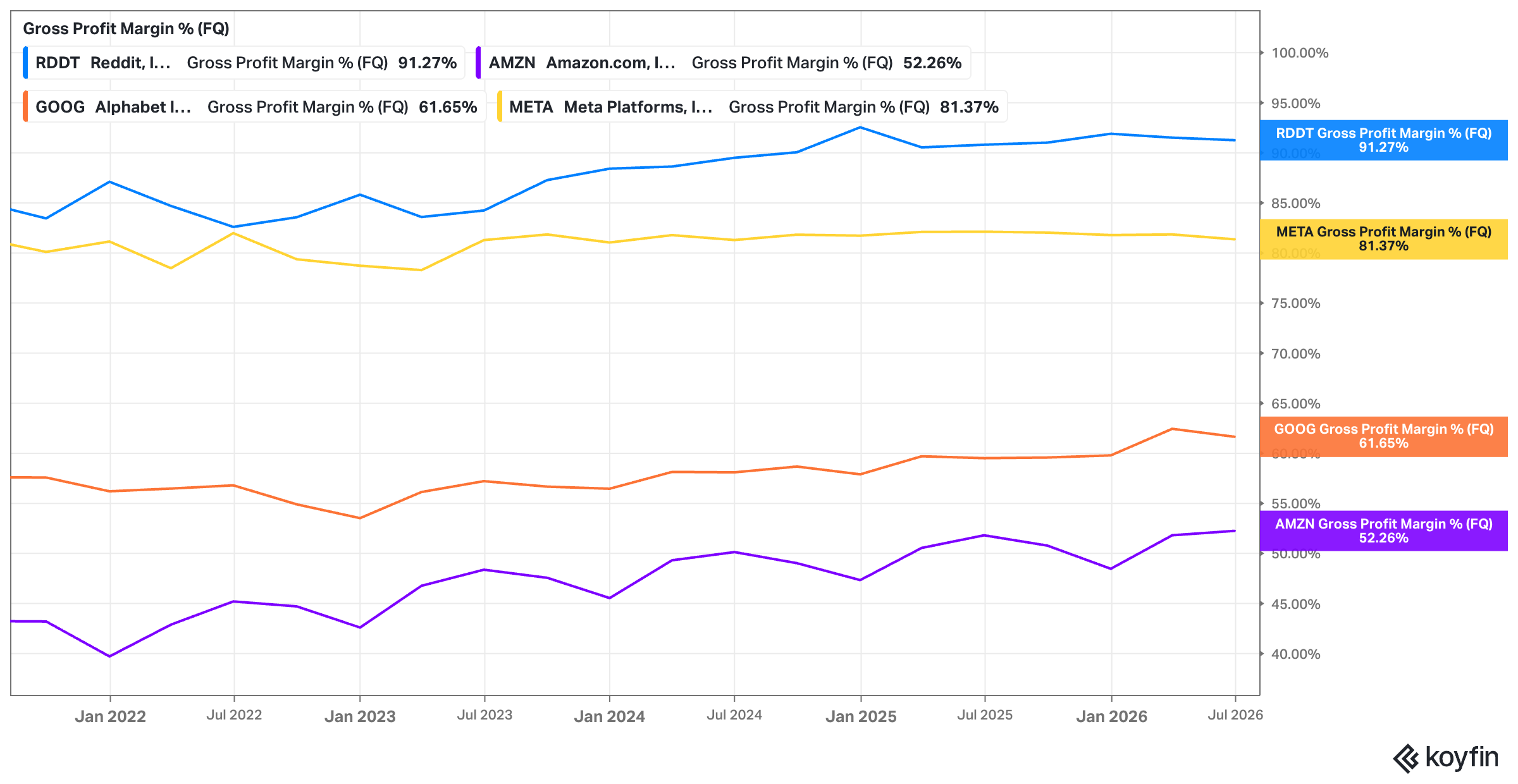
If you’re trying to picture margins five to ten years out (which I will get into in part 3 of this series - valuation), the honest range is wide and depends heavily on how the international and search build-outs consume investment along the way. But a business with 90%-plus gross margins, low CapEx requirements, and a mostly fixed cost base has every structural ingredient for margins that keep climbing even if the pace of expansion naturally slows.
The direction is clear. The timeline is debatable.
Customers
Reddit has a unique customer base, because in a way it has two “customers” which are easy to confuse:
On one side are the users, a vast global base of consumers who supply the content and the attention.
On the other are the advertisers and AI developers, the corporations who pay to reach that attention or license that content.
Reddit is (mostly) free to use. And as the say goes, …
If you aren't the customer, you are the product."
The users are the product being sold, and they’re also, in a sense, the “customers” being served.
I’ll spend Part I on the user, since without a loyal user there’s nothing to sell, and turn to the paying side and the economics in Part II.
Part I
Start with who the Reddit user is, because the demographics matter to the investment case more than they might first appear. In the U.S., this is a genuinely attractive audience for anyone with something to sell. As already highlighted, Reddits users, on average, tend to be decently affluent. Around 64% of users sit in households earning $75,000 a year or more.
The gender split runs close to balanced, roughly half male, which is worth noting because Reddit long carried a reputation as a male-skewed site and that’s less true than the stereotype suggests.
On age, the platform skews young but not adolescent, with something like 41% of users between 18 and 34 – old enough to have money, young enough to have decades of purchasing ahead of them.
“According to Comscore data about Redditors in the United States aged 18 and over, for the three months ended December 31, 2023, 41% were between the ages of 18 to 34, 50% were male, and 64% had a household annual income of $75,000 or more.” - S-1
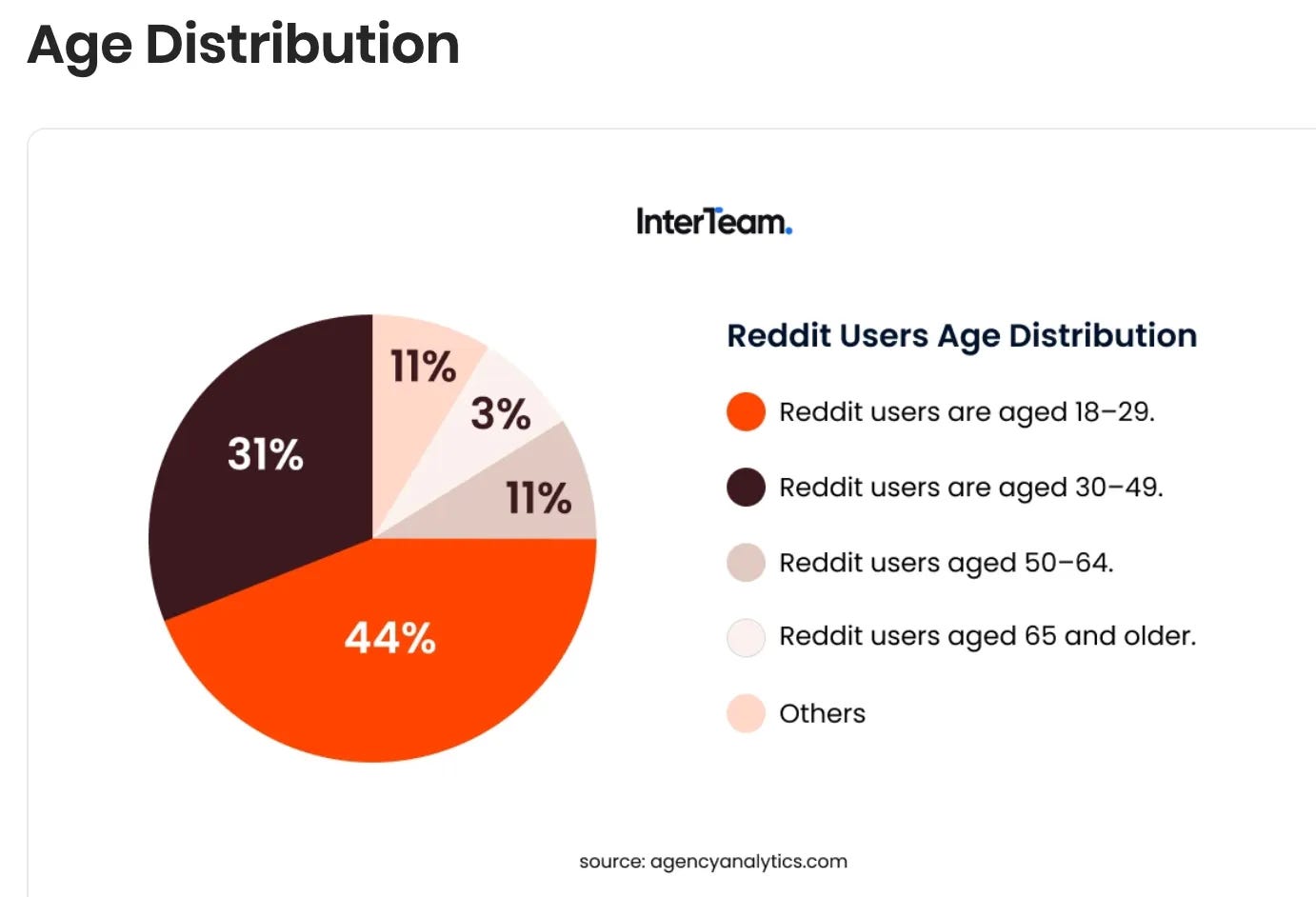
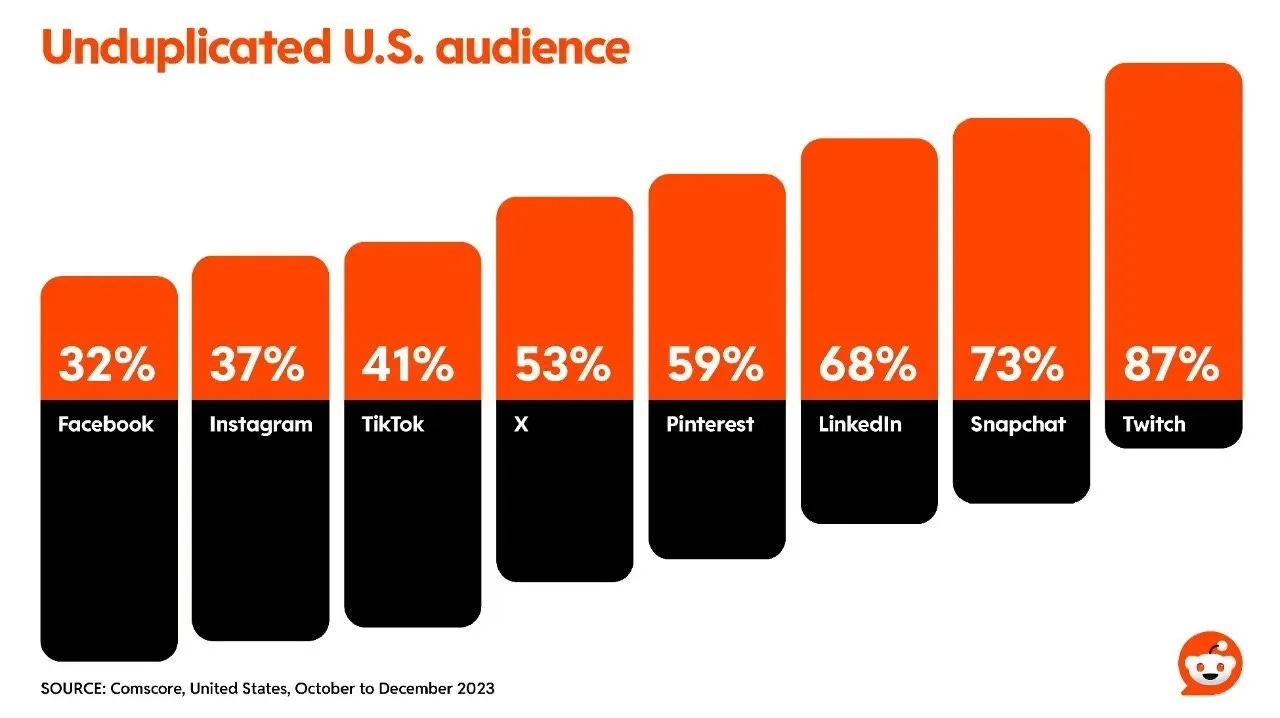
What I also found noteworthy is that “many Redditors are not active on traditional social media platforms” (S-1 filing).
“… according to Comscore data for the three months ended December 31, 2023, of people who visited Reddit in the United States, 32% were not active on Facebook, 37% were not active on Instagram, 73% were not active on Snapchat, 41% were not active on TikTok, and 53% were not active on X.” - S-1
Furthermore, what holds these people on the platform isn’t who they follow. It’s what they care about. Reddit users have self-selected into an interest graph rather than a social graph, and the values underneath that choice tell you why they’re sticky. They often prize anonymity, which is rare among the major platforms and which frees them from the performance and self-display that define Instagram or TikTok.
“Because Reddit is interest-driven versus friends-and-follower driven, and because Redditors have control over their identity, they often seek information on topics important to them that are not visible to social media platforms. For example, a Redditor might privately explore how to cure their acne, but they are unlikely to share this with friends on other platforms publicly. As such, Reddit offers advertisers a chance to reach users that other platforms cannot in the most contextually relevant ways.“ - S-1
Now, I should be careful here, because the interest graph isn't Reddit's alone anymore. Instagram and TikTok have both drifted hard in the same direction – TikTok was arguably built on it, with a "For You" feed driven far more by what you engage with than by who you know, and Instagram has spent years pivoting its feed toward algorithmic recommendation over your actual friends. So the idea that a feed should serve you what you're interested in rather than what your social circle posted is no longer a differentiator on its own.
What still separates Reddit is the structure underneath the graph. On TikTok or Instagram the interest is inferred, reverse-engineered from your behavior by an algorithm guessing at what you'll linger on. On Reddit you declare it, explicitly, by choosing to join r/mechanicalkeyboards or r/personalfinance, and then you talk to other people who declared the same thing. It's an interest graph organized around communities and conversation rather than around a solo feed of content served to you in isolation.
That, plus the anonymity mentioned above, is the real distinction. Reddit prizes pseudonymity in a way that's rare among the major social media platforms, and it frees users from the performance and self-display that still define much of Instagram and TikTok. You're usually not building a personal brand in r/personalfinance. You're just asking a question and getting honest answers from strangers who have no reason to perform for you.
You’re not there to look perfect for people you know. You’re there to talk, candidly, about a thing you’re interested in, whether that’s a mundane hobby or something closer to an existential crisis, with strangers who happen to share the obsession. Reddit shows up in the pivotal moments – the parenting struggle at 2 a.m., the scary health question, the career pivot – where your friends and family simply don’t have the specialized knowledge and a subreddit full of people who’ve experienced exactly that situation does. It has become the default place to get a recommendation you can trust, precisely because the person answering has no obvious incentive to lie, in contrast to a paid influencer or an SEO-optimized review farm. Over 40% of internet users say Reddit recommendations are the single most influential factor in their purchasing decisions, which is a staggering figure when you sit with it.
“Over 40% of Internet users consider recommendations on Reddit the most influential factor in purchasing decisions, surpassing expert reviews, influencer endorsements, and aggregated star ratings. Reddit conversations are where interests meet intent, they inform purchase decisions and offer valuable spaces for brands to connect with people looking for trustworthy opinions.“ - Call Transcript
So if Reddit disappeared, users wouldn’t just lose a website. They’d lose one of the internet’s largest open archives of human knowledge and a space for honest conversation that genuinely doesn’t exist in the same form anywhere else. That’s the mark of a product with a deep hook rather than a shallow one.
Part II – The actual customer who actually pays Reddit
Everything up to here has been about the user, the person who supplies the content and the attention. But the user doesn’t pay Reddit a cent – some do for some perks, but it really doesn’t move the needle for the business.
The customer who writes the big checks is the advertiser, and understanding that base – how it’s structured, how concentrated it is, and how it’s changing – is of course important. Reddit works with thousands of advertisers spanning the full size range, from Fortune 500 giants down to small businesses running a few hundred dollars through the self-serve tool. Historically this was a heavily large-enterprise, heavily U.S. base, and the story of the last couple of years is Reddit deliberately widening it across sizes, industries, and geographies.
Reddit sorts these relationships into three tiers based on how much hand-holding they need, and the shape of that pyramid matters.
At the top sits Large Customer Sales, the Fortune 500 and AdAge 200 names (in case you didn’t know, Ad Age's annually ranks the largest U.S. advertisers and most-advertised brands) that work through the big creative and media agencies and get a dedicated, consultative Reddit team organized around their vertical. As of late 2023 this group alone drove roughly 65% of direct ad revenue, which tells you how top-heavy the business was not long ago.
In the middle is the mid-market and SMB tier, generally companies spending north of $10 million a year, running their own campaigns with light guidance from Reddit’s ops teams – its revenue was doubling year over year by mid-2026 (“We saw strength across our sales channels, including large customers and scaled. Our scaled channel revenue, which includes mid-market and SMBs, doubled year-over-year.”).
And at the base is self-service, the smaller businesses using the automated Ads Manager with no salesperson involved at all. That bottom tier is the one I’d watch most closely for the health of the platform, because it’s the scaled, low-touch channel that lets an ad business broaden beyond a handful of whales.
The industry mix is still concentrated in the places you’d expect Reddit to work, the endemic verticals where its communities are “deep.” As of late 2023, more than half of ad revenue came from just four buckets:
technology and communications,
business and finance,
electronics, and
media and entertainment.
Recently, growth, encouragingly, is coming from newer territory – retail, travel, pharma, and automotive are all migrating budget onto the platform.
On concentration, the trend is genuinely reassuring even if the starting point wasn’t. Reddit’s advertiser count grew more than 70% year over year by mid-2026, and the reliance on the biggest players is steadily easing. The top 10 advertisers accounted for 21% of total revenue in 2025, down from 25% in 2024 and 26% in 2023. Management has noted that no single industry made up more than 15% of revenue as of late 2024, and no individual customer exceeded 10% in any of the last three years. That’s the direction you want.
I won’t leave this section without the risks, because the advertiser base carries some structural fragilities that are easy to overlook when the growth looks this good.
The first is baked into the entire digital-ad industry: advertisers have no long-term commitments and can cut or cancel spend whenever they like, which is precisely why a recession hits a business like this so quickly.
The second is agency dependency. A lot of those large customers buy through a handful of enormous agency holding companies, so a soured relationship with one of those intermediaries could dent revenue well out of proportion to any single client leaving.
And the third loops straight back to the international thesis: only a small % of ad revenue came from outside the U.S., even though more than half the users are international. It’s the runway I described in the international pillar, but it’s also a reminder that today’s revenue rests heavily on one country’s ad market, with all the concentration risk that implies.
Arguably, there’s a third distinct end consumers: AI developers. While users provide the “raw material” and advertisers have historically been the primary source of revenue, management increasingly views data licensing partners as a fundamental pillar of Reddit’s future business model. The most prominent customers are Google and OpenAI, who use Reddit’s 20-year archive for training and grounding their Large Language Models (LLMs). Neither Anthropic nor Perplexity are commercial data-licensing customers of Reddit. In fact, Reddit has sued both companies over alleged unauthorized web scraping.
“In addition, we face competition from large language models (“LLMs”) and other AI models that retrieve and synthesize information, such as those built by Google, Meta, OpenAI, and Anthropic; Redditors may choose to find information using AI tools, which in some cases may have been trained using Reddit content, instead of visiting Reddit directly. While we have made, and expect to continue to make, significant investments to integrate AI, including generative AI, into our platform, AI technologies are rapidly evolving and there can be no guarantee that our products and services will remain competitive as new AI technologies are developed, adopted, and integrated.“ - 10-K
Companies like Sprinklr, Meltwater, and Cision license the Data API to help their corporate clients uncover brand insights and monitor global trends. A newer vertical includes the Intercontinental Exchange (ICE), which uses Reddit data to develop analytics products that help investors capture market sentiment from communities like r/wallstreetbets.
Do people love Reddit, or just use it?
There’s a difference between a product people tolerate and one they’re attached to. Reddit clears the bar for attachment, and it does so in a way I find very convincing. Users say “I love Reddit” unprompted. As already highlighted, usage deepens with tenure. A new logged-in user typically starts at around 20 minutes a day. Someone who’s been on the platform for more than seven years is spending 45-plus minutes a day.
For Reddit, loyalty seems to compound. The longer you stay, the more the place has wrapped itself around your specific interests, and the harder it becomes to leave.
Reddit covers every niche imaginable, which means it grows with you through each life stage. The subreddits you needed at 22 aren’t the ones you need at 37, but they all appear on the same platform, so the platform never ages out of relevance the way a single-purpose app does (you “grow out of” Snapchat as you transition from adolescence into adulthood, for instance).
Some users describe themselves, half-jokingly, as chronically online or addicted, and while I’d treat that language carefully, the underlying point holds: there are switching costs. They aren’t financial in nature. It’s rather the accumulated relevance of a feed and a set of communities that took years to assemble. And the loyalty runs deep enough that users and volunteer moderators feel genuine ownership over the platform, which is exactly why the company handed them a slice of the IPO.
On Retention
Management has said, and I think correctly, that new-user retention is the single best measurement of product quality. It’s a cleaner signal than raw user growth, because growth can be bought with marketing while retention can only be earned by the product actually being good. So the retention trajectory is where I’d look to falsify or confirm the “people love this” claim, and lately it’s been pointing the right way. In mid-2026, Reddit reported that new-app-user retention was up 50% year over year on a relative basis, which the company flagged as an important sign that product improvements are making the platform stickier.
Search turns out to be a retention lever, which connects a few threads from earlier. Users who perform any search on Reddit show 30% higher week-one retention. That’s not a coincidence – search is how a new user discovers that Reddit has something for their specific obsession, and once they find that first relevant community, the hook sets.
There’s a quality-of-user point layered on top: direct app users and logged-in users are worth multiples more than drive-by search traffic, because they see more impressions and engage more deeply.
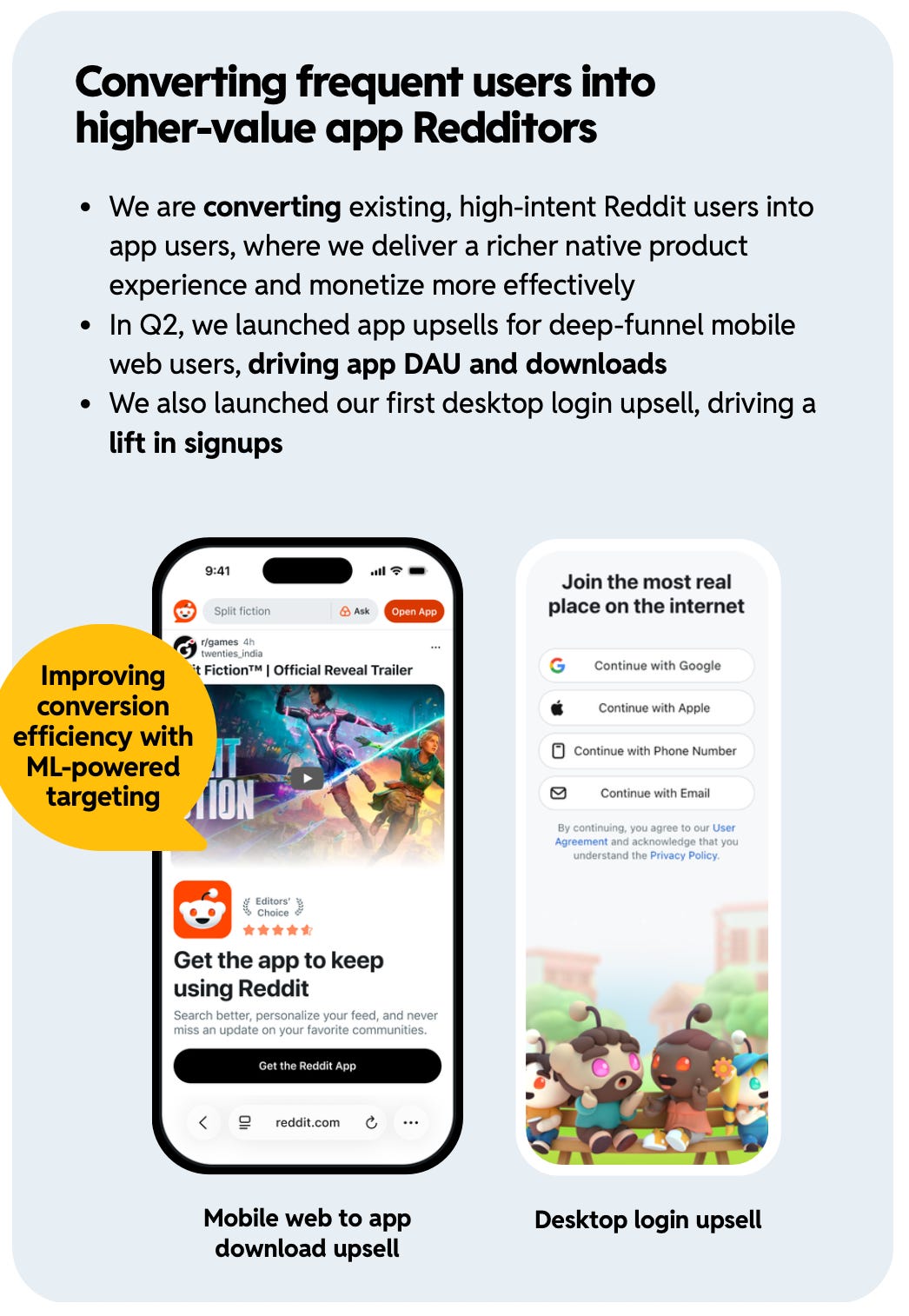
Reddit’s user-marketing spend is conservative, typically a low-to-mid single-digit percentage of revenue, and management evaluates it with a straightforward cash model that targets a quick payback. Low acquisition spend paired with rising retention is the combination you want as an investor.
“This quarter, we're kind of low mid-single digits percent of revenue. To be honest with you, Tom, we don't have sort of a pinpoint number that we're going after. We're really, at this point, looking at that quality user. We're looking at the ROI and we're looking at the retention curves of people that we're bringing on to the platform. That's really what we're focused on.“ - Call Transcript
From a customer lifetime value framework POV, Reddit looks exceptional: Low CAC, high margin per user, high retention, and lengthening customer longevity. When acquisition is cheap and the customer stays longer and monetizes more every year they’re around, that’s a fantastic position to be in.
Simplicity & Industry Analysis
A pain point solved by a business only becomes incredibly valuable if it’s hard for someone else to solve, so it’s worth being clear-eyed about who Reddit competes with.
The honest answer is that it competes on two fronts at once:
For information and recommendations, it’s up against Google, Wikipedia, and increasingly (!) the AI chatbots like ChatGPT and Gemini.
For entertainment and time, it’s up against Meta, TikTok, and YouTube. That’s a fearsome set of competitors on paper and in practice. We all know how incredibly addictive (and likely socially harmful) their algorithms are. Beyond traditional social networks, Reddit also vies with X (formerly Twitter) for real-time commentary, Discord for niche community hangouts, and platforms like Twitch or Snap for mobile-first engagement. Ultimately, Reddit isn't just competing against other forums—it's fighting any app capable of capturing five minutes of idle human attention.
“We also compete to attract and retain Redditors’ attention on the basis of our content and Redditor experiences with our platform and face significant competition for prospective users, both domestically and internationally. We compete against many companies that provide content and communications services to online users, including Google (including YouTube, Search, Maps, and Shopping), Meta (including Facebook, Instagram, Threads, and WhatsApp), Wikipedia, Snap, X, Pinterest, TikTok, Roblox, Discord, and Twitch, and which offer a variety of internet- and mobile device-based products, services, and content. Many of these companies have greater financial resources and substantially larger user bases than Reddit. Our competitors may draw users towards their products or services and away from ours. This could decrease the growth, engagement, or retention of Redditors, which, in turn, would negatively affect our business. In addition, we face competition from large language models (“LLMs”) and other AI models that retrieve and synthesize information, such as those built by Google, Meta, OpenAI, and Anthropic; Redditors may choose to find information using AI tools, which in some cases may have been trained using Reddit content, instead of visiting Reddit directly. While we have made, and expect to continue to make, significant investments to integrate AI, including generative AI, into our platform, AI technologies are rapidly evolving and there can be no guarantee that our products and services will remain competitive as new AI technologies are developed, adopted, and integrated.” - 10-K
I don’t want to soft-pedal the competition, because it’s fierce and Reddit is not the gorilla. Arguably, Reddit is the challenger. Meta is the dominant force in the room, with deeper user data and best-in-class ad-targeting ROI that make it a far easier choice for most small and local businesses, who can lean on Meta’s measurable and granular geo-targeting in a way Reddit can’t yet match.
Google is the more complicated rival, because it’s simultaneously a major partner and an existential threat, since roughly half of Reddit’s traffic is search-dependent, which hands Google enormous leverage over Reddit’s top of funnel through nothing more than an algorithm tweak or the continued rise of AI Overviews.
And then there are the benchmark peers, Pinterest and Snap, less direct competitors than yardsticks the market uses to argue about Reddit’s ARPU ceiling and its multiple.
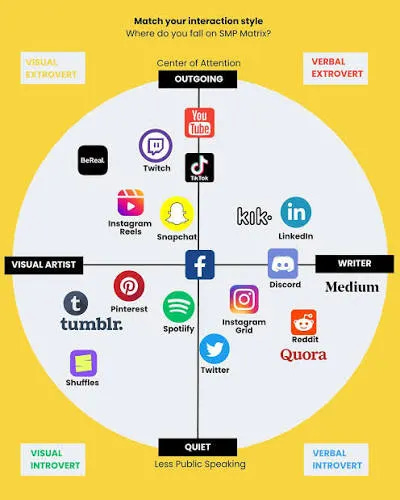
But the structure of Reddit’s product does make it genuinely awkward to replace. The entertainment platforms are mostly broadcast systems built on following – you watch what creators you follow put out, and the platform optimizes for self-display and passive consumption. Reddit optimizes for participation and belonging, which is a different psychological need and one that a follower-driven feed doesn’t scratch. You can’t easily bolt a Reddit onto Instagram, because the whole point of Reddit is that it isn’t Instagram.
And on the information side, the AI chatbots are, ironically, dependent on Reddit rather than a clean substitute for it, since they source a chunk of their most-cited answers from Reddit threads in the first place. There’s a real tension there, which I’ve flagged before and will keep flagging: those same chatbots could also intercept the user before they ever reach the thread. So I wouldn’t call the “moat” unbreachable. I’d call it structurally distinct in a way that has, so far, let Reddit outlast every direct forum competitor that came for it, from Yahoo Answers to Quora.
The graveyard of dead Q&A sites is itself a piece of evidence.
The market-share picture makes the challenge concrete. Google and Meta together hoover up somewhere between half and 70% of all digital ad spend, which leaves everyone else fighting over the remainder.
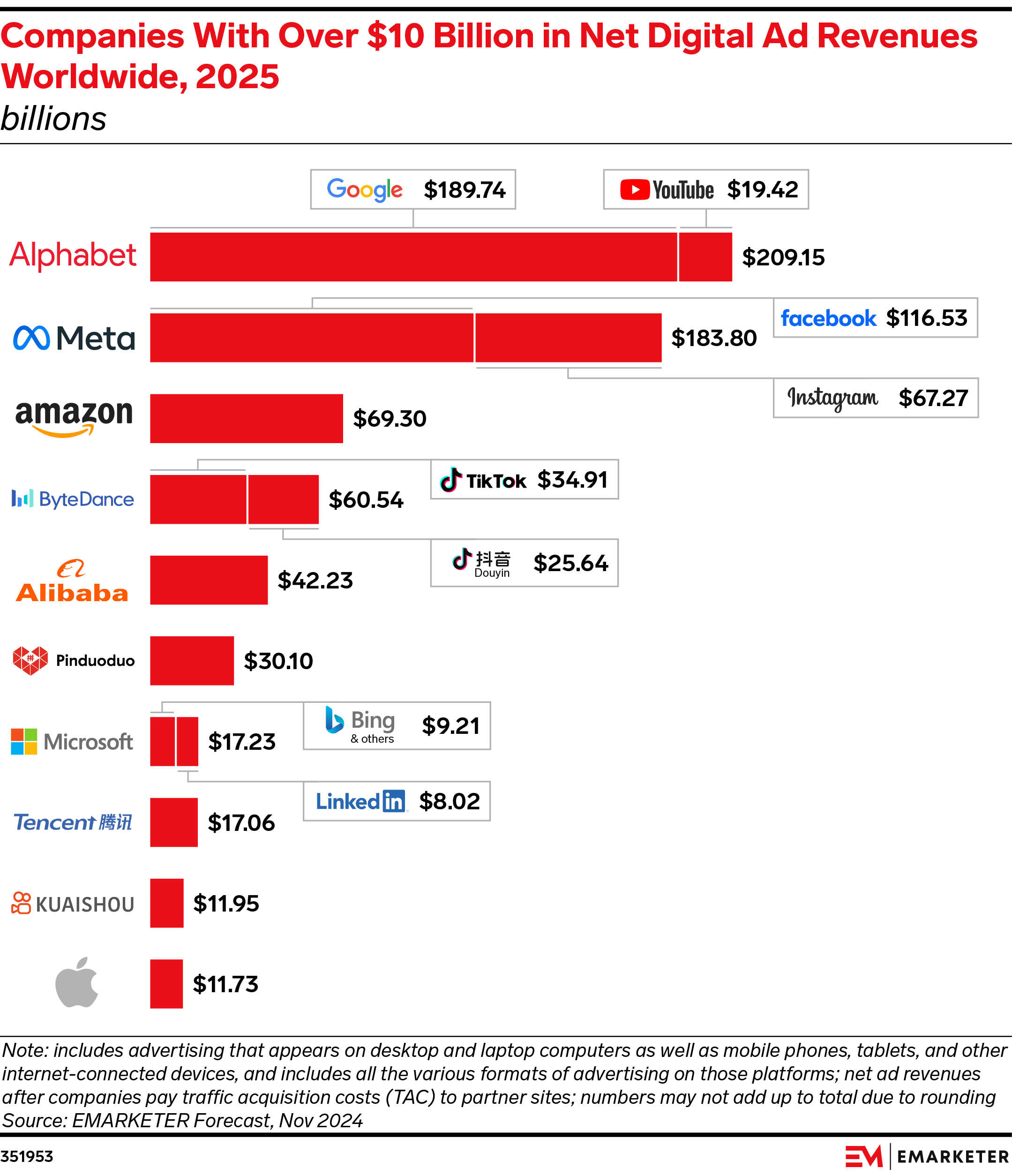
Reddit’s position within that remainder is improving, though, and one figure caught my eye: its median wallet share inside its own advertiser base roughly doubled to around 9% within twelve months. So the advertisers who are already on Reddit are handing it a bigger slice of their budgets, which is the pattern you’d want from a challenger that’s proving itself rather than plateauing. I’d file this as a crowded, highly competitive market that I’d normally prefer to avoid, softened by the fact that Reddit isn’t really competing head-to-head for the same inventory. It’s selling something the giants structurally can’t, which is why it survives in their shadow at all.
Is this a good industry, or a good business trapped in a hard one?
Reddit sits at the intersection of two industries. One is digital advertising, which is competitive, cyclical, and dominated by two giants; but at the same time of very high quality.
Every platform becomes an ad network, eventually.
The other is data licensing for AI, which barely existed three years ago.
What I can say is that Reddit occupies a genuinely attractive niche inside an otherwise brutal industry. The evidence for the niche being attractive is in the margins and the pricing. Reddit runs gross margins north of 90%, hitting 91.5% in early 2026, which is a software-like profile that most advertising businesses never approach, never even dare to dream of, and it’s the thing Huffman means when he calls the financial model one-of-one.
There’s evident pricing power too, though it’s uneven in a telling way. Generic advertisers, the CPG crowd, are paying only about 3% more year over year, which is barely keeping pace. Financial-services advertisers, on the other hand, are bidding Reddit’s prices up 25% annually because the intent in those communities converts into measurable outcomes. Read those two numbers side by side: the pricing power is real, but it concentrates in the verticals where declared intent pays off.
The differentiation itself is structural, rooted in the interest graph rather than the social graph, and that is what lets Reddit capture users at the moment they’ve declared what they want.
The niche economics are excellent while the surrounding industry stays brutal, and any honest read of the business has to hold both of those at the same time.
A twenty-year-old activity dressed in changing technology
The technology layer Reddit operates on changes fast. It went from basic web links to mobile apps to, now, AI-integrated everything, and rapid change is exactly the thing that should scare patient investors, because businesses that start doing lots of new things have a way of doing them badly. I take that concern seriously here, and I won’t pretend the roadmap from the product section, with its half-dozen new initiatives, is the picture of a company sticking to its knitting.
Here’s the counterweight, though, and it’s the reason I’m not more worried than I am. The technology around Reddit keeps changing while the actual activity inside it has stayed almost eerily constant for two decades: people talking to other people, in communities, about things they care about.
That is what Reddit was in 2005 and what Reddit is in 2026.
What changed was the wrapper, the apps and the monetization, not the human behavior at the center.
When I ask myself whether I can state with near certainty that this business and its core product won’t be obsolete in ten or twenty years, I’d probably still say “no,” though – unfortunately.
At the same time, the odds of Reddit still being around, most likely in a different shape and form, aren’t too slim either. People wanted candid advice from strangers before the internet, they’ll want it after the next platform shift, and Reddit has already survived the arrival of smartphones, the entire social-media era, and a global pandemic without abandoning its forum roots.
Betting on Reddit is closer to betting on the continuation of past behavior than it looks at first glance, even if the wrapper keeps getting redesigned.
Which way do the structural winds blow?
Weighing the long-term forces, I think the tailwinds are stronger than the headwinds, but the biggest headwind is genuinely dangerous.
On the tailwind side, the flood of “AI slop” makes Reddit’s archive of authentic human conversation more valuable the more the rest of the web degrades. You can frame this through the dead internet theory, the idea that a growing share of online content is bot-generated noise, against which human ground truth becomes scarce and prized. Social search is a rising behavior, and Reddit is the single most-cited domain by AI models across the internet, which positions it well as discovery shifts away from the old blue links.
Those are powerful, durable forces pushing in Reddit’s favor.
The headwind is the mirror image of that same trend, which is what makes it so hard to dismiss. AI cannibalization is the central risk to the whole story. If users increasingly get their Reddit-sourced answers straight from a chatbot or an AI Overview without ever clicking through to Reddit, the company loses the referral traffic that feeds its logged-out tourist audience, and it loses it precisely because its own data made the AI answer good enough to end the search.
The same force that makes Reddit’s data valuable to license could hollow out the traffic that makes Reddit valuable to advertise on.
I don’t think that tension is resolved yet, in either direction, and how it resolves is arguably the single most important open question in this investment.
TL;DR
I'll use a TL;DR here, which I'm told is deeply ingrained in Reddit's own culture – the "too long; didn't read" summary that a kind stranger drops at the bottom of a wall of text for everyone scrolling past.
Fitting, given how much text this series has already asked of you.
So, if I had to explain this company and its business model to my parents over dinner, I'd put it like this:
Reddit is a 20-year-old digital “city” built on authentic human conversation, and that conversation has become essential raw material for the AI era while also drawing an unusually high-intent, affluent audience that advertisers increasingly want to reach. It's a rare business that pairs software-like gross margins above 90% with 60%-plus revenue growth, because it's only now starting to monetize an audience it spent two decades building. The bet is simply that Reddit closes the monetization gap with giants like Meta while remaining the internet's primary source of genuine human perspective – and the main thing that could break the bet is AI intercepting its users before they ever arrive.
And that, my friends … that's the business of Reddit.
If you've made it through both parts (make sure to not miss part 1), you now have the same foundation I do: a 20-year-old platform sitting on an irreplaceable archive, a genuine inflection in profitability, an interest-and-intent model that advertisers are still learning to value properly, and a fistful of real risks – the U.S. user ceiling, the Google dependency, the AI-cannibalization tension – that I've tried not to wave away.
Deep Dive: Reddit ($RDDT) – Part 1

There are certain kinds of companies that everyone has heard of, that everyone has an opinion about, yet almost no one has actually studied them in depth. Reddit might be the most recent, purest example of this.
What I've deliberately held back so far is the part every investor actually wants to argue about.
Is it a buy?
I don't yet have an answer, and I've resisted pretending to have one, because a hypothesis this dependent on a handful of swing variables deserves to be modeled properly rather than eyeballed.
That's what the next part is for. In Part 3, I'll turn from the business (which is of exceptional quality as I concluded) to the investment, and I'll work through the things that decide whether the price makes sense: management's tenure, compensation, and whether they have real skin in the game, along with any insider buying worth noting; the balance sheet; and then the heart of it, valuation. I'll lay out the growth drivers explicitly – whether the ARPU gap can realistically close at something like a Pinterest – and take a view on where steady-state margins actually settle once the easy leverage is spent.
Crucially, I'll try to anchor my inside view to the outside one with a base-rate analysis, because it's dangerously easy to fall in love with a specific narrative and forget what usually happens to companies that looked like this. Then I'll show you my own model, assumptions exposed for you to disagree with. And I'll close with a more speculative thought I keep turning over, which is whether a certain company might end up wanting to own this thing outright.
That's the plan. See you in Part 3!
Disclaimer:
As of the date of publication the author owns no shares in the company; but that may change. The analysis presented in this blog may be flawed and/or critical information may have been overlooked. The content provided should be considered an educational resource and should not be construed as individualized investment advice, nor as a recommendation to buy or sell specific securities. I may own some of the securities discussed. The stocks, funds, and assets discussed are examples only and may not be appropriate for your individual circumstances. It is the responsibility of the reader to do their own due diligence before investing in any index fund, ETF, asset, or stock mentioned or before making any sell decisions. Also double-check if the comments made are accurate. You should always consult with a financial advisor before purchasing a specific stock and making decisions regarding your portfolio.
Eagerly awaiting part III
This is an excellent analysis of a complex company and I look forward to part 3.