You have almost certainly used Amadeus (a 23 billion € company listed in Spain). You have almost certainly never heard of it.
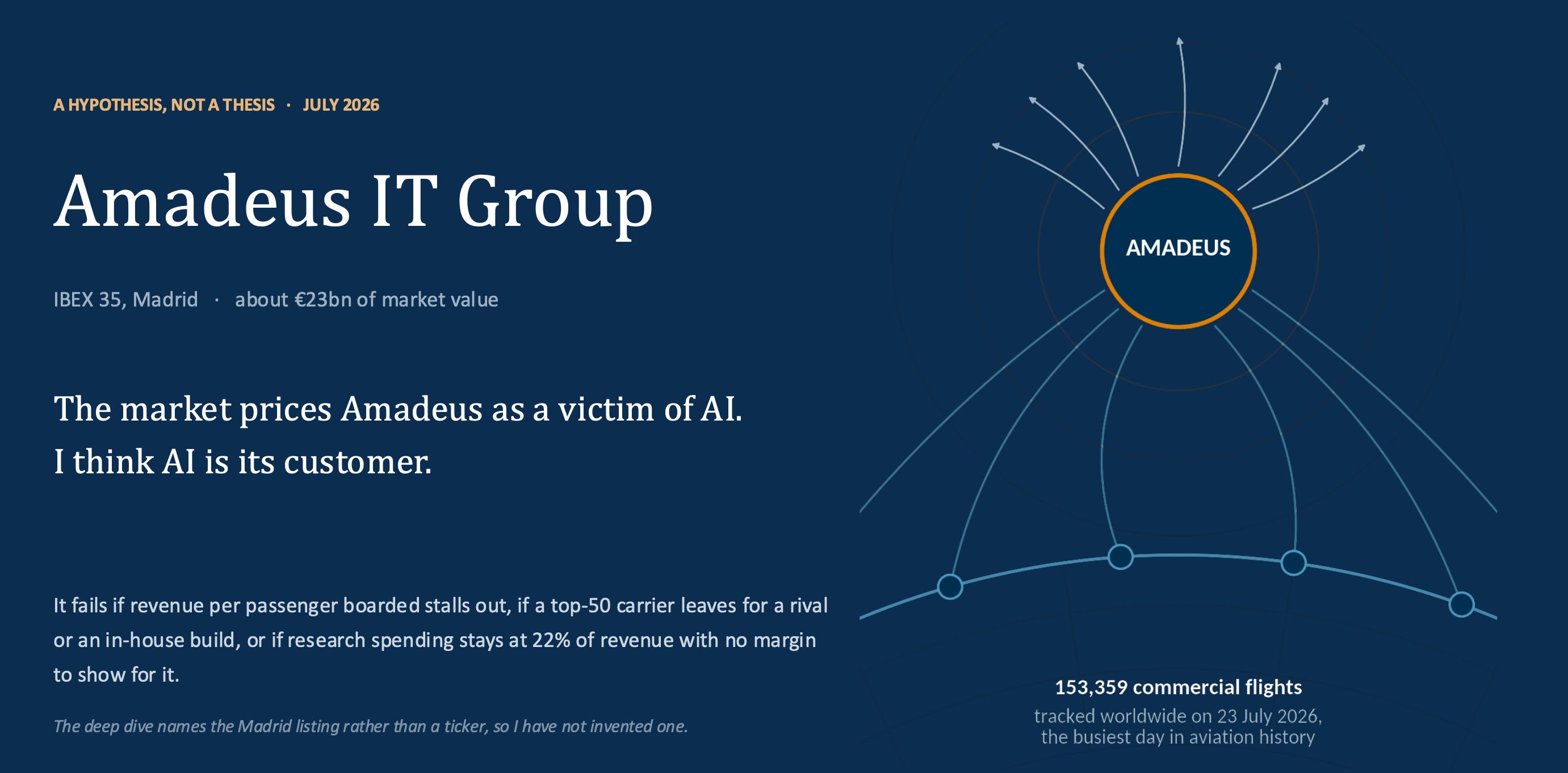
Consider that on July 23, 2026, just days before I’m writing this, the skies saw the busiest day for commercial air travel in history, with Flightradar24 tracking a staggering 153,359 commercial flights around the world.
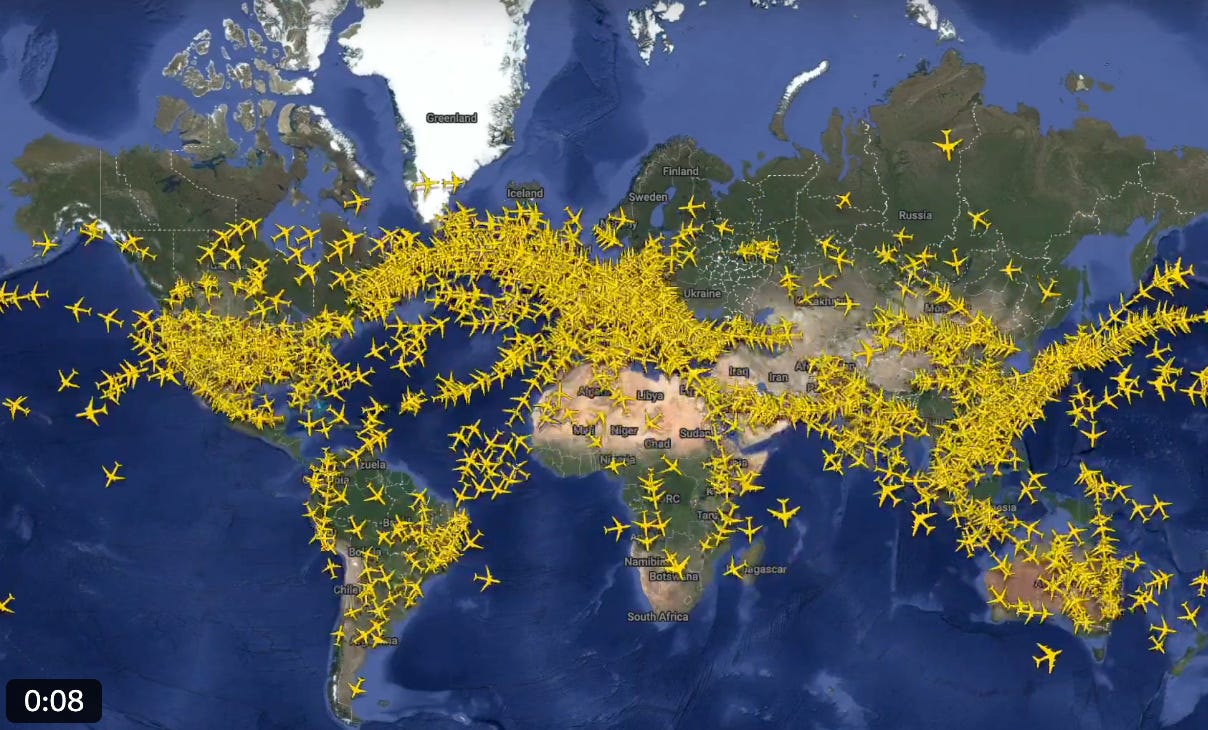
A record share of those journeys touched Amadeus somewhere along the way. Every time you book a flight, check into a hotel, or watch your boarding pass load onto your phone, there’s a strong chance the transaction ran through a company most travelers couldn’t name if their connection depended on it.
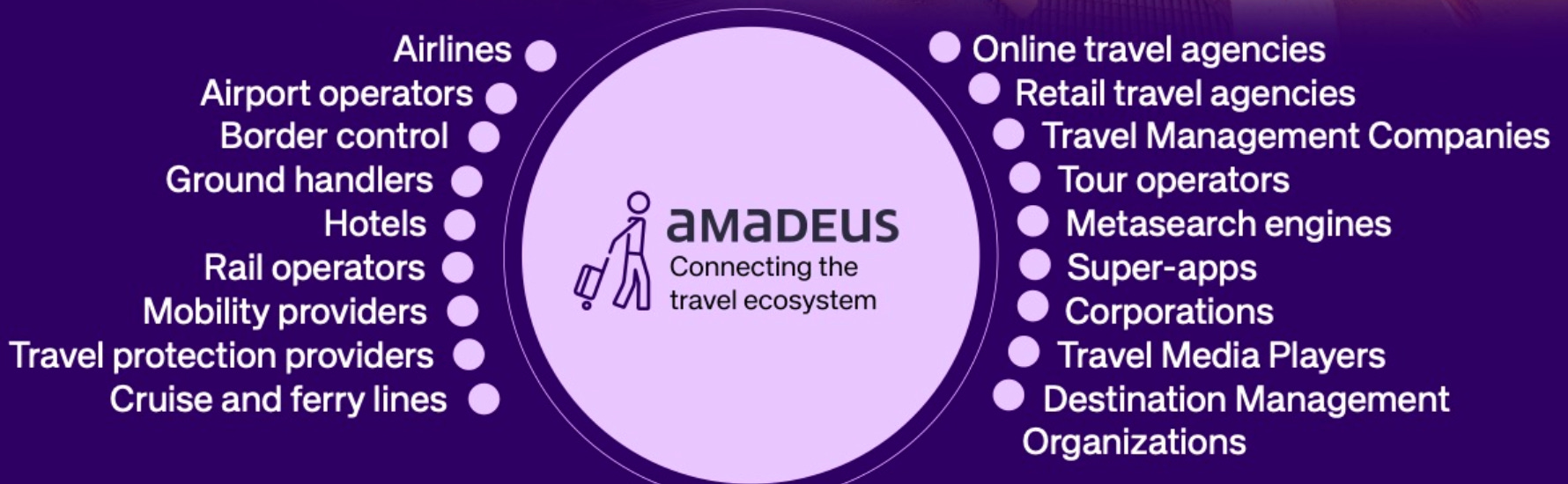
The numbers behind that anonymity are hard to fathom. Amadeus processes more than two billion boarded passengers a year, handles up to 150,000 transactions per second at peak, and fields something like three billion search requests a day. That’s a data-processing load in the same neighborhood as Google Search, humming away inside an infrastructure business that trades on the Madrid exchange and rarely makes a headline outside the trade press.

If the system is down, the plane does not take off. When a streaming service goes dark, you’re annoyed. When Amadeus goes dark, aircraft stay on the ground and airports descend into chaos.
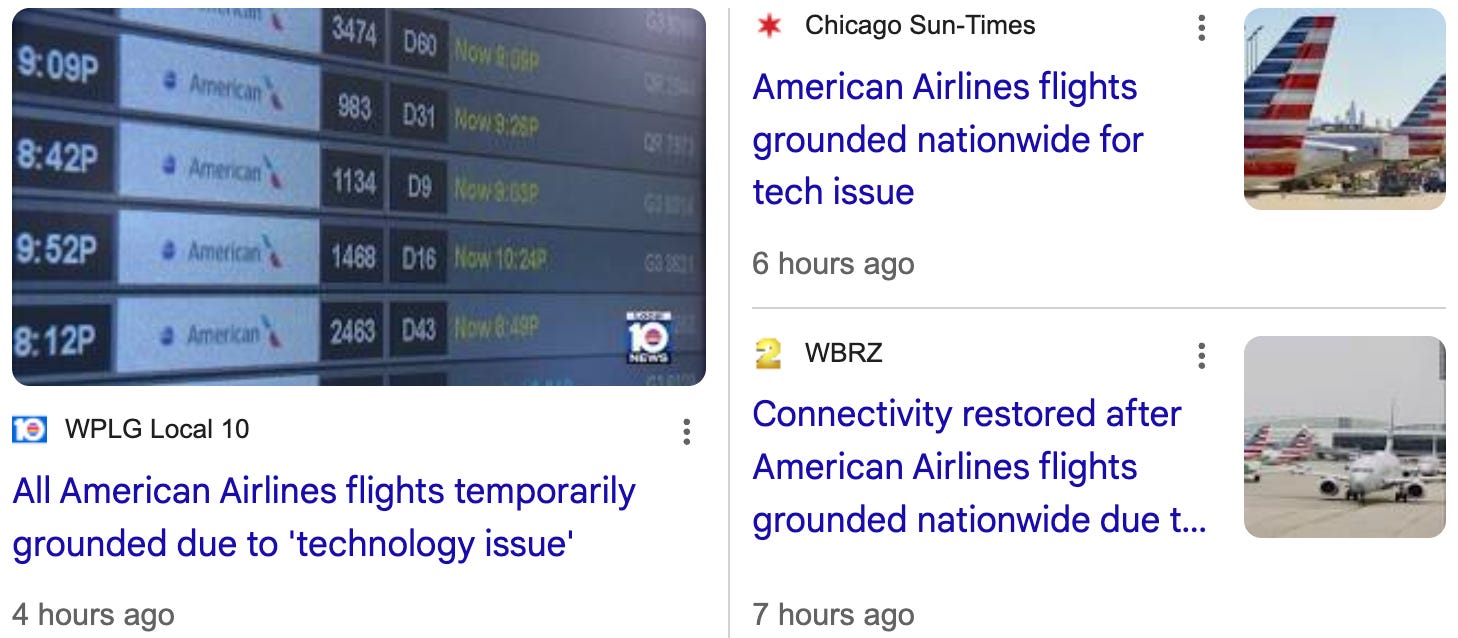
As I type this, American Airlines flights were stopped from departing after a brief IT outage led to a nationwide ground stop. A “technology issue briefly impacted connectivity” for some systems, the airline said in a statement. “Connectivity has been fully restored. We apologize to our customers for the inconvenience. We appreciate the efforts of our team to bring our systems back online so quickly and take care of our customers.” (shoutout to Heavy Moat Investments for sharing this with me today).
“Looks like AA uses a mix of Sabre and outsourced solutions to India. Not a good look and costs millions.“ - Heavy Moat Investments
It is the SAP of airlines, running check-in, luggage handling, and departure control with near-zero tolerance for error, which is why the company holds itself to a 99.99% uptime standard. Half a day of downtime would cascade into mass cancellations across the globe.
That is the definition of mission-critical, and it’s the kind of position most less-embedded software companies would trade a decade of growth to occupy.
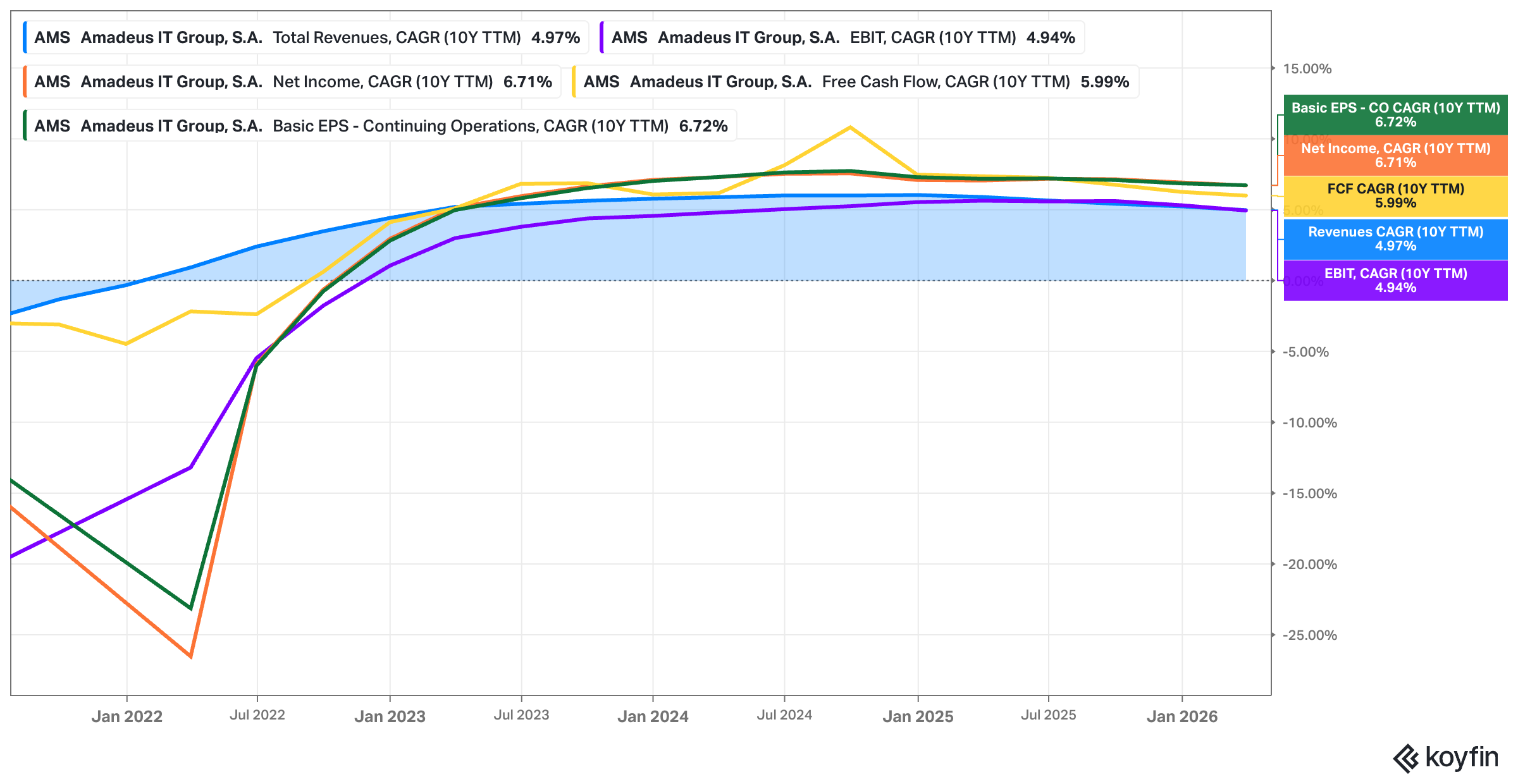
So here is the puzzle that pulled me into this name. Over the last ten years, Amadeus grew. Revenue compounded at roughly 5% a year, EBIT at about the same, and earnings per share at close to 7%. The business got bigger, more profitable, and more entrenched.
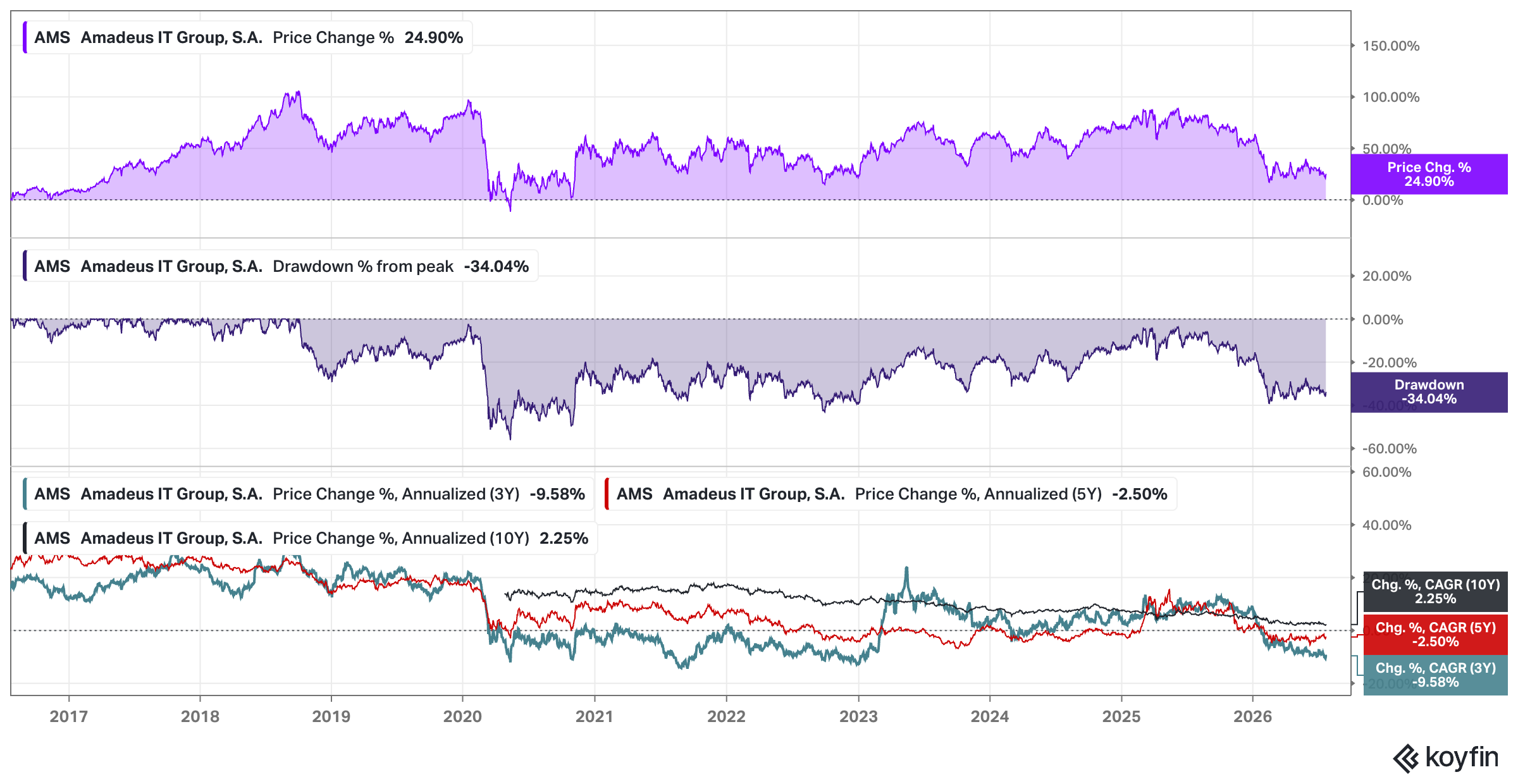
As many stocks that attractive me or catch my attention, the stock did almost nothing. A shareholder who bought ten years ago has earned an annualized price return of around 2%, and the picture gets worse as you shorten the window: negative over five years, and worse still over three (-9.5% CAGR). As I write, the shares sit about 34% below their peak. A company that kept compounding, and a share price that went sideways for a decade. When those two lines diverge that far for that long, one of them is usually wrong, even if the starting valuation was clearly too high.
And once again, – and there are strong similarities to our Workiva analysis – it all comes down to a single word:
AI.
The prevailing fear is that agentic search and chatbots will disintermediate the distribution layer, letting airlines and travelers route around the middleman and cut Amadeus out of the flow. That anxiety has compressed the valuation from a historical norm in the mid-20s times earnings down to roughly 16x trailing and under 14x forward, with the stock changing hands at about 16x free cash flow (please note that the FCF multiple display below is off as it doesn’t account for “payments for intangible assets”).
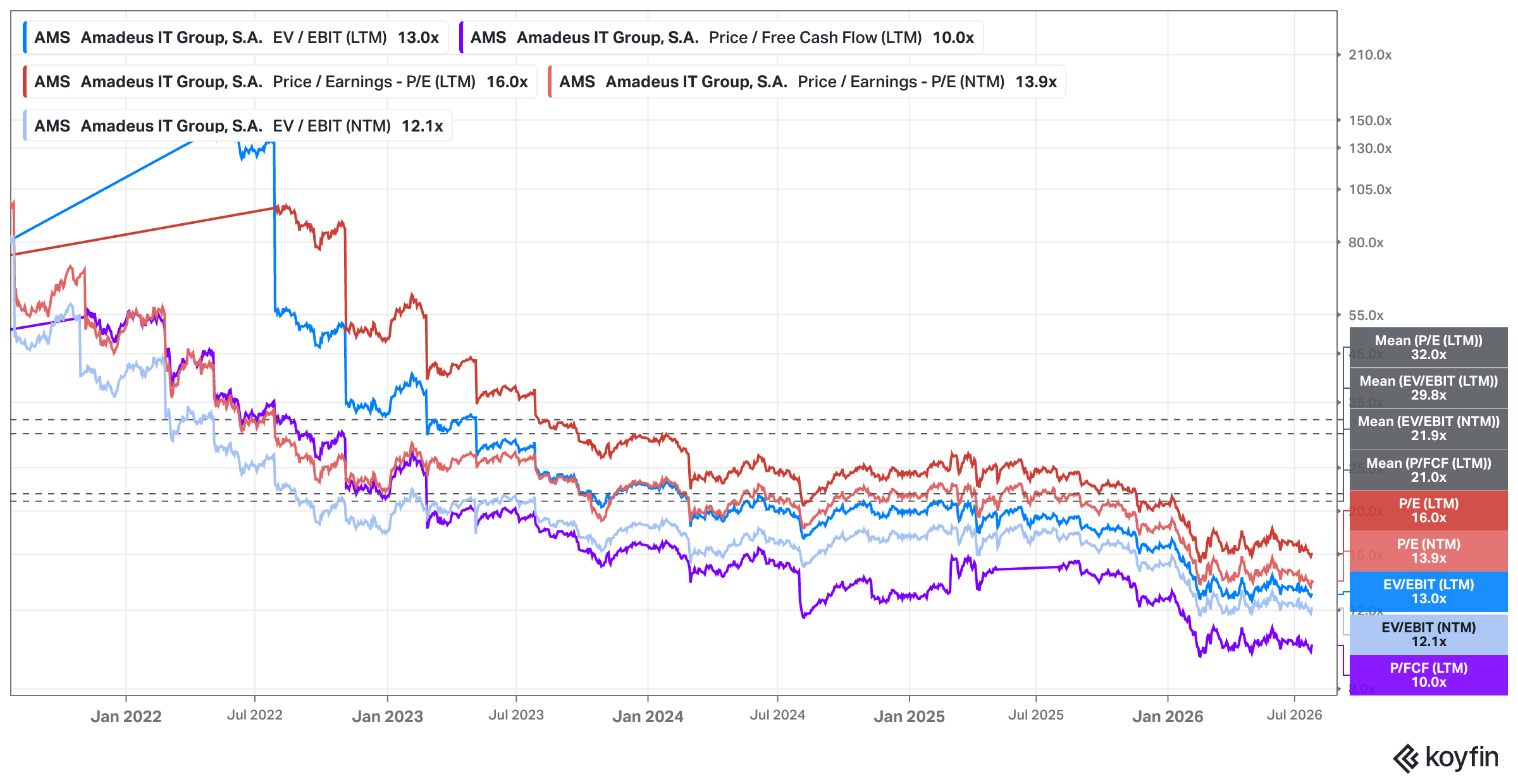
The multiple did the damage here, not the fundamentals.
And I think the story behind it has the causation backwards. My reading, which I’ll spend this piece testing (rather than assuming), is that AI is less a threat to Amadeus than a customer of it. The large language models supply the brains for travel planning. They lack the plumbing to touch legacy airline systems, live pricing, and the deterministic record that makes a booking valid, legal, and operational. Amadeus is that plumbing, and it’s the neutral orchestrator airlines trust precisely because it isn’t Google.
There’s a new, a stranger chapter still. Amadeus is becoming an identity company. Through its acquisition of Idemia Public Security and the rollout of biometric corridors in places like Jakarta, it’s building a world of seamless travel where you clear borders and board planes without ever producing a document, verified on the move by facial recognition that has multiplied border-crossing capacity tenfold in early deployments. A future without passports, orchestrated by a former airline-booking consortium. Which is a fitting turn for a company that started life in 1987 when Lufthansa, Air France, Iberia, and SAS banded together to build a shared, neutral platform for an industry that couldn’t agree on much else. Nearly four decades later, that consortium has grown into what analysts affectionately call a friendly gorilla, a business with more than 50% market share that wins by being a channel friend to its customers rather than a toll they resent.
That’s the tension I want to work through in the pages that follow. A dominant, mission-critical, cash-generative business, priced by the market as if its best days are behind it.
And the timing is pointed, because Amadeus reports this Friday (as I type this, I’m not sure I will be able to release before the quarterly results. Please keep in mind that the analysis below was conducted pre-Q2 results). If you’ve never studied the name, this is the week to fix that, since a set of numbers landing against a beaten-down multiple is exactly the setup where a misunderstood business can move.
What this deep dive covers:
We cover the key thesis in about 10,000 words:
The seven-part bull case (”Bam Bam Bam Bam Bam Bam Bam”)
What went wrong
Investment Slide Deck – the deep dive in a highly compressed + visualized form
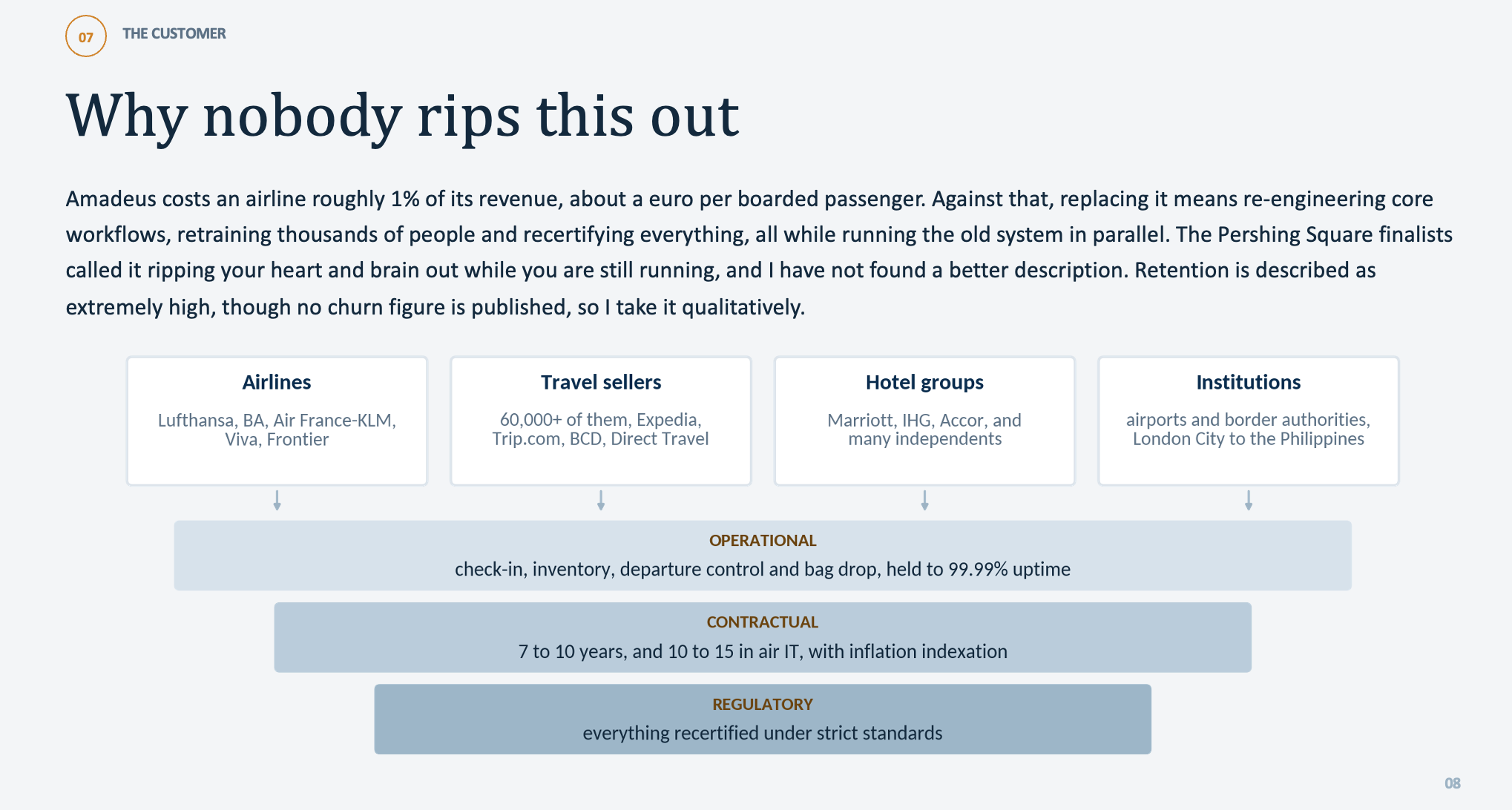
Every deep dive now comes with a companion slide deck. It’s the whole argument in compressed form – the hypothesis, the business, the competitive position, the valuation, and the case against – for the days when you don’t have an hour to spare but still want the shape of the thing. Paid subscribers get both, the long piece and the deck, on every deep dive from here on.
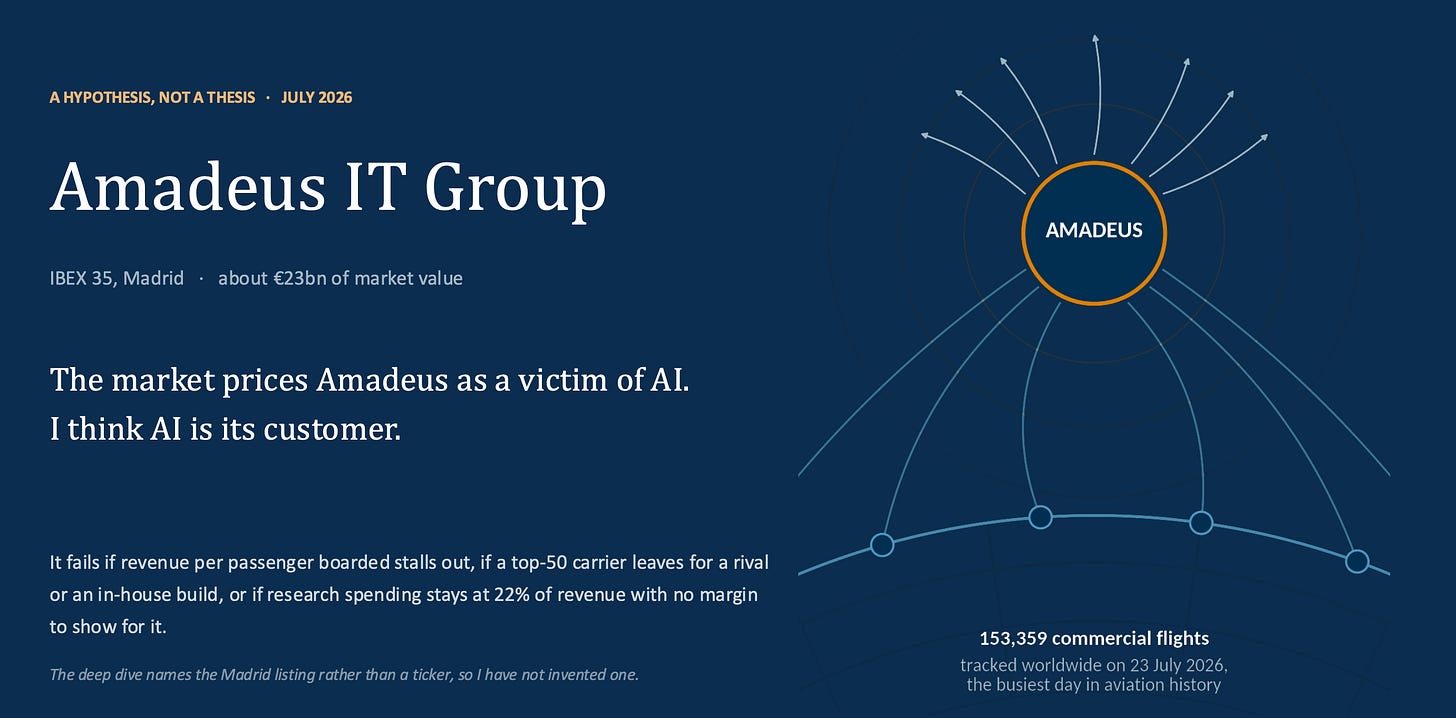
I do want to stress that this time I built the slide deck with Claude’s Opus 5 and the result blew me away! I think the deck is really really good!
If you then want to dig even deeper, we cover the business, the management team, detailed valuation work, etc. in the subsequent sections one more time:
The origin story
The business itself
Unit economics analysis
The customer
Legal structure, cyclicality, and operating leverage
The moat
Is it a good business in a good industry
Management and governance
Growth drivers and forecasting
Margins outlook
Valuation (including a downloadable model)
Other findings
Disclaimer
As of the date of publication the author owns no shares in the company; but that may change. The analysis presented in this blog may be flawed and/or critical information may have been overlooked. The content provided should be considered an educational resource and should not be construed as individualized investment advice, nor as a recommendation to buy or sell specific securities. I may own some of the securities discussed. The stocks, funds, and assets discussed are examples only and may not be appropriate for your individual circumstances. It is the responsibility of the reader to do their own due diligence before investing in any index fund, ETF, asset, or stock mentioned or before making any sell decisions. Also double-check if the comments made are accurate. You should always consult with a financial advisor before purchasing a specific stock and making decisions regarding your portfolio.
“Bam Bam Bam Bam Bam”-Hypothesis
Why look at Amadeus now you may ask? Well, Amadeus may currently be severely mispriced, trading at a roughly 40% discount to its historical multiples due to overstated AI disintermediation fears that have overwhelmed its fundamental performance. What the market may be missing is that Amadeus is entering a “harvesting phase” where seven years of heavy R&D and cloud migration costs are shifting into a high-margin revenue driver, specifically through the “black box” of Nevio’s superior unit economics.
This may create a compelling entry point for a business that acts as the essential infrastructure layer AI agents require to operate reliably at scale.
As always, one deliberate choice in how I’ve framed this, and it isn’t pedantry. I intentionally call this an investment hypothesis rather than a “statement of belief” or a thesis. While a thesis often encourages a search for confirmatory data, this hypothesis remains unverified and is built to be actively stress-tested and falsified in the subsequent sections. My objective is not to find information that supports my view, but to attempt to falsify the claim that AI will disintermediate the distribution layer or that airlines can economically replace their mission-critical IT “nervous systems.” Keep that posture in mind as you read.
Bam #1: The Gorilla in the Plumbing
Amadeus’s oligopolistic dominance is the result of a decades-long compounding effect where scale, technological reinvestment, and network effects have created a nearly insurmountable lead over most of its peers. Industry insiders often call it the “gorilla of travel IT,” and the label fits.
“I think the best way of summarizing the business is as the gorilla of travel IT, but a friendly gorilla which is able to grow well ahead of a structurally growing market i.e. travel and importantly this is in a low risk way, given its diversification across geography and travel provider customer, and the inflation linked nature of how the revenue model works.“ - Business Breakdowns episode on Amadeus
Amadeus operates as the essential plumbing for the global travel industry, the nervous system that unobtrusively routes the signals every airline, agency, and traveler depends on without ever thinking about it.
In its core segments, Amadeus commands a position that is frequently a multiple the size of its nearest competitor.
On the IT side, it is the primary system of record for over 50% of the world’s airlines, processing roughly 2.2 billion passengers boarded each year. That’s about 46% of total global air traffic flowing through one company’s software. The dominance is most visible where it matters most commercially, at the top of the market: 50 of the top 50 airlines globally run Amadeus’s Passenger Service Systems, whether that’s the legacy Altea platform or New Skies.
Amadeus Altéa: A comprehensive Passenger Service System (PSS) designed primarily for full-service, network, and legacy airlines to manage end-to-end flight reservations, seat inventory, and airport departure control.
Navitaire New Skies (by Amadeus): A digital-first, ticketless PSS tailored for low-cost (LCC) and hybrid carriers, optimized for direct distribution, high-volume ancillary retailing, and web-centric bookings.
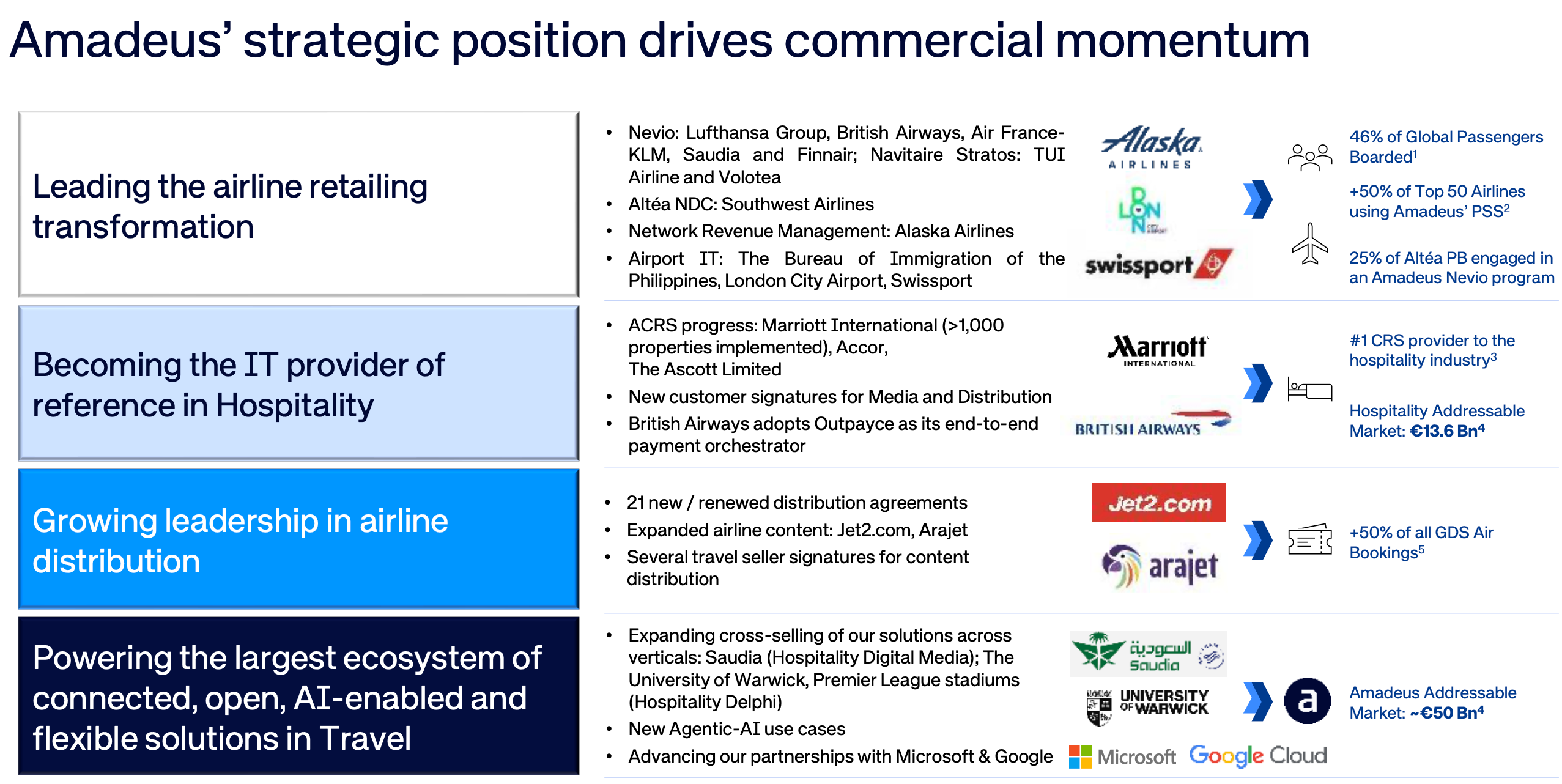
In the Global Distribution System market, Amadeus holds a 55% share, sitting well ahead of Sabre at around 35% and Travelport at roughly 10%.
This is where it gets interesting!
Become a paying subscriber to read the rest of this post and get access to all of my other research, including valuation spreadsheets, deep dives (e.g. well-known mid- and large caps such as LVMH, Duolingo, Meta, Edenred as well as more hidden gems such as Tiger Brokers, Digital Ocean, Ashtead Technologies, InPost, Timee, and MANY more), and powerful investing frameworks.
As a member, you get:
Complete Access: Every deep dive in our library (65+ and counting).
The WhatsApp Community: Real-time discussion and networking with like-minded investors.
Digital Investing Conferences: Around three times a year, we also hold digital conferences where members present and share stock ideas, and discuss broader themes, and we’d love for you to join in!
Incredible Value: Full access to all of this for less than €1/day.