

Dear second-level thinkers,
That greeting is new, and so is this kind of post. Let me explain both before I get into the substance, because there are three to four things I want to cover today and the last one ends with a favor I would like to ask of you, so I’d appreciate it if you stick around.
Almost everything I publish here is analysis. A company deep dive, an investing framework, updated thoughts on business valuation, a mistake I made.
What follows is none of those.
It is a piece about the process of writing itself, the art of writing, the business of writing, about how it travels, and about a problem I have not solved.
I plan to write more of these. Vitaliy Katsenelson is the model I have in mind. He built his reputation on value investing and then started publishing essays about classical music, chess, Stoicism, and his children, and a good number of his readers arrived for the investing and stayed for the rest. He describes himself as an investor who thinks through writing. That framing appeals to me enormously. I am a teacher and a writer as much as I am an investor, and the parts of me that show up in a Dino Polska deep dive are a narrow slice of the person doing the writing.
So these more personal pieces, or so I intend, are going to appear from time to time, and I will file them under the “NEW? Start Here” tab on the homepage.
1) Why the greeting changed
I sat down with Pieter from Compounding Quality the other day to record a podcast (find it here), and somewhere in the prep I noticed that he opens his emails with “Dear Partners.”
I liked what that does. It treats the reader as somebody who is in this with you rather than somebody you are broadcasting at. It makes it more personal.
So I went looking for my own version, and “Dear second-level thinkers” is where I landed. Tell me in the comments what you make of the choice. I am open to better suggestions.
The term comes from Howard Marks. First-level thinking looks at a business, decides it is a good one, and buys the stock. Second-level thinking asks what everybody else already believes about that business, what the price is already paying for, and where the consensus might have it wrong. It is slower, more uncomfortable, yet it is invaluable in investing.
That distinction matters more in 2026 than ever. Information has never been cheaper. More abundant. Anybody can have a competent summary of a 10-K in forty seconds and a serviceable DCF thirty seconds later. The floor of financial analysis has risen enormously. What the machines made abundant is the first level. Critical thinking, leaning into your experience as an investor, intuition, recognizing patterns, an ability to connect the dots – those skills stayed scarce, and the homogenizing pull of AI in research is making them scarcer still.
That is the work I am trying to do here, and that is who I think you are.
2) Declaring war on the algorithm
A reader wrote to me recently, responding to a Note where I admitted that I struggle to get the word out about this blog.
His reply, translated from the German, was that quality is not my problem. He had asked an AI to rank some investing Substacks so he could learn from the best, I came out near the top, and his conclusion was that marketing is the lever I have not pulled.
I want to be careful here, because leaning on an AI-generated ranking as evidence of my own quality is exactly the kind of first-level move I just spent a few paragraphs criticizing. Treat it as one reader’s opinion, which is what it is. Quality is also in the eye of the beholder; I realize that.
The “weak marketing” diagnosis rings true all the same, and I have been chewing on it for weeks.
Here is a chart I came across today – the “substack finance” search term is absolutely booming on Google Search.
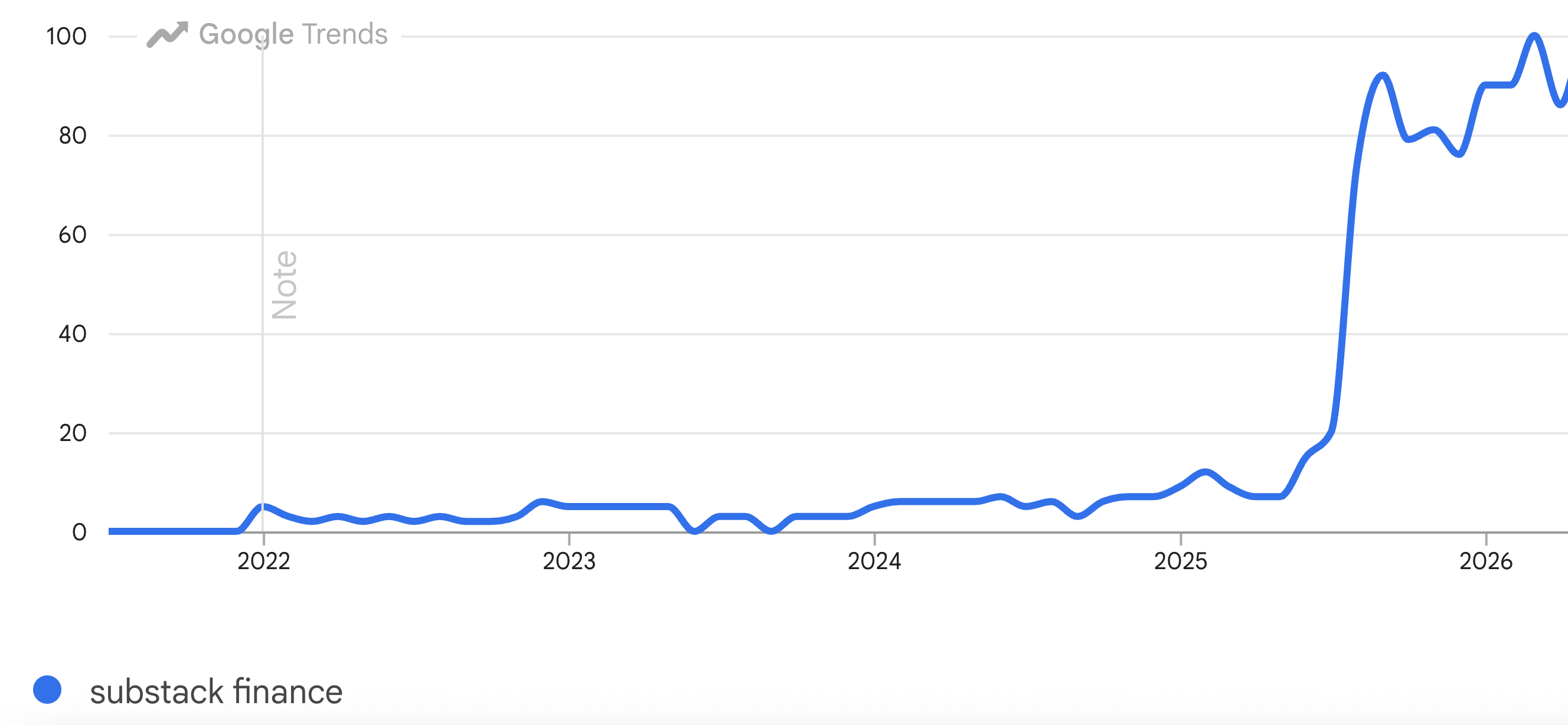
Interest in the category is more than holding up fine. What is strange is how badly that lines up with what I hear from other writers in the stock research niche, most of whom describe the last several months as a grind. Tough. Many see a decline in their paying subscriber base.
A fantastic recent article by Joe | Goldman Won't Cover This, who analyzed the top 100 finance Substacks, provides some insights in that regard. His finding was that this is a “winner takes the most” market, where the big creators capture most of the subscribers.
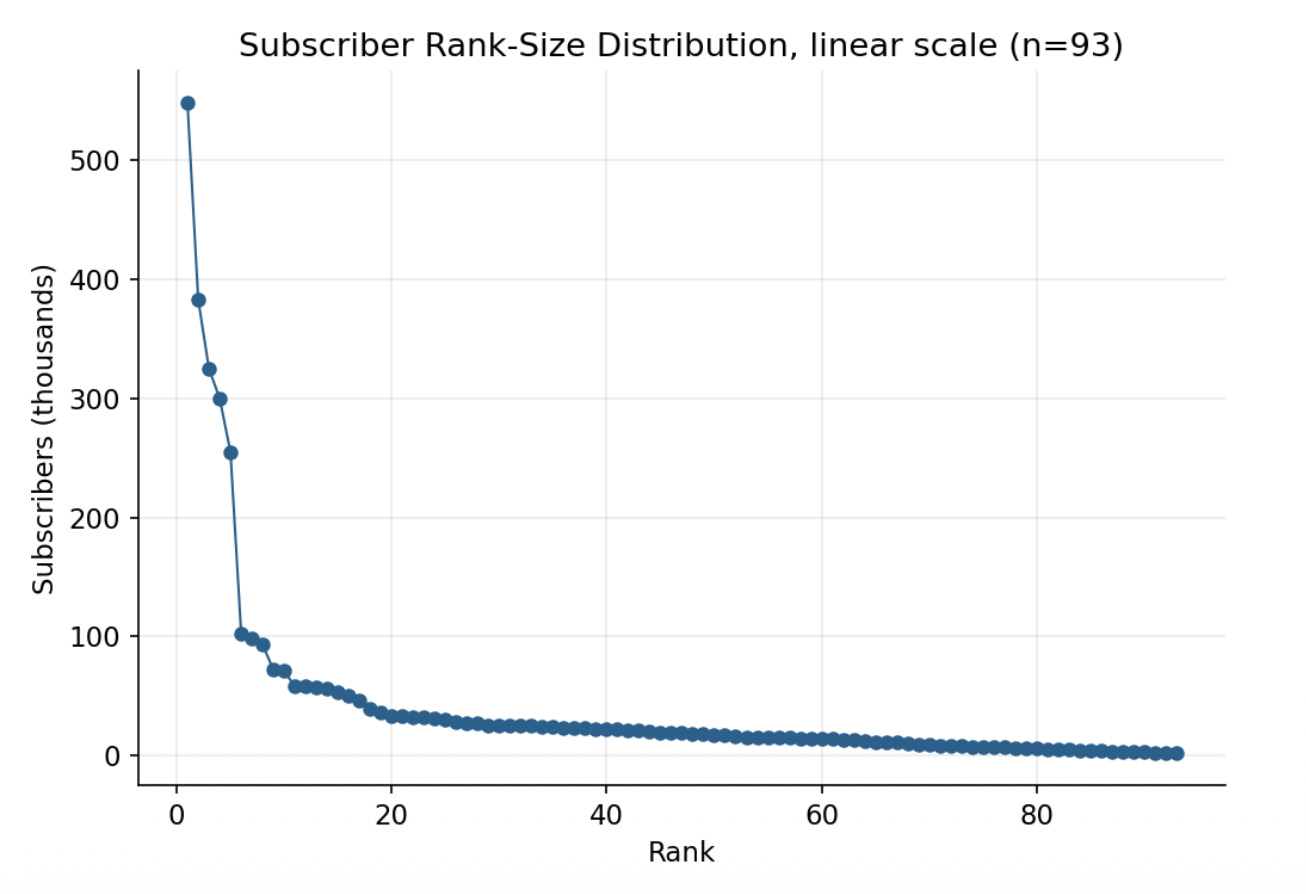
And the top ten publications also plausibly out-earn the remaining ninety (from the Top 100) combined, and where the gap between the top four and everybody else runs to orders of magnitude.
“Overall the Finance Substack space is a ‘winner takes the most’ market. It is likely that the top 10 Finance Substacks generate more revenue than the bottom 90 combined. The difference in revenue with the top 4 finance newsletters is massive, orders of magnitude.
“For the top of the list I had to lean on a tool called Substats.io, which estimates paid subscribers and revenue from public data and claims roughly a 15% margin of error against confirmed figures elsewhere. It puts Michael Burry at $8.4m, Citrini at $6.7m, Doomberg at $4.5m, and Compounding Quality at $4.9m. Take the ranking with a pinch of salt since there’s no date attached to it. Citrini has since overtaken Burry and Doomberg has overtaken Compounding Quality, based on their current leaderboard positions.”
His revenue figures come from a third-party estimation tool with a stated margin of error around fifteen percent and no date attached, so hold the specific numbers loosely. But his conclusions seem directionally right: There is an absolutely brutal “winner takes all” dynamic at play on Substack. Pure capitalism.
Sociologists have a name for this. Robert Merton called it the Matthew effect in a 1968 paper in Science, after the line in Matthew 25 about how those who already have will be given more. He was studying scientific credit: when two researchers produce comparable work, the more eminent one collects most of the recognition, which makes her more eminent still, which makes the next round even more lopsided.
Network scientists describe the same mechanism as preferential attachment. New connections attach to nodes that already have many connections. Advantage compounds on itself with no reference to merit, and once it starts, it is close to self-sustaining.
Every discovery mechanism on a platform like Substack works this way. Recommendations flow from large accounts to other large accounts. Leaderboards rank by size and then feed the ranking back into discovery. A writer with a hundred thousand subscribers has a hundred thousand recommendation slots to give away. I have far fewer. The size of his/her audience gives him/her authority.
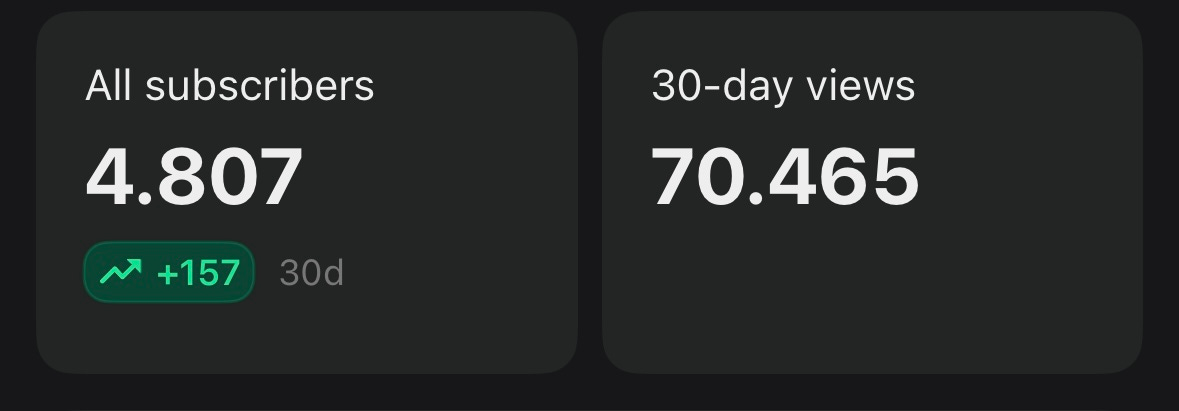
To give you a sense of the arithmetic on my end, I am adding roughly 100 to 200 free subscribers a month, and that trend points down, while writers a few tiers up add thousands in the same window. These figures are unfathomable to me. Mostapha from Compound With AI, who, if you’ve tuned into my podcast with him, you will know, is an incredibly generous and supportive fellow writer, shared with me that he has a few Notes that have gained him an incredible amount of new followers and subscribers.
My hunch is that the explanation for this is a combination of the factors mentioned above (Bestseller lists, cross-recommendations across big accounts, authority bias) and possibly a Substack algorithm that favors both small (to keep them on the platform) and big writers.
Those sitting somewhere in the middle are having a tough time.
3) Where you come in!
So today I decided to “declare war” on that algorithm. Which is where you come in.
One writer I use as a “North Star” is Rebound Capital, who has built a large audience, converts free readers to paid at a rate I would love to match, and whose investing philosophy overlaps with mine a good bit. My understanding is that a public endorsement from Michael Burry preceded a step change in his paid subscriber count, and that he has referred to it himself. Take that as secondhand information, because it is.
Still, the mechanism is what I want you to notice. One credible person vouching moved more than any individual write-up ever did. One member in a group chat set up by James Emanuel put it very succinctly today:
“[A]udiences on Substack are signal seeking much more by reputation these days than by the quality of the investment write up or thesis.“ - The Polymath Investor
Reputation travels through people. And that dear second-level thinkers makes word of mouth the one distribution channel the algorithm does not control, and it is the reason I am about to ask you for something.
If you have gotten value out of what I publish, and you would put your own name behind the quality of it, help me get the signal out! Occasionally is enough. Think about who in your orbit would actually benefit: somebody who just started investing and is drowning in noise, somebody who has been at it for a decade and reads deep dives properly and recognizes the amount of works it requires to put in to release a deep dive likes the ones I publish regularly, a colleague who keeps asking you what to buy, an online friend in a Discord or a WhatsApp group where investing comes up, A Reddit thread on a company I covered (or one asking for great writers in the finance niche), a finance student, somebody who writes or podcasts in this space themselves.
Then pitch me to them. Forward your favorite free article with a line of your own attached (the “Library” has a full overview if you want to pick.
Library

Welcome to a comprehensive overview of all the posts I’ve shared so far, organized by type for easy reference. Whether you’re looking for in-depth company deep dives, process-oriented insights, valuation approaches, or market commentary, this page serves as a central hub to navigate through all the content I’ve published. Each section below highlights a…
Send them the podcast. Restack a Note with a comment rather than a bare like, because comments carry considerably more reach. Recommend the publication from your own Substack if you have one.
Any of it helps more than you would think.
A New Incentive System
Do it out of goodwill if that is enough.
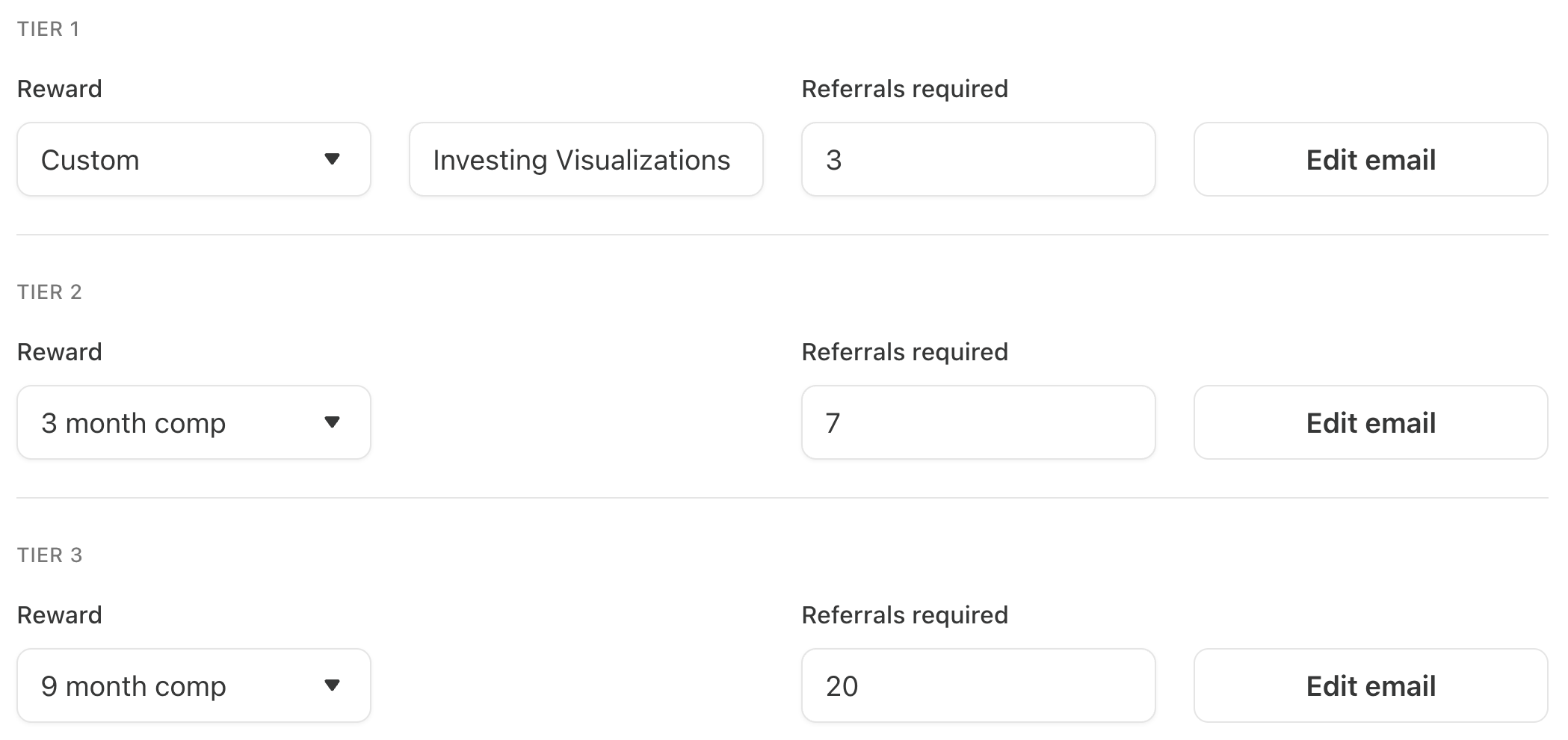
If you would rather have an external incentive (should I really insert Munger’s famous quote here? I pass), I just lowered the thresholds on the referral program, so a free paid subscription is now within reach for a handful of signups (8 referrals for 3 months, 20 for 9 months & a free investing ebook for 3 referrals).
4) Am I publishing too much?
Last thing, and this one is more of me practising self-reflection rather than asking you for a favor.
I sometimes suspect I put out too much, which sounds counterintuitive.
I work hard, I love writing, and when a piece is finished, I want it in your hands. There is no release strategy behind any of it. No every-fourth-day cadence, no drip schedule, no holding a good post back until Tuesday because Tuesday performs better or whatever.
Quality first always – I take as much time as it takes –, then out the door. That is my “system” (lol).
But Herbert Simon made an observation in 1971 that I keep bumping into. A wealth of information, he wrote, creates a poverty of attention. Information consumes the attention of whoever receives it, so abundance on one side manufactures scarcity on the other.
Here is what August looked like.
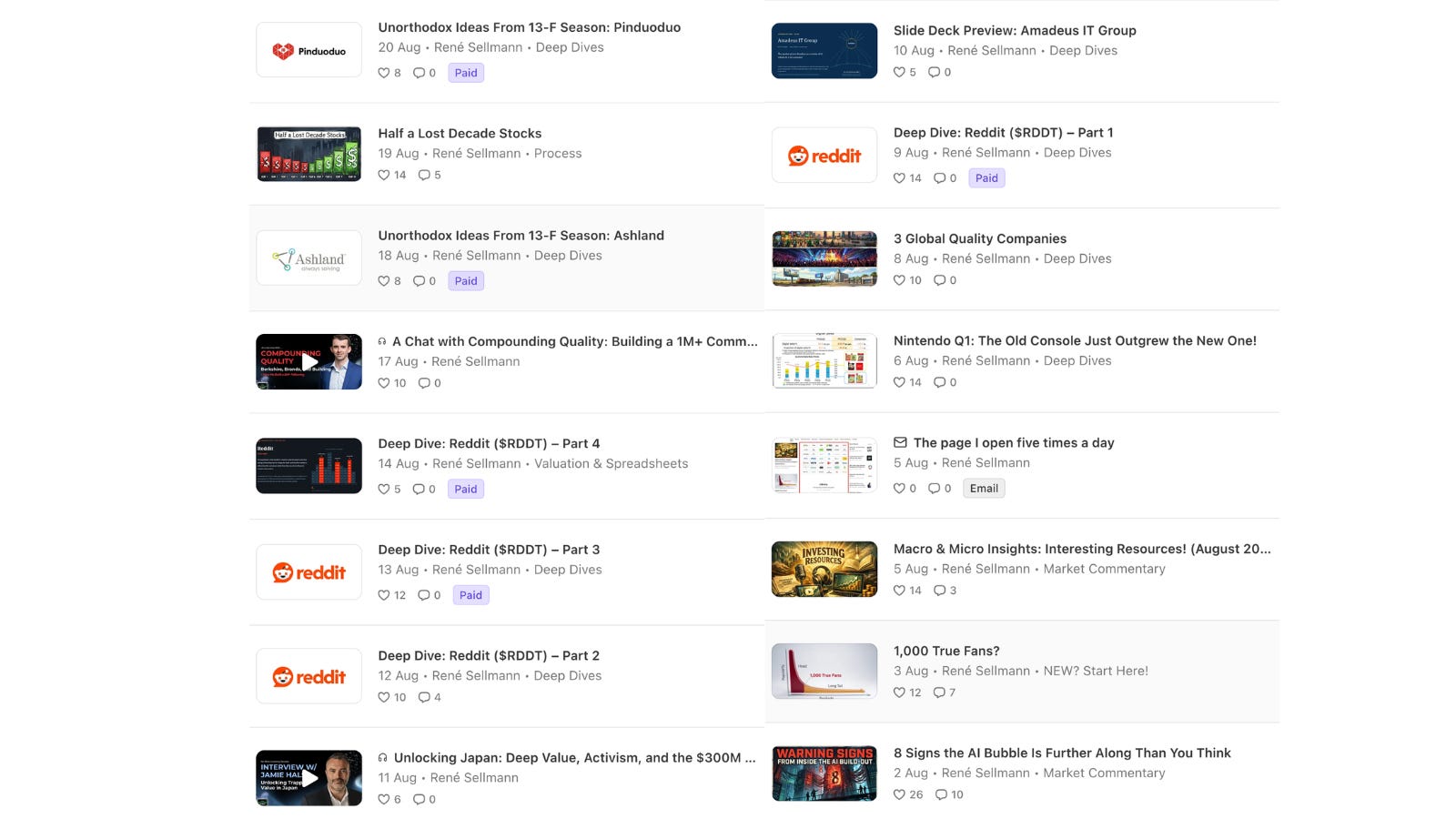
So I would rather ask you than guess. Would you prefer everything, exactly as it arrives now? Would a monthly index help, one that sorts the month into what is core and what is peripheral so you can skip with confidence? Or would you rather I simply published less and made each piece count for more? But then again, I put my everything into each piece either way.
Leave a comment or respond to the email, and tell me. I read all of them.
That’s it for today, dear second-level thinkers. That’s it for this more personal article. I’m curious how you feel about this format.
Regards René
Starting is becoming harder and harder too, even if you have good thesis.
Great article Rene! And I agree with you; marketing is the channel you need. Your work is great. I have enjoyed and learned a lot from you over the years. It's the hard part, for sure, and for what it's worth I think you put out enough content, if you enjoy putting out the work, keep putting it out. I know it's part of how you process and think about companies and you shouldn't put a limit on that.
As for the name, I like Second-Leverlers?
And for what it's worth, modeling Vitaliy is always a good choice :).