

Dear compounders,
In this follow-up part of my Atour Lifestyle series, I want to focus on one question:
“What return does Atour earn on the money it puts to work for growth?
For that, I prefer return on incremental invested capital (ROIIC) over plain ROIC. ROIC measures the return on all capital ever invested in a business, including decisions made a decade ago. ROIIC narrows the lens to the most recent yuan and asks what they produced.
Atour has changed so much over the last five years that this second question tells me far more.
Two disclaimers before we start. None of what follows is precise math. Splitting expenses into maintenance and growth buckets takes judgment, and I treat the output as a ballpark figure that gives me a feel for where the business is heading.
I also measured earnings power with income before taxes (EBT), which was partly an accident. I reused the prompt I built for my recent Tiger Brokers piece, and for a brokerage that earns significant interest income, EBT is the better proxy. For a franchise hotel business that isn’t particularly sensitive to interest rates, operating income (EBIT) would have been my preferred choice.
I prefer EBIT over owner earnings for this calculation by the way. Owner earnings (and incremental changes in that regard) would be the theoretically most sound metric. But in reality, cash flow metrics are much more cyclical, making ROIIC calculations over shorter time windows more sensitive to misrepresentations of actual changes in underlying earnings.
I only noticed that slip-up after building the model and decided against rebuilding it, because the difference is rather small anyway. Over the latest three years, EBIT grew by about RMB 2.17 billion versus RMB 2.22 billion for EBT, which would nudge the result from roughly 59% to 57%. Good enough.
All my prior Atour Lifestyle write-ups:
2026-10: Deep Dive: Atour Lifestyle Holdings Ltd. ($ATAT) – Part 4 - ($)
2026-10: Deep Dive: Atour Lifestyle Holdings Ltd. ($ATAT) – Part 3 - ($)
2026-10: Deep Dive: Atour Lifestyle Holdings Ltd. ($ATAT) – Part 2 - ($)
2026-10: Deep Dive: Atour Lifestyle Holdings Ltd. ($ATAT) – Part 1 - ($)
Where does a hotel company without hotels invest?
Look for Atour’s textbook growth investments on the balance sheet and you’ll barely find any. Corporate CapEx, which covers fixtures in the few remaining leased hotels, retail displays and IT systems, came to RMB 86 million in FY 2025 and just RMB 15 million in the first nine months of 2026. Against trailing pre-tax income of RMB 2.9 billion, that’s a rounding error.

Franchisees pay for the construction of new hotels, so the physical expansion of the network happens on their balance sheets.
We live in an increasingly intangible world. And thus, most of Atour’s own growth spending runs through the income statement instead.
Selling and marketing (S&M) climbed from RMB 124 million in FY 2021, or 5.8% of revenue, to RMB 1.49 billion in FY 2025, or 15.2%.

The bulk of it goes toward brand building and customer acquisition for Atour Planet, the retail business, on Douyin, Tmall and JD. Technology and development (T&D) grew from RMB 52 million to RMB 178 million over the same period and funds the in-house reservation and hotel operating software as well as the material-science work behind the Deep Sleep products.
To turn these lines into growth capital, I made an educated guess about how much of each one simply keeps the existing business running.
I assumed 35% of CapEx is maintenance, mostly upkeep of leased hotels and IT hardware.
For S&M, I set aside 20% to defend occupancy and the existing A-Card member base.
And for T&D, 40% to keep the reservation system and cloud hosting running.
The rest counts as growth.
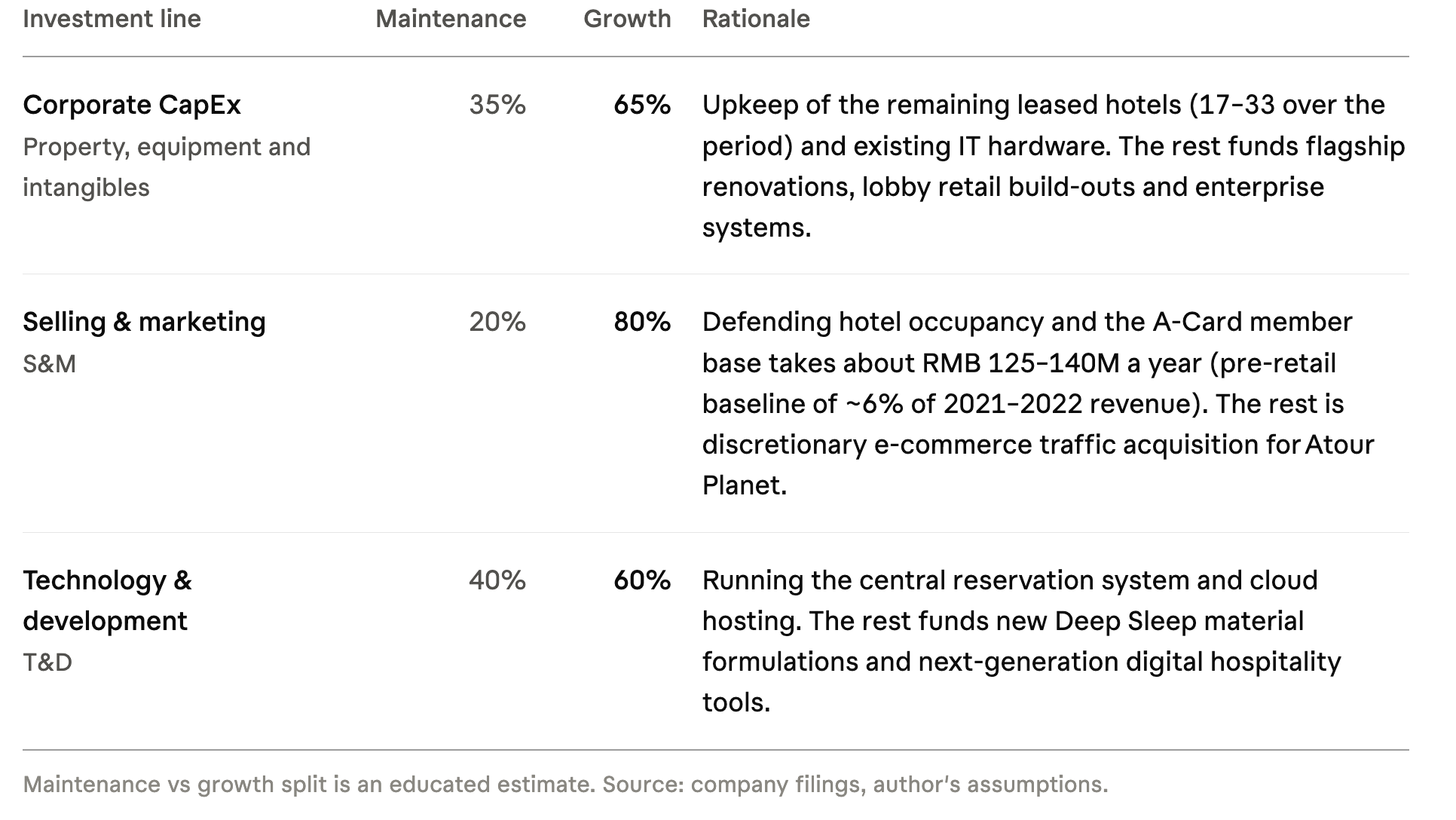
S&M makes up close to 90% of the resulting growth capital, so the S&M split is the assumption with the most influence on the result.

What does a yuan of growth spend earn?
I then compared the change in EBT over each window with the cumulative growth capital Atour spent during it. The filings I worked with only provide full figures from FY 2021 onward, so my “five-year” window runs from FY 2021 to the twelve months through Q3 2026, which is 4.75 years.
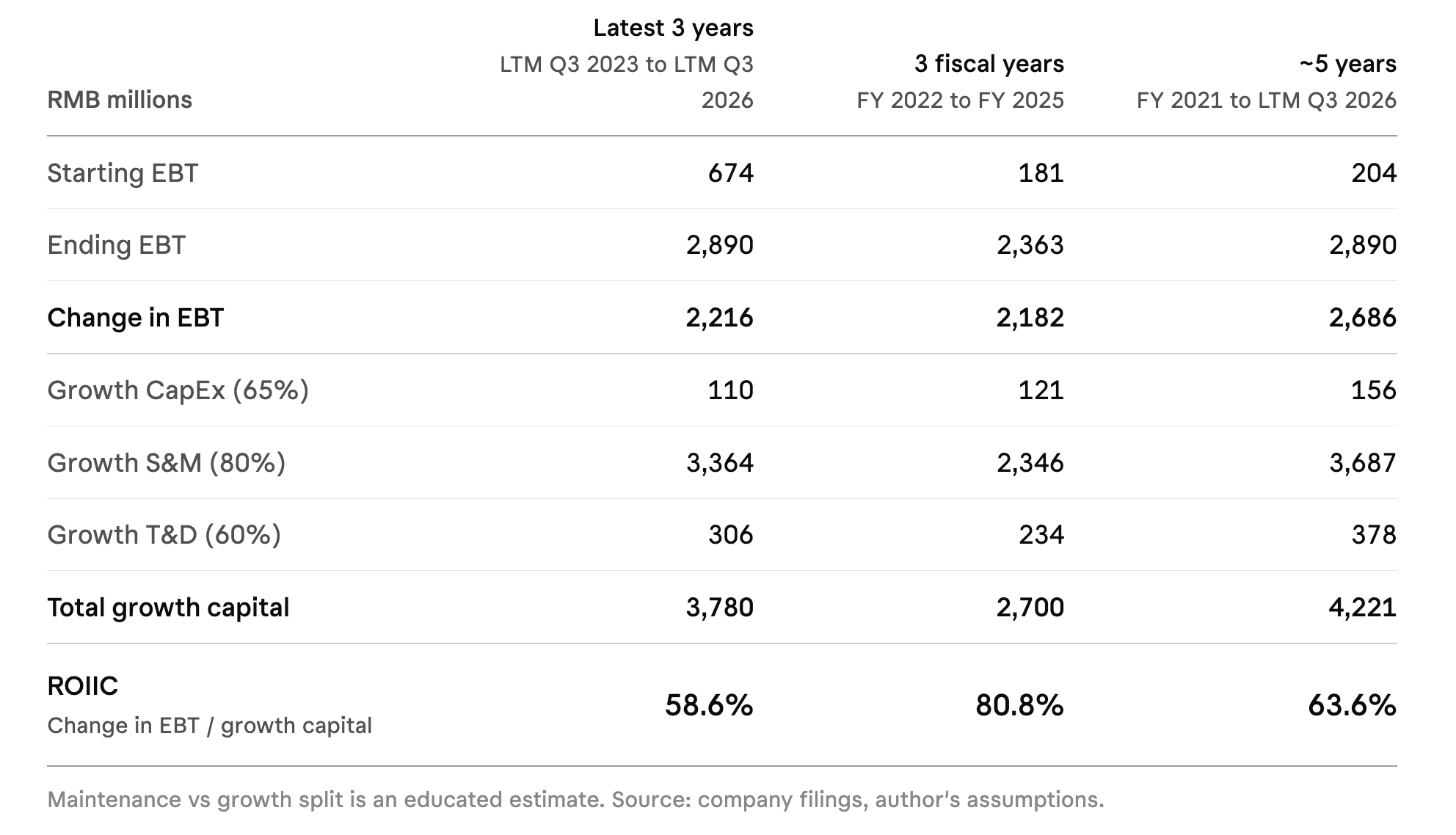
Over the latest three years, every yuan of growth spending added roughly 59 fen of annual pre-tax earnings. Over the longer window, it’s closer to 64 fen. The FY 2022 to FY 2025 window shows 81%, but I put less weight on it. FY 2022 was the trough year, hit by lockdowns and a loss-making fourth quarter, so a good chunk of the increase reflects recovery.
Had I stuck to balance-sheet CapEx, the result would have been absurd. Dividing the change in EBT by growth CapEx alone gives more than 1,700% in every window.
Why do I believe the true figure is higher?
These numbers lean conservative. S&M and T&D are expensed, so the ending EBT has already absorbed the growth spending of the latest year – about RMB 1.7 billion of growth S&M and T&D in the trailing twelve months alone. The same spending therefore counts twice: once as capital in the denominator and once as a cost that shrinks the numerator.
Add growth S&M and T&D back to EBT at both ends of each window, roughly what you would do if you capitalized them, and ROIIC climbs to somewhere between 97% and 123%.
The second half of the equation I always have in mind when considering investments – ROIIC x reinvestment rate – is the reinvestment rate, because the value compounding rate equals ROIIC multiplied by the reinvestment rate.
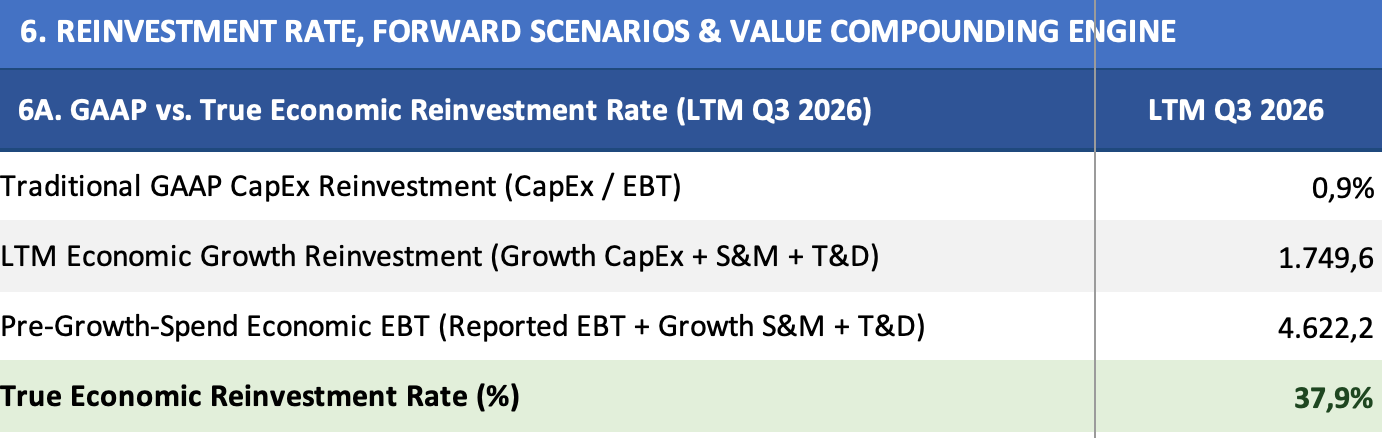
A traditional reinvestment rate, CapEx divided by earnings, would put Atour at about 1%, which makes no sense for a company growing this fast. Measuring growth CapEx, growth S&M and growth T&D against EBT before that growth spending, I get a reinvestment rate of about 38% for the trailing twelve months.
If ROIIC normalizes to 40% to 55% as retail matures and competition picks up, and the reinvestment rate stays between 35% and 40%, Atour would compound intrinsic value at roughly 14% to 22%.

That range sits well below what the business delivers today. Revenue grew north of 30% year over year in the first nine months of 2026, and EBT grew 32%.
Again, the larger part of growth – on the hotel franchising side at least – comes from what the formula leaves out. It only counts Atour’s own capital, and every new hotel is funded by a franchisee, so the main engine of the lodging business grows on someone else’s balance sheet and never shows up in my denominator.
I therefore see 14% to 22% as closer to a floor and think Atour’s intrinsic value is currently compounding faster, even if I wouldn’t extrapolate today’s pace.
Should a franchise machine dilute its own returns?
Stepping back from the spreadsheet, I see two very different businesses under one roof.
The ROIIC on the franchising side is close to infinite, or at least extraordinarily high, because the hotel network expands without requiring meaningful capital from Atour.
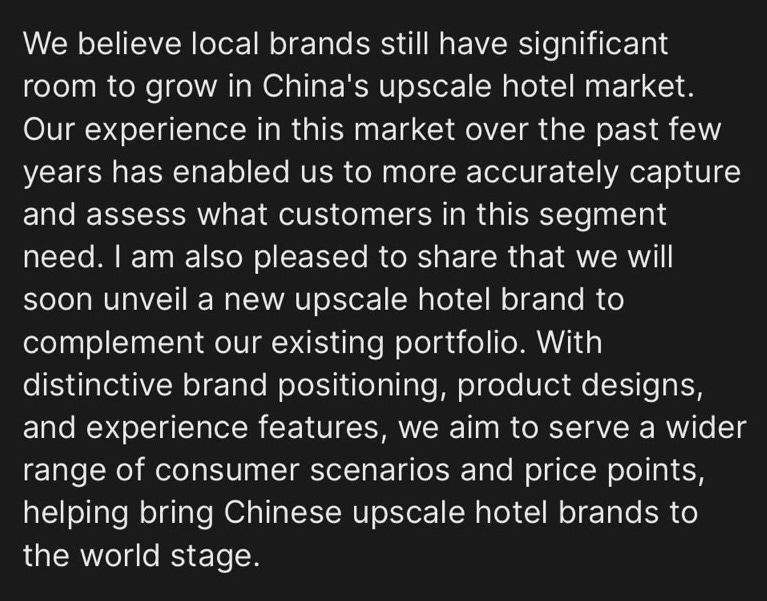
The below comment was the key takeaway from the Q3 earnings call by the way (a new brand + international ambition).
Retail is a structurally inferior business. It carries inventory, relies on paid traffic from platforms where competitors bid for the same customers, and earns operating margins far below franchise royalties.
Its ROIIC will be significantly lower. And it keeps growing in importance: retail went from 9% of revenue in FY 2021 to 41% in the first nine months of 2026, while leased hotels shrank from 29% to 4%.
As retail grows, the group’s headline ROIC will drift lower.
So is this a problem?
I think management is making the right call. Michael Mauboussin has shown that value creation depends on two things:
the spread between the return on new investment and the cost of capital, and
how much capital you can deploy at that spread.
A company that starts from a very high ROIC but lacks reinvestment opportunities can create more value by moving into areas with lower, still attractive returns. Group ROIC falls in that scenario, and intrinsic value still grows faster, because the reinvestment lever can be pulled and the reinvestment rate stays high.
Atour has to do something with the cash its franchise business throws off. It can hand it back to shareholders, which works fine if the shareholder receiving it is a skilled capital allocator him- or herself. More often, though, good internal reinvestment opportunities beat what investors can find in public markets on their own.
I would thus even encourage Atour’s management to look for further adjacent verticals over time if attractive opportunities come along, even if they dilute the headline ROIC/ROIIC.
Constellation Software went through a similar debate. In 2019, its board lowered the hurdle rate for acquisitions requiring at least US$100 million of equity, and in his February 2021 letter, Mark Leonard went further and argued for investing all of the company’s cash instead of paying it out. His reasoning was that even at lower hurdle rates, Constellation would likely earn more on that capital than its shareholders could by reinvesting dividends themselves. The shift sparked plenty of debate at the time, and the logic carries over to Atour.
What impresses me most is how well Atour has executed in retail so far. Looked at qualitatively, selling pillows, comforters, and fragrances online doesn’t strike me as an attractive industry to compete in. Barriers to entry are low, customers are fickle, and traffic has to be bought from platforms that hold the pricing power. Yet Atour has grown Atour Planet to about RMB 5.2 billion in trailing revenue at gross margins of around 52%, using its hotel rooms as showrooms.
That’s a remarkable achievement in a tough arena, and it makes me more comfortable with management pulling the reinvestment lever whenever it finds the next opportunity.
Until next time, keep compounding.