

A quick note before we start: this is not a research piece. No business analysis, no model, no valuation. It's a more personal write-up about writing itself – where I am eighteen months in, and a number that has been rattling around my head in the last few days. Normal programming resumes soon ;-).
I was on the podcast of The Dutch Investors this week, and somewhere in the middle host Siem asked me a question I hadn’t prepared for. Not about a company, or a macro theme, or a mental model. He asked what I actually want to accomplish with my content.
My answer was, more or less, nothing in particular.
No revenue target. No subscriber number. No plan to turn this into something. I first and foremost write because I like writing – and the same could be said about creating video content, sharing insights on X/Substack Notes/Threads, recording podcasts, etc. –, and because I like the work that has to happen before the writing: the reading of company filings, listening to earnings calls, thinking critically and, at times, creatively, doing research on a current them, picking the right valuation model for a company at hand, depending on its profile and maturity, the slow (or sometimes fast) process of a business becoming legible to me.
If I stopped publishing tomorrow, I would probably still do most of it. The publishing part just makes me do it properly. In fact, this is what I like Substack and writing written research notes much better than creating YouTube content. The audience on Substack’s platform allows me to go really deep on companies, the management team, the financials, risks, etc. YouTube rewards videos with mass appeal, with clickbaity titles and thumbnails, shallow analysis that doesn’t go too deep.
Substack is different.
But back to the podcast. I think that answer may sound evasive on the podcast. It isn’t. It’s the most useful thing I’ve figured out in the past six years of creating stock market-related content on various platforms.
Some takeaways and goals (seven in total):
#1 – Producing beats consuming
If I had to name one life-hack that has actually made me happier, it’s this: spend more of your day producing than consuming. Doing as opposed to just sitting around, staring at the wall or doomscrolling your TikTok feed.
Not because producing is virtuous, but because consuming leaves nothing behind. You finish a day of binge-watching a new Netflix series, and you have nothing you can point at. You finish a day of writing, drawing, taking photos, building a map for a video game, recording a tutorial for your university peers, WHATEVER (!), and there’s a thing that didn’t exist that morning, however small, however flawed.
#2 – Focus on what you can control
The second part of the same idea: point your effort at the things you actually control.
I have no direct control over whether this newsletter reaches 10,000 subscribers. None. That number is a function of the algorithm, the market cycle, whether someone with a big audience happens to restack me on a Tuesday. Treating it as a goal to hit by deadline X is a way of making my mood a function of other people’s decisions.
What I do control is a) the cadence – whether a piece goes out when I said it would, how regularly I show up for my audience. And b) the quality – whether the analysis is deep enough that you couldn’t have gotten it somewhere else.
That’s it.
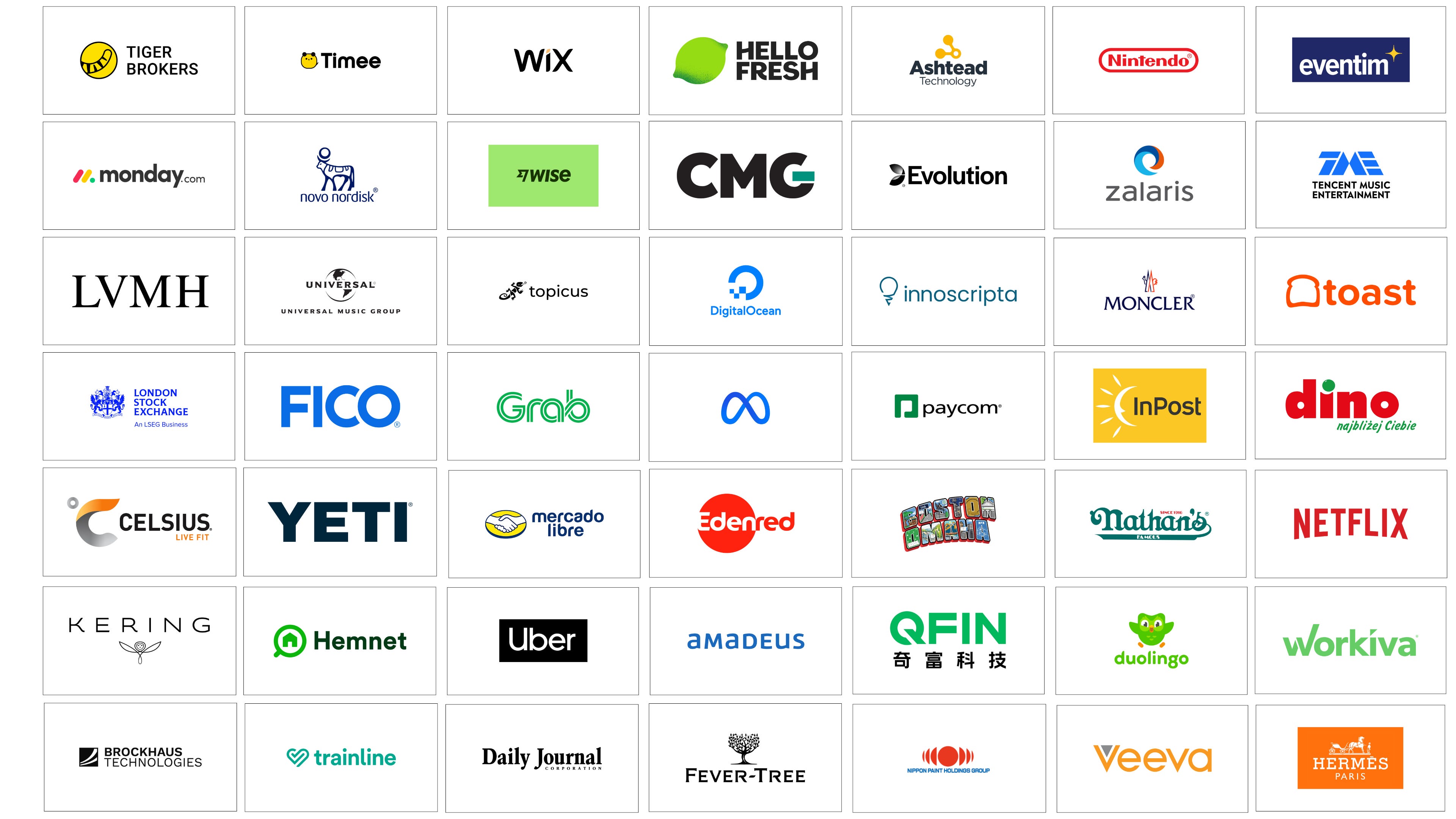
Welcome to Compound with René. You can find an overview of the companies I shared a deep dive on in the visualization below.
If you haven’t subscribed, you can join 4,600 readers who enjoy the quality of the deep dives, the process-oriented pieces, the analytical insight, and the valuation discipline here:
#3 – Attracting the right people
The nice thing about optimizing for quality rather than reach is that it selects your readers for you. I can see this in our WhatsApp community, and it’s the part of this whole “project” I’m most proud of. Nobody is posting rocket emojis. People show up with actual expertise from their actual jobs or their investing background and the research they have done. Everyone is friendly, curious, and useful. I didn’t engineer that. It’s what you get when the front door is a 6,000+-word deep dive rather than a hot take or a shallow analysis.
I like to think of this as a form of survivorship bias. Do you have the attention span to consume deeper critical analyses, or are you looking for easy fixes and answers?
#4 – 1,000 true fans?
A few weeks ago Rebound Capital crossed 1,000 paid subscribers, and in the post about it, he referred to Kevin Kelly’s essay, 1,000 True Fans – at least indirectly.
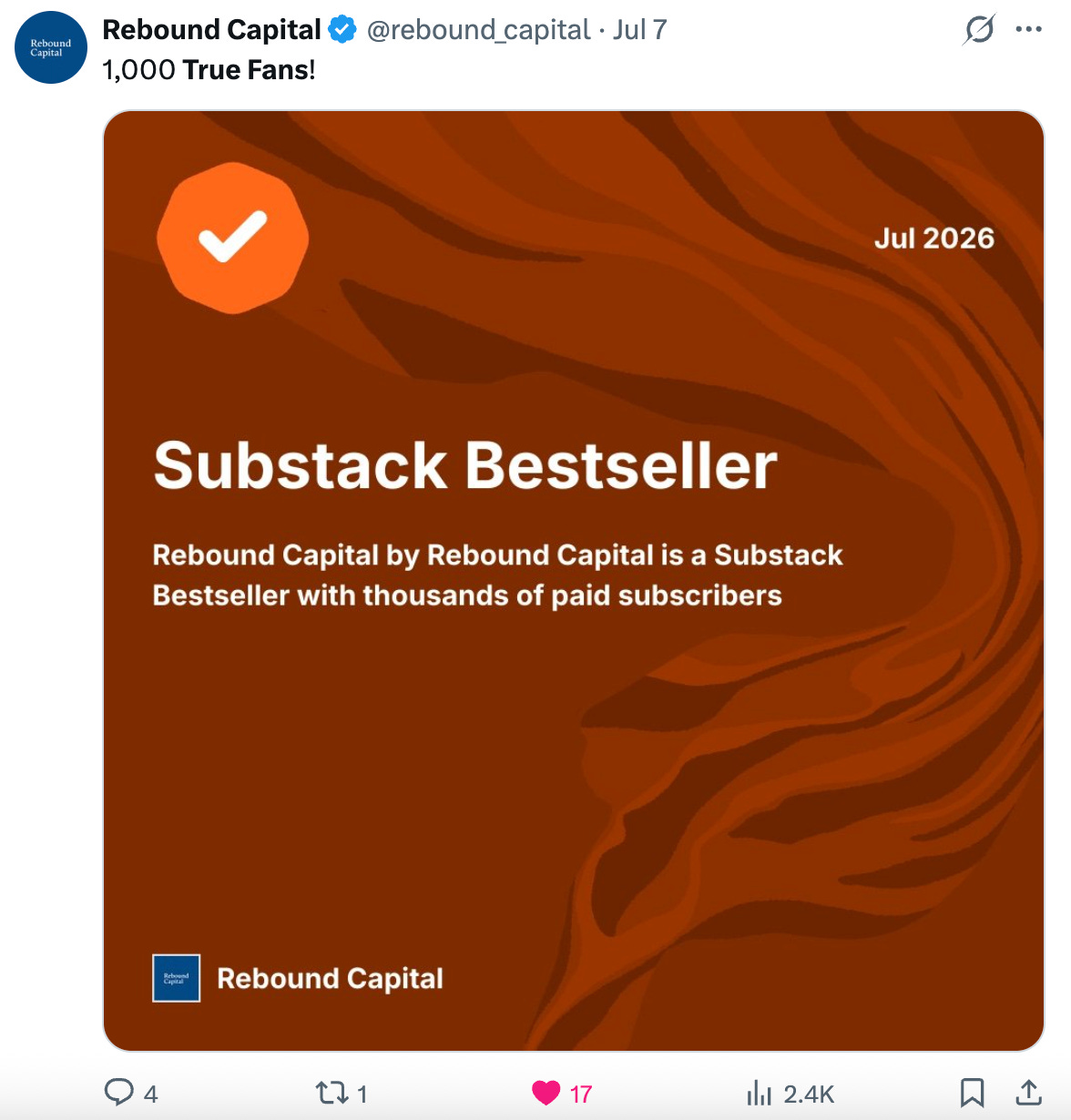
First: what an accomplishment! Congrats to him. I exchanged a couple of DMs with him a few months ago, and he struck me as a genuinely nice person willing to help and support others.
Anyone who has tried to convince even one stranger on the internet to pay for written work knows what a thousand of them represents.
Second: the essay lodged itself in my head and hasn’t left.
Kelly published it on The Technium in March 2008, and a core pillar of the essay is the concept of the “Long Tail” in light of the creator economy. It was the fashionable idea back then and everyone was celebrating what it did for consumers.
“This new ability for the creator to retain the full price is revolutionary, but a second technological innovation amplifies that power further. A fundamental virtue of a peer-to-peer network (like the web) is that the most obscure node is only one click away from the most popular node. In other words the most obscure under-selling book, song, or idea, is only one click away from the best selling book, song or idea. Early in the rise of the web the large aggregators of content and products, such as eBay, Amazon, Netflix, etc, noticed that the total sales of *all* the lowest selling obscure items would equal or in some cases exceed the sales of the few best selling items. Chris Anderson (my successor at Wired) named this effect “The Long Tail,” for the visually graphed shape of the sales distribution curve: a low nearly interminable line of items selling only a few copies per year that form a long “tail” for the abrupt vertical beast of a few bestsellers. But the area of the tail was as big as the head. With that insight, the aggregators had great incentive to encourage audiences to click on the obscure items. They invented recommendation engines and other algorithms to channel attention to the rare creations in the long tail. Even web search companies like Google, Bing, Baidu found it in their interests to reward searchers with the obscure because they could sell ads in the long tail as well. The result was that the most obscure became less obscure.“
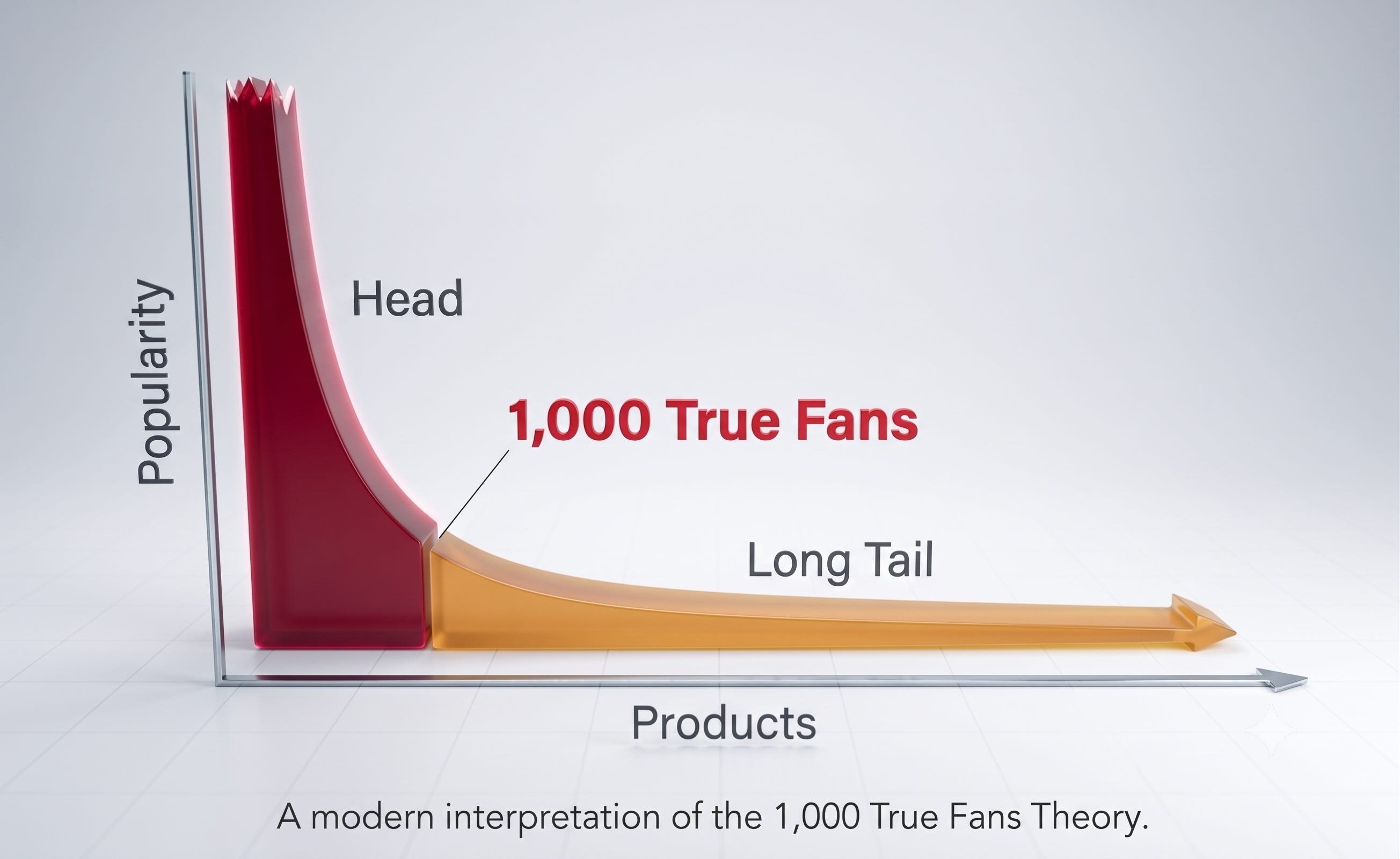
However, the “Long Tail” brought its own set of problems:
“The long tail is famously good news for two classes of people; a few lucky aggregators, such as Amazon and Netflix, and 6 billion consumers. Of those two, I think consumers earn the greater reward from the wealth hidden in infinite niches.
But the long tail is a decidedly mixed blessing for creators. Individual artists, producers, inventors and makers are overlooked in the equation. The long tail does not raise the sales of creators much, but it does add massive competition and endless downward pressure on prices. Unless artists become a large aggregator of other artist’s works, the long tail offers no path out of the quiet doldrums of minuscule sales.”
His way out was effectively the concept of “1,000 true fans.”
A creator... needs to acquire only 1,000 True Fans to make a living.
The arithmetic is almost insultingly simple. A “true fan,” according to Kelly, is someone who will buy anything you produce. Get $100 a year from each – Kelly frames it elsewhere in the essay as roughly one day’s wages, which I find an interesting way to think about it – keep the full amount because they pay you directly, and a thousand of them is $100,000. “A living for most folks,” he writes (remember that the piece was released in 2008). Not a fortune. A living.
What made the idea stick with a large audience is his reframing. Kelly’s point is that a thousand is a number a human being can hold in their head. “You might even be able to remember a thousand names. If you added one new true fan per day, it’d only take a few years to gain a thousand.”
5 – But Substack is plateauing and AI is coming for writers …
I’ve read several pieces recently arguing that Substack is plateauing. That writing is doomed as AI is broadly adopted. That the competition has become brutal. That big and small writers alike are struggling to grow at all.
And in the comments under one of my own posts, someone recently made the point that when this exuberant market finally turns – and it will eventually – the appetite for equity research specifically will dry up, and a lot of “us” will stop.
I think all of that is basically right, and none of it changes what I’m doing.
Here’s why:
Every one of those forces is a filter on the median, not on the work. AI has made competent writing easier, almost infinite, which means competent writing (grammar, style, vocabulary) is now worth roughly what it costs. What it has not done, and I don’t think will do anytime soon, is generate the thing that actually moves an investment view: outside-the-box thinking, a mental model built over decades of watching businesses succeed and fail applied to a new analysis, the creative leap of noticing that this company is really the same shape as that one from a different industry twenty years ago, identifying inflection points. Genuine insight. Valuable insight because it is not priced in by the market.
The bull market ending doesn’t destroy that – it just thins out the people who were just in this for a quick buck or the fame.
Over the very long term, anyone who delivers more value than they charge will find an audience. That is a timeless business mechanism.
#6 – The part I’m bad at
The uncomfortable corollary is that providing value and being found are two different problems.
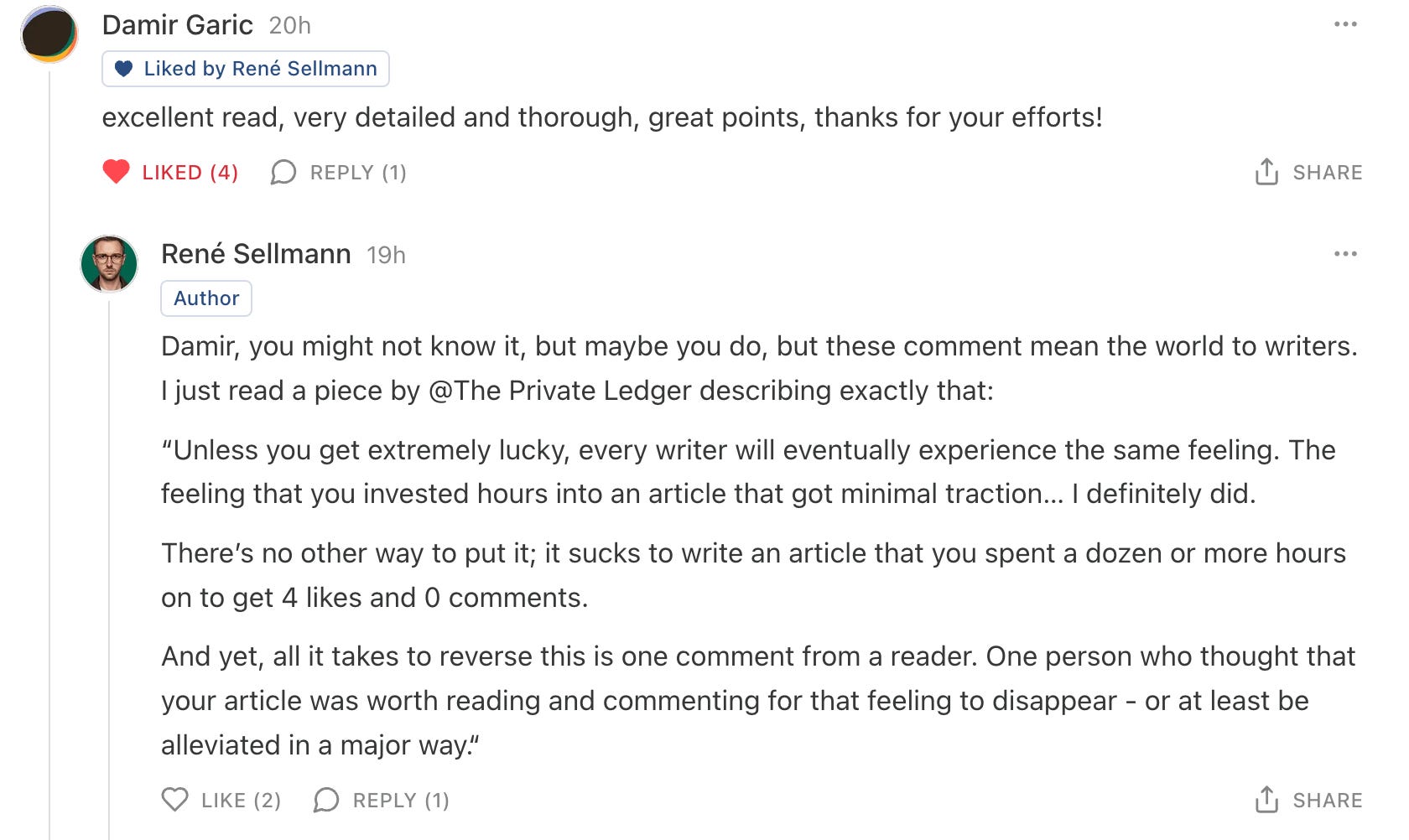
The Private Ledger wrote something in early July in an article that genuinely deflated me for an hour:
“Not every investment has an equal reward. This is equally true in business as it is in Substack. To date, all of my posts combined have brought me a total of 98 subscribers. My top performing (and first ever) note has also brought me exactly 98 subscribers. My posts have taken hundreds of hours of painstaking research, writing and editing. My note took me about 10 minutes to write.”
I know this feeling in my bones. I have published pieces that cost me three weekends and a fair chunk of my sanity and added, net, zero subscribers.
That is not a rare event. That is a normal Tuesday.
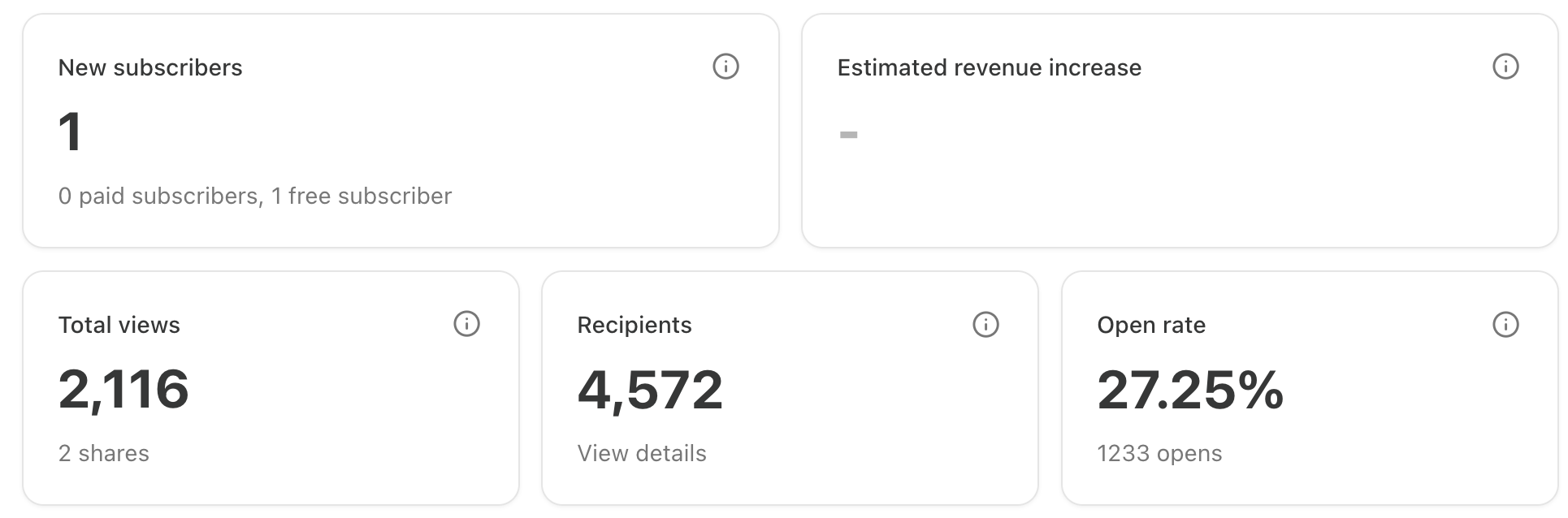
Want to see a current example? Below you see the stats of yesterday’s write-up “8 Signs the AI Bubble Is Further Along Than You Think“ that has genuinely done quite well in terms of likes received and comments shared. New subscribers added: 1.
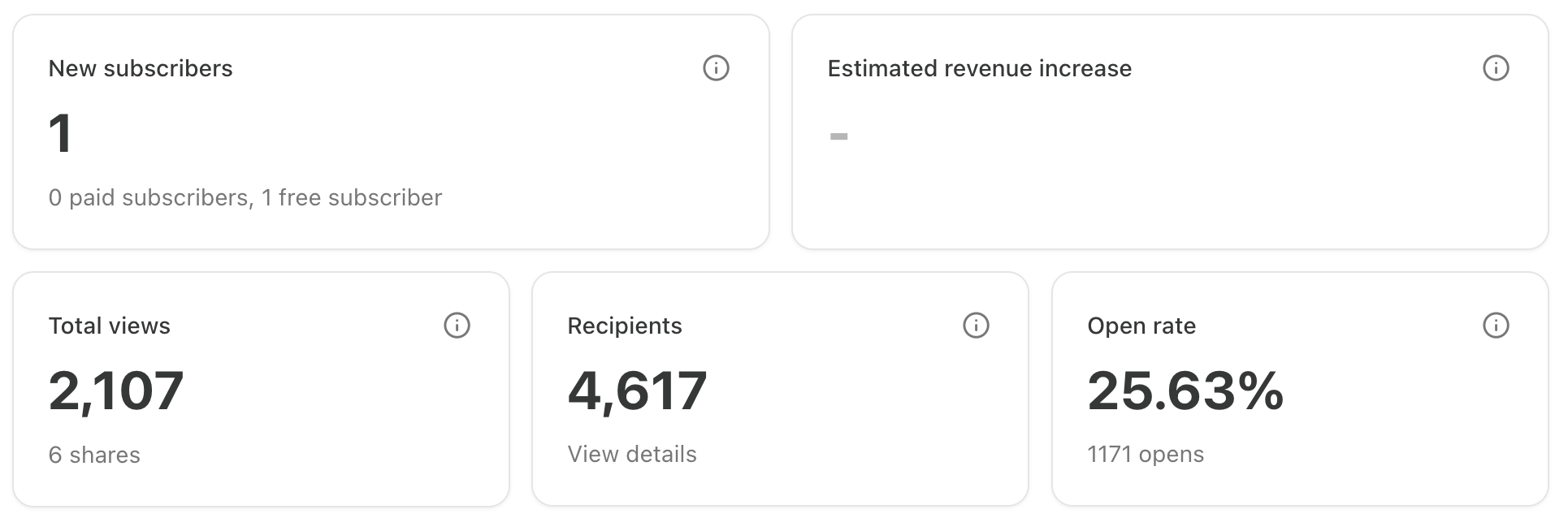
Or my latest deep dive on Amadeus IT Group, which I spent hours and hours researching (+ building a valuation model, + creating a custom slide deck) while on holiday. One new free subscriber. Zero new paying subscribers.
I think this is another advantage I may have over some other investors who aren’t in this for the long run. I love studying businesses. So sure, there are brief moments of disappointment. But usually I just shrug for a moment and then move on. On to the next deep dive!
Kelly is blunt about this in the essay, too, and it’s the paragraph I keep skipping over and shouldn’t. Cultivating true fans is …
“time consuming, sometimes nerve racking, and not for everyone.”
Some creators, he says, “should just paint, or sew, or make music” and let somebody else handle the fans. That’s me. I would rather spend eleven hours reconstructing a segment’s true economics than eleven minutes writing a note about it.
#7 – Because the A in SMART stands for attainable
So why am I still writing down a number?
The old SMART framework is a corporate cliché at this point, but the A is what I had to think of regardless. Goals are supposed to be attainable – stretchy enough to pull you forward, plausible enough that your brain doesn’t file them under fantasy and stop trying.
A million readers is not attainable (for me at least) and, worse, it isn’t even meaningful as a target. Kelly says this directly: “Millions of paying fans is not a realistic goal to shoot for, especially when you are starting out. But a thousand fans is doable.”
And here’s the part that makes me think it isn’t arrogance to say it out loud: There are hundreds of millions of people investing globally. If one in a million of them wants what I specifically offer – global equity research for people who love businesses, obsessed with quality and disciplined valuation, no hype, deep analytical work for the patient minority – that’s still a large enough pool. Compared to some other nichés, the investing TAM is absolutely massive!
Kelly’s line: “any 1-in-a-million appeal can find 1,000 true fans. The trick is to practically find those fans, or more accurately, to have them find you.”
I’m confident in the work. As outlined, not yet in the marketing. But I will try to do better on that front too. And I’m learning from others too – both big (such as Compound With AI or Compounding Quality) and small (such as The Private Ledger, Alpha Engines by Gianni, or Learning.Investing.Thriving.)
And of course you can help me to by spreading the word, leaving a comment occasionally, restacking a write-up. You might want to start right now?
Wrapping up
We’re closing in on 5,000 free subscribers. Eighteen months ago that number was one, and it was me. My YouTube audience gave me a 100 subscriber boost, but that was about it (generally, I’ve found that YouTube subscribers translate very poorly to blog subscribers).
I don’t take it for granted, and I’m aware of how much of it is timing, luck, and the generosity of people who restacked something when they didn’t have to.
A thousand true fans is a long way off. A very long way in fact. I might never get there. But one can dream big, right?
The market may turn, the appetite for this kind of work may thin out, and the honest answer is that most of that is outside my control anyway. But the target is doing something useful in the meantime: it keeps me pointed at depth instead of reach, at the hundred people who read every word instead of the ten thousand who opened one thing once.
Kelly calls it “a much saner destiny to hope for.” I’ll take that. And in the meantime, the only two things I actually control are showing up on schedule and doing work that’s worth your time.
That, I can promise.
“If I stopped publishing tomorrow, I would probably still do most of it. The publishing part just makes me do it properly.”
Bingo. That’s the only reason I signed up for X and now Substack. I’m already doing the research, why not share it anyway in a nice readable format? And yeah I can’t watch YouTube finance videos anymore, just don’t find them as helpful as a good Substack post. I still publish the podcast there since a few people like listening that way.
And you’re also right about producing, although I don’t hate on those who want to consume (they are our subscribers anyway lol). But as a former baseball player, I want to play, not watch. I get it.
Much appreciated - I bought Amadeus. Good find and good write up. The people on Substack lurk so I would not read into a lack of comments. For me, no comment means it’s probably accurate and well thought out.