

Dear compounders,
On September 8, Wise CFO Emmanuel Thomassin joined Goldman Sachs analyst Mohammed Moawalla on stage at the Communacopia + Technology Conference in San Francisco.
Most conference fireside chats are reruns of the last earnings call. This one had more meat on it than usual. I listened to it two days ago, and I went through the transcript again line by line this morning, and pulled out ten points that were either new to me or that management had never said this openly before.
Wise wasn’t the only company I’m tracking appearing at the conference. Reddit’s Steve Huffman held his own fireside chat a couple of hours earlier the same day, and if I find anything in that session or others that adds to what I’ve already written in my Reddit deep dive, I’ll summarize it in a separate post.
And without further ado, let me unpack the new insights. Here’s a list of some of the things we will cover:
Why Wise’s CFO thinks one of its best-known rivals could end up as a customer
A new date for the Belgian remediation, and what’s next for Wise in the U.S.
What Wise’s 50% margin target actually refers to
When operating leverage will finally show up
Whether a $170 million marketing budget is enough, and a telling word from the CFO
A fresh mid-term target for Wise Platform
The asset Wise has spent years building that you won’t find on its balance sheet
Wise’s stance on stablecoins, and a Windows 95 anecdote
Whether Wise is about to become an acquirer
A bank that tried to build what Wise has, and gave up
Tip: If you access “The Library” and hit ctrl+F you can easily access all the previous write-ups on Wise I have published.
Library

Welcome to a comprehensive overview of all the posts I’ve shared so far, organized by type for easy reference. Whether you’re looking for in-depth company deep dives, process-oriented insights, valuation approaches, or market commentary, this page serves as a central hub to navigate through all the content I’ve published. Each section below highlights a…
Disclaimer:
As of the date of publication the author owns shares in the company; but that may change. The analysis presented in this blog may be flawed and/or critical information may have been overlooked. The content provided should be considered an educational resource and should not be construed as individualized investment advice, nor as a recommendation to buy or sell specific securities. I may own some of the securities discussed. The stocks, funds, and assets discussed are examples only and may not be appropriate for your individual circumstances. It is the responsibility of the reader to do their own due diligence before investing in any index fund, ETF, asset, or stock mentioned or before making any sell decisions. Also double-check if the comments made are accurate. You should always consult with a financial advisor before purchasing a specific stock and making decisions regarding your portfolio.
1. Will Revolut be a Wise Platform customer by 2031?
The most quotable line came at the very end of the session. Asked about the competitive landscape, Thomassin said Wise sees “no reason in our mind that Revolut should not use us in 5 years from now” as a Wise Platform partner.
“Well, I think like -- first I start with Revolut, I mean there is no reason in our mind that Revolut should not use us in 5 years from now. I mean, we’re completely agnostic and we don’t ask for exclusivity. We don’t dictate the price, they can charge whatever they want. And we -- the big advantage that we have is that we continue to build this infrastructure. And I’d like to talk about the kind of equation.
He described Wise as an agnostic infrastructure provider that asks partners for no exclusivity and doesn’t dictate their pricing, so they can charge their own customers whatever they like.
In his framing, Revolut isn’t even a direct competitor, since the two companies focus on different things. Wise wants to provide payment infrastructure to every bank, and fintechs like Revolut are part of that ambition.
§So that’s why in terms of competitions, we don’t look at Revolut as competitors because we are not focusing on the same thing. We are focusing on infrastructure that we want to offer to every bank, include fintech companies like Revolut.“
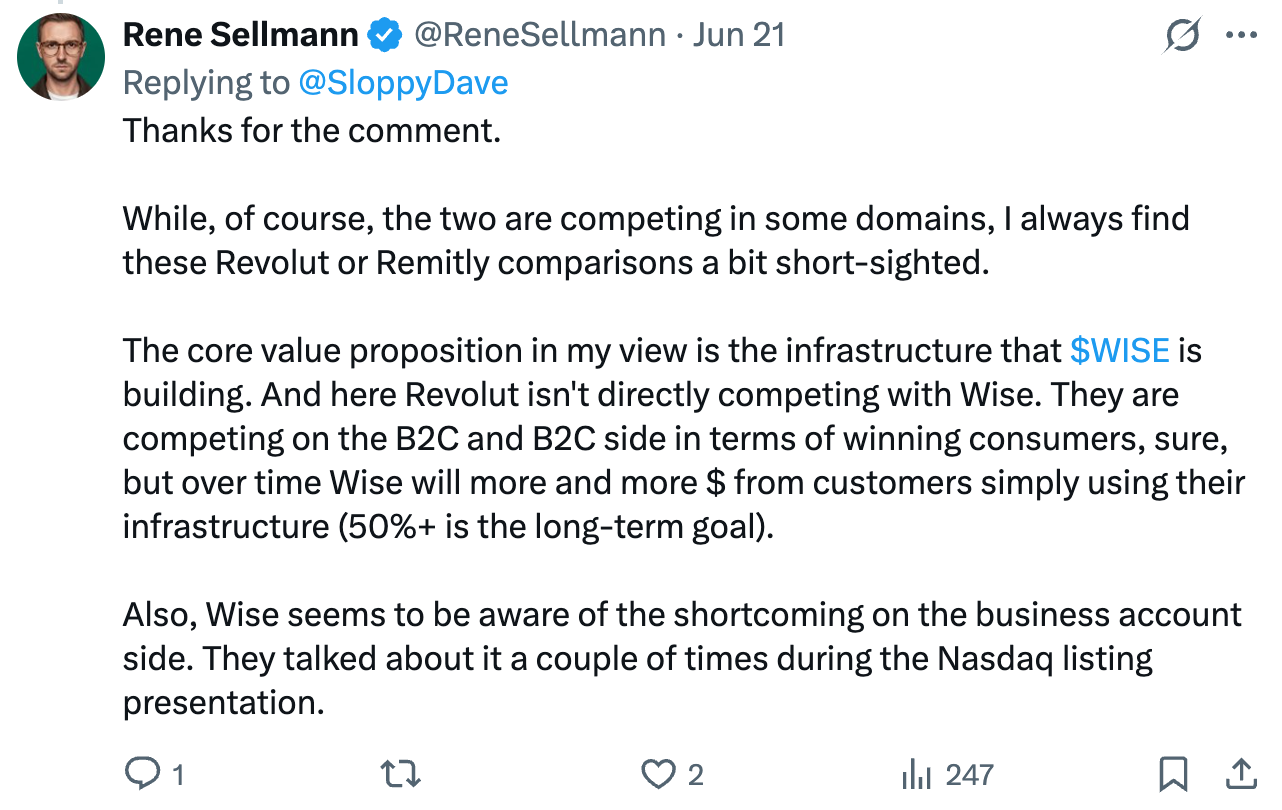
Wise has spent 15 years building proprietary infrastructure and direct connections into domestic payment systems, and Japan alone took four years to secure. A competitor wanting the same network would need massive amounts of capital and time, and it would have to subsidize losses along the way to match Wise on price. At some point, renting Wise’s rails becomes the rational choice, even for a rival as well-funded as Revolut.
I’ve been pointing this out myself on X for a while now, and it’s nice to see that Wise’s CFO apparently thinks so too. It’s also one more reason why I find the constant Wise-versus-Revolut comparisons unhelpful. Revolut is fighting for the customer’s home screen, and Wise would be perfectly happy to power the transfers behind it, for a fee.

2. Is the compliance overhang smaller than the headlines made it look?
I grouped the Brussels and U.S. compliance discussion and the U.S. update into one insight.
When Moawalla brought up the compliance concerns the OCC cited in denying Wise’s U.S. national trust bank charter (I covered the denial in detail here), Thomassin argued that Wise’s regulatory scrutiny isn’t unique. A fintech growing this fast will naturally attract more regulatory focus, other European fintechs are hitting the same wall as they scale, and remediation is, in his words, almost part of the industry.
Wise has been investing heavily in KYC and KYB for many years. Growth keeps raising the bar anyway.
Thomassin also put a date on Belgium. The remediation Wise is working through there will be delivered by the end of the year, after which the regulators will come back and assess it.
“So for us, the remediation that we are facing, for example, in Belgium, the way the press is something that we will deliver by the end of the year and then the regulators will come back to us after observing the remediation. I mean, we can see that other fintech companies in Europe are facing the same kind of wall as they grow.“
As far as I can tell, Wise hasn’t communicated the year-end timeline for Belgium this explicitly before.
On the U.S. side, Wise has resolved all remediation items stemming from its prior consent order and is now waiting for state confirmation that everything has been remediated.
“The OCC applications happened a year ago. And since then, we've been doing a lot in terms of the business mature a lot, the compliance departments have been also like maturing. Looking back in some -- with some insight, I think like we would have reconsidered the application that we made because we were also like facing a consent order almost at the same time in the U.S. So we resolved all the remediation from the consent order, and then we're waiting for the confirmation of the state that everything have been remediated.“
My first reaction was that this makes the drama surrounding the Brussels investigation leak in June much less dramatic than it initially seemed. I still lean that way, but I want to be careful, because two separate tracks are running in Belgium. The remediation Thomassin referred to most likely relates to the supervisory plan the National Bank of Belgium put Wise into back in 2024, after it found missing proof of address for hundreds of thousands of customers.
The Brussels prosecutor’s probe is a different animal. It concerns roughly €500 million in suspicious transactions, and in June prosecutors said the investigation was nearing completion, that they were finalizing a direct summons before the criminal court, and that they would pass their findings on to the National Bank. A year-end delivery on the supervisory side is reassuring. It tells us little about how the criminal track ends or whether the prosecutor’s findings will flow back into the National Bank’s assessment, so I’d call the supervisory side on schedule and leave the criminal side as an open question.
The U.S. commentary was more candid than I expected. Thomassin reminded the audience that the U.S. is Wise’s largest single market opportunity, which is why the Austin office has grown to around 900 employees, why there’s a smaller office in New York, and why Wise listed on Nasdaq for visibility.
He also admitted that, with hindsight, Wise would have reconsidered its OCC application, since it was facing a consent order at almost the same time. For context, Wise’s U.S. entity paid a $4.2 million penalty last year after six state regulators found Bank Secrecy Act and AML violations.
Since the application, the business and its compliance department have matured a lot, and the U.S. regulatory setup has shifted as well. Wise originally wanted access to U.S. payment schemes through a federal account.
Following the denial, the OCC has given Wise the green light to reapply. There’s no firm timeline yet, but the next application will be filed under the GENIUS Act framework, incorporating the recent regulatory shifts around stablecoins.
This is where it gets interesting
Become a paying subscriber to read the rest of this post and get access to all of my other research, including valuation spreadsheets, deep dives (e.g. well-known mid- and large caps such as LVMH, Duolingo, Meta, Edenred as well as more hidden gems such as Digital Ocean, Ashtead Technologies, InPost, Timee, and MANY more), and powerful investing frameworks.
As a member, you get:
Complete Access: Every deep dive in our library (65+ and counting). The most thorough analyses you will be able to get your hands on (including downloadable models).
Access to my 150+ Global Watchlist: And How To Use It to Outperform the Market!
Slide Decks: Every deep dive now comes with a companion slide deck. It’s the whole argument in compressed form – the hypothesis, the business, the competitive position, the valuation, and the case against – for the days when you don’t have an hour to spare but still want the shape of the thing. Paid subscribers get both, the long piece and the deck.
The WhatsApp Community: Real-time discussion and networking with like-minded investors.
Digital Investing Conferences: Around three times a year, we also hold digital conferences where members present and share stock ideas, and discuss broader themes, and we’d love for you to join in!
Downloadable Visual Blueprints: Direct access to high-resolution PDF reference sheets distilling timeless investment classics, insights from my proprietary investing framework, and essential valuation mechanics into structured visual architecture. Print them, save them, and build your own institutional reference binder.
Incredible Value: Full access to all of this for less than €1/day.