

Dear compounders,
Welcome back to my perception change series. If you’re new here, the short version is this. Ember Infrastructure Management made a 615p per share proposal for Ashtead Technology, a company I own and have written about at length, and I started preparing for the possibility of having to redeploy that capital. Instead of letting a deal force my hand, I’m working through the seven highest-ranked companies on my watchlist one by one (in fact, I can think of more ideas that seem interesting, and I might add more to the list I cover in this format), each through the lens of my perception change framework.
So far we’ve covered Grab, Novo Nordisk, LVMH and Hermès - check out my homepage or the Library post to find them.
New here? Join 5,000+ readers and get 3 FREE GIFTS when you subscribe:
📈 Valuation Spreadsheet
📚 eBook: Investing Visualizations
💡 eBook: 250 Thought-Provoking Quotes
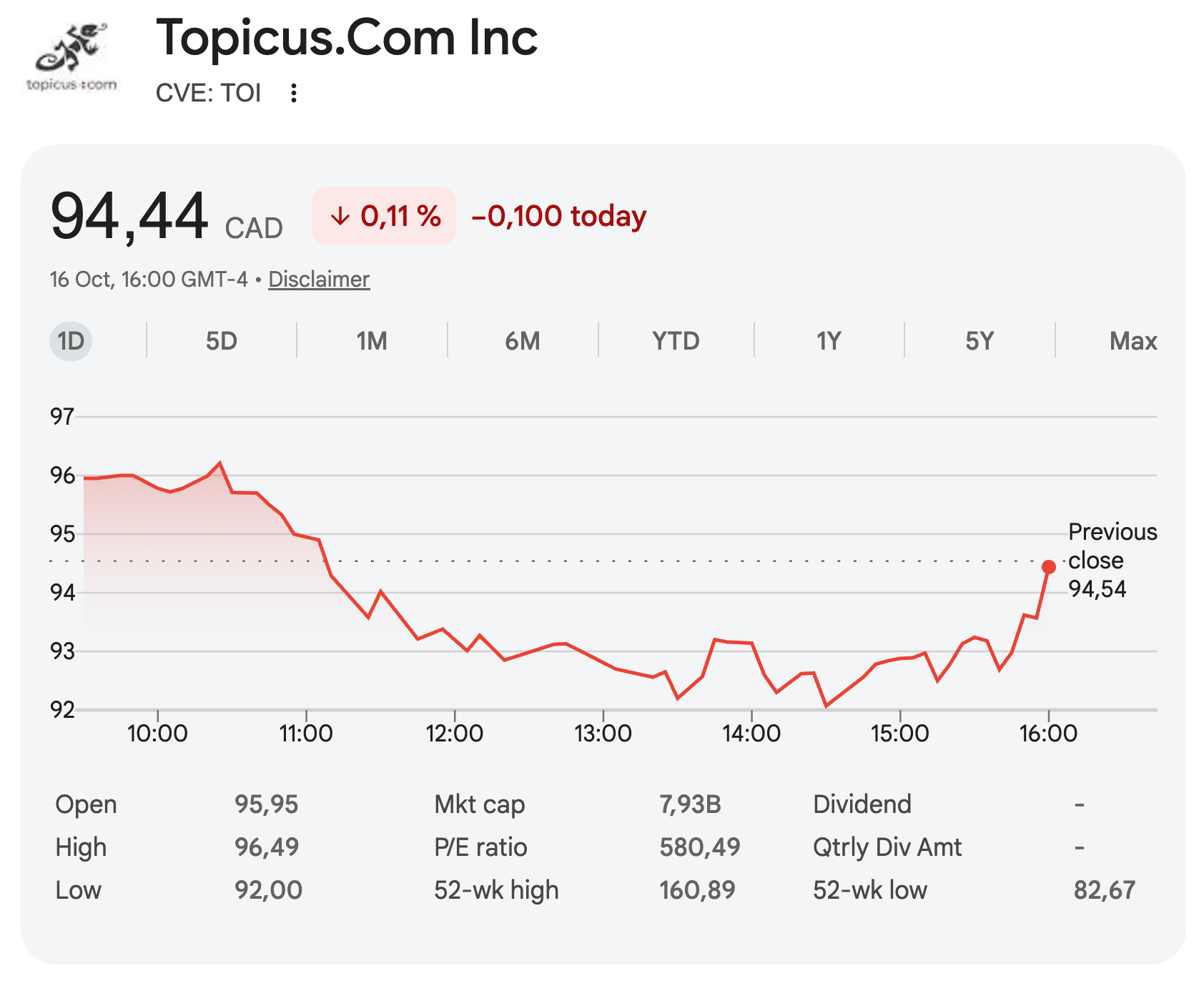
Idea #5 is a special case. I published my Topicus deep dive in March, when the stock traded at roughly C$94, and I decided to stay on the sidelines. Seven months later, the share price is almost exactly where I left it, while a lot has changed underneath. So I revisited the idea over this weekend and put together an update post.
The stock is optically cheaper (see updated valuation below). Yet, there have been some major developments that I consider net-negatives (even though the weighing of these is a subjective call you have to make). Arguably, the price stood still, and the perception didn’t, so the question is whether the market is now right to keep its distance.
Disclaimer: As of the date of publication the author owns no shares in the company; but that may change. The analysis presented in this blog may be flawed and/or critical information may have been overlooked. The content provided should be considered an educational resource and should not be construed as individualized investment advice, nor as a recommendation to buy or sell specific securities. I may own some of the securities discussed. The stocks, funds, and assets discussed are examples only and may not be appropriate for your individual circumstances. It is the responsibility of the reader to do their own due diligence before investing in any index fund, ETF, asset, or stock mentioned or before making any sell decisions. Also double-check if the comments made are accurate. You should always consult with a financial advisor before purchasing a specific stock and making decisions regarding your portfolio.
Idea #5: Topicus
Topicus is another idea in this series I have already covered in depth this year. I published my deep dive in March (linked below) – I’m pretty sure the most comprehensive analysis of Topicus on the Internet (and I’d refer you to this deep dive series for the initial hypothesis and all the details regarding this business, its structure, its ownership, how to value it, etc., etc.) –, when the shares traded at roughly C$94, and I ended up on the sidelines.
I liked the business, and I liked the setup, but I had no idle cash at the time, didn’t want to sell anything else, couldn’t get entirely comfortable with the AI risk (which I assess to be much lower compared to other software peers, though), and I wanted a wider margin of safety, ideally somewhere around C$60 to C$65.
Deep Dive: Topicus.com Inc. ($TOI) – Master Piece

What started as a curiosity about a Constellation Software spin-off evolved into a massive 40,000-word journey through the intricacies of European software consolidation. To make this research as accessible as possible, I’ve woven all four parts of the
My AI disruption risk weights back then were 50% defensible, 30% beneficiary and 20% “vertical market software is cooked,” and I built the overall case on five BAMs:
a record-low valuation,
a 2014/15-vintage Constellation,
European fragmentation,
experienced CSI-trained leadership, and
sticky software.
Seven months later, the share price is almost exactly where it was, at C$94 on October 16.
That stability hides a lot of change underneath. The CEO behind my fourth BAM has retired, and Topicus is pushing its decentralized model one level further up by turning its operating groups into autonomous, stand-alone entities – effectively the CSU-playbook.
“Enhanced Decentralization”?
In the September 14, 2026 press release announcing van Poelje’s retirement, Topicus also announced:
“As part of these leadership changes, the Topicus Board plans to implement an enhanced decentralization strategy for its TSS operating groups. Each such operating group will be expected to operate as an autonomous, stand-alone entity, while respecting the rights of the parties to Topicus’ Investor Rights and Governance Agreement.”
“The Total Specific Solutions Public operating group, led by Han Knooren, expects to change its name in the near future, as it transitions into an autonomous, stand-alone operating group, which name change will be publicly announced once complete.”
I’m not entirely sure what this truly means to be fully honest. Topicus has always been built on decentralization. The business units have always been decentralized, so this is about a different layer: the operating groups’ relationship to the top of Topicus. The release doesn’t spell it out, so everything below is just my interpretation.
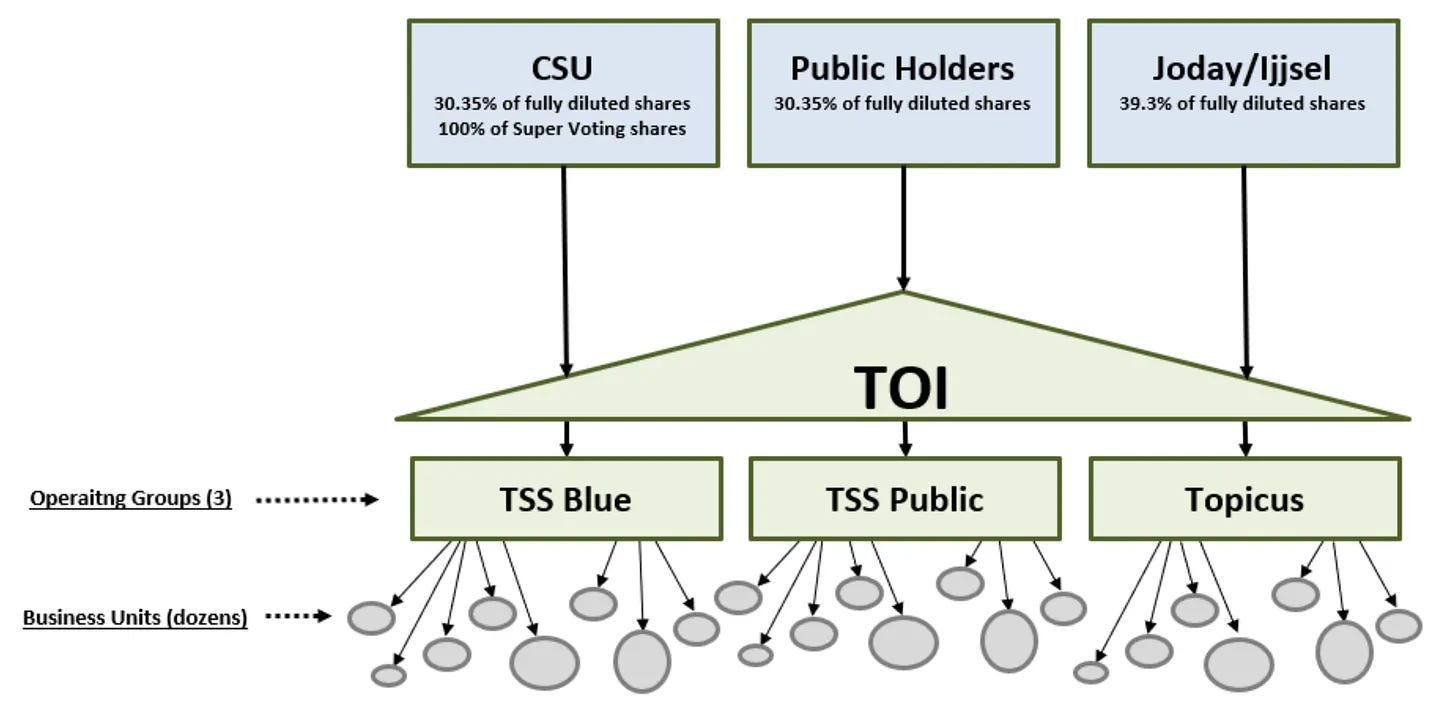
TSS Public and TSS Blue sit under one TSS umbrella (TSS Europe B.V.). They share a brand and, in practice, have had van Poelje as the single capital allocator and deal approver at the top. Making each group “autonomous, stand-alone” most likely means:
each group runs its own M&A pipeline, capital allocation and hurdle rates
capital moves between the groups and the top in a more formalized way, closer to how Volaris, Harris or Jonas work inside Constellation
Dropping “TSS” from TSS Public’s name is the visible sign that the shared umbrella is weakening. Each group becomes its own brand, like the Topicus operating group already is.
Why now? Zanders is both Topicus CEO and head of TSS Blue. If the umbrella stayed strong, Knooren, who runs TSS Public, would effectively report to the head of a rival group. Giving each group autonomy avoids that, and it means no one has to replace van Poelje as the central allocator.
In other words, the decentralization is the succession plan. This is my read of it at least - what is yours?
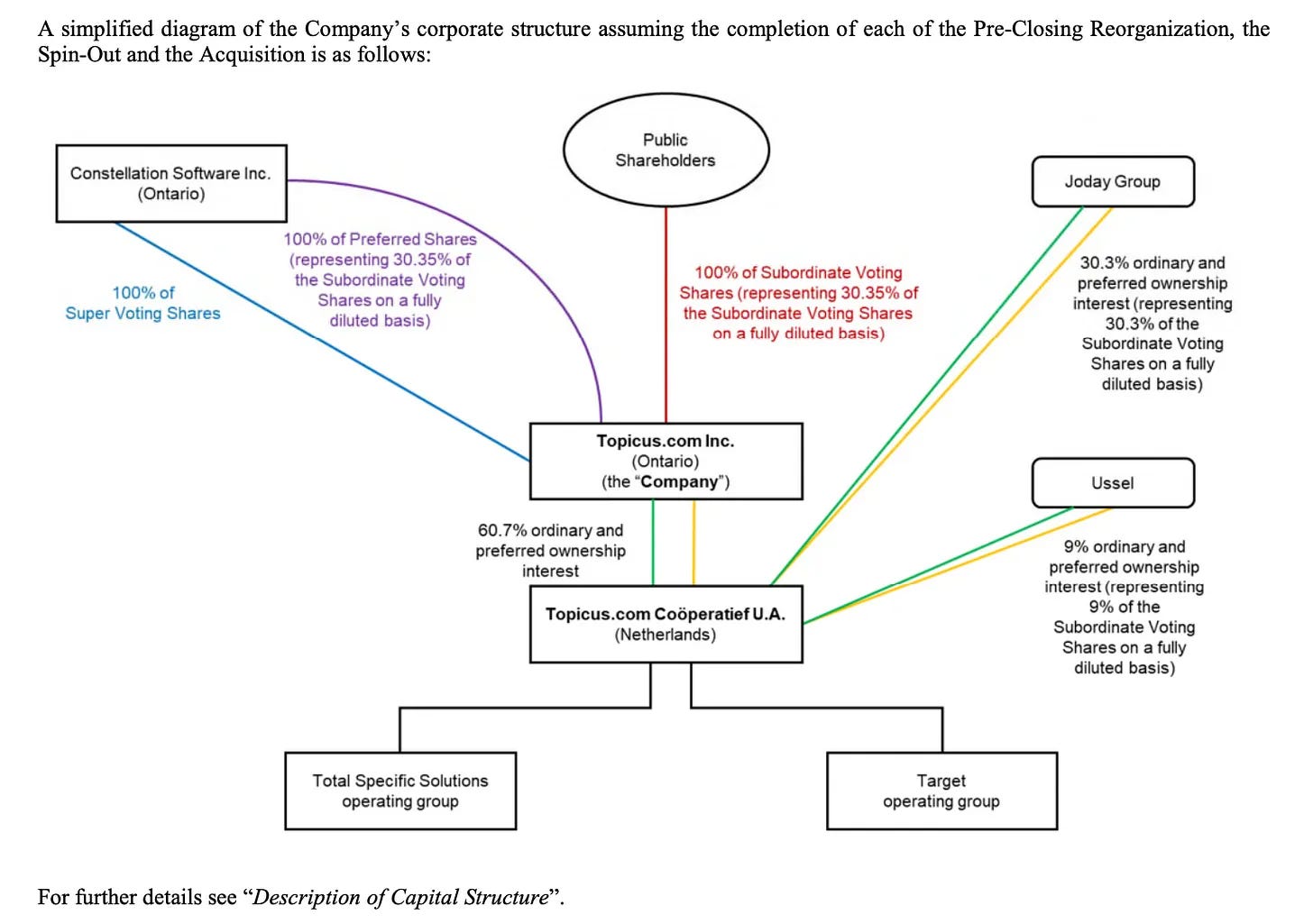
As a reminder, Topicus doesn’t own all of the businesses directly. They sit in Topicus Coop, where Joday, Ijssel and Constellation have contractual rights under the Investor Rights and Governance Agreement:
Joday must approve every acquisition
deals over US$100M need Constellation board approval
nomination rights
the call options, which are defined by holder group
So the clause says the operating groups gain autonomy inside that framework, not by changing it.
Furthermore, Topicus made its first public take-private attempt, in Australia of all places, and was rejected.
Deal activity slowed sharply while the balance sheet was deleveraged.
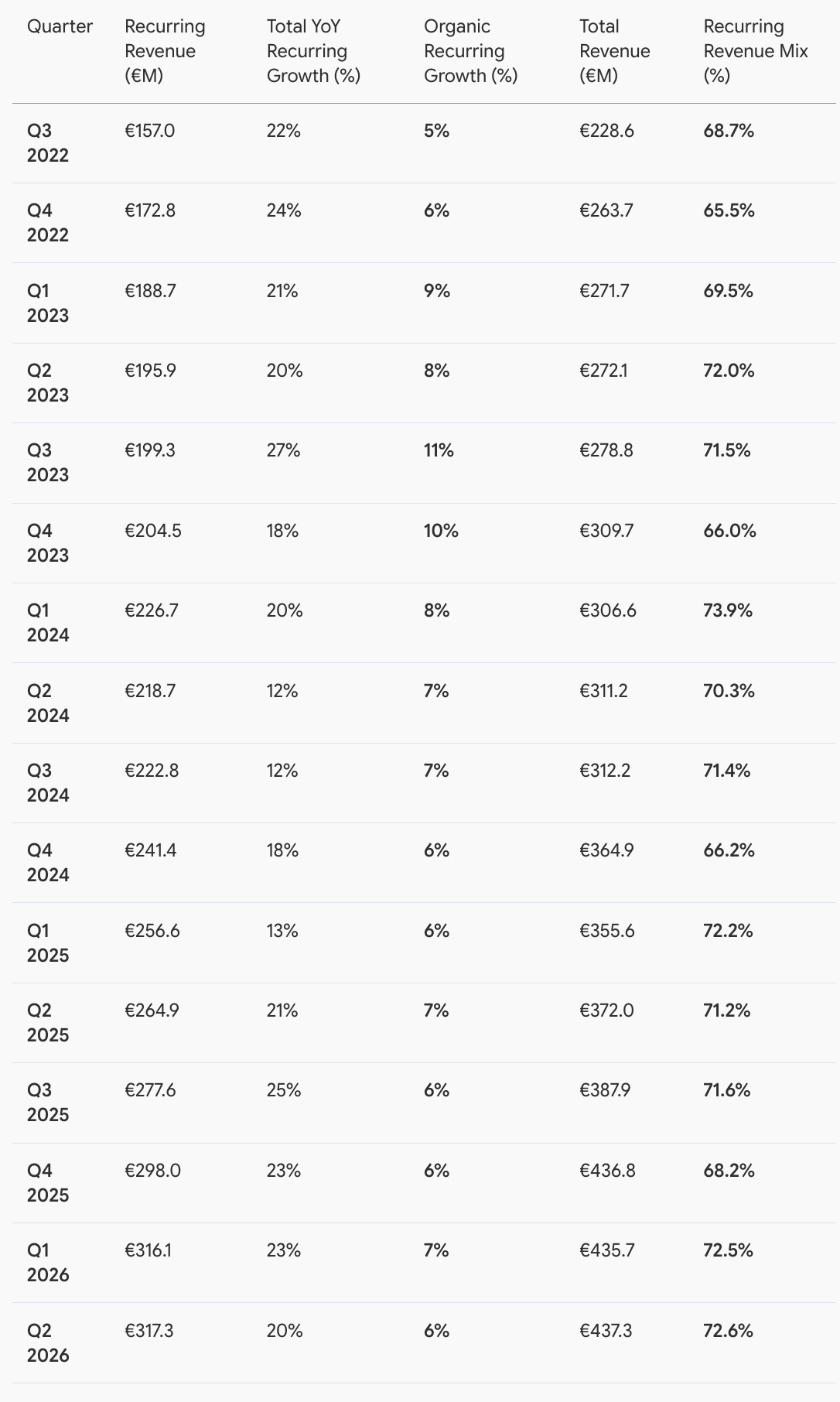
AI fears haven’t shown up in the numbers, with recurring organic growth steady at 6–7%, and still the stock has missed the software rebound that lifted Constellation about 40% off its lows.
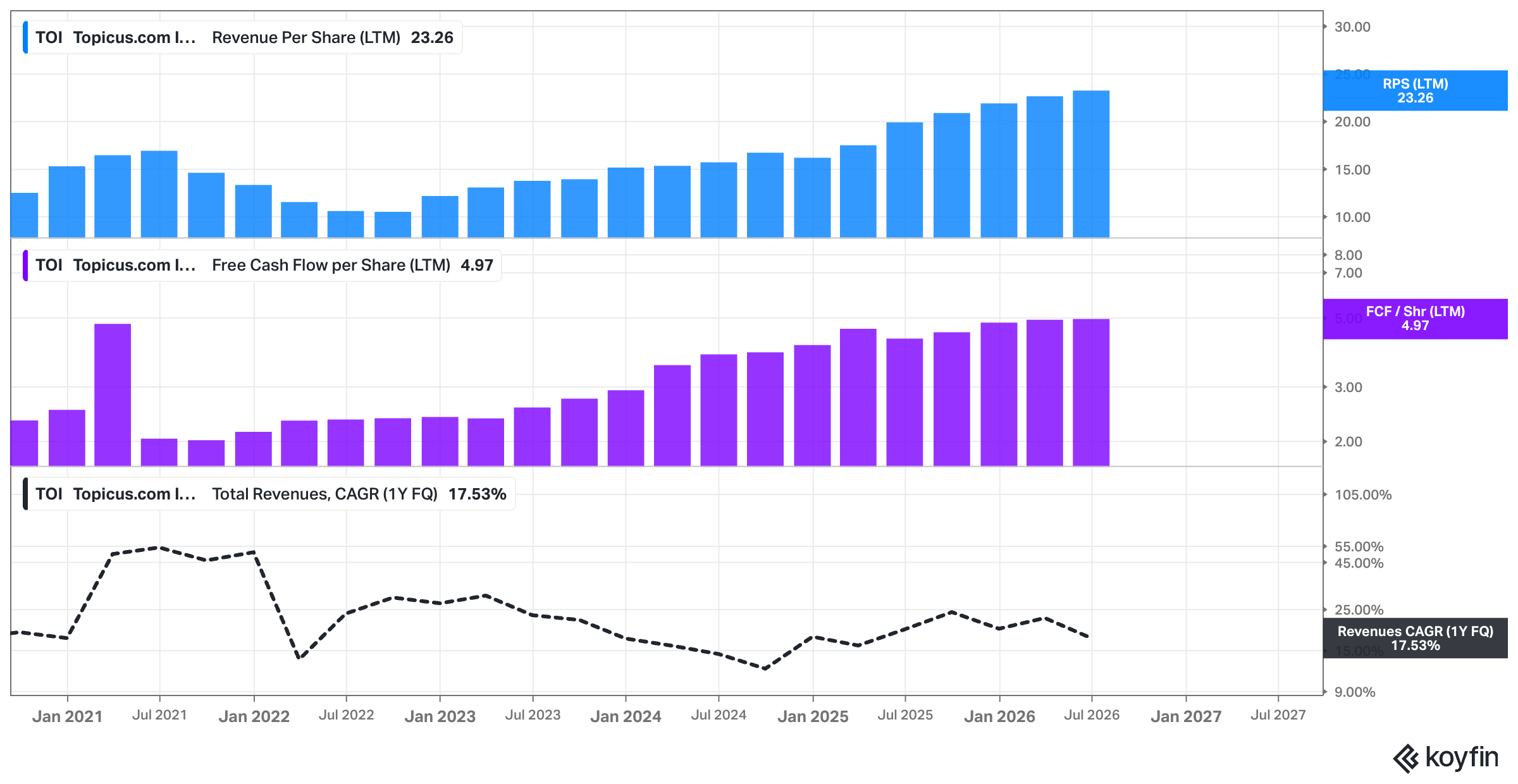
So the questions to ask have shifted slightly since March. This post is a brief update with some fresh thoughts and an emphasis on both quantitative and qualitative perception change analysis.
What is the price trying to tell us?
Let’s have a quick glance at the price action and the quantitative part of my perception analysis before we move back to the qualitative insights.
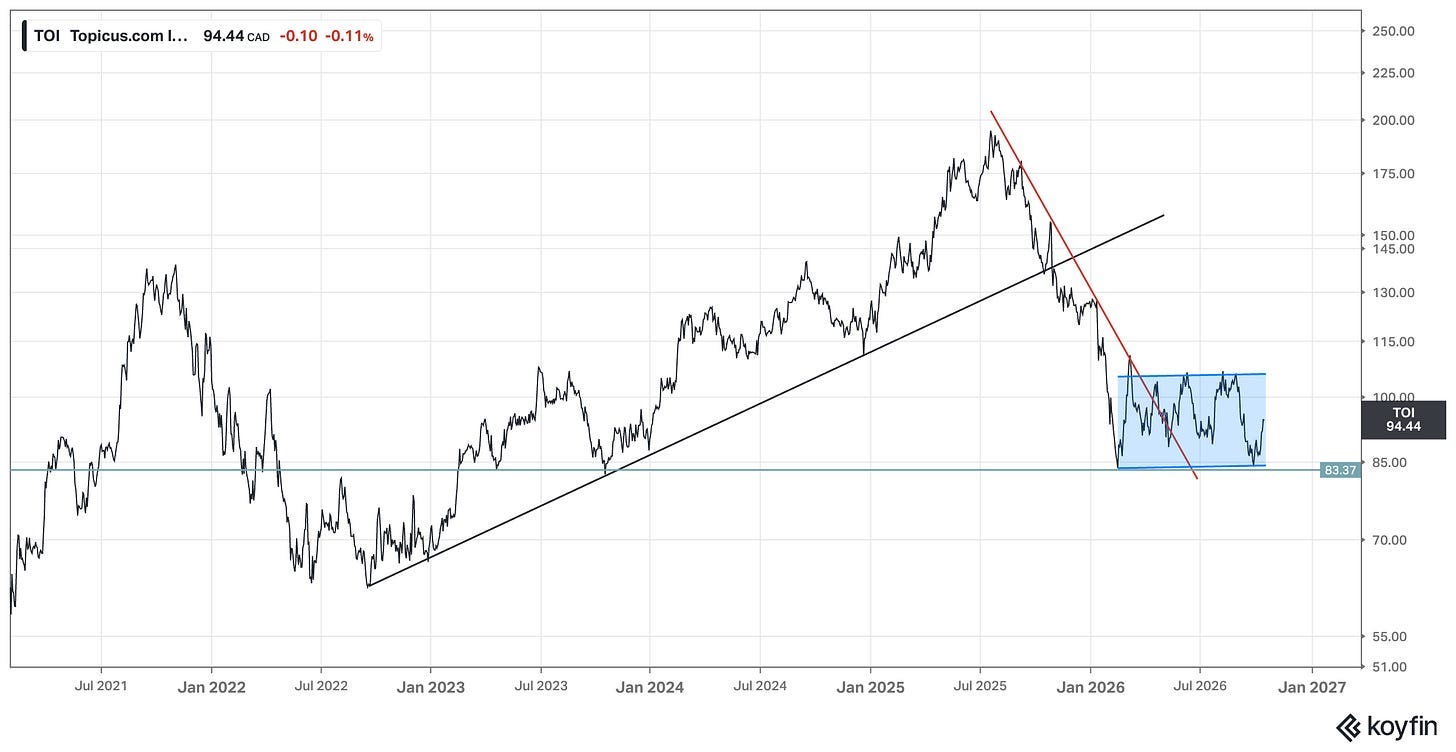
Topicus has only been listed since its spin-off from Constellation in early 2021, which is too short a history to identify a true long-term trend.
Still, the uptrend that started in late 2022, after the last 50% sell-off, carried reasonably strong signal value with its five touchpoints, and it has been broken. As with so many other long-term compounders this year, it broke hard.
There is support in the low C$80s, and the stock has respected it remarkably well. For around eight months now Topicus has traded in a sideways channel of roughly C$85 to C$105 per share.
Given the magnitude of the SaaS fears earlier this year, and given that the stock refused to make new lows even after its CEO stepped down, I’m inclined to think this support is reasonably strong. The level isn’t new either. The C$83 to C$85 area marked the October 2023 low.
The range also did something helpful: The steep downtrend from the 2025 peak didn’t end with a dramatic reversal. It simply ran out of time as price moved sideways and drifted out of it, which is what stabilization looks like in my framework.
The lower boundary has now held twice, in February and on September 29 with an intraday low of C$84, while the ceiling around C$105 to C$106 has capped three rallies.
A daily close above that ceiling on rising volume would be my first piece of price confirmation. If the low-C$80s support breaks instead, the next clear support I see is the 2022 low in the low C$60s. That would be a drawdown of almost 70% from the peak, and it happens to be the exact range I named as my wish price in March.
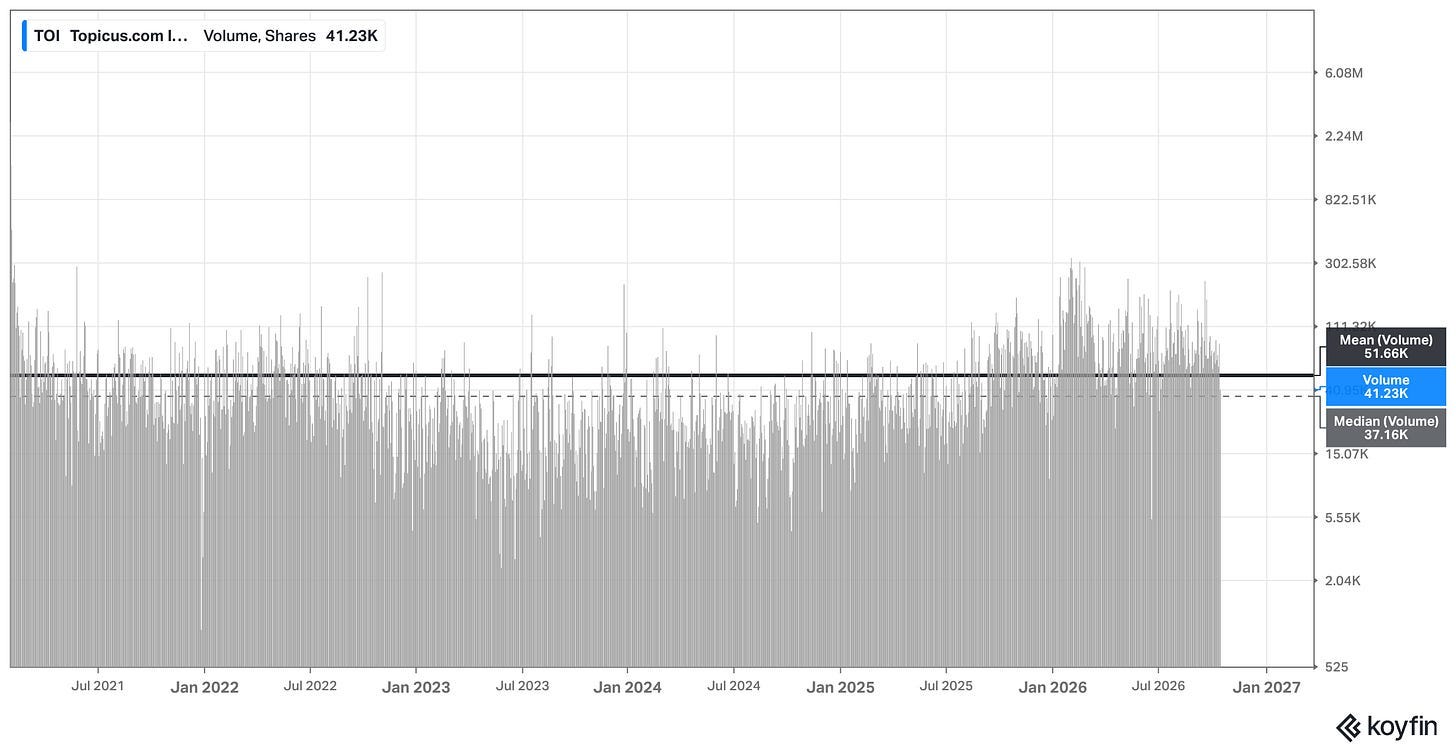
The SaaS-apocalypse fears of early 2026 are also reflected in the elevated volume we saw back then and which remained high throughout 2026. Daily volume spiked above 300,000 shares in February and March. It has come down from those peaks but still runs above the long-term mean of about 52,000 shares, so the selling hasn’t fully dried up yet.
The chart also reminds me how illiquid this stock is. At roughly C$4-5 million traded per day on the TSX Venture Exchange, Topicus is hard to own for large institutions, which limits both the forced sellers and the eager buyers.
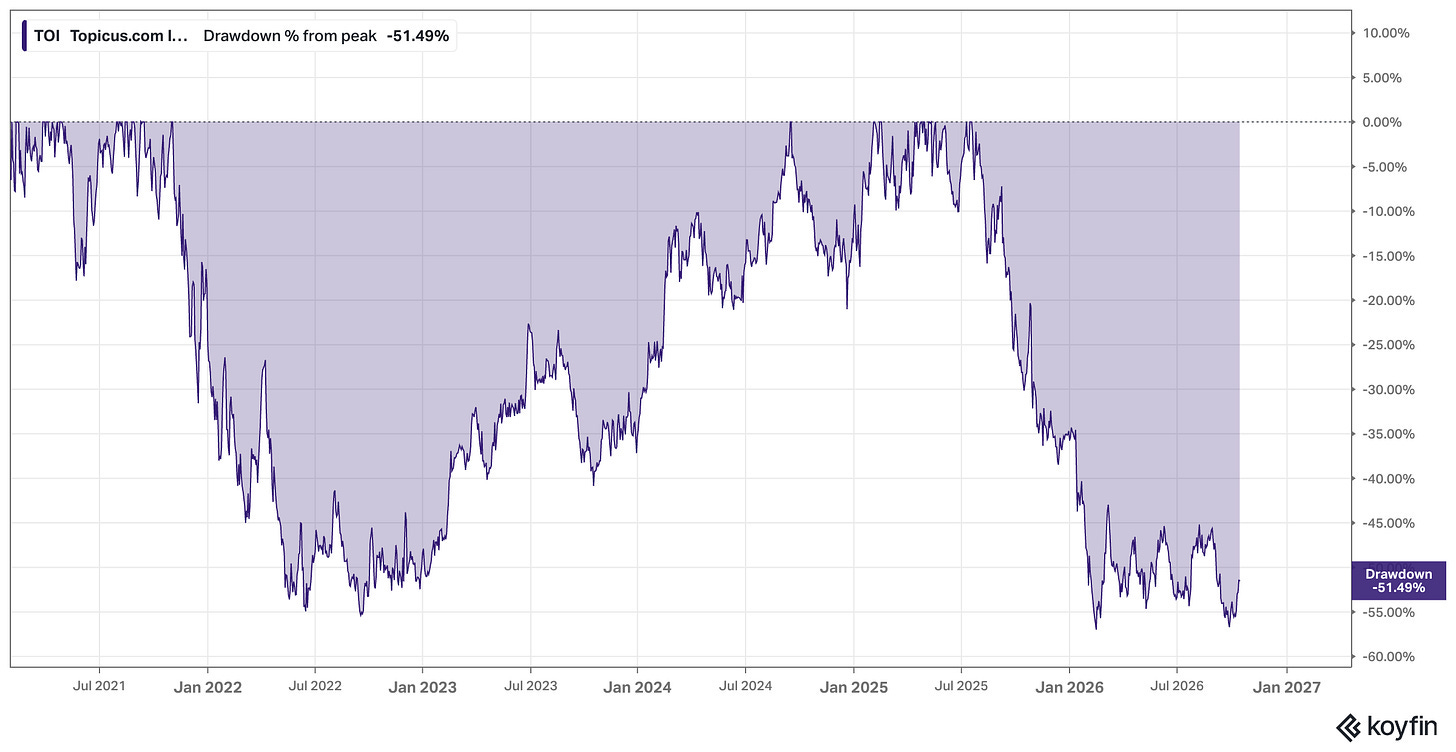
Still in a massive drawdown. At −51% from the July 2025 peak, and close to −57% at the lows, this drawdown is almost identical in depth to the one in 2022, which bottomed at around −55%. That episode was followed by an almost roughly threefold rally to the 2025 high. I wouldn’t lean on the analogy too heavily. In 2022, the sell-off was driven by rising rates and multiple compression across all long-duration assets.
This time the market is questioning the terminal value of vertical software itself, and that perception is harder to reverse over any near-term time frame.
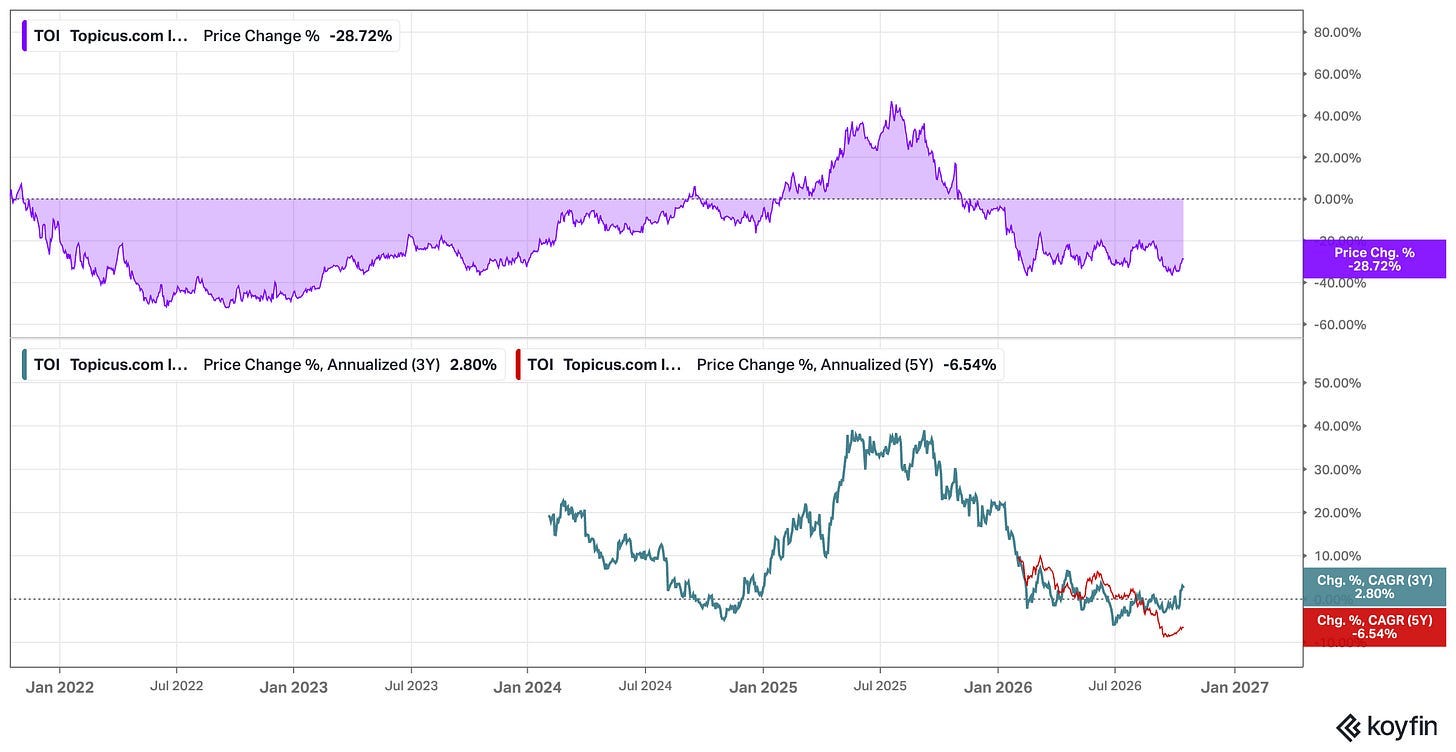
Down almost 30% over five years. Half a lost decade. The 5-year CAGR is −6.5% and the 3-year CAGR is barely positive at 2.8%, which means a negative return after inflation. To be fair, the five-year window starts close to the post-spin-off euphoria of 2021, so it exaggerates the damage somewhat.
So what is the price telling me? The long-term uptrend is broken, the drawdown is deep, and the stock has lagged its parent over the last year (even though both are basically on par over three years).
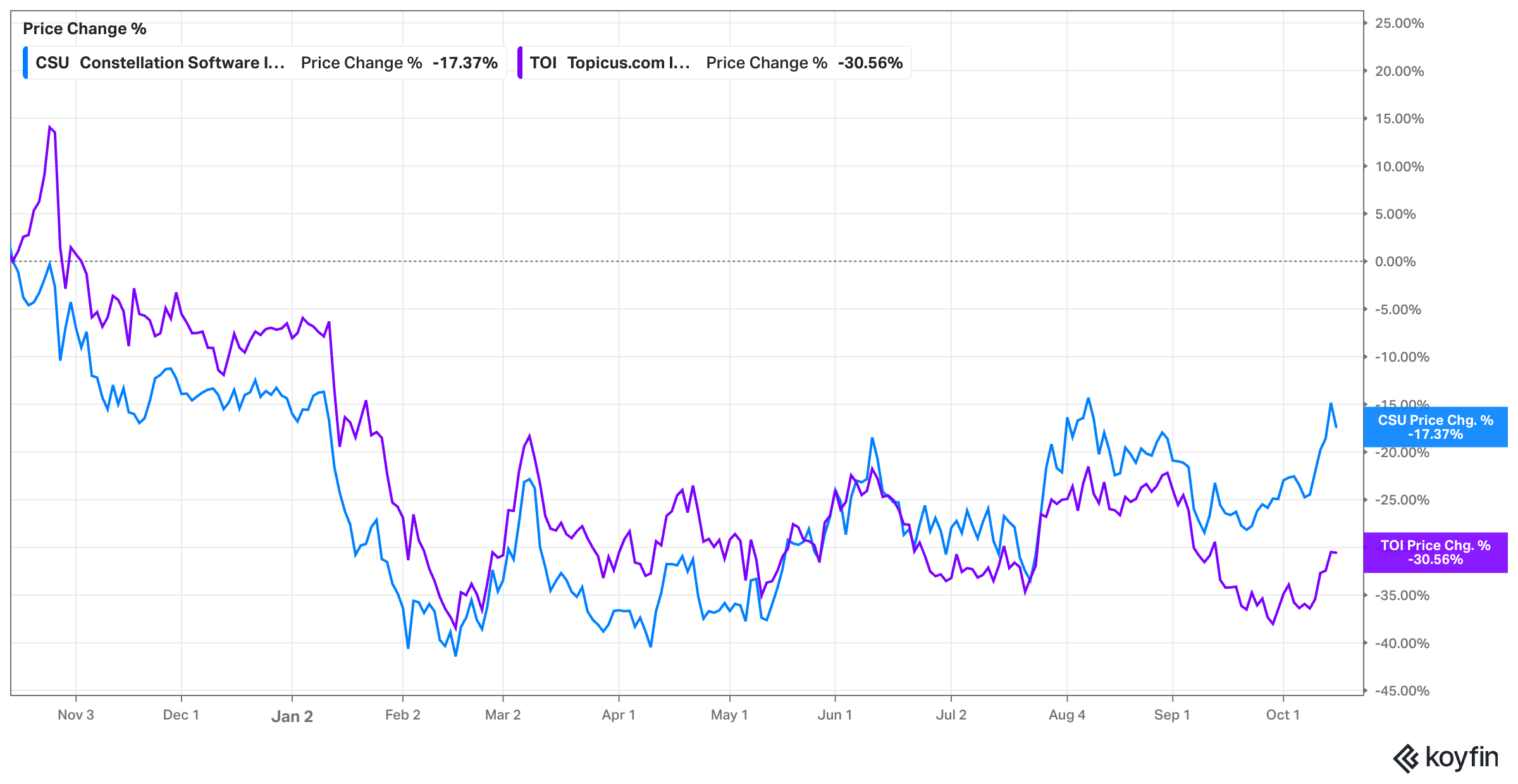
At the same time, Topicus has absorbed a CEO departure, a rejected takeover bid and a sector-wide AI scare without making a new low.
The market has had eight months and plenty of bad news to push the stock below C$83, and it hasn’t managed to.
Arguably, this is a stabilizing trend, yet a base with no breakout yet, which puts Topicus one step ahead of where Hermès stands today for instance.
Which new insights change how I think about the idea qualitatively?
The biggest qualitative change since March sits at the very top. Robin van Poelje retired as CEO on October 1. A CEO step-down can be a thesis breaker for me and it requires taking a hard look again, I believe.
Ramon Zanders, who runs the TSS Blue operating group, took over and keeps running TSS Blue alongside his new role.
In my deep dive, I flagged van Poelje as a key-person risk, and that risk has now materialized. He stays on as Chairman, the role he held before he became CEO in 2021. He keeps his influence through Joday, which still holds 29.38% of the Coop units. And he keeps his seat on Asseco’s supervisory board, where he has sat alongside Zanders since November 2025 and was reappointed in May for the 2027–2031 term.

The press release cited personal reasons without further explanation.

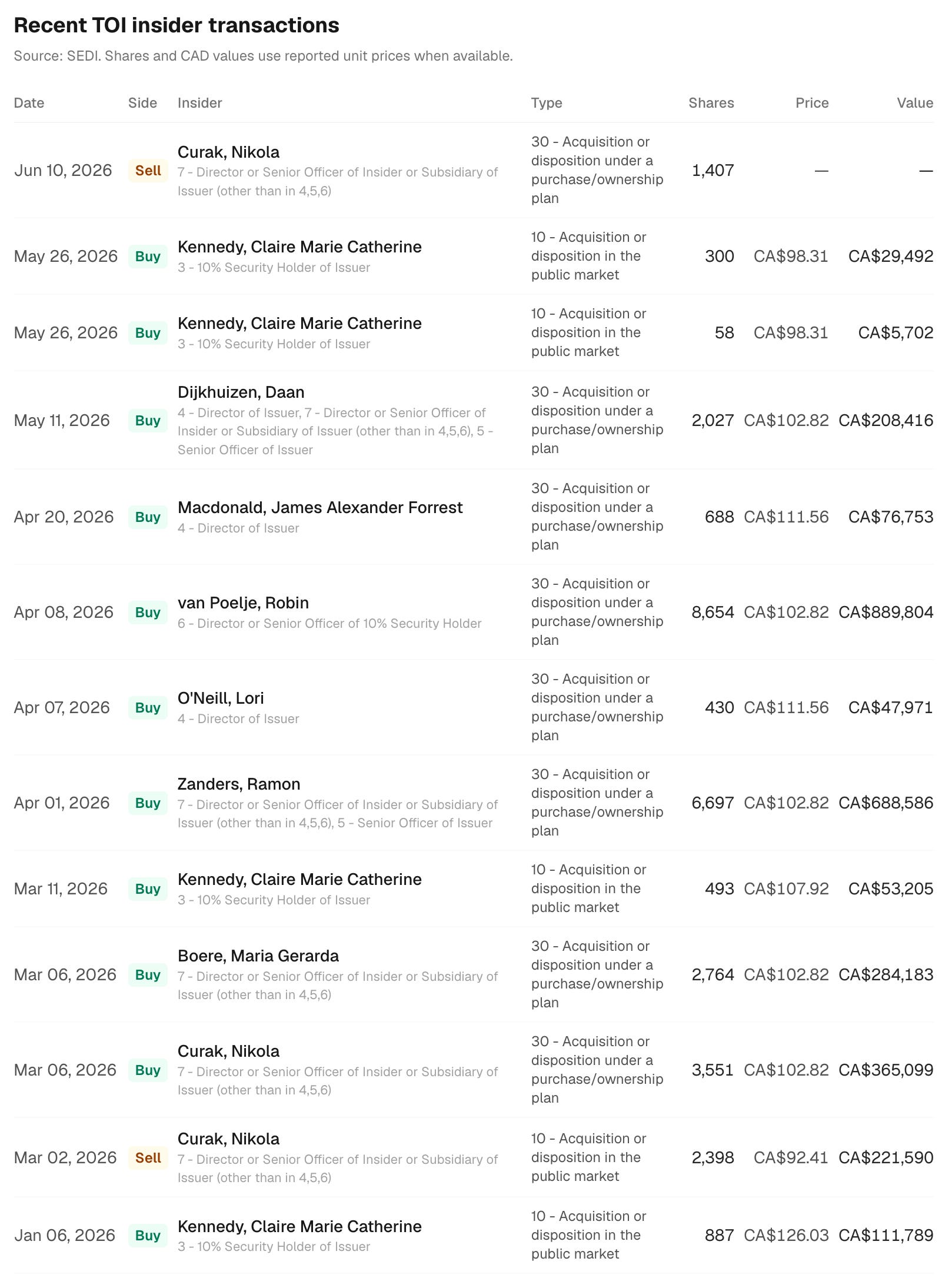
What reassures me about the timing is that van Poelje bought around C$0.89 million of Topicus shares at C$102.82 in April, and Zanders bought around C$0.69 million, both only months before the succession was announced.
Moreover, a CEO stepping down, is arguably less of a problem for a company that has “decentralization” in its DNA than for a company more dependent on the CEO’s (or the founder’s) vision and leadership.
If anything, it might make Topicus more decentralized, which, given the firm’s structure and the line of business it is in (programmatic acquiring) is likely a good thing.
Which brings me to the next point. The second change is structural. As discussed further above already, each TSS operating group will run as an autonomous, stand-alone entity within the boundaries of the Investor Rights and Governance Agreement, and TSS Public under Han Knooren will get a new name. Even though I’m not 100% sure of what this change means in practice, and what truly changes, this is essentially the Constellation playbook. The capital allocation moves further down the organization.
I see three ways to read it:
The generous reading is “more hunters,” meaning more people with the authority to find and close deals.
The pragmatic reading is a succession structure for a company that has no single heir to van Poelje.
A more speculative reading, and quite frankly rather unlikely one, would be optionality for future separations, given the Lumine spin-off precedent. Nobody has argued the last one publicly, the reference to the governance agreement cuts against it, and nothing in the public filings points to a change in Constellation’s super-voting control.
I thus lean toward a mix of the first two.
The third piece is Daan Dijkhuizen, CEO of the Topicus operating group and the leader behind the product-led culture of ParnasSys and FORCE, has agreed to join and support Constellation’s drive to accelerate AI-first initiatives across the whole Constellation group. Mark Miller said Constellation is “very fortunate to benefit from Daan’s extensive experience and expertise in supporting our AI implementation strategy.” In a way, this release reveals that Constellation sees Topicus as a source of AI expertise worth spreading across the entire group, which gives weight to my AI beneficiary scenario. The open question is how much of his attention the Topicus operating group keeps, and the coming reports should make that clearer. His vehicle, Ijssel Group, also exchanged 190,000 Coop units into Topicus shares in Q2, taking its stake from 6.29% to 6.14% of the units. An exchange isn’t a sale, of course, and I wouldn’t over-read it, but it belongs in this update piece.
The market’s reaction to the leadership change was telling. The stock fell 5.7% the day after the announcement, from C$96.00 to C$90.56, and slid to its C$84.05 intraday low on September 29 before recovering to C$94.44. Most commentary framed the change as continuity. For me, it changes the character of my fourth BAM, which moves from a van Poelje premium to an institution premium: decentralization, the Constellation playbook, and Constellation’s oversight. That is arguably more durable and closer to how Constellation itself works.
What happens to the cash?
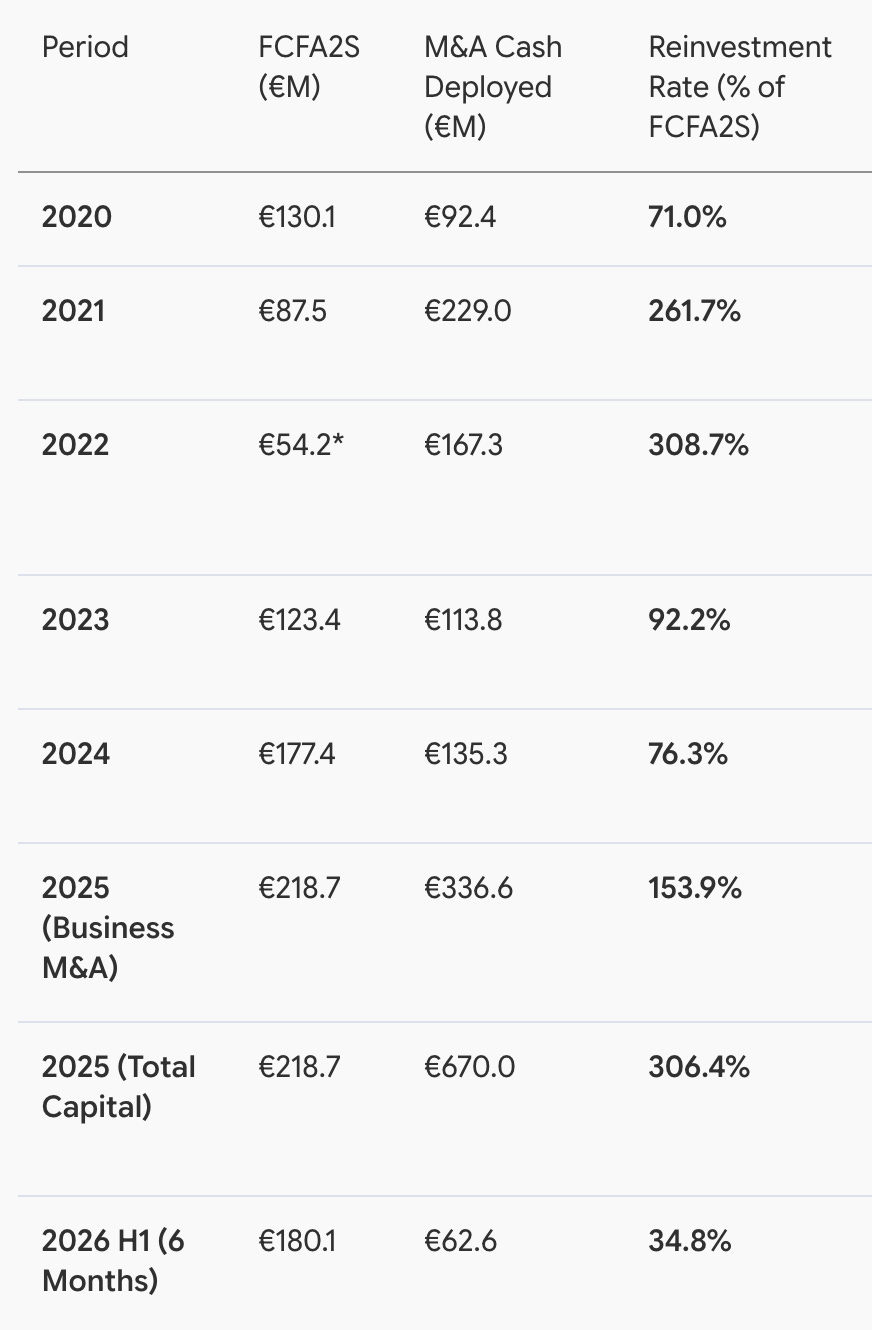
For a serial acquirer, the reinvestment rate is the single most important driver of intrinsic value, and this is where 2026 looks weakest. In the first half, Topicus spent €46.3 million in cash on acquisitions, against almost €250 million in the first half of 2025 (all of this while CSU bought more than ever).
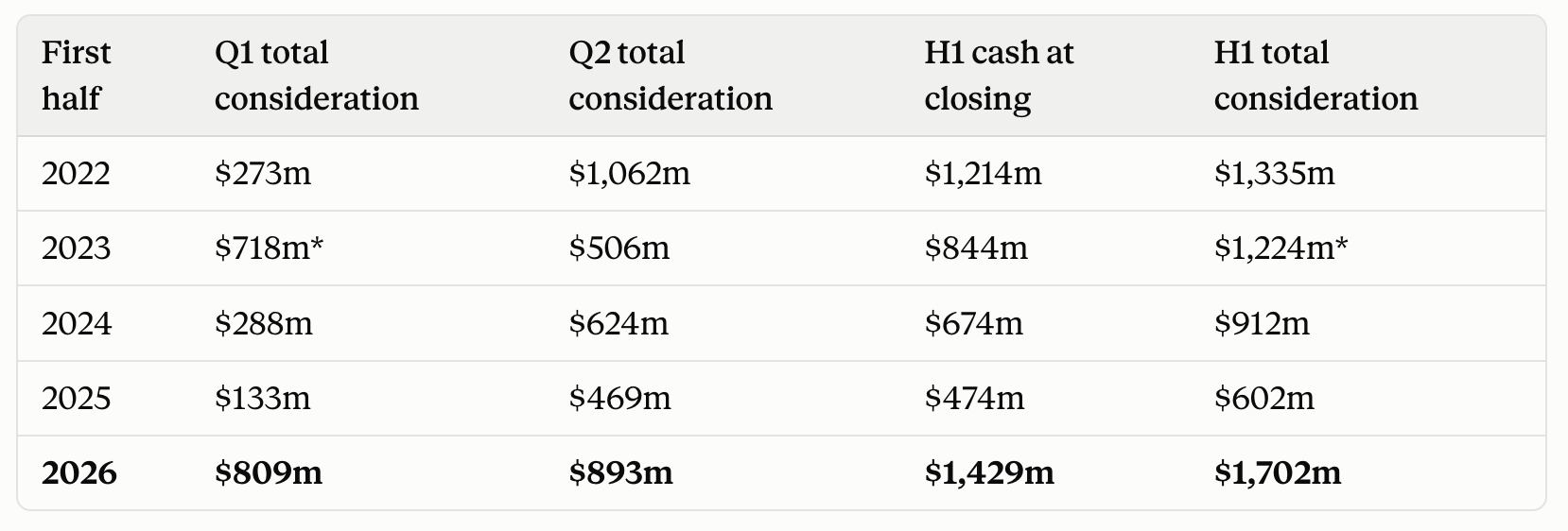
Including holdbacks and earn-outs, total consideration was €62.7 million – find a reinvestment rate overview in the table below:
Another €56 million was committed in the first five weeks of Q3. In early October, TSS acquired Cimkey in Spain, the first deal in quite some time.
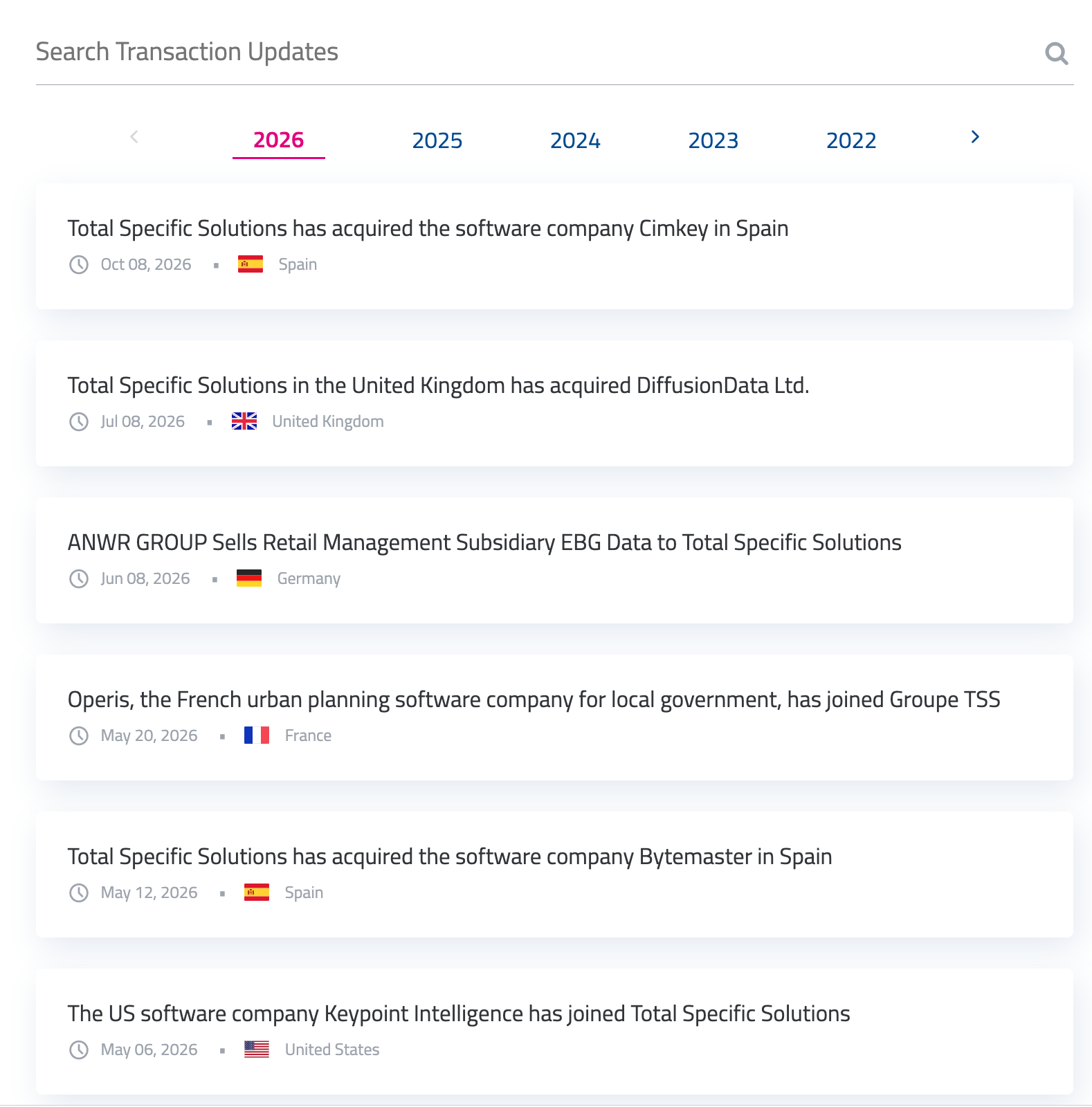
So the pace has picked up, but the year will still fall well short of 2025. None of the deals were individually significant, and the verticals were as broad as ever, from automotive and legal software to gaming, labs, ERP, education and fleet management.
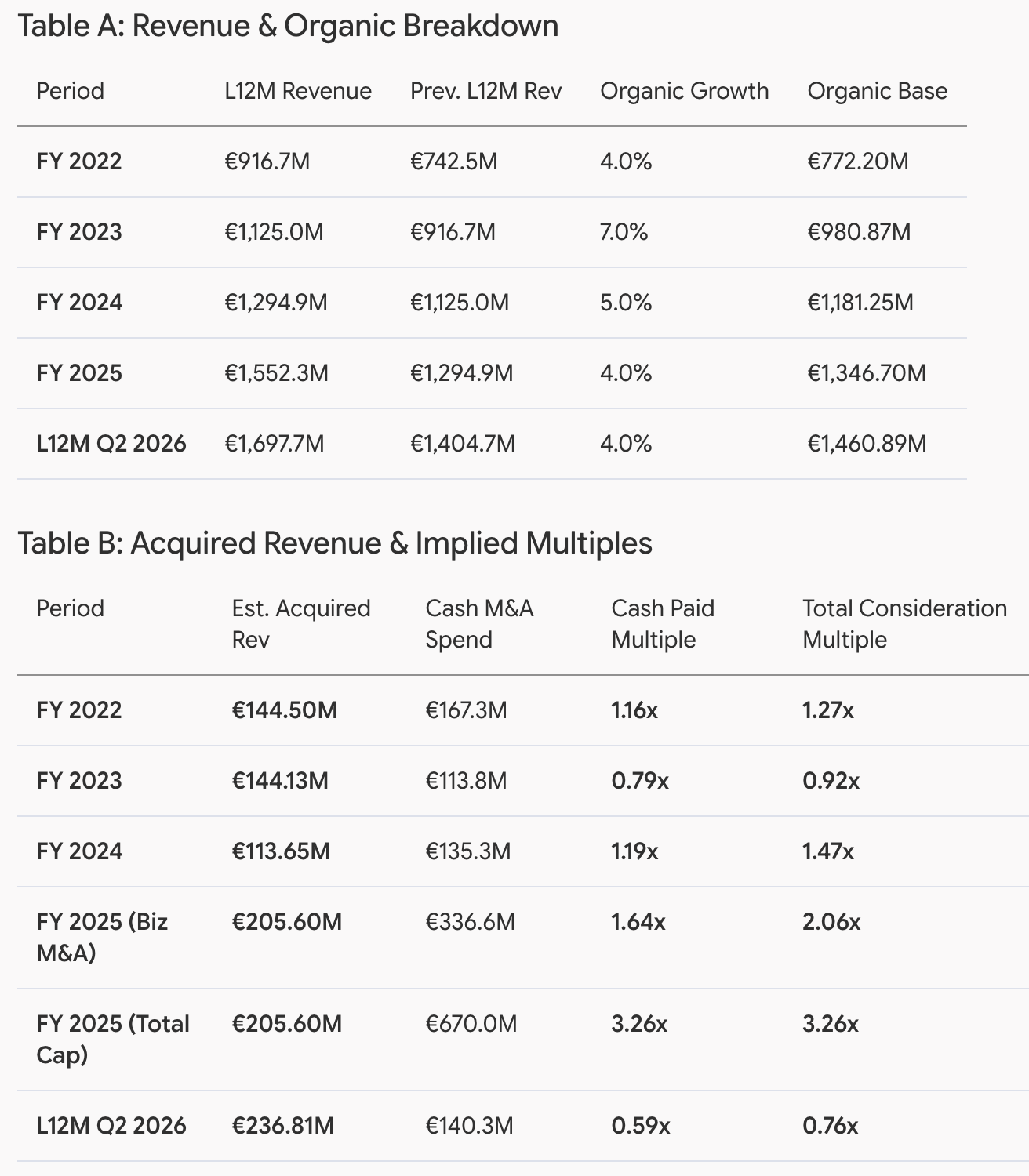
Below, I have also attached an updated table estimating the multiples paid by Topicus.
Formula: L12M cash acquisition amount / (L12M revenue − previous L12M revenue × (1 + organic growth))
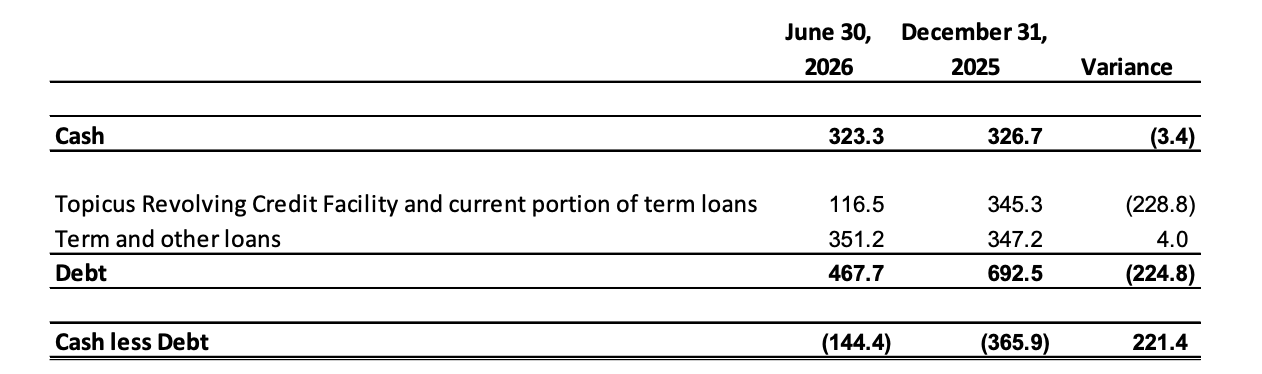
In terms of capital allocation options, instead of deploying most of its FCFA2O into acquisitions, Topicus repaid €229 million of its revolver, and net debt fell to €144 million, or about 0.4x EBITDA.
I see two possible explanations, and both are probably true.
The first is discipline. Constellation said on its Q2 call that competition for deals “remains intense, with no improvement in win rates or pricing,” and they spoke of a “real disconnect” between the SaaS sell-off in public markets and pricing in private ones.
“Yes, I think the competition is still very robust. No one is giving up on vertical software, whether it’s large or small. We’re seeing some weaknesses at the high end, but -- in pricing, but it’s still very, very competitive. So it’s not like we’re increasing our win rates or anything like that. It’s same old try to get as much as we can. I don’t see any improvement, but we had so many people out there looking for acquisitions across the board or across the globe. And it’s a matter of developing those relationships over the long term.” - CIO Bernard Anzarouth, CSU Q2 Call
“So I don’t see that terminal value diminishing the way that people have seen that in the public markets. And I think there really is a disconnect. Now maybe there are some businesses that are on the fringe that maybe it could be copied really quickly, very easily replaceable. I just don’t see that. And so to me, fundamentally, I believe in the businesses that we’re running here. And just the shift in this tooling that we have in our shed that we could just take advantage of and deliver everything that we need for our customers.” - CIO Bernard Anzarouth, CSU May Special Call
“It's just the same amount across the market as we've always seen. So nothing's changed. There's a real disconnect between the SaaSpocalypse publicly traded stuff and private markets. But yes, it's just ebbs and flow of the market.” - CIO Bernard Anzarouth, CSU Q1 Call
If private sellers haven’t lowered their expectations, waiting is the right call. But it also means that the bull case for the acquisition engine (lower valuations in private markets too) hasn’t materialized.
The second is distraction. A leadership transition, a reorganization into autonomous groups, and two large listed-company situations in Asseco and ReadyTech all compete for management attention. Whatever the mix, the slowdown shows up in the numbers at the very moment the market questions the terminal value of the model.
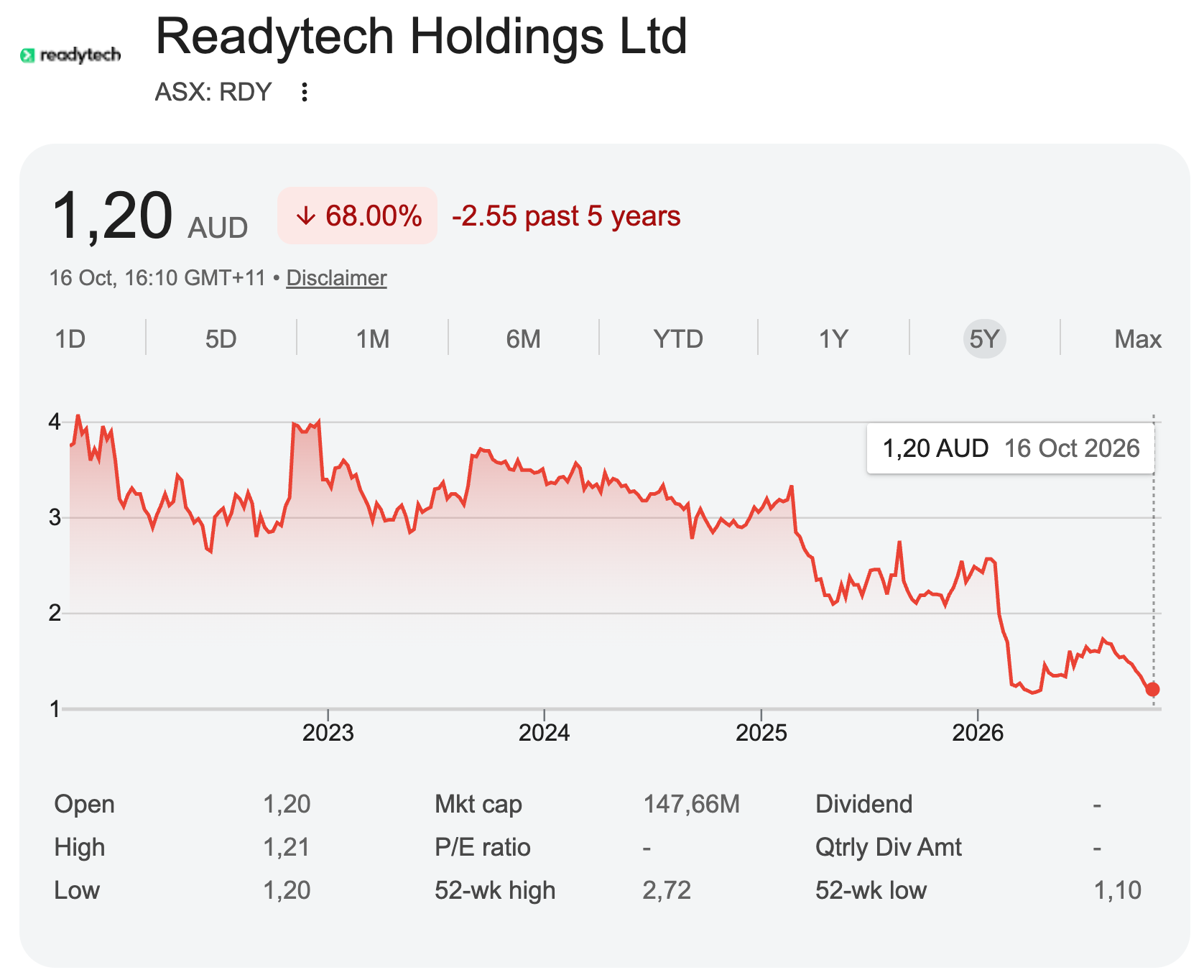
The cheapness this year sits in public markets, which explains why Topicus’ biggest moves were listed-company moves. In late May it bid A$1.75 per share for ReadyTech, an Australian vertical software company, and on June 1 it raised the offer to an A$2.00 scheme, a 49.3% premium and about A$247 million of equity. The board unanimously rejected it as not adequately reflecting ReadyTech’s inherent value, and the shareholder HD Capital said publicly it was not a seller at A$2. Since then, there has been neither a revised bid nor a withdrawal.
There is arguably a third explanation. Businesses don’t move linearly, and over time Topicus will experience cyclicality in deal flow too, of course. So maybe this is just a “dry patch” followed by periods with an above-average number of acquisitions - it’d be odd if the acquisition engine suddenly broke together entirely (why would it?).
I take three things from the episode. Topicus is willing to pay a meaningful premium for a de-rated listed software asset, the same playbook Constellation and Lumine are running. It didn’t chase the price, which is the discipline I want to see. And my third BAM, “European fragmentation,” no longer tells the whole story. Australia, the US deal for Keypoint Intelligence, and van Poelje’s mention of Indonesia at the AGM all point to a group that is widening its hunting ground (Topicus is “slowly but surely moving out of Europe.”).
That could be a) ambition, a widening of the TAM and runway, or b) a sign that Europe alone no longer offers enough deals at the right price and that competition is heating up (or a combination of both).
I suspect it’s some of both.
Readers of today’s post might ask why Topicus doesn’t buy back its own stock at multi-year lows?
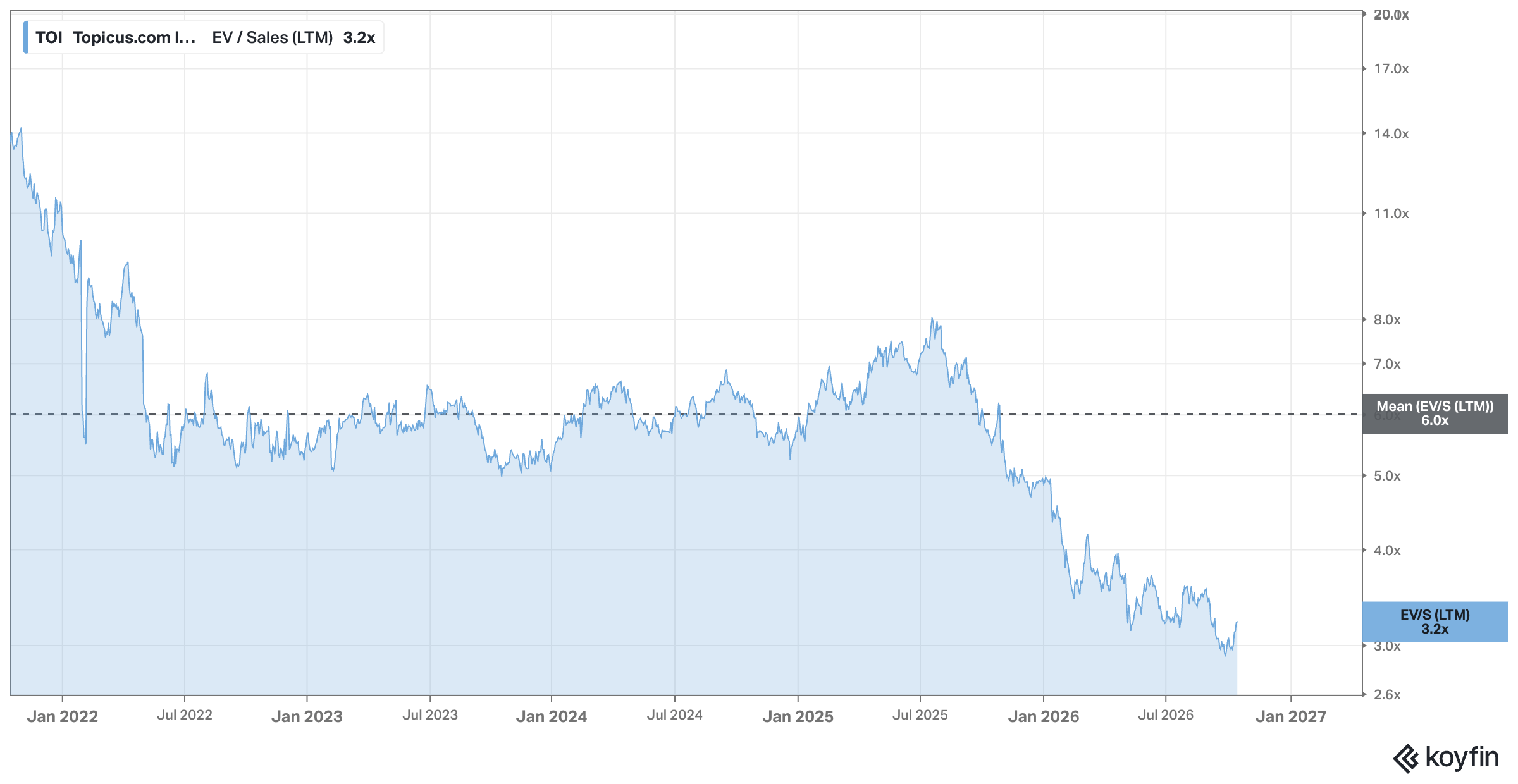
I asked myself the same question, and the answer is less mysterious than it may seem; and is actually quite straightforward. Constellation-family hurdle rates for acquisitions sit well into the double digits (and have been slightly lowered at the parent as it scaled). At a low-20s multiple of free cash flow available to shareholders (FCFA2S), a buyback earns roughly a 4–5% cash yield plus 6–7% organic growth, or around 10–11% a year. That doesn’t clear the bar they apply to deals, so skipping buybacks is consistent with their own logic.
If a full year of under-deployment passes without a special dividend like the one in March 2024, though, the questions surrounding distributions will get louder, and rightly so.
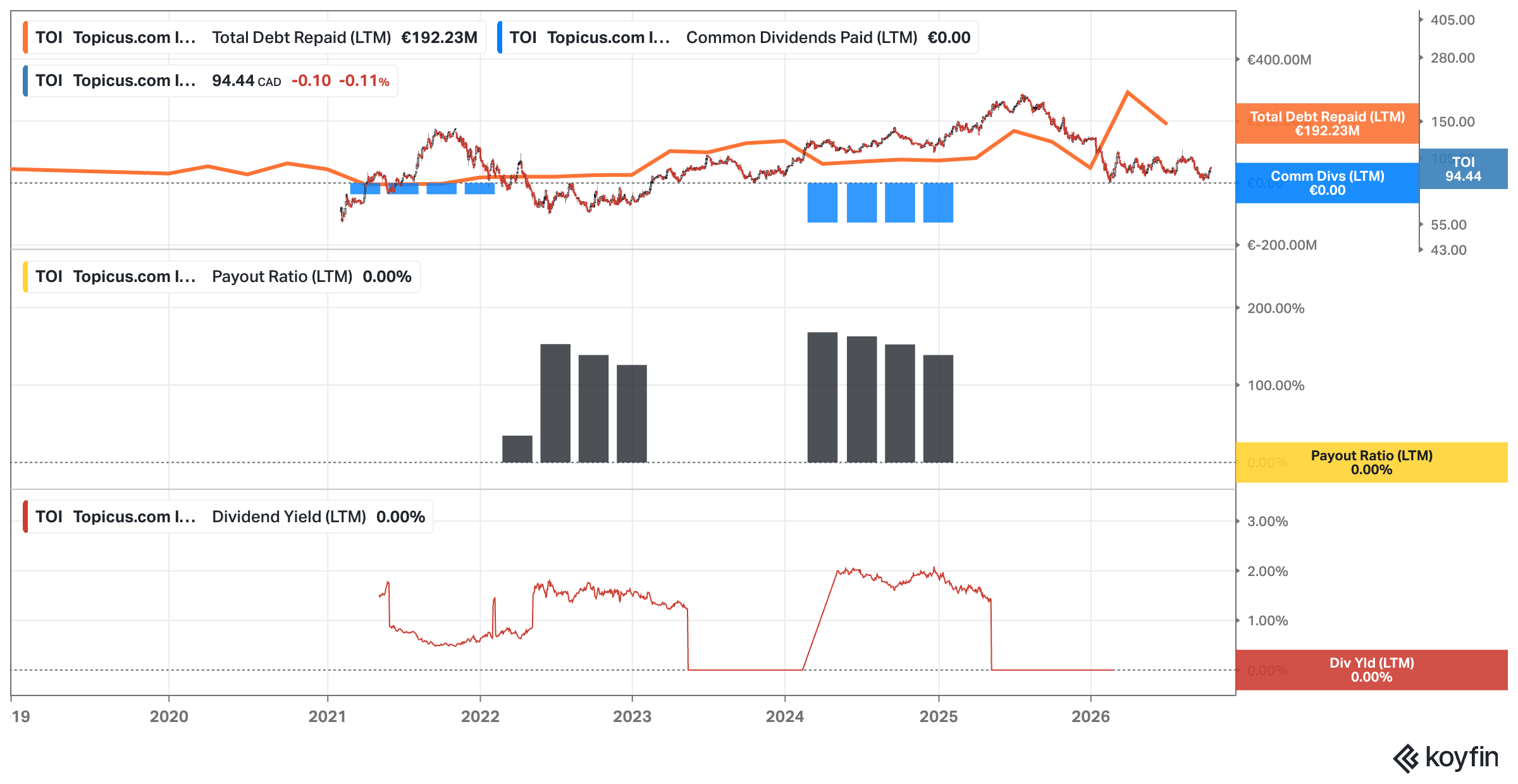
Asseco Poland is the other half of the capital story. The cash did arrive, with a €59.0 million dividend in Q2 and €19.8 million of equity-method “income” in H1. Influence at 23% has its limits, though. Polish pension funds, which together hold about 23% as well, blocked the management incentive plan TSS sponsored, first at the March EGM and again in August.
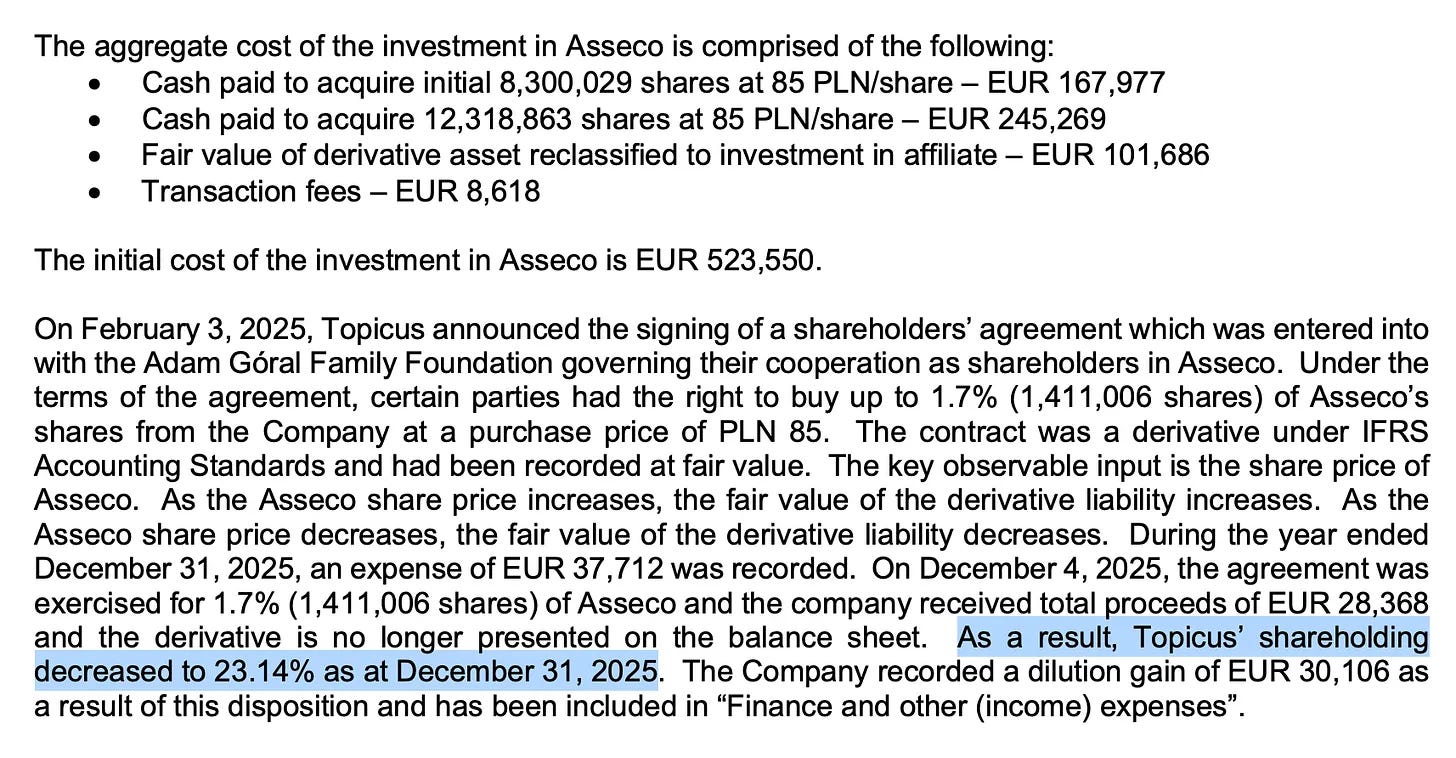
Anyone who read the Asseco deal as Topicus taking control of a Constellation-style platform should take note, because minority-holder politics are a hard constraint here.
Context:
In October 2025, TSS, as Asseco’s largest shareholder, proposed a one-off incentive program funded with shares. Part of the rationale was succession: according to the supervisory board chairman, the program for founder Adam Góral was meant to implement the handover of the company’s management to Rafał Kozłowski. The original design was generous to Góral – he would have had the right to acquire 3% of the shares at 1 zloty each, a package worth over PLN 400 million at market prices.
That is where the pension funds pushed back, led by Nationale-Nederlanden OFE, which holds more than 9% of Asseco. NN OFE proposed in early February that Asseco’s treasury shares be cancelled rather than used for the incentive program. Under that pressure, Góral backed out, his family foundation filing a resolution under which he gave up his participation, waiving shares worth several hundred million zloty, and the February meeting was cancelled.
The first actual vote came at the March EGM. The slimmed-down plan would have granted 1.4 million shares, or 1.7% of share capital, from treasury stock. Góral’s family foundation and TSS voted in favour, but the funds, above all NN OFE, were against. It failed by a small margin of votes, and NN OFE’s counter-proposal to cancel all treasury shares failed too, so the result was a stalemate.
Management came back in summer with sweeter terms. Analyst Piotr Raciborski of Wood & Company pointed out that the implied dividend for 2027–2030, which the plan made a condition, rose from PLN 1.7 billion to PLN 2.8 billion, and Asseco also offered to cancel the remaining treasury shares not handed to managers. It still did not pass. At the 12 August EGM three resolutions were on the table and all of them failed: management’s two – the manager programs and the cancellation of 1.09 million treasury shares – and NN OFE’s motion to cancel all 2.49 million treasury shares. The core of the dispute is this: the funds opposed using Asseco’s treasury shares to pay management and wanted the shares cancelled instead.
TL;DR: TSS’s proposed incentive structures often involve stock options, equity grants, or performance units tied to growth and Return on Invested Capital (ROIC) targets. Polish Open Pension Funds (OFE), as fiduciary institutional investors, are notoriously conservative regarding equity-based compensation.
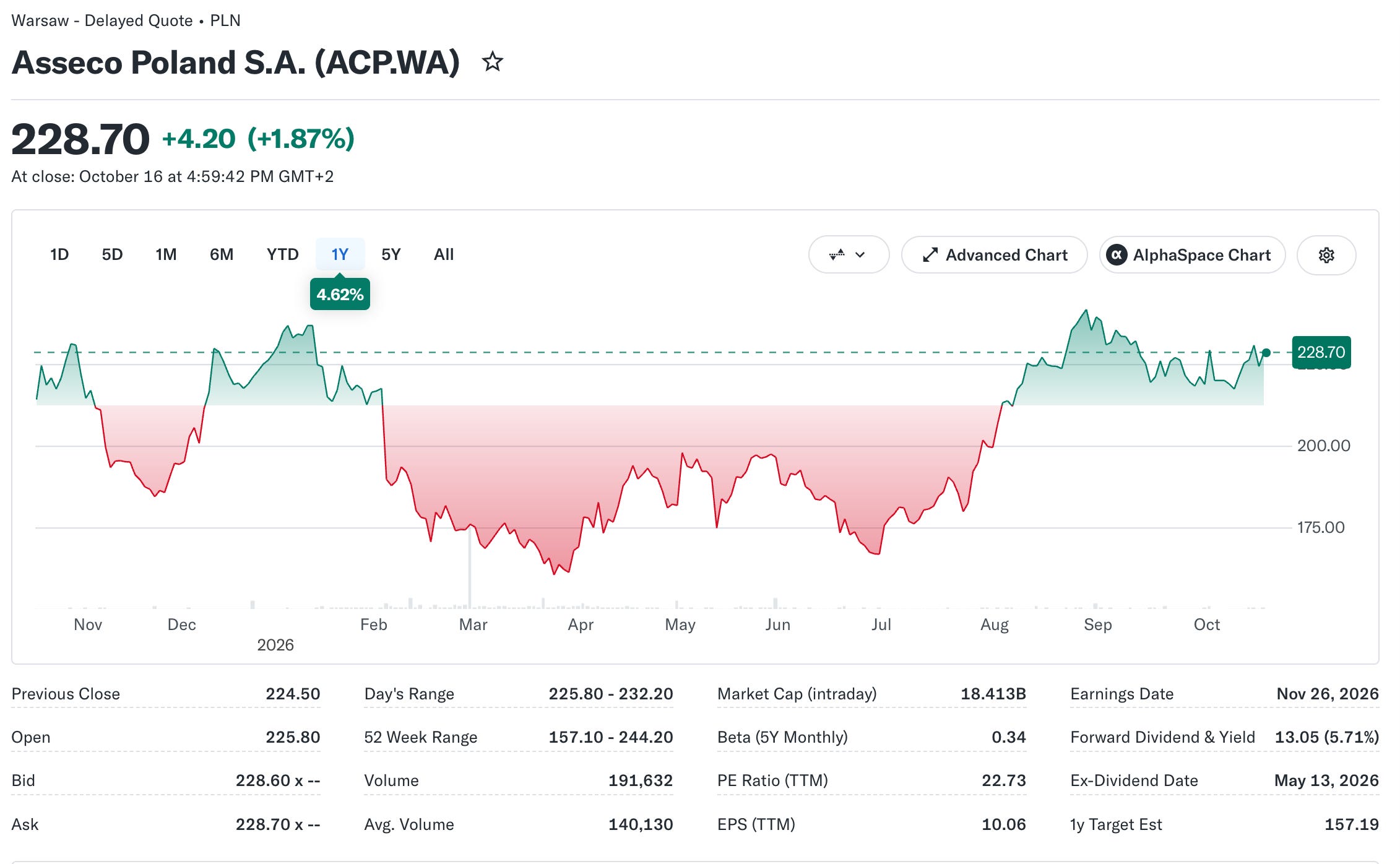
The stake itself has made a round trip. Its “fair value” (“based on the share price of Asseco“) fell from €1,039 million at the end of 2025 to €747 million at the end of June, and with Asseco back near PLN 230 it is roughly where it started the year.
The Asseco dividend also distorts the cash flow picture, and I see the same mistake repeated in public commentary. Reported FCFA2S rose 24% to €180.1 million in H1, and almost all of that growth is the Asseco dividend, which jumped from €7.7 million a year earlier to €59.0 million.
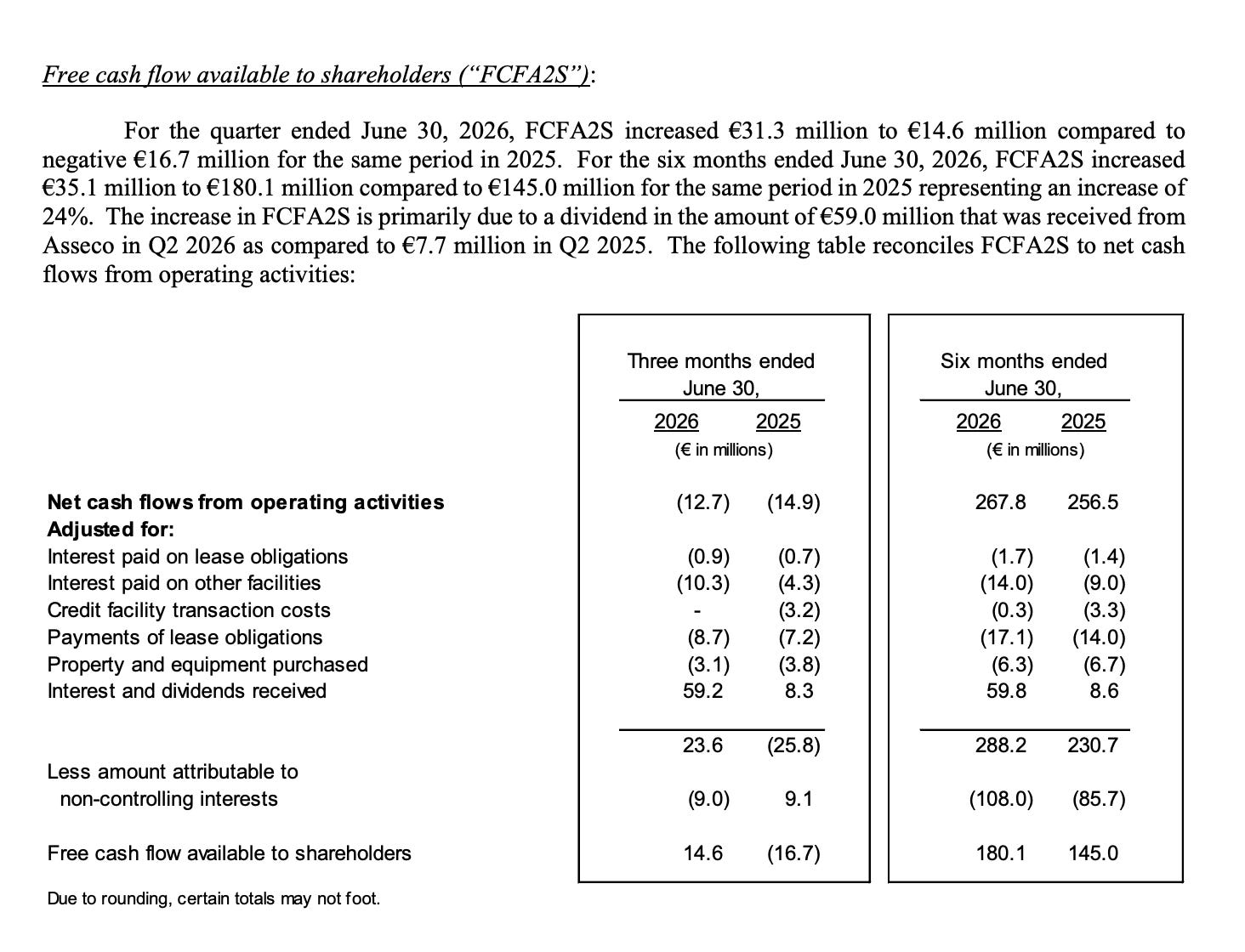
Some commentators strip out the full dividend and conclude that core FCFA2S fell from €137 million to €121 million. That overstates the decline. FCFA2S is reported after deducting the share attributable to non-controlling interests, and the dividend arrives at Topicus Coop, where Topicus Inc. owns roughly 64%. Removing only that 64% share, core FCFA2S was roughly €142 million against €140 million a year earlier.
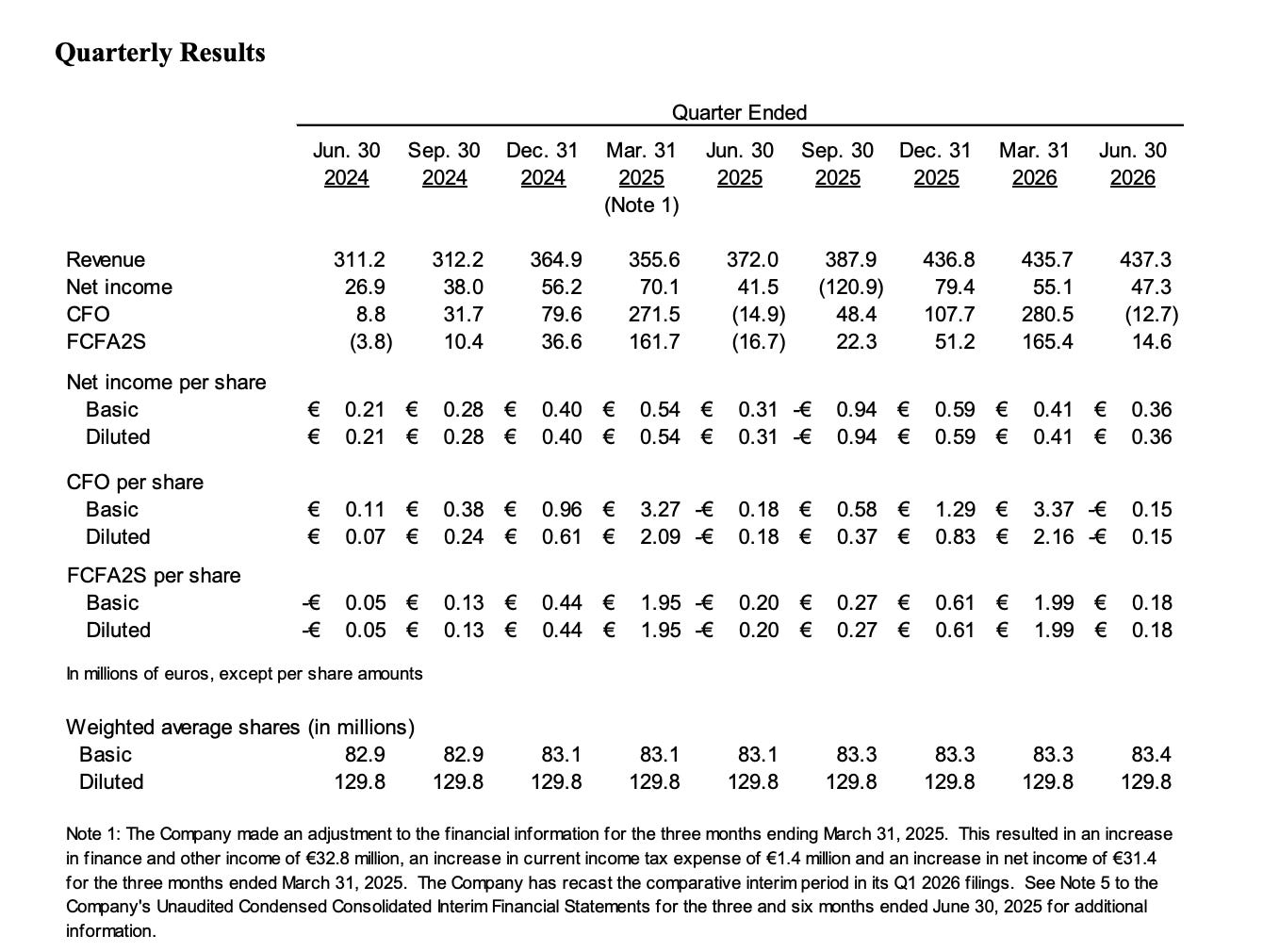
Underlying cash generation went sideways in the first half, with Q1 alone up just 2%, and that was after a working capital drag. The same consistency rule matters for valuation. If you value Topicus on its 83.4 million Topicus Inc. shares, the Asseco stake also has to be counted at its roughly 64% look-through value. Counting it at 100% is the easiest way to manufacture a cheap stub that doesn’t exist.
Is AI showing up in the numbers?
So far, it isn’t, and that’s the bull evidence. Organic growth in maintenance and other recurring revenue was 7% in Q1 and 6% in Q2 2026, in the same 6–8% band as every quarter since Q2 2024. Total organic growth was 5% and 4%. At Constellation’s AGM in May, management said a review of around 900 businesses showed little AI impact either way, and Mark Miller added that they “really haven’t seen … any AI-related attrition of customers.” Across a portfolio that size, that’s a meaningful data point.
It is, however, also an absence of evidence, but not evidence of absence, and in a business where churn shows up with a lag, I don’t want to confuse the two.
“Absence of evidence is not evidence of absence.”
Management has added a new AI risk factor to both 2026 MD&As, warning that AI “may also reduce barriers to entry … resulting in increased competition and price pressure.”
“Many of our businesses are in the process of incorporating artificial intelligence (“AI”) solutions into their software, services, and operations. We expect that AI will generally continue to become more important to our company and to our customers over time. Our competitors may incorporate AI into their products, operations or services more quickly or successfully than us, develop superior products and services through the use of AI, or more effectively develop or acquire access to AI software, services or tools, which could negatively impact our businesses’ ability to compete effectively. AI may also reduce barriers to entry in the industries in which we operate, resulting in increased competition and price pressure. Further, given the rapid pace of change and highly competitive environment in connection with AI, there is an increased level of risk that the AI solutions that we develop or adopt will not be effective or commercially viable. While we aim to develop and use AI responsibly and attempt to identify and mitigate ethical and legal issues presented by its use, AI technologies are complex and rapidly evolving. The use of AI in our businesses may generate risks with respect to harmful content, accuracy, perceived or actual bias, discrimination, human rights claims, allegations of lack of transparency, intellectual property infringement or misappropriation, breach of contract, data privacy, cyber security and misuse of personal or protected information, among others. […]”
It’s boilerplate, but it is the first time the bear case appears in their own words.
Below is another interesting excerpt from a 2025 expert interview I came across:
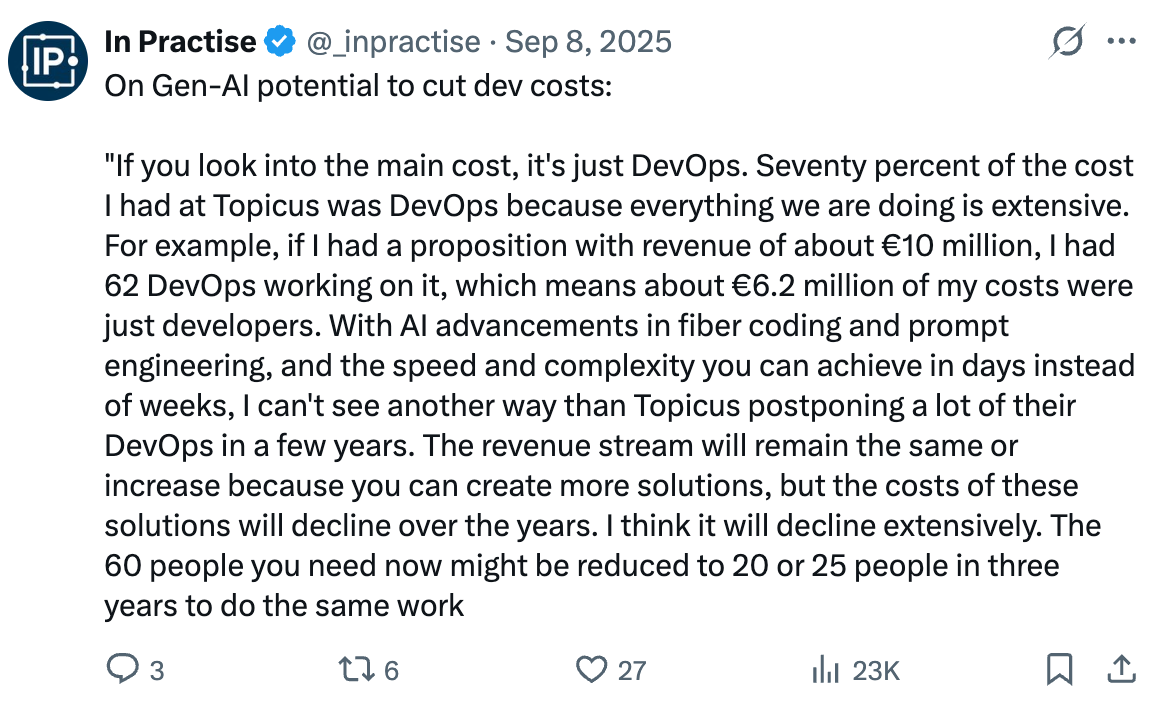
"Initially, Topicus underestimated the impact of AI. Two years ago, during a summit in Toronto with various CEOs active at Constellation Software, there were different workshops. Only one out of 500 workshops was about AI. At that time, AI wasn't considered a big deal; it was more about reading, making films, or enhancing text. They didn't consider AI as a tool for building more code or creating insights from the vast information in our systems. It took about two years for Topicus to start thinking about doing more with AI. Interestingly, one of my best friends became the first AI lead at Topicus just two months ago. He has assembled a team of 10 people from various divisions at Topicus who are interested in AI. They have been focusing solely on AI for the past two months. Previously, only some DevOps enthusiasts were exploring AI on their own, but it wasn't regulated by Topicus" - Former Topicus Director on Topicus AI strategy (InPractice Expert Interview - from 2025!)
AI as an operating lever is gaining credibility across the peer group. Constellation says productivity gains will be reinvested in product rather than taken as margin, and its deal screen now includes an AI lens. At the AGM, Celcat, a Topicus-family business, was presented as rebuilt into an AI “system of action,” with growth rising from about 12% to about 23%.
Chapters Group raised its 2026 organic EBITDA growth guidance to the high thirties and credited AI automation. Van Poelje himself called self-disruption “easier said than done.”
The sector narrative has eased without being resolved. Software rallied around 40% from the March bottom, yet Bank of America argued in early October that agentic AI is a bigger threat to SMB- and consumer-facing software, and part of Topicus’ long tail is exactly that.
Weighing all of it, I’m inclined to shift my March weights from 50/30/20 to something like 55/30/15. The evidence is incremental, and nothing is decisive as long as Topicus doesn’t disclose churn.
PS: The AI Bull Case remains the same:
Why won’t the market pay up?
The most important perception fact is a relative one. Constellation went from about C$2,196 at its January low to about C$3,200 as of Friday, a gain of roughly 40%, and it is back above its 200-day moving average. Roper temporarily rallied on raised guidance, and Asseco and Chapters are up for the year.
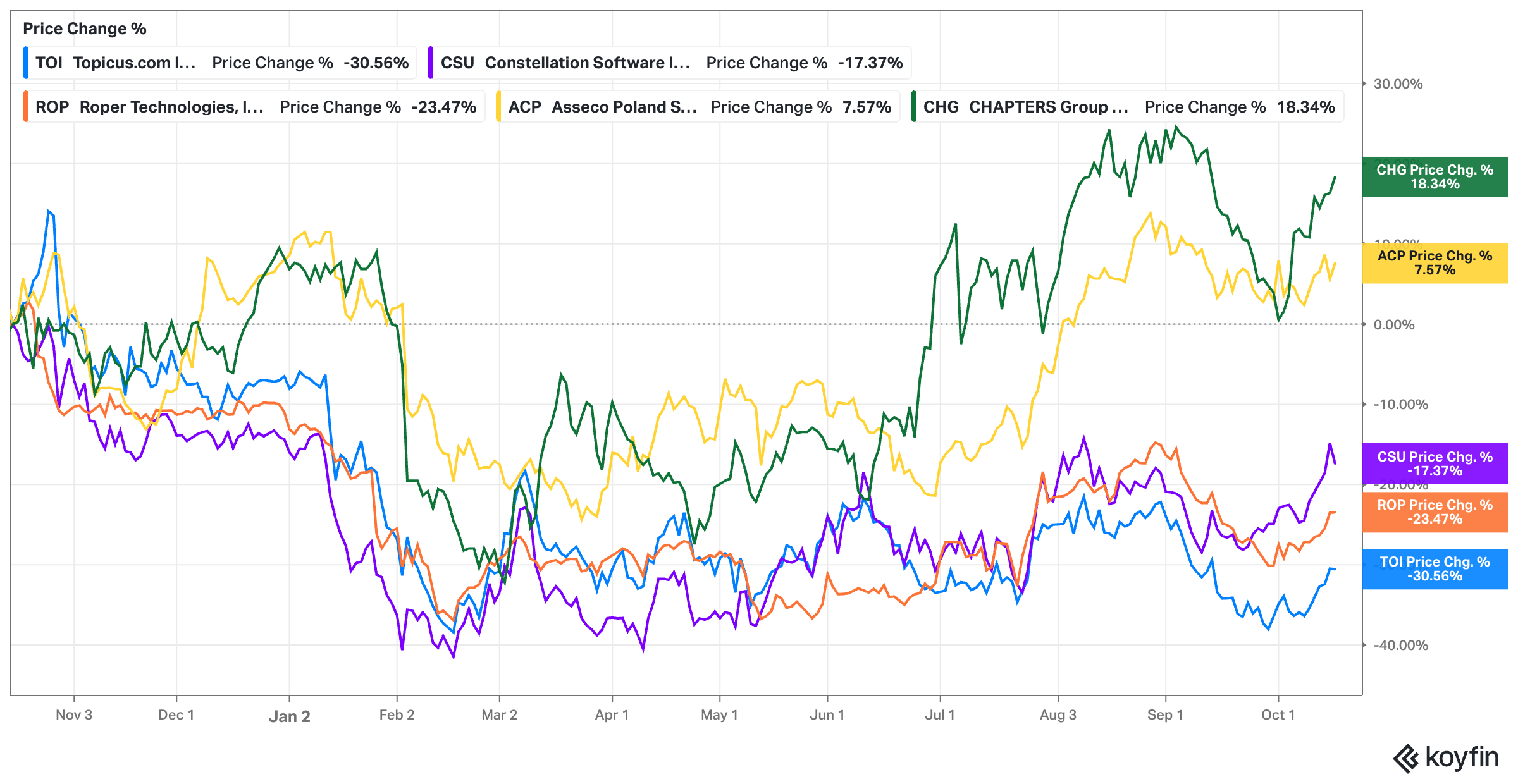
Topicus is the worst-performing name among this list, with a one-year decline of about 30%.
Good news doesn’t move it either. The stock drifted lower after Q1, fell 3.3% on 1.7 times average volume after a Q2 with 18% revenue growth, and lost 5.7% on the CEO news. The market is applying a Topicus-specific discount on top of the sector’s AI discount, and the obvious candidates are the leadership transition, the slower deployment, and the complexity of Asseco and ReadyTech.
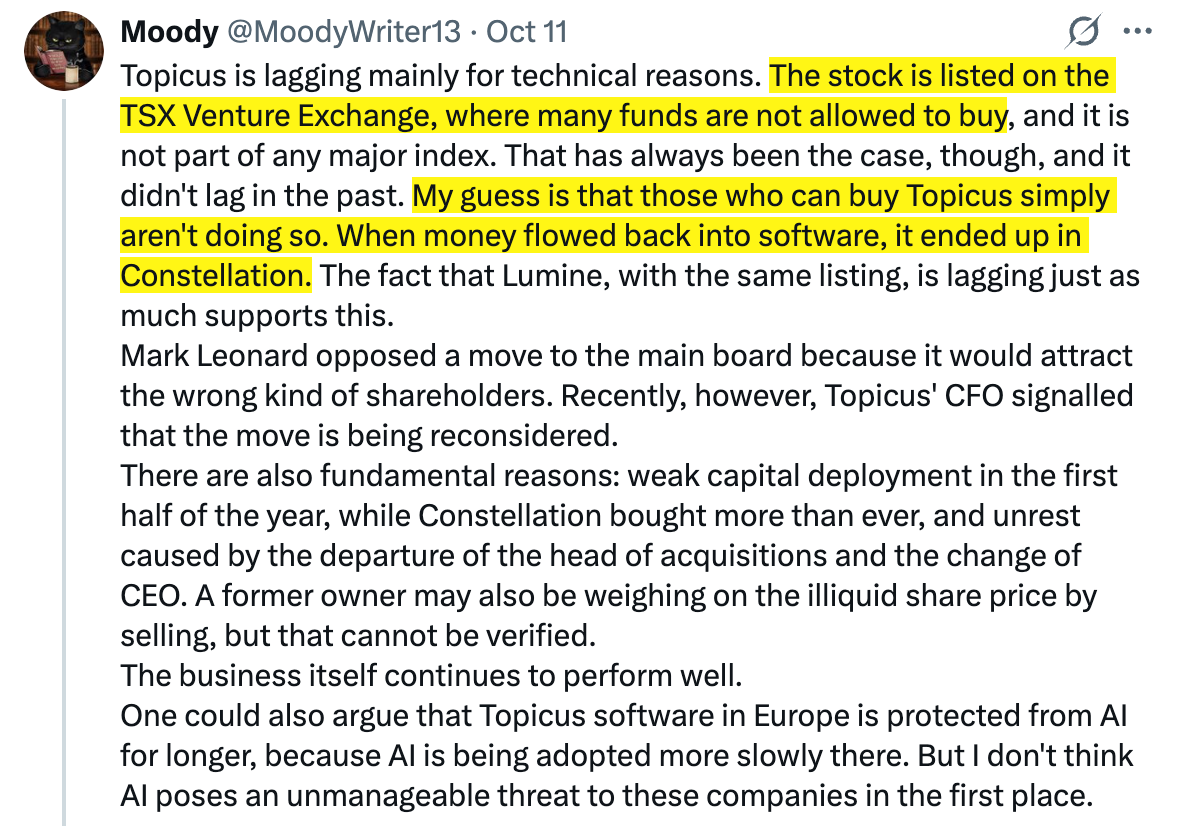
The people closest to the company and the sell side haven’t followed the share price. All three covering analysts, RBC, TD Cowen and Desjardins, still rate the stock a Buy or Outperform, with targets reset from around C$190–210 in 2025 to about C$145, more than 50% above today’s price. A gap that wide means either the sell side is slow or the market doesn’t trust the cash conversion. Insiders made 11 open-market purchases worth about C$2.76 million between March and May at C$98 to C$112, including the van Poelje and Zanders purchases. The bonus rule, under which insiders put 75% of their after-tax bonus into shares, makes some of that buying mechanical, but Zanders’ purchase stands out in size.
Mohnish Pabrai’s Wagons fund held Topicus at 4.71% in March, almost the same weight as Constellation.
Nobody seems to be aggressively betting against Topicus. Most investors are simply ignoring it.
Two smaller overhangs are worth mentioning. Competition for talent has arrived faster than expected maybe. Chapters Group raised about €64 million at €42 per share in July from investors including Mitch Rales and Daniel Ek’s family office, has around €110 million of deals in due diligence and has raised its guidance twice. Van Poelje acknowledged at the Constellation AGM that copycats like Chapters are poaching talent. In my deep dive, I thought a serious clash was a decade away. That may still hold for deals, while the fight for people has already started, with Volaris, Lagercrantz and Vitec all active across Europe as well.
The Dutch Box 3 tax overhang, on the other hand, is fading. After the lower house passed a tax on actual returns including unrealized gains from 2028, the cabinet moved in September toward taxing realized gains on shares instead, through an amending bill the Senate must pass by year-end. If it passes, the risk of forced selling by Dutch employee-shareholders largely disappears.
PS: Here is how my five BAMs from March hold up today:

Final Verdict:
Running all of this through my framework, Topicus sits mainly in the “micro bucket,” with an uncertainty overhang made up of a CEO transition, a reorganization, a deployment pause and two complex listed-company situations.
“Micro perception changes sit at the intersection of fundamentals and psychology. They arise when something goes wrong at the company level, hits near-term earnings or margins, and dominates the narrative – even though it does little to impair long-term earnings power.“
That’s the bucket I find most attractive, because it rewards deep knowledge of the business, and overhangs like these tend to clear with time and a few clean quarters.
The second bucket is factor and style rotation, as the market derated vertical software and serial acquirers as a group on AI fears. Constellation’s rebound shows that this pressure has started to ease for the leader of the pack. Topicus simply hasn’t been allowed to join yet.
Who is selling, and why? My read is generalist software money treating Topicus as one more AI-exposed name, plus Constellation-family investors who prefer the parent’s liquidity and track record.
What is the market extrapolating? That deployment stays at H1 levels and that the post-van Poelje era will be a weaker version of the past. With roughly €120 million deployed or committed by early August and a deleveraged balance sheet, I think that’s too harsh.
What would improve perception even slightly? Potentially, a clean first quarter under Zanders on November 4, with recurring organic growth of 6% or better and a visible pickup in deployment. How long could the pressure last? Probably two to four quarters, about the time a new CEO needs to establish a pattern. What am I paid to wait? Recurring revenue growing organically at 6–7% plus acquisitions, a cash flow yield in the mid-single digits, and a balance sheet with plenty of dry powder.
From a technical point of view, I’d categorize Topicus as “interesting,” with clear triggers for a starter position. Topicus passes the stabilization test that Hermès fails. It has built an eight-month base, absorbed a string of negatives and high-volume days without making a new low, and the core business is to a large extent still doing what it did in March (if you believe the acquisition slowdown in H1 is temporary).
What it lacks is confirmation, both on the chart and in capital allocation.
In my write-up from February and March, I modelled an IRR in the range of 15-20% depending on various reinvestment rates, ROIICs on capital deployed, and exit multiple scenarios. Ultimately, not much has changed since, even though I still cannot get fully comfortable with the AI risk (and the potential imüact on TSS’s terminal value) and likely prefer companies less exposed to it (or even better, more likely to be beneficiaries, which effectively means ignoring the software space entirely, because I certainly believe Topicus and its peers are some of the “safer” ways to bet on the software space in light of AI)
Still, if I update my valuation from March, at an unchanged C$94, Topicus has become noticeably cheaper on a look-through basis. The Asseco stake (as its share price recovered) now covers about 20% of Topicus’s market value, up from 13% in February.
I don’t have a strong view on the intrinsic value of Asseco, which you ultimately need to develop if you want to factor the stake into your valuation work.
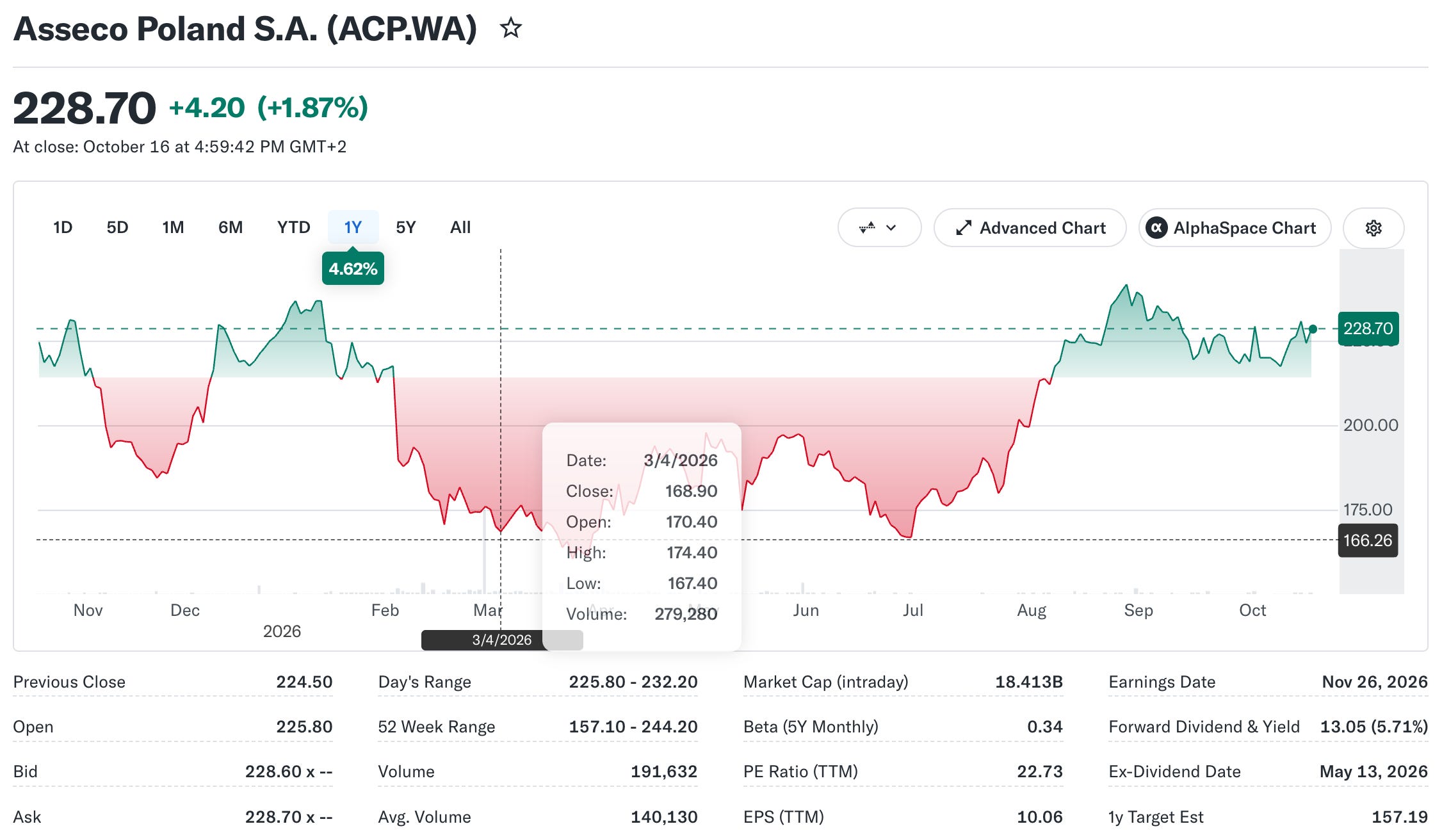
And LTM FCFA2O has grown in the mid-teens percentage range since the Q3 2025 LTM figures I used in my first write-up.
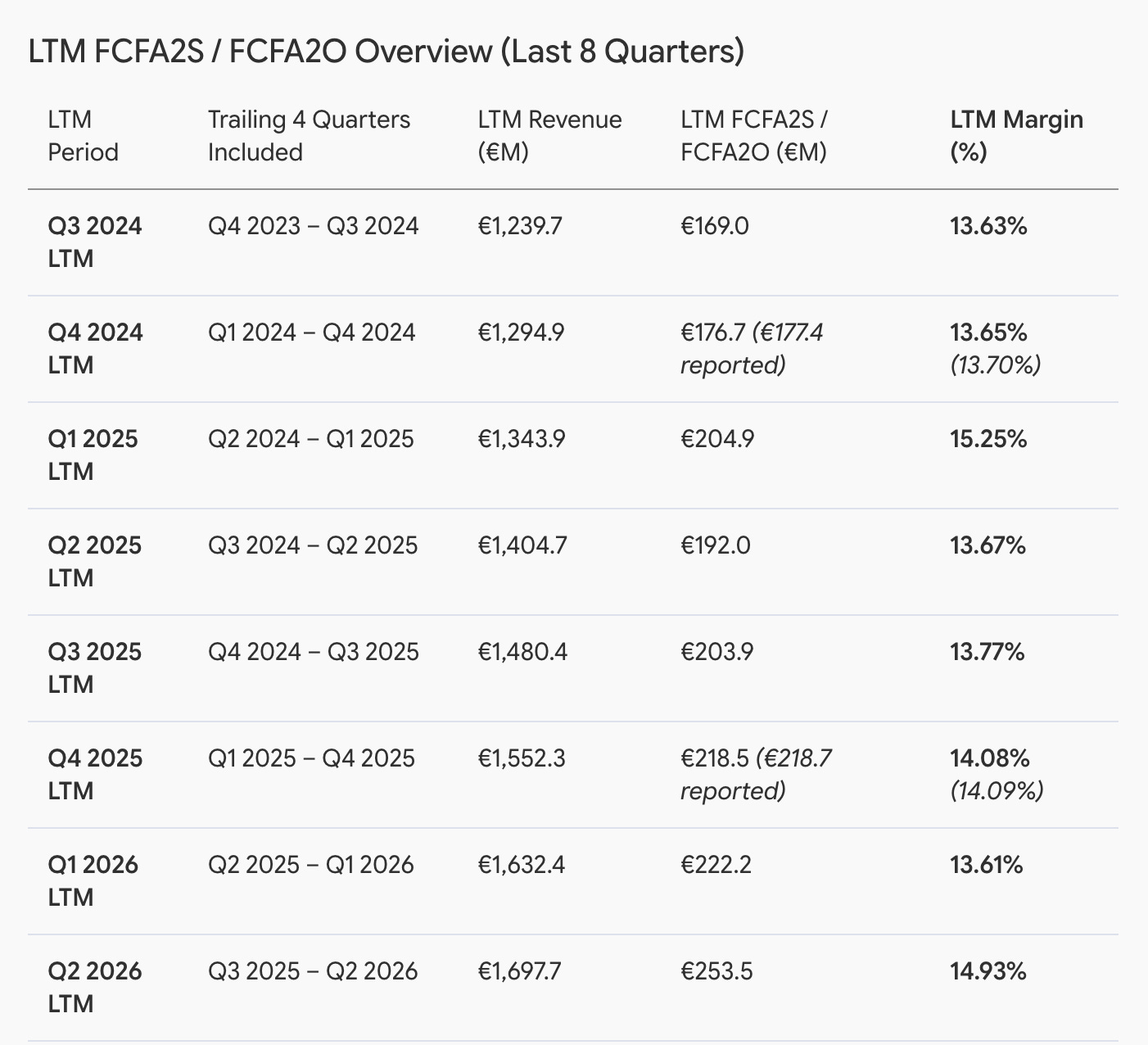
Together, these bring the ex-Asseco multiple down from 19.6x to roughly 15.5x. Even on the stale €218.7M denominator, it would be 17.9x, so the Asseco rerating alone accounts for about 1.7 turns.
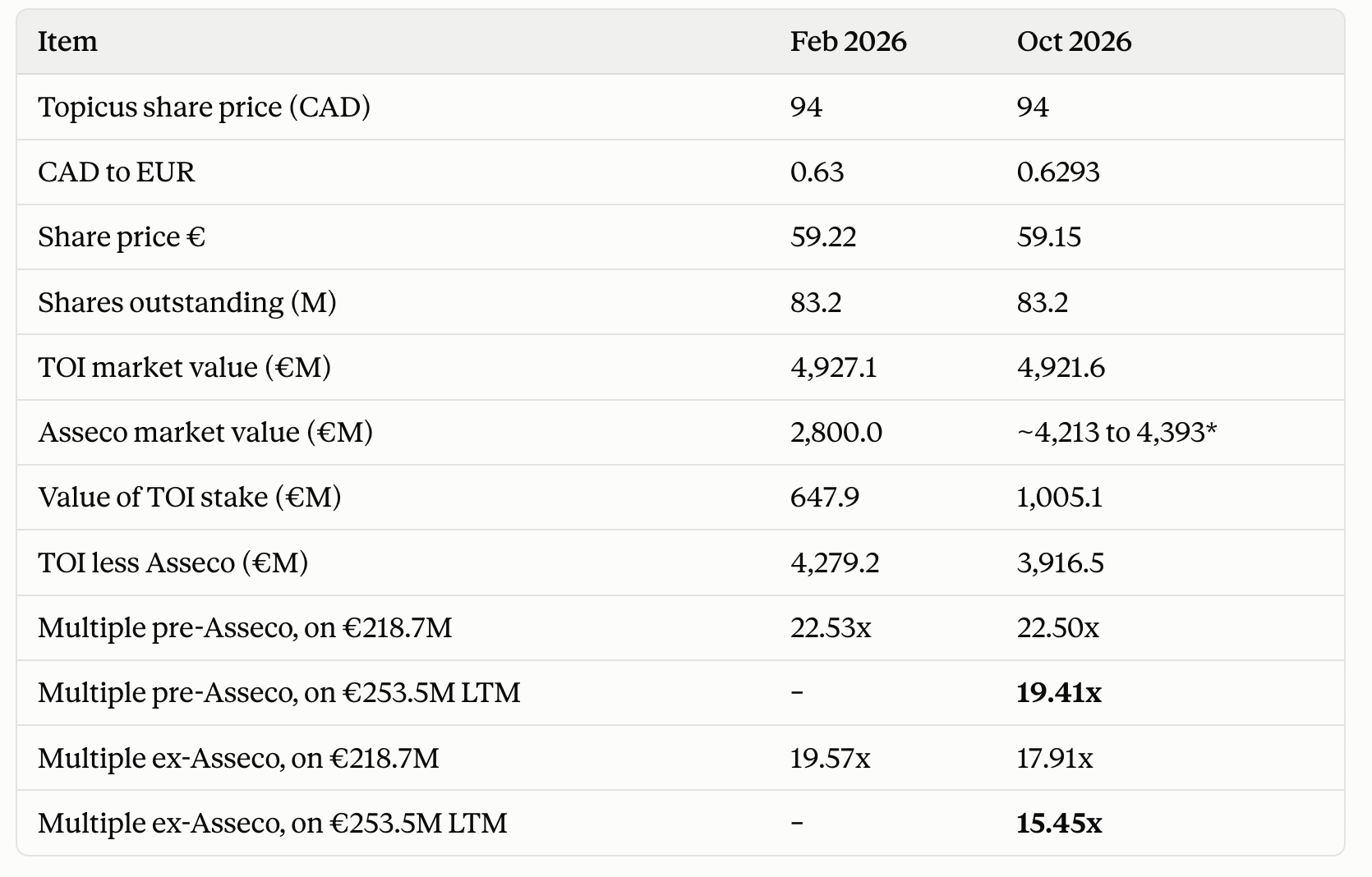
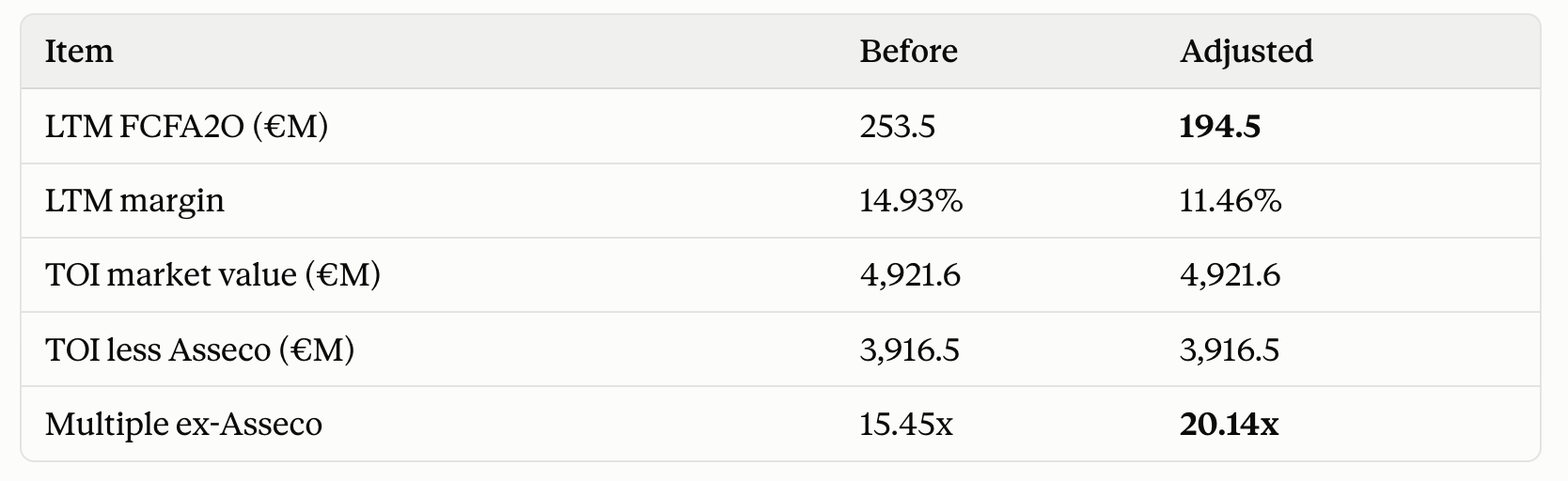
There is one important caveat, though! Subtracting the stake at market value while keeping the full FCFA2O is only clean if the Asseco dividends Topicus receives aren’t flowing into FCFA2O. But it is, as discussed above (and I’ll insert the screenshot again below), and the dividend is significant now relative to trailing FCFA2O, so counting the stake twice, and the ex-Asseco multiple is flattered a little.
So here’s a more accurate calculation:
Further Reading:
Disclaimer:
As of the date of publication the author owns no shares in the company; but that may change. The analysis presented in this blog may be flawed and/or critical information may have been overlooked. The content provided should be considered an educational resource and should not be construed as individualized investment advice, nor as a recommendation to buy or sell specific securities. I may own some of the securities discussed. The stocks, funds, and assets discussed are examples only and may not be appropriate for your individual circumstances. It is the responsibility of the reader to do their own due diligence before investing in any index fund, ETF, asset, or stock mentioned or before making any sell decisions. Also double-check if the comments made are accurate. You should always consult with a financial advisor before purchasing a specific stock and making decisions regarding your portfolio.