

You can read this article entirely for free. If you find value in this research, consider becoming a Premium Member to unlock our full archive and join our growing circle of investors (I highly recommend checking out “The Library” to see what’s inside; you can find it right on the homepage).
Why join the community, you may ask? Our library is fast approaching 70 comprehensive deep dives, providing institutional-level research on some of the world’s most fascinating businesses. Most recently, we’ve dissected companies like Grab Holdings ($GRAB), Fair Isaac ($FICO), and Topicus.com ($TOI).
As a member, you get:
Complete Access: Every deep dive in our library
The WhatsApp Community: Real-time discussion and networking with like-minded investors.
Incredible Value: Full access to all of this for less than $1/day.
If you want to see the level of research we provide before committing, the following deep dives are, for instance, free to read:
InPost ($INPST) - generated an IRR of >400% as an acquisition offer emerged 2-3 months post write-up
DigitalOcean ($DOCN) - up 5x in less than a year post write-up release
In my view, the primary job of an investor is not to find reasons to buy, but rather to find every possible reason to say no.
The investment landscape is one where the default state is noise – an endless stream of pitches, charts, headlines, CNBC interviews, engagement-bait on social media platforms, and quarterly updates designed to make you feel like you are missing the next great multibagger.
In my experience, the only way to survive this onslaught without diluting your capital into mediocrity is to develop a set of filters so rigid and so uncompromising that they feel almost violent.
The Violent Art of Saying No
I spend the vast majority of my time looking for the exit door on a research project. If I can find one structural flaw, one misaligned incentive, or embedded expectations that require too good an execution, I move on.
It is a superpower.

I was recently listening to an interview with Andrew Hollingworth, the founder of Holland Advisors. He operates with a very similar philosophy, specifically regarding his heavy bias toward owner–operators.
For him, and for me as well, seeing a founder with significant skin in the game is a signal that cuts through the static. It is a filter that allows you to ignore 90% of the public markets immediately. Of course, the risk is that you will brush off a valid idea too quickly. You will watch stocks you passed on at $10 run to $50. That is the price of admission.
However, a strong filter protects your downside and ensures that when you finally do say yes, you are standing on a foundation of high conviction. Your job is to pass. You must try to break the thesis.
Why I Am Selfishly Writing This Post
This leads me to a new mental model I have been grappling with this week. I have my usual list of high–quality signals – e.g. (strong) secular tailwinds, above-average industries, founder–led businesses, share cannibals that aggressively retire their own stock, and “spawners” that have the DNA to create new business lines from scratch.
But while reading a post by a fellow author who goes by the name Unemployed Value Degen, I stumbled upon a concept I had never formally integrated into my framework: the “toehold.”
He is one of the very few writers covering Tiger Brokers, a company I have discussed frequently on this blog and one that I currently own in a significant position in my portfolio. I had to read his take.

I found his analysis of the core thesis excellent, but what really stuck in my mind was his mention of IBKR’s small ownership stake (which I was of course aware of), but the idea that the ownership might be a (strong) predictive signal for superior future performance.
It was a “lightbulb” moment. In the spirit of Mohnish Pabrai, whenever I encounter a new mental model that carries genuine weight, I want to punch it into my brain. I want to do everything humanly possible to ensure it sticks. Thus, this post is, quite frankly, born of a very selfish motivation. I am writing this to force myself to memorize the concept, to test the logic, and to ensure that the next time I see a toehold in a filing, I recognize it as the potentially powerful signal it might be.
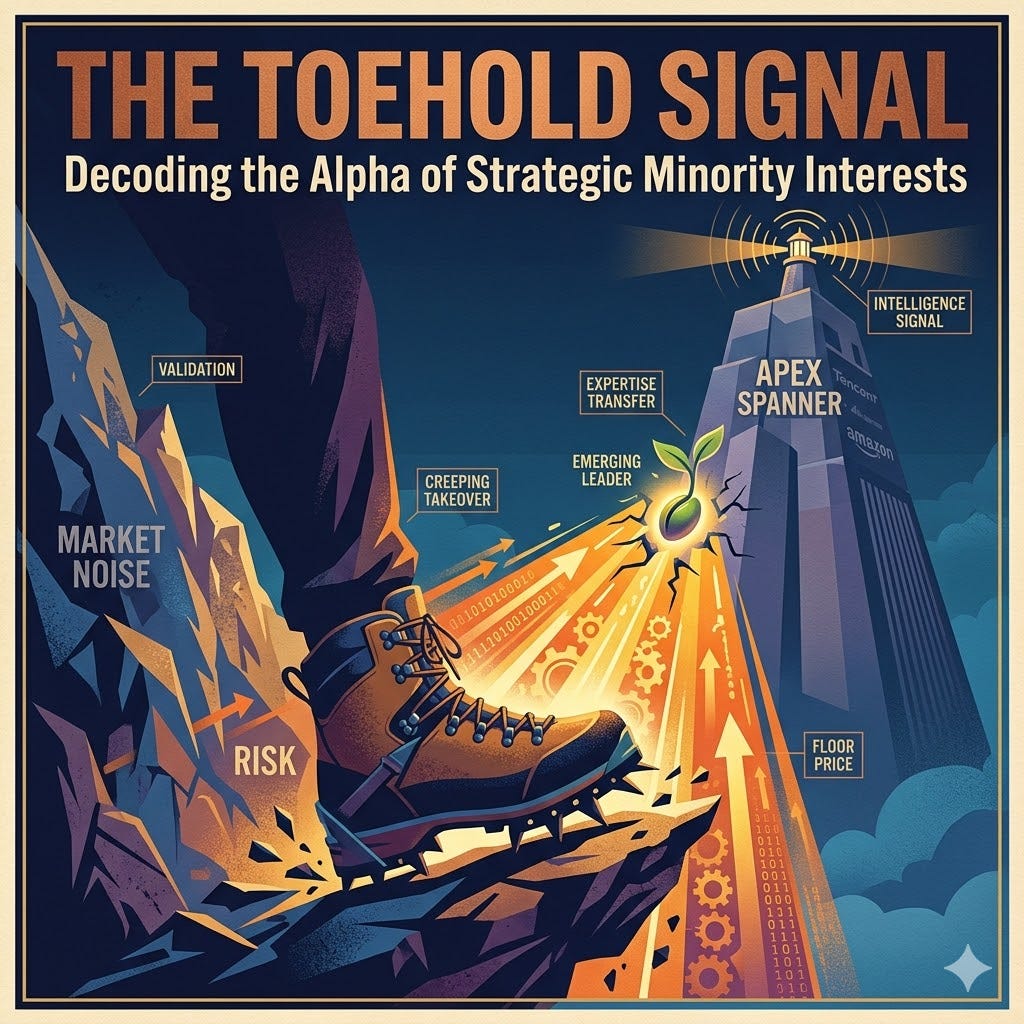
The concept of a toehold is deceptively simple, yet it carries implications that most retail investors completely overlook. If we can identify why a larger, more sophisticated competitor is willing to take a minority stake in a smaller peer, we gain access to a level of due diligence that no individual investor could ever hope to replicate. It is a form of validation that goes beyond what any spreadsheet can tell us.
Over the following segments, I want to explore why this happens, look at the historical evidence of outperformance, and understand how we can use this to sharpen our filters even further.
More Than a Minority Interest: The Anatomy of a Toehold
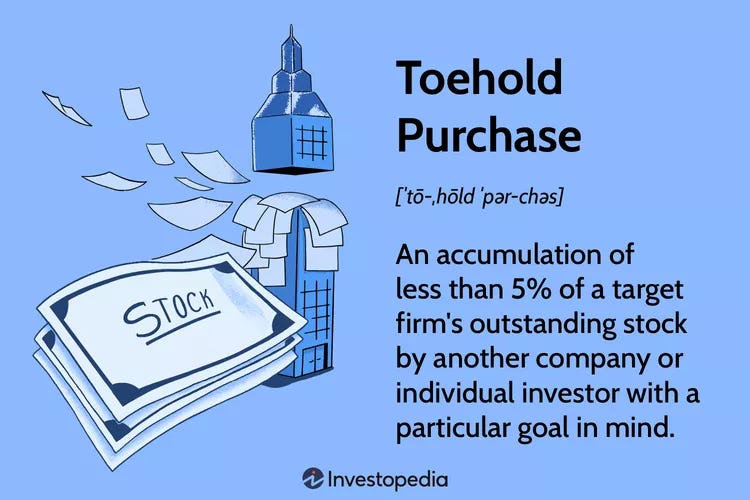
To understand why this concept carries such weight, we first need to define what we are actually looking at. In the blog post that sparked my curiosity, Unemployed Value Degen laid out the case for UP Fintech (TIGR) by highlighting a specific shareholder:
“UP Fintech holdings is still controlled by its founder, Tianhua Wu, with over 12% of economic ownership, and voting control with class B shares that have 20x voting rights. There are also strategic ownership stakes held by Xiaomi, the mobile phone / automobile manufacturer, and Interactive Brokers. When looking at the Interactive Brokers’ ownership stake in particular, it qualifies as a “toehold” – a small ownership stake by a larger competitor. This is usually accompanied by technology and expertise transfers, indicating a bright future for the smaller company, and sometimes foreshadows an eventual acquisition. Sure enough, Interactive Brokers assisted TIGR with the US compliance and Know Your Client rules. The last time I bought a stock with a toehold, it was VitaCoco at $9, and today it trades at $65. Toeholds were a primary area of research of my former PhD advisor, and whenever I stumble across one, it immediately catches my attention.”
This passage touches on the idea of asymmetrical information. When a large, established player like Interactive Brokers takes a stake in a younger, more nimble competitor, they are frequently doing more than just parking capital. They are performing a level of due diligence that you and I, as outside investors, simply cannot access. They are looking under the hood, so to speak. When they write that check, they are effectively telling the market that this smaller company has passed the most rigorous audit possible – one conducted by its own rivals.
Why Competitors Make the Best Auditors
Most investors spend their time tracking institutional ownership – looking for which superstar investor is buying which stock – everyone gets excited during 13-F season!
And while that can be a useful signal, it is fundamentally different from a toehold. A professional (fundamental-oriented) fund manager is an expert in realms such as business and competitive advantage analysis, portfolio management, valuation, or capital allocation, but a competitor is an expert in the actual field the business operates in. If a dominant player in an industry decides to own a piece of a smaller challenger rather than trying to crush them out of existence, we should pay attention. It suggests that the smaller company possesses something the larger one lacks: perhaps a more efficient tech stack, a better user acquisition strategy, or a specific geographic advantage.
This is a kind of “validation signal” in its purest form. A toehold suggests that the incumbent sees the smaller company as a peer or a future partner rather than a nuisance.
In the case of Tiger Brokers, having Interactive Brokers – the gold standard for discount brokerage infrastructure – assist with US compliance is not just a “nice to have” partnership. It is a massive operational lift. It removes the execution risk that plagues so many high–growth fintechs.
“We currently rely on Interactive Brokers to execute, settle and clear a portion of the trades of the U.S. and Hong Kong stocks and other financial instruments, and to comply with certain federal, state and other laws, as discussed more fully in Item 4.B “Business Overview-Our Core Products and Services-Brokerage Services. ” For the years ended December 31, 2023, 2024 and 2025, 16.6%, 10.6% and 6.6% of our total net revenues were executed and cleared by Interactive Brokers. For consolidated accounts, the information of which is not fully disclosed to Interactive Brokers, we receive commission fees and direct a pre-determined portion to Interactive Brokers.“ - Tiger’s 2025 Annual Report
For us, the filter is simple. If one of the best brokerage businesses, one of the best brokerage infrastructure providers in the world, is betting on their regional competitor’s success, the probability of that competitor being a “fraud” or a “failure” drops meaningfully.
The rest of this post is FREE to read. I only ask that you subscribe, which costs nothing and can be undone with a single click whenever you like.
The wall also helps keep my writing from being freely scraped by AI crawlers, so I hope you understand the small extra step.
In return, you get every deep dive, earnings review, and process piece I publish, straight to your inbox.