

Dear compounders,
I’ll be upfront about something that might sound arrogant, and arrogance is not what I’m aiming for in this post. I’m not putting myself forward as someone to look up to, and you’re free to ignore my ramblings altogether.
What I want to argue, though, is that most of us should be far (!) more skeptical about whose views on investing we listen to, and about whose views we give any weight at all.

You won’t find any names in this post; that’s on purpose. I try to follow Buffett’s habit of praising by name and criticizing by category. I haven’t always managed it, and I’ve slipped more than once over the years – and some public personalities deserve special scrutiny. Today, I’m describing a pattern I keep seeing across the investing world. If I named names, the argument would quickly turn into a debate about individuals, though, and lose what I’m actually trying to say.
I realize this is hard to do when you’re just starting out. The jargon, the hundreds of styles and philosophies, the endless stream of commentators, the constant effort to find some signal in all the noise – that’s overwhelming enough before you also have to judge the people talking.
Early on, you more or less have to borrow other people’s views before you can form your own.

Signal Is Rare – If 92% of Professionals Can’t Beat the Index, Why Trust the Guy on Twitter?
I’ve been thinking about investing almost every day for about ten years. That isn’t actually a long time, and I’d welcome anyone with more experience to add their perspective.
Still, if those years have taught me one thing, it’s that you should be very selective about who you believe has something valuable to say.
Genuine insight is rare. A variant perception that turns out to be right often enough to matter and contribute to your own performance is even rarer.
It seems as if everyone has an opinion, everyone can package it nicely, and everyone can sound contrarian. Most people, including plenty of so-called professionals, know far less than they let on and are frankly not very good at this. Some are very knowledgeable, but struggle applying it successfully in the real world.
“Knowledge without action is wastefulness and action without knowledge is foolishness.” – Al-Ghazali.
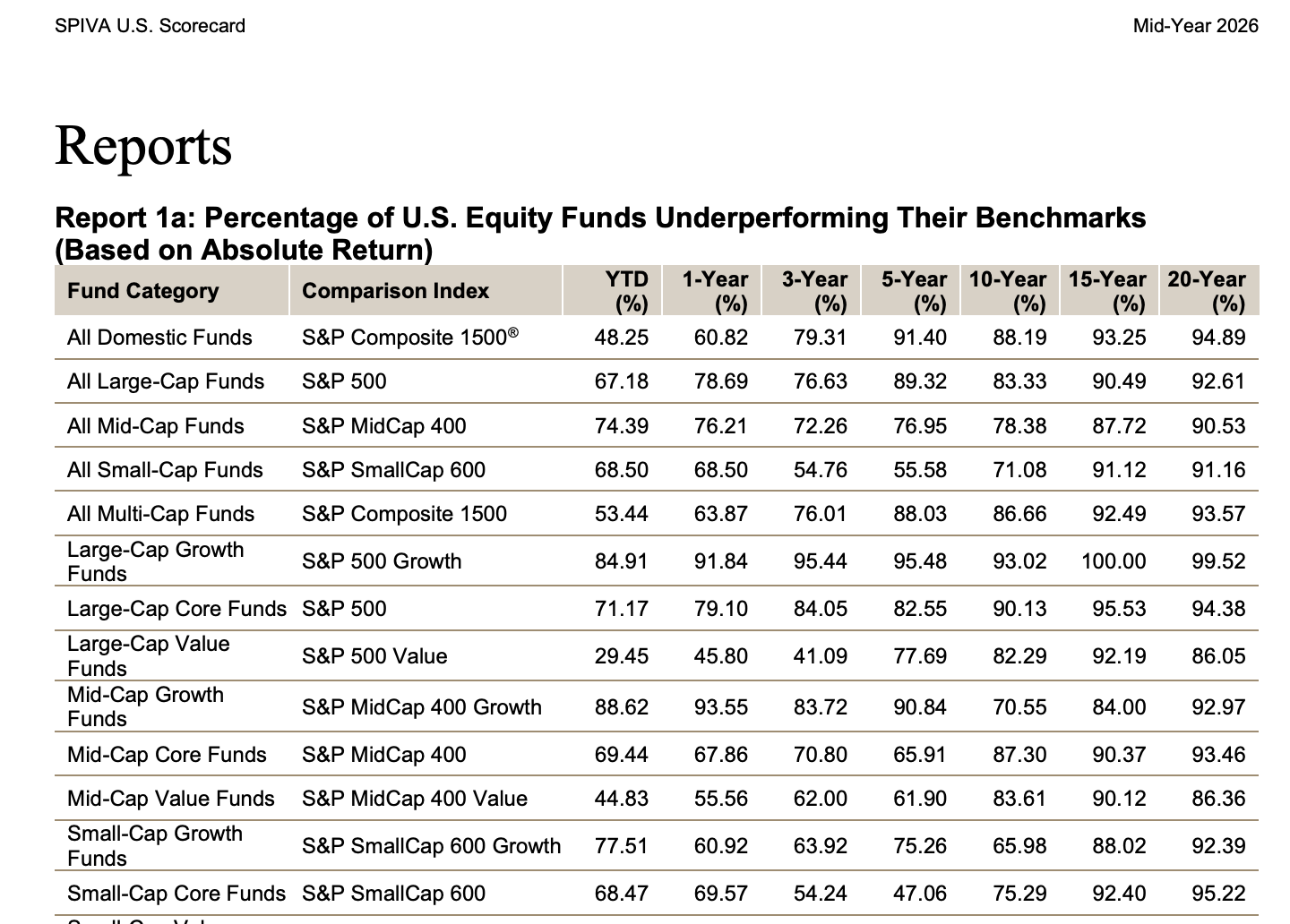
If you think that’s an exaggeration, look at the numbers. S&P Dow Jones Indices has tracked active funds against their benchmarks for more than two decades in its SPIVA scorecards. In the latest U.S. edition, with data through June 2026, 90.49% of large-cap funds trailed the S&P 500 over 15 years, and 92.61% did over 20 years. The people managing those funds are full-time professionals with research teams, data access, and management meetings most of us will never get.
The Exceptional Exceptions
The few exceptional investors I’ve come across share an unusual mix of traits: They’re hungry enough to work at every part of the craft, from security selection to position sizing to timing. They’re humble enough to keep questioning themselves and open-minded enough to let contradicting views in. They’re curious about how people who invest very differently think. And somehow they’re also confident enough to fully trust their own judgment when it counts. Holding all of that at once is hard, and very few people you meet online manage it.

If you want to test this yourself, here’s a small exercise. Go to Dataroma, which tracks the 13F filings of a long list of so-called superinvestors, and pick five funds at random. Then look at their decisions through the three sources of alpha I just mentioned. Do their best ideas actually make up their biggest positions, or are the high-conviction names buried at 1% while mediocre ones sit at 10%? Do they add when prices are low and trim when they’re stretched, or do they chase whatever just worked? And does the stock selection itself look like the work of someone with a real edge? Remember that a 13F only shows U.S.-listed long positions, with up to a 45-day delay, so you might only be seeing part of the picture. I’d bet that for most of the five, you’ll come away less impressed than the word “superinvestor” suggests, and that’s exactly the point.

Questions Worth Asking
It’s also worth thinking about what the online world rewards. Attention goes to conviction, frequency, and a clean narrative. Being right over a full cycle gets very little of it. Someone who posts with total certainty every day has proven only one thing, which is that they post every day. Over time, I’ve found a few simple questions far more useful than any follower count:
Can I check their record across a full market cycle, including the bad years?
Do they talk openly about their mistakes and what those mistakes taught them?
Have I ever seen them change their mind in public?
Do they say what would prove them wrong before the outcome is known?
Do they explain why they think something, or just what they think?
Do they have their own money in what they talk about?
How do they earn a living – from being right, or from getting attention?
Do they talk in probabilities and ranges, or in certainties?
Do they stick to what they understand, or have a confident take on every stock, macro event, and asset class?
Do they engage with the strongest argument against their view, or only with the weakest?
Did their process stay the same through the last big drawdown, or did their style change with the market?
Do they bring up old calls that went wrong, or do those quietly disappear?
Beyond the Gurus
None of this applies only to the famous names you find on Dataroma et. al. It applies just as much to lesser-known fund managers who’ve built a reputation in some corner of the investing world, where a few good years and a well-written letter can be enough for near-cult status.
And it applies to Substack, which I say knowing full well that I’m one of the people writing there. I encourage you to be skeptical of the insights I provide too. But let me tell you that, based on my critical judgment, many writers sound smart. They use the right frameworks, quote the right books, they have read all the Buffett letters, and build impressive spreadsheets. Sounding smart is not valuable at all in this game, though. Judgment can be badly flawed in exactly the areas that matter most, while everything around it looks polished.
As always, Buffett put it best:
“There’s a great desire of the priesthood in finance to want to teach the things that they know and you don’t know, and that they spent a long time learning and that maybe requires a fair amount of mathematics and other complicated things. It really has nothing to do with investment success.”
The same caution applies to investing communities, and ours is no exception. The topic came up recently in our community chat, and the exchange prompted me to integrate this angle into the draft I had already finished for this post. One member admitted, half-jokingly:
“Personally I find myself getting sucked into being interested in these businesses by virtue of membership of this forum.”
Another member, who has been at this much longer, replied:
“Once you are a member of many forums and done 2-3 full market cycles over 25 years, you end up only trusting your own work. Investing is a very lonely sport despite being surrounded by people everywhere.”
I think both of them are right. Communities are wonderful for finding and sharing ideas, and I mean that sincerely.
Yet, and this is what I encourage you to be wary of, they can also turn into echo chambers, where a stock looks more attractive the more often it gets mentioned and the higher the “conviction” of other members seems. And for most people in a chat or a forum, you can’t answer a single one of the questions above. You don’t know their record, their position sizes, or how they behaved in the last drawdown. It might just be a random online alias. That creates the risk of giving someone an “authority status” they don’t deserve.

Again, my advice is to stay highly skeptical of anyone whose thinking and results you don’t know deeply, and that includes me.
Never Underestimate Luck
Then there’s luck, which I think might be the most underrated factor of all. A spectacular five-year run can look like skill – again, I truly have to bite on my tongue not to mention some names – and be something else entirely. Someone may simply have started at the right point in a cycle and ridden it, or owned one huge winner that carried the whole portfolio while the rest of their decisions, from a process quality point of view, were mediocre at best.
To put it bluntly, some of the people with the best recent numbers aren’t very good investors. Every “cycle” – and we are really referring to shorter-term, 2-5-year “cyclical cycles” and not longer-term 10-20-year structural cycles – has its 5-10 investors that seem like geniuses at the time. only to underperform badly over the subsequent cycle.
Five years is also much shorter than it feels. A friend pointed out in a recent exchange that the past few years were a string of cycles in their own right: up from 2018 into 2020, down in the Covid crash, up into the 2021 boom, down in 2022, and up for four years since on the back of AI.
A lot of what passes for skill today may just be a rising tide that has lasted longer than most people’s investing careers.
"Only when the tide goes out do you discover who's been swimming naked." - Buffett
So when you look at someone’s record, ask how of it may have come from a single position, and whether they’ve ever had to invest through a long sideways stretch.

Again, coming back to the set of questions I shared further above, you don’t need to unfollow everyone who fails that test. Plenty of people are worth reading for a good question, a useful data point, or simply a different way of seeing a company. Just be honest with yourself about how much skill sits behind the confident tone, and adjust how much weight you give each voice accordingly.
Until next time, keep compounding!
Sad, but mostly true. I write this as a retired fund manager who did beat the index over 26 years, not of course every year, and not in the US, but in Asia where markets are less efficient. It is also true that beating the index becomes harder the more funds you have under management. The best chance to beat is with a manager who has a clear and consistent strategy with a minimum of 10 years experience in that strategy, less than $3 billion under management, and a lot of his/her net worth in the strategy.
Bravo!