

When a stock falls more than 90 % from its highs, most investors stop looking. They assume something is permanently broken, that the business has revealed its true nature, and that any remaining curiosity is a waste of time. What was interesting at 10x the current price, suddenly isn’t anymore. Recency bias takes over, analysts start downgrading the stocks, fewer investors talk about the idea on X and former bulls delete old threads, fatigue replaces curiosity, and the stock quietly enters the graveyard of “never again” ideas.
On December 9, for instance, Morgan Stanley downgraded HelloFresh and reduced its price target to €5.50 from €8.30 per share. As a result, the stock tanked another 5% this morning.
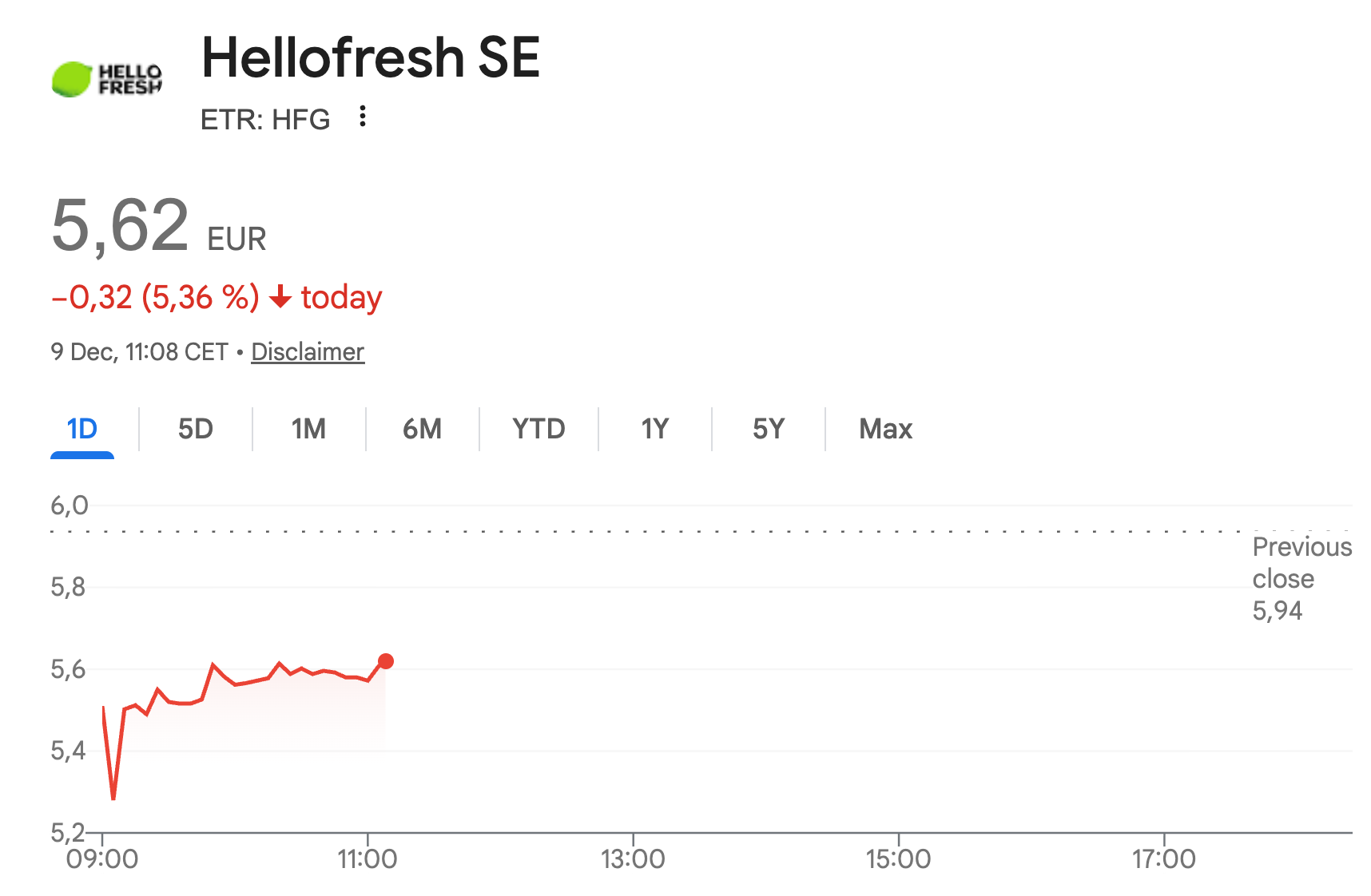
So arguably, HelloFresh sits exactly in that category today – a former market darling (at one point trading at 95€/share) turned market orphan, trading at roughly 0.12x sales and priced as if the underlying model might never produce durable profits again.
The lackluster stock performance – down 94% since November 2021! – is hard to ignore, and in a way, it forces a simple but important question: Can HelloFresh actually be a structurally profitable business?

I didn’t approach this analysis expecting to find an obvious bargain. The share price drop alone doesn’t guarantee that. Companies’ public market values often deserve to fall significantly, and sometimes – or actually, more often than not –, they never recover.
But the more I examined the fundamentals of HelloFresh, recent management commentary about the planned “operational reset,” the cohort behavior, and the margin rebuild, the more interested I became. A business trading at this multiple doesn’t need perfection – it needs “survivability,” reasonable steady-state margins, and a path to consistent free cash flow.
If a company trades at 0.15x EV/Sales and earns a 3% profit margin, the implied profit multiple is roughly 5x. So if those pieces fall into place, even partially, the upside becomes genuinely meaningful.
This deep dive isn’t written to defend the past. The company overexpanded, overestimated post-pandemic demand, and allowed promotional intensity (“I don’t think it’s a big secret that people have gamified their ability to shop us on a discount“ – HFG’s SVM at the 2025 CMD) to undermine customer quality. Yet the story doesn’t end there. Beneath the surface, the model is evolving, and the company is rebuilding around higher-retention cohorts, a more disciplined marketing approach, and structural efficiency gains across fulfillment. At around 0.12x sales, the market isn’t just skeptical; it’s essentially asking whether the business model works at all. That’s the question I’m trying to answer.
I find situations like this worth digging into every once in a while; companies in which sentiment has absolutely collapsed, uncertainty is high, and valuation embeds fear and basically no hope. If the model is fundamentally flawed, the stock deserves its fate - it’s worth zero (in fact, some of these businesses are worth less than $0 – a negative value!). But if the economics are viable, if margins can stabilize, and if the business can translate scale into predictable profitability – like some smaller competitors have proven they can –, the gap between price and value may be too large to ignore.
And that’s why I’m putting together this piece. I want to examine whether HelloFresh is a structurally broken business or a deeply misunderstood one – because at this valuation, even a modest level of normalcy could lead to a vastly different outcome for shareholders.
Here’s what we will cover in this 21,000-word analysis:
High-level thesis and the “Bam Bam Bam Bam Bam” & why-now framing
Detailed breakdown of the product and service offering
Full operating model analysis, including unit economics and geographic footprint
Customer behavior, retention dynamics, and cohort economics
Industry structure, simplicity, and long-term predictability
Competitive advantage analysis
Assessment of business quality and structural profitability
Historical growth patterns and forward-looking growth drivers
A discussion of the lackluster Q3 results
Management background, integrity, and capital allocation skills
Critical management concerns and potential blind spots; including a discussion of a recent short report
Comprehensive balance sheet review
Operating insights derived from the structure of the balance sheet
Inversion: strongest counterarguments and “short thesis” logic
The Grizzly Research short thesis and HFG’s rebuttal
Full risk landscape across macro, operational, competitive, regulatory, and financial dimensions
In-depth valuation (including a discussion of HFG’s peers)
The full story starts here:
The rest of this post covers all of the aspects mentioned above . If you’re serious about sharpening your investing edge, the full post (and all my previous premium content, including valuation spreadsheets, deep dives (e.g. well-known mid- and large caps such as LVMH, Duolingo, Meta, Edenred as well as more hidden gems such as Tiger Brokers, Digital Ocean, Ashtead Technologies, InPost, Timee, and MANY more) and powerful investing frameworks. is just a click away. Upgrade your subscription, support my work, and keep learning.
Annual members also get access to my private WhatsApp groups – daily discussions with like-minded investors, analysis feedback, and direct access to me.
PS: Using the app on iOS? Apple doesn’t allow in-app subscriptions without a big fee. To keep things fair and pay a lower subscription price, I recommend just heading to the site in your browser (desktop or mobile) to subscribe.