

The last two weeks were probably the most active stretch of my entire investing career.
That’s quite a statement coming from me, so let me put it into perspective right away: The philosophy I follow treats activity with a good deal of suspicion, because more often than not, activity kills returns. Activity does not equal results in investing.
Hence, it wouldn’t be unusual for me to go six or even twelve months without a single meaningful transaction, apart from adding some capital from my day job here and there.
Some of my best decisions were the ones I never made. “Intelligent holding” is one term that comes to mind here. “Extreme patience” is another.
“The world is full of foolish gamblers and they will not do as well as the patient investors.” – Charlie Munger
A post Dimitry Nakhla shared on Thursday captures the point well. Stephen Mandel’s Lone Pine owned roughly 9.2 million shares of Mastercard back in 2008. Since then, the fund has fully exited and re-entered the position six times.
Now here is the catch: Had it simply held on to those original shares, they would be worth about $5.9 billion today, more than a third of the entire fund.
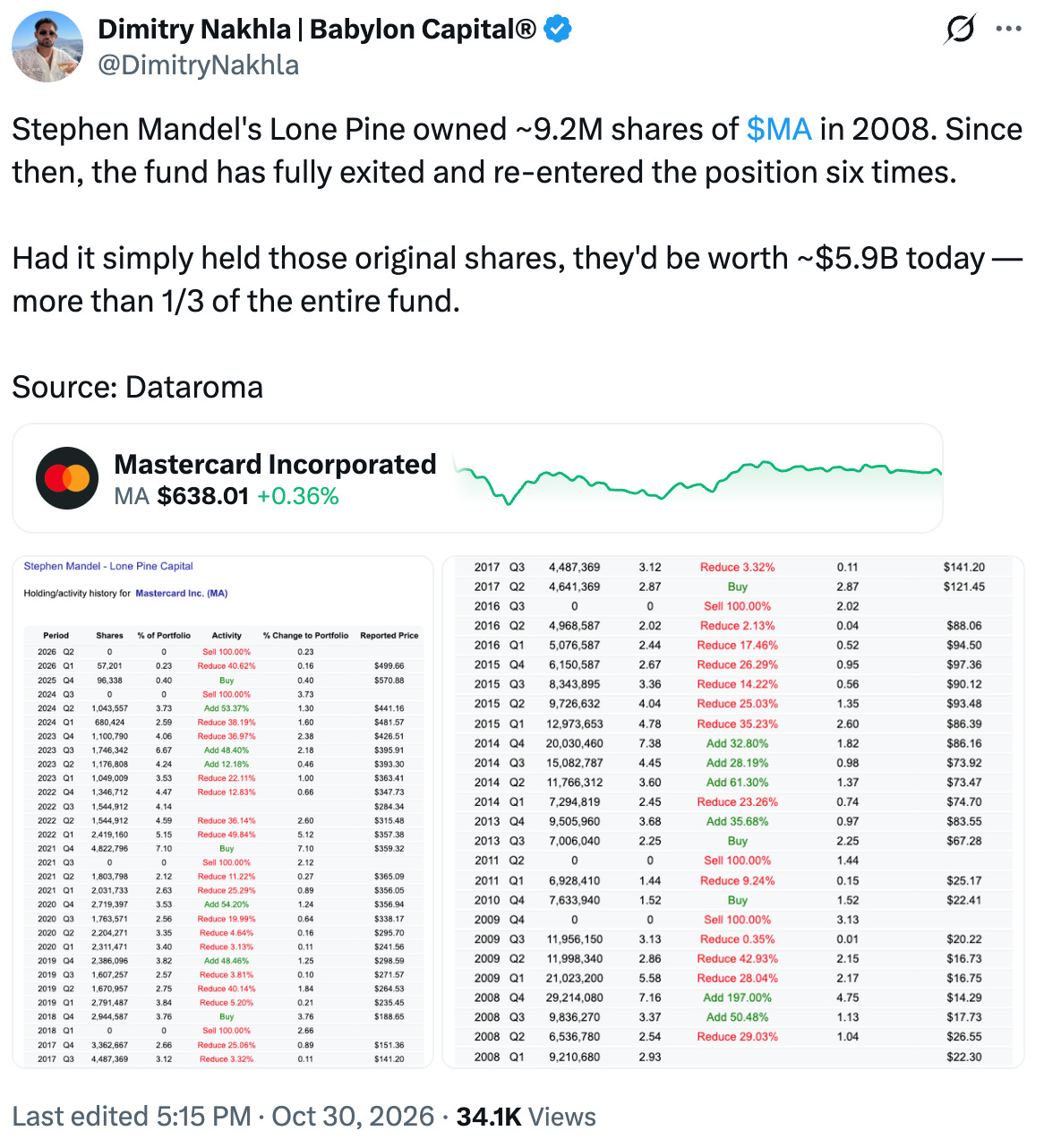
Six round trips. In one of the greatest compounders of the past two decades, executed by one of the most respected stock pickers of his generation. If a professional with Mandel’s resources and track record can’t resist the urge to trade around a winner, what chance do the rest of us have?
So why all the activity in my portfolio over the past few weeks you may ask? As you’ll see throughout this post, I didn’t suddenly discover a passion for trading. Two events left me with a mountain of cash. The first was my (active) decision to sell Edenred. The second was largely out of my hands: Ashtead Technology received a takeover offer, and once the board recommended it, there was little reason left to hold on.
Together, the two positions accounted for roughly a third of my portfolio.
Option value of cash
I’m a big believer in the option value of cash. Cash gives you the ability to act when others are forced to sell, and that ability is worth more in some environments than in others. Right now, I’d argue it’s worth more than in most periods of the 2020s. The exuberance in semis, AI, and big tech has stretched parts of the market to levels that leave little room for error, and the macro backdrop has turned noticeably less friendly.
From my investment framework:
In general, as the expected future return of the market goes down, the option value of money increases. When the market is likely to provide poor long-term returns, this is usually right before it will return good numbers again. Put differently, as market valuations reach very high levels, the chances of a steep drop increase significantly. For example, in 2007 or 2000 investors might have expected very low long-term returns based on fundamental market indicators, but then within 1, 2, or 3 years, all of a sudden investors had very good chances to achieve returns of 15% by simply investing in a broad market
In September, the Fed raised rates for the first time in three years, to a range of 3.75–4%, with headline PCE inflation at 3.8% and oil hovering around $100 a barrel. It held steady at its meeting this week, but markets are already pricing in another hike in December. In that world, dollar cash even pays you a respectable yield while you wait.
That argument comes with a catch, though. An option only creates value if you’re willing to exercise it at some point, and cash that never gets deployed is insurance you paid for and never claimed.
I would argue that the past two weeks offered more chances to exercise than I’ve seen in a long time.
One index, two markets
I believe this is one of the toughest markets for stock pickers I’ve experienced, and at the same time one of the best.
You may wonder why?
Let me start with the tough part. Market breadth is extremely narrow. If you’re a US-focused investor and you haven’t owned the tech and AI names that make up a large chunk of the index, chances are you’re trailing the market. You may well be looking at a negative year while the headline numbers look perfectly fine.
And the headline numbers do look fine. The S&P 500 is up around 10% this year, on top of a strong five-year run, and on a rolling basis the last 15 years rank among the best stretches the index has ever (!) had.
Cullen Roche posted the chart below on Friday. Even at the intraday low of a rough week, the index sat only 3.6% below its all-time high. That’s a rounding error next to the 20% drawdown of 2022, let alone the 44% and 51% collapses of 2002 and 2009.
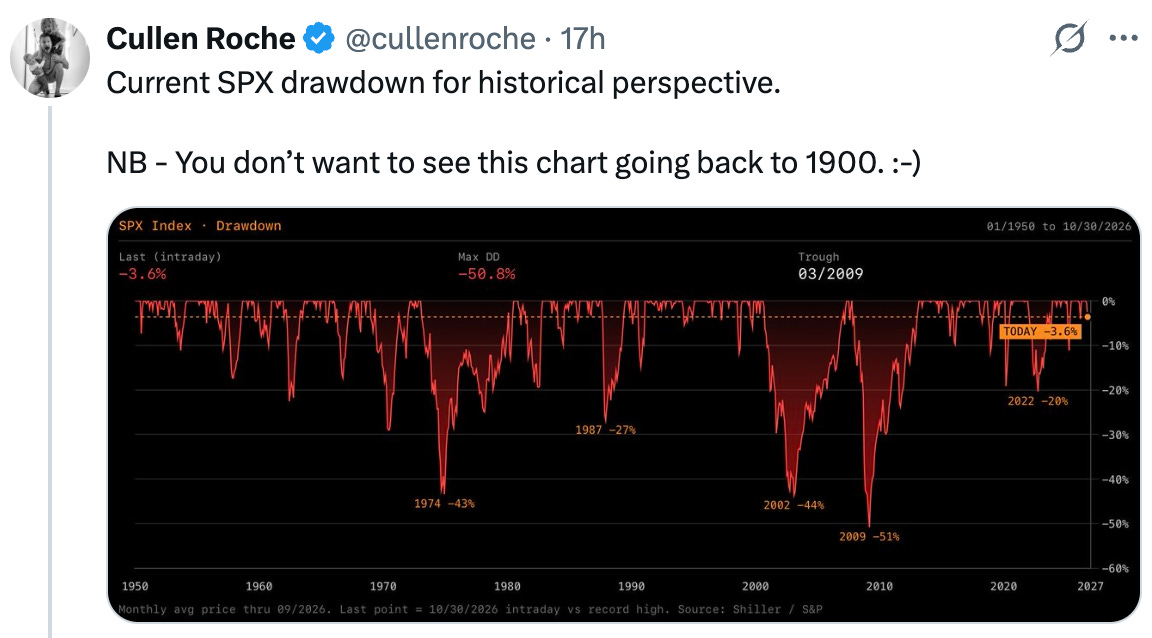
Now look underneath…
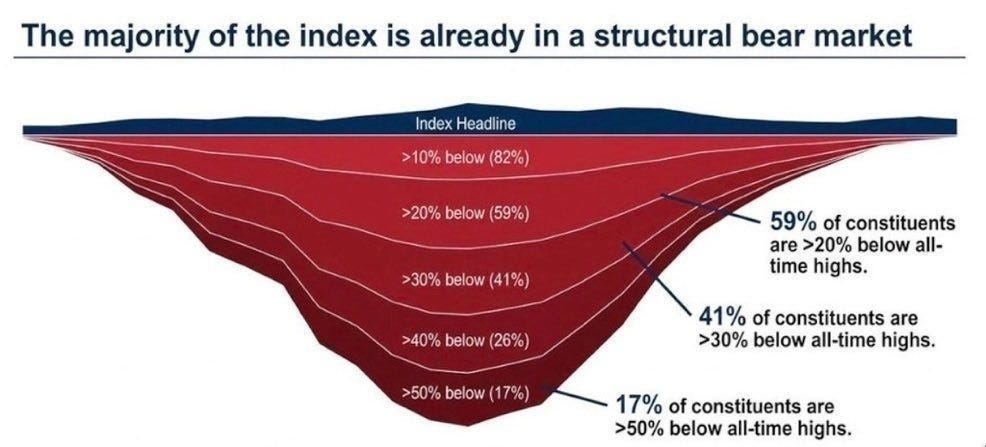
Roughly 82% of the index’s constituents trade more than 10% below their all-time highs. Fully 59% are down more than 20%, the conventional threshold for a bear market. Four in ten have lost more than 30%, and almost one in five has been cut in half. And I believe this chart was created more than two weeks ago. Arguably, there has been more carnage under the hood since.
A single index, then, but effectively two markets. The first is a handful of mega-caps tied to the AI build-out, heavy enough to drag the headline number wherever they go. The second is everything else, and that second market has been in a bear market for a while now.

This is also where the opportunity lies. If you work bottom-up and judge individual businesses on their own cash flows, the second market is where I’m finding high-quality companies at multiples I haven’t seen in years.
Meanwhile, index-level valuations, distorted by the mega-caps, suggest everything is expensive.
With that backdrop, let’s get to the transactions. I won’t turn this into a series of deep dives. For most of these names, I’ve written at length before, and I’ll link to those pieces. What you’ll get here are elevator pitches: what I’m seeing, why I bought or sold, and what makes me uneasy.
Update: overall, the post still ended up being 10,000 words long, so I guess there are (hopefully) some valuable insights or some food for thought for you to find
One more caveat before we start. I’m writing this off the top of my head, without pulling up exact dates and execution prices, so treat any numbers on my own trades as approximate.
Disclaimer: As of the date of publication, the author OWNS SHARES in the companies discussed (except for those I sold of course); but that may change. The analysis presented in this blog may be flawed and/or critical information may have been overlooked. The content provided should be considered an educational resource and should not be construed as individualized investment advice, nor as a recommendation to buy or sell specific securities. I may own some of the securities discussed. The stocks, funds, and assets discussed are examples only and may not be appropriate for your individual circumstances. It is the responsibility of the reader to do their own due diligence before investing in any index fund, ETF, asset, or stock mentioned or before making any sell decisions. Also double-check if the comments made are accurate. You should always consult with a financial advisor before purchasing a specific stock and making decisions regarding your portfolio.
Sell Decisions
Let me start with the sells, since they set everything else in motion. Both exits were full exits, and both had very different reasons behind them.
Edenred
It all started with Edenred. I sold my entire position somewhere above €29 per share, on Friday, October 16, if memory serves. Edenred made up close to 10% of my portfolio at the time. I bought my initial tranches around €24 and €22 and doubled the position at much lower levels, pretty much at the exact low, so the exit came close to a double on that addition.
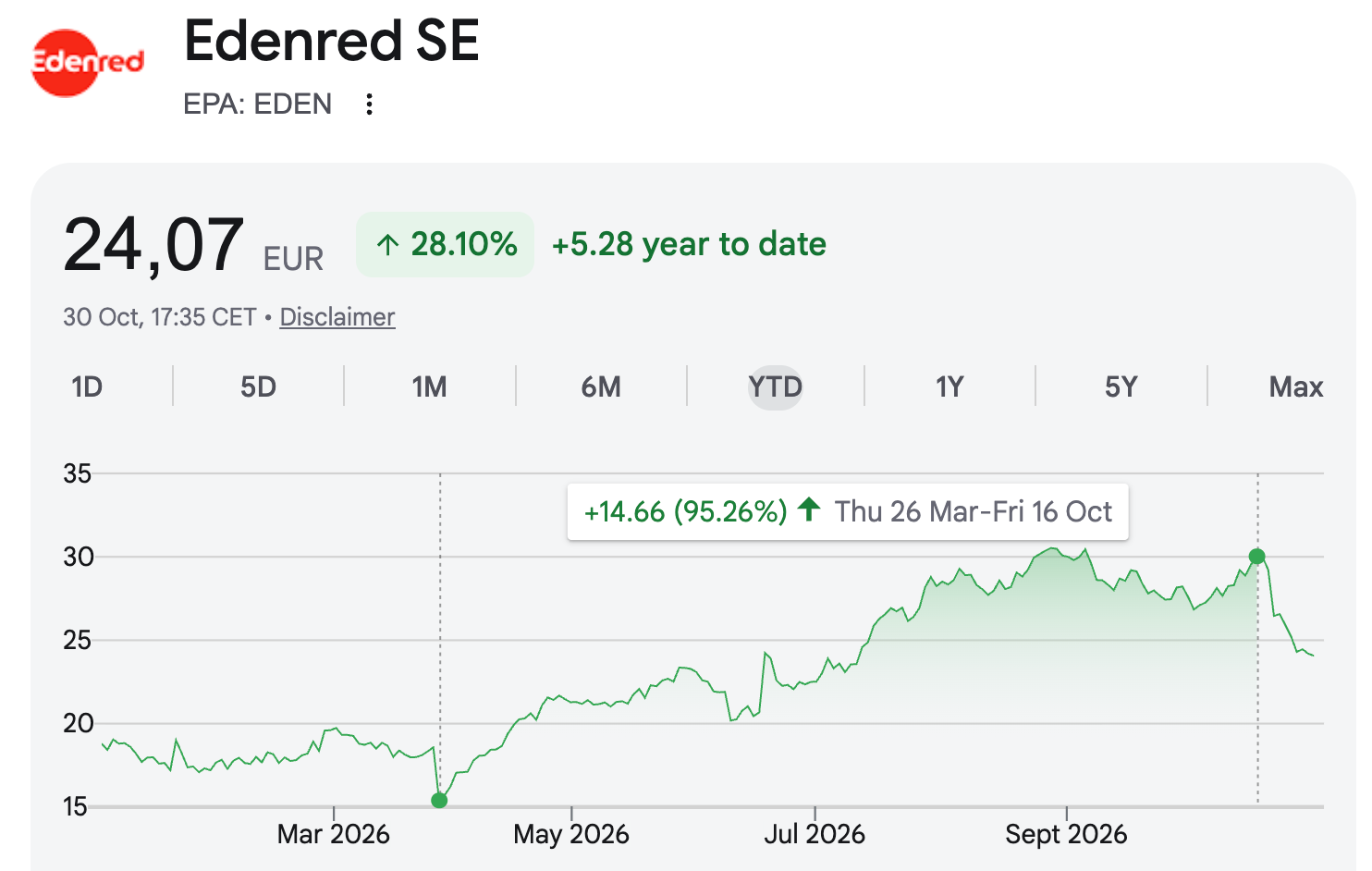
My reasoning was simple. Edenred is still cheap in my view, but the IRR profile of a stock looks very different at €29 than at €20 or €16. Underneath the regulatory noise, going forward, the business grows somewhere in the mid-to-high single digits. Management’s targets for 2027 and 2028 call for 8–12% annual EBITDA growth, after a 2026 reset in which EBITDA is guided to decline. That’s a respectable trajectory. I simply preferred to move the capital into businesses compounding intrinsic value at 15% or more, whose long-term trajectory I like better, and that are less dependent on a market rerating.
Then the third-quarter results came out on October 21, five days after I sold. Operating revenue was down 1.2% on a comparable basis. New meal voucher rules in Italy and Brazil, including commission caps and the opening of Brazil’s system to open payment networks, keep eating into the core Benefits business. Excluding those effects, organic growth was 6.6%, and Mobility grew a healthy 10.7%. The market didn’t care. The stock fell 5.5% to around €27.60 that day and has since slipped to roughly €24, about 17% below where I sold.
I’ll be honest. I haven’t studied the release in any depth, and it would be dishonest to claim I saw it coming. I got lucky with the timing. Investors have a nasty habit of judging decisions by their outcomes, something Annie Duke calls “resulting,” and a well-timed exit tempts you to rewrite the story as foresight. I’d rather call it what it was: a reallocation decision that happened to land just before a bad print.

There’s also a less flattering way to look at this trade, and I think you deserve to hear it. At €24, Edenred trades near multi-year lows, management is buying back stock under a program of up to €600 million through November 2027, and the regulatory headwinds will eventually lap themselves. If the 2027–28 targets hold, a patient owner could earn a perfectly decent return from here. By selling, I swapped a cheap, slower-growing business with visible regulatory risk for faster growers at higher multiples, plus a few names (as you’ll see) that are anything but low-risk. Whether that was the right decision won’t be clear for some time.
Ashtead Technology: 1% of upside against 44% of downside
Ashtead was a different story, and the decision was much easier.
For those who haven’t followed the saga: in September, Ashtead confirmed it had received a takeover approach from Ember Infrastructure Management, a US private equity firm. The board unequivocally rejected the first two proposals. On October 21, it announced that it had agreed to Ember’s fourth proposal of 615p per share in cash, valuing the company at around £505 million. That’s an 81% premium to the undisturbed close of 340p on September 22, and the board intends to recommend that shareholders vote in favor. Completion is expected around the turn of the year.
The shares jumped roughly 15% to about 609p that morning, and I sold my entire position the same day. At that price, Ashtead made up about a quarter of my portfolio.
At 609p, the remaining upside to the 615p offer was about 1%. Spread over a few months until completion, that works out to an annualized return of a few percent, roughly what dollar cash pays you right now. The downside, on the other hand, was substantial. Deals of this kind can still fall apart. Financing can wobble, regulators can intervene, the shareholder vote can disappoint, or something can surface during due diligence. If that happened, the stock would likely fall back, maybe even toward the undisturbed level of around 340p, a drop of more than 40%.
You can turn this into an implied probability. To make money holding a stock at 609p that either goes to 615p or falls to 340p, you need to believe the deal closes with more than 97–98% certainty. I’m sure the deal is likely to close. I’m not sure it’s that likely, and even if it is, I’d be taking on a fat tail for a sliver of return.
Merger arbitrage is a perfectly legitimate strategy, but it’s a job for specialists who can diversify across dozens of deals. With a quarter of my portfolio in a single situation, holding made no sense for me.
The part that stings is something else. I’ve argued before that Ashtead’s intrinsic value is above 615p, and I still believe that. Private equity buyers don’t pay full price for businesses out of generosity. They buy when they see more value than the public market is willing to price. Every takeover of a company you own outright caps the compounding you signed up for, it triggers tax payments, and Ashtead is now the fifth company I’ve covered in a deep dive to attract a takeover approach. It’s a nice validation of the work. But it’s also a reminder that the public market keeps handing quality small caps to private buyers at prices that look generous only against a depressed share price.
What do you do with a third of your portfolio in cash?
Normally, I’d be perfectly comfortable sitting on that much cash for a while. After everything I wrote above about the option value of cash, you might expect me to have done exactly that.
I didn’t wait long, though, because I was seeing plenty of opportunities, and I’m not alone in that. Many investors, peers such as GabGrowth, Emerging Value or Heavy Moat Investments, superstar investors such as Bill Ackman, and many lesser-known active fund managers whose letters I read, and whose judgment I respect, have been saying the same thing in recent months.

So let’s take a look at what I’ve been buying. I will cover eight different stocks that I either bought for the first time or added to below.