

Before robots, surgeons fought their own instruments.
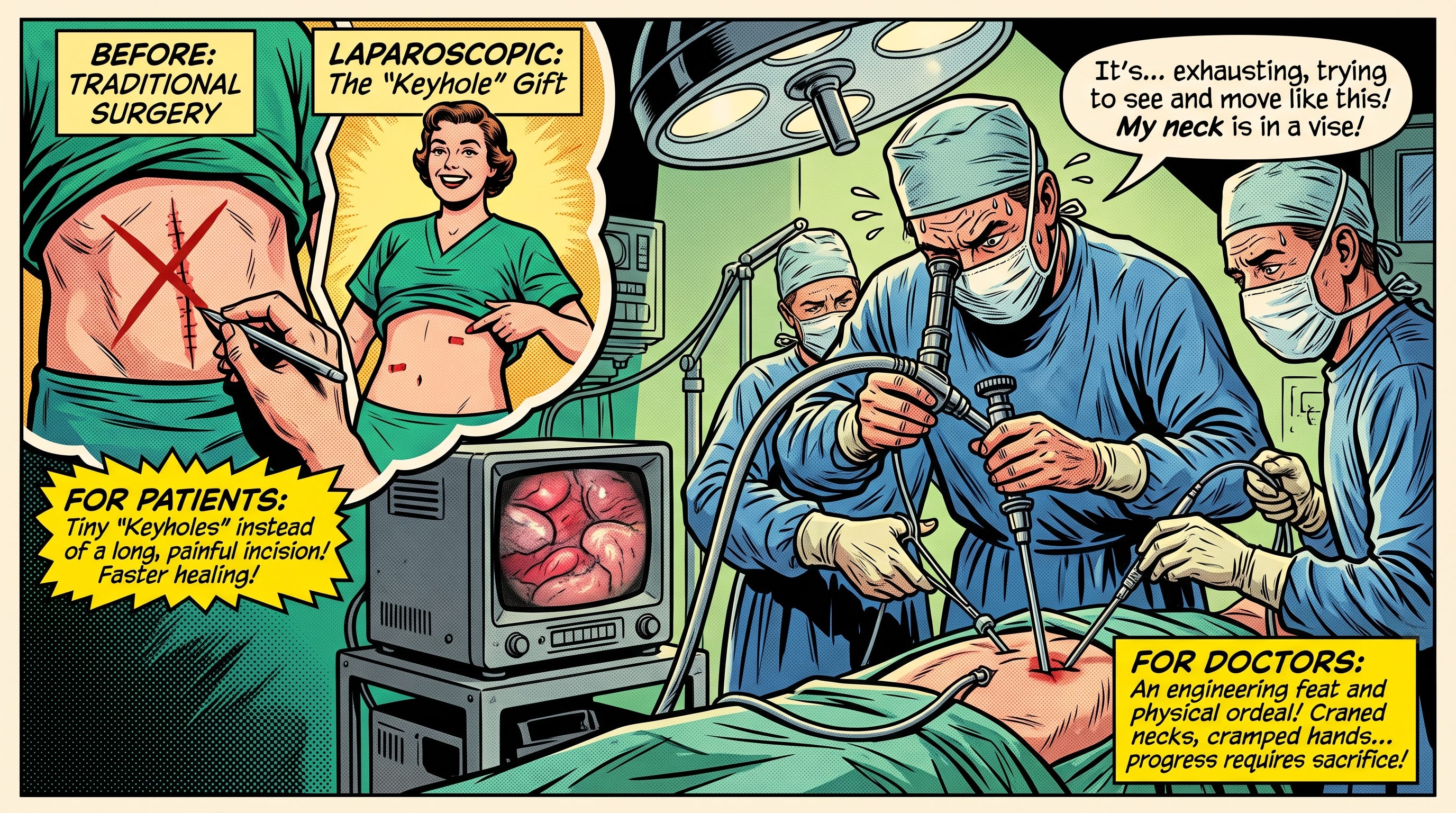
Laparoscopic surgery, the keyhole approach that spared patients from long incisions, was a gift to patients and a physical ordeal for the people performing it.
A surgeon would hold an 18-inch rigid steel tool inserted through a dime-sized opening. Because that opening acted as a pivot, moving the hand left sent the instrument tip right, and lifting the hand pushed the tip down – though twisting the handle along its axis stayed one-to-one. Surgeons call this the fulcrum effect, and learning to work against it took years, all while standing hunched over an operating table for six, eight, sometimes ten hours a day.
Chronic neck, back, and shoulder injuries ended careers early.
In 1995, Frederic Moll, John Freund, and Robert Younge founded a company to fix that.
They licensed DARPA-funded research originally meant to let surgeons operate on wounded soldiers from a distance, and built a prototype they named “Lenny,” after Leonardo da Vinci.
The goal was to eliminate the fulcrum effect by matching a surgeon’s hand movements one-to-one inside the body. When the da Vinci system received FDA clearance in 2000, it restored natural hand-eye alignment, added 3D high-definition vision, and introduced wristed instruments more dexterous than the human hand.
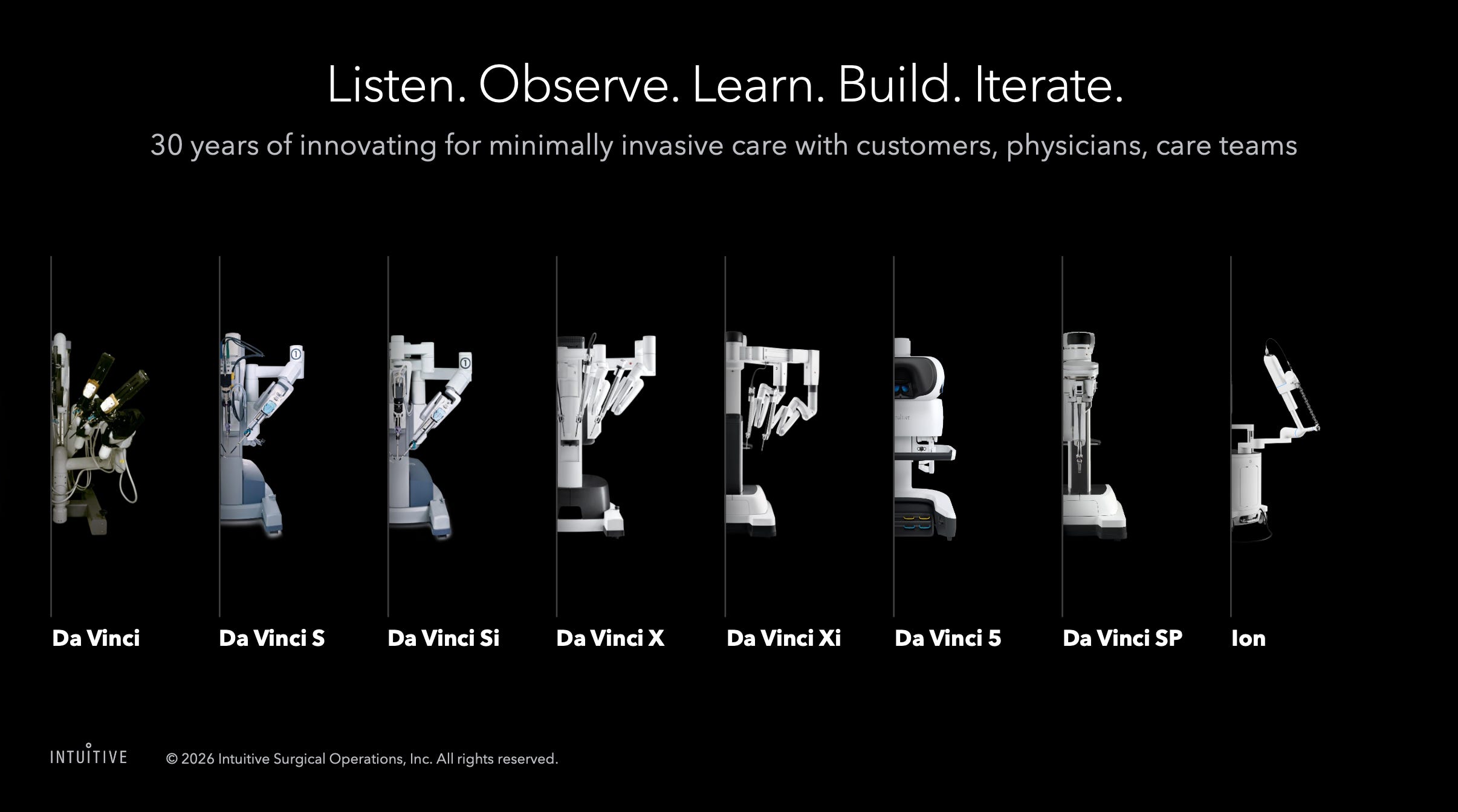
Surgeons stopped standing and started sitting, working from a console like pilots.
The company’s name says exactly what it set out to do: make complex minimally invasive surgery feel intuitive to the human mind and hand.
It worked. More than 20 million patients have now been treated on Intuitive’s systems, the installed base exceeds 11,000 da Vinci robots across more than 70 countries, and the stock is a 320-bagger since its IPO (and is now a $100 billion+ market cap company).
“Our mission: We believe that minimally invasive care is life- enhancing care. Through ingenuity and intelligent technology, we expand the potential of physicians to heal without constraints.
Our vision: We envision a future of care that is less invasive and profoundly better, where diseases are identified early and treated quickly so patients can get back to what matters most.“ - Intuitive IR Material
When the Best Business in Medtech Goes on Sale
Over the past five years, revenue and EBIT have both compounded at about 16.4% a year (almost a double), with net income, free cash flow, and EPS all growing around 14%.
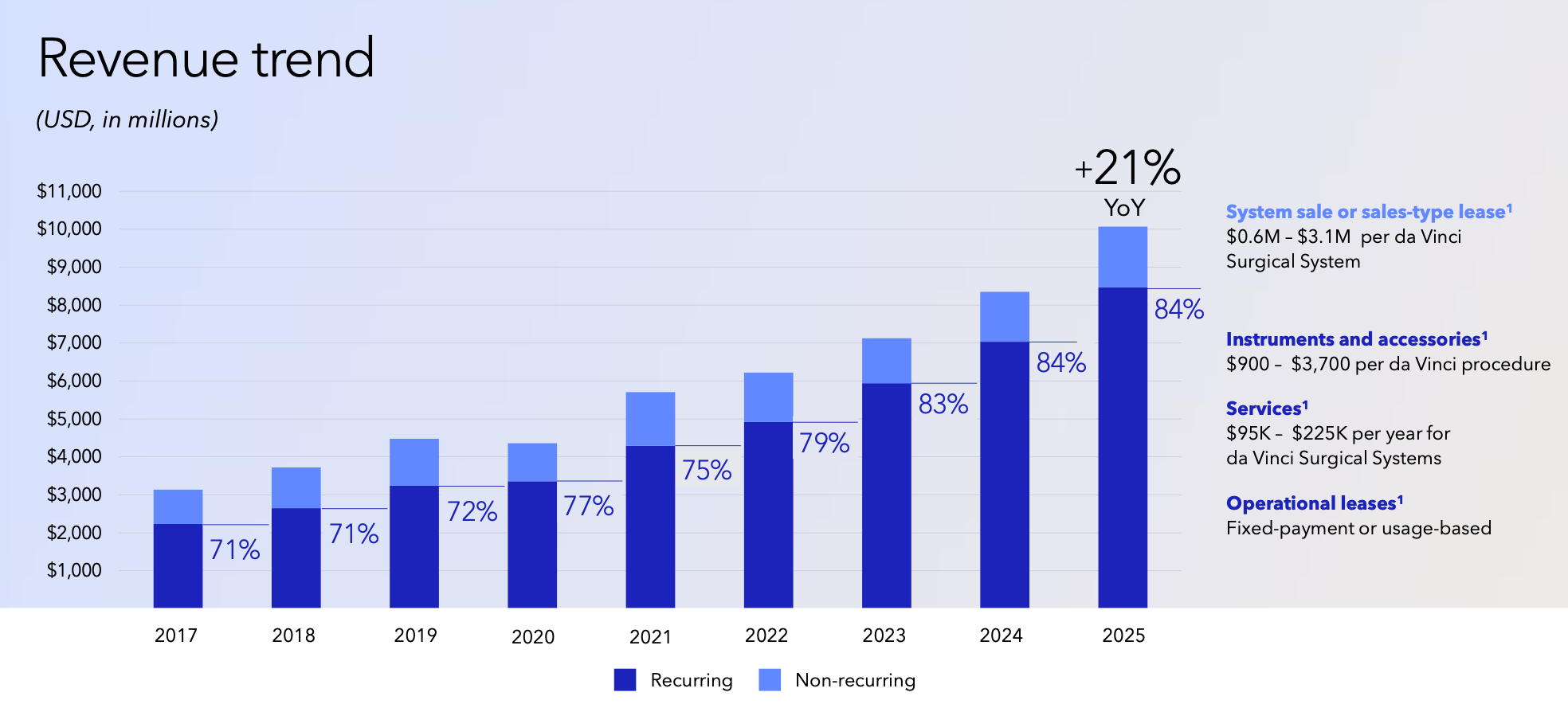
Recurring revenue reached 84% of the total in 2025. Non-GAAP operating margins touched 42.1% in the second quarter of 2026.
There aren’t many businesses like this anywhere, let alone in healthcare.
And the stock is down roughly 40% from its peak.
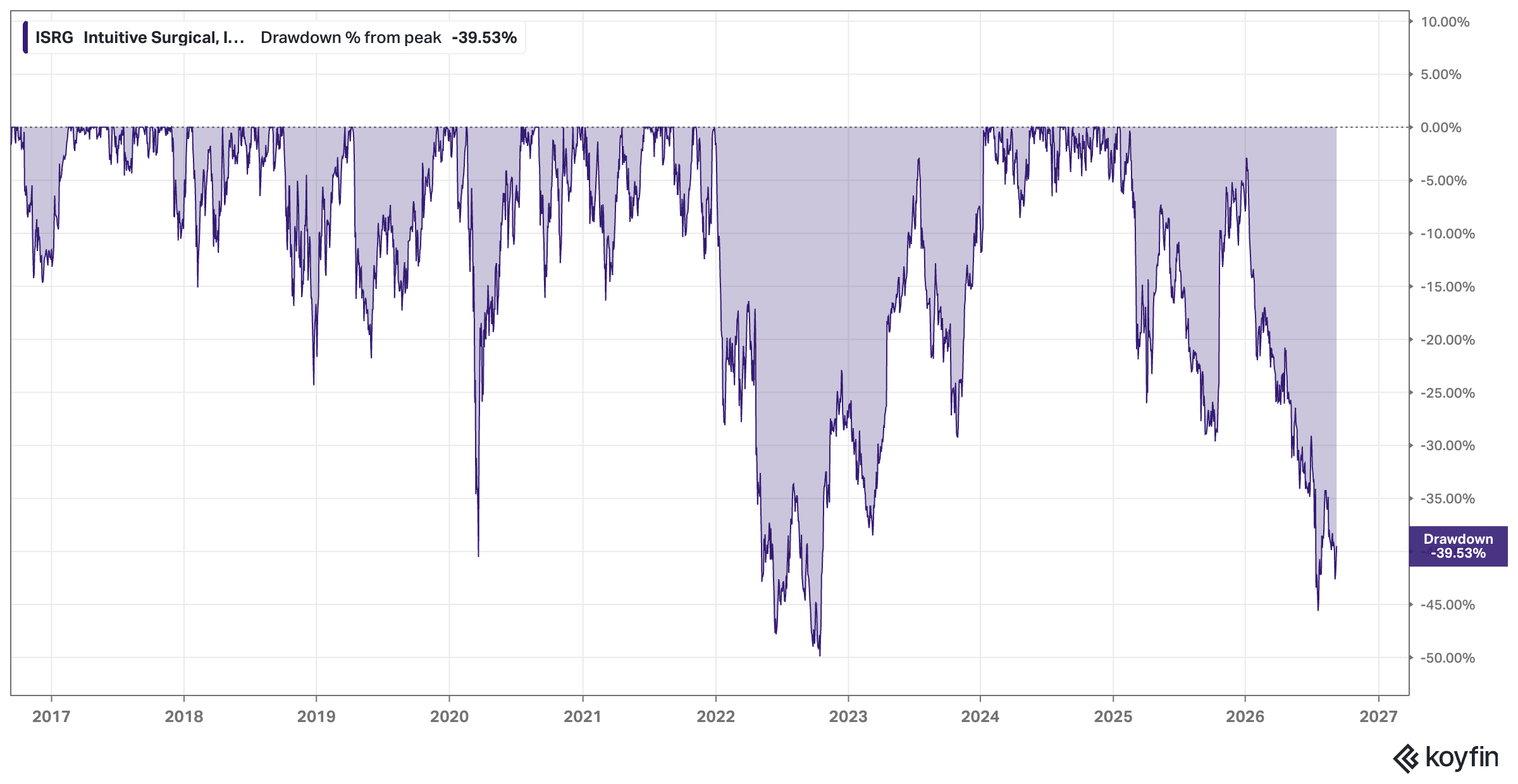
Shares recently traded near $350, barely above a 52-week low of around $330 and far below last year’s high of above $600.
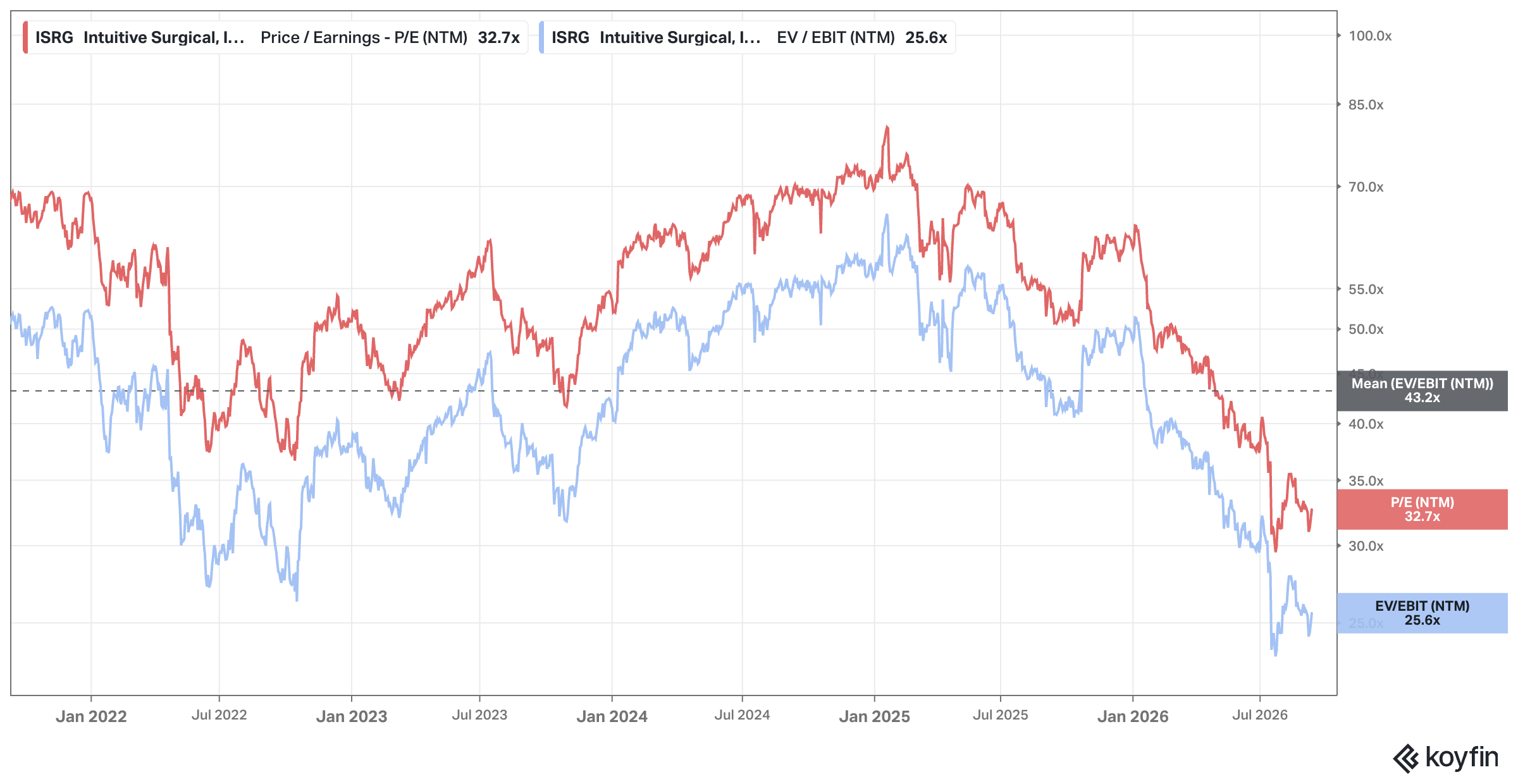
The forward P/E has fallen from 80+x in early 2025 at its most expensive to about 33x today, against a five-year mean closer to 50x, and EV/EBIT sits at 25.6x versus a historical mean of 43.2x.
On an earnings yield basis, this is the cheapest Intuitive has looked since 2016, while still growing 15% to 20%. The stock is practically flat over five years – half a lost decade.
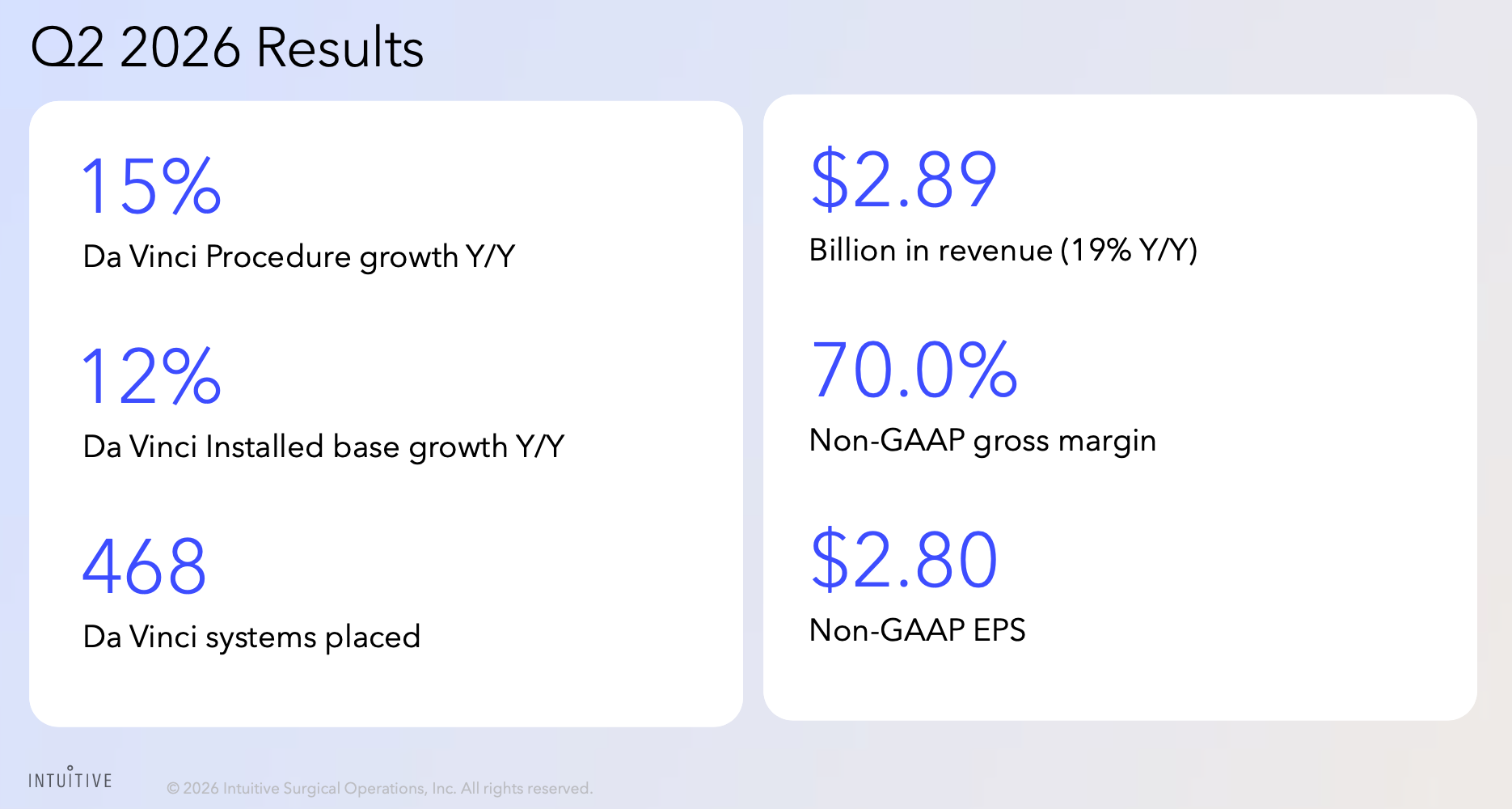
So what happened? Three things, mostly. U.S. procedure growth slowed to 12% in the second quarter, which management blamed partly on patients deferring care after ACA subsidies expired.
Management then declined to raise full-year guidance despite a clean beat, and the stock fell 14% the next day.
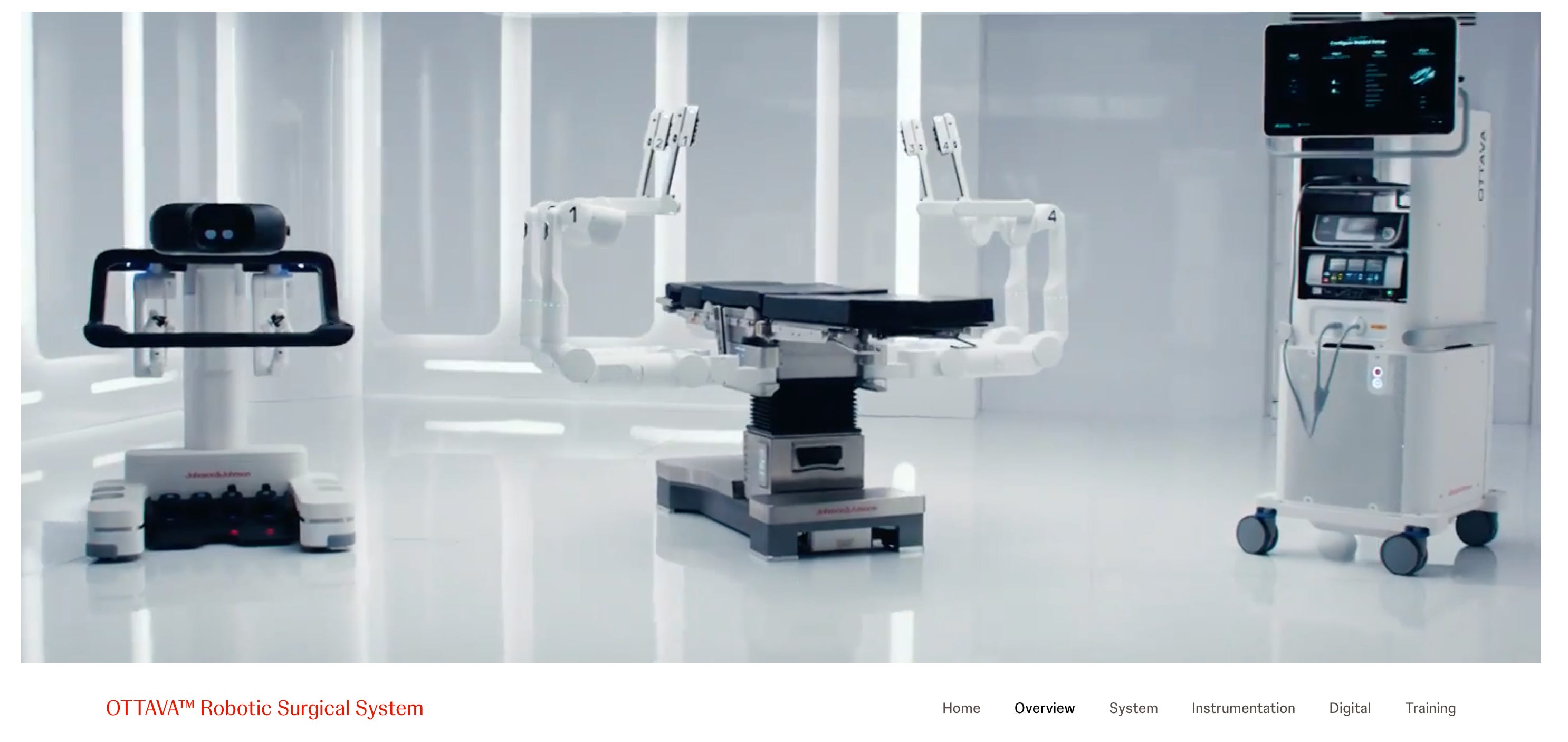
A few days later, days after that, the FDA cleared Johnson & Johnson’s Ottava for ten general surgery procedures, the first credible challenger on da Vinci’s home turf in two decades.
“The system received marketing authorization for multiple procedures in general surgery, including Roux-en-Y gastric bypass, gastrectomy, cholecystectomy, splenectomy, gastric sleeve, small bowel resection, appendectomy, lysis of adhesions, fundoplication, and hiatal hernia repair. “We are pioneering a new category of surgical robotics with OTTAVA,” said Tim Schmid, Executive Vice President, Worldwide Chairman, MedTech, Johnson & Johnson. ‘This is the start of the next era in surgery as we deliver not just a new surgical robotics system, but a catalyst for fundamentally better surgical care that is informed by technology, guided by clinical insight, and delivered with care by Johnson & Johnson.’“ - J&A
Medtronic’s Hugo had already been cleared for urology in late 2025. After twenty years without a serious rival, Intuitive now has two.
And China adds another front, since in 2025, Chinese-made laparoscopic robots outsold imported ones in public tenders for the first time. Out of 90 laparoscopic surgical robots procured by Chinese public hospitals in 2025, domestic Chinese brands secured 47 units (approx. 52% of awarded volume), officially surpassing imported systems.
That’s the setup, and this deep dive is my attempt to work out which version of it is true:
Is this a temporary repricing of a business whose economics and long-term growth runway are intact, …
… or the market correctly recognizing that the “monopoly years” are over and the margins as well as the growth that came with them can’t last?
I’ll walk through eight reasons the business might be worth owning, and spend a good portion of the post trying to knock them down.

What this deep dive series covers (this is part 1):
We cover the key thesis structure along key pillars of my analytical framework:
The 90-second eight-part bull case (”Bam Bam Bam Bam Bam Bam Bam Bam”)
The business itself
Unit economics analysis
Beyond Miller’s 90-second pitch: A granular breakdown of each of the pillars (the core of the analysis)
What went wrong
Investment Slide Deck – the deep dive in a highly compressed + visualized form
Every deep dive now comes with a companion slide deck. It’s the whole argument in compressed form – the hypothesis, the business, the competitive position, the valuation, and the case against – for the days when you don’t have an hour to spare but still want the shape of the thing. Paid subscribers get both, the long piece and the deck, on every deep dive from here on.
The origin story
The customer
The moat
Is it a good business in a good industry
Management and governance
Growth drivers and forecasting
Margins outlook
Valuation (including a downloadable model)
Other interesting findings
Disclaimer
As of the date of publication the author owns no shares in the company; but that may change. The analysis presented in this blog may be flawed and/or critical information may have been overlooked. The content provided should be considered an educational resource and should not be construed as individualized investment advice, nor as a recommendation to buy or sell specific securities. I may own some of the securities discussed. The stocks, funds, and assets discussed are examples only and may not be appropriate for your individual circumstances. It is the responsibility of the reader to do their own due diligence before investing in any index fund, ETF, asset, or stock mentioned or before making any sell decisions. Also double-check if the comments made are accurate. You should always consult with a financial advisor before purchasing a specific stock and making decisions regarding your portfolio.
The Bill Miller-Style “Bam Bam Bam Bam Bam”-90 Second-Hypothesis
Every deep dive on this blog starts with a story Bill Miller once told about how to pitch a stock. I recently noticed that even Joel Greenblatt referred to this framework during his Special Situations class way back in the day. It’s the best antidote I know to the 40-page research report nobody finishes, which I will put together anyway, in a second step, for those who like the initial hypothesis and are interested in a more thorough analysis of the setup (in total 25,000 words).
Welcome to Compound with René. You can find an overview of the companies I shared a deep dive on in the visualization below.
If you haven’t subscribed, you can join 5,000 readers who enjoy the quality of the deep dives, the process-oriented pieces, the analytical insight, and the valuation discipline, here:
Here’s how the former Legg Mason manager put it:
“I want to emphasize in your presentations that if you go into investing, you will realize that portfolio managers have ultra-short attention spans. And there is basically no successful portfolio manager of my acquaintance who has ever wanted to hear a story longer than 90 seconds. Peter Lynch, when an analyst came in to pitch him a stock, would turn on an egg timer for 90 seconds. The analyst had to complete the presentation within 90 seconds and be out of there. […] If you speak to a portfolio manager, the best thing to say is, ‘I want to talk to you about Homestore. It is at $2.25. The 52-week range is $2 to $4 and the all-time high was $100 in 2000. I think it is a buy for the following five reasons: 1. Bam 2. Bam 3. Bam 4. Bam 5. Bam. The stock is trading at $2 and change. I think it is worth $6 or $8 or whatever. Here is why I think it is worth that. Here are the risks.’”
I love that format because it forces discipline. If I can’t explain why a company is worth owning before Lynch’s egg timer rings, I probably don’t understand it well enough to put money behind it.
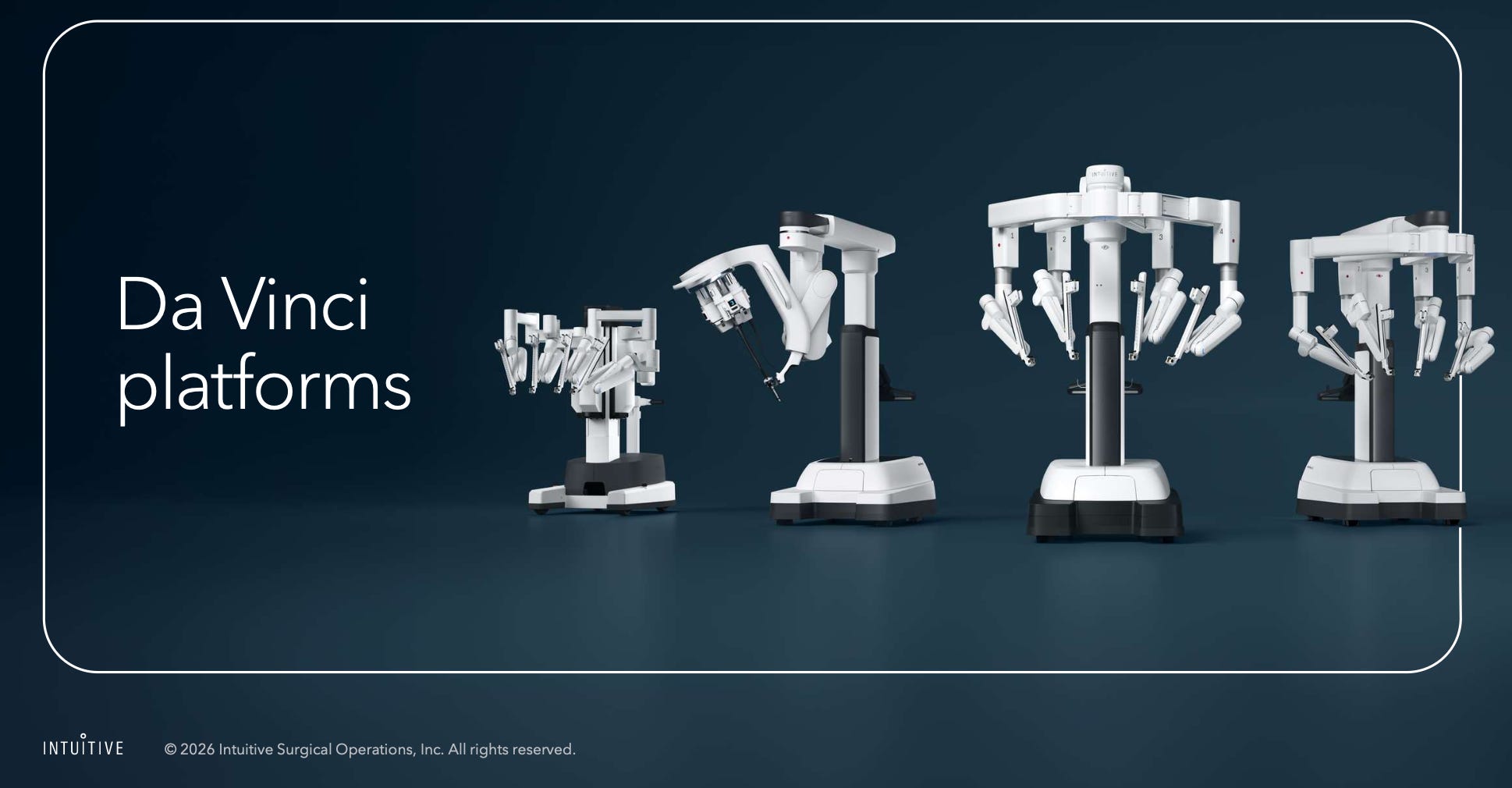
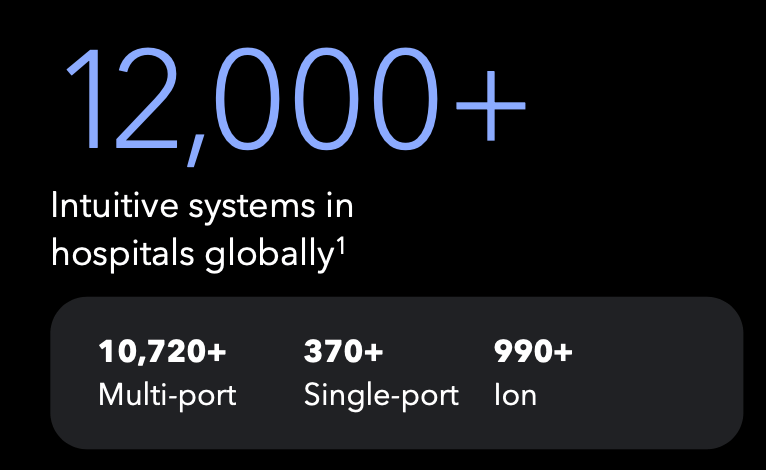
So here is my version for Intuitive Surgical (ISRG). The company that turned robotic surgery from a novelty into the standard of care is in the middle of its most important product cycle in a decade, with da Vinci 5 rolling into an installed base of more than 12,000 systems across its various systems (multiport, singleport & Ion).
At the same time, the first serious competitors are finally arriving with platforms of their own, and investors are asking whether a stock that almost never looks cheap has already priced in the good years. Remember that all investors should care about are the years ahead!
That tension is exactly why the stock and business deserve a fresh look now.
A quick word on vocabulary before the bams. You’ll notice I call what follows an investment hypothesis, and as my regular readers know, I do that on purpose in these deep dives. As a reminder, a thesis is a statement of belief, and once you’ve written one down, your brain starts hunting for evidence that you were right all along. Calling it a hypothesis keeps me more open-minded. It’s a claim that hasn’t been verified yet, and my job over the next sections is also to try to falsify it and present the counterarguments.
Here is the hypothesis in plain terms. The market tends to model a gradual fade in Intuitive’s procedure growth as its core markets mature and competitors show up. What I think it underweights is how much runway da Vinci 5, the push into benign general surgery, and the tiered XiR fleet add to that growth, and how long Intuitive’s lead can hold while every one of those extra procedures pulls high-margin recurring revenue through the installed base.
Intuitive Surgical's "XiR" fleet represents the company’s strategically modified variant of its widely adopted da Vinci Xi surgical system. The “XiR” fleet refers to the factory-refurbished da Vinci Xi robotic surgical systems. It is designed specifically to capture cost-conscious international markets and expand penetration into decentralized healthcare facilities.
If that’s right, the fade comes later and slower than the price implies. It is one of my core beliefs that markets tend to misprice the durability of superior ROIIC and earnings growth rather frequently. That’s the bulls’ thesis here.
If the bulls are wrong, and growth slows sooner than later, the stock might still be expensive despite the large drawdown.
Have you tried listening to my write-ups in the Substack app? I think it’s a great experience, especially for my longer analyses. Get to know a business while taking a walk, doing sports, or lying on your sofa with your eyes closed 😉.
Miller Asked for Five Bams. For Intuitive Surgical, I Have Eight…
Here’s my 90-second pitch on why Intuitive is worth your attention right now (we will discuss each of these BAMs more thoroughly again further below):
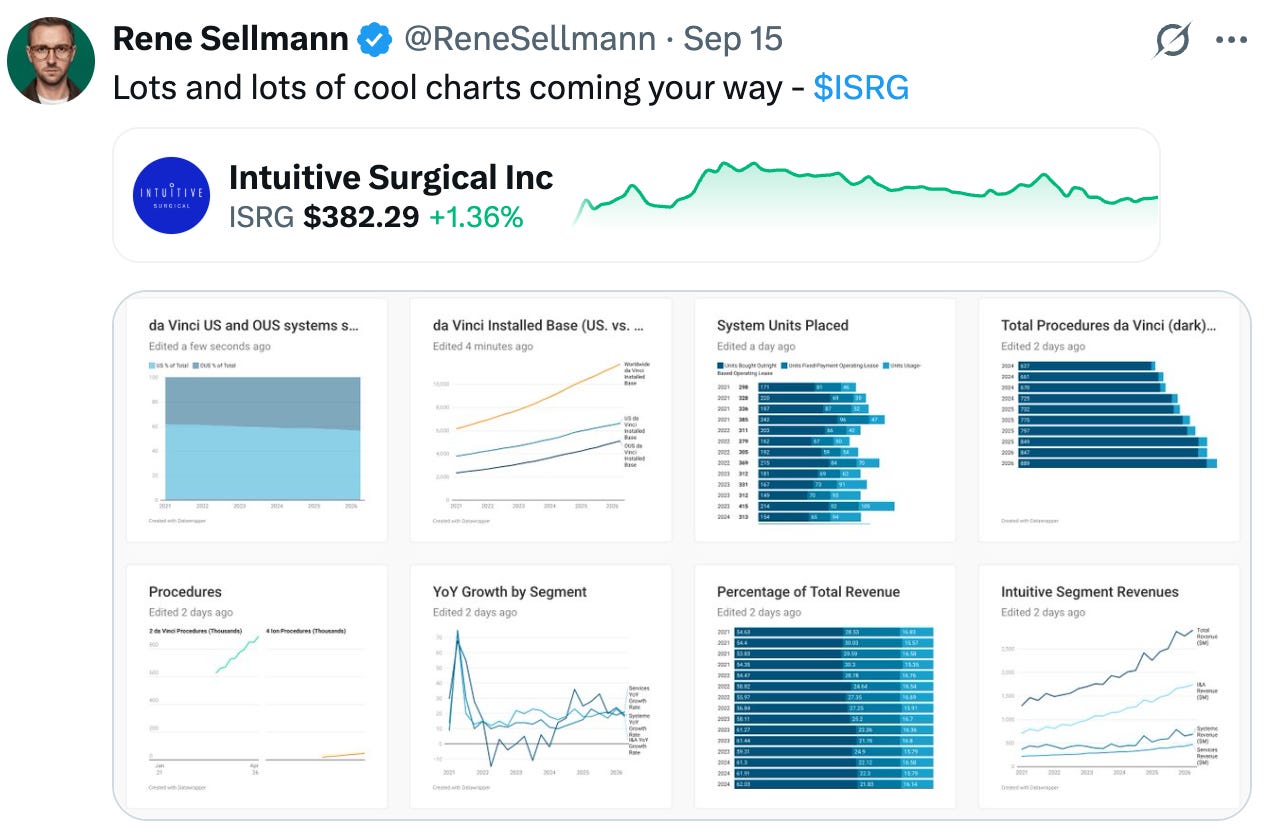
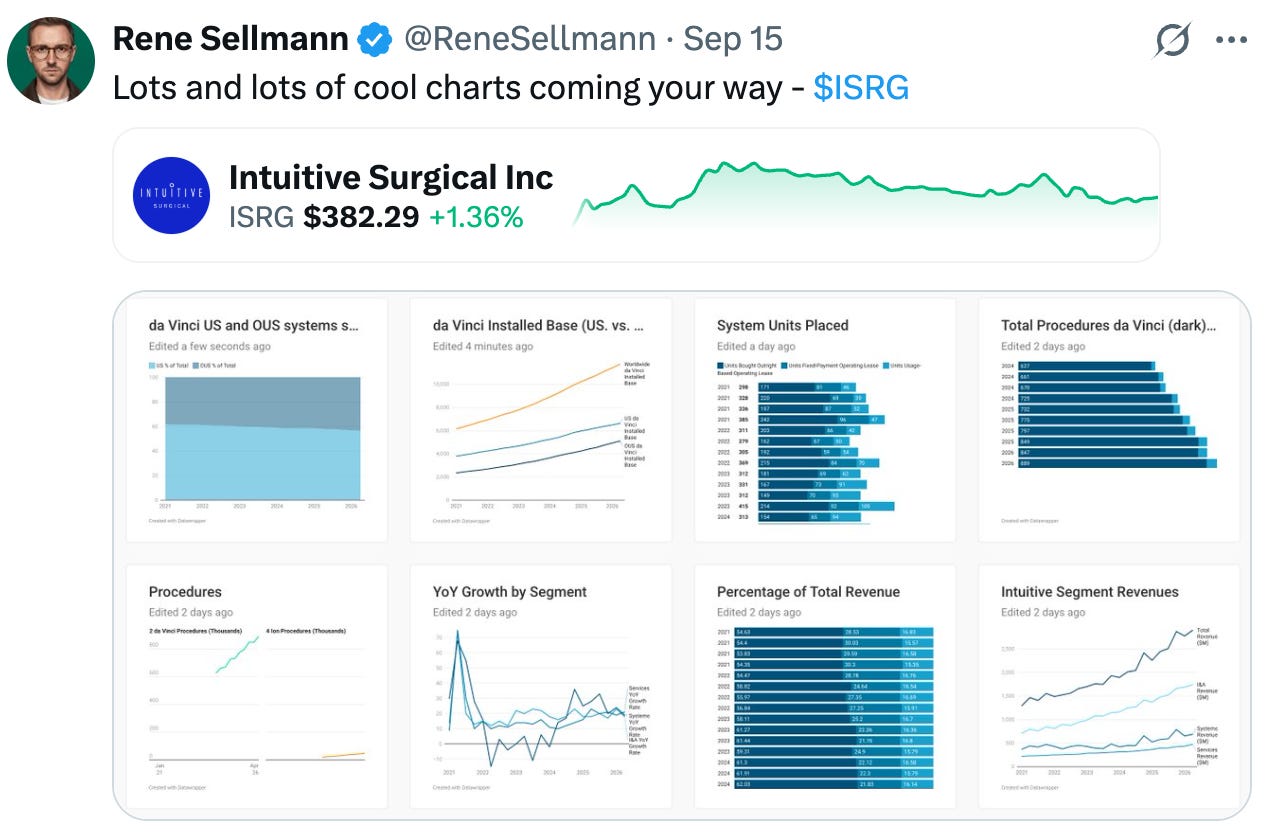
Bam #1 – A high-margin razor-and-blade model with ~80% recurring revenue: Intuitive has a massive global installed base of more than 12,000 systems, and each one works like a toll booth. Surgeons can’t operate without the instruments and accessories, hospitals sign service contracts to keep the robots running, and a growing share of systems sit on operating leases. Put together, more recently more than 80% of revenue is recurring (lots of charts follow further below; see teaser screenshot from X below), and switching costs climb every year a system stays in the medical facility, the staff gets trained on it, and OR workflows get built around it.
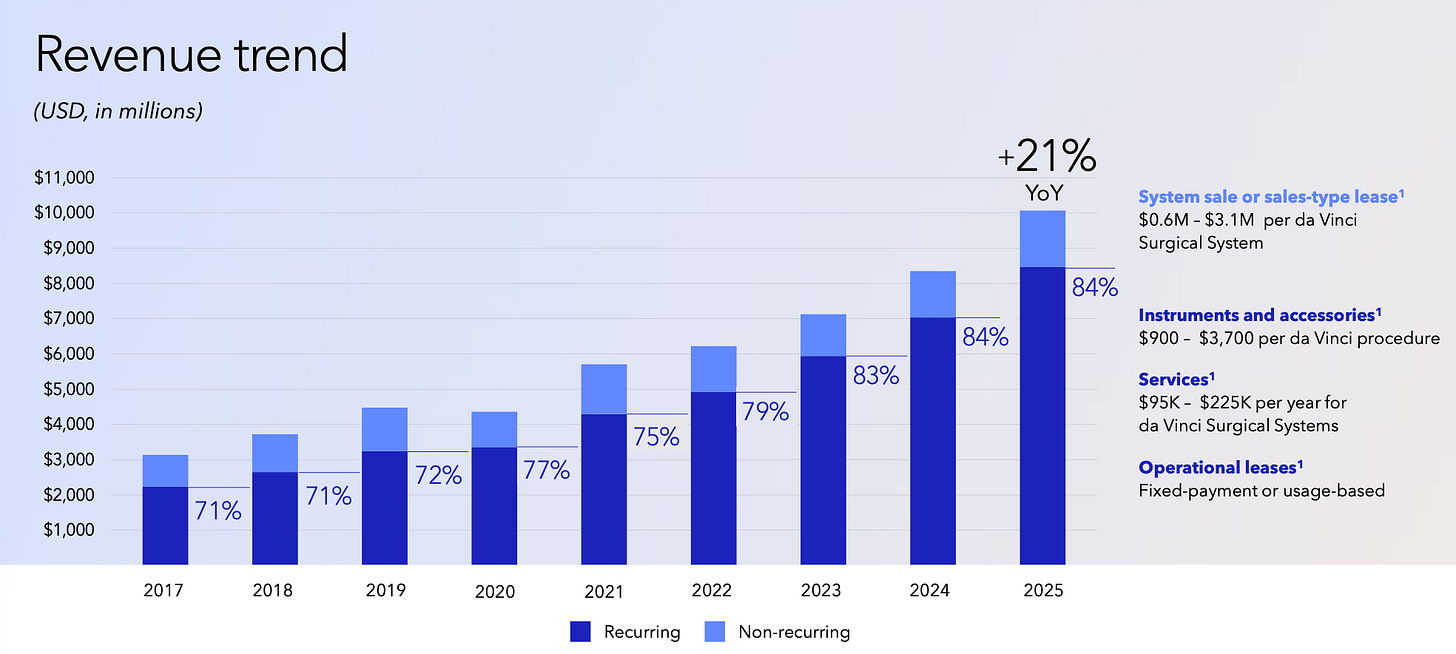
One caveat I’ll flag right away here is that the magnitude of recurring revenue depends on the period, and more importantly, on how you define recurring, and while leases lower the hurdle for hospitals, they also move capital risk onto Intuitive’s own books.
Bam #2 – The da Vinci 5 inflection and a 10,000x compute flywheel: The new da Vinci 5 packs 10,000 times the computing power of prior generations, adds Force Feedback so surgeons can sense the pressure they’re applying to tissue, and improves ergonomics for the person hunched over the console for hours. The bull case is this widens Intuitive’s technological lead over late-arriving competitive platforms by five to ten years.
I want to be careful here, however. Computing power is an input, and hospitals pay for outcomes. The flywheel only turns if all that compute translates into better data, better instruments, better patient outcomes, and eventually results that surgeons can feel and administrators can measure. A 5–10 year lead is also the type of company claim you want to treat carefully, given that Medtronic and Johnson & Johnson, and Chinese players too, have plenty of money to throw at the opportunity.
Bam #3 – TAM expansion and line-of-sight growth from 7M to 9M+ procedures: Intuitive’s addressable da Vinci procedure pipeline has grown from roughly 7 million to more than 9 million. Much of that comes from benign general surgery (gallbladder removals, hernia repairs, appendectomies), plus acute care and newer indications like cardiac procedures and nipple-sparing mastectomy. This is where the long runway comes from. Beyond the company-defined “line of sight”-TAM, there’s a global soft-tissue surgical market of around 23 million procedures, spanning open surgery and conventional laparoscopy, and Intuitive argues that roughly 20 million of those can and should be performed with a minimally invasive approach.
General surgery cases come in high volumes but at lower acuity, and reimbursement rarely rises just because a robot was used. That puts pressure on the hospital’s cost per case and, over time, on what Intuitive can charge per procedure. And generally, a TAM figure published by a company in an IR deck always deserves a haircut.
Bam #4 – A tiered fleet strategy (XiR) that opens up ASCs and emerging markets: Refurbished Xi systems, branded XiR, give cost-sensitive buyers an economic way in. Plenty of Ambulatory Surgery Centers and international hospitals can’t justify a brand-new flagship, but they can justify a refurbished one that then also brings in high-margin recurring revenue. Think of it as a certified pre-owned car at a car dealership that has passed a strict multi-point inspection and comes with a factory-backed warranty. It widens the customer acquisition funnel and brings new surgeons onto the platform, and the idea is that it does so without diluting premium dV5 pricing.
At the same time, bears would argue that if U.S. hospitals that would otherwise have bought a dV5 start choosing XiR because it’s “good enough,” the tiered strategy could turn into a cannibalization dynamic to some extent.
The full analysis starts here!
Become a paying subscriber to read the rest of this post and get access to all of my other research, including valuation spreadsheets, deep dives (e.g. well-known mid- and large caps such as LVMH, Duolingo, Meta, Edenred as well as more hidden gems such as Digital Ocean, Ashtead Technologies, InPost, Timee, and MANY more), and powerful investing frameworks.
As a member, you get:
Complete Access: Every deep dive in our library (65+ and counting). The most thorough analyses you will be able to get your hands on (including downloadable models).
Access to my 150+ Global Watchlist: And How To Use It to Outperform the Market!
Slide Decks: Every deep dive now comes with a companion slide deck. It’s the whole argument in compressed form – the hypothesis, the business, the competitive position, the valuation, and the case against – for the days when you don’t have an hour to spare but still want the shape of the thing. Paid subscribers get both, the long piece and the deck.
The WhatsApp Community: Real-time discussion and networking with like-minded investors.
Digital Investing Conferences: Around three times a year, we also hold digital conferences where members present and share stock ideas, and discuss broader themes, and we’d love for you to join in!
Downloadable Visual Blueprints: Direct access to high-resolution PDF reference sheets distilling timeless investment classics, insights from my proprietary investing framework, and essential valuation mechanics into structured visual architecture. Print them, save them, and build your own institutional reference binder.
Incredible Value: Full access to all of this for less than €1/day.
PS: Using the app on iOS? Apple doesn’t allow in-app subscriptions without a big fee. To keep things fair and pay a lower subscription price, I recommend just heading to the site in your browser (desktop or mobile) to subscribe.