Dear compounders,
A few years ago, before I started this blog, my investing community was a handful of people in a WhatsApp group. We ran a format called “Stock of the Month." Whoever was interested dug into the same company for a few weeks, and we threw findings, charts, and half-finished theories into a dedicated channel.
One month, the pick was EVS Broadcast Equipment, as it was still called back then, a Belgian company most of you have probably never heard of, even though there’s a good chance you’ve watched its work.
New here? Join 5,000+ readers and get 3 FREE GIFTS when you subscribe:
📈 Valuation Spreadsheet
📚 eBook: Investing Visualizations
💡 eBook: 250 Thought-Provoking Quotes

I remember the mood in the chat as intrigued. EVS was never going to be one of the best businesses in the world. It had carved out a niche, looked likely to grow in the mid to high single digits for the foreseeable future and didn’t trade at a demanding multiple. I still passed. Luckily. I honestly can’t remember why anymore, and as far as I recall, the others passed too. The company stayed on my watchlist, though, and the pillars of the business stuck with me.
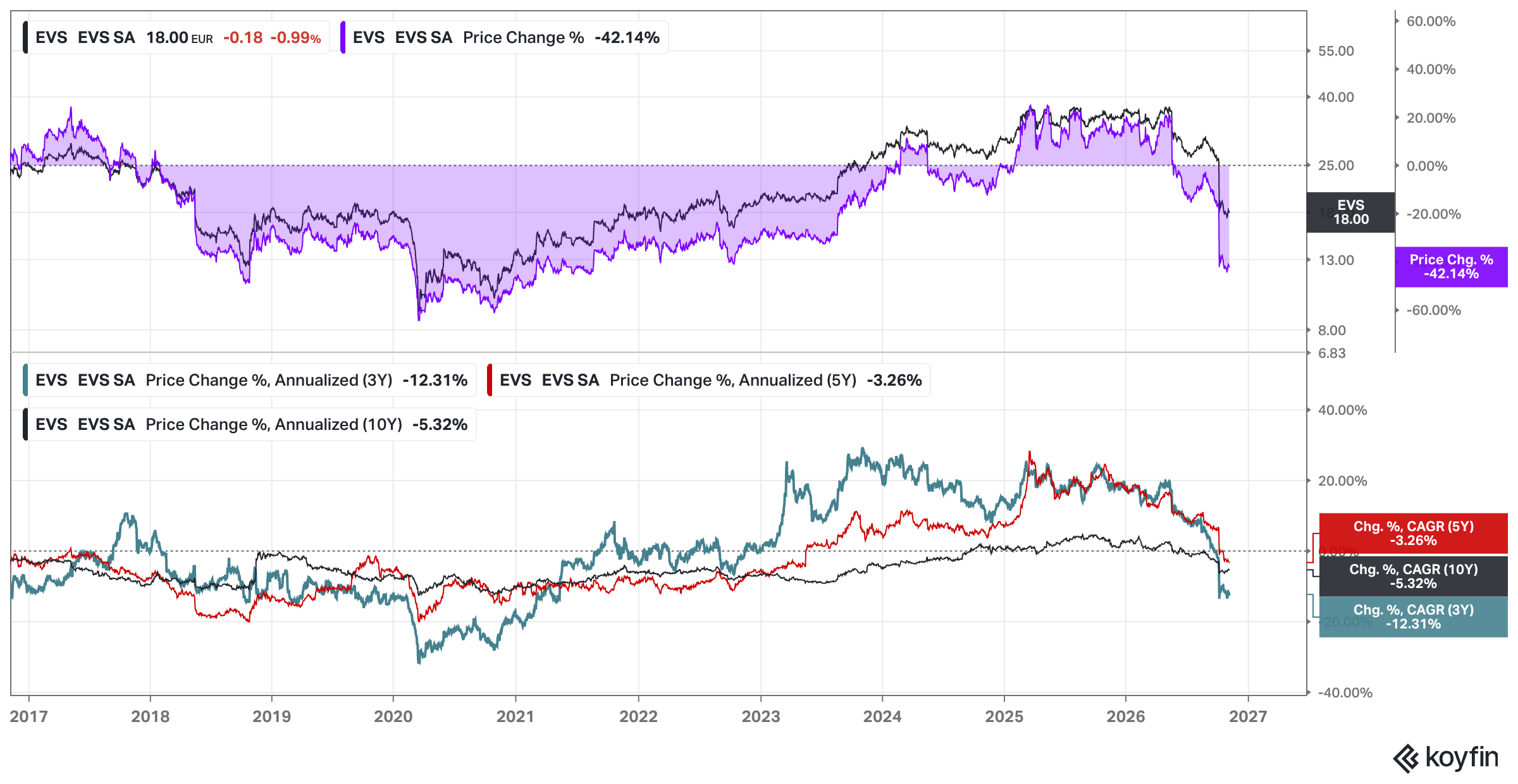
Then, a few days/weeks ago, one community member brought it up in our stock ideas chat. The name rang a bell, and the chart set off an alarm. EVS now trades at €18.00, about 68% below its more recent “all-time high” of €55-56 (back in 2013; it traded even higher pre-GFC), and over the past three years the shares have lost roughly 12% a year (that’s compounded).
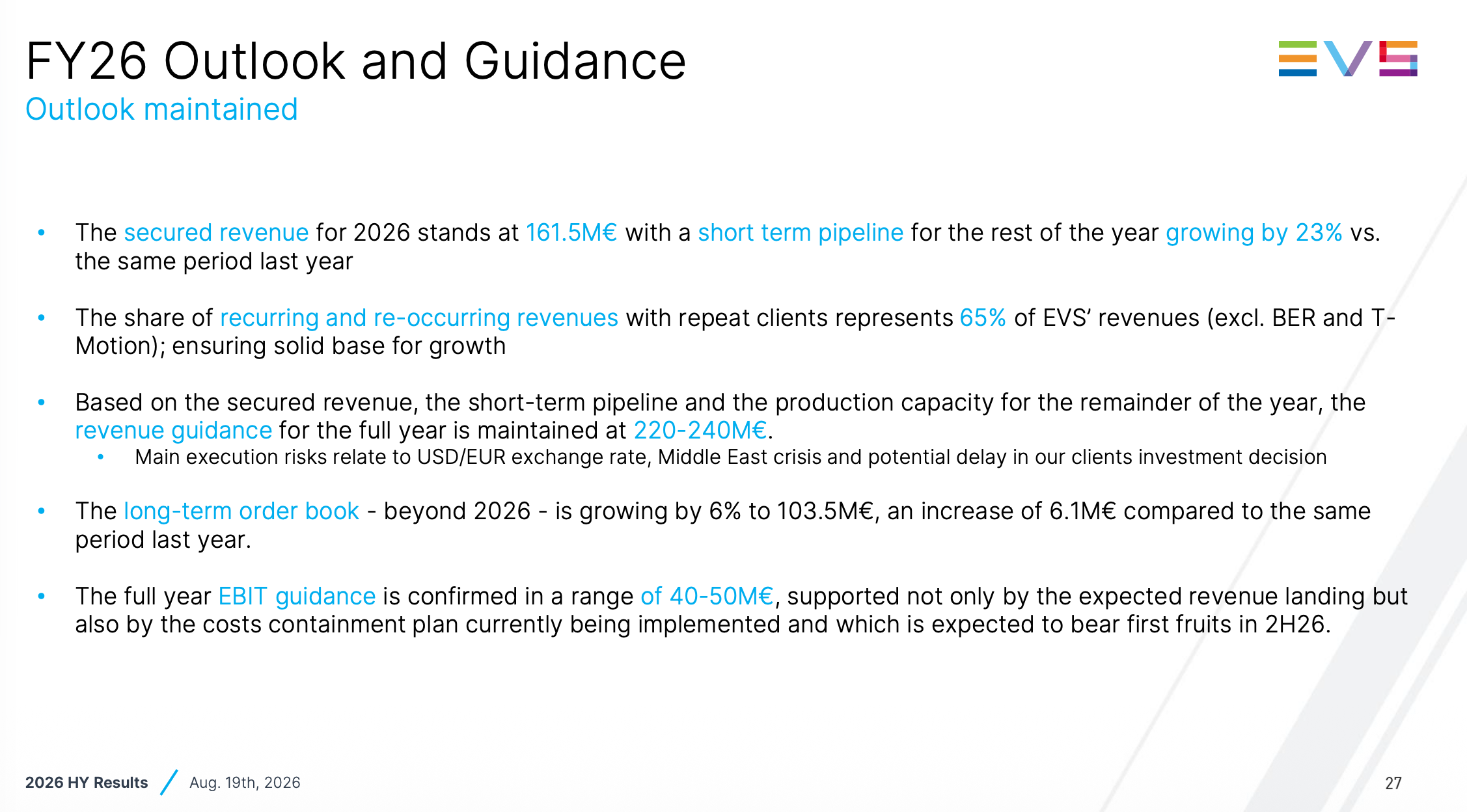
Most of the damage came in a matter of weeks. In October 2026, management cut its full-year revenue guidance by 14%, only seven weeks after confirming it, as Middle East orders froze and customers everywhere took longer to sign.
The stock gapped down and hasn’t made a serious attempt to recover. It keeps drifting toward new lows, which tells me the market is still selling every piece of bad news and isn’t looking for reasons to buy yet.
And that’s usually when I get very interested!
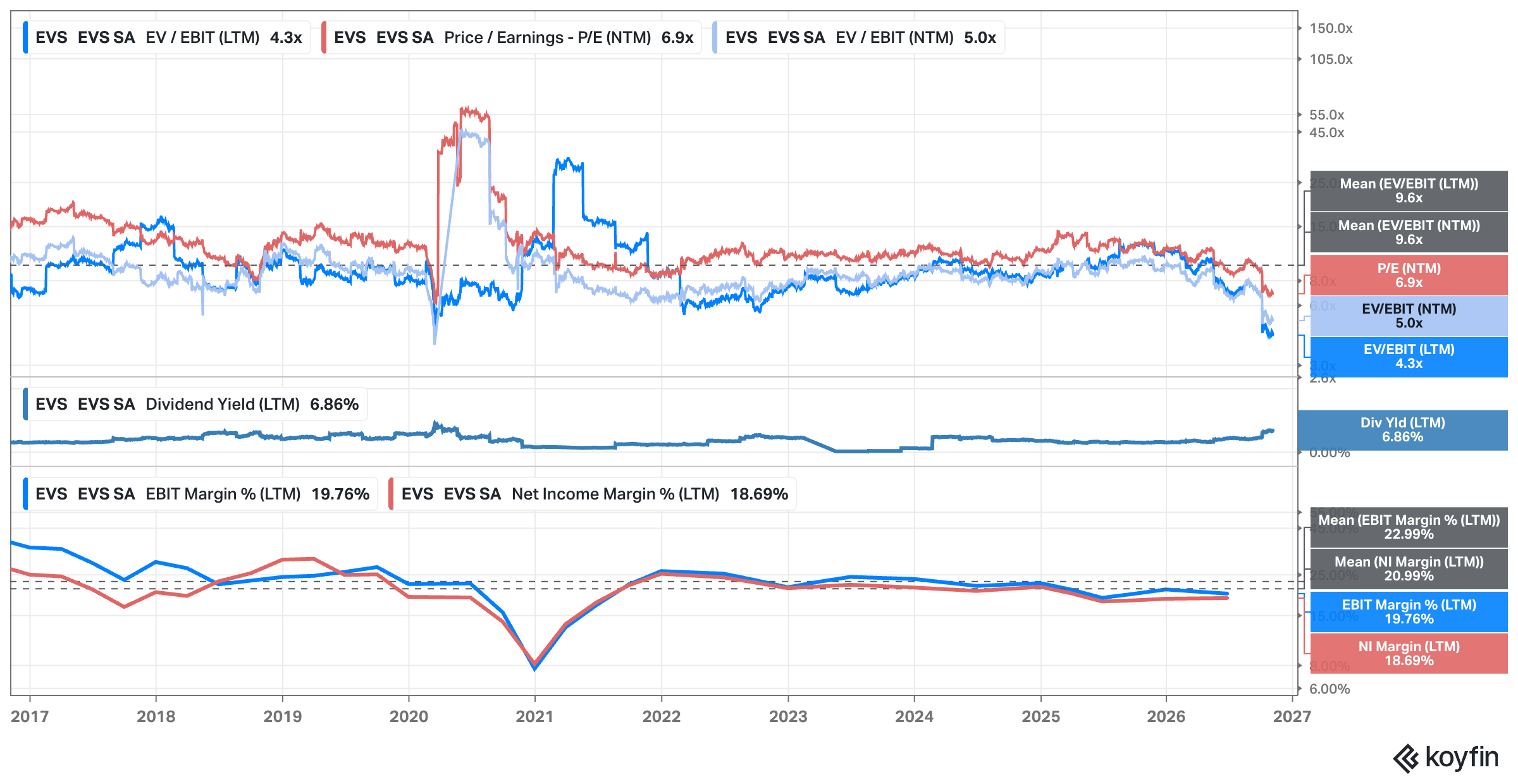
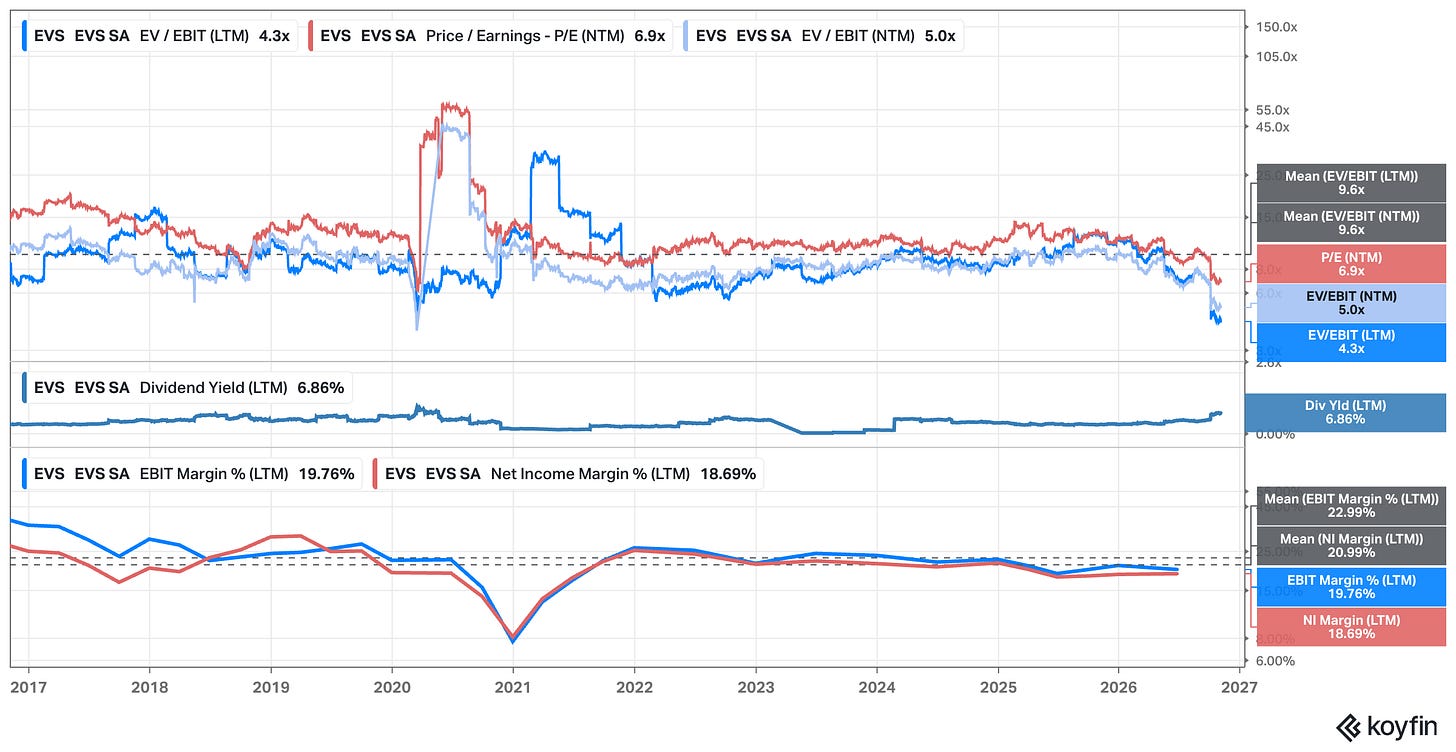
On paper, the multiples look almost absurd. EVS trades at 4.3 times trailing EV/EBIT, less than half its long-term average of 9.6x (which itself strikes me as low), and pays a dividend yield of almost 7%.
The detail that caught my eye is one column over. On a forward basis, the multiple rises to 5.0x, which means analysts expect operating profits to shrink, and I suspect most of those estimates still predate the October warning. On my own estimate of around €20 million in 2026 EBIT (more on that in the model section), EVS trades at about 10x EV/EBIT, slightly above its long-term average of 9.6x, but that’s on a depressed earnings base and a normalized 4-5x view is possibly the more accurate representation of EVS’s current cheapness..
So I took a fresh look, with the advantage of knowing the company somewhat already.
What I found is more complicated than the story I remembered. EVS has grown revenue for five consecutive years, yet once you strip out acquisitions and Big Event Rentals, the revised guidance implies that the core business shrinks sharply in the second half of 2026.
Its name has turned into a job title for thousands of technicians, which is about as strong a moat as hardware gets, while a new generation of operators is learning the craft on tools that cost a fraction of an EVS system.
And one of the signposts I track sits only a few points above the level where I’d abandon the idea altogether.
Whether that adds up to a bargain or a value trap is what this post tries to find out. As always, I’ll frame the case as a hypothesis and spend most of my time trying to break it.
Here's what you'll find in this post (among other things):
Why the strongest moat EVS has is a job title, and why a €10,000 Blackmagic setup in a college gym worries me more than any rival's flagship product.
What happens to an operator moat once AI can pick the angle and cut the replay by itself – and why EVS is building exactly that tool.
A rough look at the economics of a single replay system, and why nearly all of its margin may end up in software once the hardware moves onto off-the-shelf servers.
Why management's "65% recurring revenue" shrinks to 20% once you read the fine print, and what the growing long-term order book actually measures (hint: contract length).
The mix shift underneath the headline growth: the most profitable customer group is shrinking, and the fastest-growing one probably earns less.
How a hyperscaler's 3D replays at the Winter Olympics could matter more in the long run than anything EVS's traditional rivals are doing.
What management named as its biggest risks in March 2026, seven months before a different one cut the guidance by 14%.
How the share price collapse may have narrowed the acquisition path to the €350 million target, through a rule management set for itself.
What the bonus plan rewards, what it ignores, and why the budgets behind it look forgiving.
The signposts I'll track, and the one already uncomfortably close to tripping.
TAM analysis
A five-year model with three scenarios + the case for EVS as a textbook private equity target
A practical note on Belgium's 30% dividend withholding tax, if you're in it for the yield.
… and so much more! (this is another 81-page report)

The Bill Miller-Style “Bam Bam Bam Bam Bam”-90 Second-Hypothesis
So let me try Bill Miller’s 90-second pitch with EVS (Euronext Brussels: EVS). The stock trades at €18-19. Its 52-week range runs from about €18 to €39. I think it could potentially be an interesting opportunity for five reasons.
Bam #1: EVS is the industry standard in a job where nobody can afford a mistake. Live tier-1 sports broadcasters can’t risk their replay system failing mid-match, and EVS holds 35% to 50% core market share in live replay. Its Live Slow-Motion ecosystem (LSM-VIA) is so entrenched in outside broadcast (OB) vans and stadiums that technicians around the world who run it are called “EVS operators.” Once your brand name has turned into a job title, you have a level of customer intimacy most hardware vendors can only dream of.
“EVS was known for its pioneering work in tapeless television technology, including the launch of the Live Slow-Motion (LSM) system, which rapidly became the standard replay technology for all broadcast sporting events worldwide.“ - 2024 Annual report
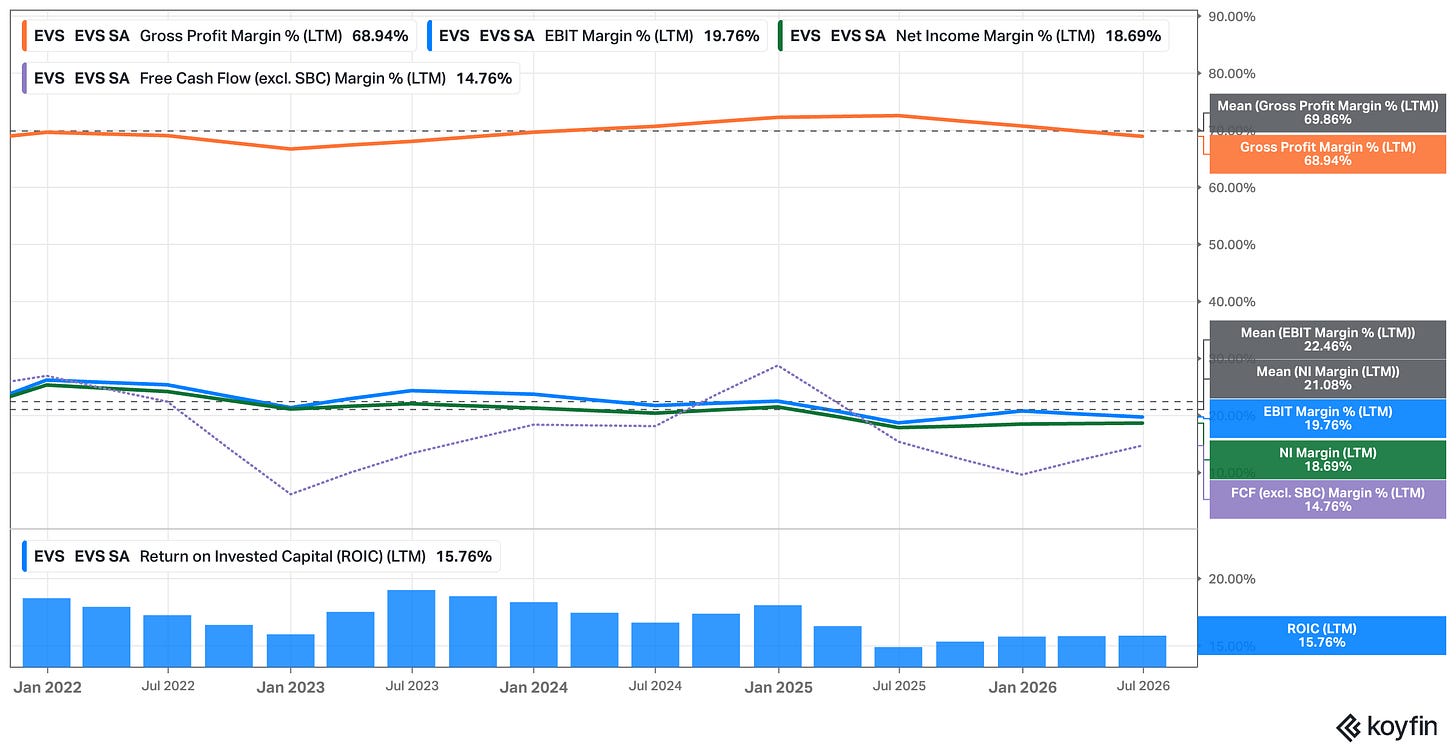
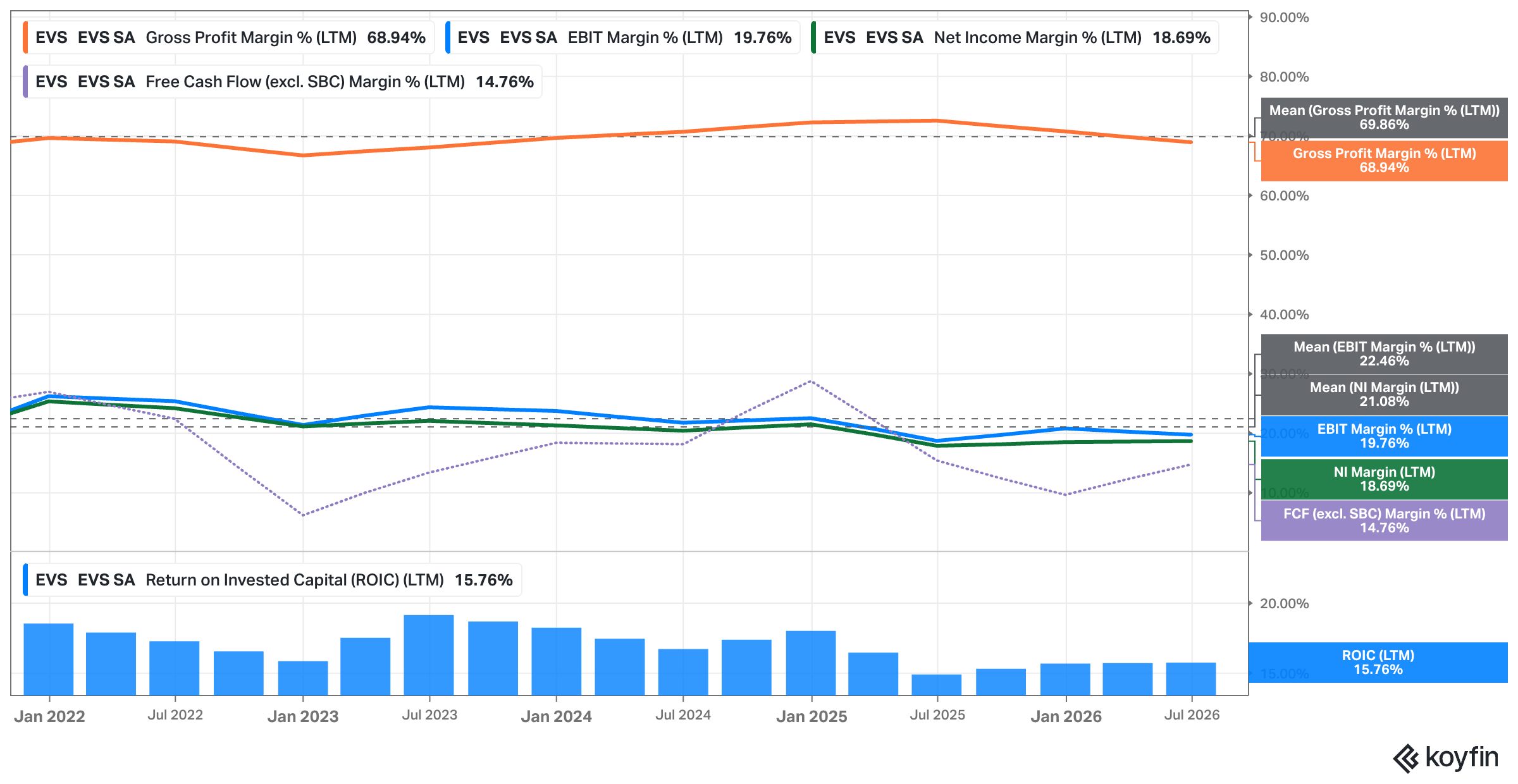
Bam #2: The margins point to pricing power. EVS posted a gross margin of 70.8% in 2025 and 72.3% in 2024, a level that's rare for a company selling physical equipment. Its operating margin of around 20% is also ahead of larger competitors and was historically quite stable in the 20% (+/- a few percentage points) range. Recurring service agreements and software licenses made up 16.7% of revenue in 2025. Management counts a much larger share as "recurring or re-occurring" in H1: 65% of revenue in the first half of 2026, excluding Big Event Rentals and T-Motion. Only 20% of that comes from contracts, though, and the other 45% comes from repeat clients who can postpone their next purchase. Historically, EVS has pushed through price increases without customers walking away. The first half of 2026 suggests that may be changing.
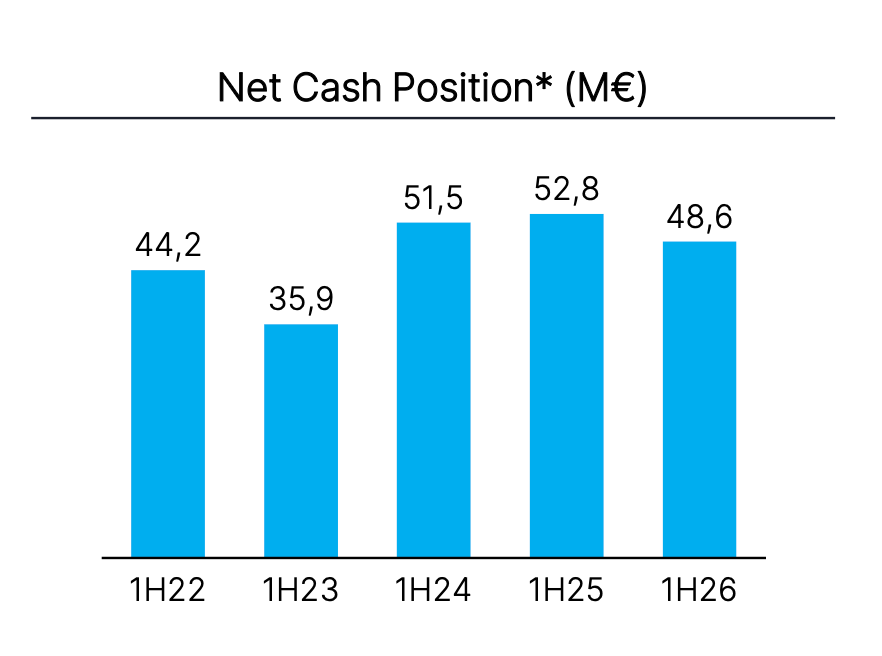
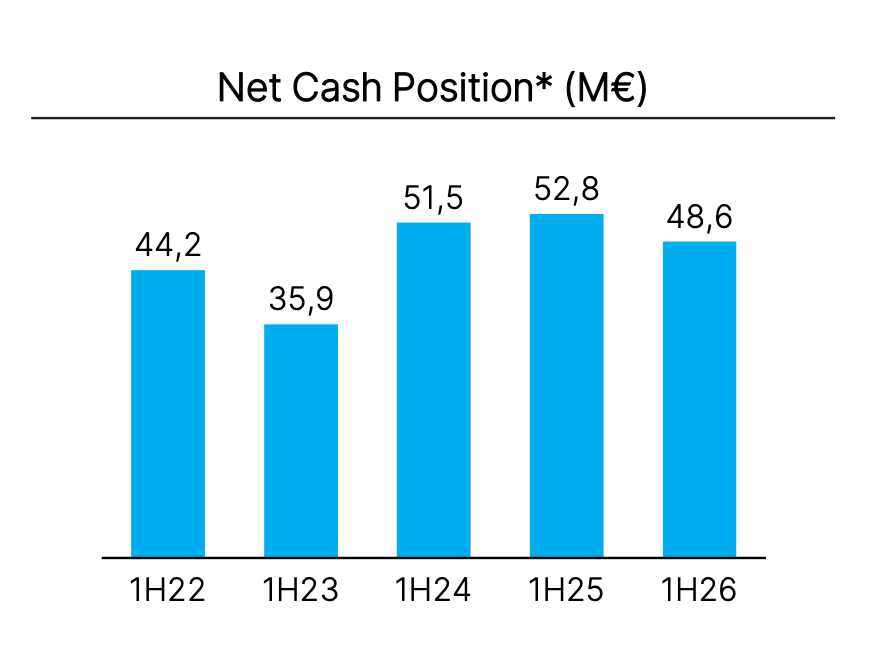
Bam #3: The balance sheet is strong, and management shares the spoils. EVS held €48.6 million in net cash at mid-2026 and carries zero bank debt.
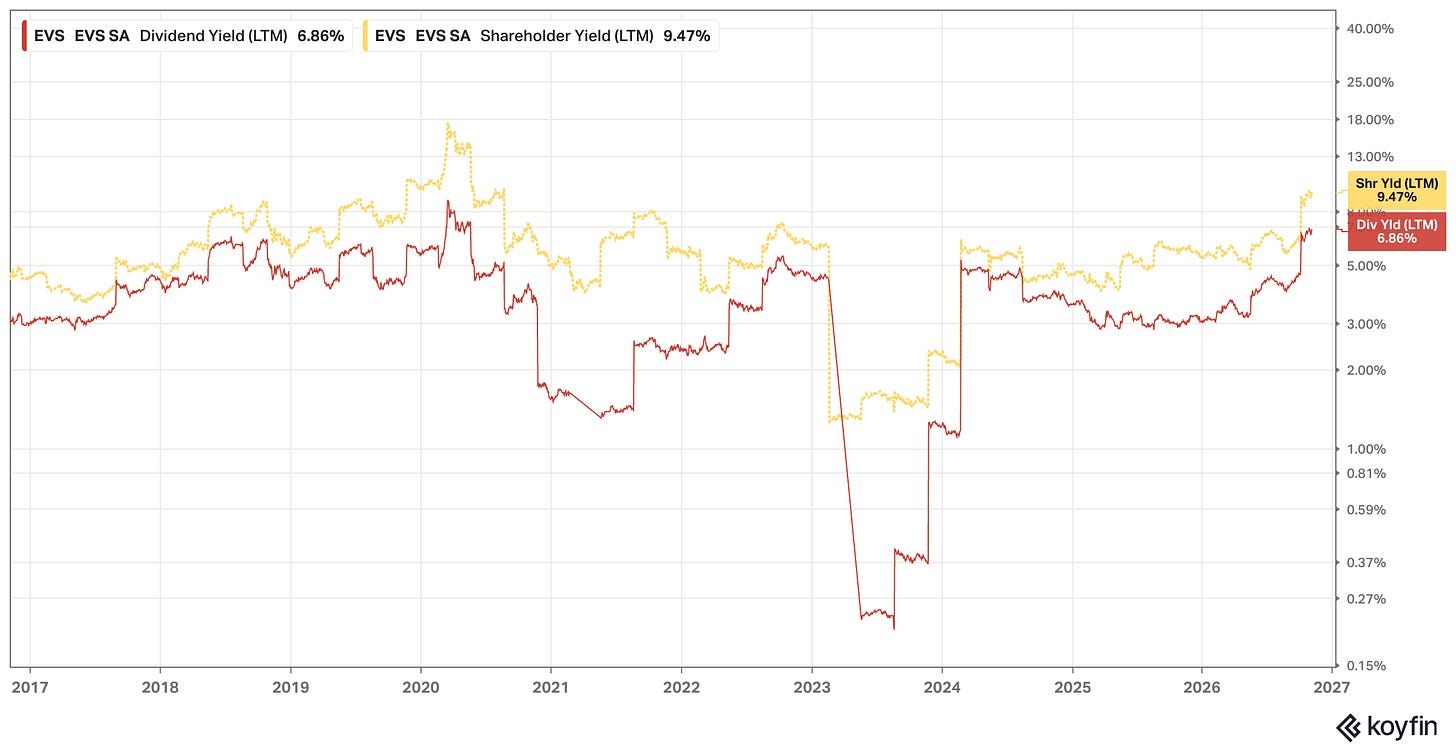
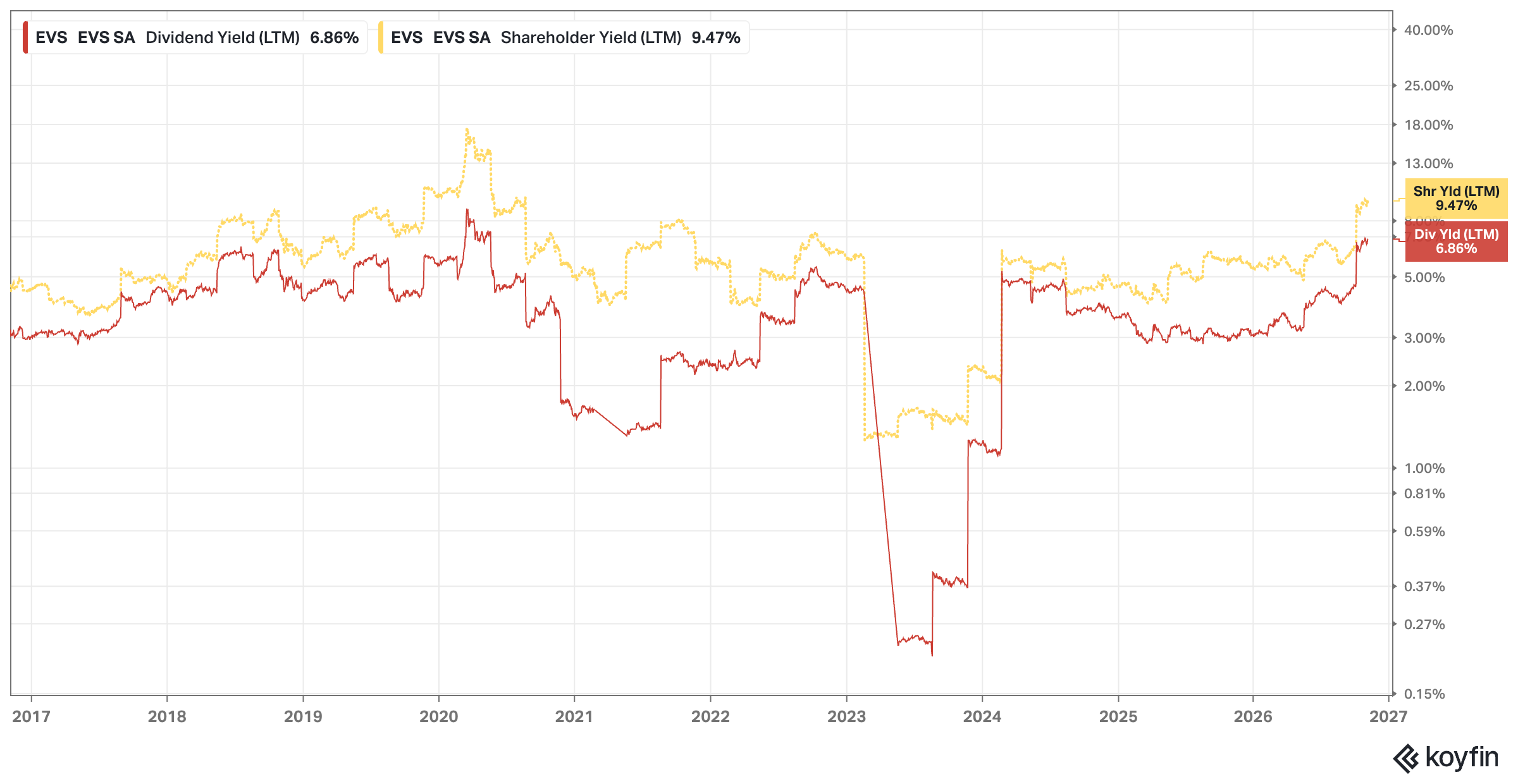
H1 Deck A formal capital allocation framework commits the company to a €1.20 dividend per share every year through 2027 (“As part of the new capital allocation framework defined at the beginning of 2025, EVS has implemented a new dividend policy for the period 2025-2027, setting the annual dividend at EUR 1.20 per share for the next 3 years. This renewed base dividend policy represents an increase of EUR 0.10 per share (or 9.1%) compared to the previous policy 2022-2024.“). At today's price, that's a yield of about 6.7%, covered more than twice by trailing earnings, though only about 1.2 to 1.3 times by what I expect EVS to earn in 2026. Koyfin puts the aggregate shareholder yield including buybacks at more than 9%, yet as I'll show further below, the buybacks have mostly offset dilution from warrants, so the dividend is the part that actually reaches shareholders.
A practical note on that dividend before anyone gets too excited about the yield. Belgium withholds 30% of every dividend at source. Most of its tax treaties cap the rate at 15%, so foreign investors can reclaim the difference, but only by filing form 276 Div.-Aut. After filing, you need to have the form stamped by your home country’s tax authority and then wait. Once the Belgian authorities receive the paperwork, a treaty refund can take eleven months. The process is bureaucratic enough that for most retail investors with a normal-sized position, it isn’t worth the effort, so in practice they simply lose the full 30%. At €18.00, the €1.20 dividend is a gross yield of 6.7%, which shrinks to about 4.7% after Belgian withholding tax, and that’s before any tax at home.
Thus, if the dividend is part of your reason to own EVS, check with your broker how they handle Belgian dividends first.
Bam #4: A structural tax shield lifts returns on capital. EVS makes use of Belgium’s statutory innovation income deduction and R&D wage exemptions, which brings its normalized effective tax rate down to roughly between 8% and 11%, against Belgium's statutory corporate tax rate of 25%. That helps fuel an attractive return on invested capital.
“EVS benefits from the following tax incentives related to innovation and research & development:
Innovation income deduction
Deduction for investments in R&D
Exemption from withholding tax for R&D employees
98 Innovation income deduction and deduction for investments in R&D are deducted from the taxable base of EVS in Belgium and consequently reduce the corporate tax paid by the Company. Exemption from withholding tax for R&D employees represents a payment exemption of part of the withholding tax paid on salaries, which results in a reduction of the R&D payroll costs incurred by the Company.“ - 2025 Report
Bam #5: The valuation assumes the business is in permanent decline. At €18, EVS trades at a record-low sales multiple, 4.3x trailing operating profit (against EV), 7x NTM earnings. Work the price backward on 2025 earnings, and the market seems to price in revenue declines for years to come. That's an odd expectation for a company that grew revenue for five consecutive years through 2025, compounding at more than 12% a year from its pre-pandemic 2019 base, and that ended June 2026 with an order book for deliveries beyond 2026 of €103.6 million. Even on my lower 2026 estimate, the price implies something closer to no growth at all.
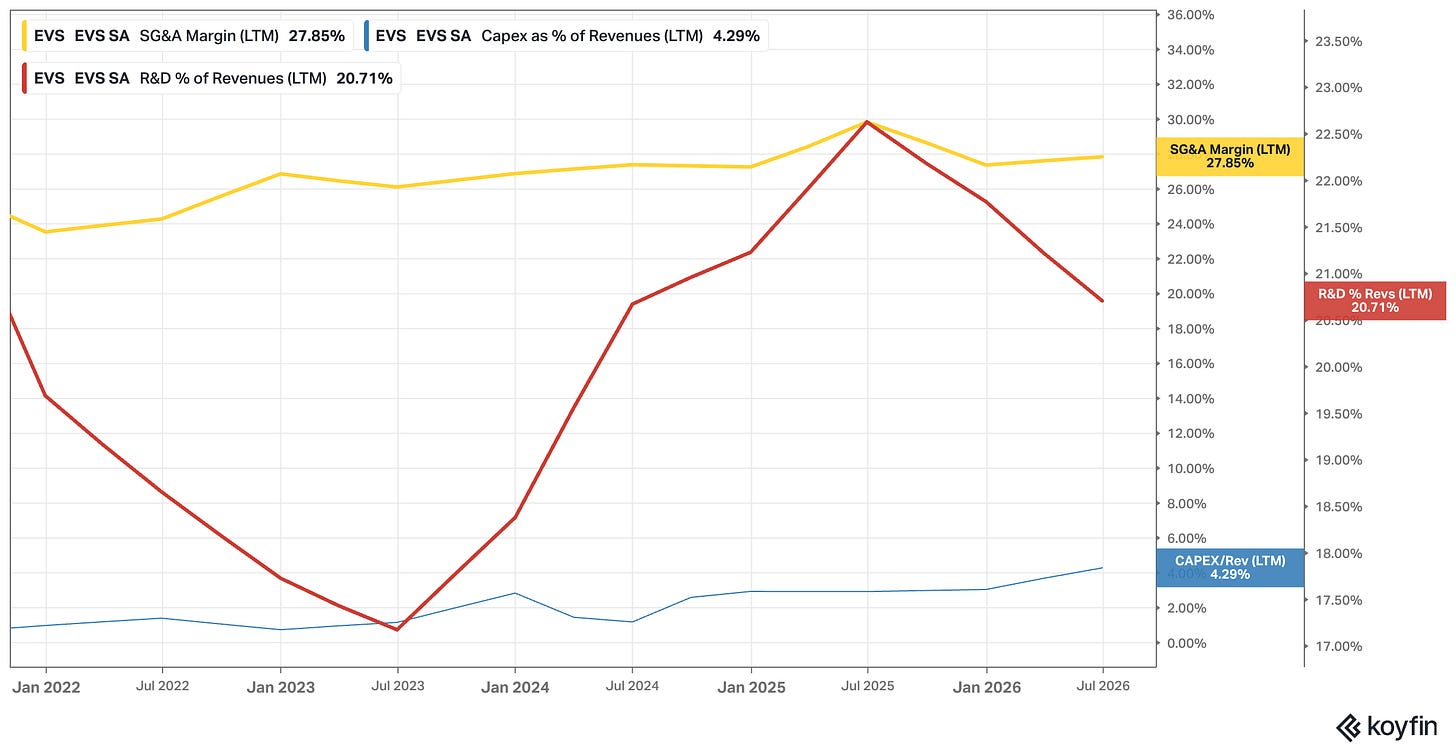
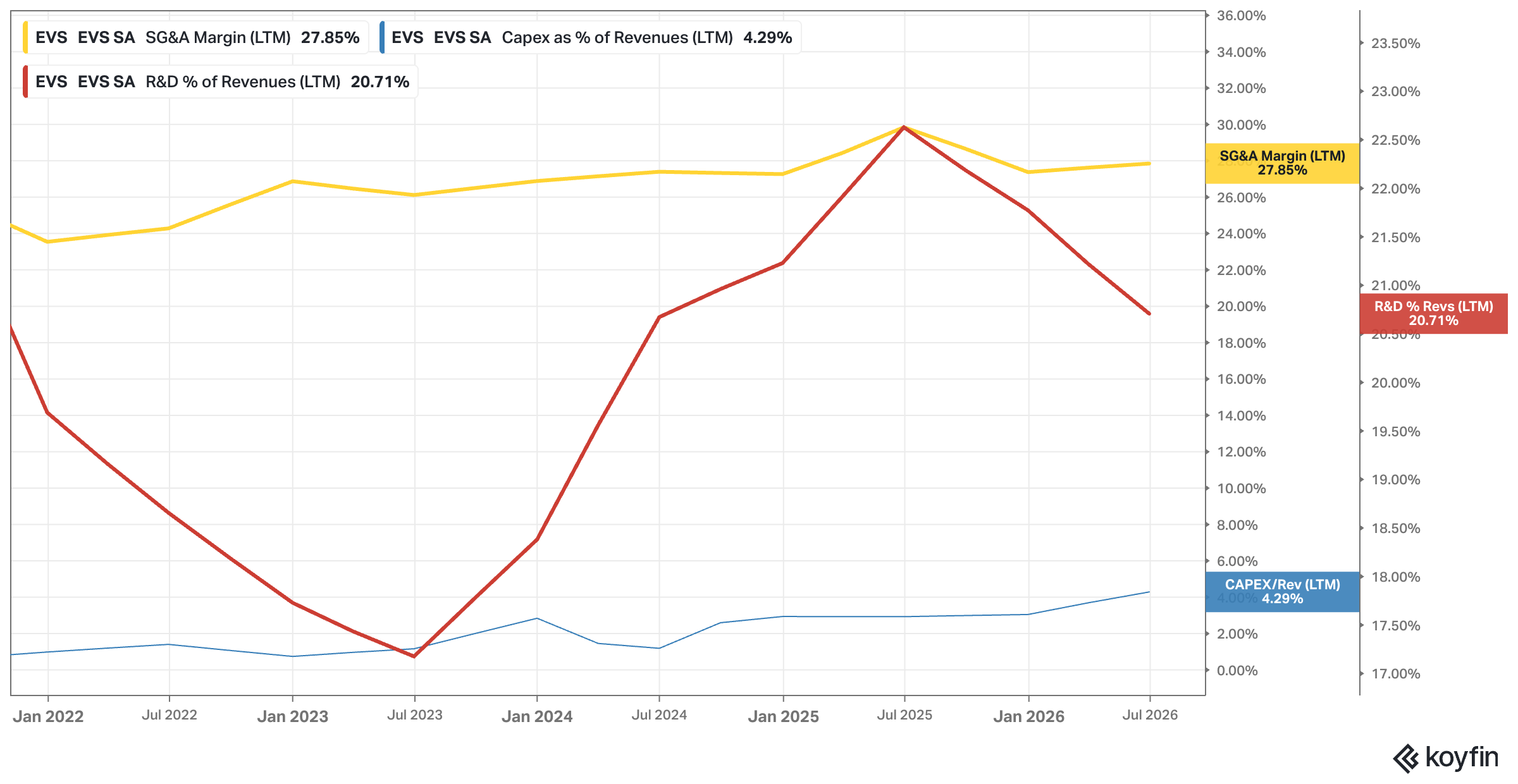
The risks fit in two sentences (more on it further below): A structural shift toward cloud-native production and open IP standards like SMPTE ST 2110 could let lower-cost competitors slowly displace proprietary hardware replay. And with fixed R&D expenses at roughly 18-25% of revenue, every macro delay in customer procurement turns into painful negative operating leverage.
Before the timer rings, you deserve to know why EVS matters right now. The shares have fallen >40% since March 2026, after management lowered full-year revenue guidance to €190–205 million because Middle East orders were paused and customers took longer to make decisions. The market treats that shortfall as the beginning of terminal erosion, yet management commentary and customer pipeline data describe purchasing decisions that have been pushed out with contracts still intact, and contracted Big Event Rentals for the Winter Olympics and the World Cup secure baseline volume.
With the shares trading at multi-decade trough multiples, the trading update on November 17 sets up an asymmetric risk-reward, since any early sign that the pipeline is stabilizing could act as a catalyst.
What went wrong?
Every cheap stock got cheap for a reason, and I want to understand EVS’s reasons before I argue with them. I count four, and they feed into each other.
Frozen procurement led to a revenue warning: In October 2026, EVS cut the midpoint of its full-year outlook by 14%, from €220–240 million down to the €190–205 million range I mentioned in the pitch. September orders dropped sharply, and in the Middle East, geopolitical unrest had already caused first-half order intake to collapse by 90%. Roughly 25% of the opportunities management expected to close in the fourth quarter have slipped into 2027 (“As a result, commercial opportunities representing approximately 25% of the pipeline that had previously been expected to mature during the fourth quarter 2026 have been moved to 2027“). Some have also been cancelled, though (“A number of commercial opportunities for 2026 have been cancelled due to clients budget constraints“).
The full analysis starts here!
Become a paying subscriber to read the rest of this post and get access to all of my other research, including valuation spreadsheets, deep dives (e.g. well-known mid- and large caps such as LVMH, Duolingo, Meta, Edenred as well as more hidden gems such as Digital Ocean, Ashtead Technologies, InPost, Timee, and MANY more), and powerful investing frameworks.
As a member, you get:
Complete Access: Every deep dive in our library (65+ and counting). The most thorough analyses you will be able to get your hands on (including downloadable models).
Access to my 150+ Global Watchlist: And How To Use It to Outperform the Market!
Slide Decks: Every deep dive now comes with a companion slide deck. It’s the whole argument in compressed form – the hypothesis, the business, the competitive position, the valuation, and the case against – for the days when you don’t have an hour to spare but still want the shape of the thing. Paid subscribers get both, the long piece and the deck.
The Community: Real-time discussion in the various subgroups of the subscriber chart, and networking opportunities with like-minded investors.
Digital Investing Conferences: Around three times a year, we also hold digital conferences where members present and share stock ideas, and discuss broader themes, and we’d love for you to join in!
Downloadable Visual Blueprints: Direct access to high-resolution PDF reference sheets distilling timeless investment classics, insights from my proprietary investing framework, and essential valuation mechanics into structured visual architecture. Print them, save them, and build your own institutional reference binder.
Incredible Value: Full access to all of this for less than €1/day.
PS: Using the app on iOS? Apple doesn’t allow in-app subscriptions without a big fee. To keep things fair and pay a lower subscription price, I recommend just heading to the site in your browser (desktop or mobile) to subscribe.
You can find an overview of the companies I shared a deep dive on in the visualization below.