

Dear compounders,
Sooner or later, every marketplace company I study shows me the same slide. It’s a circle of arrows: more supply attracts more buyers, more buyers allow better prices, and better prices bring in more supply.
The flywheel.
I’ve seen so many of them in investor presentations that the slide itself has become a yellow flag for me.
AUTO1 has one too.
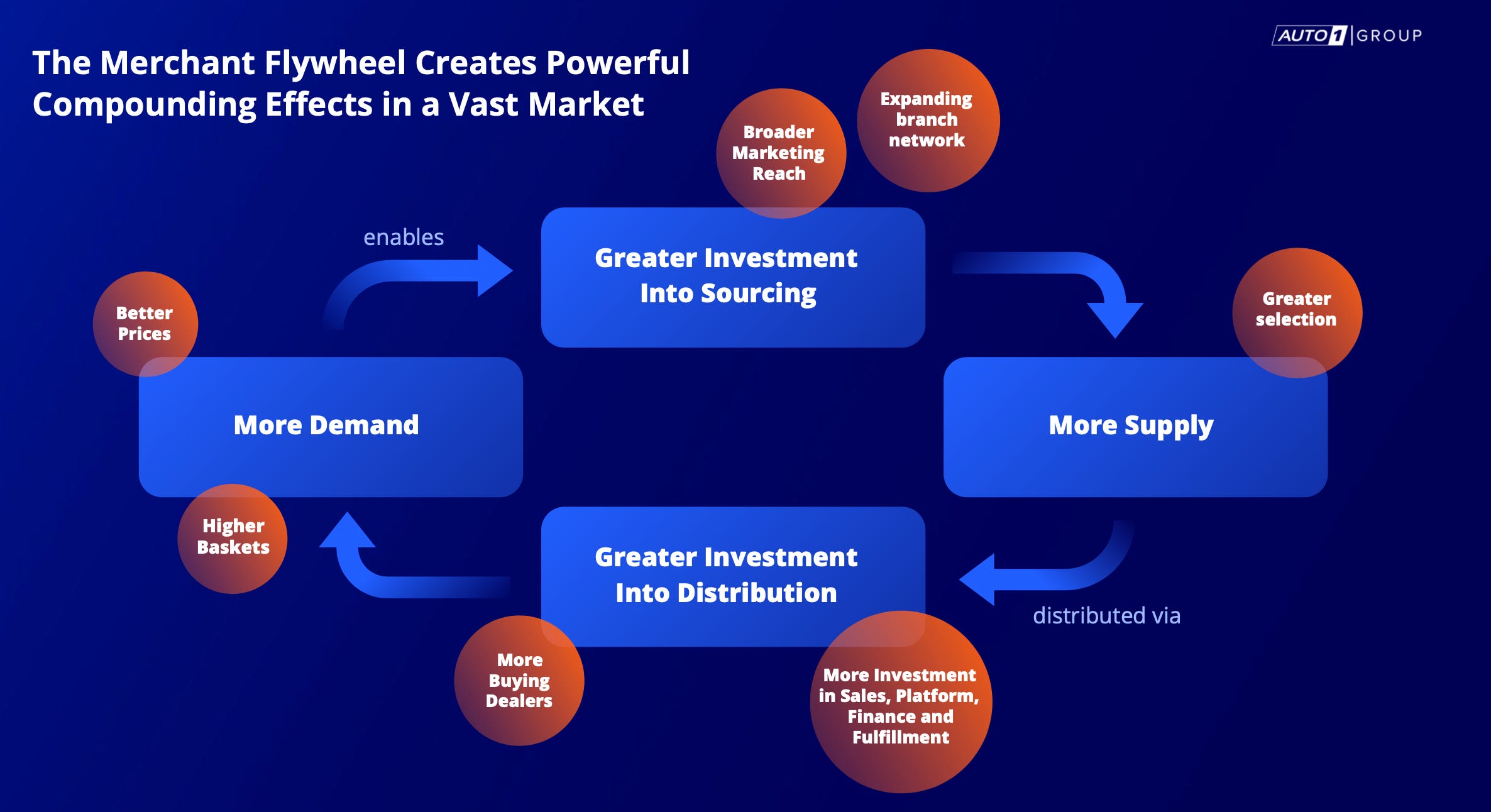
It also has things most flywheel slides don’t: a pan-European network of drop-off branches, production centers and trucks, millions of realized transactions feeding its pricing models, more than a billion euros of loans on its balance sheet, and 12 years of losses before its first profitable year. Cazoo burned around €2 billion trying to build something similar and didn’t survive.
AUTO1 did.
Some of what carried it through is certainly best described as a moat.
Some of it may simply be a well-funded, well-run machine that a determined rival could copy over time.
Telling the two apart is what this part of the series is about.
This is part 2 of my AUTO1 deep dive. In part 1, I laid the groundwork on the business itself and how its pieces fit together. If you haven’t read it yet, I’d start there, because this part builds on it.

Here’s what I cover in this part of this series:
What it would cost a rival with a pile of cash to rebuild AUTO1’s position, and who the most credible attacker would be
Whether AUTO1 has pricing power in a market where every car’s price can be compared, and what the Q3 2026 supply squeeze tells us about it
How AUTO1 scores across my six moat categories, and how bulls and bears might read the same evidence differently – what’s my assessment?
Whether the moat is widening or narrowing, and the risks that could breach it
Michael Mauboussin's two roads to a high return on capital, and which one AUTO1 is traveling. I break ROIC into NOPAT margin and capital turnover for Merchant, Retail and the group, first on inventory alone and then with the loan books included, both today and at management's long-term targets
The signals I’ll watch to falsify the moat part of my hypothesis
The “moat traps” where investors might be fooling themselves
The part I'm most excited about is a back-of-the-envelope ROIC model that shows how a business, like AUTO1, earning a few cents per euro of sales can still produce attractive returns, what range AUTO1 currently operates in, may achieve at steady state, and what it would take for AUTO1 to get there.
And here’s an overview of some of the things you’ll find throughout this entire deep dive series:
The 90-second pitch: the case for AUTO1 as Bill Miller would want to hear it, plus the debate the stock hinges on.
The backstory: how AUTO1 was built, what it got right where others failed, and the setbacks it survived along the way.
Unit economics: one car in each segment, broken down line by line, and why the simple “high margins good, low margins bad” rule doesn’t capture this business.
The cash question: how capital-light AUTO1 really is, and why the accounting makes that so hard to see.
Operating leverage: how much margin upside is still ahead and how much has already been harvested.
The moat: where AUTO1’s competitive advantages come from, and an honest attempt to find the places where I might be fooling myself.
Management: who runs the company, who owns it, and what the incentive structure says about alignment with shareholders.
Valuation
Growth and runway: how big the opportunity is, where the growth will come from, and how much of it can reach owners.
Look-through forward multiples: How my valuation approach makes use of a twist and what kind of forward multiple range the stock currently trades at based on this approach.
Where I differ from the market: what consensus believes, where I think it’s wrong and where it may have a point.
The post-mortem: the risks that could sink the idea and the kill criteria that would make me walk away.
All of this, and much more, in this 80-page report – as always, arguably the most comprehensive analysis of the business you will be able to get your hands on.
Moat Analysis – How wide and deep is AUTO1’s moat, and is it getting stronger?
Misjudging a moat is one of the most expensive mistakes an investor can make, so this segment is where I want to be at my most skeptical.
New here? Join 5,400+ readers and get 3 FREE GIFTS when you subscribe:
📈 Valuation Spreadsheet
📚 eBook: Investing Visualizations
💡 eBook: 250 Thought-Provoking Quotes

AUTO1 doesn’t rely on a single defensive feature. Its advantage comes from vertical integration. A proprietary pricing dataset, a pan-European physical network, liquidity on both sides of the platform, and institutional ABS funding all reinforce each other.
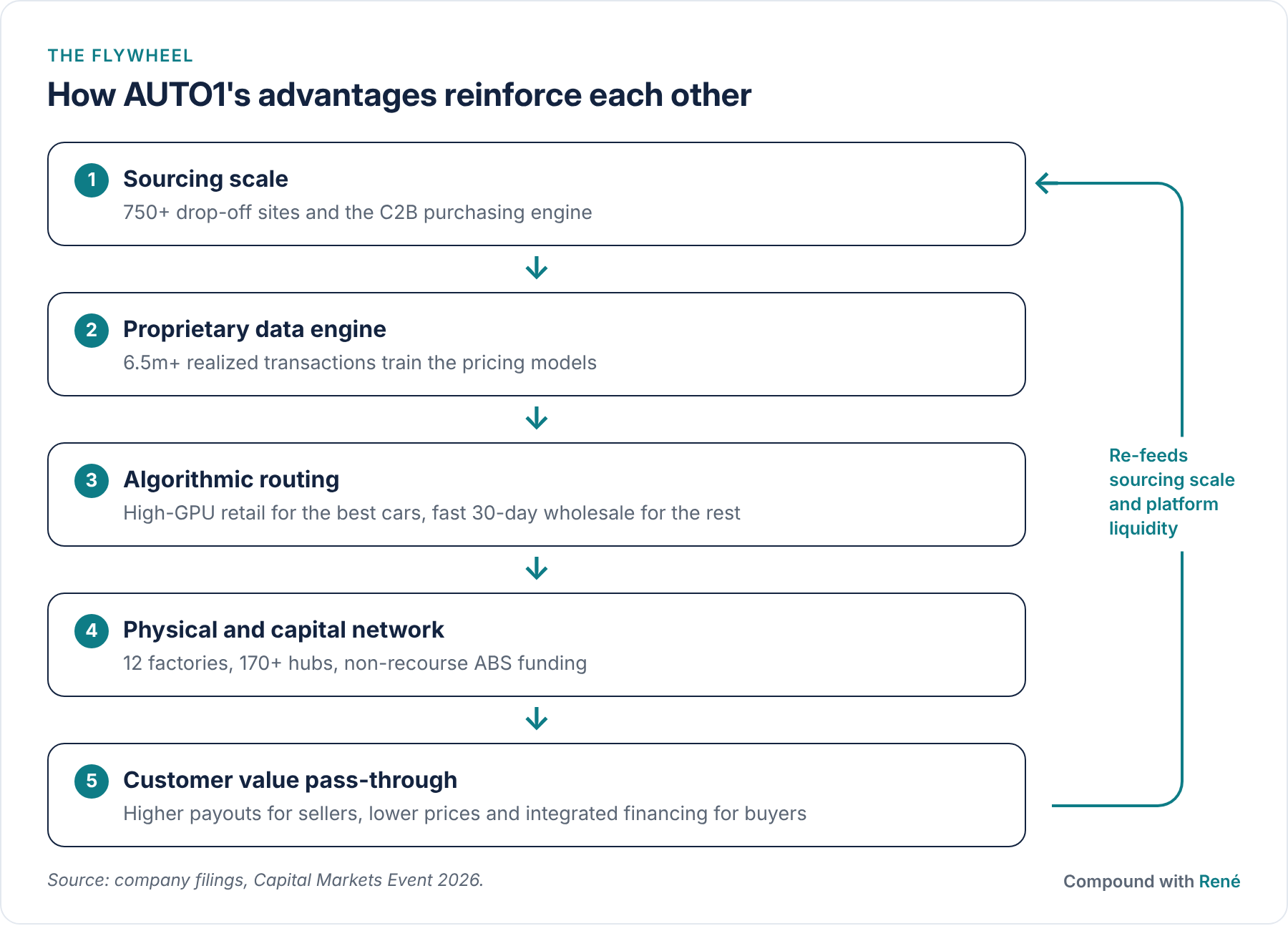
Few businesses in an industry known for thin margins, heavy physical complexity, and local competition combine all of that.
And that combination is what separates AUTO1 from physical dealers, classifieds, and asset-light brokers.