

A quick note before we dive in: this post comes to you courtesy of The Dutch Investors, a team whose approach to investing closely mirrors my own. Over time it became clear that we’re chasing the same thing from different angles – patient, fundamentals- and quality-driven investing grounded in a long-term view – and that our readers likely share that mindset too. So we decided to introduce our audiences to each other. This is a guest post they wrote, published here in full. If you like what you read below, I’d encourage you to check out their work – I think you’ll find it well worth your time. With that, I’ll hand it over.
Hi, we’re The Dutch Investors.
The three of us share one habit: an obsession with investing to the point it has bored our partners. But then, about 3 years ago, we met and were able to share our passions. We could (and still can) rant for hours.
We founded TDI because we wanted a place to discuss businesses, analyze stocks, learn together, and compound wealth together. Our goal is simple: to expand your investing universe.

This article aims to introduce you to three unusual and (hopefully) unknown Dutch businesses we think are run by competent management, have a sustainable competitive advantage, and are of high quality.
We tried to stay away from the Dutch companies you’re already familiar with. They’re not the usual suspects. We could have picked ASML, Heineken, Shell, Booking, Prosus, or Ahold Delhaize. Wonderful companies, all of them. But you already know them, and so does every other investor. There is no edge to be gained there. The three companies below are smaller, less known, and run by capable management.
Company Idea 1: Nedap N.V.
🏢 Company name: Nedap N.V.
⌛CAGR since IPO: 11.2%
✨ Market Cap: ~€650 million
📊 Revenue FY25: ~€296 million
If you are not Dutch, chances are small that you know Nedap. It is one of the reasons why this company might be even more exciting to you.
You probably know Amsterdam and The Hague, perhaps Rotterdam and Utrecht. Nedap is not located in any of these cities. The company has its headquarters located in Groenlo, a small village in the East of the Netherlands with around 10,000 inhabitants near the German border.
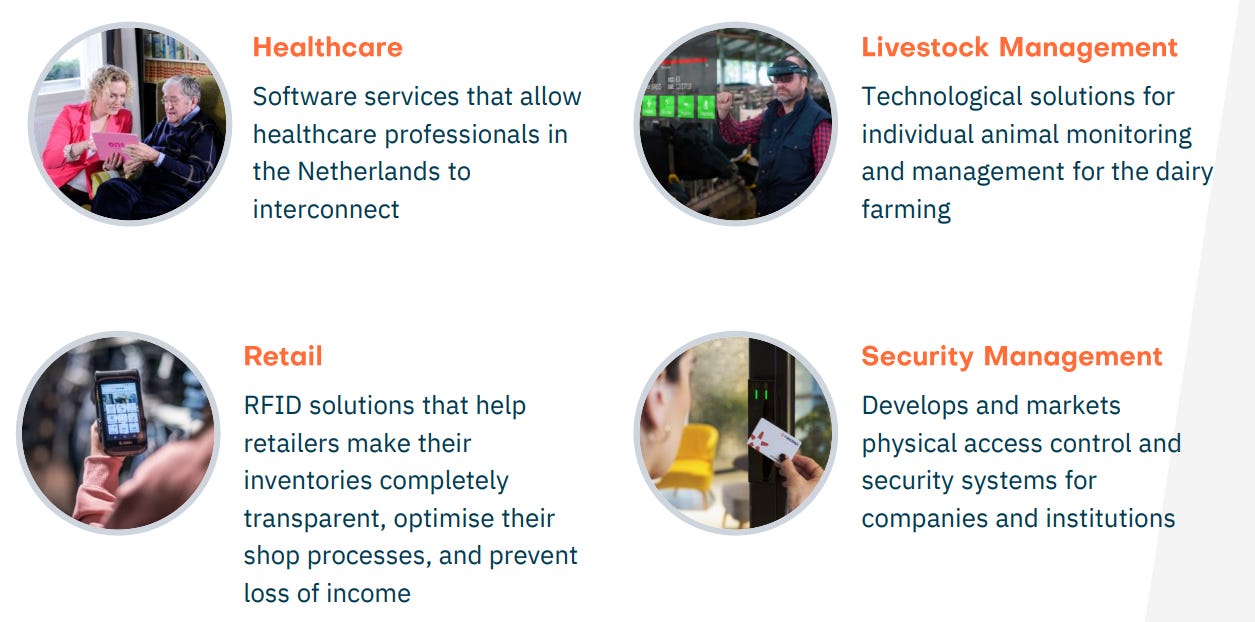
Former CEO Ruben Wegman studied computer science, joined Nedap in 1997, and has run the company since 2009. He left at the end of 2025. Under Wegman, Nedap has spent nearly two decades narrowing its focus from seven markets down to four.
We actually had the chance to talk to Wegman just weeks before he left. It’s freely available on all podcasting platforms.
The business model is straightforward but easy to underestimate.
The Business Model & Competitive Advantage
Nedap is transitioning from a hardware- to a software-driven company, focusing on superior software solutions tailored to customer needs. While hardware production is outsourced, Nedap retains control over key components, selling integrated hardware-software packages. Nedap is the market leader in these four key markets.
🐮Key market 1 - Livestock: Nedap started their livestock division in 1977. In this division, Nedap offers a combination of hardware and software to farmers. Currently, Nedap is only active in the cattle industry.

In livestock, Nedap is a global leader with over 40% market share, offering smart monitoring solutions with the goal of increasing productivity and improving the health management of cows. Think of it like a Fitbit but for cows. They have over 8 million connected cows, 25,000 farms, and operate in more than 50 countries.
🧑⚕️Key market 2 - Healthcare:
This is where Nedap has the strongest market position in our eyes. Moreover, it’s probably the most profitable in the future because it’s all software. Nedap’s market share in the elderly care market is 60%. In the disability care market, this percentage is around 50%.
In healthcare, its Ons (meaning ‘us’ in Dutch) platform simplifies administrative tasks for caregivers and health organizations, with a customer retention rate of 99% and a strong market position in elderly and disability care.

Think of Ons Nedap as an all-in-one platform where you can perform these activities:
Electronic patient file management: health overview, medications, quality monitoring.
Care logistics: calendar, scheduler, planning, capacity management.
Administration: financial dashboard, billing, cross-health traffic (safely exchanging sensitive health information to and from other health organizations).
We asked someone who works with Ons about alternatives, and she said:
“If the organization would change the system, all caretakers would definitely disagree. We are used to this way of working and our clients’ information is in the system.”
🔐Key market 3 - Security:
In security, Nedap is mainly active in access management. Think about personnel access management solutions for employees of Amsterdam Schiphol Airport. Especially in Europe, Nedap has a strong market position with 36% of the top 250 European organizations as clients, including Airbus, Vodafone, Volkswagen, and Unilever.

🔐Key market 4 - Retail:
Do you know that bleeping sound when someone walks out of a store with unpaid products? For decades, Nedap has been known for the system that detects whether a product is paid for and alarms the shop owner when someone walks out of a shop with an unpaid product. Although it still sells those gates to customers, based on RF or RFID, it is not Nedap’s core focus within the retail area anymore.
In retail, it leads in RFID (Radio Frequency Identification)-based inventory solutions, significantly enhancing inventory accuracy for clients like Adidas and Decathlon, while also offering secure self-checkout technologies. A great thing is that Nedap is bigger than competitors 1, 2, and 3 combined with a total market share of 35% of retail RFID users.
Valuation & Ending Thoughts
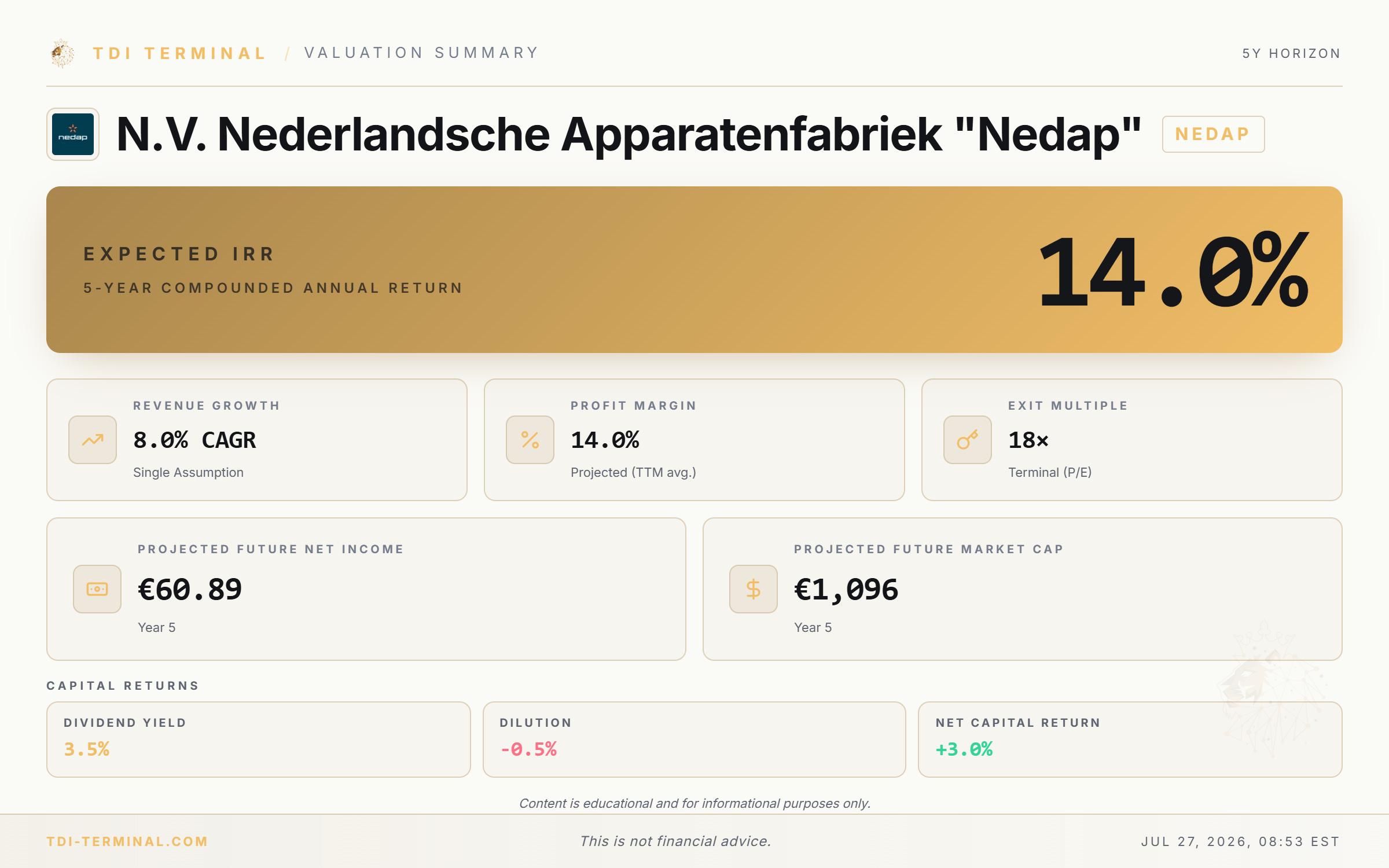
Assuming 8% growth (CAGR), a 14% profit margin, and an 18-times exit multiple, including dividends, the IRR from today’s price of €99 should be around 14%.
We believe Nedap is one of the highest-quality, yet most overlooked, Dutch software companies. Because of its low-volume and small market capitalization, it is not (yet) included in many of the funds and investments that drive the majority of the volume.
There are numerous factors to consider and be aware of, and even a high-quality business can be a poor investment if the valuation is too high. Our entire deep dive is free for you to read and explore.

Company Idea 2: Ferrari Group
🏢 Company name: Ferrari Group PLC
⌛CAGR since IPO: 7.2%
✨ Market Cap: ~€700 million
📊 Revenue FY25: ~€359 million
To avoid any confusion, this company is not the luxury supercar manufacturer famous for its fast red cars. Apart from the name, which is just a coincidence, the companies don’t have a lot in common. This is about a high-security logistics company.
Founded in 1959 in Alessandria within Italy’s golden triangle of jewelry crafting, Ferrari Group originally served as a customs broker for regional goldsmiths. Today, it is domiciled in London and listed on Euronext Amsterdam. It remains a true family company: co-founder Miranda Ferrari’s stepsons, Marco and Corrado Deiana, serve as CEO and COO. The Deiana family retains ~71% ownership.
The Business Model & Competitive Advantage
The business is unglamorous, highly specialized, and split across four key operating divisions:
🚢 Key segment 1 - International Shipping:
Accounting for roughly 66% of total revenue, this is the core engine. Ferrari Group transports high-value goods across borders, managing logistics, high-security vaulting, and complex customs clearance.
🚚 Key segment 2 - Domestic Shipping:
Accounts for 17% of revenue. It handles point-to-point secure road transport within single national borders, bridging local boutique networks to major transport hubs.
✨ Key segment 3 - Special Services:
Accounts for 11% of revenue. They provide tailored security and logistics for high-profile trade shows, private VIP exhibitions, and events like Monaco’s Grand Prix de la Haute Joaillerie.
🏬 Key segment 4 - Warehousing:
With 6% of total revenue, it offers vaulting, inventory storage, and value-added tax/customs bond management for ultra-luxury brands.

Across these segments, Ferrari Group moves over €170 billion in luxury goods annually for 100+ brands across 64 countries. Client retention sits near 100%, driven by 3–5 year contracts and absolute operational trust.
Ferrari Group’s high entry barriers include custom-built security infrastructure, global regulatory compliance licenses, and deep integration into luxury supply chains. In addition to shipping boxes, they also handle all the risks that come with the process.
Valuation & Ending Thoughts
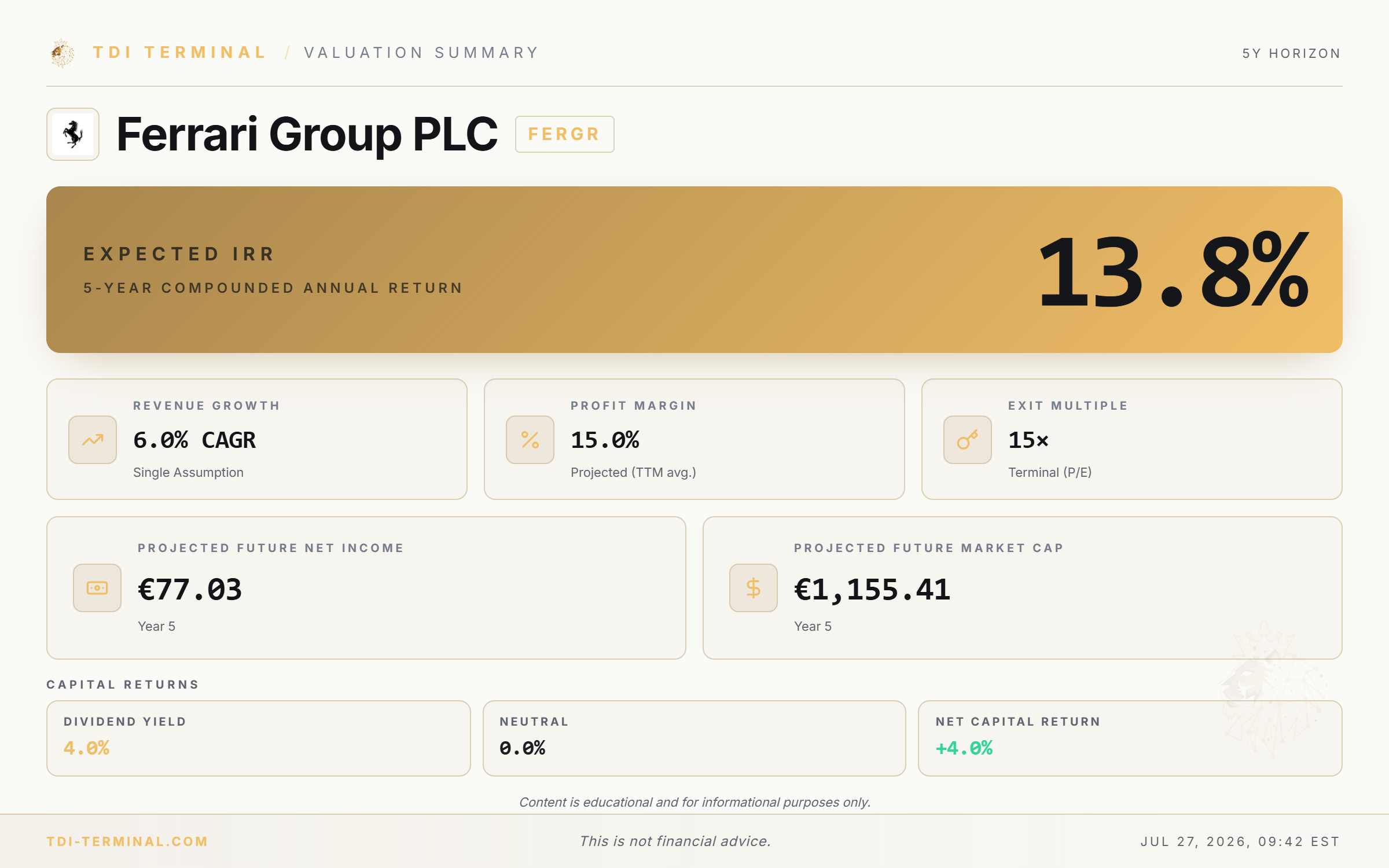
For the medium term, in this case five years, we think the 6-8% annual growth is doable. To be conservative, despite rising expectations for luxury logistics. Management expects bottom-line margins to improve, but again, to be conservative, we assume a free cash flow margin of 15% on average.
At the current price of around €8, one can expect an IRR of around 13.8%, including a 4% dividend.
Ferrari Group offers a sticky, high-margin moat in a niche that scale competitors rarely attempt to replicate. It remains a quiet compounder hiding behind one of the most famous names in the world.

Company Idea 3: Basic-Fit
🏢 Company name: Basic-Fit N.V.
⌛CAGR since IPO: 8.2%
✨ Market Cap: ~€2.1 billion
📊 Revenue FY25: ~€1.42 billion
Basic-Fit, the largest budget gym chain in Europe with its headquarters in Hoofddorp, is almost certainly a name you’ve seen before. The origin story is almost accidental: founder René Moos started a tennis school in 1984, added a fitness corner when he had spare space, and eventually merged with a competitor in 2004 under the HealthCity brand. In 2010, the company split into a premium line (HealthCity) and a budget tier (Basic-Fit), took on private equity backing from 3i Group, and listed on Euronext Amsterdam in 2016 at €15 a share. Moos remains CEO and the largest individual shareholder.
The Business Model & Competitive Advantage
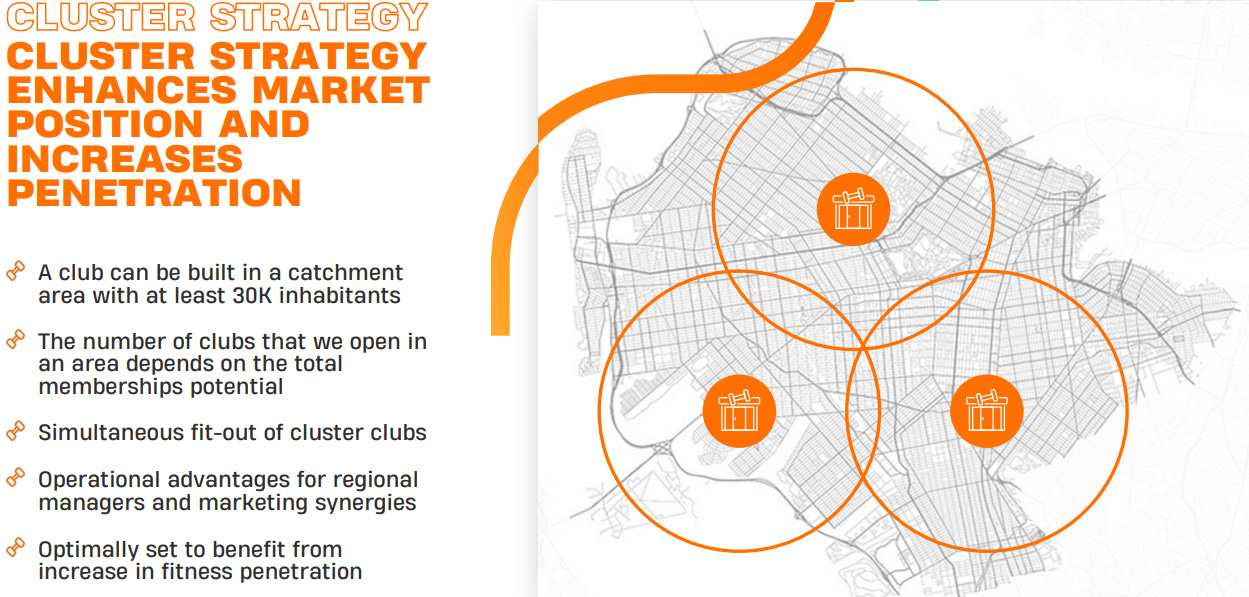
The model is simple: low-price, 24/7, largely unstaffed gyms with tiered monthly memberships (~€25 to €35/month). When Basic-Fit grows, they open multiple clubs at the same time in the same area to meet all of their customers’ needs before their competitors can respond. This is called a cluster strategy.
Basic-Fit ended 2025 with 1,660 owned clubs (excluding its recently acquired Clever Fit franchise network) and 4.82 million members. Average revenue per member is about €25. It’s a wonderfully simple, yet profitable model when executed well.
Basic-Fit’s unit economics and massive purchasing scale are its core drivers:
🏋️ Key driver 1 - High-ROIC Unit Economics:
Return on invested capital (ROIC) reached 31% at mature clubs in 2025, which was higher than the company’s own 30% goal. Even though core markets are getting older, this shows that the playbook still gives good results.
💥 Key driver 2 - Scale-Driven Purchasing Power:
When you add up all the costs, scale gives you an edge that standalone gyms can’t match. Basic-Fit gets bulk equipment prices from companies like Matrix and TechnoGym and handles software, app development, and national marketing for its millions of paying members.
🤝 Key driver 3 - High Member Retention:
Membership lasts an average of 23 months, which is almost twice as long as the fitness industry average of less than 12 months. This means that the business can count on steady income.
Valuation & Ending Thoughts
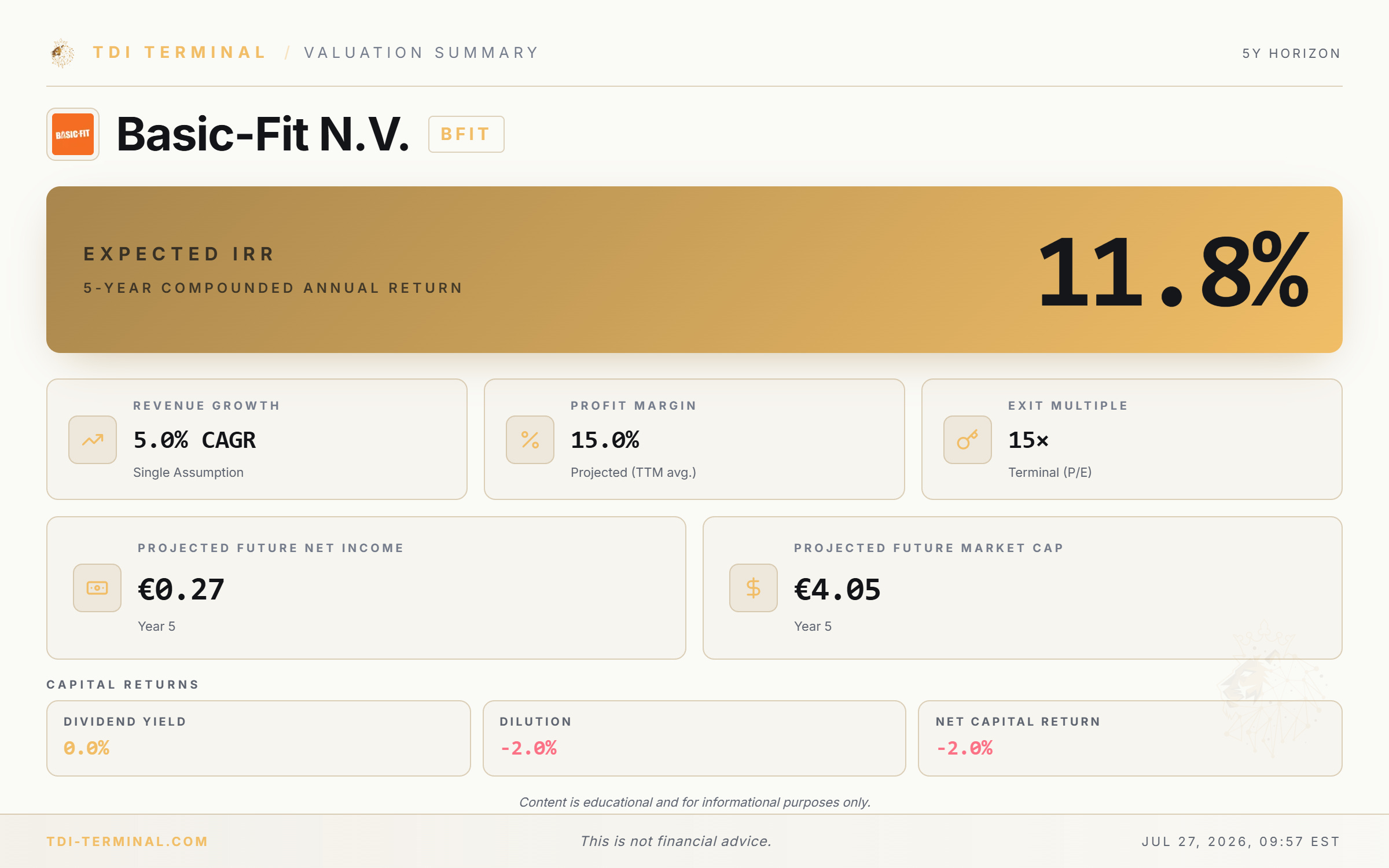
We know that the target is to open around 100 clubs per year for the coming years. That means Basic-Fit could have 2650 operating clubs in 2031. At least 80% of clubs will be mature at that time because the percentage of mature clubs will become higher as Basic-Fit grows. This means a total EBIT of €428 million can be expected from these mature clubs (2251 clubs times €190,000 in EBIT). Just imagine what happens if Basic-Fit were to stop expanding. Money would pour out, and an EBIT margin of 24.5% would be realistic.
Our baseline is to assume 100 extra clubs per year. One can expect about 11.8% IRR, including 2% dilution.
On the one hand, investing in Basic-Fit comes with risks. Think about debt levels, pace of maturity, and club openings. Furthermore, pandemics or other catastrophes could weaken the business. On the other hand, the valuation we used is pretty conservative.
💭 Closing Thoughts
None of these three are perfect, and we wouldn’t want you to read this as a buy list. It’s not.
What they have in common is that they’re run by people who’ve been doing this a long time, in businesses protected by something durable, whether it be switching costs, specialization, or scale earned the hard way.
The Dutch market, and Europe more broadly, is full of companies like this, and are easy to overlook if you only look where everyone else is already looking.
If you want more of this, we’d be happy to welcome you.
This post was made in collaboration with René Sellmann.
Excellent post, my friends! Thanks for sharing!!!
Very insightful article. Thanks.